Not Bad [David’s blog on Merely A Thought Monday]

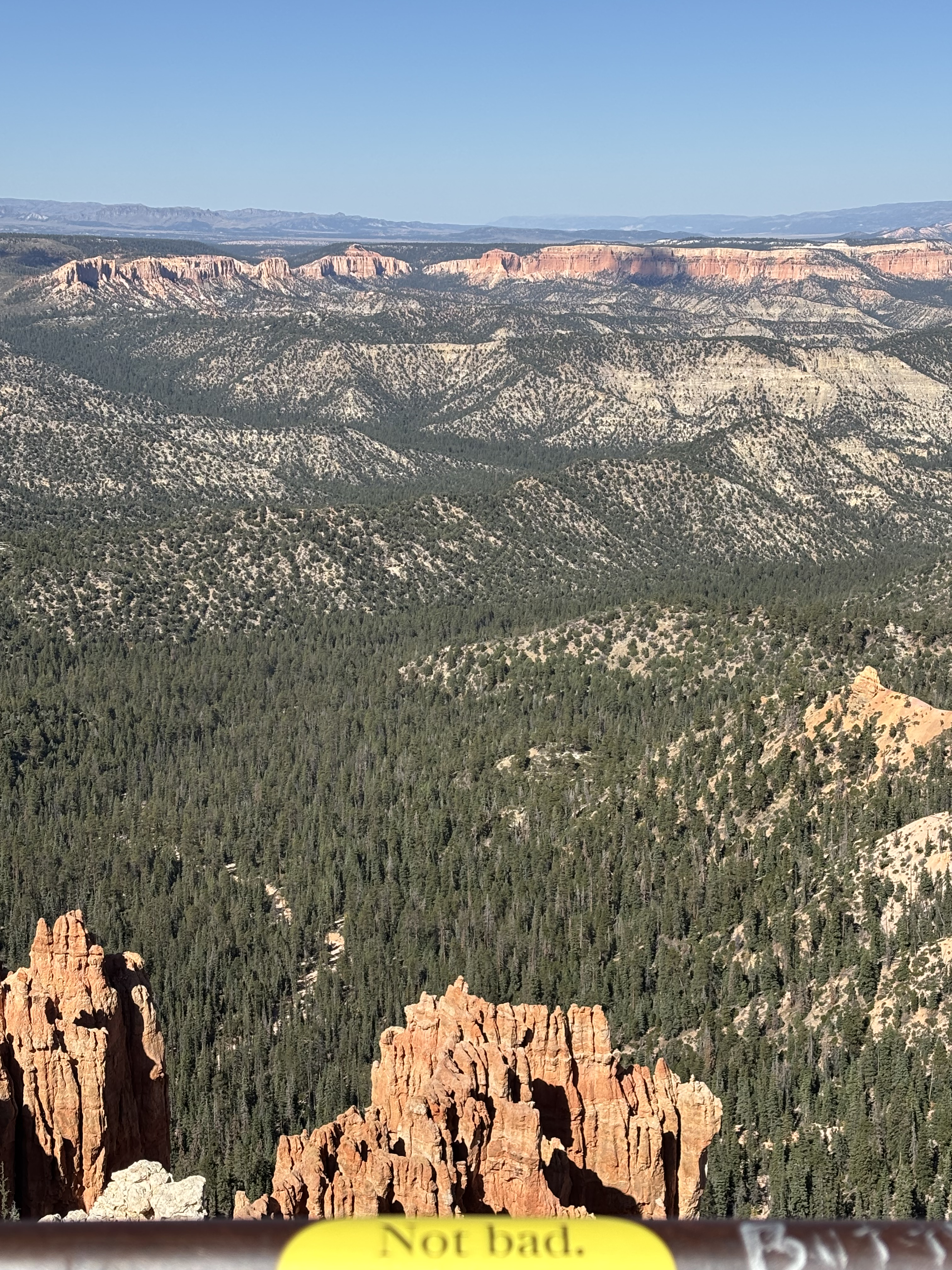
In a fit of understatement, someone placed a yellow sticker on the railing overlooking the sweeping view of Bryce Canyon. It read, “Not bad”. The awe is visceral, “I feel it in the pit of my stomach,” Kerri said. Standing at the edge, as is often the case, words fall short. “Not bad” is as good a phrase of wonderment as any other.

For a moment Gay was overwhelmed. With tears in her eyes she said, “And I get to be here to see it.” There were moments in the past few years that she had every reason to believe that she would not be here.

I was struck by her acknowledgement. It is something that I hope to express every day for the rest of my life. Deep appreciation. “And I get to be here to see it.” Like most people, I let far too many days of this life slip by without realizing or recognizing the astonishing gift of being here to see it.

Every day is as awesome as a peek into Bryce Canyon. Not Bad.

read Kerri’s blogpost about NOT BAD

like. share. subscribe. support. comment…thank you.

Look Around [David’s blog on Merely A Thought Monday]

Strolling on the path through the park, we followed the shoreline. Just at the spot where the path meets the marina, we found an appeal chalked on the walkway: be good people. As Kerri snapped a photo, I wondered who wrote it. Who felt compelled to bring their chalk to the park and petition goodness from passers-by? I wondered if they’d had their fill of bad examples of humanity, snapped-up their chalk, and headed to the original location of social media, the public square.

Or, perhaps it was not a plea but was their wish for us. “My wish for you is to be good people.” Why, on this day, did they feel compelled to make their wish visible?

There are many ideas, definitions and word associations of goodness yet they are bound together by a single notion-thread: consider first the needs of others. Brothers/Sisters keeper. “Good people” reach their hand to assist others.

I gathered a few words used to characterize “good people”: Empathy. Consideration. Accountability. Compassion. Kindness. Each word, each characteristic, is other-people-focused. “How can I help?” Share, because there is plenty-enough for all.

As Kerri took a picture of the message I jumped into a memory, a time of desperation. Some thought-angel dinged my noggin and sent me out into the city to witness acts of kindness. As I have previously written, I saw generosity everywhere I looked. People being good in small ways and large. Opening doors. Paying for a stranger’s cup of coffee. Holding up traffic so a senior could safely cross the street. Asking the bus driver to “Wait a second!” – someone was racing to catch the bus. A second made all the difference for someone.

Those good people, everyday people doing everyday things, buoyed me, filled me with hope and light. If I’d had chalk in my pocket on that day I might have scribbled on the sidewalk, “Good people are everywhere! Look around!” I saw them because I decided to look for them.

If I’d had chalk in my pocket, after Kerri was finished with her photograph, I’d have written a message for the “Be good people” writer: “Thanks for the reminder. See good people”.

They are everywhere.

read Kerri’s blogpost about BE GOOD PEOPLE

like. support. share. subscribe. comment…thank you.

Check Your Stems [David’s blog on KS Friday]

Wild Carrot. Queen Anne’s Lace. Throughout every season we find ourselves marveling at the aesthetic structure of the plant. The graceful curves and shapes. They inspire movement and floral symbols in my paintings.

Summoning the Oracle, Google, I learned that a common question asked is how to discern Queen Anne’s Lace from poisonous Hemlock. They are surprisingly similar in appearance. “Poison hemlock stems are smooth, while Queen Anne’s Lace stems are covered with tiny hairs…” The moral of the story? Check your stems.

Check your stems.

The verb form of the word ‘stem’ concerns origins. Comes from. Arises from. For instance, the stem of the word ‘democracy’ arises from ancient Greece. The word literally means the people (demos) rule (kratos). “Democratic government is commonly juxtaposed with oligarchic and monarchic systems, which are ruled by a minority and a sole monarch respectively.” Healthy disagreement, opposing points of view expressed without fear en route to compromise, is the beating heart – the stem – of a democracy.

The stem of the word ‘fascism’ comes from Latin and means, “bundle of sticks,” – the visual symbol evolved to include an axe at the center of the bundle, representing “a way of organizing a society in which a government ruled by a dictator controls the lives of the people and in which people are not allowed to disagree with the government.” Elimination of opposing points of view is the stem of fascism.

“Fascism’s origins are…ultimately centered on a mythos of national rebirth from decadence.” You could find no better or clearer tag line for a fascist intention than Make America Great Again. You could not pen a better blueprint for the fascist overthrow of democracy than Project 2025. The forcible suppression of opposition. Political violence as a necessary means of national rejuvenation, the demonization of the “other”.

As demonstrated in their gathering in Milwaukee, the reds are now a perfect expression of their symbol: a bundle of tightly bound sticks in lock-step – with an axe hanging over their heads ready to eliminate any voice of opposition. It turns out, like their sycophantic VP pick, many of these men and women, who once called their supreme red leader “America’s Hitler” and “a wannabe dictator”, were right. Sadly, they lack the courage of their convictions. They fear the axe. They lack a basic grasp of the necessity in a healthy democracy for genuine voices of opposition.

Is it rule by-the-people-and-for-the-people or a fascist autocracy?

How can we discern democracy from poisonous fascism? Check the stems.

Open your eyes and look, really look. The red hats have wrapped themselves in the flag so they might appear like the Grand Old Party. They are not. To anyone undecided or confused or jaded, I can only offer this advice: it’s important to check your stems before you ingest too much fascist hemlock believing you’re dining on democracy.

This Part of the Journey on the album of the same name © 1997, 2000 Kerri Sherwood

Kerri’s albums are available on iTunes and streaming on Pandora and iHeart Radio

read Kerri’s blogpost about WILD CARROT

like. share. support. comment. subscribe…thank you.

Doodlebug It! [David’s blog on Not So Flawed Wednesday]

Some words are just too yummy to ignore. For instance, doodlebugging! Who wouldn’t want to toss that delicious word into almost any conversation-salad or happy poem? “The poor man was doodlebugging to no avail!” I am surprised that doodlebugging escaped the keen word-eye of Dr. Seuss!

Doodlebugging means to dowse or divine for treasure or petroleum. I ask myself, “What would I rather find, petroleum or treasure?” Well, I guess I would need more information. What kind of treasure? I imagine myself diligently doodlebugging in the backyard, my “Y” shaped stick goes wild! I dig a deep hole. Kerri stands on the deck, none-too-pleased with my doodlebugging destruction, until I leap into the hole and pull up a hefty pirate’s treasure, complete with many gold doubloons!

And, if I don’t divine for imagined treasure, I need to know whether or not I own the rights on the land I am doodlebugging. There’s no sense in doodlebugging for oil if someone else gets the profits for my newly dowsed black gold, texas tea.

I’ve decided that our poor sad nation needs a good doodlebugging. Despite the rhetoric, petroleum won’t cure what ails us so I suggest we doodlebug for treasure. Specifically, we seem to have lost our most valuable treasure: our moral compass. It has to be out there in the grass somewhere. Perhaps if neighbors across the land, regardless of political affiliation, met in the front yard or on the street, each with a handy “Y” shaped stick, and began a serious doodlebugging project in search for that pesky compass, together we’d find what we seek. A common cause which, after all, forms the foundation for unity and provides the seeds for ethical decision-making. Ethics are usually surfaced – or resurface – when people decide to serve something larger than their own interests.

We used to have one. I mean a common cause. It was called the Constitution, a document that framed, guided and preserved our democracy. Toward a more perfect union. By the way, union means ‘joining’ or ‘uniting.’ It’s what makes our common cause, in the midst of so much rich diversity, more perfect. The challenge is that the Constitution is lost or in hiding. Parchment is notoriously hard to doodlebug. One person will never find it. So, maybe if we all meet together in the front yard, armed with a harmless stick and a good intention, shake hands, laugh a little, and work with the people we so dearly love to vilify, we just might find the medicine our divided-against-itself nation needs. It’s hard to hate someone once you meet them in person, talk for a spell about family, food and “So, what do you do for work?”

A little friendly neighbor-chat while doodlebugging together will do away with the abstractions, labels, and dial-down the fear-mongering. In our common search for the lost compass, we just might learn that we have more in common than we’ve been led to believe.

read Kerri’s blog about Y

like. share. support. comment. subscribe…or go meet, talk and doodlebug with someone new! thank you.

A Dream Itself [David’s blog on KS Friday]

I awoke this morning with a line from Hamlet running through my mind: “There are more things on heaven and earth, Horatio, than are dreamt of in your philosophy.” What dream, what night-wander was I following that made me bob to the surface with a line from Hamlet as my first thought of the day?

Sometimes I use Google like I use the i-Ching. A divining tool. I called up the phrase from the mighty Google and read two opposing opinions of the meaning of the line. Of course. Divining tools generally cast a broad net. The first writer interpreted the line to mean that the human imagination has limits; there is so much that we don’t know and cannot yet imagined. The second interpretation was stated with absolute authority. This is what Shakespeare meant! “One must believe what he or she sees. Even if they previously did not think so, the real evidence should change their mind.”

Evidence or the limits of imagination? Evidence as the limiter of imagination? I was no closer to answering my dreamtime question but I was affirmed in the dynamic nature of perception and interpretation. What a great play!

Living as we now are, in the advent of A-I, one must not believe what he or she sees. I have no idea what Shakespeare meant – we never discussed it – but I am certain that what one sees is no longer evidence of anything. What one hears requires vetting. There are more things on heaven and earth than Shakespeare could have possibly imagined. Our world is beyond his dreaming or he might have suggested to Horatio that he must question everything he hears and challenge everything he sees.

And, about my dreamtime question? I’ll leave that, too, to Hamlet: “A dream itself is but a shadow.”

Kerri’s albums are available on iTunes and streaming on Pandora and iHeart Radio

read Kerri’s blogpost about THE NIGHT

like. comment. share. subscribe. support. thank you!

Beyond Words [David’s blog on Not So Flawed Wednesday]

Sometimes the obvious is hard to write about. A heart path. A heart on the path. My mind jumped to the easiest association: a heart path is a metaphor for a spiritual life. Despite the countless tomes written across cultures and through the ages, including the current river of memes flowing across our screens, a spiritual life is impossible to wrap in words. Yet we have a long and complex history of trying.

I have friends who are Buddhist, friends who are Christian, friends who are Jewish, friends who are Muslim. I’ve spent time with Hindu priests and I’ve been introduced to the Tao. As they say, many paths, one destination. Heart paths, all. It is worth remembering that no single path is better or worse than any other. As Joseph Campbell suggested, religions are vehicles. A ride share.

A spiritual path need not require a deity or a book of rules. As Kerri says, “If it’s not about kindness it’s not about anything.” Kindness is an expression of the heart. Kind-heartedness. Warm-heartedness. Tender-heartedness. A heart path invokes this quality: selflessness. Deities and rulebooks can be twisted, human-made as they are, to serve un-kind, selfish intentions. Stoke divisions. Division is the opposite of a heart path. Kindness is an expression of unity.

A heart is a good symbol for the path because we all have one – every single one of us. Skin color, cultural orientation, systems of belief, sexual identity…do not alter the simple fact: we have hearts in common. Many hearts (plural) reaching for the single shared heart. One heart (singular).

Transcendent.

read Kerri’s blogpost about HEART ON THE PATH

like. comment. support. share. subscribe. many thanks.

Grasp The Enormity [David’s blog on Two Artists Tuesday]

Benison was my word-of-the-day. It was a new word to me and it means a blessing or benediction (to bestow a blessing). I especially appreciated this word-of-the-day since I’ve lately been listening for the word “blessing”. It’s become something of a study or a game. I laughed when the word popped into my inbox. “Good timing!” I chirped.

I rarely go a day without hearing someone, somewhere, utter the word “blessing”. On the street, in the grocery store, neighbors chatting over the fence, in a bar, passing people on the trail…I’ve decided it’s a blanket word, generic, used to include many experiences. “What a blessing!”

I was considering adding it to my list of over-used and no longer meaningful words, like paradigm or story except that lately I’m of the opinion that this whole life, the entire ride with all of it’s ups and downs and confusions and clarities, is a blessing. A benison. A gift. Every single moment.

It flies in the face of common sense since I was given to understand that blessings are unique, something special. If every single moment is a blessing, then what’s the point of elevating this moment over that moment? Of course, I realized that I was (again) missing the point. The whole ride is a blessing. We mostly don’t realize it. We are mostly unconscious of it. Our awareness is some-other-place making lists or worrying worries so we mis-understand it. The word “blessing” is a descriptor of something unique and precious: those rare moments we actually grasp the enormity of being alive. Full stop and, as Lydia reminded me, breathe in the awe.

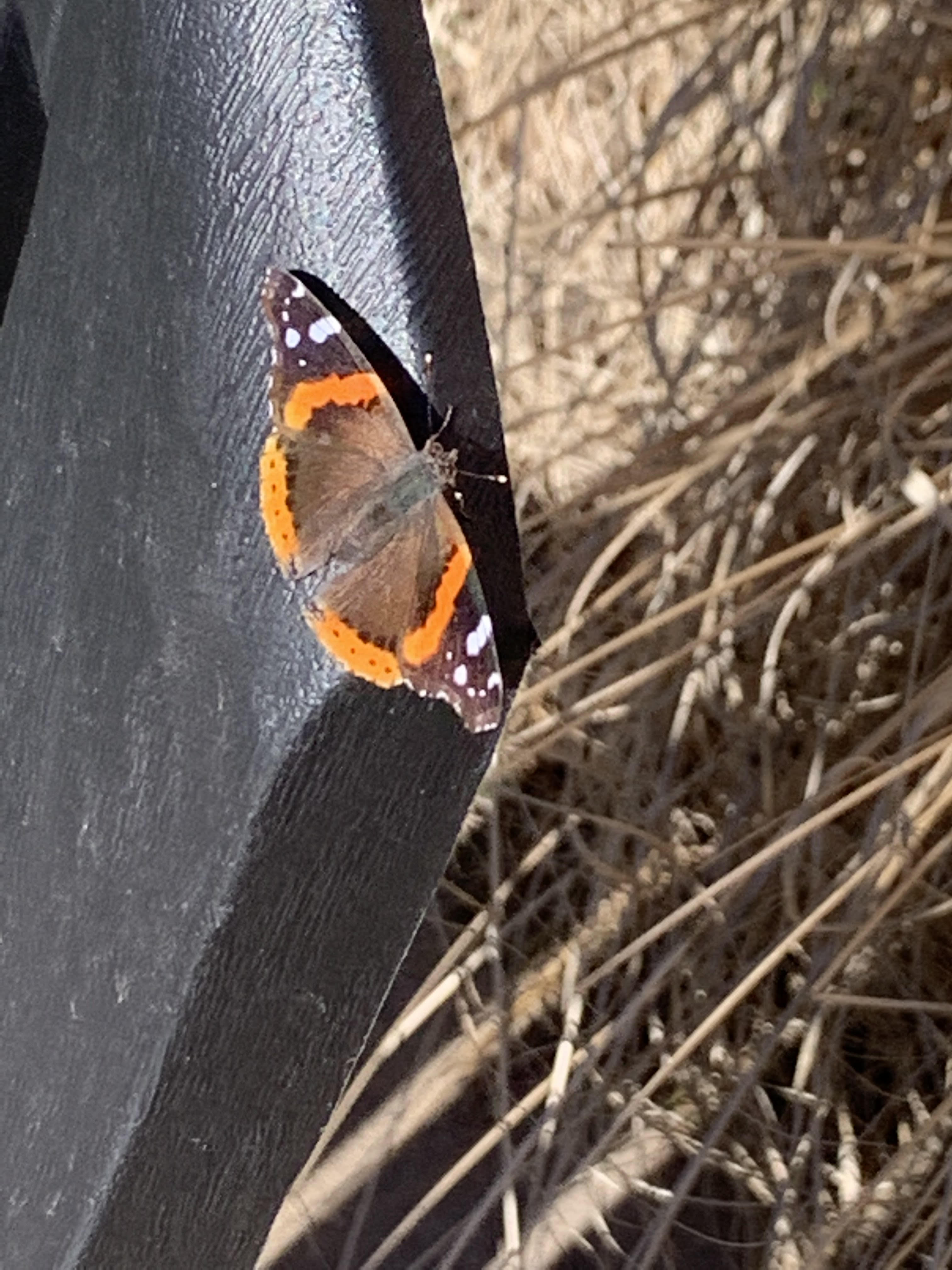
These days I think Kerri and I are practicing seeing our blessings. We are cultivating our capacity to notice. We note with delight the first buds of spring. We savor tastes. We love on the Dogga. So, when the Red Admiral butterfly landed on the Adirondack chair on a sunny early spring afternoon, “a symbol of spiritual awakening, transformation and renewal” we simultaneously said, “What a blessing!”

A benison. Yes, for us, a gift.

read Kerri’s blogpost about BLESSINGS

like. comment. share. support. subscribe. we appreciate it!

Beyond Words [David’s blog on DR Thursday]

“Truth, like time itself, is a product of a conversation man has with himself about and through the techniques of communication he has invented.” ~ Neil Postman, Amusing Ourselves To Death

I’ve felt for months the need to apologize to J. We were having a conversation about truth – and notions of god – and in his current place-on-the-path he’s necessarily seeking absolutes. For him, relative truth smacks of falsehood or some loosey-goosey scary philosophy. He’s looking for a hard rock on which to build his house of wisdom. I was flip rather than helpful. How do you begin to discuss truth as a cultural orientation or a fluid marker that changes with time? When I was J’s age, truth could be established with a photograph. Not so anymore.

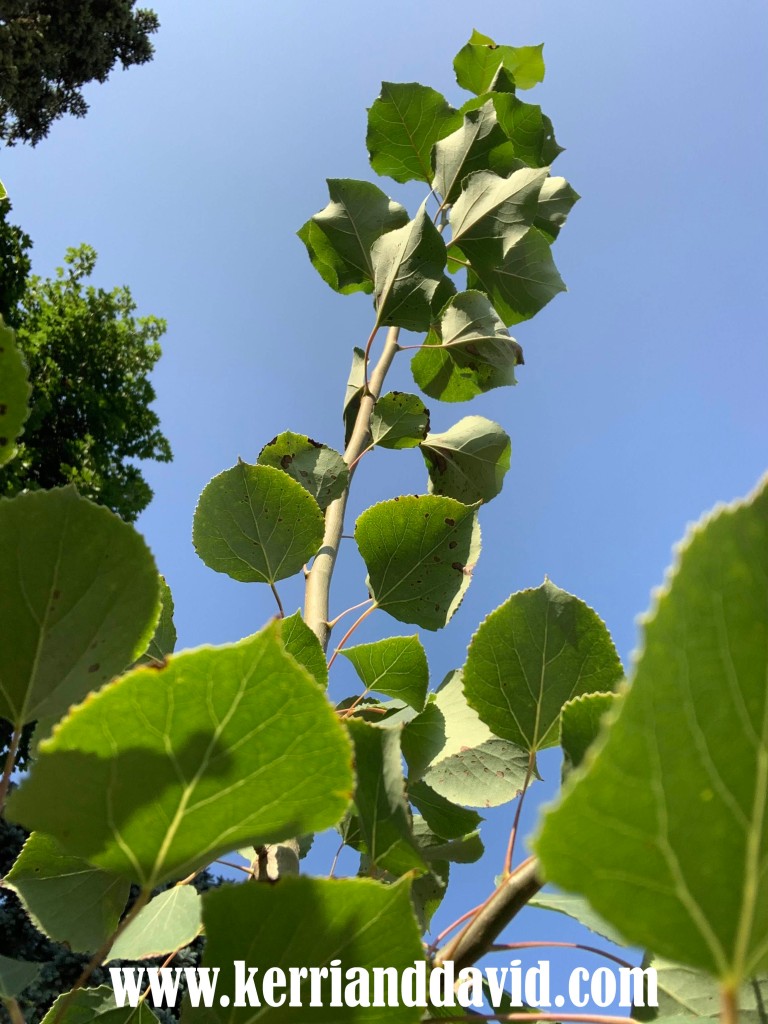
Breck, our little quaking aspen tree has come to represent a form of truth for me. Breck almost didn’t make it. We brought her home from the high mountains of Colorado and for a few years she lived and struggled in a big pot. She barely survived the first place we planted her. It was not a good location so we moved her to different soil where she’d enjoy more sun. And now she is flourishing. Last year she grew more than three feet taller.

Breck’s truth/health has very little to do with hard answers to abstract questions. For her – and me – truth is found in relationships; her environment. The right spot. Good soil. Rejuvenating sun. She brings an impulse to life: perseverance. Tenacity. Adaptability. We love her and I believe she “knows” that, too. Love is a truth that knows no absolute. I couldn’t explain that to J because I was playing with him, bringing levity to his seriousness.

And, in truth (what other word can I use?), I have become a doubter that any serious conversation about truth or gods can happen through something so limited as language. That’s what I should have expressed to J. I should have taken him outside to see the stars.

Now, when I want to have those conversations with myself, when I am seeking a better question, I walk on the trail next to the river. I turn my face to the sun. I try to detach myself from the clocks and lists and tv debates. I look at Breck quaking in the wind. I await each spring for the buds to appear on her limbs. There’s truth-beyond-words in her life-cycle, the return of her leaves and her captivating shimmer dance with the breezes.

read Kerri’s blogpost about BRECK

share. like. subscribe. comment. support. thanks!

Open The Tiny Measure [David’s blog on KS Friday]

My first question: when did UFO (unidentified flying object) become UAP (unidentified anomalous phenomenon)? I know I am late to the party on this one. Like you, I’ve been reading the UAP headlines for a few years and, each time, ask myself the same question: Why the moniker change?

I did a little research this morning and came upon this phrase from Bill Nelson at NASA: “We want to shift the conversation about UAP’s from sentimentalism to science.” Apparently, George Lucas and Steven Spielberg have our space-alien-sentimentalism dialed to an all-time high. Human imagination runs amok with unidentified flying objects and not so much with unidentified anomalous phenomenon.

Language matters. Since our reference point is…us…a flying object, like an airplane or a spaceship implies a pilot, a “being” at the controls. An anomalous phenomenon? It’s another way of saying unusual occurrence and what, exactly, is an occurrence? If it’s unusually amorphous, there is nothing to hang your hat on. The only thing to do is call a scientist or artist since the imagination needs a few parameters to light its fire.

There was another sad-ancient-yet-contemporary-cautionary-tale that popped up in my reading: “NASA recently appointed a director for UFO research, but is not divulging the identity to protect them from the kind of threats and harassment faced by the panel members during the study.” Science and art are -and always have been – dangerous business. Galileo spent his last years on earth under house arrest for publishing his science; it contradicted the firmly-held belief of the day. He was forced to recant his findings or face the fate of heretics.

Belief does not appreciate being contradicted, especially when there is evidence involved – or as is true in the current example – no evidence at all. Belief has a wonky relationship with evidence. We are witness to that all-too-human phenomenon in our times, just as was Galileo. Protecting poll workers and UAP scientists from the violence of those who are unshakable in their faith and/or “news” source (their reference point).

We do not need science (or maybe we do) to see our absurdity.

We have the capacity to exercise our imaginations in this vast universe of possibilities. We have the ability to question if we desire to use it. We have the gift of unbridled curiosity and need not go off the rails into rootless belief if we allow that, “There are more things in heaven and earth than are dreamt of in [our] philosophy”. We can be afraid of ideas, run from progress, or threaten the artists and scientists that force us to open our smallish belief and tiny measure of “normal”. Growth is always preceded by an uncomfortable step into the unknown. A challenge to what we think we “know”.

And then, after the upset, we need to find language to describe the new world that we discover there.

Time Together/This Part of the Journey © 1997 & 2000 Kerri Sherwood

Kerri’s albums are available on iTunes and streaming on Pandora and iHeart Radio

read Kerri’s blogpost about UFO and UAP

like. share. support. subscribe. comment. thank you.

A Second Look [David’s blog on Two Artists Tuesday]

Aura Moon Double Haiku

An appearance.

Things are rarely what they seem.

Masks conceal faces.

The moon winks and nods,

Tugging at the aching heart.

“Take a second look.“

The aura of the back light at night. Wires that carry electricity to the house. A sliver moon. A photographer playing with the elements. What began as a spontaneous chase to capture the waning moon became a rolling series of discoveries: “Look what happens when the light is on!”

“I want to shoot the moon through the wires,” she said, aiming her camera.

“A good first line for a novel or a play,” I thought.

Character One: I want to shoot the moon through the wires.

Character Two: Maybe we should talk about it? (no answer) Do you think we’ll hear the owl tonight?

And so it goes, listening and looking into the night. The story progresses until their desires meet at a distant crossroads.

read Kerri’s blogpost about THE WINKY MOON

like. support. subscribe. share. comment.