Lay It To Your Heart [on Two Artists Tuesday]

“This entire week is about noticing,” Kerri said, looking at the week’s photos we’d just uploaded into our site. Sometimes the melange has an intentional theme and sometimes a theme announces itself. Our lives have become about noticing. I suspect all of our writing is, in one way or another, about noticing.

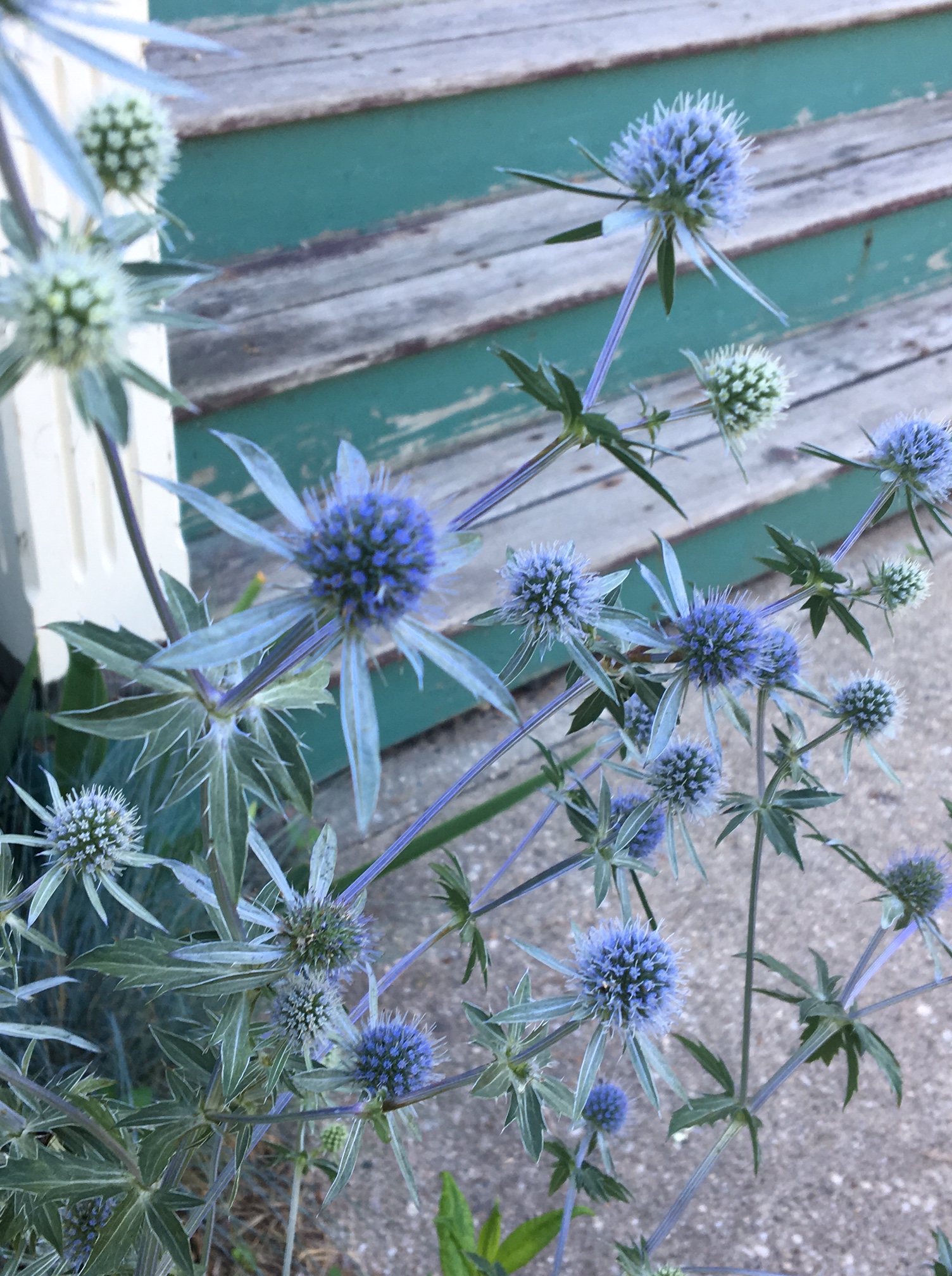
This is Blue eryngo. Flat Sea Holly to the poet. Eryngium planum to those more interested in species categorization. Shakespeare would know it as a thistle, a cure for love sickness. “And lay it to your heart.”

The evening breeze turned our steps toward the marina. It was a brutally humid day and we were restless in the air’s oppression. Arm in arm we talked of how long it had been since we wandered in this direction. It used to be a daily stroll but more recently we’ve sought trails away from people. The forest quiet rather than the crowds at the shore.

The color of the plant stopped us. I felt as if I was looking at a magical universe of purple-blue planets or something more likely found under water. While Kerri snapped photos I marveled at the color. The shape of the leaves reaching from the thistle center. Little blue suns.

Our chance encounter with the Flat Sea Holly blew some nice air into our sails. We walked on talking about the gift of noticing, taking photographs, how to be better artists, amazing sights all around.

Shakespeare’s thistle cures more than lovesickness. We lay it to our hearts and it lifted our humid-heavy- spirits.

read Kerri’s blogpost about FLAT SEA HOLLY

Wear One Sock [on saturday morning smack-dab]

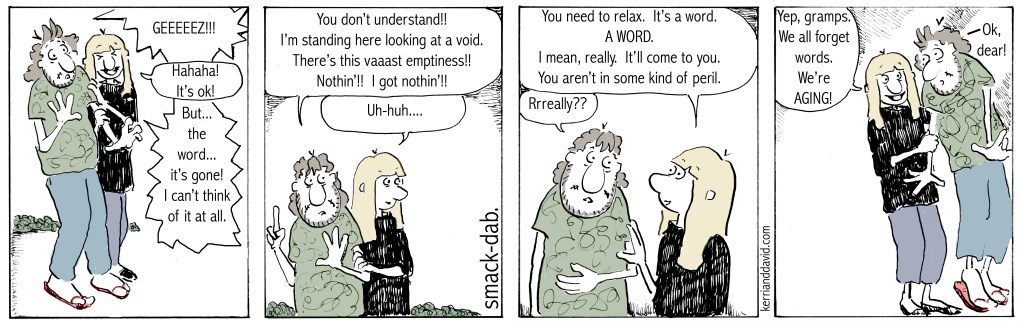
My elders warned me but I scoffed. It will never happen to me! “Words,” they cautioned, “will become like socks in the dryer. Two sock-words will go into the spinning barrel of your mind. Only one will come out.”

What happens to the other sock? Where is that perfect word match? I open the drawer of my brain only to find half the word-socks have gone missing. Poof.

I should never have scoffed. I wander through my days trying to mask the fact that I’m only wearing a single word-sock.

I imagine the satisfied smiles of all the ancestors getting the last laugh. “Told you so,” they smirk, frown, and ask, suddenly snapping their fingers to stimulate their synapses, “And, what’s your name, again?”

I’d tell them (in my imagination) but think it’s good practice to exercise their brains so I smile and quip, “Who’s asking?”

read Kerri’s blogpost about WORD LOSS

smack-dab. © 2022 kerrianddavid.com

Intend Renewal [on DR Thursday]

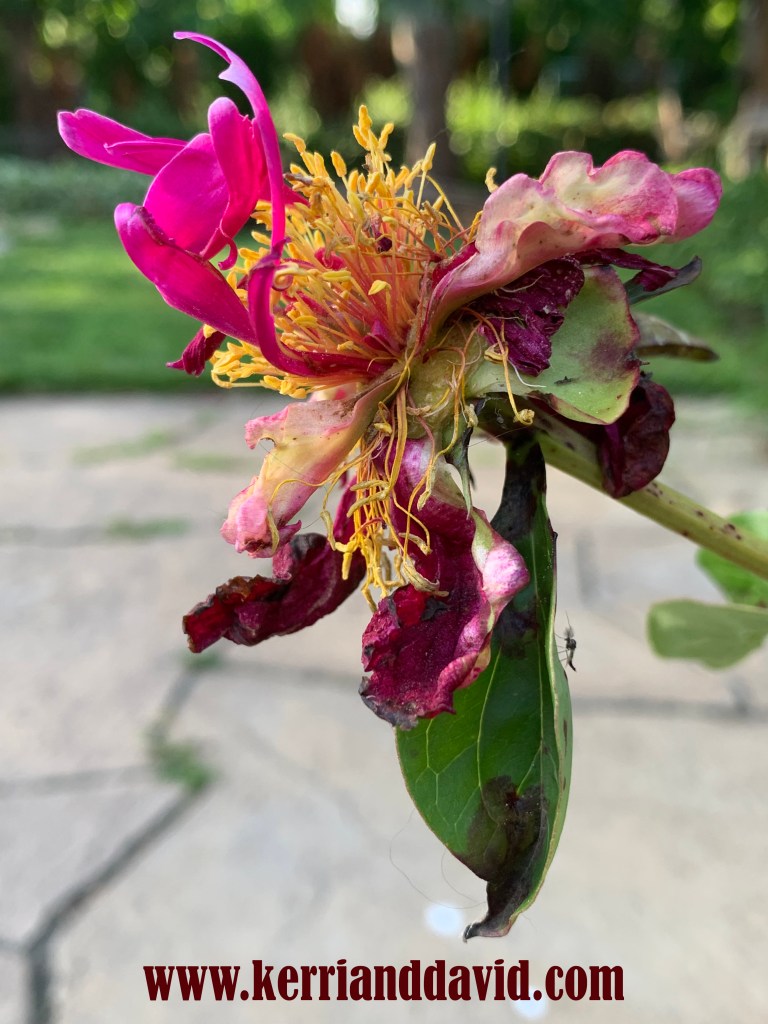
Context is everything. When we chose this picture for our Melange, I thought I’d probably write about renewal. Out of devastation, a phoenix rises. Or, perhaps the kind of renewal that doesn’t just happen but requires a bit of scraping, new soil, scattered seed, and hay-net to prevent the birds from feasting on the seed. Intentional renewal.

Context. Between the day we chose this photo and this cool quiet morning that I’m attempting to write about it, the mass shooting at Highland Park happened. I’m finding it nearly impossible to write about renewal.

Highland Park is not far away. We attend the annual art fair on their small-town Main Street. We’ve driven through 4 times in the last two weeks.

We were about to go out the door and walk to our local 4th of July festival when the news arrived. We looked at each other, no words necessary. We kicked off our shoes. We decided to stay home. Going to a place where people congregate – like grocery stores or elementary schools or places of worship or movie theatres or parades meant to celebrate our “independence” – seemed unsafe.

Context.

HIghland Park was one of three locations in the USA that experienced mass shootings on the 4th of July. No, check that. Four locations. Even as I type, Kerri brought news of the mass shooting that happened here – not so many blocks away – on the 4th. Staying home was a good choice. Oops. Check that. More news. There were eight. Oops (again). Check that. Eleven.

I cannot write about renewal but, for the third time this week, I am tapping out thoughts about interconnectivity.

It is a trick of language to say, “I broke my toe” and believe that only the isolated body-part called “toe” is injured while everything else is fine. Except it’s not fine. An injury anywhere to the body is an injury to the whole body. Everything is impacted. Everything adjusts. The pain-impulse you feel in your toe has already completed a round trip to your brain. Your posture adjusts so expect your hip or back to be sore tomorrow. Your spatial awareness goes on high alert: it’s best to avoid toe contact with any immovable object. If you desire to understand interconnectivity, consider how your whole body might respond if you happen to stub your seeming-isolated-and-already-broken-toe. Whole body response. Imagine it.

There have been over 300 mass shootings in the United States this year. So, the single most puzzling comment to come out of HIghland Park? “How could it happen here?” As if “here” is somehow isolated from Uvalde or Buffalo or Boulder or…it’s a long list and growing.

The whole nation-body is injured. It’s the illusion of isolation that underpins the mad-thought that more guns, unrestricted, are a solution to gun violence. Build a fortress? Isolate? Better doors? Arm yourself? It’s only the toe.

Where exactly is the boundary of “here?” And why would it be okay for “it” to happen “there”?

We’re all here. There is no “there” that is “safe.” Context is everything.

Perhaps I am writing about renewal. The intentional kind that requires some leadership scraping, new soil, seed, and a whole-body community united and relentless in their demand for proper protections from the insanity of guns.

read Kerri’s blogpost bout NEW GRASS

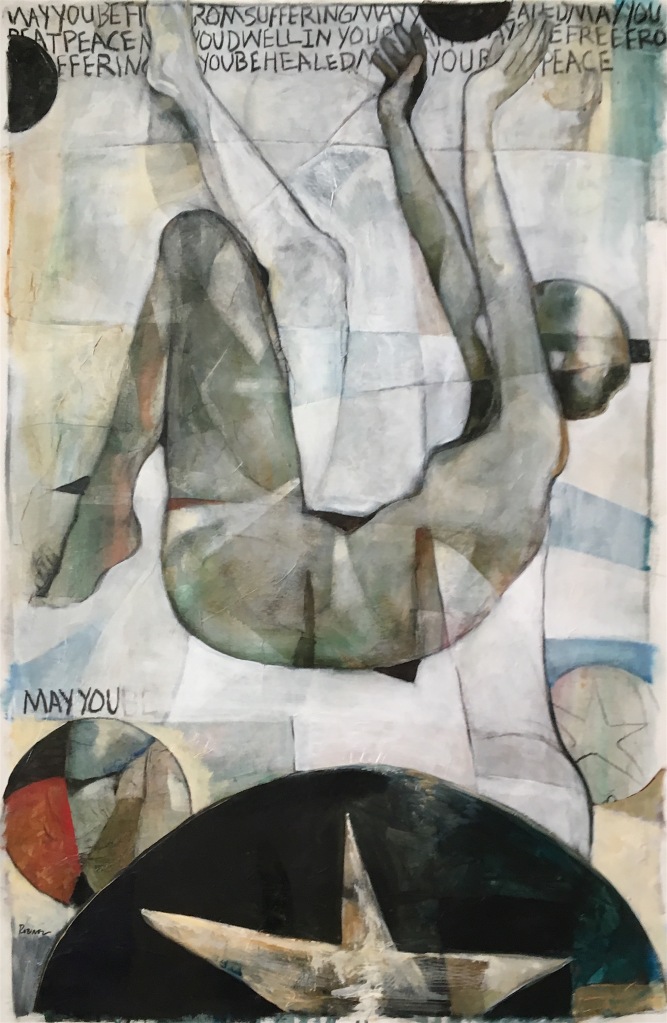
may you © 2015 david robinson

Live The Words [on Merely A Thought Monday]

We awake each morning to birdsong. I imagine the birds’ song raises the spirit of the sun. Or, the birds sing because the sun raises their spirits. Both are good stories.

When I was in college I had a professor who seemed a bit radical. Now I recognize that he was not radical. He was a scientist and his data was prophetic. He was sounding an alarm for his students, knowing that his students could not yet hear him. He was the first person to introduce me to the notion of climate change. At the time, the world was still smarting from the oil crisis of the 1970’s. One day in class he said, ‘If you think the oil wars are bad, just wait until the water wars.” I heard his voice this morning while looking at photographs of Lake Mead and the river Po. Dwindling water meets rising population. Panic is in the air. In the meantime, Australia is drowning. Desperation is on the rise.

I like to imagine the birds raising the sun while the sun raises the song in the birds. It’s a story of interconnectivity. It’s to understand the question, ‘what causes what?’ – as a two way street. You impact your environment and your environment impacts you. Or, better stated, you and your environment are not separate events. (“The love you take is equal to the love you make.” ~ The Beatles)

Though he never used the word, “interconnectivity” was the construct my seeming-radical professor was asking us to consider. He understood that his students were products of a long tradition of disconnection. A dedicated delusion of dominance over nature ruled our construct and he was attempting to puncture that absurdity bubble. Pour toxins into your river and your water will poison you. Pour carbon into your air and your air will eventually pour carbon into you.

The same applies to governance and society in general. What we pour into it is what we will experience as it. H wrote that, “Politics is simply the exercise of being a good neighbor for the sake of the neighborhood.” Interconnectivity. For the sake of the neighborhood. Demonize your neighbor and they will, in turn, demonize you. Refuse to listen to your neighbors and they will refuse to listen to you. Pour guns into your community and your community will inevitably aim its guns at you. Lie to gain power and the lie will gain power over you.

Pour support, service, acceptance, consideration…into your community and it will respond in kind. “Do unto others as you would have them do unto you,” is not so complicated a concept when seen through the lens of interconnectivity. Kindness begets kindness. Acceptance begets acceptance. Honesty begets honesty. Intend it. Practice it.

These are easy words to say. Living the words is quite another story. Unless you happen to be a bird, singing the sun awake as the sun pours its rejuvenating warmth over your song.

read Kerri’s blogpost about THIS DAY AND AGE

Use Your Words [on Two Artists Tuesday]

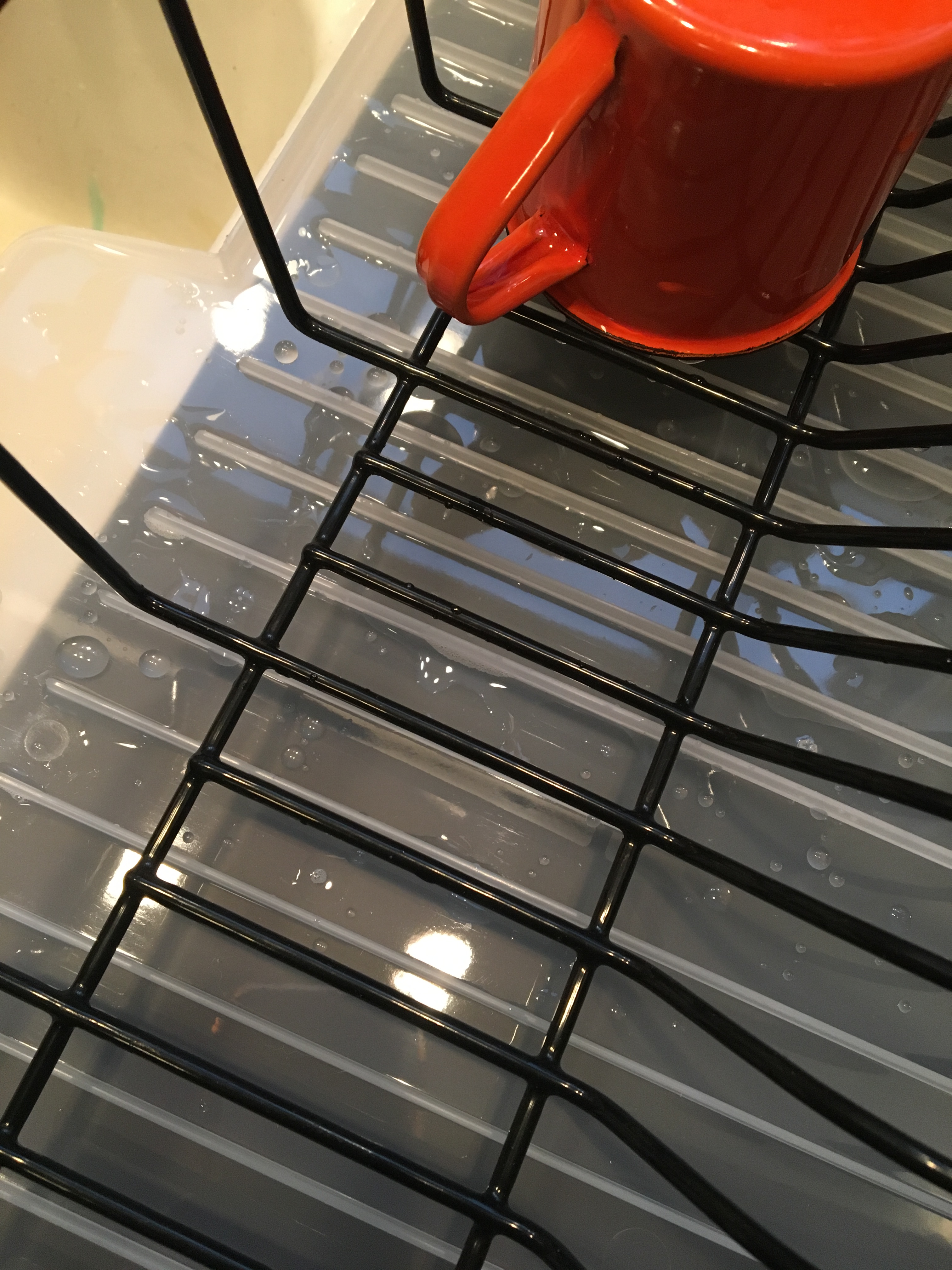
Kerri calls this photo ‘Dish rack with orange cup.’ “It sounds like the title of a painting!” she exclaimed.

We generally go through our day making fun of the words we paste on our experiences and pull from our conversations. I am forever proclaiming, “That sounds like the name of a band!” Or, “Hey, that sounds like a lyric!” For a guy that can’t hear lyrics in songs – and is famous for singing my-own-made-up lyrics – I’m particularly adept at thinking I hear lyrics in conversations all around me. I know, I know. I am a walking paradox, a living conundrum, a human-thought-puzzle with a few pieces missing from my box.

Lately, our language game has a new and always surprising twist: simple words that refuse to come to mind. For instance, reaching for the word”ravioli” necessitated, “You know, little pasta pillows with stuff inside.” Tell me honestly, doesn’t that description sound like the beginning line of a poem or a silly lyric? Little pasta pillows with stuff inside. 20 drew a little green orb on his shopping list because the word ‘avocado’ refused a timely recall.

I was on the ground howling with laughter when Kerri’s brain refused to pull a word from the abyss. Twisting her wrist back and forth, making a Tin-Man-esque-joint-with-no-oil sound, she begged for my help. “Come on!” she pleaded, “What is it?”

“Arthritis?” I offered, tears rolling down my cheeks.

“YES!” she danced. “ARTHRITIS! That’s it! That’s it!”

Side note: YES was a rock band in the 70’s. The band members most certainly now have arthritis. Their biggest hit was Roundabout. The song lyrics begin with this: I’ll be the roundabout/The words will make you out n’ out…[side note to side note: I’m not making up the lyric. I Googled it to avoid worldwide criticism].

Speaking of roundabouts, we took down Dogga’s roundabout sign in the yard. Actually, the weather did it for us when it snapped the metal support pole. He doesn’t seem to care. He continues to run circles without his sign giving him direction. The sign will soon go up in my office as a reminder that my brain’s movement and Dogga’s running path are one and the same: circular. Each cutting a trail in our own way.

It’s simple really. Arthritis! Dish rack with orange cup. A still life or almost-haiku-line? “What’s the word for…?” Reminders all to take ourselves less seriously. To never invest too much in or believe too heartily in the words used or the stuff we think. It’s all made up poetry, a band name, a lyric, anyway.

read Kerri’s blogpost and BUY THE PRINT!

Re-Connect [on Merely A Thought Monday]

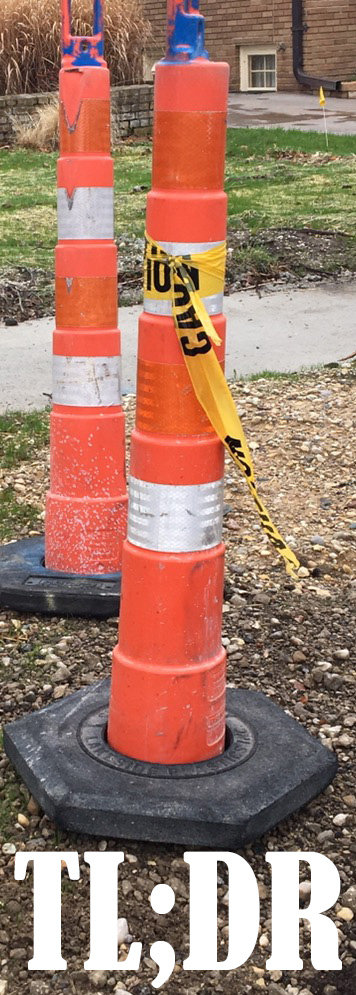
The latest addition to my “Terms in this Unknown Land” document is TL;DR. Too-Long-Didn’t-Read. I laughed aloud when I heard this new acronym in a meeting. If there is a sign of our times, an identifying marker of our era, it is this: TL;DR.

We communicate through text and emoji. Chat. Twitter is a thing because it mandates brevity. Scrolling the news app is a study in cramming the full story into a brief headline. Marketers have mastered the 5 second ad. Businesses are liberal in their use of “narrative” and “story” but have no time to actually hear one. A short synopsis will have to do. Get to the point.

As a member of my culture I find that I scan more than I read. If I can find it on Youtube, I’d rather watch it than read about it. When I began writing blogposts ten years ago, the “rule” was 800 words or less. The rule has adjusted with our attention spans and now the target is between 400 and 600 words. Often, when I receive links to articles, they come complete with an estimate of how many minutes are required to read them. Yesterday, I read advice from a marketing guru that suggested we restrict paragraphs to two sentences or less; more than two sentences is a red flag: too much information. Less than two sentences is…a sentence.

So much information is coming at us all the time, we have no time or thought-space to take it all in. I wonder if we can discern relevance from dreck. A quick look at our leaders leaves me with a resounding “No!” Relevance is lost in the dreck and, since they represent us, they are us, our information inundation has rendered our attention spans tiny and blunted our acuity. We are awash in information while wisdom has gone missing.

Each week I attend meetings; the central concern is explicitly or implicitly about helping people connect. It reminds me of the conversations I heard in graduate school: while living in a city of a million people, the concern was about how to create community. So many people. So little community.

I ponder these things every day. With our ubiquitous technology, we couldn’t be more connected. Through social media, I know what people had for dinner or what cute thing the kids said. I receive advertising that confirms my devices are listening to me. Yesterday, for-the-hell-of-it, I said, “Machu Picchu.” Today I am awash in travel ads for Peru.

We are connected. Connection to everything is connection to nothing. Relevance is hard to discern in a tsunami of information masking as connectivity.

Relationships – real relationships – take time. Values cannot be communicated in a text. They must be demonstrated and deeply rooted in lived narrative. Stories that carry relevance cannot be well-told in synopsis. Opinions are so easy to tweet. Dreck is easy to fling. It is not the capacity to share that we lose in the crush. It is not connection. It’s the capacity to be present. With presence comes the capacity to listen. Presence is not in a hurry to be some other place.

Rich connectivity requires more than quick consumption of information. Sharing, real sharing, the kind beyond pressing a “send” button, is a two-way street between people who have the time to invest in each other. Once, it was called relationship.

TM;CL. Too much. Can’t listen.

read Kerri’s blogpost about TL;DR

Say The Word [on Two Artists Tuesday]

“In the realm of ideas, everything depends upon enthusiasm…in the real world all rests on perseverance.” ~ Goethe

To outside eyes it looks like a small stack of plastic Adirondack chairs. To our eyes, it is a marker of something almost unimaginable to us during these past few years: stable ground.

If you want to know what these semi-cheap plastic chairs represent to us, look no further than the movie Gravity. Sandra Bullock in space in a story of “if it can go wrong, it will go wrong.” Through a rolling series of disasters peppered with just-in-the-knick-of-time hand-holds, against all odds, she splashes down to earth, safe. She stands on a beach, shaky legs. For the first time in a seeming eternity: stable ground.

Perseverance is a word used after the fact. During the free fall to earth, nothing feels even remotely like tenacity. Survival-mode does not allow for meaningful reflection or personal congratulations. Look for anything to grab to stop the fall. Believe that the ghost of George Clooney will crawl into the space capsule with a kick-in-the-butt speech at the very moment when giving up seems like the only option.

“There’s always another option,” we told ourselves. There’s always another step to take. Any step. There must be…

During our free fall we sat on our back deck in our broken white, cracking-and-en-route-to-collapsing plastic Adirondack chairs. We felt the sun on our faces. We talked of appreciating our moments. We encouraged and affirmed each other when “hope” was a word that made us roll our eyes and laugh-out-loud.

Last week, in a daring gesture of new times, we bought (on sale!) six black Adirondack chairs. Six! For friends to sit in when they come to visit. A statement of “hope” during a season of pandemic.

Yesterday we sat for the first time in two of our new chairs, faces in the sun, appreciating our moment. And, for the first time in three years, we dared utter the word “perseverance.” Shaky legs. Stable ground.

read Kerri’s blogpost about NEW CHAIRS

Chew On It [on Merely A Thought Monday]

The first and most important question of the day is, “What is nougat?” I’ve always been more of a peanut M&M’s guy or, these days, a straight-up almonds, sea salt in dark chocolate lover. I’m currently accepting donations of Chocolove’s Salted Almond Butter in Dark Chocolate. You should be, too.

So, what is nougat? Originally it was honey, nuts, and egg whites but in this era of “it’s-better-not-to-know-what-I-just-put-into-my-mouth-and-called-it-candy,” I wonder what passes for nougat? I only ask because I’d never heard of a Charleston Chew so, to understand the reference, I looked it up. When I read that a Charleston Chew is, “…flavored nougat covered in chocolate flavored coating…” I immediately spotted the word “flavored” twice in the same sentence. If the chocolate isn’t really chocolate then what are the odds that the “flavored” nougat is really honey, nuts and egg whites?

To borrow and bastardize a bit of Hamlet”To eat; perchance to savor: aye, there’s the rub.” Kerri assures me that a Charleston Chew is yummy. Who cares what’s in it if it makes my toes wiggle with satisfaction? It’s the inverse argument of all those nasty foods adults made us swallow as children: who cares if it’s good for me if it makes me gag? Make me go hungry and send me to my room! Please! Caring adults forget that kids squirrel away and hide Charleston Chews beneath the mattress so banishment to the bedroom for not choking down brussel sprouts is tasty a reward.

This is key to understanding why people do what they do: we know what’s in a brussel sprout*. We have no idea what’s in a Charleston Chew. We’ll clamp down our jaws or pitch public fits rather than eat what’s good for us. Yet, we’ll happily binge on mystery snacks that are certainly no good for us but, damn-do-they-taste-good. Insight: humans are not rational beings. We puff up and proudly defend all manner of thought-nougat but can’t be bothered to look up the source or verity of the dreck we’re feeding on.

Of our current dilemmas, there is one thing that is certain: we can’t Charleston Chew our way out of this.

Take heart. There’s always Chocolove.

[*now that I’m rumored to be an adult I love roasted brussel sprouts]

read Kerri’s blogpost about CHARLESTON CHEWS

Taste The Sound [on KS Friday]

Toadshade trillium. Say it out loud and taste the sounds. Toadshade trillium. Yummy words worthy of e.e. cummings.

I am working in a tech space and keep a document on my desktop: Terms in this Unknown Land. Tech folk speak in acronyms, PAI and SMB, SERP and TAM. Although my colleagues are mostly left-brainers, they are remarkably poetic in their language, peppering their acronym-speak with tasty terms like “cluster calculations” and “stemmings.” I admit to losing the sense of the conversation in the sound. They are, despite the stereotype, passionate and creative and unconsciously poetic. “Plots a curve of probability.”

Toadshade trillium. Plots a curve of probability. Forget the meaning and taste the sound! What might Mary Oliver have done with those syllables!

My lesson this week: I cannot stand and work at my computer all day. I can do the standing (I have a stand-up desk) but staring at a screen eventually shuts down my brain. Across from my stand-up desk is my drafting table. I think better with big pieces of paper and a pencil and then translate back to the computer. I need to move to think but that’s only part of the lesson. When at the drafting table I’m more likely to take things less seriously. I free myself. I get snarky and funny and scribble and draw big arrows and make fun of myself and the logjam in my thinking. I play.

And, while I play, I talk aloud, and hear the sounds of the shapes that I draw. Poetry and motion. Taste the movement. One and the same. Free the thinking. It’s enough to scare the dog but it’s liberating to my kinesthetic necessity. I scribble notes in every direction and dance back and forth between word and image. Consequently, I produce better work.

Thank goodness I finally tasted a few word-sounds that sent me tumbling into a productive scribble dance.

read Kerri’s blogpost about TOADSHADE TRILLIUM

kerri’s albums are available on iTunes and streaming on Pandora

pulling weeds/right now © 2010 kerri sherwood

Breathe At Human Pace [on KS Friday]

We live in a time in which cars are capable of parking and braking themselves. I am able to type a message into a little box that I carry in my pocket and my message, through space and time to anywhere in the world, is delivered immediately. I write my thoughts in this device and then publish all over the world. I’ve learned of a software that is able to write my thoughts without me – faster and with fewer grammatical errors at the outset. I think and write in a pattern capable of being recognized. I am, therefore, capable of being approximated. What is amazing today is common tomorrow. So it goes with the pace of change.

I read in The Dream Society, written two decades ago, that the aim of the industrial era was to spare humanity physical toil and the aim of the information age is to relieve us from the exertion of thought. We’re producing data at a staggering rate and, ironically, the explosion is both serving the intention and overwhelming our capacity to keep up. We can’t possibly process the tsunami of information that washes over us everyday. We are human. We have a tough time sussing out truth from belief-fantasy even when not washed down the roaring information streams.

It is why I hang out with Desi. Desi is the little tree sprout that we rescued from the Des Plaines river trail over two years ago. When Desi came home with us, her tiny trunk was needle thin. She is thriving in her pot and has more than doubled in size, yet, by the standards of data, her growth is glacial. And that is precisely why I visit her each day. She is in no rush. Efficiency for Desi has nothing to do with speed. Health is about good soil and light. Like all plants, she could be pushed artificially, but why? Pushing might get her to adulthood faster but would also damage her systems. Efficiency and health, for Desi, are all about natural pace. Slow, slow, slow to human eyes.

Desi reminds me that the pace of my life is artificial. A choice. The pace, the incessant noise vying for my attention, are human-made, unnatural. Don’t get me wrong. I delight that Google maps gets me where I want to go. I appreciate having a phone available while walking a backwoods trail. One of the great joys of my life is watching Kerri photograph – with her phone – the world she sees. I love to write and push a button to share. I am, despite my advertising, not a luddite. I’m also aware that the media – the medium – is the message. We are – we become – what we consume and how we consume it. It is a necessity in our age of rolling miracles to keep both eyes open.

I think it is healthy (although virtually impossible) to occasionally crawl out of the stream and breathe at human pace. To think without the expectation of assistance. Each day, for a few minutes, I hang out with Desi, a reminder that an inch of growth every year is sometimes fast enough.

Kerri’s albums are available on iTunes and streaming on Pandora

read Kerri’s blogpost about DESI

taking stock/right now © 2010 kerri sherwood