Leave Her A Note [on DR Thursday]

IMG_2686 copy 2

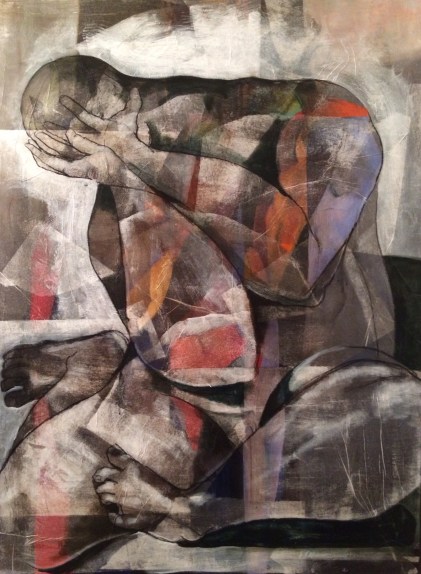
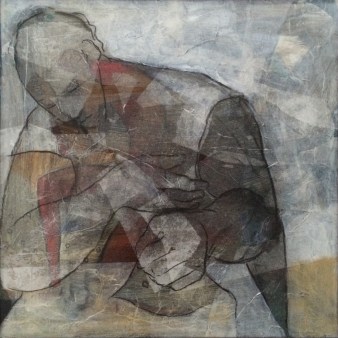
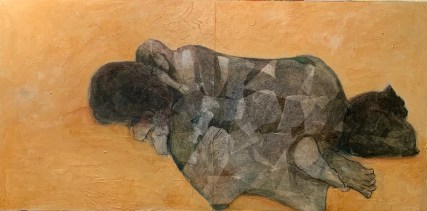
my loves, mixed media, 24 x 48IN

I came around the corner just in time to see it. Kerri crawled onto the bed, resting her head on DogDog, she closed her eyes. BabyCat, not wanting to be left out of the snuggle, moved over and curled into the cuddle. I stood very still and memorized the moment.

My artistic well has been dry all winter. I believe dry spells are great opportunities to experiment, to make messes and learn again to be free, to not take anything on the easel too seriously. And so, in my emptiness, I began playing with my memorized moment [last week I published the rolling iterations this image passed through].

Sometimes playing with an image feels like wrestling with an angel. It has the upper hand and is toying with you, the mere mortal. One day, after wiping the latest iteration off the canvas, I had a very mortal thought: this might be the last painting I ever paint. Pandemic thoughts reach deep.

And, what if this was my last painting? What if? I would want my last painting to be a love note to my wife. I would want her to know that one day, as she laid her head on DogDog and BabyCat curled against her, I stood in absolute adoration and appreciation of my family, my wife, my moment. My life. My loves.


read Kerri’s blog post about MY LOVES


pumpkinfarm website box copy


my loves ©️ 2020 david robinson

*this painting is not yet up on the site. the paint is still drying.

**there’s another canvas on the easel with a painting already in process! (phew).

Learn It Again and Again [on DR Thursday]

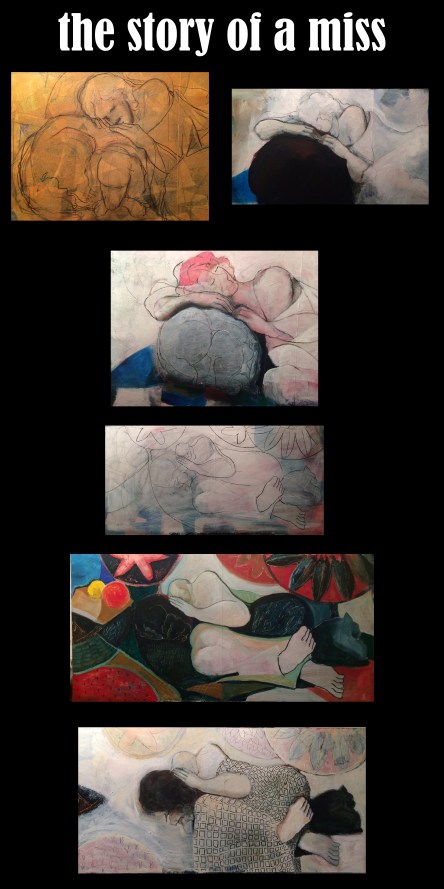
the story of a miss copy

“I begin with an idea and then it becomes something else.” ~ Pablo Picasso

This trail of images, all on the same canvas, is an idea trying hard not to become something else. It is a series of fitful starts and dissatisfied restarts.  It is not uncommon, when I feel that my well is dry, to start a painting and shove it through many phases of discontent. I pull on it and push on it like so much taffy.

I’ve learned (or I am making it up at this very moment) that this exercise of discontent is important. It is a necessary skill to develop – not to get too attached to an idea or invested in how it “should” be. When my well is empty, I generally stumble into this old mistake: I try to force a result. I try to make it happen. I somehow forget that the best work is a relationship, a process that has very little to do with muscle and everything to do with heart. And so, I roll through a series of forced images.

And then, one day, I throw up my hands and all thoughts of my precious idea go out the window. I let go. And that is the exact moment that the idea becomes something else and the painting can finally begin.


read Kerri’s blog post about THE STORY OF A MISS


drc website header copy


shadows on TPAC sidewalk website box copy


Why Wait? [on DR Thursday]

they wait copy

they wait, mixed media,  24 x 18IN

“Perhaps all the dragons of our lives are princesses who are only waiting to see us once beautiful and brave.” ~Rainier Maria Rilke

And, so, we wait. We sit in our homes for the benefit of all. I’ve heard from my pals that time has seemed to warp, twist, and fade. Routines are broken. Patterns scattered in the new necessity. It begs the question, as we wander from room to room, where can we go if cannot go from here?
I’m fond of a thought from Eckhart Tolle: Presence is when you are no longer waiting for the next moment, believing that the next moment will be more fulfilling than this one.
In our daily walks, we often end up in the cemetery at the end of the street. It is the only place we can go and not cross paths with other people. Cemeteries are good for perspective. There are birth dates and death dates and nothing in between. Whole lives lived, loves lost and found, fortunes made and lost.  ‘Imagine all the crap this person worried about that didn’t really matter,” I say. Kerri nods. I imagine each and every one of these souls would give anything – anything for a single moment of precious life. Any moment would do, but I suspect they’d want back all of those moments that they branded as “waiting.” Moments wanting to be somewhere else and completely missing what was right before them, rich and beautiful.
Presence is one of those easily abstracted and often misunderstood experiences. It can be found in the drawer labeled ‘spiritual things.’ It is loaded with paradox. One cannot strive for presence. Striving for presence is the ultimate oxymoron. Presence is actually very practical. Stop striving to be elsewhere. That’s it. Simple. Yet, that is what makes it so hard to embody. It requires a bit of surrender.
And, so, in this time of pandemic, we wait. We sit in our homes for the benefit of all. Time twists. Assumptions turn to dust. Tomorrow cannot be planned. We writhe for entertainment, places to go. We grouse for something to fulfill us, distract us. We make up things to fill time.
Strolling through the cemetery, I ask myself, “How much of my life am I willing to give away to waiting?”

feet on the street WI website box copy

they wait ©️ 2018 david robinson

Ask, “What Now?” [on DR Thursday]

weeping man copy 2

“Although each of us is fashioned in careful incompletion, we were created to long for each other. The secret of our completion can only be found in the other. Huge differences may separate us, yet they are exactly what draw us to each other. It is as though forged together we form one presence, for each of us has half of a language that the other seeks.” ~ John O’Donohue, Beauty

My favorite definition of “story” comes from Robert Olen Butler: a story happens when a yearning meets an obstacle. It is, of course, also a great definition of the experience of being alive. In our “careful incompletion” we yearn for other things and other places, other ideas of ourselves. And, so, we set sail. We seek.

Without yearning there would be no story. Without obstacles there would be no story.

Like you, I have spent my time on the kitchen floor, Kerri’s code-phrase for weeping.  When my obstacle was insurmountable, when my yearning required leaving. Loss. Weeping invited surrender. Surrender required weeping. Letting go.

And, after the weeping, emptied of what was, I, like you, stood, took a deep breath and asked myself, “What now?”


read Kerri’s blog post about WEEPING MAN


cropped head kiss website copy


weeping man ©️ 2015 david robinson

Look Again [on DR Thursday]

EARTHInterrupted7.THIS ONEJPG copy 3

It’s all a matter of context. As it stands, this is the seventh painting in a series I call Earth Interrupted. This piece would not exist today except Kerri stopped me from painting over it. She likes it. I find it dark. Foreboding. Of the seven paintings, it is the darkest piece in the series. When I painted it, I didn’t know how to place it – I didn’t know its reference point. It wasn’t and isn’t comfortable.

I pulled it out of the stacks last week. Now, in this time of pandemic, I know exactly what it represents. Everyday in the news I see a graphic of the virus. It is dark and foreboding.  Earth interrupted.

In an earlier version of myself I spent a great deal of time trying to educate educators to this simple truth: art is not supposed to be entertainment. It can’t always be comfortable. In fact, it holds diminished value if it doesn’t sometimes challenge, sometimes upset, sometimes confront, sometimes incite. Art is powerful because it confronts us, asks us to question what we see and think and believe.

And now, looking at this painting that makes me uncomfortable, I find it necessary to listen to that earlier version of me. This painting is beautiful, not because it makes me feel good or takes me away, it is vital because it upsets me. It lands me squarely into this inescapable moment in time.


read Kerri’s blog post about E.I. 7


k&dbw backs website box_ copy


earth interrupted vii ©️ 2018 david robinson

Look For The Manatee [on DR Thursday]

canopy copy

This has never been Kerri’s favorite painting. When I chose it for this week’s melange I asked her why she didn’t like it. She said, “Because there’s a manatee in it.”

“A manatee?”

“Keep in mind,” she said, “that I’m inkblot challenged.”

Wait. What?

Responding to the blank look in my eyes, she added, “I could never see Jesus in the pancake. Stuff like that.”

“The pancake?” My synapse fell short of the hoop. She Googled inkblots to demonstrate her disability.

“See (she pointed to an inkblot on the screen)! There’s Florida and I’m supposed to see Jesus. Wait. Oh. There he is. Wait! There’s a lot of stuff in there!” she marveled, squinting at the blot.

Blink. Blink.

“Oh! Maybe it’s that I see too much stuff in the inkblot!

I pulled up the image of the painting. “It’s called Canopy,” I said. I enlarged the image.

She looked close. “Wait. That’s not a manatee!” she exclaimed. “That’s a person’s leg!” She looked closer. “Hmmm.”

It is, after all, what I love about art: It is never complete. It emerges anew with each new look, each new performance. What I intend has very little to do with what is perceived and in that space between artist and audience, a new creation, a new conversation arises. Imagination is like that. It opens worlds of surprising possibilities. It projects itself into the known, into the painting, and magically transforms it.

“So, you don’t like manatees?” I tease.

“I love manatees!” she huffs. “Just not in your paintings.”


read Kerri’s blog post on CANOPY


not our best morning minturn website box copy


canopy ©️ 2009 david robinson

Answer The Call [on DR Thursday]

Eve copy 2This painting makes me laugh. It is an inside joke [in my exclusive club of one], a mash-up between Newton’s apple and the variety enjoyed by Eve. The apple, in both stories, is a symbol for knowledge – or, better, that most human of characteristics: curiosity.

Curiosity is piqued when forbidden. Isn’t that the point of Pandora’s box or Eve’s apple? That piece of symbolic fruit is better understood in a greater illustrative context (making it, therefore, useful): in the story, there are two trees in the allegorical garden, 1) a tree of knowledge and 2) a tree of everlasting life. To “know” requires separation. Eat of this apple and you will forever discern between this and that. With this apple comes self-knowledge. You will “know” rather than simply “be.” You will, in your separation from your Self, spend the rest of your days attempting to get back into the garden to eat from the other tree (unity, wholeness, no-separation,…purpose, meaning, etc.). It’s a parabolic life cycle. Don’t bite that apple, I dare you.

The other apple-of-legend knocked some insight into Newton. “And, why did that apple fall straight to the ground?” Newton asked himself. His answer: universal gravitation! Every body in the universe is attracted to every other body with a force that is directly proportional to the product of their masses and inversely proportional to the square of the distance between them [my comprehension and advanced math stopped at the word “force” so the rest of the law is yours to sense-make]. This apple was most welcome!

In both cases, I imagined, seated in front of my easel, that both the symbolic Eve and the actual Sir Isaac, in their respective apple moments, looked to the sky and uttered, “You have got to be kidding me!” And, so, curiosity calls.


read Kerri’s blog post about EVE


sunsetonisland website box copy

eve ©️ 2004ish david robinson


Plant What You Love [on DR Thursday]

K.Dot Dogga Close Up copy

“All that we are arises with our thoughts. Speak or act with a pure mind and heart and happiness will follow you as your shadow, unshakable.” ~The Buddha

What is it to speak or act with a pure mind and heart? I’ve often thought about Don Miguel Ruiz’s 4th Agreement: be impeccable to your word. He writes that being impeccable to your word is the most self-loving thing you can do. Mean what you say. Say what you mean.  And, beyond that, say nothing. How often have I said something I didn’t mean? How often have I done something out of anger or spite or fear that I knew I would later regret?

Pure (adjective): free of contamination.

Wayne Muller wrote a book I admire, How Then Shall We Live. In it, he asks four questions. The second question is, “What do I love?” He writes that “we must plant what we love in the garden of our lives.” Plant anger and you will grow anger. Plant generosity and you will grow generosity. Nurture reactivity and your garden will run amok with weedy reactivity. So, self love: say what you mean and only that. Mean what you say and only that. Jay made me laugh out loud when she told us what she used to say to her young students: “You can think it in your mind but don’t let it out of your mouth.”

Horatio told me that I needed to get back into the studio, even if it was only to sit and sip a glass of wine. I took his advice. On the easel was a canvas with the trace of an image that I had sketched and then wiped clean. On a cold autumn day, DogDog and BabyCat asleep on the bed, Kerri (pre-broken wrists) crawled between them and cuddled with DogDog.

An image of what I love. In this time of high anxiety, anger, division and fear, in the quiet of my studio (which induces quiet in my mind), perhaps my entry back into painting should be attention to my garden. In this first image, I will plant what I most love.


k.Dot Dogga BCat copy


read Kerri’s blog post about SKETCHES


cropped head kiss website copy

Draw [on DR Thursday]

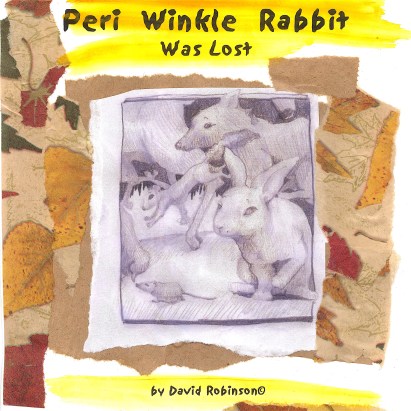
Peri Winkle Square copy

Sue’s request was clear: write a story that is hopeful but does not pretend that everything will be easy or rosy in the end.

In 2005, while Sue Eskridge was teaching a course on children’s literature at The University of the Pacific, Hurricane Katrina devastated the Gulf Coast of America. Sue had an idea. She refocused her class to help children who were displaced or had lost their parents in the storm. Her class approached several artists and children’s book authors and asked them to write and illustrate a story, to make single-copy-books. The books would be bundled with other supplies and through service organizations would go to children that needed them. “We want to give them hope but not false hope,” she said when she asked if I would “quick do a book.”

What do you do when the forest fire comes? The hurricane? The pandemic? Run. Hide. But then what? People pull together. People pull apart. The disaster invokes the best in us. The disaster invokes the worst in us. Ultimately, we realize that we are in it together and our togetherness can be defined through selflessness or through selfishness.

What defines us? I lived in Los Angeles during the riots and martial law. People turned on each other. I also saw the same community, just two years later during the Northridge earthquake, pull together. 9/11. AIDS. Our rhetoric does not define us. Our actions do.

I did as Sue asked. I quick did a book, Peri Winkle Rabbit Was Lost. I only had a few days and managed to write the story and smack out 16 illustrations. A story of personal gifts brought to communal need in the aftermath of a fire. When I bundled the original and sent it off to Sue I promised myself that I would someday go back into the story and draw all the pictures, fill in the 10 or so illustrations that I did not have time to realize.

This week, we retreated into our home, this pandemic hot and frightening and eerily invisible, except for the growing and incomprehensible numbers on the screen. The unreal reality. The hurricane that cannot yet be grasped.  I asked myself what might be a worthwhile project to do while isolating?  And then I remembered my promise to Peri Winkle Rabbit.

Draw. And perhaps a new story? One that deals with the hot fire now raging through our divided world? Two narratives. One pandemic. What are the odds that this crisis will burn off our national division and clear our eyes so that we are capable of stepping into a single story. I will ask Peri Winkle Rabbit.


read Kerri’s blog post on PERI WINKLE RABBIT


their palettes website box copy


Step Into The Ripple [on DR Thursday]

sometimesfaith WITH EYES jpeg copy 2

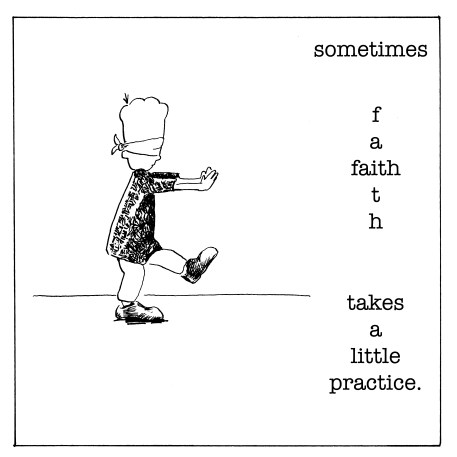
I’ve never understood faith as a religious term. Look up the word in the dictionary and you’ll come across trust, belief, and conviction. Rather than a lofty word reserved for worship day, it has always struck me as an everyday something – that becomes extraordinary when you realize how ever-present-and-ordinary it actually is. Stepping blindly. Blindly stepping. Each and everyday.

We surround ourselves with calendars and lists and routines and rituals and patterns – all necessary mechanisms to plan our days but they also serve to protect us from the truth of our walk on this earth: there is not a moment, an hour, or day that is actually known before it is lived. Every moment of every day is a step into the unknown.

The real practice of faith is not about an abstraction.  It is a recognition that walking in faith is an essential part of the human condition. The real practice is in realizing it. Being right where you are, open to the reality and empty of the illusion of certainty that you know what is coming. You do not. The true spiritual practice is to empty yourself of the need for the illusion of control.

Fully inhabiting the moment. Standing at the crossroad of past and future without the map of ‘I-know-what’s-going-to-happen’ dulling the experience.

Spiritual practices are not meant to be other worldly. They are, at their best, concrete relationships found at the intersection of past and future, in that tiny slice of infinity called “the moment.” It is a miracle of unknowns and surprises.

The practice of faith is the practice of putting down what you think you know – dropping the notion that you know what will happen- and stepping fully and with intention into the rippling unknown.


read Kerri’s blog post about FAITH


frozen lake website box copy

chasing bubbles ©️ 2019 david robinson

chicken marsala ©️ 2016 david robinson & kerri sherwood