Check The Resale [on KS Friday]

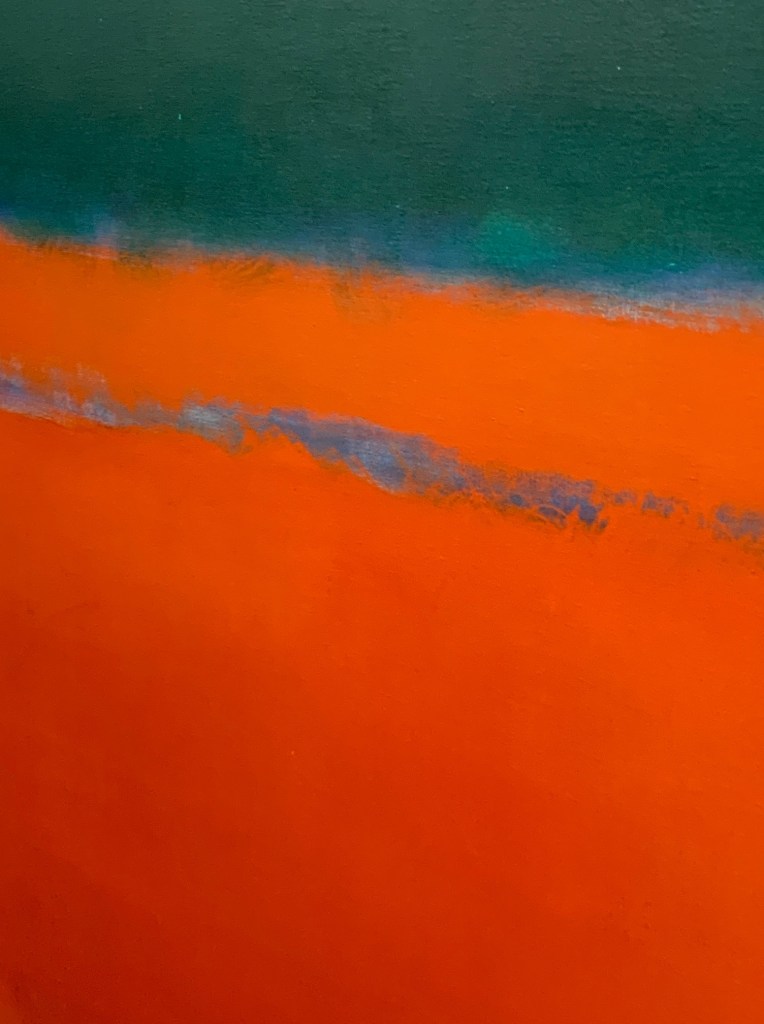
“Although Rothko lived modestly for much of his life, the resale value of his paintings grew tremendously in the decades following his suicide.”

The premise of this sentence made my jammies bunch-up. This wiki entry might have been written about Van Gogh. “Lived modestly” is a euphemism for “poor.” My favorite stereotype: the poor artist.

William Blake also lived modestly; he’d be shocked at the “resale value” of his work now. Nothing brings valuation to an artist’s work like the sudden end of the supply. Blake’s life came to a natural conclusion, so at least there’s that.

How do we know something has value? Resale, of course. Commodity. Soul reduced to a bottom line.

.003 percent of the nation’s budget goes to the National Endowment for the Arts. Valuation. If you desire to truly understand the phrase, “lived modestly,” visit your local not-for-profit arts organization. They’ll heap sincere gratitude upon you if you donate a ream of paper.

As an exercise in understanding soul, ask an actor or painter or dancer or composer the most obvious question: why do you do it?

Their answer will have nothing to do with resale value or commodity. Keep in mind, that doesn’t mean that they don’t want to be paid. Imagine Van Gogh’s answer. Or Mark Rothko’s. Emily Dickinson’s. Wouldn’t you love to know what they knew, see what they saw? Attempting to stand in their shoes, to see what they saw, is the reason that their resale value is so high. They connect us to something greater than commodity.

A caution: the next time you ask yourself, “What’s it all about?” be careful to direct your question to your inner Mary Oliver rather than your inner Elon Musk. They serve remarkably different gods.

My favorite quote of late: “And while a hundred civilizations have prospered (sometimes for centuries) without computers or windmills or even the wheel, none have survived a few generations without art.” David Bayles & Ted Orland, Art & Fear

.003%. That equates to an amount far less than Jeff Bezos’ tax bill. As a percentage, that’s much more than Kerri gets paid for a single spin of one of her pieces on your favorite streaming service (.000079 of a cent). Spotify, Pandora, and the rest are making out like bandits while the independent artists continue to “live modestly.”

What’s the real value of a nation that so desperately undervalues its art? I guess we’ll just have to wait for the postmortem resale.

Kerri’s albums are available on iTunes and streaming on Pandora

read Kerri’s blogpost about ROTHKO

every breath/as it is © 2004 kerri sherwood

Ask A Simple Question [on DR Thursday]

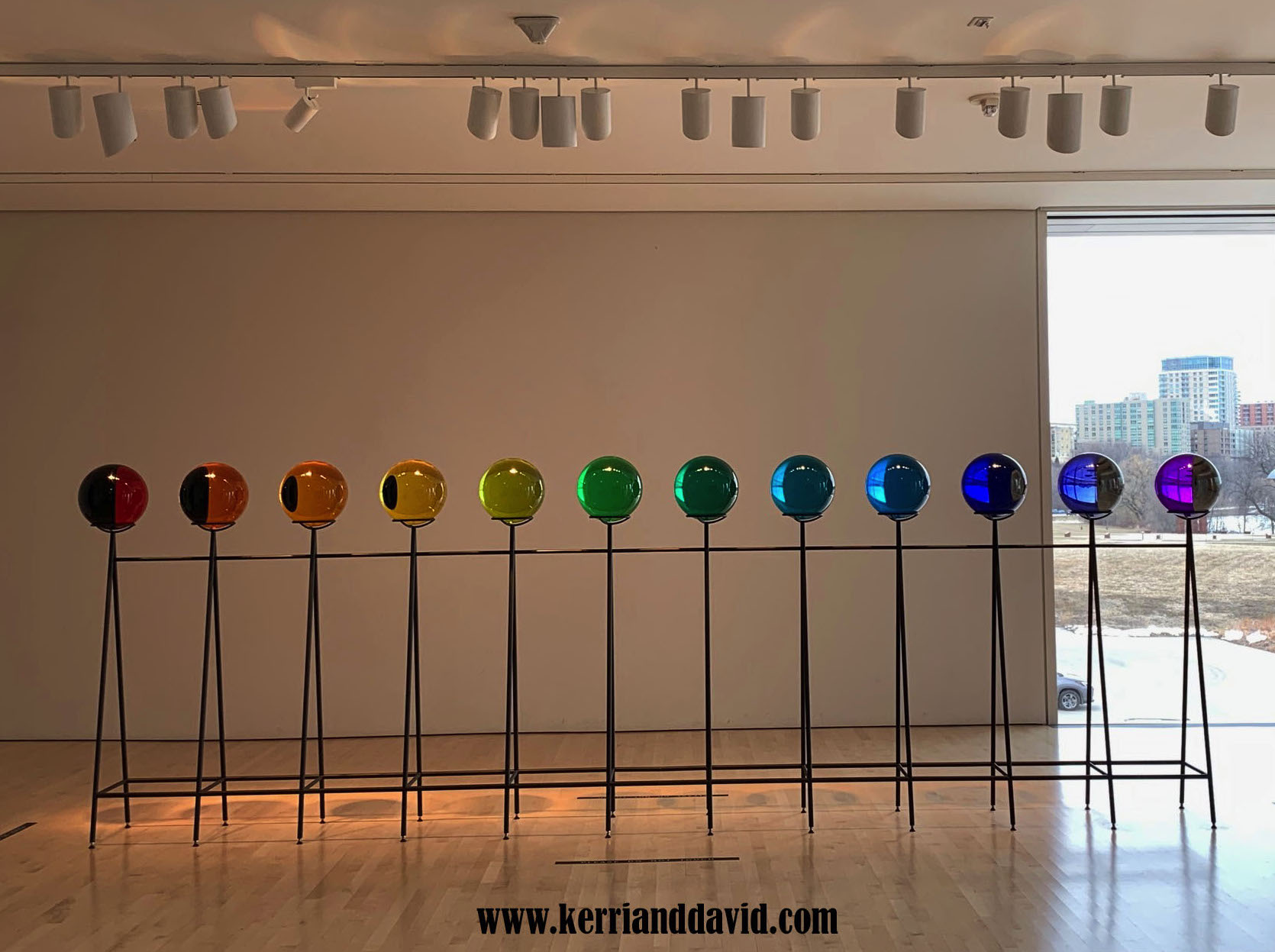
It’s existential. What you see changes depending upon where you stand. That’s true when engaging any piece of sculpture. It’s true when engaging anything in life. Point-of-view is fluid and relational. This sculptural reminder is Olafur Eliasson’s Rainbow Bridge.

In another era of my life facilitating diversity and inclusion workshops, the same surprisingly simple concept was usually a revelation to people. What you call “normal” is merely a point-of-view. Most importantly, it’s not everyone’s point-of-view. Your “normal” is unique to you, not universal. Most hopeful: it’s not fixed in stone. It’s changeable. Relational. Capable of growth. A mature point-of-view recognizes that it need not, it cannot, be the center of the universe. A mature point-of-view necessarily asks an all important question: “What do you see?”

It’s not only possible to look at the same sculpture and see a myriad of differences, it’s necessary. It’s human. Sharing what we see is how we, together, create community. A common center is created by a circle of differing points of view. A common experience is borne of sharing disparate points-of-view of the same event. A common center is made functional when everyone in the circle is capable of asking with sincerity a simple question: What do you see? It is made vibrant when everyone in the circle expects the answers to be different than their answer.

Art is one way of responding to the simple question.

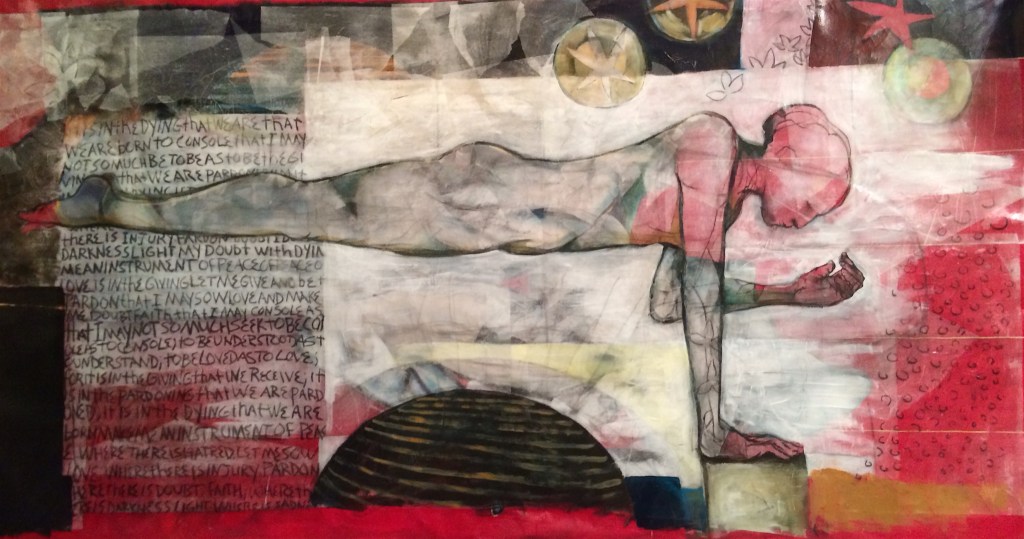
Instrument of Peace, 48x91IN, mixed media

read Kerri’s blogpost about RAINBOW BRIDGE

instrument of peace © 2017 david robinson

Welcome Home [on Not So Flawed Wednesday]

I realized on a night dive, 90 feet below the surface in the darkest dark I’d ever experienced, that my consciousness was like the flashlight I held. I saw only what was in the small space illuminated by my light. There was a vast world beyond what I could perceive in my limited view. I understood that the most potent choice I have – or will ever have – is where I decide to aim my light.

“Welcome home!” she said as we stepped into the gallery with three magnificent sculptures by Barbara Hepworth. The soft light, the floor-to-ceiling windows drawing us toward the lake. An open clean space. She was imagining this room was what our future home might feel like. I lapsed into studio fantasies.

I’ve always appreciated this room in the museum but for some reason, on this day, the sculptures were magnetic. While Kerri took photographs, I communed with Barbara Hepworth. The pieces are totems. Sacred symbols. Barbara Hepworth was a woman sculptor in a century that pretended the arts were the province of men. Her life spanned both world wars. She reached beyond the horror of her time to something more elemental. I found hope in her work. Guidance. Perseverance. She was shining her light on what humankind might become. Form and emptiness, perfectly balanced.

“Look,” Kerri said, showing me the photo. “It’s a porthole.” A perfect circle. A horizon. “I could stay here all day,” she closed her eyes and breathed in the space.

“Me, too.” Welcome home.

read Kerri’s blogpost about THE PORTHOLE

Reach Back To Move Forward [on Two Artists Tuesday]

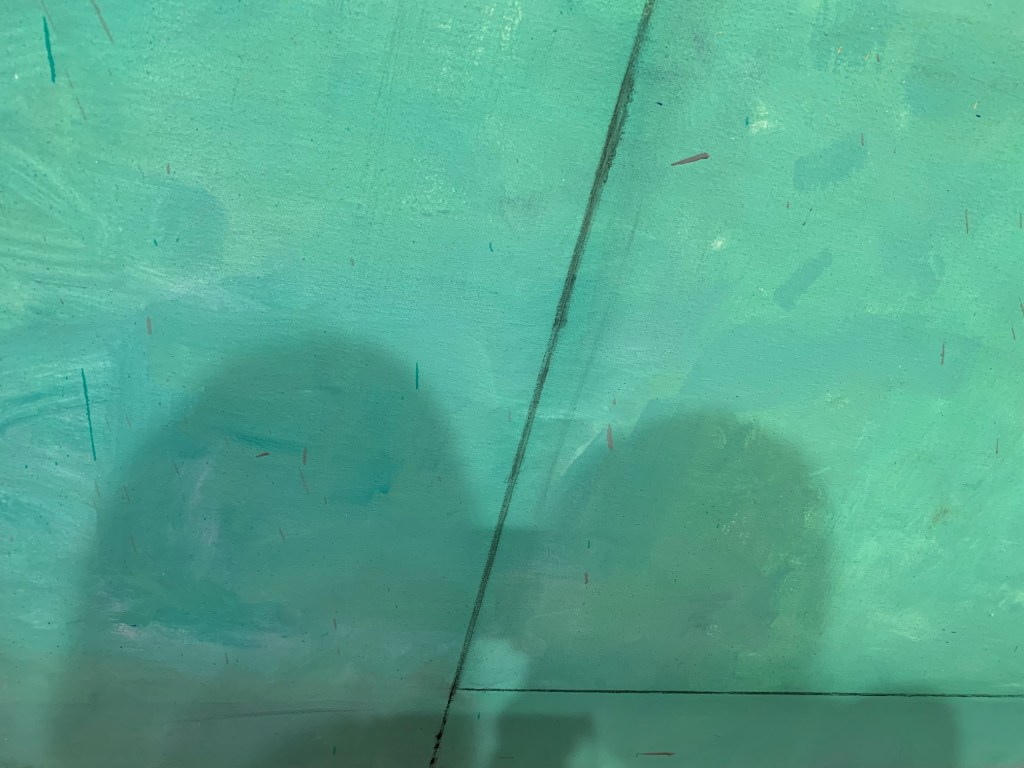
I wrote with great derision of the day I went to the Museum of Modern Art in NYC and watched people line up to take selfies with Van Gogh’s Starry Night. So, more than 15 years later, I howled with laughter at myself when Kerri beckoned me to stand with her so we might take a shadow shot with Diebenkorn’s painting, Ocean Park #68. “We’ll call it ‘Richard and Us!” she smiled.

Kerri recently challenged me to let go of my figurative work, release the image and paint my feelings. The moment before she beckoned me to take the shadow shot, I was having a minor revelation. There’s a reason I have stood in front of this painting for hours. There’s a reason it “talks with me” about simplicity and courage. Early in his life Richard Diebenkorn was a figurative painter. Even earlier, his work was abstract and resembled the paintings of the masters he admired. As his work matured it circled back to abstraction. He didn’t “let go” of his figurative work; he grew through it. He reached through it. In Ocean Park, he fulfilled his unique voice.

I read that his Ocean Park series was greatly influenced by the work of Henri Matisse. I imagined Richard Diebenkorn standing in front of his favorite Matisse, having a quiet conversation about simplicity and the courage to explore. In the gallery light, his shadow cast upon the painting as he moved forward to study the brushstrokes. He leaned in. He reached back to Henri to move forward. Had he lived in the age of cell phones and easy shots, I’m certain he’d have taken a shadow-selfie so he might remember the moment his shadow touched Henri’s.

We were alone in the gallery when Kerri took our shadow-selfie with Richard. We had him all to ourselves. We leaned in. I thought it especially poignant, our shadows cast upon a painting, an artist, who has cast his long shadow upon me. We caught the moment our shadow touched Richard’s. Reaching back to move forward,

read Kerri’s blogpost about RICHARD AND US

Trace The Line [on Merely A Thought Monday]

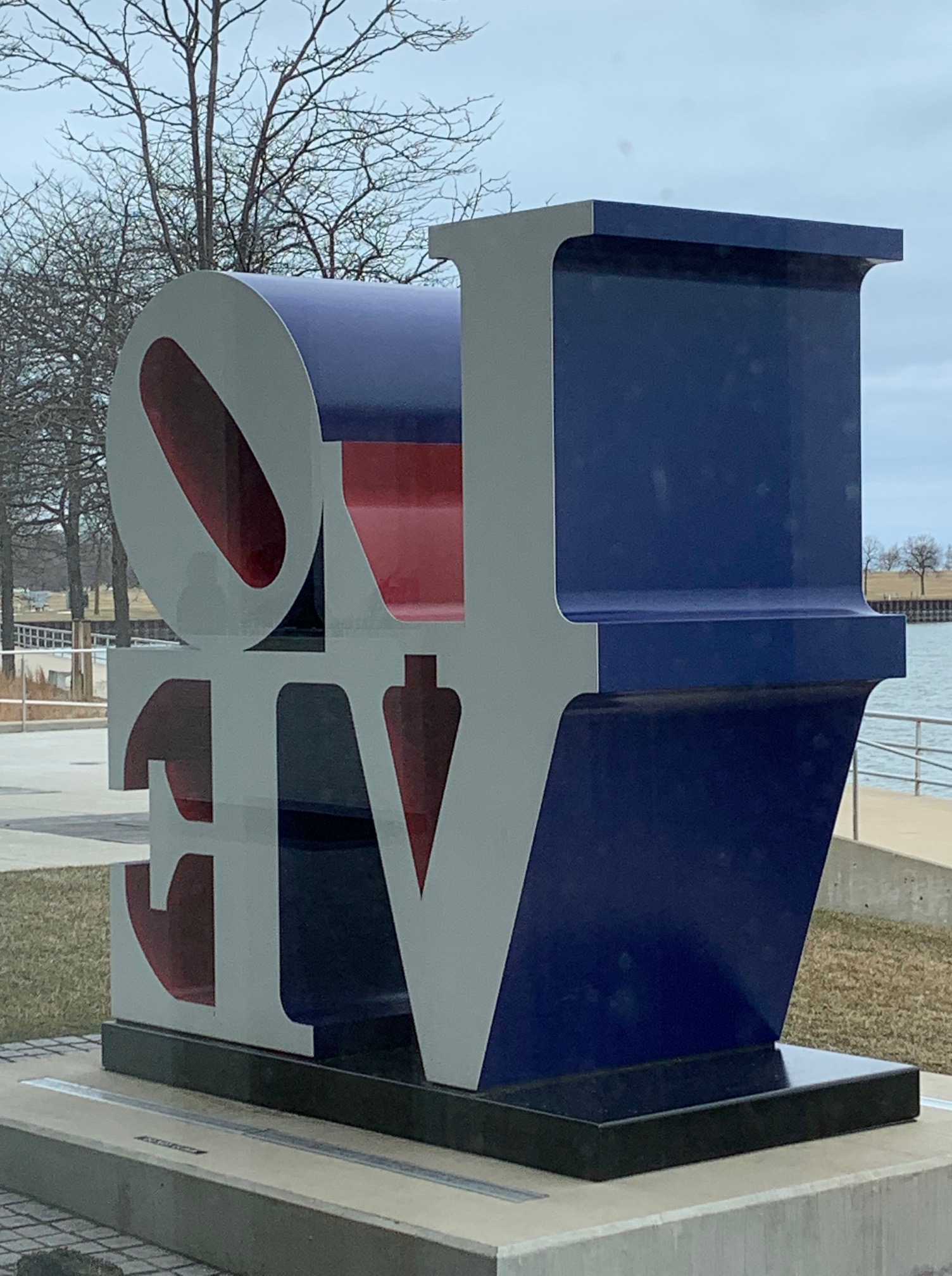
Love has a lineage. Without Piet Mondrian there would be no Ellsworth Kelly. Without Ellsworth Kelly there would be no Robert Indiana. For that matter, without Georges Seurat or Henri Matisse there would be no Piet Mondrian. Without the invention of the camera and the science of optics there would be no Georges Seurat. Of course, I’m referring to Robert Indiana’s sculpture, Love. We are rarely aware of how many lives influence our thoughts and give shape to our passing moments.

Love, the non-sculpted variety, follows the same principle in every life. It has a lineage. Chose any moment – any emotion – and follow the thread. An amazing web of interconnectivity emerges that stretches beyond…beyond. Sometimes I stop on a trail and wonder how I came to be walking through the woods in Wisconsin holding this woman’s hand. A tumble of choices. An immensity of influences and circumstances that quickly become impossible to comprehend. It’s no wonder destiny is such an attractive notion! Phew!

Four simple letters. Stacked symbols designed into another symbol. An aspiration? A graphic design? History placed Love in the box called Pop Art, thereby giving it a location-in-time. A starting point. A relative nod to lineage.

Standing in the museum, gazing out the window at Love, Dale Chihuly’s color explosion to my right, Kerri taking a photograph of the sculpture over the shoulder of a biker seated at a cafe table, the guard lost in his thoughts, a school tour echoing in the next gallery, a mural behind me that I’ve not yet taken in though it’s tapping me on the shoulder…meaning being made and shared and expressed all around me! How is it possible that we ever think we originate on our own? How is it possible that we ever think we walk this path alone?

read Kerri’s blogpost about LOVE

Appreciate It [on KS Friday]

“…where there are people, there is art.” ~ Alex Grey, The Mission of Art

Have you ever Googled the definition of art? I have: (noun) the expression or application of human creative skill and imagination, typically in a visual form such as painting or sculpture, producing works to be appreciated primarily for their beauty or emotional power.

It’s necessary to pay attention to the two phrases comprising the definition: 1) expression or application of human creative skill and imagination…2) to be appreciated primarily for their beauty or emotional power. Appreciated expression. The value measurement is beauty or emotional power.

A deeply personal expression that touches the universal. The art in a small child scribbling is not in what’s “produced” – it’s in our witness to the beauty of a new-human being discovering the joy of expression. Moms, full to overflowing with appreciation, hang the scribble on the refrigerator. There is no purer experience of art.

Very few children survive the moment when free expression tangles with expectation: now we make art. Scribble meets intention. Appreciation is less easy to attain when the circle grows beyond mom’s refrigerator. “Art” meets a bottom line valuation where beauty and emotional power sometimes take a back seat.

It sounds bleak until you look around and recognize what you see. People pointing cameras everywhere. Painted rocks on the trail. A chalk drawing on the sidewalk. Homes decorated. Magazines with recipes and gorgeous shots of possibility. Sculpture on the beach. Youtube videos abound. Architecture and the design of apps. Music! My god, the music. I passed a man whistling a tune that lifted his step and mine.

Expression. Appreciation. Imagination run amok. Mom’s refrigerator is everywhere. What could be more human?

Kerri’s albums are available on iTunes and streaming on Pandora

read Kerri’s blogpost about ICE

nurture me/released from the heart © 1995 kerri sherwood

Protect The Seed [on DR Thursday]

Lately I’ve been applying for many jobs so I’m configuring and reconfiguring resumes and writing cover letters. They essentially serve as a surface-layer life review. This is who I am. This is what I’ve done. Of course, for me, that means I am thinking about art and artistry.

When I write the words “art” and “artistry”, I am aware that they mean something to me that I will never be able to convey through language. They are not “things” that I do or have done, they are not welcome career paths or positive attributes that potential employers desire to see on a resume. I wish I could count the times someone has said to me, “Yes, but what are you really going to do?”

“No, no, no!” I think. “You don’t get it! It’s not something I do.” I’ve learned over time to keep that thought to myself. There’s no point debating the worth of a way-of-life in a world that measures value in dollars and cents. Against this calculus, artistry makes no sense.

What am I really going to do? Paint. Write. Perform. And bring my artist’s sensibility to an organization. The people who hire me will fully realize the benefit of someone who sees through my eyes, someone whose artistry permeates everything they do. At this stage in my life, I’ve run companies, I’ve saved companies, I’ve held people’s hands and led them into and through impossible conversations, I’ve stood in organizational fires and, sometimes, taken Tom’s advice and let the place close-down. “Make space for something new to enter.”

As I write my resumes, I am daily reminded that we are embroiled in a culture war. We are standing in a historical teachable moment: we will either tell our full story and grow or we will do what we’ve done in the past and ignore our addiction to fantasy and opt for history-censorship. There’s never been a better or more necessary time to be an artist. Artists hold, express, and reflect the identity of their community. Nihilism has brought us here and that empty “anti-woke” sun is setting.

What we say matters. That’s an artist’s thought. How we say what we say matters. That, too, is an artist’s thought. Mattering is a word of relationship. Consideration of others is the province of mattering. That, too, is an artist’s thought. It’s an artist’s imperative: tell all sides of the story.

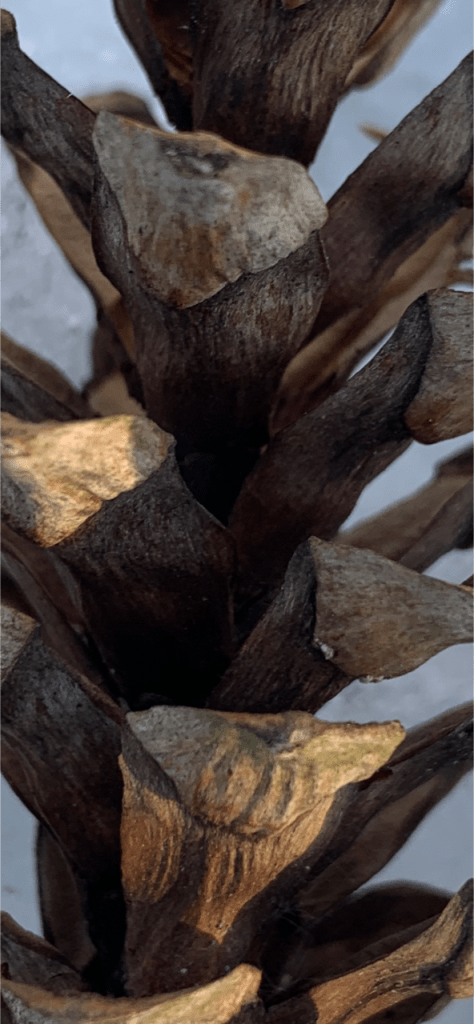
Kerri and I walk the trails to clear our minds and our walks have provided me with a perfect metaphor; artists are pine cones. The pine cone holds the seeds. It’s a protective, nurturing organism . It’s “…the female reproductive structure of the tree.” It’s the keeper of the essence and promise of the next generation.

From the deep archive. A painting from another century. From the estate of Marian Jacobs

read Kerri’s blogpost about PINE CONES

painting from another century (I can’t recall the title) © 1990, 2023 david robinson

Shape The Story [on KS Friday]

“It’s amazing how a little tomorrow can make up for a whole lot of yesterday.” ~ John Guare

Jen’s question sparked a many-days-conversation between Kerri and me. She asked about my favorite childhood birthday memory. I stared into space. My memory pool was empty. There was nothing but white noise between my ears. I sputtered something about awkward valentines in elementary school. Later, on the drive home, I confessed to Kerri how unnerved I was to have little or no distinct memory to recount. Both Jen and Brad had palpable stories to tell – and many of them.

Since that evening we’ve talked about the power of reminiscing. Neither of us has lived near our families. We’ve had relatively few opportunities to sit around a table and tell stories of childhood, recount foibles, ask questions, laugh at where we’ve been and what we’ve done with the people who shared the experiences with us. During our recent trip to Florida I was startled at Bill’s precise memories of his time in Vietnam. Each year he gathers with the surviving members of his squad and they tell stories of their service. His memories are clear because he regularly tells and hears the stories. It’s a ritual meant to keep vital the thread of connection to the past. Shared story is the glue that holds together a family, found-family or otherwise.

Last night we were wide awake at 3am. We turned on the light and returned to our conversation about the power of reminiscence. The power of enlivening stories with others who hold the same memory. Kerri can tell me stories about raising her children but I wasn’t there. We were not parents together so I am able ask questions but I am unable to spark a visceral memory with, “Do you remember when we…” A one way street is not as accessible as a memory street shared by two.

Inevitably, as the sun began to rise on our sleepless night, our conversation turned toward what we want to create. Together. What are the shapes of our dreams? We began to tell stories in the other direction. We imagined and, so, we created. The power of reminiscence balanced by the power of aspiration. We laughed and built metaphoric houses. We populated studios with creations. Kerri challenged me to paint in a new way, not images but to give color and shape to my feelings.

Feelings. Suddenly, I remember a birthday from a time I was very young, single digits. In the basement, made from refrigerator boxes, Columbus built a birthday surprise. A train or an airplane? I can’t remember. But I felt like it was yesterday, the thrill of running down the stairs to see what my father had made for me.

Kerri’s albums are available on iTunes and streaming on Pandora

read Kerri’s blogpost about THE TRACKS

meander/as it is © 2004 kerri sherwood

Commune [on Not So Flawed Wednesday]

“Art is communion of one soul to another, offered through the symbolic language of form and content.” ~ Alex Grey, The Mission of Art

I just looked up the word “mystic” in the dictionary. Just as a word can clarify, it can also obscure. “Mystic” is one of those words. Mystic implies intention. A seeker. A receiver. Someone unique; out of the ordinary. Yet, who isn’t searching for a truth that dances beyond the intellect? We will – all of us – be “absorbed into the absolute” someday and each of us, in our own way, must reconcile our individual lives with our inevitable disappearance into unity. Everyone is a mystic, whether they realize it our not.

I’m sitting in our bed, it’s February, and the birds are singing outside. The sun is pouring through the window and I’m thinking of looking up another word: bask. The birdsong pulls my heart into springtime yet I want to issue a caution. Be careful, birds! Today feels like spring but tomorrow will feel like winter. Suddenly it occurs to me that, in their song, the birds are issuing a caution to me: Sing! Today is all you have. Luxuriate in the sun and quilts.

A few nights ago, at dinner, Brad told us of an initiative he’s launching at his work. It is cathedral building. Rather than legislating behavior they are, with great intention, cultivating an environment of inclusion. Equity, not rooted in reinforcing distinction and separation, but fostering a culture of belonging. Unity. Reaching for the truth that lives beyond words or intellect or legislation or rules or pronouns or… An everyday intention: the “communion of one soul to another.” A corporate initiative borne from a mystic impulse? Float all boats? Equality beyond lip-service? A bottom line AND a service motive?

It can happen. It is happening. I find that incredibly hopeful. Mystical, in fact. Artistic.

read Kerri’s blogpost about THE MOONRISE

Scribble With Purpose [on DR Thursday]

Henri Matisse said, “Creativity takes courage.” I suppose that is true when considering the enormous pressures to conform to a style or standard. To create what is acceptable or expected. To suss-out what will be rewarded with approval and/or profit. In this context, it takes enormous courage to deviate. To explore. To surprise yourself by breaking form and risking ridicule and rejection and poverty. In this context, it takes courage to show up. It takes courage to punch through.

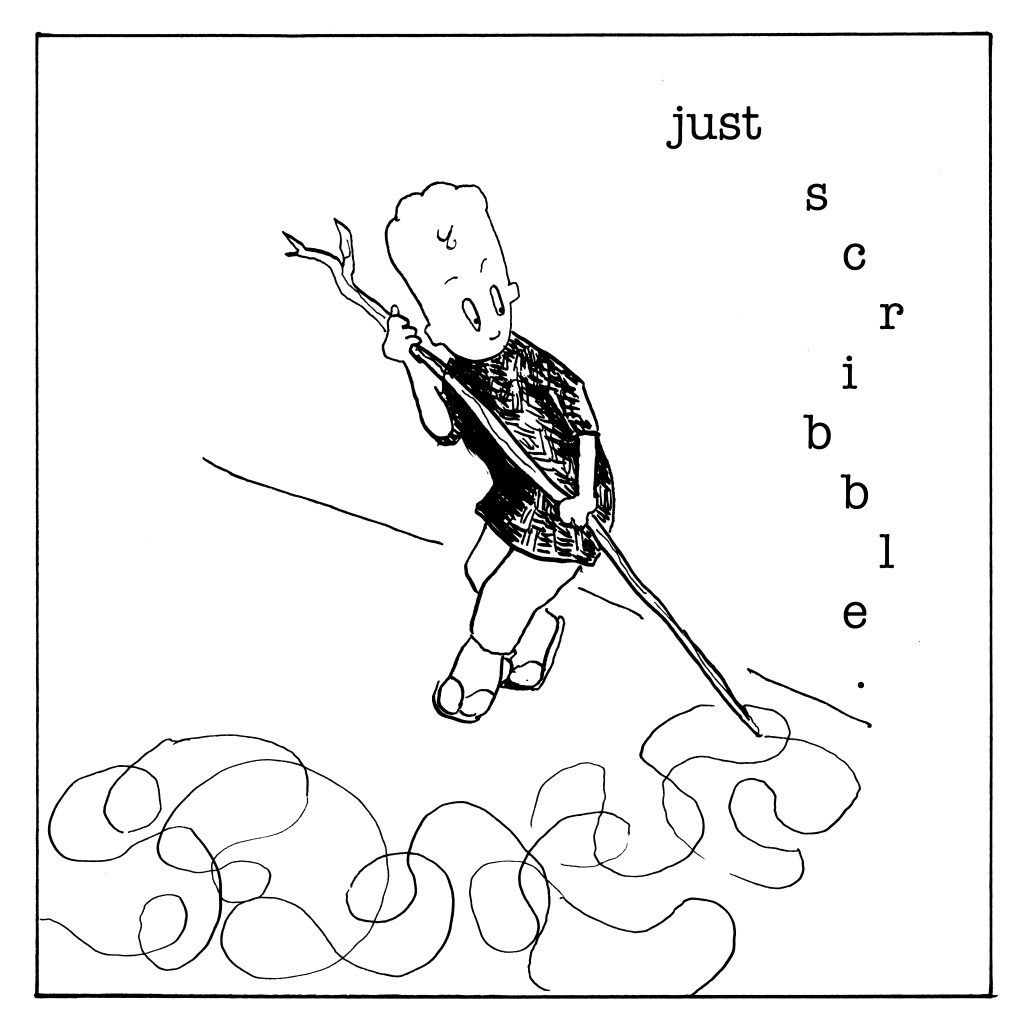
On the other hand, creativity is the most natural thing in the world. Ask any child. On second thought, please don’t ask any child since it will only confuse them. They have no idea that creativity – to an adult – is a separate thing. What’s scary and vulnerable to the tall people is commonplace to the little critters. There’s help for the older folks: allow the child-inside to scribble with abandon. Recognize that the story of, “I’m not creative,” is a creative act. The story of “It’s scary to create,” is also a creative act. It’s a story.

Creativity runs like wild horses through every day of our lives. Our perceptions and interpretations and fears are pure storytelling. The real challenge is not the absence of creativity but the conscious appreciation of our rampant creativity. The squeeze to conform serves as a heavy curtain obscuring our vibrant expressiveness.

The courage that Henri Matisse references is borne of the tension between the desire to be appreciated (to fit in, to succeed) and the yearning to break new trail or sail into undiscovered lands. To risk. To intentionally and publicly scribble outside the lines. To say aloud what needs saying.

Creativity is the most natural thing in the world. As it turns out, so is conformity. We are, after all, like wolves: animals that run in a pack. Humans die in isolation so serving the will of the group is a high priority. The wrestling match between creativity and conformity is necessary.

The progressive impulse. The conservative impulse. A bowstring drawn taut between these two poles provides the necessary tension to send the arrow of our ideas and dreams sailing toward the distant target. Children scribble with abandon. Grown up children, those telling themselves the story of “I’m a creator,” learn to scribble with purpose.

read Kerri’s blogpost about PUNCHING THROUGH

shared fatherhood, 25.5X40.5IN, mixed media on panel

shared fatherhood 2 © 2017 david robinson

chicken marsala/just scribble © 2016 kerri sherwood & david robinson