React [on Two Artist’s Tuesday]

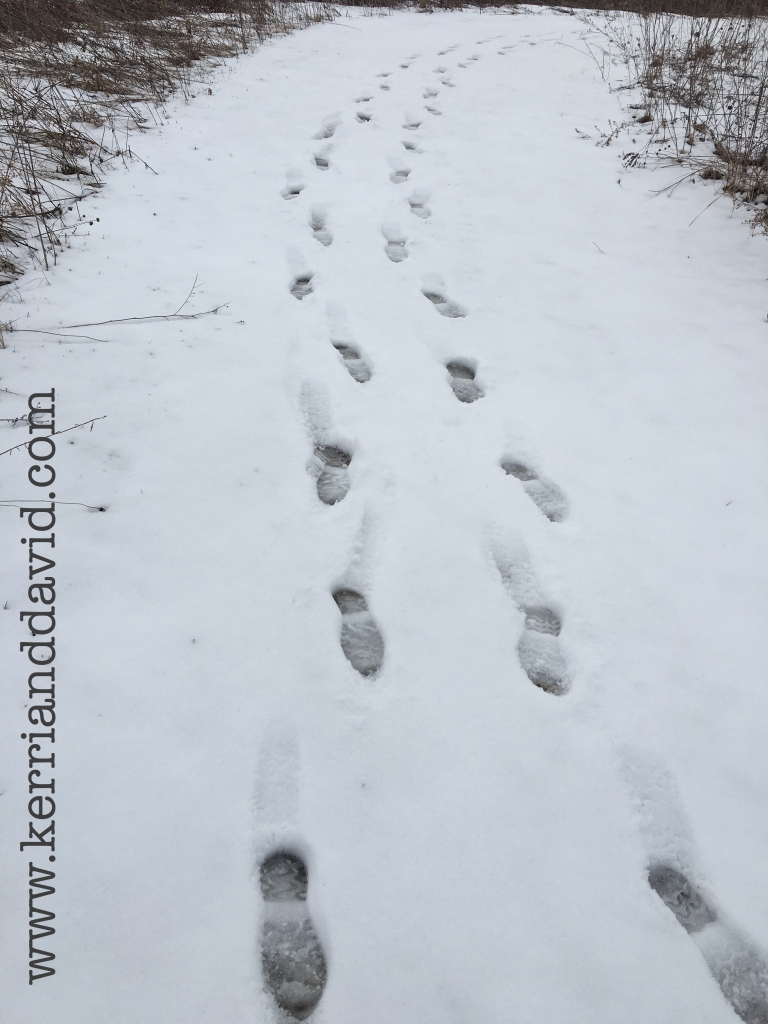
The answer is herbicide. That blue coloring sprayed on stumps and shards of stumps along our path is meant to prevent the invasive species from sending up new shoots. Eliminating the invasive species so the native plants might someday make a comeback is the point. It only looks like total plant decimation with performance-art-blue dotting the eradicated forest. It is, in actuality, rejuvenation.

We met a couple walking the path. They were bird watchers and thrilled about the rejuvenation project. They explained how the work would allow the river to return to its natural course. The invasive plants were choking the waterway. With the removal of the invasive plants, the wildlife, like the plants, might have a renaissance. They assured us we’d see the difference when spring returned.

When I lived in the pacific northwest, there was deep concern about the salmon. Damming the rivers interrupted the natural cycle of the salmon’s return to spawn and the entire ecosystem was suffering because of it. Salmon are considered a “keystone” species; without the keystone, the ecosystem falls apart.

As we walked our loop I wondered how the invasive plants were introduced and how long had it taken for the invaders to choke the native plants? What prompted the preserve to act now?

Most likely, the invasive plants were introduced unknowingly by people. We cultivate land. We “utilize” nature as a resource. We study. We explore. We develop. We trade. We migrate. We are a force of nature. We walk well tended paths constructed for our ease and enjoyment. Sometimes conscious and sometimes unconscious of our impact.

I had a great conversation with a forest ranger about the re-introduction of wolves into Yellowstone. The thought of “managing” nature has always struck me as paradoxical. We eradicated the wolves and then felt the impact. We re-introduced the wolves to try and correct the mistake before the ecosystem collapsed, and set off another chain reaction of unintended consequences that required further intervention. It’s like prescribing a drug to manage the side effects of a medication.

As we walked I wondered if the concept of natural balance is just too hard for us to grok. We generally don’t realize that interdependence applies to us, too. We believe we are nature’s managers rather than part of the chain. That prevents us from seeing ourselves as invasive, responsible, reactive.

We manage. And sometimes that looks like forest-performance-art-devastation with accents of green-shade-blue.

read Kerri’s blogpost about HERBICIDE

Ask The Bird [on Merely A Thought Monday]

“I think we consider too much the good luck of the early bird and not enough the bad luck of the early worm.” FDR

I laughed aloud when I read this quote. Luck certainly comes from a point of view. The good luck of the early bird is not great for the worm. I’ll add that tasty tidbit to my book of low-bar-wisdom: It’s never good news when you are on the breakfast menu.

Luck, good or bad, is never an incident isolated in time. That’s the point of the famous Chinese fable. Is it good luck or bad? Who knows. It’s all dominoes. I met Kerri because my career (and life) was collapsing. Was my career collapse good luck or bad? Ask Kerri if meeting me was good luck or bad and her answer will probably waver given the events of the day.

These past few months, after the software start-up went away and we tumbled into our latest reinvention, I’ve been pondering the Chinese fable more than usual. It felt like great luck when the opportunity appeared. If feels like bad luck in its disappearance. Both/And. I was certainly prepared when the opportunity came along. No amount of preparation-meeting-opportunity kept the company from vanishing. Bird or worm? We’ll see.

I love the notion that luck, the good side, is out there, looking for us. I imagine Luck standing on the horizon each day, shielding her eyes and whispering, “Where are they?” With us standing on our horizon looking for Luck and Luck standing on her horizon looking for us, it’s only a matter of time before we spot each other.

And, maybe we already have. That’s the tricky thing I’ve learned about Luck. She sometimes comes in disguises. That wily Luck is a trickster and has a wicked sense of humor.

This is all I know: if I was writing the children’s-book-for-adults-about-luck, the worm would have just crawled out of a tequila bottle and the newly intoxicated early bird would be left with an important question: was that worm good luck or bad?

read Kerri’s blogpost about LUCK

Visit An Old Friend [on saturday morning smack-dab.]

We often walk the same trail. You’d think we’d get bored but we like to see how it changes through different seasons and at different times of the day. It’s never the same. It’s like an old friend.

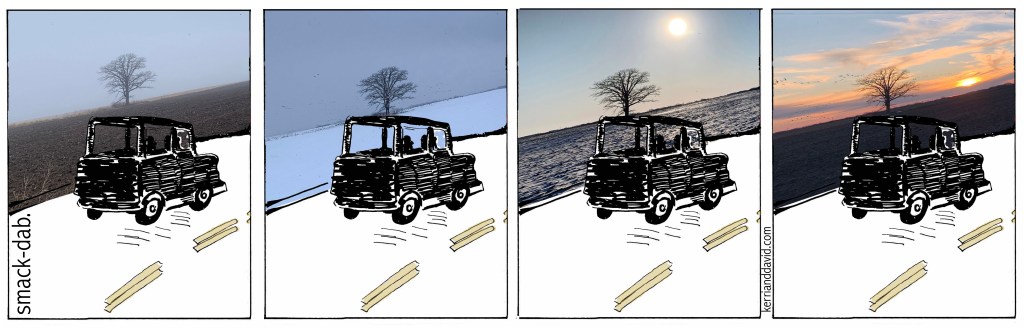
In the same way, on our way home, we stop and visit a tree in a farmer’s field. It stands in isolation, alluring on the horizon. It is both the same and never the same. A guardian in the fog. The geese land in the surrounding field and gather close to its protective arms. It is an ancient beacon in the cold icy snow. It’s silhouette at sunset has moved me to tears. We have a relationship with it. It’s like an old friend.

Our old friends remind us to open our eyes. To pay attention. To make no assumptions. They are never the same and, I suppose, the same is true of us, too. A different season. A different time of day. Through cold and sun, fog and rain, if we stop to see or slow down enough to notice, time reveals us as we are. Ever-changing. Beautiful.

read Kerri’s blogpost about THE TREE

smack-dab. © 2023 kerrianddavid.com

Check The Resale [on KS Friday]

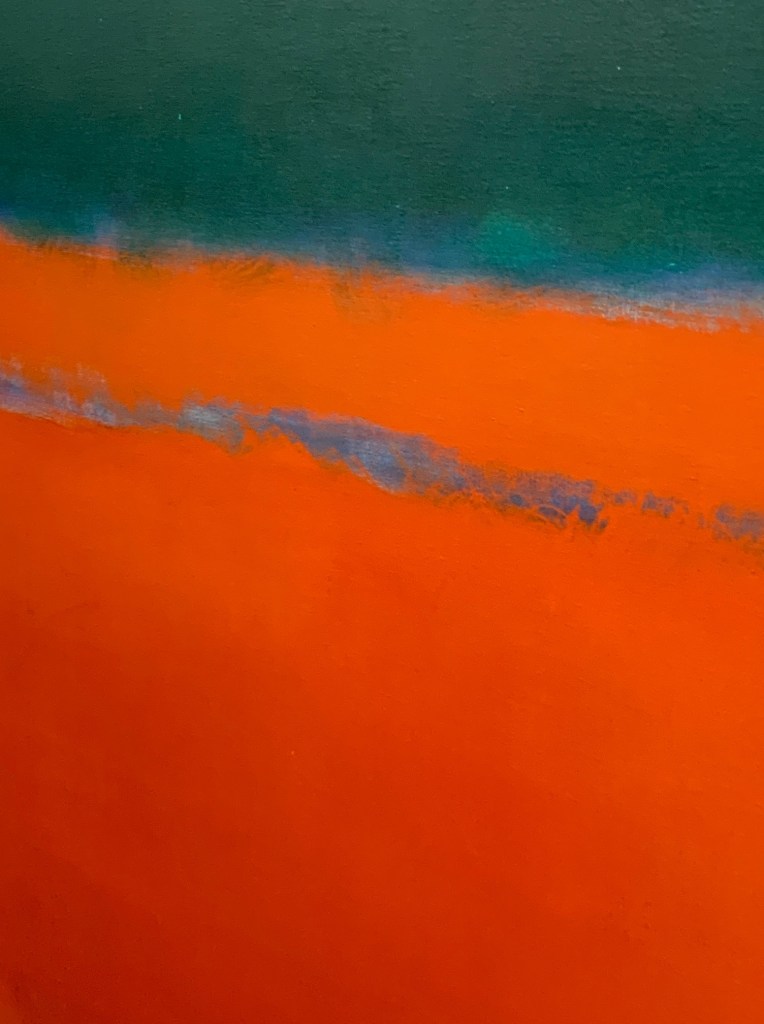
“Although Rothko lived modestly for much of his life, the resale value of his paintings grew tremendously in the decades following his suicide.”

The premise of this sentence made my jammies bunch-up. This wiki entry might have been written about Van Gogh. “Lived modestly” is a euphemism for “poor.” My favorite stereotype: the poor artist.

William Blake also lived modestly; he’d be shocked at the “resale value” of his work now. Nothing brings valuation to an artist’s work like the sudden end of the supply. Blake’s life came to a natural conclusion, so at least there’s that.

How do we know something has value? Resale, of course. Commodity. Soul reduced to a bottom line.

.003 percent of the nation’s budget goes to the National Endowment for the Arts. Valuation. If you desire to truly understand the phrase, “lived modestly,” visit your local not-for-profit arts organization. They’ll heap sincere gratitude upon you if you donate a ream of paper.

As an exercise in understanding soul, ask an actor or painter or dancer or composer the most obvious question: why do you do it?

Their answer will have nothing to do with resale value or commodity. Keep in mind, that doesn’t mean that they don’t want to be paid. Imagine Van Gogh’s answer. Or Mark Rothko’s. Emily Dickinson’s. Wouldn’t you love to know what they knew, see what they saw? Attempting to stand in their shoes, to see what they saw, is the reason that their resale value is so high. They connect us to something greater than commodity.

A caution: the next time you ask yourself, “What’s it all about?” be careful to direct your question to your inner Mary Oliver rather than your inner Elon Musk. They serve remarkably different gods.

My favorite quote of late: “And while a hundred civilizations have prospered (sometimes for centuries) without computers or windmills or even the wheel, none have survived a few generations without art.” David Bayles & Ted Orland, Art & Fear

.003%. That equates to an amount far less than Jeff Bezos’ tax bill. As a percentage, that’s much more than Kerri gets paid for a single spin of one of her pieces on your favorite streaming service (.000079 of a cent). Spotify, Pandora, and the rest are making out like bandits while the independent artists continue to “live modestly.”

What’s the real value of a nation that so desperately undervalues its art? I guess we’ll just have to wait for the postmortem resale.

Kerri’s albums are available on iTunes and streaming on Pandora

read Kerri’s blogpost about ROTHKO

every breath/as it is © 2004 kerri sherwood

Ask A Simple Question [on DR Thursday]

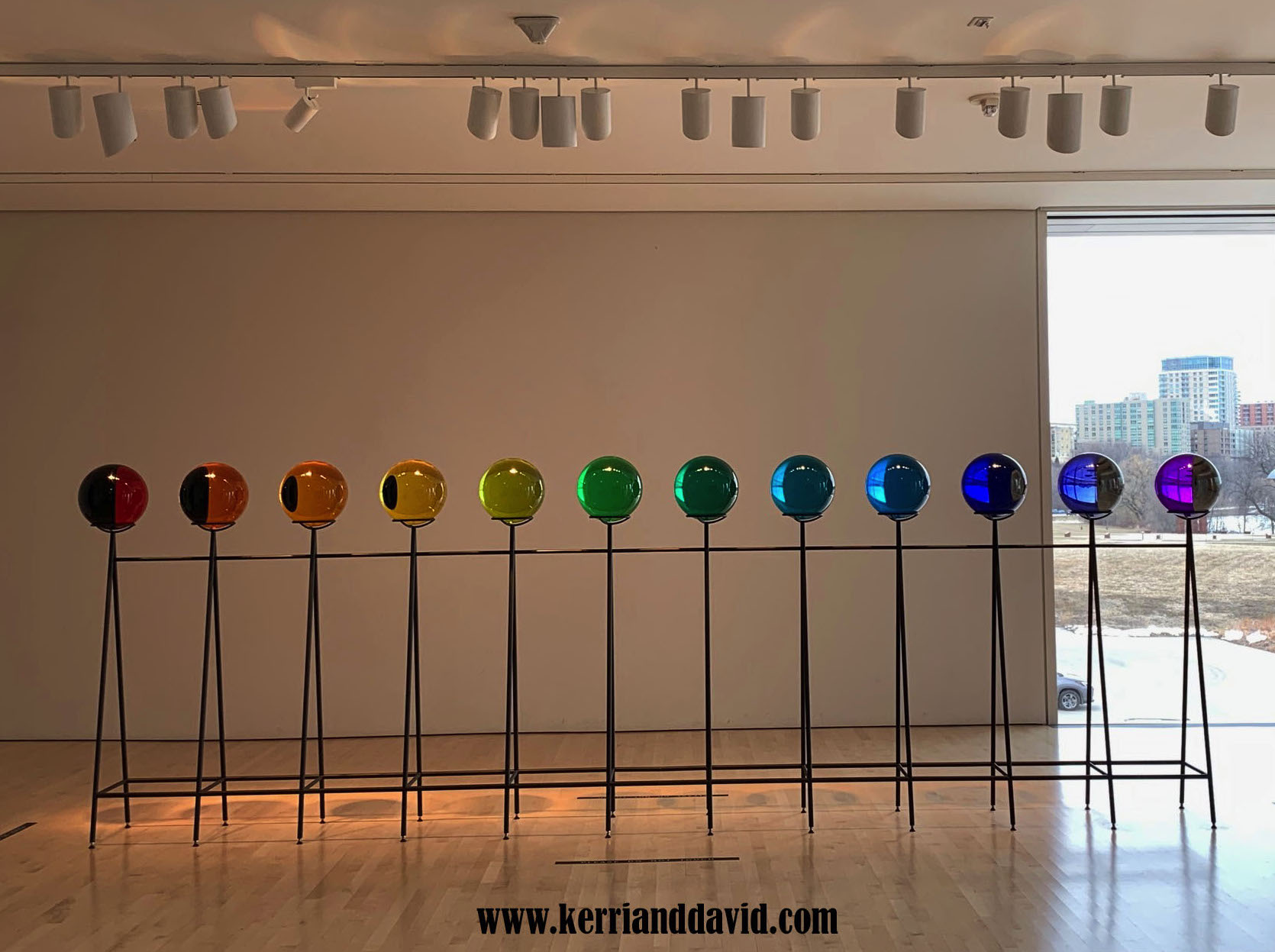
It’s existential. What you see changes depending upon where you stand. That’s true when engaging any piece of sculpture. It’s true when engaging anything in life. Point-of-view is fluid and relational. This sculptural reminder is Olafur Eliasson’s Rainbow Bridge.

In another era of my life facilitating diversity and inclusion workshops, the same surprisingly simple concept was usually a revelation to people. What you call “normal” is merely a point-of-view. Most importantly, it’s not everyone’s point-of-view. Your “normal” is unique to you, not universal. Most hopeful: it’s not fixed in stone. It’s changeable. Relational. Capable of growth. A mature point-of-view recognizes that it need not, it cannot, be the center of the universe. A mature point-of-view necessarily asks an all important question: “What do you see?”

It’s not only possible to look at the same sculpture and see a myriad of differences, it’s necessary. It’s human. Sharing what we see is how we, together, create community. A common center is created by a circle of differing points of view. A common experience is borne of sharing disparate points-of-view of the same event. A common center is made functional when everyone in the circle is capable of asking with sincerity a simple question: What do you see? It is made vibrant when everyone in the circle expects the answers to be different than their answer.

Art is one way of responding to the simple question.

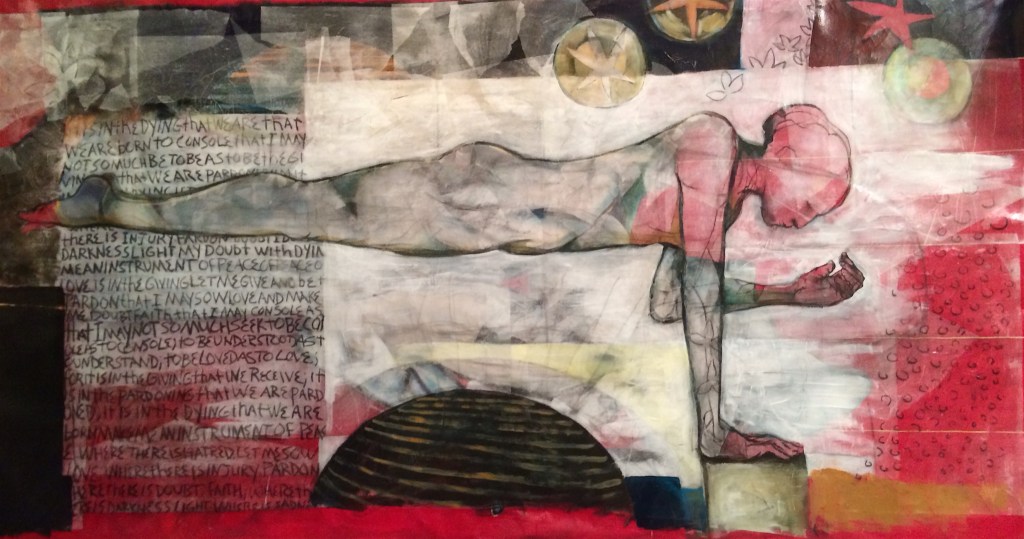
Instrument of Peace, 48x91IN, mixed media

read Kerri’s blogpost about RAINBOW BRIDGE

instrument of peace © 2017 david robinson

Welcome Home [on Not So Flawed Wednesday]

I realized on a night dive, 90 feet below the surface in the darkest dark I’d ever experienced, that my consciousness was like the flashlight I held. I saw only what was in the small space illuminated by my light. There was a vast world beyond what I could perceive in my limited view. I understood that the most potent choice I have – or will ever have – is where I decide to aim my light.

“Welcome home!” she said as we stepped into the gallery with three magnificent sculptures by Barbara Hepworth. The soft light, the floor-to-ceiling windows drawing us toward the lake. An open clean space. She was imagining this room was what our future home might feel like. I lapsed into studio fantasies.

I’ve always appreciated this room in the museum but for some reason, on this day, the sculptures were magnetic. While Kerri took photographs, I communed with Barbara Hepworth. The pieces are totems. Sacred symbols. Barbara Hepworth was a woman sculptor in a century that pretended the arts were the province of men. Her life spanned both world wars. She reached beyond the horror of her time to something more elemental. I found hope in her work. Guidance. Perseverance. She was shining her light on what humankind might become. Form and emptiness, perfectly balanced.

“Look,” Kerri said, showing me the photo. “It’s a porthole.” A perfect circle. A horizon. “I could stay here all day,” she closed her eyes and breathed in the space.

“Me, too.” Welcome home.

read Kerri’s blogpost about THE PORTHOLE

Reach Back To Move Forward [on Two Artists Tuesday]

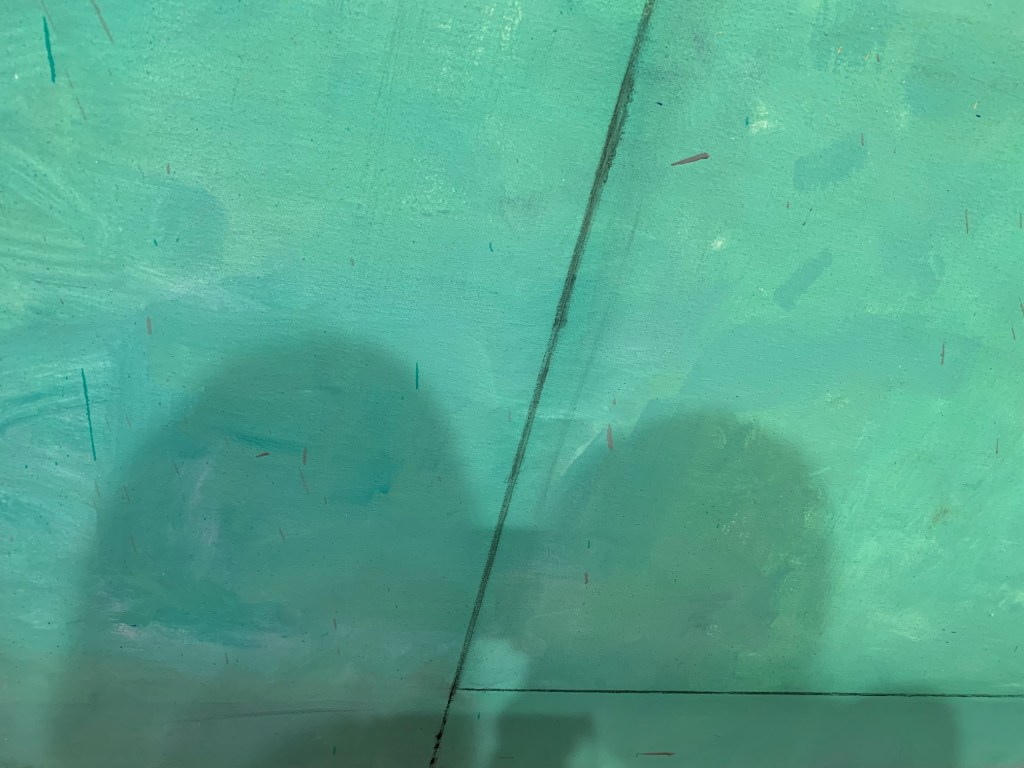
I wrote with great derision of the day I went to the Museum of Modern Art in NYC and watched people line up to take selfies with Van Gogh’s Starry Night. So, more than 15 years later, I howled with laughter at myself when Kerri beckoned me to stand with her so we might take a shadow shot with Diebenkorn’s painting, Ocean Park #68. “We’ll call it ‘Richard and Us!” she smiled.

Kerri recently challenged me to let go of my figurative work, release the image and paint my feelings. The moment before she beckoned me to take the shadow shot, I was having a minor revelation. There’s a reason I have stood in front of this painting for hours. There’s a reason it “talks with me” about simplicity and courage. Early in his life Richard Diebenkorn was a figurative painter. Even earlier, his work was abstract and resembled the paintings of the masters he admired. As his work matured it circled back to abstraction. He didn’t “let go” of his figurative work; he grew through it. He reached through it. In Ocean Park, he fulfilled his unique voice.

I read that his Ocean Park series was greatly influenced by the work of Henri Matisse. I imagined Richard Diebenkorn standing in front of his favorite Matisse, having a quiet conversation about simplicity and the courage to explore. In the gallery light, his shadow cast upon the painting as he moved forward to study the brushstrokes. He leaned in. He reached back to Henri to move forward. Had he lived in the age of cell phones and easy shots, I’m certain he’d have taken a shadow-selfie so he might remember the moment his shadow touched Henri’s.

We were alone in the gallery when Kerri took our shadow-selfie with Richard. We had him all to ourselves. We leaned in. I thought it especially poignant, our shadows cast upon a painting, an artist, who has cast his long shadow upon me. We caught the moment our shadow touched Richard’s. Reaching back to move forward,

read Kerri’s blogpost about RICHARD AND US

Trace The Line [on Merely A Thought Monday]

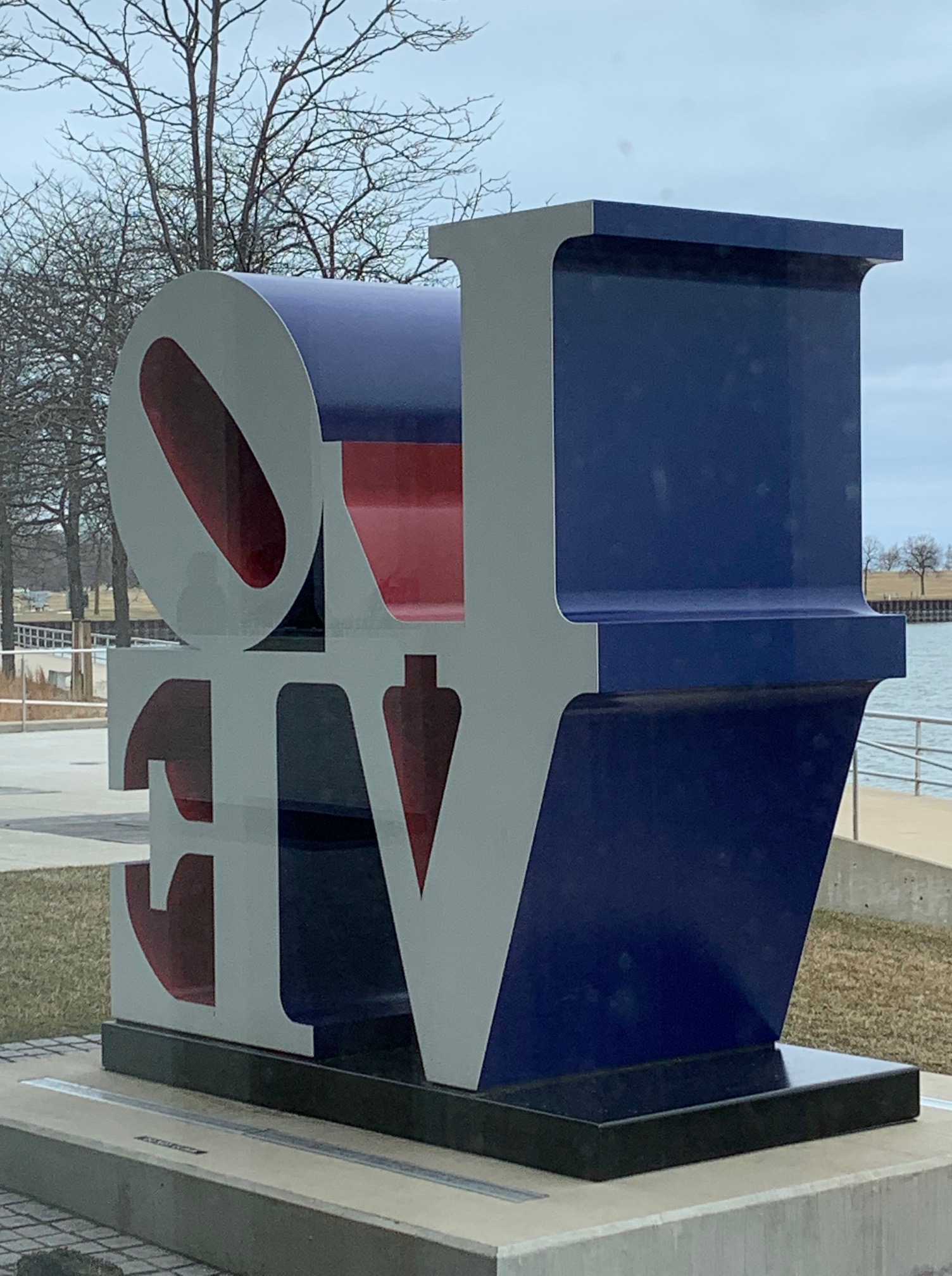
Love has a lineage. Without Piet Mondrian there would be no Ellsworth Kelly. Without Ellsworth Kelly there would be no Robert Indiana. For that matter, without Georges Seurat or Henri Matisse there would be no Piet Mondrian. Without the invention of the camera and the science of optics there would be no Georges Seurat. Of course, I’m referring to Robert Indiana’s sculpture, Love. We are rarely aware of how many lives influence our thoughts and give shape to our passing moments.

Love, the non-sculpted variety, follows the same principle in every life. It has a lineage. Chose any moment – any emotion – and follow the thread. An amazing web of interconnectivity emerges that stretches beyond…beyond. Sometimes I stop on a trail and wonder how I came to be walking through the woods in Wisconsin holding this woman’s hand. A tumble of choices. An immensity of influences and circumstances that quickly become impossible to comprehend. It’s no wonder destiny is such an attractive notion! Phew!

Four simple letters. Stacked symbols designed into another symbol. An aspiration? A graphic design? History placed Love in the box called Pop Art, thereby giving it a location-in-time. A starting point. A relative nod to lineage.

Standing in the museum, gazing out the window at Love, Dale Chihuly’s color explosion to my right, Kerri taking a photograph of the sculpture over the shoulder of a biker seated at a cafe table, the guard lost in his thoughts, a school tour echoing in the next gallery, a mural behind me that I’ve not yet taken in though it’s tapping me on the shoulder…meaning being made and shared and expressed all around me! How is it possible that we ever think we originate on our own? How is it possible that we ever think we walk this path alone?

read Kerri’s blogpost about LOVE

Breathe Again [on saturday morning smack-dab.]

Yesterday, as a birthday present, Kerri took me to the Milwaukee Museum of Art. I haven’t been to a gallery or art museum since COVID and she could tell I was running on empty. In the past, we’d spend hours sitting in front of Richard Diebenkorn’s paintings. The museum has two of his Ocean Park series and I never tire of my conversation with them.

Adjacent to Diebenkorn is the site of my greatest artistic victory: it’s where, years ago, I introduced Kerri to Ellsworth Kelly. At first she rejected him outright. Now, she joins me in my delight of his vibrant love of color. I smiled to the core of my being yesterday when she took my hand and with great anticipation led me to the gallery room where Ellsworth’s paintings live. Someday we will make a pilgrimage to Ellsworth Kelly’s Austin at the Blanchard Museum of Art. It is a sacred space of color and light.

I didn’t know how much I needed to hang out with the masters. I knew I needed to refill my artistic-cup but wasn’t aware of how much I longed to step out of the race-for-tomorrow and sit in quiet consultation with the artist-dedication-to-now. Richard, Ellsworth, Georgia, Pablo and the rest. Today, I feel as if I can breathe…

read Kerri’s blogpost about ELLSWORTH KELLY

smack-dab. © 2023 kerrianddavid.com

Reminisce [on KS Friday]

Staring at a waterfall throws me into reminiscence. The rushing water pulls me into the past. I never know where I’m going to land, who I will remember, or what moment I’ll revisit. Waterfalls are time machines. They are also great reminders that time-does-not-stand-still.

While Kerri took photos of the falls, I was transported back to the ranch. A long time ago. Sunset over the fields. Tom and I sipped wine while he told stories. He was a great teller of stories. He was a great saver-of-lost-boys and it had only just occurred to me that I was among the lost boys that he’d saved.

Applying for jobs is akin to staring at a waterfall. Reminiscence without the romance. I was preparing material for a position that involved mentorship and, to stir my cover-letter-thinking, Kerri asked me a question, “What was the single most important moment you’ve experienced with one of your mentors?”

I responded with the first memory that came to mind. And, in truth, it didn’t come to my mind; it hit my heart like thunderclap. Tom came for a visit. I was living in Seattle and he flew in to spend some time with me. It was so simple. A visit. This man that I so admired went out of his way to hang out with me. I mattered. It altered the path of my life.

Time flows by. The waterfall of my life is rich beyond measure. I am now the age Tom was the evening that we sipped wine on the deck at the ranch. I am forever grateful that he altered the course of my life-river – by simply showing up.

Tom and me a long time ago.

read Kerri’s blogpost about THE WATERFALL

[this piece reminds me of THE LOST BOY and Tom]

Kerri’s albums are available on iTunes and streaming on Pandora

riverstone/as it is © 2004 kerri sherwood