Incessant Musing [David’s blog on DR Thursday]

grasses. winter. snow. root. energy. fallow. aging. relevance.

I am ever so slowly working on a painting. In my mind it is a political statement which is why my movement is glacial. I sit in my rocking chair staring at the work-in-progress and wonder if what I want to say needs to be said. I wonder why I need to say it. I wonder if paintings that “say it” are worth painting at all. My teachers and mentors, all of them, taught me that great art happens when you “say it without saying it”.

Dogga stands in the middle of the snowy yard and barks. These are test-barks. Nothing is happening in the neighborhood and he wants something to bark about. In the absence of a meaningful bark objective, in the absence of other dogs barking in the neighborhood or the neighbor starting his car, he barks, “Is anyone out there?” Is my painting akin to Dogga barking?

Tom told me that when my beard was grey I would have a crisis of relevance. My age-peers would read my rough drafts and consider my work viable but the younger artist in my life would not. I have found that to be true. When Tom was in his middle 60’s he was arguably at the peak of his abilities yet the many, many artists whose careers he’d informed and shaped simply stopped responding to his calls. So he simply stopped trying. That was his last and perhaps greatest lesson to me: do not place your relevance in the hands of others. Follow the muse until your legs will no longer carry you. Bark and see what comes back at you.

Michelangelo sculpted his most prescient work in the last chapter of his 88 year life though he kept them under wraps since his patrons would have thought them to be irrelevant. It took the world 450 years to catch up to his Mannerist pieces.

And then there is this timeless bit of advice from a younger version of Tom: A writer writes. A painter paints. The rest is not really relevant. It’s always at this re-membrance that I stand up from my chair, put down my incessant musing, and grab my brush. A painter paints.

relevance. aging. fallow. energy. root. snow. winter. grasses.

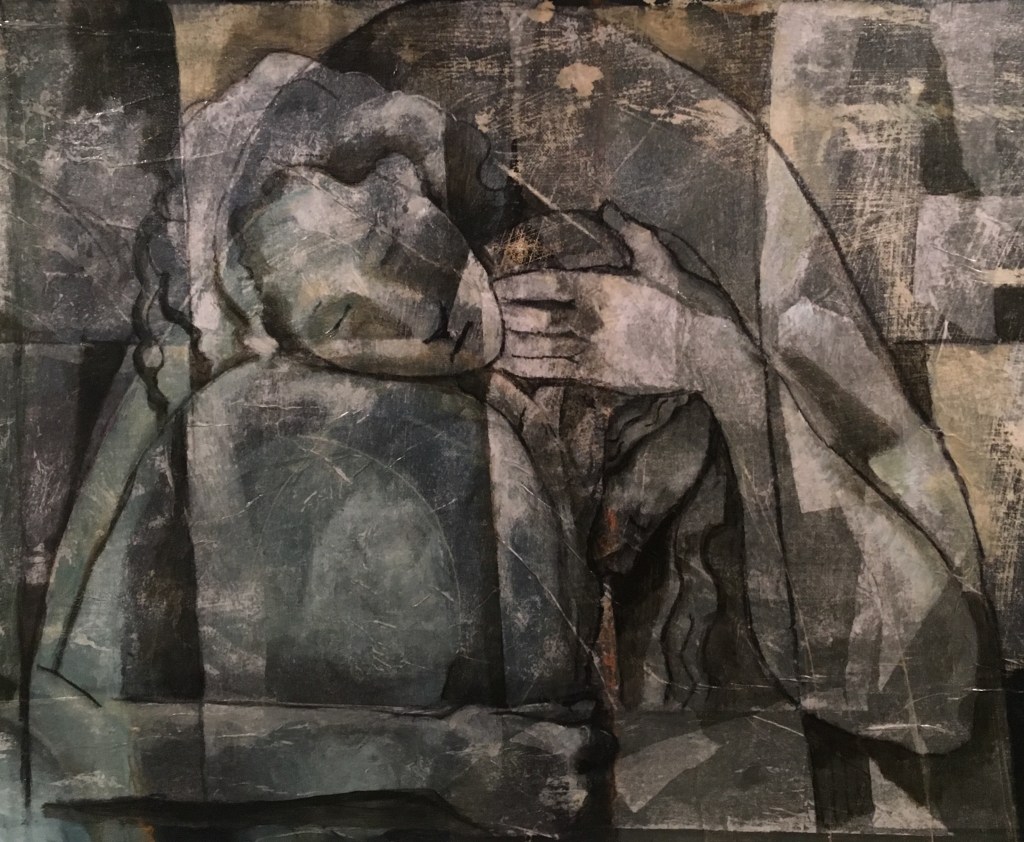
a work in progress: Polynices & Eteocles

read Kerri’s blogpost about WINTER GRASSES
likesharesupportthankyou

Never-In-My-Life [David’s blog on Merely A Thought Monday]

Never-in-my-life did I imagine that I’d sit on a deck and wile away a day peering through binoculars at a crow’s nest. We cooed and awed at the babies when they showed their beaks or flapped their young wings, the diligent parents flying to and fro to feed the bottomless bellies of their hatchlings.

Never-in-my-life did I imagine that discovering a turtle’s nest, the eggs newly hatched, could inspire the depths of wonderment that we felt. It was such an unusual find that, at first, we had no idea what we were seeing. We pondered what kind of bird nests in the ground and then it hit us. We were witness to an ancient birth rite, turtle eggs cracked open from the inside. With no mother to guide them, feed them or protect them, the newly hatched turtles somehow knew where to go, what to do. They scrambled to the safety of the river, at least that is what I imagined. We were giddy with excitement.

Last night we watched – again – the movie About Time. It remains my favorite movie of all time. Even after multiple viewings I laugh aloud and struggle not to sob along the way. Even knowing what is about to come, I am deliciously caught by surprise. It makes me yearn to go back and do things differently AND to not change a single precious moment. Both/And. Every single time we watch it. Never-in-my-life.

Enjoy life. Morsels. Alan Watts might say, the ever-present now. Last night, while setting up the coffee for the morning, I wondered how many bags of Cameron’s Velvet Moon Espresso Roast I have ground and thoroughly enjoyed. Maybe hundreds. Lately, I’m paying attention to how much I enjoy the evening ritual of closing our day by grinding coffee, the smell and the anticipation. Watching Dogga wind-down by following the chipmunk trail across the yard one last time. Never-in-my-life did I think I would love so extraordinarily so much…ordinary.

Kerri is sitting next to me – her writing interrupted, caught in the hate-stream and disbelief of a conservative’s rhetoric. It brought to mind a quote by Neil Postman, written in another era but prophetically describing our era: “…irrelevance seems to us to be filled with import, and incoherence seems eminently sane.” Entertainment posing as the news-of-the-day. Noise without substance. A manufactured thrill. Contextless content. Like a drug it is meant to keep us hooked. Nothing more, nothing less. Never-in-my-life did I imagine…

Never-in-my-life did I think I would so thoroughly delight in living upside-down, so appreciate my quirky capacity to question, my driving desire to detach from the noise. It is no wonder that I find the reality of the crows nesting so refreshing. The smell of the coffee so grounding. The miracle of turtles emerging from the earth to find the water so utterly hopeful.

read Kerri’s blogpost about ENJOY LIFE MORSELS

like. share. support. comment. subscribe. many thanks.

Rely On It [David’s blog on saturday morning smack-dab.]

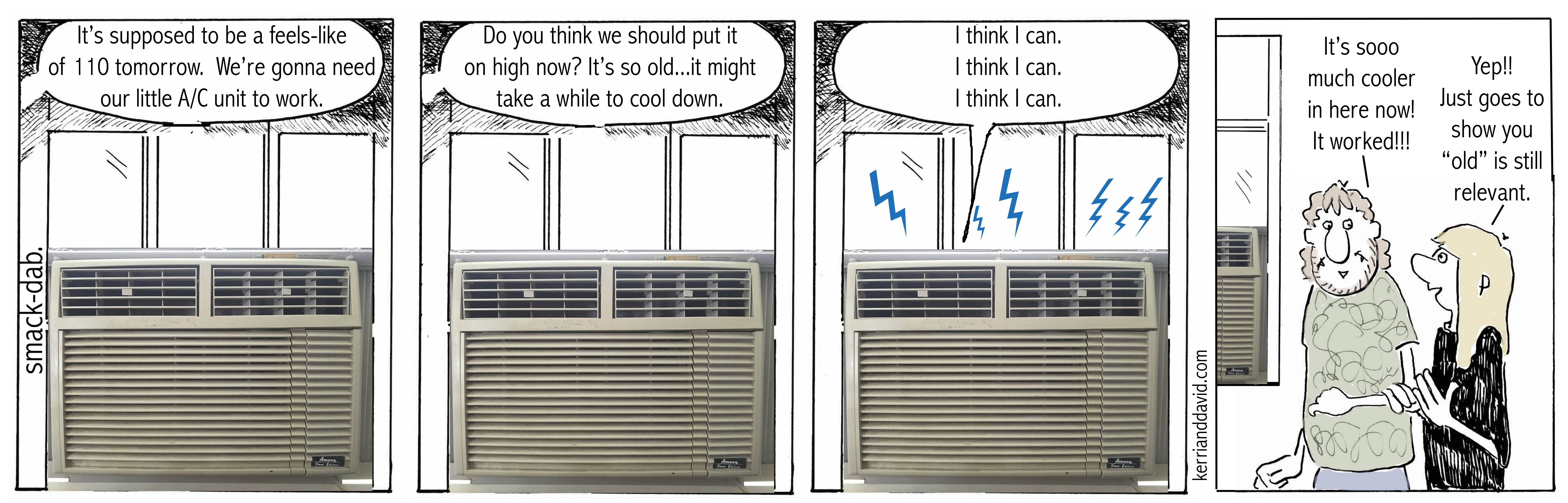
Our old window AC unit weighs a ton. On the day I haul it up from the basement and heft it into the window, Kerri retreats to the bedroom. “I can’t watch!” she says, fleeing. It’s part of our ritual. For some reason we always wait until the last moment to resurrect it. We wait until we’ve sufficiently suffered before we look at each other and say in unison, “I can’t stand it any more!” That, too, is part of our ritual.

We can’t afford to replace it with something made in the current century though, truth be told, I’m not sure we would if we could. It’s a workhorse! It comes from a time when planned obsolescence was not yet on the plan. It’s like our stove and will likely outlive us all. Built-to-last.

This week, while firmly under the heat-dome, with temperatures soaring to the ridiculous, our too-heavy-not-pretty-waaay-too-loud-ancient-old-AC was not only up to the task, it was a champ. We knew it would be. We’ll take steadfast over fast, dedicated over disposable, any day of the week. Loyal. Committed. Dependable.

Confidently relying on the extraordinary relevance of age and experience. How odd! It’s something we increasingly identify with. It’s rapidly becoming part of our reality.

read Kerri’s blogpost on RELEVANCE

share. like. comment. support. we appreciate it all.

smack-dab © 2023 kerrianddavid.com

Discern [on Not So Flawed Wednesday]

It’s a little over two miles to Steve’s garage. When we drop the car for a repair, especially in the early morning, we like to walk home. The route takes us by the lake. We take our time, more stroll than stride, and breathe in the early morning quiet.

We are dedicated walkers. We’ve become dedicated seekers and creators of quiet. It’s as if we are counterbalancing the crazy-noise-of-the-news with a stalwart sanctuary that we take with us wherever we go. We walk slow enough to notice. We walk slow enough to appreciate.

There is, of course, a direct correlation between pace-of-movement and paying attention. It’s hard to smell the roses when racing through the day. Lately, much of my work-in-the-world involves addressing information overload. The pace-of-movement need not be physical, it also applies to the river of information rushing across our screens. It’s no wonder we’re angry and anxious and aggressive. I’ve adopted a phrase from my colleague, Greg; he calls the info-torrent More/Faster. We live in the age of info-gluttony and have difficulty discerning between what has nutritional value and what is dross.

Until we slow down. There is a correlation between the pace of movement and peace-of-mind. There is a correlation between pace and the capacity to determine relevance.

It’s why we walk to or from Steve’s Garage. It’s why we end the work day holding hands and walking the neighborhood. It’s why we begin each day sitting side-by-side writing. To slow it down. To discern relevance in a fast moving info-river of dedicated draff. To see what matters in a More/Faster world racing too fast to see anything at all.

We smell flowers. Feel the dew on leaves. Turn our faces to the sun as it reaches through the morning clouds. Real stuff. Stuff of the moment. The small discoveries available when racing to the next thing is the last thing you want to do.

read Kerri’s blogpost about MORNING SKY

Interpret The Impression [on DR Thursday]

“Art, to me, is the interpretation of the impression which nature makes upon the eye and brain.” ~ Childe Hassam

The eye of the mind. Interpretation of the impression. Imagination. Nature.

This morning Kerri told me that she’s having a stand-off with her piano.

This morning I picked up a box to clear my studio space. I asked myself, “What are you doing?” I set down the box where I found it.

Lately, I’ve been working with an overabundance of business models. Not surprisingly, each addresses the same contemporary challenge: people are having trouble discerning between what is actionable and what is not, what has relevance and what does not. A variation on the theme: focus is hard to come by. Models, I remind myself, are interpretations.

I’ve read that the first evidence of humans making art is found in the funeral rites of our distant ancestors. Decoration? Talisman? Fuel for the trip? An interpretation of life, making peace with the unknowable. Nature makes an impression. Humans respond.

The interpretation-of-the-impression-that-nature-makes points to something essential about art and life: it needs to be shared. It is nothing if not witnessed. We stand in the art gallery and drink it in. We stand at the graveside supplying our fellow traveler for the long journey ahead. We place the crayon drawing on the refrigerator.

Nature makes an impression.We are nature’s impression. Interpreting what that means.

read Kerri’s blog post about IMPRESSIONS

motherdaughter © 2019 david robinson

Re-Connect [on Merely A Thought Monday]

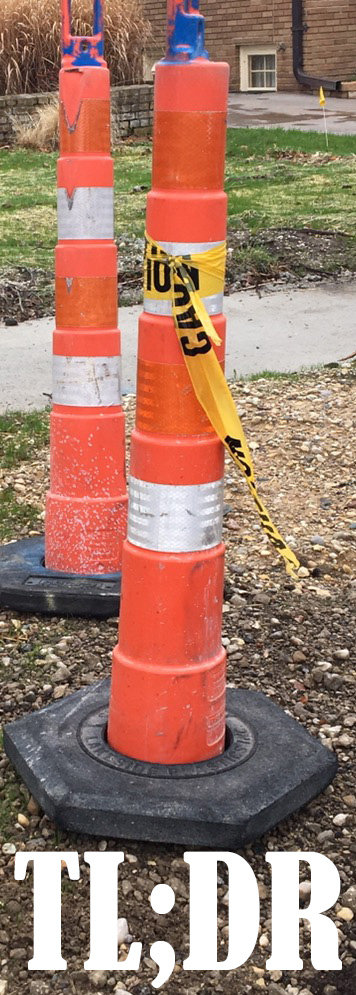
The latest addition to my “Terms in this Unknown Land” document is TL;DR. Too-Long-Didn’t-Read. I laughed aloud when I heard this new acronym in a meeting. If there is a sign of our times, an identifying marker of our era, it is this: TL;DR.

We communicate through text and emoji. Chat. Twitter is a thing because it mandates brevity. Scrolling the news app is a study in cramming the full story into a brief headline. Marketers have mastered the 5 second ad. Businesses are liberal in their use of “narrative” and “story” but have no time to actually hear one. A short synopsis will have to do. Get to the point.

As a member of my culture I find that I scan more than I read. If I can find it on Youtube, I’d rather watch it than read about it. When I began writing blogposts ten years ago, the “rule” was 800 words or less. The rule has adjusted with our attention spans and now the target is between 400 and 600 words. Often, when I receive links to articles, they come complete with an estimate of how many minutes are required to read them. Yesterday, I read advice from a marketing guru that suggested we restrict paragraphs to two sentences or less; more than two sentences is a red flag: too much information. Less than two sentences is…a sentence.

So much information is coming at us all the time, we have no time or thought-space to take it all in. I wonder if we can discern relevance from dreck. A quick look at our leaders leaves me with a resounding “No!” Relevance is lost in the dreck and, since they represent us, they are us, our information inundation has rendered our attention spans tiny and blunted our acuity. We are awash in information while wisdom has gone missing.

Each week I attend meetings; the central concern is explicitly or implicitly about helping people connect. It reminds me of the conversations I heard in graduate school: while living in a city of a million people, the concern was about how to create community. So many people. So little community.

I ponder these things every day. With our ubiquitous technology, we couldn’t be more connected. Through social media, I know what people had for dinner or what cute thing the kids said. I receive advertising that confirms my devices are listening to me. Yesterday, for-the-hell-of-it, I said, “Machu Picchu.” Today I am awash in travel ads for Peru.

We are connected. Connection to everything is connection to nothing. Relevance is hard to discern in a tsunami of information masking as connectivity.

Relationships – real relationships – take time. Values cannot be communicated in a text. They must be demonstrated and deeply rooted in lived narrative. Stories that carry relevance cannot be well-told in synopsis. Opinions are so easy to tweet. Dreck is easy to fling. It is not the capacity to share that we lose in the crush. It is not connection. It’s the capacity to be present. With presence comes the capacity to listen. Presence is not in a hurry to be some other place.

Rich connectivity requires more than quick consumption of information. Sharing, real sharing, the kind beyond pressing a “send” button, is a two-way street between people who have the time to invest in each other. Once, it was called relationship.

TM;CL. Too much. Can’t listen.

read Kerri’s blogpost about TL;DR

Discern [on Flawed Wednesday]

“For in the end, he [Aldous Huxley] was trying to tell us what afflicted the people in ‘Brave New World’ was not that they were laughing instead of thinking, but that they did not know what they were laughing about and why they had stopped thinking.” Neil Postman, Amusing Ourselves To Death: Public Discourse In The Age Of Show Business

Neil Postman wrote Amusing Ourselves To Death in 1985. Cassandra, sounding the alarm to a community too distracted to listen. Were he alive today, he’d think – but would not say – “I told you so.” All the quotes in this post are his.

I read in my daily-news-horror-trawl a quote from a Wyoming man who believes he’s protected from the pandemic because of the color of his hair. It might sound wacky until you consider that his staunch belief in the virus’ preference for hair color is just one of the many misinformation narratives currently being fed to the angry and easily led. He is, without question or thought, breathing the gas of a political party that wants to keep him distracted, fearful and high.

If you are not choking on the fumes of excessive gaslighting, then you are among those whose eyes are burning from the corrosive air it produces. Are you as tired as I am of reading accounts of deathbed appeals for the vaccine? It is too late, in your final moments of life, to realize you’ve been duped. It’s a tragedy. Are you as disgusted as I am, having been witness to the undeniable violence of the insurrection, of listening to the blatant denials? Despite what your eyes saw, it was just another day of tourists wandering through the Capitol. Gaslight tears.

During the first year of the pandemic an acquaintance latched onto a comorbidity table lifted from the CDC website and circulated as “proof” that COVID was less dangerous than the common cold. It was, of course, taken out of context. A quick visit to the CDC website (seriously, less than 30 seconds), viewed in context and with an understanding of the meaning of the word “comorbidity,” easily debunked the claim. Our acquaintance, enraged, doubled down on his claim of “proof” – though he could not be bothered to spend 30 seconds to check the poison gas that he was gulping.

“When a population becomes distracted by trivia, when cultural life is redefined as a perpetual round of entertainments, when serious public conversation becomes a form of baby-talk, when, in short, a people become an audience, and their public business a vaudeville act, then a nation finds itself at risk; culture-death is a clear possibility.”

The legal defense has been successfully used to defend both Tucker Carlson and Rachel Maddow: the courts ruled that reasonable viewers should know the difference between news and opinion. This is news. This is not.

Do we have the ability to differentiate between public business and a vaudeville act? The evidence is not hopeful.

The court’s ruling, then, is likely based on a faulty premise: that people are able to differentiate. That the audience is reason-able or values reason. Able-To-Reason. Reason is the power to think, understand and form judgments through a process of logic. In order to be reasonable one must value reason. One must want it.

Logic and reason, both assume the inclination and capacity to question. Curiosity, real curiosity, does not seek agreement or group think. It seeks to step into the gap between what is espoused and what is lived. It seeks solid ground to build upon so must recognize sand when it sees it.

And, what if “reason” long ago fled the coop? Or, what if “reason,” has never been a dominant trait in the coop in the first place? What if discernment dies in the presence of so much gas?

“Huxley feared the truth would be drowned in a sea of irrelevance.”

read Kerri’s blog post about IT DOESN’T KNOW

Do Anything Else

sharpersquareinstrofpeacewordsonlyjpeg

It occurs to me now that all along I’ve been asking irrelevant questions. Or, perhaps framing my questions too narrowly. For instance, years ago I went to graduate school to study systems because I wanted to follow a question that reached deep into my life and identity as an artist: can a mythology be rekindled once it has died? Art, after all, is one of the primary life-keepers of a culture’s story and the beating heart of the story is its mythology. And, according to all indicators, our mythology is mostly dead [as Joseph Campbell said, for evidence of our mythological demise, all you need to do is look at the news]. So, the younger version of myself wanted to understand the purpose of my life as an artist if, indeed, I was in service to a dead mythology. Heady questions, yes? Relevant questions?

In the early 1990’s I was invited to a photographer’s studio to see the “newest thing” in photography. The photographer had a new “program” called Photoshop. Before my eyes he “photoshopped” me into a picture, a place I’d never before visited. Today, all of this seems commonplace. Now, any 5 year old can manipulate an image but at the time a photograph stood for proof that something had actually happened. A photograph could not lie. It was evidence of truth. That day, standing in the photographer’s studio, I realized that the old reliable anchors for truth no longer existed. What was our anchor?

The truly significant events in our lives rarely come in with a roar.

We’ve been hearing a lot lately about fake news – as if this was a new phenomenon. It brings to my mind a terrific book written in 1985 by Neil Postman, Amusing Ourselves To Death. Here’s bit from the first page:

“Our politics, religion, news, athletics, education, and commerce have been transformed into congenial adjuncts of show business, largely without protest or even much popular notice. The result is that we are a people on the verge of amusing ourselves to death.”

I suppose fake news refers to something wholly concocted but I’d argue that when news agencies pander and promote themselves to conservative or liberal viewpoints, when ratings drive content, it’s all fake news. News with an agenda is…not news. It is, however, dangerous to a democracy and no longer free (as in free press, a cornerstone of our democracy). Historically, newspapers have always had a point of view but there was some attention paid to what was printed as news. Opinion was confined to an editorial page. When the line between true and concocted is blurred, when a populace cannot discern between entertainment and substance, it no longer has the capacity to make sound (read, “informed”) judgments. Worse, it is gullible, gossip-eaten and infinitely manipulate-able. It is, as Neil Postman wrote, entertaining itself to death.

I recently wrote about the absence of recognizable communal anchors (mythology) and the dangers of a community with nothing but the soft soil of belief and opinion as its driver. Is planting a personal-truth flag and defending its territory all that is left to us?

What else can we do? Now, there’s a relevant, open-ended question! Roger once told me that he would never be able to understand suicide. He said something like, “In that moment, rather than take your own life, why not do anything else? Why not make any other choice?” Another relevant question!

What else can we do? In the face of our own entertainment-driven suicide, why not do anything else? Turn off the blather, go outside, meet your neighbor, tell stories of your children or your ancestors. If common ground can’t be found it can certainly be created. Inhabit something bigger than opinion. It’s less entertaining but certainly more useful. Great art – no matter the form- lives in those bigger fields.


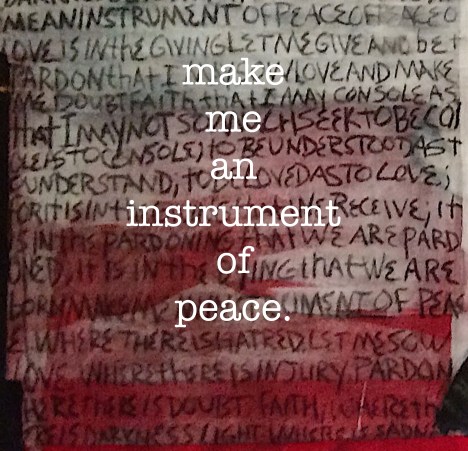
MAKE ME AN INSTRUMENT OF PEACE – GIFTS

to kickstart your peace, listen to this:

for PEACE on iTunes, go here (track 5 on the album AS IT IS)

Save

Save

Save

Save

Save

Save

Save

Make Art So.

at one time even this was considered a new technology

at one time even this was considered new technology. numbers, too!

Chet said, “But where’s the human in all of it?” His question took me by surprise. It is a question that often puzzles me. I was telling him about my recent inner earthquake, the moment that the train of technology jumped the tracks and collided with my art engine. Both exploded.

For weeks I’d been looking forward to a full day of exploration at the Chicago Art Expo. Hundreds of contemporary galleries from around the world assembled in one place, each showing their premiere work. As an artist these events have always fed my soul. This time, with the exception of a few older masters (a Chagall, a Picasso), a Hockney that made me smile, and few pieces from The San Francisco Figurative painters, I was unmoved. Worse, I was uninterested. As I wandered through the exhibits I listened to curators over and over again working hard to give context to the art. The viewers had no immediate access to it. They (like me) needed an explanation to access its relevance. I felt as if I was watching art-priests interpreting god for parishioners who had no expectation of direct access to the divine. The art needed a middleman. It required an explanation.

Just before going to the Expo, Skip shared a link with me. It was a video of animator Glen Keane drawing in virtual space. He was literally drawing from within the image. It took my breath away. Glen Keane called the technology a new tool but, like many new tools – so many new technologies, this one has the capacity to change our relationship with life and, therefore, with art because it could change our relationship with time and space. At one point in time, electric light was a new technology. The automobile, the airplane, the telephone, the camera and the phonograph were once new technologies. Each changed our relationship with sound, light, distance, the planet…each other. They changed how we see and experience possibilities. And, at the time of their invention, the community, at first, did not understand the power being introduced into their lives. They, like we, were stepping into the future with their eyes in the rearview mirror. What we know as art changed with the introduction of each of these technologies.

I couldn’t help but see the work at the Expo through the lens of this most contemporary tool. My eyes, for a moment, were wrenched from the rearview mirror and forced to look straight ahead through the windshield. Relative to the tool, the work at the Expo seemed abstract to the point of inaccessibility. It felt academic and I felt distant from it (lots of head, little heart). The tool although incomprehensible, was exhilarating, approachable, and inspiring. It made me want to play. It made me want to create. With this tool, Jackson Pollock would have danced and splashed in 3-D space. Picasso would have explored Cubism from within the cube. And, with this tool, I could see them doing it; I could sit in the same space and get paint on my face. In the video, Glen Keane says, “When an artist makes a line, it is a seismograph to their soul.” This tool, this technology, is a 4 dimensional seismograph.

Eve Ensler wrote, “Art has the power to explode the heart and open up other energetic capacities to re-perceive it. It defies boundaries and leaps tall buildings. It transports, it translates, it transcends. Transcendence is so important right now because our lives are so mechanized, controlled, and commodified; art has the capacity to open our souls and could be our revolutionary, evolutionary salvation.”

Yes. And, yes again. I can draw in the dirt with a stick. I can draw in virtual space. The verb remains the same. The access to others – the reach of the art – changes.

To Chet I wanted to say that humans create technology. And, in turn, technology informs humans and, therefore, art. Our very short attention spans are the result of our relationship with technology –  800 word blog posts are now too long, and 140 character tweets are desirable. Much of the Expo was digital photography or digitally altered images. It was mental and cold and abstract – certainly expressions of our time – expediency allows for little depth of experience. The technology did not make it cold; the way it is wielded by human beings makes it so.

Capture The Essence

Dog-Dog and treasure

Dog-Dog and treasure

Tripper Dog-Dog-Dog gathers his stuff around him. He has two stinky blankets that he pulls from his crate each morning, a red Kong, a blue chew bone with a handy looped rope pull, another blue toy that once looked like a jack but has been chewed beyond recognition, a once-stuffed moose from Josh that is now an unrecognizable shredded mess though he carries it around as if it was precious cargo. There is also a muddy tennis ball, a raw hide bone and usually a sock pilfered from my sock basket. If Kerri and I shift locations within the house, move from the living room to the sun room, Dog-Dog’s worldly possessions will slowly migrate with us. He is subtle and I rarely see the migration in progress; I suddenly realize that I am sitting within a nest of Dog-Dog treasure.

My favorite section in The Lost Boy is a series of questions that Tom asked: 1) if you were given a cardboard box and it was all that was going to be allowed to provide proof that you walked on this earth, what would you put in your box? 2) Beyond proof, what would you put in the box that captured the essence of who you were, that distinguished you from all the others? 3)What are the collections, the things you gather around you that are somehow supposed to tell others who you are? These questions might seem simple but are surprisingly complex. How does your stuff tell the story of who you are? Or, a better question: does your stuff define you? Can your stuff – your car, your house, your granite counter tops, your clothes, your jewelry,…, – capture your essence?

Tom asked two other related and relevant questions: In packing your box, would you be tempted to scrub your life of its messiness? Would you try to eliminate the mundane, the everyday? Would you throw away your rough drafts? Would you ignore the relationships that didn’t work out? Would you explain away the ugliness, the ruthless choices? Would you burn your personal journals so that the future might never glimpse your doubt, your struggles, your frailty?

I would add these questions: What if your essence was only available to you once you value the messiness? What if, in throwing away the mundane, you actually eliminate what is truly special about you? I’ve often taught and touted a tenet from improvisational theatre: drop your clever and pick up your ordinary – most of us diminish/neglect our greatest gifts because we label them as ordinary. They come naturally to us so we don’t always recognize them. In trying so hard to be clever, to be right, to be flawless,…to be other, we regularly overlook the real treasure and relegate ourselves to that most shameful pile labeled ‘ordinary.’

Scrubbing life to a sterile, conflict-less blandness is a recipe for….boredom and, at the end of the day, a very uninteresting box. Of this I am certain: if Dog-Dog had to pack his box today, I would be proud to sit amidst the stinky blankets, blue bones and remnants of moose toy. Dog-Dog hides none of his messiness.