Just Look Around [David’s blog on Flawed Wednesday]

If you seek levity, if you are in want of a giggle, may I suggest that you follow Kerri and me through the grocery store and politely eavesdrop on our commentary.

I’m aware that for most people grocery shopping is a chore, a routine obligation. For us it evokes our inner stand-up-comic. Grocery stores tickle our whimsy and unleash tsunamis of sarcasm or impromptu songs. There’s so much material to work with!

“Baby Bok Choy is fun to say,” I mention as Kerri scrutinizes the baby bok choy options. Never one to let an alliteration pass her by, she launches into a lyric, a pseudo-rap personifying the virtues and exploits of the leafy green cabbage. The aisle clears as other shoppers find spontaneous public art dangerous.

Later, using her big, outdoor voice, she reads aloud the list of ingredients on a jar, proclaiming, “Trans-fats! Uh-OH! Get ready! Those MAGA Republicans are going to pop-a-gasket over this one!” Reading on she asks the entire world, “Does anybody really know what butylated hydroxyanisole is, anyway! Who would eat this stuff?”

“What does it meant to be butylated?” I ask, using my quiet indoor voice to model appropriate volume control.

“Don’t be a hydroxy-ANISOL,” she says and smiles. And then: “Someone butylated the baby bok choy…” she declares in mock alarm, unaware that the aisle has once again emptied of shoppers.

I push the cart so I regularly discover that I am holding conversations with myself. When she doesn’t respond to my commentary I realize that some odd grocery item two aisles back caught her fancy. I navigate a u-turn and find her standing incredulous before a multi-layered pastel cake. “Did you seeeee this?!” she exclaims.

“No.” I say.

“Oh. My. God!”

“What is it?”

“Have you ever seen anything so hideous?” she looks at me, wide-eyed.

“What is it?”

“The thought of eating this makes my teeth hurt! Doesn’t it make your teeth hurt?”

“What is it?”

“Who would ever think this was a good idea?”

“What is it?”

“And they made it Easter colors so people would buy it? Do you think people actually buy this?”

“What is it?”

“No wonder this nation is in trouble. People will eat anything!”

“Oh, it’s fox news!” I blurt, “In a cake!” A revelation.

She looks at me as if I haven’t been listening, “It’s a cotton-candy-cake!” she says, a new alliteration rising.

“Yeah. That’s what I just said. Fox news.”

“Who eats this stuff,” she asks, wrinkling her face.

“Just look around.” I say. “Sad.”

It makes my teeth hurt.

read Kerri’s blogpost about COTTON CANDY CAKE

likesharesupportsubscribecomment…thankyou.

Yes. It’s Like That [David’s blog on Two Artists Tuesday]

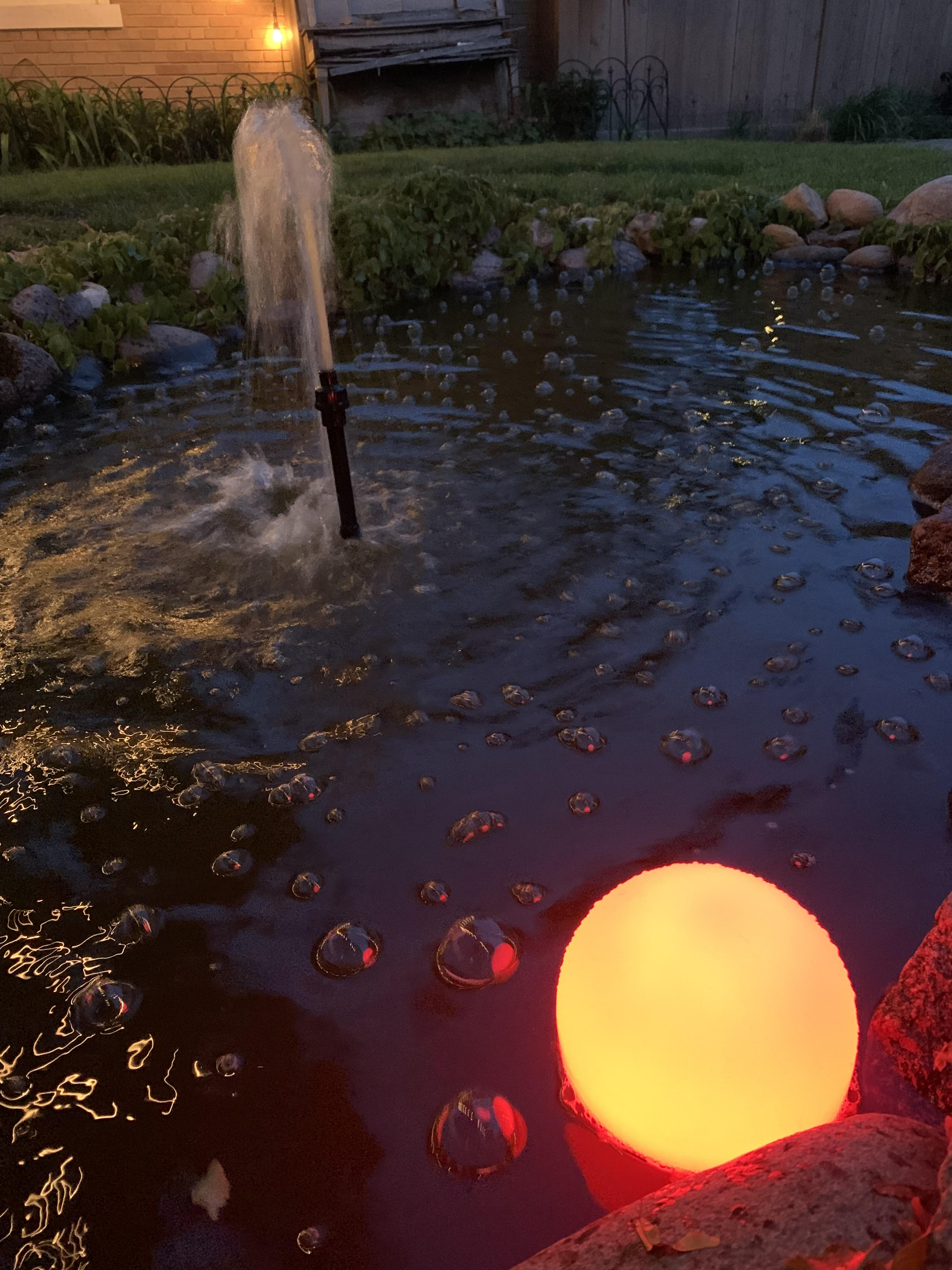
I used to wonder how Emily Dickinson, living most of her life in the isolation of her family home, could write poetry so soul-expansive. Her world of experience was impossibly narrow yet her view into the human heart so broad and deep. I am no longer confused about the limitlessness available in a tiny garden. There is more life teeming in our small backyard than I can possibly comprehend.

It had been years since we gathered with the Up-North gang in our home. They commented that our yard was “zen”. It’s true. We’ve come to think of it as our sanctuary. A creation borne of Covid isolation, of necessity during the pandemic, we brought our full attention to the only place in the world that seemed safe. Our yard. Over long winter months, sitting at the black table in our sunroom, we stared into the backyard. We watched the patterns of the birds and discovered the nests of bunnies and chipmunks. We watched with awe the subtle changes of seasons and the play of light. We wondered how we could make our safe space more comfortable for us and amenable to the plants and animals. We dreamed. And slowly, throughout our isolation and beyond, we carefully attended to our peace-of-heart. Is it no wonder that we now adore sitting in our yard, daily trying to comprehend the abounding life within our eyesight?

Emily Dickinson wrote her poems from just such an expansive place. Lately I feel an affinity with her. More than once, lost in wonder, I have thought, “How can I possibly describe what I’m seeing and feeling?” I understand, like Emily, it’s not possible to capture, but isn’t that the artist’s job, the poet’s errand, to somehow express that which is beyond our capacity to grasp? To bring hearts and minds together through a poem or play or a composition, so we might together whisper, “Yes. It’s like that.”

read Kerri’s blogpost about THE ORB

share. support. like. comment. subscribe. we appreciate it.

Language Blossoms [David’s blog on Two Artists Tuesday]

I just experienced something new: a visual route to a find synonym. That might not seem like a big deal but for a visual-guy like me it fundamentally changes my relationship with language.

I wanted another word for “shine” and, instead of finding a static linear list, a blossom of interconnectivity unfolded on my screen. Shine in the center, five interconnected primary synonyms, with each of the five subsequently sprouting five fingers of word possibility. I was gobsmacked. Like a child with a new toy, I clicked back into the site again and again so I might see the word bloom.

I’ve directed (and loved) many of Shakespeare’s plays. I am an avid reader. I write everyday and spend more time than I care to admit chasing down words. Yet, had you met me when I was a wee-lad of 22, none of these things would have seemed possible. It hurt to read. The worst hell imaginable for me was diagraming sentences. My knuckles were rapped by stern-faced English teachers more than once for poor use of language, rotten sentence construction. And, although I had an undeniable enthusiasm for the theatre, I literally hated reading plays when I was in high school.

Linear sequential is not my friend.

One day in my 24th year an actor introduced me to Shakespeare. Active language. Delicious sounds and living images. The penny dropped. The world opened. I have been a voracious eater-of-language ever since. When rehearsing, I dance my words.

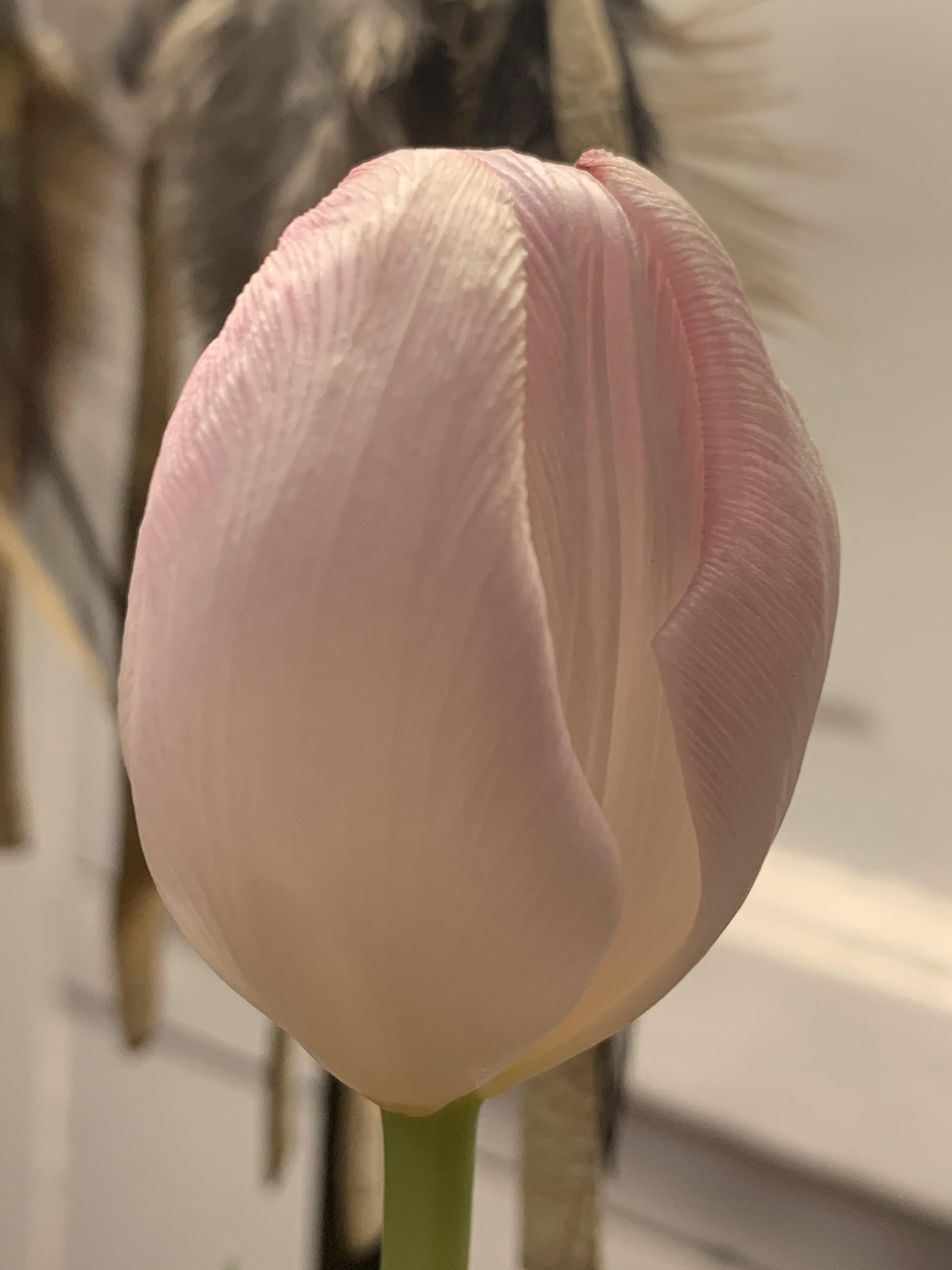
Words matter. They are alive when not forced to toe-the-line. Symbol and sound, makers of meaning, each intimately connected to the other. When I come back to this earth I will hopefully be a poet, attempting to capture in language that which is impossible to articulate. The beauty of a pink tulip. A flower selected by a mother for a rare visit from her daughter. Our daughter. Our daughter: a surprising and remarkable combination of words I never thought I’d utter.

Language unfolds and reaches deep into pools of meaning. Words blossom. And nothing is ever the same.

read Kerri’s blogpost about PINK TULIPS

like. share. support. comment. four words that inspire gratitude in our hearts.

buymeacoffee is exactly what you make of it. the meaning is yours to give.

Listen To The Sing-Song [David’s blog on Merely A Thought Monday]

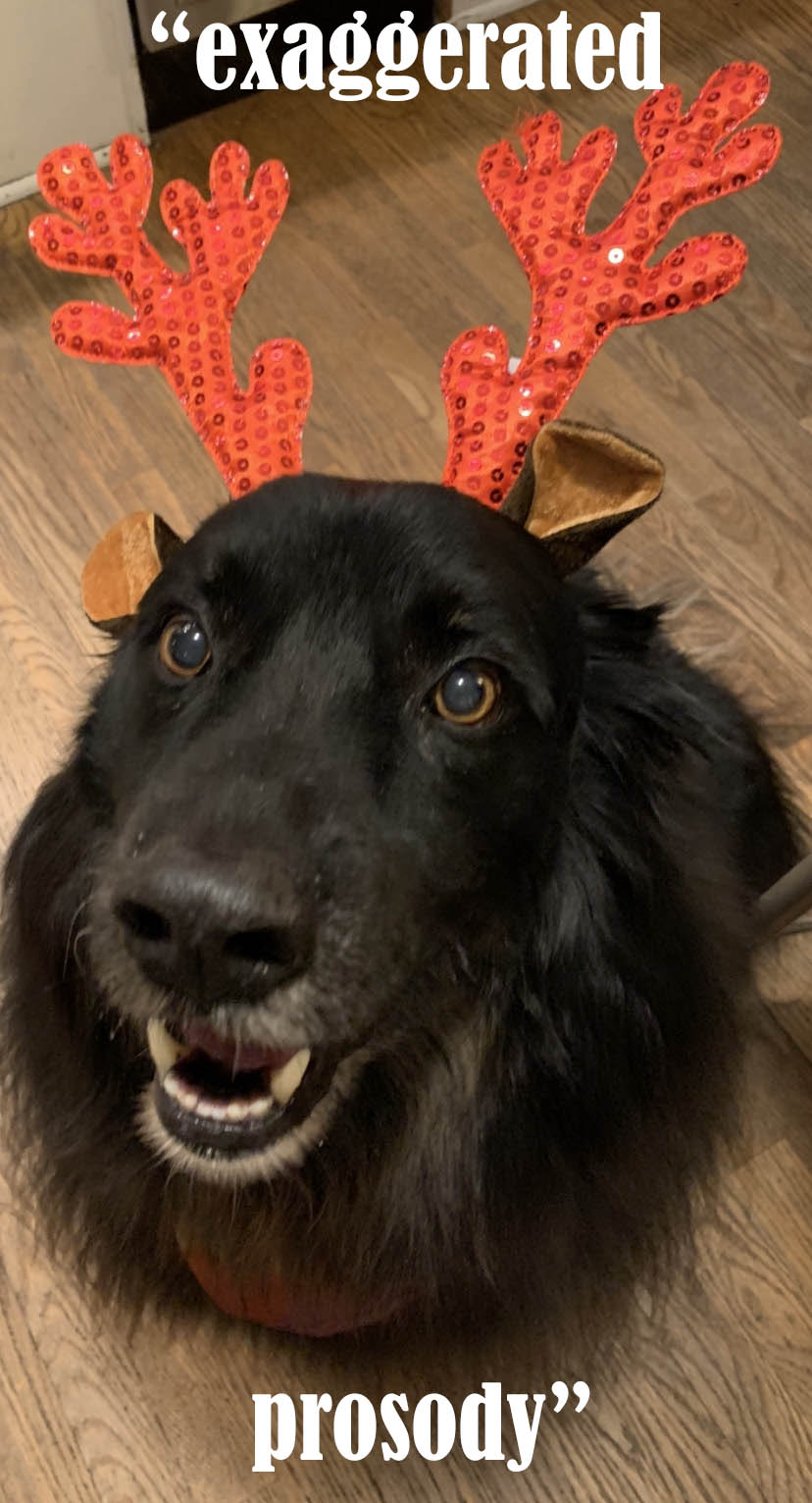
The sound, rhythm and pattern of language. Listen to the sing-song of a mother talking to her infant child. Exaggerated prosody. Love carried through time and space on a warm carpet of sweetly over-elaborated sound waves. The words carry less meaning than the prosody. The shape of the sound, exaggerated to invoke a giggle. A bright face. A smile.

In our house, the exaggerated prosody is reserved for Dogga. “It’s time for sleepy-night-night!” Kerri sings to a tired-faced-Dogga. There is a distinct rhythm to “sleepy-night-night” that has become a comforting ritual chant. Our day would not be complete without it. He wags his tail and lopes toward the bedroom. Or, “We’re going to the living room!” she says in response to his constant anticipation of our next move. The words “living room” elongated and embued with excitement. He dashes to beat us there and, in my mind, to convince us that he’s been waiting all along.

When Unka John arrives, his ritual Dogga sing-song goes like this: “Hey! Hey! Give me that bone!” The game is explicit, the sound of the words as exacting as a line from Sondheim. After Unka John pretends to eat Dogga’s bone and returns it to the awaiting Dogga mouth, signaling the end of the arrival game, he chants two consecutive times, “Do you want a treat!” with the hard accent and lift on the word “treat.” It sets-off a full body wag and race to the treat jar. “Gentle! Gentle!” is the incantation that signals Dogga to sit and tenderly accept the treat. Of course, the whole sequence of Unka-John love-fest is ignited when we say to Dogga, “Guess who’s coming?” in a melodic line that we know will provoke a bouncing-dog-rush to the front door as we await the imminent arrival.

The meaning is not carried in the words, rather, it’s in the poetry of the tones. The generosity of the sound.

It’s the poetry of everyday life. The ritual sounds we use to shape our day, to create our comfort-home. To fill our hearts with gratitude. To clearly say, “I love you” in sound and tone when our words are merely, “Do you want some lunch?”

read Kerri’s blogpost about EXAGGERATED PROSODY

like. support. share. comment. all carry forward the meaning and are appreciated with or without sound.

buymeacoffee is a sing-song of generosity offered to the ongoing work of the artists and travelers that support you journey.

Savor The Words [David’s blog on Merely A Thought Monday]

Her delight in finding the stack of Nancy Drew novels, her girlhood favorites, sparked a question. She asked, “What did you read as a kid?” Instantly, I was a deer in the headlights. I muttered something incomprehensible and changed the subject in order to dodge the question.

It’s not that I didn’t remember. The truth is that I wasn’t a reader until I was in my mid 20’s. It’s as if someone threw a switch and I was instantly transformed from dullard to a voracious reader. I generally have two or three books going at the same time, making up for lost reading time.

A few years ago it occurred to me that I was reading like a starving man at a smorgasbord. I was gobbling words without breathing or tasting. So I decided to try an experiment. Read books like they are poetry. Savor a few pages at a time. Consider for a full day what I have read in my few pages. Re-read it if I am unclear. Re-read it if it is gorgeously written.

My experiment is going well. I’m living in the books rather than blowing through them. I delight in the phrases, the way words are put together to invoke images and sounds and tastes. Sometimes a phrase is so beautifully written it makes my eyes water. I feel as if I’ve pulled off the freeway, stepped out of the car, and am walking through a meadow. I see more. I appreciate more.

I credit the age of information with my new reading practice. I’ve been studying how people engage with their screens, how I have been engaging with my screen. We skim. We jump. We tab hop. There’s so much information demanding our attention, stuffing the nooks and crannies of our minds. Emails, texts, slacks, social streams…

I’m finding my peace, out of the stream and off the info-super-highway, turning paper pages with intention, paying full attention to what is written there, no more than a few pages at a time.

read Kerri’s blog about NANCY DREW

like. share. support. comment. savor. sample. contemplate. replicate. all things we appreciate.

buymeacoffee is an online fictional book repository where you can lose your ever-loving-mind and fall into strange lands where you find yourself supporting the work of artists you appreciate. Ridiculous!

Incant [on Not So Flawed Wednesday]

It reads like a love poem. Puschkinia blooms in the empty moment between the fading of the snowdrops and the blooming of Chionodoxa.”

Despite their desire to be understood otherwise, botanists are poets, too. Taste these sounds: siehei, sardensis, forbesii. Spoken together they form an incantation worthy of Macbeth’s witches. There are three witches in the play: Category, Sub-category, and Group. Chionodoxa, we are told, is commonly called “Glory Of the Snow”. The poet-botanist would have us know that, in the empty moment between the fading of snowdrops and the blooming of the Glory-Of-The-Snow, tiny Puschkinia reaches through the soil and fills the void with cobalt and white.

Love poems and incantations. Love poems are incantations. “And because love battles not only in its burning agricultures but also in the mouths of men and women,… Neruda. Ahhhh.

“Double, double toil and trouble; fire burn and cauldron bubble.” What will the future bring? Glory-Of-The-Snow, of course! Shakespeare would have nothing less.

All of this poetry came alive in our front yard this week. It was the empty moment, It was the space between the fading snowdrops and the blooming of Chiondoxa. Had we not looked up from our computers, had we feared the cold wind off the lake and stayed comfy and warm inside, we certainly would have missed it.

Love poems and incantations. Harbingers. Nature quietly whispers its temptation, “Puschkinia blooms.”

read Kerri’s blogpost about PUSHKINIA

Embrace The Mix [on Merely A Thought Monday]

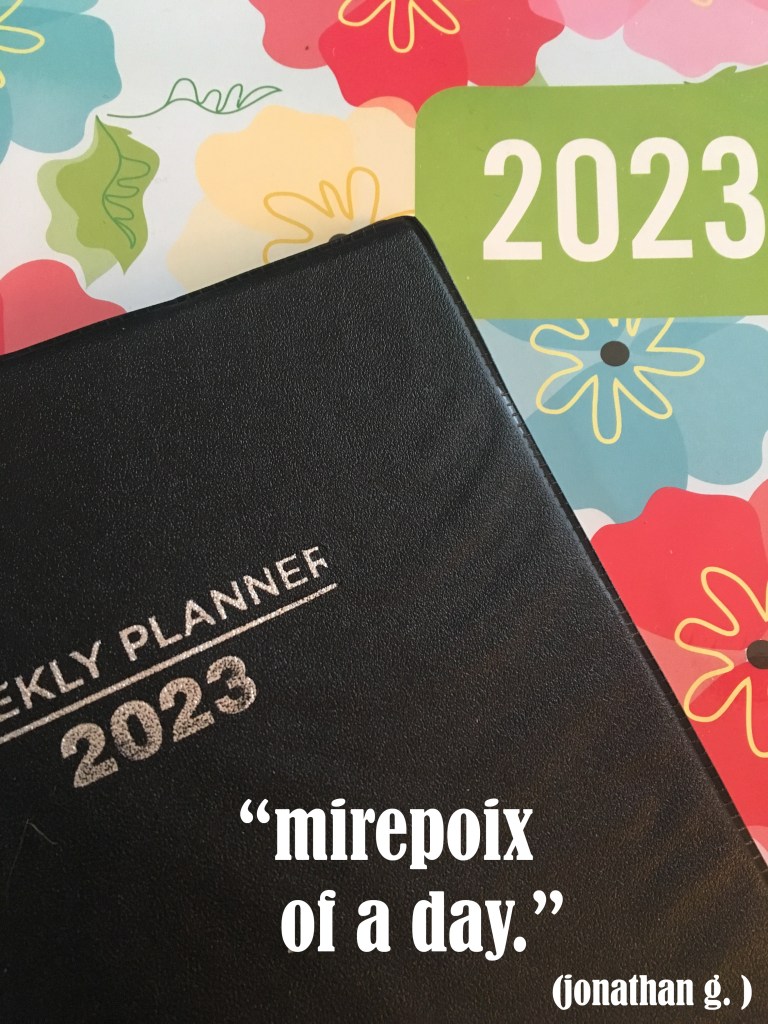
mirepoix: a mixture of sautéed chopped vegetables used in sauces.

mélange: a mixture; a medley.

“The purpose of life is to be defeated by greater and greater things.” ~ Rainier Maria Rilke

If Rainier were here right now I’d tell him to shut up. Who wants a buzz-kill poet spilling simple truth all over an otherwise good start to the day? The least he could do is wait until I’ve finished my coffee.

Yesterday was harsh. Well, okay, it was also good. And, okay, okay…sometimes great. I woke up stuck under a dark cloud. If I drew myself as a cartoon I’d have a raincloud pouring rain over my head in every panel. Well, until we took a long walk in the cold. My fingers started to sting. For reasons I can’t explain, stinging fingers made us laugh and laughter made the cartoon rain stop. The cartoon cloud was still there though the weather report improved. And then there was the 10pm concert with Barker. What a treat! We watched until the streaming was interrupted at 1:20am, but by that time I was thrilled and filled with music and with no hint of cloud-cover.

When we awoke this morning with a too-late-night-hang-over, Kerri called us, “Dirty stay-ups.”

“What’s a dirty stay-up?” I exclaimed (okay, I was too tired to exclaim. It was more of a croak or whine but that’s not the point).

“Us,” was her one-word answer that convinced me I’d better get some coffee going or it was going to be a day of one word answers.

Among humanity’s greatest achievements is denial. Denial is why we also invented poetry. If it hurts, at least make it sound pretty and pretend that it’s not as bad as you know it is.

Take that, Rainer!” A well-deserved early morning pre-coffee-poet-dis! I’m capable of spilling some hard truth even as I’m right in the middle of being defeated by greater and greater things! And, I have to say, as a recent dirty stay-up, with not yet enough caffeine in my veins, and with one word responses coming to my every question, I can say with conviction that this, too, will be a mirepoix of a day.

Thank goodness.

read Kerri’s blogpost about MIREPOIX

Play [on DR Thursday]

“Perhaps all the dragons of our lives are princesses who are only waiting to see us once beautiful and brave.” ~ Rainier Maria Rilke

The poet would have us understand this: our dragons are waiting to see us. They do not transform once we are beautiful and brave. Dragons do not suddenly appear as princesses. No, we transform. What we see changes. Through beautiful and brave eyes, princesses no longer appear as dragons.

Waiting to be seen. Waiting to see. I think Rilke knows that we are all beautiful and brave but are convinced otherwise. So, we hide. Or pretend. We don armor. The view from inside a tank is not as clear or expansive as the view from the outside. The poet would have us feel safe enough to open the hatch and step outside. It is there, in the expansive outside, that dragons facades fall away revealing princesses.

Another poet, Rumi, wrote, “Live as if everything is rigged in your favor.” Even before you see them as princesses, know that the dragons are on your team. That’s why they are waiting to see us as we are. Knowing the game is rigged in our favor is the surest path to seeing them as they are.

We decided to take a day away from the grindstone. We lifted our noses from the stone and took a drive to a small town. There was a specific shop in the tiny town that we wanted to visit. We drove back roads and successfully lost all sense of time and direction.

Instead of the warm day we’d hoped for, it was cold and rainy. Our fingertips ached and the ends of our noses were crimson so rather than wander the streets as we planned, we spent our time inside, imagining outrageous purchases and talking with shopkeepers. In those shops, laughing with those warm-hearted-people, our dragons fell from our sight.

We remembered: beautiful and brave are qualities of playfulness. To be seen, to see the dragons transform, play. The poet would have us play! Why wait?

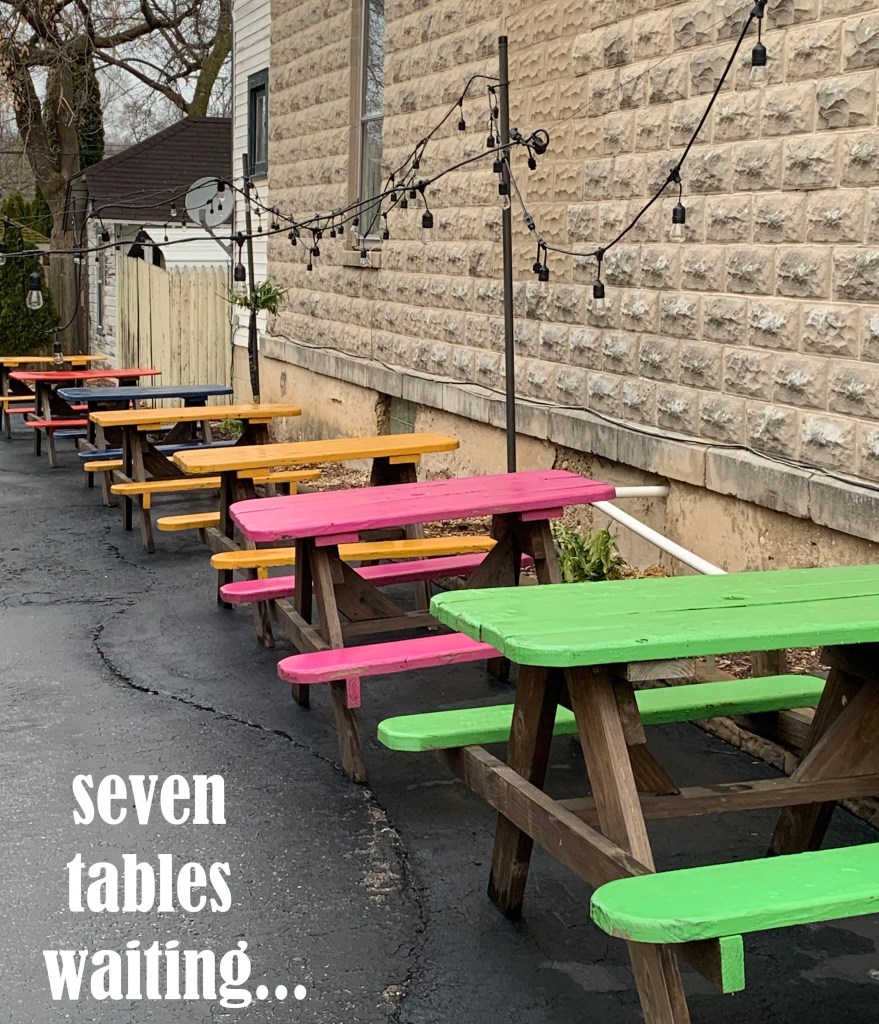
The town was alive with sparkling light. Colorful picnic tables, undaunted by the rain, waited patiently for warmer times. We played and everything tilted in our favor.

read Kerri’s blogpost about COLORFUL TABLES

Kerri’s Christmas albums are available on iTunes and streaming on Pandora

a dragon’s tale illustration © david robinson

waiting/joy! a christmas album © 1998 kerri sherwood

Connect The Dots [on Two Artists Tuesday]

A curious sentiment painted on the concrete support wall of a busy overpass in a burgeoning city. Crumbling cement sidewalks, hard asphalt, steel cable supports securing a post just outside of the picture frame. A message about bridges painted beneath a bridge.

People hustle by as if there was no time to spare. They drive fast over and around the curious sentiment. The painter-of-the-sentiment placed it adjacent to a stoplight. Perhaps, while revving their engine, awaiting the return of the green light, a motorist might turn and read the thought. Perhaps the motorist might breathe it in. Perhaps the motorist might consider the message as they passed beneath the bridge.

What gets you from here to there? From birth to death? Amidst the hard realities of the road, the steel cables, the thoughtless people whizzing passed, the persevering grasses pushing through the cracks in the cement, the litter at your feet? A thirteenth century Sufi poet thought it important enough to write about it. A twenty-first century painter thought it important enough to paint the poem on a wall.

People across time and cultures have thought it necessary to place significant messages on walls. Aspirations and appeals to our better nature. A compass pointing the way for what might be, what exists but goes largely unseen. The primary thing. Every parent knows this bridge beyond the abstraction of a message on the wall. Every time rings are exchanged, vows spoken, the unseen is understood.

The hawk landed on the fence. Kerri met its eyes and they stared at each other for what seemed a very long time. Divisions disappeared. Forms fell away. Life experienced life.

Just try and place a word on that experience! A Sufi-poet tried. A contemporary street artist thought it necessary to paint the sentiment on a hard wall. What bridge connects the poet and the painter?

read Kerri’s blogpost about THE BRIDGE

Arrive At Magic [on saturday morning smack-dab.]

It’s true. We read to each other. We read poetry to each other.

Lately, Kerri’s reading to me from Pablo Neruda’s Book of Questions. First, she reads the question in Spanish and makes me guess what Neruda asks. It’s important to note that she doesn’t know Spanish. Her first poetry pass is lyrical Spanish-sounding-gobbledygook-syllables followed by a studied look of expectation (remember, she’s a composer and musician – even her gobbledygook sounds lovely). “Well?” she asks, arching her brow. I make up an answer or stare dumbly. After I fail miserably, she hits me with the English translation. Lovely either way, coherent and incoherent.

Lovely either way. The bluebells and dark hazel can come to us through the yummy words and imagination we share or while slow-walking a trail. We may not have the power to invoke a well-timed Amazon delivery but, truth-be-told, I much prefer the way we arrive at our blue-bell magic. Coherent or incoherent. Either way. Lovely.

read Kerri’s blogpost about POETRY

smack-dab. © 2022 kerrianddavid.com