Look At Them Now [on Not So Flawed Wednesday]

Kerri hit the nail on the head. “Most people wouldn’t do this,” she said. “They’d think it was the same. They’d be bored” True. Too true.

She made her observation while we were walking our usual trail. We don’t walk it everyday but often enough to call it “ours” or “the usual.” Although we walk the same trail, to us it is never the same. Never. For instance, a few days ago the Mayapples bloomed. A single white flower hides beneath the leafy canopy. Last week we checked but the flowers hadn’t yet appeared. They’ll be gone by Father’s Day, the flower and the plant, just as the mystery cowboy told us. Walk the same path long enough and you’re likely to converse with a mystery cowboy.

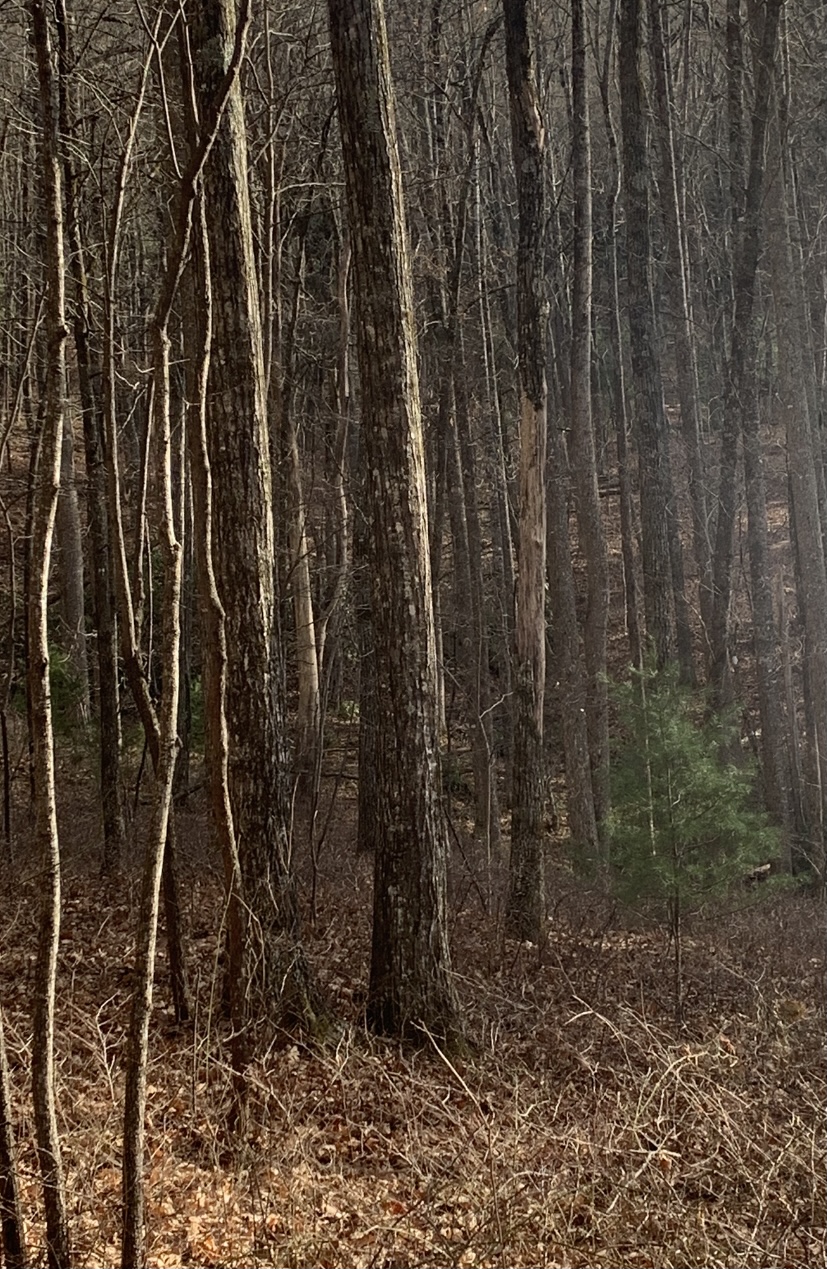
It’s an exercise in seeing. Or, perhaps, it’s an exercise in not taking the surrounding world for granted. It is constantly moving. Dynamic. A crane flew right over our heads! The turtles are barely visible buried in the mud of the river. Tender green shoots broke through the devastated landscape and now, only a few weeks later, a blanket of vibrant viridian covers the forest floor. Tiny purple and blue flowers soon followed. The honeysuckle have now made an appearance. The thunderous frog song has all but disappeared.

And then there is the light. Dear god, the light. The colors shape-shift as the sun moves across the sky. The cloudy days evoke entirely different tones. There’ a reason filmmakers call the impending sunset “golden hour.” The winter palette is a world away from the summer hues.

We hold hands. We walk slow enough to see, slow enough to immerse. Slow enough to give our attention to the unique-within-the-same. Each day uncommon. Seeing it is a practice of challenging the assumption of “sameness.”

The practice of the trail has become the practice of our lives – or vice versa. Move slow enough to see. Pay attention. Give attention.

Across the yard from the farmhouse porch stand two guardian trees. “Look!” she exclaimed, running to show me the latest photo. “They’re so amazing,” she said, showing me the growing series. “They’re entirely different in the morning than they are in this light…” she said, turning her focus and camera back to the trees. “Geez! Look at them now!”

read Kerri’s blogpost about THE TREES

if you enjoy the post, like it. or share it. or buyusacoffee (qr or link). or tell us what you think. we love it all.

Ask A Better Question [on Merely A Thought Monday]

I just erased the post I’d written for today. We often write a few days ahead so we have time to reflect on or edit what we’ve written. We’ve learned that it’s a good practice to consider what you are about to spill into the world.

It’s a good practice because it affords us the opportunity to ask, “Is this what I mean to say? Is this what I really want to say?” The post that I’d initially written was bothering me. A lot. Sipping coffee, I confessed my discomfort to my chief editor and life-collaborator (Kerri) and we followed the trail until we found the source of my chagrin.

There is a question, a much more important question, behind and beyond clarifying what I really want to say. It is this: “Is this who I want to be?” My post was making me uncomfortable because it was the opposite of what I profess to be. It was the opposite of who I understand myself to be. Of who I want to be.

I’ve often written and taught about “the spaces between.” Relationship. Intuition. Heart. Facts and data require interpretation and live on the spectrum at the farthest point away from wisdom. Focus on the spaces between, the movement rather than the noun, and an entirely different life opens. Wisdom is more like water than stone.

Most cliches touch a truth-root and today that is the case for me: We teach what we most need to learn. Thank goodness my editor was around to gently slap open my eyes and help me ask myself a better question.

read Kerri’s blogpost about THE SPACES

Move The Eye [on Two Artists Tuesday]

“If you think good work is somehow synonymous with perfect work, you are headed for big trouble. Art is human; error is human; ergo, art is error.” ~ Art & Fear, David Bayles & Ted Orland

The winterberries came as a shock. Vibrant red pops in a bleak landscape of brown and grey. “They look like maraschino cherries!” Kerri laughed as she waded into the brush to get a photograph. In Wisconsin, the mere mention of maraschino cherries invokes immediate and widespread mixing of brandy old-fashioneds. Even though it was early in the day, I imagine people for miles around sensed the invocation and sprang toward their liquor cabinets.

“Sour or sweet?’ I asked, trying to be clever, but she was too engrossed in her photograph to hear my quip.

Watching her crouch to capture the shot, I thought, “Red makes the eye move.” It’s a lesson I learned beyond the abstract and used in my narrative paintings – a series that I’ve had on the back burner for ages. Limit the palette, move the eye with winterberry red. It’s a director’s thought. Guide the eye. It’s a playwright’s plot; tell the story through the anomaly. Create movement through curiosity rather than control.

Explode the idea. Run toward the edge. Extol the sore thumb!

I let my eye roam across the fields. Winterberry shock to Winterberry shock, electric reds pulling my eye across muted purple and drab green. The wind rattling branches, antlers clacking in the sky. I breathed it all in as she waded through the grasses back to the path. “Make big mistakes,” I heard Quinn whisper.

“The bigger the better,” I whispered in reply.

read Kerri’s blogpost about WINTERBERRIES

Taste The Sound [on KS Friday]

Toadshade trillium. Say it out loud and taste the sounds. Toadshade trillium. Yummy words worthy of e.e. cummings.

I am working in a tech space and keep a document on my desktop: Terms in this Unknown Land. Tech folk speak in acronyms, PAI and SMB, SERP and TAM. Although my colleagues are mostly left-brainers, they are remarkably poetic in their language, peppering their acronym-speak with tasty terms like “cluster calculations” and “stemmings.” I admit to losing the sense of the conversation in the sound. They are, despite the stereotype, passionate and creative and unconsciously poetic. “Plots a curve of probability.”

Toadshade trillium. Plots a curve of probability. Forget the meaning and taste the sound! What might Mary Oliver have done with those syllables!

My lesson this week: I cannot stand and work at my computer all day. I can do the standing (I have a stand-up desk) but staring at a screen eventually shuts down my brain. Across from my stand-up desk is my drafting table. I think better with big pieces of paper and a pencil and then translate back to the computer. I need to move to think but that’s only part of the lesson. When at the drafting table I’m more likely to take things less seriously. I free myself. I get snarky and funny and scribble and draw big arrows and make fun of myself and the logjam in my thinking. I play.

And, while I play, I talk aloud, and hear the sounds of the shapes that I draw. Poetry and motion. Taste the movement. One and the same. Free the thinking. It’s enough to scare the dog but it’s liberating to my kinesthetic necessity. I scribble notes in every direction and dance back and forth between word and image. Consequently, I produce better work.

Thank goodness I finally tasted a few word-sounds that sent me tumbling into a productive scribble dance.

read Kerri’s blogpost about TOADSHADE TRILLIUM

kerri’s albums are available on iTunes and streaming on Pandora

pulling weeds/right now © 2010 kerri sherwood

Dream [on Not So Flawed Wednesday]

When does a dream turn into a goal?

Lately, I’m having conversations that confuse me. Business thinking, engineer minds, make models for creation. Creativity plans as action templates and guides.

Screen writers make plans, too. Step outlines. The difference is in the process. A creative mind makes models and plans with full intent to throw them away. To discover the best story, their plan involves making space for the better idea. Open up by tossing the model. Clear the deck by shuffling the plan. Sketches and rough drafts. It’s a conversation with the muse. Muses are notoriously structure resistant until the story makes an audience sit forward. Movement first. Then, the structure begins.

The engineer mind works in the opposite direction. The dream must wear the mask of a goal or it is considered invalid. Too squishy. Construction begins immediately with targets and tasks. Order. It is, in fact, the same process as the creative mind, only it is less forgiving of space. It forces the muse to move. Time is of the essence. Structure first. Then movement. Efficiency is a tree with shallow roots.

It confuses me. Dreams do not wear ties or leather shoes, yet, scrape the blueprint and you’ll find a dream every time. Perspective requires stepping away from the canvas. Standing too close for too long and loss of vision is the result. Every time. It’s not a mystery or voodoo. It’s physics. Great ideas and idea-break-throughs happen in the shower or walking on the trail. A clear mind. A different focus creates space. Too tight thinking, too close in for too long, sucks energy.

Once upon a time I worked with organizations and educators. They also confused me. Squeezing the air out of their space they’d gasp, “We can’t breathe.” A little bit of space, some play, a refocus on the relationships was good medicine. Fresh air. Step back and see the painting. The point of perspective is to see. The secret: permission to remove the status games and need to be an authority and, for a moment, reconnect the players to their dream.

At the nucleus of every goal beats the wild heart of a dream.

read Kerri’s blog post about DREAM

Look Out The Window [on Two Artists Tuesday]

I came down the stairs, having just finished work for the day, and found her staring out of the bedroom window. “You have to come see this!” she said.

Atop John and Michele’s house, hundreds of birds, starlings, jockeying on the roof, taking turns diving into the gutters. And then, in heartbeat, the entire murmuration whirled as one into the sky. The visual impact of their singular launch nearly knocked us over.

And then, they were in the trees and swooping down to the pond. We ran to the sunroom where we could see the backyard. Dozens and dozens of birds and, we realized, not just starlings, great-tailed grackles were in the mix. The starlings, apparently late for a date or not willing to wrestle the grackles, swirled into the sky and disappeared, leaving the great-tails to enjoy the pond.

For a few moments it was like watching a bird ballet. The pulse of bird dancers, rising and falling in groups to the water, according to a symphony that we could not hear but could see in their choreography. And then, like the starlings, in a heartbeat, they were gone.

We looked at each other to confirm that we actually saw what we just saw. No dream or hallucination. It happened and we were lucky enough to look in the right direction at the right moment.

It’s not that it’s rare. This ballet happens all day, everyday. It’s rare that we are privy to the performance or are captured by the play happening around us.

“What if I hadn’t looked out the window?” Kerri asked.

read Kerri’s blogpost about STARLINGS AND GRACKLES

Jump Out Of Your Chair [on KS Friday]

If I want to think clearly – or clear my thinking – I walk. Sitting still has always been and continues to be an invitation for thought-log-jams. It was a problem when I was a student. Classrooms come with desks and an expectation that the learner will sit still. I became a master of the controlled wiggle, not because it broke the logjam but because it helped maintain my sanity. For me, sitting still is like a hair shirt with an itchy tag. Sitting still makes my IQ plummet several points. Sitting still interrupts my synapses.

Tom Mck told me that the alternative schools were populated by artists. I intimately understood his observation. Artists need to move to think. They thrive in an alternative to still-sitting.

I’ve made sure that my work throughout my adulthood included movement. Directing plays. Painting big paintings. Facilitating workshops. Even as a teacher I cleared the room of desks. This morning I saw a headline in Forbes Magazine declaring that children learn more through play than through guided instruction. It was curious to me that this was a headline. Sugata Mitra’s been shouting the news for decades. Neil Postman spent his life reading the research and advocating for what the research implied: turn little people toward a passion and get out of the way. Curiosity and desire are an unbeatable team. They will move faster than you might imagine. Move, move, move. Dance. Paint. Sing. Construct. Act. Play. They will let you know when they need you.

I’m learning the lesson again. My work places me squarely in front of a computer for hours each day. Flow. Eddy. Logjam. Wiggle. Move. Sigh, as the synapses start firing up again. Repeat. At this advanced stage of earth-time, you’d think I’d have grasped the full understanding that, for me to be effective, I have to move around. Each morning I review the previous day’s work and immediately know whether or not I found a movement/sitting-still balance.

When we stepped on the trail and entered the woods in North Carolina, my mind was chock-full-of-thought-logs. Like everyone else, I stare at the screen and lose track of time. A day can pass me by and I never leave my swivel chair. I swivel for survival. For months, I’d been swiveling and forgetting to stand up and dance my ideas. Fifteen minutes into our hike, the jam broke free. My mind cleared. I could see the subtle landscape inside and outside. I breathed a deep breath. The forest was gorgeous. My mind was spacious and flowing! I resolved, once again, yet again, to attend to the necessity of movement that keeps my mind and heart flowing. Wiggling is maintenance, merely. Swiveling is not a solution. The real game, the full flow, is only available when I jump out of my chair and move-it.

read Kerri’s blog post about THE FOREST

Kerri’s albums are available on iTunes and streaming on Pandora

meander/as it is © 2004 kerri sherwood

Round The Corner [on saturday morning smack-dab.]

Kerri breaks a pinkie toe about once a quarter. She is circular in her thinking so it only makes sense that she is circular in her movements. She regularly gets tangled in the vacuum cord – vacuuming in circles. The challenge for every circular thinker is that, unless they live in a yurt, they actually live in straight-line spaces. Circle in the square. Straight-line spaces, rooms shaped like rectangles, have corners and people that move and think in arcs often try to cut corners. Baby toes pay the price.

There is a special sound she makes when she’s re-broken her toe. There’s a special sound she makes when she sees a big spider. I’ve learned to discern the sounds. These days, instead of asking, “Is everything okay?” I know it is more efficient and helpful to ask, “Left or right?” Then, I find her writhing in a doorway and help her get off the floor.

read Kerri’s blog post about BABY TOES

smack-dab. ©️ 2021 kerrianddavid.com

Root And Fly [on KS Friday]

“Inspiration does exist but it must find you working.” ~ Pablo Picasso

At some point I realized that all of the good guidance I have received, all of the masters that I have admired, made statements about Roots & Wings.

“A writer writes. A painter paints.” ~ Tom McKenzie

“You must write 10 bad pages to arrive at one good page.” ~ John Guare

“Live on the plateau (in the present moment).” ~ George Leonard

“Cultivate your serendipity.” ~ Tom Quinn

I remember Jim E. teaching actors not to push their voices to be heard but, first and foremost, to root down into the earth.

After years of practice I am approaching the lesson that Saul taught his tai chi students: stay on the root and the energy will move you. He also taught me, on a brilliant Saturday morning when I was trying to bend the world to my will, to look beyond my opponent into the field of opportunity. It is two ways of saying the same thing. Root. And the wings will appear. Root, and possibility will find you.

Work at the easel, and inspiration will arise.

all of Kerri’s albums are available on iTunes or streaming on Pandora

read Kerri’s gorgeous blog post on ROOTS AND WINGS

give me roots, give them wings/released from the heart ©️ 1995 kerri sherwood

Find A Horizon [on Not So Flawed Wednesday]

“Be not afraid of growing slowly, be only afraid of standing still.” ~ Chinese Proverb

Each morning, Kerri wanders outside to check her tomatoes. It is one of my favorite new rituals. I watch from the window as she steps out beyond the deck to the potting table, hands on hips, and scrutinizes the plants for newcomers. After a careful count she hurries back into the house to tell me the results of her count. Each day yields a new arrival. “There are ten!” she proclaimed this morning. Then, she took out her phone to show me the photos she’d taken. A family portrait of tomatoes. Miracles in the making.

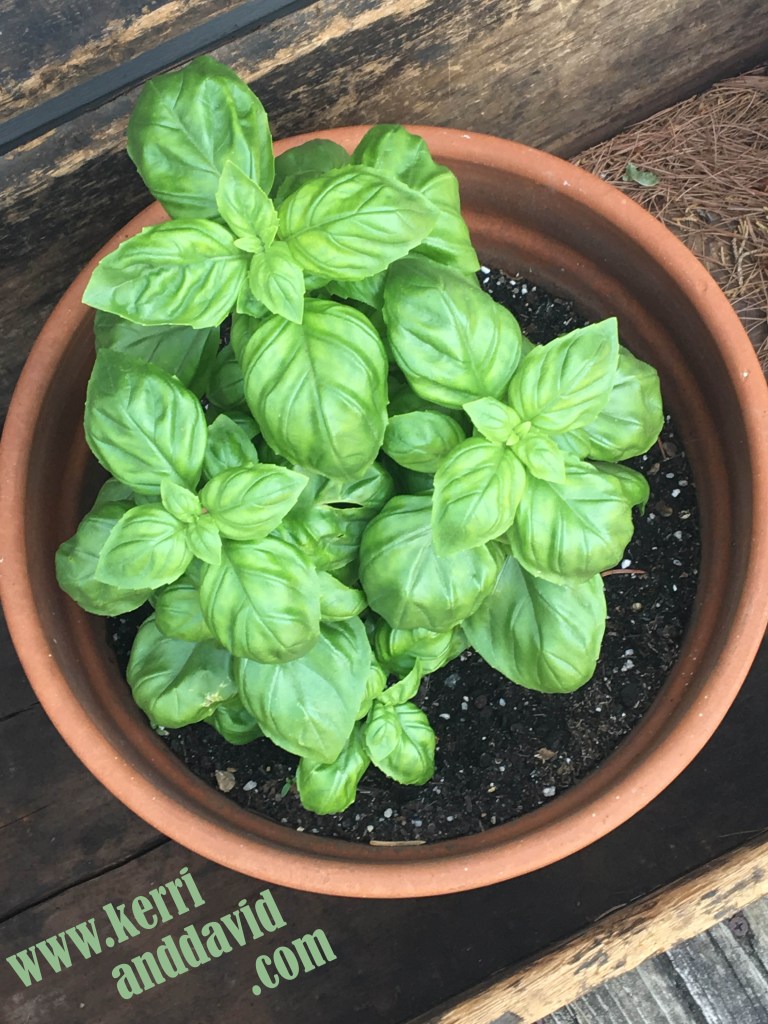
Seasoned gardeners might not experience the same level of enthusiasm, but we newbies are wide-eyed at the little green orbs that show up overnight, at the basil plants spilling out of their pots.

It has already inspired new recipes. I blubbered on Sunday evening when I tasted the basil-and-tomato-saute over pasta. Food-that-makes-you-close-your-eyes-and-slow-down-so-that-you-can-savor-every-last-bit-of-it is high on my list of pleasures-to-be-cultivated.

We are learning. We are trying new things. We are setting up new spaces, rearranging furniture. At the same time, we are cleaning out, pulling bins from the basement. Sorting. Making space. The energy is moving.

In the past few years, our growth and learning has looked and felt like loss. Job losses, dear ones passing, broken wrists. Armor falling to the ground. Layers peeled. There’s nothing like time spent in the wilderness to put a fire beneath curiosity. When the questions are basic, “What do we do now?,” the available options are at the same time infinite and absent. There’s only one thing to be done and that is to keep moving. Find a horizon and walk toward it.

The tomatoes are harbingers. The season of losing layers may, at last, be done. There is now plenty of space for curiosity, for growing things. “What do we do now?” is still a question floating in the air. But, from our point of view, with the wasteland just behind us, we see the yellow buds and tiny green orbs as signaling a harvest to come. Hope. The energy is moving. A daily visit to the potting bench, rubbing basil leaves to enjoy the scent, seems like just the right amount of forward movement.

read Kerri’s blog post about TOMATOES