Now We Must Ask [David’s blog on Flawed Wednesday]

“The more you know yourself, the more clarity there is. Self-knowledge has no end – you don’t achieve, you don’t come to a conclusion. It is an endless river.” ~ Jiddu Krishnamurti

In these times it is difficult not to write about the ubiquitous inanity and daily horror show produced by the current administration. We are writing a few days ahead, so it has become our practice to acknowledge that we might have to dump our initial posts if the latest outrage, the intentional starving of citizens, the kidnapping of people off the streets, the dissolution of congress to protect pedophiles…is too much to ignore. In truth, it’s all too much to ignore and it’s too toxic to focus on all of the time. We look away to remind ourselves that the goodness in people far outweighs the malicious spirit that currently claims the national narrative.

To that end I have this paradoxical reflection to offer: to all of you out there who voted for this but now daily proclaim that this is not what you voted for, I want to 1) roll my eyes and shout, “While you were cheering and waving Mass Deportation signs, did you not read your sign?” Did you think this was a sitcom? Project 2025 explicitly articulated this horror show in minute detail; you have no excuse – other than laziness – to now claim that this is not what you voted for. Yet, 2) it is never too late to wake up. It is never too late to realize that you’ve been duped. Saying, “I made a mistake,” is a step on the path of self-knowledge.

In waking up ever so slightly, there are two questions to ask: 1) “How was I so easily duped?” And, 2) “What will I do with my new awareness?” Knowing that this is not what you voted for does not absolve you from responsibility. You opened the cage and let loose the monster. It is not enough to divest yourself of culpability. People in fishing boats are being murdered, people with brown skin are being beaten and disappeared, millions are losing their healthcare and it is estimated that 50,000 people will die each year because of this loss…Saying, “It’s not my fault,” is akin to sticking your head back into the sand. Saying, “I made a mistake,” needs to be followed with a second step: corrective action. Self-knowledge is a bit of a misnomer; self-knowledge is inert until activated when it becomes dynamic: responsibility.

This ugly white supremacy has been a part of our national identity since our inception. A few days ago I told Kerri that it is my belief that our national mask is slipping. This terror-face is not new, it is merely revealing itself (again). We are seeing this part of our national identity with renewed clarity. Past generations, having seen this part of our national face, have been successful at restoring the mask, suppressing but not eliminating the ugliness.

Now we see it. And the two questions to ask ourselves are akin to those who claim that this is not what they voted for. We see it. What will we do with our new awareness? We claim to be a democracy yet we are currently witness to our rabid inability to reconcile ourselves with our history of slavery, of the genocide of native peoples…We continue to entertain a political party that actively – and perpetually – suppresses the vote of people of color and of women. It is unmasked. It is in full view. It is fascism and has no place in a multi-cultural democracy. It is no longer enough to say, “We see it.” If we stop there the cycle will once again repeat itself. The ugly face will be driven underground until if pops up as the reincarnation of The Confederacy or Jim Crow or MAGA.

We see it. Now we must ask ourselves how we translate our seeing, our self-knowledge, into responsible action. We claim to be a democracy: how do we close the gap between our rhetoric – who we claim to be – and our lived actions as translated into policy and daily practice – and into history?

read Kerri’s blogpost about THE RIVER

likesharesupportthankyou

No Comparison [David’s blog on Not So Flawed Wednesday]

“So as long as the mind is comparing, there is no love, and the mind is always judging, comparing, weighing, looking to find out where the weakness is. So where there is comparison, there is no love.”
Jiddu Krishnamurti, On Love and Loneliness

The snow was nested in the pine needles when the wind blew the bundle from the safety of the branch. Together, snow and fascicle landed far below on the well-worn path. I would not have seen it had she not suddenly knelt, pulled her glove from her hand with her teeth and braved the bitter wind to snap an up-close photograph.

Many days later, while choosing photographs for our next Melange, she asks, “Which do you like better?” She shows me the snow-and-pine-needle-embrace among many other photographs. I rarely have a coherent answer to the better-or-worse question. Her photos are always beautiful or curious or interesting – they are certainly moments-in-the-world that I would have missed had she not stopped to capture the image. While she gazes at the beauty on the trail I am generally lost in my thought. It is generally impossible for me to compare the worth of one photograph over another.

I am working on a painting and have given myself full permission to make a mess. It’s harder than you might imagine to turn off the inner-critic, the one who demands better work, the one that compares me with others. In comparison, I always lose.

I am employing a strategy to silence my inner voice of comparison: when the critic roars I pick up a rag or wide-tool incapable of nuance and I smear. I am afraid that I don’t know what I am doing – so I make certain that I don’t; I dive head-long into not knowing. In splodging paint, I guarantee that there can be no comparison to others or to any version of my past-artist-self.

“When you are comparing, you are really not looking at the sunset which is there, but you are looking at it in order to compare it with something else. So comparison prevents you from looking fully.”
― Jiddu Krishnamurti, On Love and Loneliness

In the moment she kneels on a bitter cold day to capture the embrace of snow and pine needles, there is no comparison. She is looking fully. What I see when she shows me the photograph is a moment of seeing, a moment of beauty recognized. Love realized. It’s the same reason I stand at an easel and wipe away my trepidation. To see, subject and object undifferentiated. For a moment, no comparison. One.

read Kerri’s blogpost about SNOW AND PINE NEEDLES

likesharecommentsupportsubscribe…thankyou.

Lean Into The Lull [David’s blog on KS Friday]

“I’m trying to immerse in the lull,” Kerri said and smiled.

We find ourselves with a square or two on the calendar with nothing written in it. A wise friend suggested we embrace the lull and cultivate a bit of quiet mind. We have some big decisions looming but not yet pressing. Fortunately, we have a trip up north that meshes with our empty calendar. There’s a canoe calling our name.

“Nothing needs deciding today,” our wise friend suggested.

Krishnamurti wrote that no problem can truly be solved until the mind is still. Constantly chewing on the question rarely leads to anything but more problem creation. Panic. Or blindness to possibility.

Usually “letting go” for a day or two is a difficult task but we’re finding exhaustion is a great helper. “I don’t have a thought in my head!” I said this morning, staring into space.

“Good!” Kerri said. “That’s the whole point!”

Actions for leaning into the lull: Hug the exhaustion. Send the weighty decisions to sleep-away-camp. Keep the calendar space as empty as the mind. Paddle the canoe. Take a nap.

Peace will find us there.

Peace on the album As It Is © 2004 Kerri Sherwood

Kerri’s albums are available on iTunes or streaming on Pandora and iHeart Radio

read Kerri’s blogpost about PEACE

like. support. share. subscribe. comment…thank you.

The Abdication of Answers [David’s blog on Two Artists Tuesday]

“Truth is a pathless land.” ~ Jiddu Krishnamurti

I confess. I’ve spent an inordinate amount of my life looking for answers. Mostly, the answers I sought concerned questions like “Who am I?” or “What’s my purpose?” I sought the answers as if they actually existed. Somewhere out there. I thought I’d find it if I kept looking.

“The whole of life, from the moment you are born until the moment you die, is a process of learning.” ~ Jiddu Krishnamurti

It took a while but one of the later versions of myself quite suddenly understood that there was no answer to find. There was a life to be lived. I might arrive at answers – if I still needed answers – on check-out day. And even in that passing moment, my answers would most likely be a learning experience. A discovery.

“Freedom from the desire for an answer is essential to the understanding of a problem.” ~ Jiddu Krishnamurti

On hot humid days we walk along the shore in hopes of finding a cool breeze. Our hot-day-walks are slow, ambling. Kerri stops periodically to take a photograph: the bamboo growing beside the marina, cornflowers in the community garden, a seagull atop a light post. We talk about what matters and what does not. The quiet river running beneath our conversation is the abdication of answer-seeking. We revel in the birds splashing in the birdbath, the first sip of coffee in the morning, the smell of onion and garlic sautéing…slow walks on hot days. Noticing a kindness. Answers are nowhere to be found. Presence is everywhere.

“When I understand myself, I understand you, and out of that understanding comes love.” ~ Jiddu Krishnamurti

Lately Kerri says, “I’m not all that. We’re not all that.” There is freedom found when perspective arrives, an undeniable truth in a vast, vast universe. We are passing through. Nothing more, nothing less. How we treat each other is on the list of what matters. Do we help or hurt others in the time we share together on our passage?

read Kerri’s blogpost about BAMBOO

like. share. support. comment. subscribe…thank you.

Arrive [David’s blog on KS Friday]

“You must understand the whole of life, not just one part of it. That is why you must read, that is why you must look at the skies, why you must sing, dance and write poems, and suffer, and understand, for all that is life.” ~ Krishnamurti, Think On These Things

The amaryllis is making a reach for the sky. The first time I saw it – a bulb encased in pink wax – I wondered what alien life form just entered our house. We had to ask the same questions we’d need to ask if it was an alien creature: How do we take care of it? How do we feed it? The answer was simple. Leave it alone. That answer confirmed my suspicion. It was an alien after all!

There is so much in this life that I do not understand. In fact, if I am honest, I think most of this life is beyond my capacity to comprehend. Last night, not ready yet for sleep, I watched a nine-minute youtube teaching by Thich Nhat Hahn. Stop Running. The title caught my eye because so much of life feels like running. Running to explain, Running to justify. Running to judgment. Running from fear. Running toward gain. I wanted to hear some thoughts about standing still. In that way, I might understand why there is so much running. In the end, his answer was beautifully simple: rather than run, arrive. Be home.

Rob made us laugh. He’s one of several people who lately reminded Kerri and me that we are not normal. “I didn’t mean for that to sound like it did!” he exclaimed. He’s helping us sort out our plan B. It’s true. Our “normal” in comparison to others is alien like the amaryllis. Rob is attempting to help us see what is special about how we are doing life. And, like everyone, we are mostly blind to ourselves. To our unique choices. To our “one wild and precious life.”

Between the alien amaryllis growing in our sunroom, conversations with Rob and a brief teaching by Thich Nhat Hahn, I am fully confident that I need to cease all attempts at understanding anything at all. Maybe it is time to arrive. Maybe it is time to arrive, to stand still and fully breathe-in all the possible awe teeming in this mysterious ungraspable universe.

Connected from Released From The Heart, The Best So Far © 1995, 1999 Kerri Sherwood

Kerri’s albums are available on iTunes and streaming on Pandora and iHeart Radio

read Kerri’s blogpost about AMARYLLIS

comment. like. support. share. subscribe.

Keep Your Nickel [on Merely A Thought Monday]

The second part of the quotes reads like this: “The ability to observe without evaluating is the highest form of intelligence.” It’s another way of saying, “Be in the moment.”

Being in your moment is harder that it sounds. Lately I’ve been pondering two Buddhist practices that came by way of Quadzilla. First, develop the capacity to discern between the fear raging inside and what’s actually happening outside. Unless there’s a tiger chasing you, the fear is most-likely manufactured. Second, learn to discern between what-you-feel and the story you layer on top of what you feel. Feel the feeling, chuck the story. Develop these two practices of discernment and arrive at equanimity: “mental calmness”, the ability to observe without evaluating.

The first part of the quote reads: “It is no measure of health to be well-adjusted to a profoundly sick society.”

Each time I scroll through the news-of-the-day I hear Tom’s voice in my head: “When I was a kid and the circus came to town I paid a nickel to go into the tent to see the ‘freak show.’ Cows with two heads, etc. Now, all I need to do is watch what’s on tv.” In his final years, Tom retreated to his ranch and spent his time cutting the grass and tending the land. He watched baseball games. For a time I was concerned with his isolation but now I understand it completely. He was a deeply sensitive man, a gifted theatre artist, and rather than grow numb to the “freak show,” to try and make sense of the sense-less, he put his hands in the soil. He watched the sunrise and sunset. He found his health in the quiet place beyond the sickness of the society.

Pasting the quote back together in proper order: “It’s no measure of health to be well-adjusted to a profoundly sick society. The ability to observe without evaluating is the highest form of intelligence.” ~ Krishnamurti

The lessons keep coming. Late in life Tom made the choice to keep his nickel and stay clear of the world concocted inside the tent. The world inside the tent is manipulated. It’s meant to rile, to confuse. He discerned between where to place his focus and where not to place his focus. Stay out of the tent. Focus on the soil. The movement of the sun. Family. Ancestry. Helping. Chopping wood. Carrying water. The real stuff.

Outside the tent, outside the made-up-horror-story, there’s no reason to evaluate [to judge]. It’s another way of saying “Appreciate your moment.”

read Kerri’s blogpost about KEEP YOUR HEAD UP

like it. share it. support it. comment on it. we appreciate it.

Be There [on Merely A Thought Monday]

“Most of us are frightened of dying because we don’t know what it meant to live. We don’t know how to live, therefore we don’t know how to die.” ~ Jiddu Krishnamurti

Today we took a walk in the swirling snow. The wind stung my face and I was grateful for the extra layer I’d put on before we set out. Our destination was the city civic building on the other side of downtown. The Sisu property tax bill was due. We could have mailed it or taken the car. “People must think we’re crazy,” Kerri said as we leaned into the wind and laughed.

On Monday we interred Beaky’s ashes. As I watched the attendant seal the niche, I thought of a famous quote by Helen Keller: “Life is either a daring adventure or nothing at all.” And that quote brought to mind two more that I appreciate and stitch together as a single thought: Science may have found a cure for most evils; but it has found no remedy for the worst of them all—the apathy of human beings./Security is mostly a superstition. It does not exist in nature, nor do the children of men as a whole experience it.”

The apathy of human beings. Security is mostly a superstition. Reach your hand and help another; a cure for both apathy and security-superstition.

I only knew Beaky for a brief time but she had an enormous impact on me. She was in a rehab facility the day I met her and I knew immediately that she was special. Every nurse, therapist or aide that came in to see her left feeling better. Beaky was a lifter of spirits. These dedicated people were her caregivers yet, in the midst of her pain, she gave care to them. Kindness was her north star and she followed it with a passion.

Yesterday I had an interview with Joe. His job is checking-in and coaching people on unemployment, mostly making certain they are on track seeking new work. We had a great conversation. We told stories and laughed. We swapped ideas. I left the conversation uplifted and I’m sure he felt the same way. People supporting people is a two-way street and is life-giving. Adventures are made of stepping into the unknown and the heart of another human being is always unknown territory. I was grateful for his kindness.

Kindness is also a potent cure for apathy. Like reaching your hand, kindness requires an outward focus.

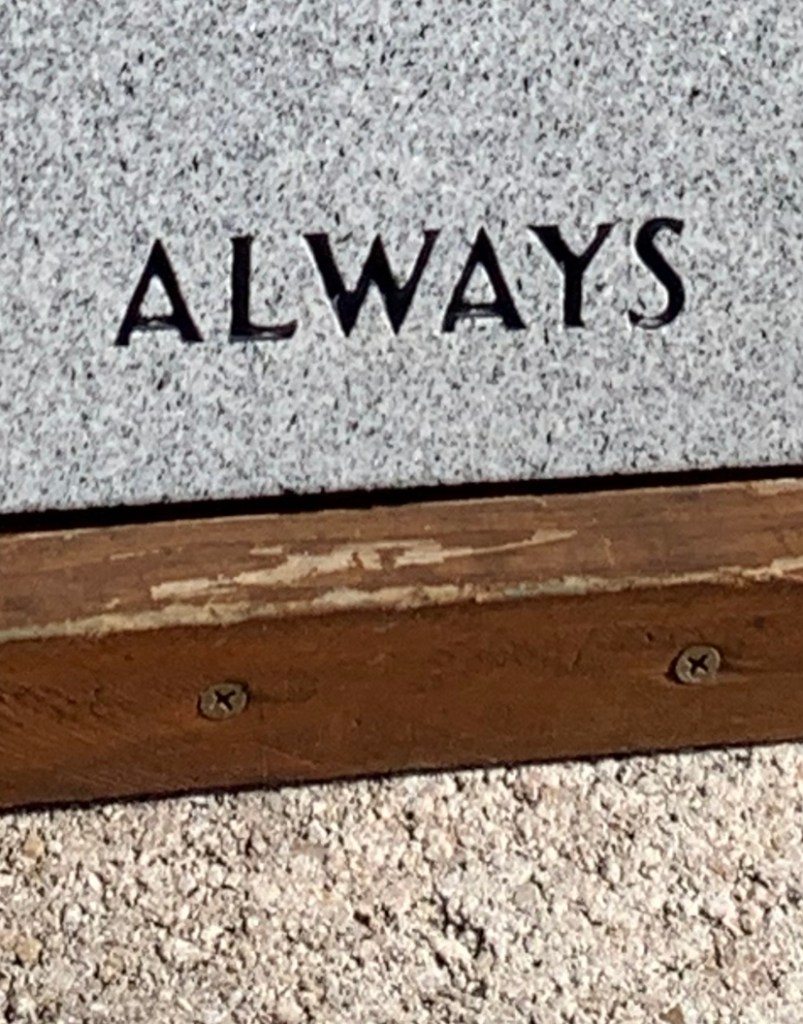
It’s really not so difficult. Before sealing the niche, Kerri played the ukulele and we sang Irving Berlin’s Always: Days may not be fair, Always/That’s when I’ll be there, Always.

Being there. Especially in the moments when life is not fair. Plenty of people have taught me (again and again) the simple power of presence, giving me the assurance that I am not alone. Being there, it’s nothing more or less than knowing how to live.

read Kerri’s blogpost about ALWAYS

Have A Constitutional [on Two Artists Tuesday]

“Have you not noticed that love is silence? It may be while holding the hand of another, or looking lovingly at a child, or taking in the beauty of an evening. Love has no past or future, and so it is with this extraordinary state of silence.” ~ Jiddu Krishnamurti

As the evening cools the heat of the day, we look at each other, no words need be said, stand, hold hands and walk out the gate. In another era, they called this kind of evening stroll a “constitutional.” Walking at days end is good for your constitution, your health.

I’ve learned it’s good for my mental health. All of the energy swirling around inside my brain channels down and out through my feet. Fifteen minutes into our stroll, I take a deep breath. I sigh. The last swirl spirals out. With a clear mind, I relax. I squeeze Kerri’s hand. The beauty of the evening flows in. I can see beyond what I think.

We walk a loop through the neighborhood that winds toward the shore, past the beach house where we held our wedding reception. We follow the path through the park, emerging onto First Avenue along the row of houses overlooking the lake, by Jim and Linda’s old house. Echos of laughter. Good times gone by.

Sometimes we talk. Sometimes not.

The other night, as we strolled in silence, I smiled at how much of my life I spent trying to “get somewhere.” Trying to “achieve” or “obtain” some imagined thing. Always separate from my moment. It made my constitutional that much sweeter, knowing I had no where else I wanted to be. No imagined place, racing around my mind, pulling me from the lapping water, the cooling evening air, my wife’s hand, the sound of our slow walking.

read Kerri’s blogpost about EVENING

Look To The Field [on Two Artists Tuesday]

“…if you observe your mind very quietly without giving explanations, if you just let the mind be aware of its own struggle, you will soon find that there comes a state in which there is no struggle at all, but an astonishing watchfulness. In that state of watchfulness there is no sense of superior or inferior, there is no big man or little man, there is no guru. All those absurdities are gone because the mind is fully awake; and the mind that is fully awake is joyous.” ~ Krishnamurti, Think On These Things

Saul told me to look beyond my opponent to the field of all-possibilities. He even gave it a location, a hundred feet beyond where he stood. We were doing an exercise called push-hands and, as a tai-chi master, he was teaching me not only where to place my focus but also where to place my belief. It took me a few years to grok: believe in resistance and resistance will appear. Call it an opponent and you’ve defined the relationship and, therefore, your choices. An obstacle is only an obstacle because it is identified as so.

I met Kerri because my world collapsed. Did my world collapse or did it open? Saul would say, “Neither.” Energy is energy. It moves and we give story to the movement, thereby shaping it. Storytelling is more powerful than we know.

Saul might as well have said, “The opponent lives in your mind. Look beyond your mind. Look beyond the story.” It’s a good practice to have an experience before naming it. It’s a better practice to have an experience and not name it at all. I’m not there yet, though I can see the field that Saul recommended. It exists beyond my definition-noise.

Saul threw me across the room yet never touched me. He laughed. I wanted to ask, “How did you do that?” but I already knew what his answer would be: “I didn’t. You threw yourself.”

read Kerri’s blog post on this Two Artists Tuesday

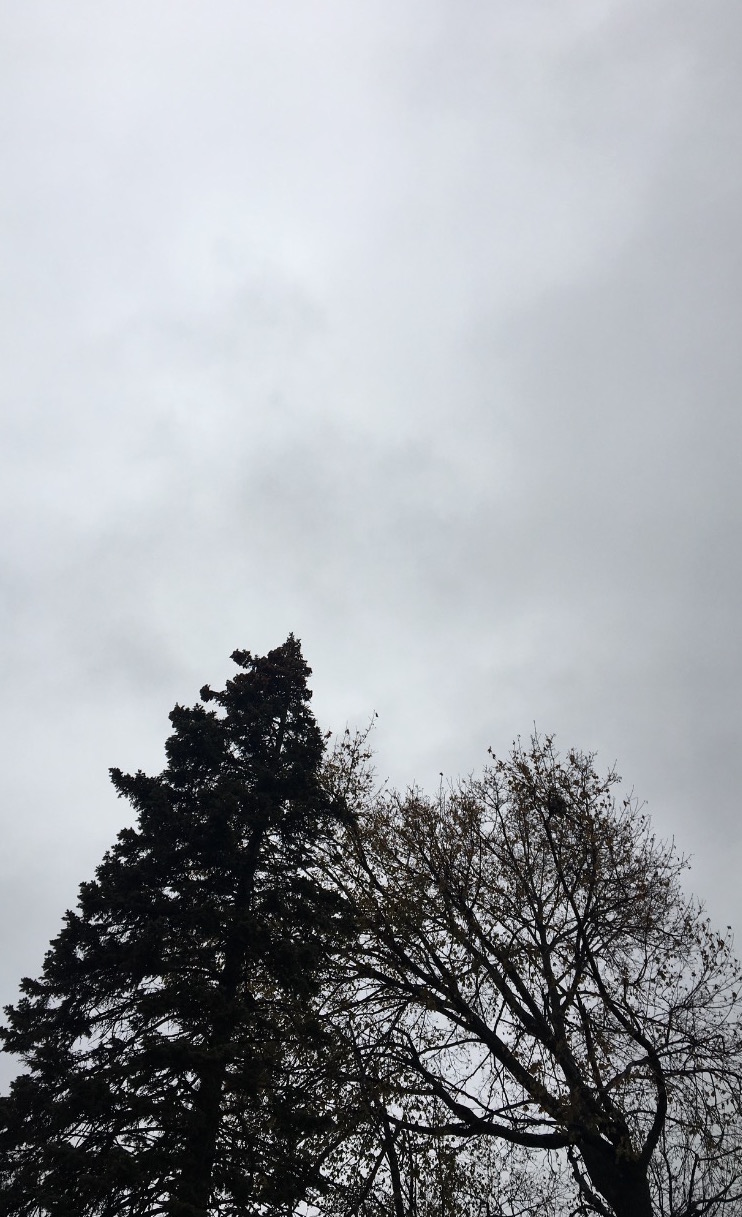
tree and sky © 2021 kerri sherwood

Recognize The Greater [on DR Thursday]

strange sky

“Can a shallow mind appreciate beauty?…When the mind is merely concerned with itself and its own activities, it is not beautiful; whatever it does, it remains ugly, limited, therefore it is incapable of knowing what beauty is.” ~Krishnamurti, Think On These Things

What accounts for the strange color of the sky? Smoke from the fires? A coming storm?

The quote above is only half of the thought. It is the set up for the real point to be made. A shallow mind is concerned only for itself. And, while consumed with the lesser, it misses the greater. It is the unintentional theme that emerged for me this week: losing the greater for the lesser. The baby goes out with the bathwater.

It is a matter of perception, of focus placement.

Yesterday I wrote about the judge questioning the potential juror about his capacity to experience hardship in order to keep the system going and growing. The juror entered the exchange with a self-focus and exited, admonished, with perhaps the possibility of seeing something beyond his own agenda. Perhaps.

I read that Rome fell when the luxuries became more important than the essentials. Societies fall when they can no longer discern between what is important and what is not, when the lesser is protected at the expense of the greater.

Years ago, during a facilitation, a young woman pulled herself from and exercise. She sat on the sidelines and brooded. After the exercise, during the debrief, she claimed that she was discriminated against because her team did not listen to her ideas. Initially, her team scrambled to apologize – one does not want to be accused of discrimination. We asked the team to explore the situation a bit further. Because the young woman’s idea was rejected, was she truly a victim of discrimination? It was an illuminating conversation. The problem – the real problem – arises when we can no longer discern between what is discrimination and what is not? There is terrible discrimination in our world and needs to be addressed. It can’t be seriously confronted if we are incapable of distinguishing between the rejection of an idea and laws that prevent citizens of color from voting.

In a pandemic, a mask is not a breach of personal freedom. It is not the state ripping away control of your body. It is a minor inconvenience to ensure the mitigation of a virus that is killing scores of fellow citizens. Despite the rhetoric otherwise, the fearmongering and tribe-building, wearing a mask is something done for the health of the whole. It is not unlike jury duty.

It is a matter of perception. Of focus placement. Self or other? Lesser or greater?

The rest of the quote: “Whereas, a mind that is not concerned with itself, that is free of ambition, a mind that is not caught up in its own desires or driven by pursuit of its own success – such a mind is not shallow, and it flowers in goodness. Do you understand? It is this inward goodness that gives beauty, even to a so-called ugly face.”

Pay attention to the verb. Beauty is given. Concern for the well-being of the other is a sentiment expressed and championed in every corner of the world, by all the figures we quote, elevate, and sometimes emulate. Martin Luther King, Ghandi, Abraham Lincoln, Mother Teresa,…it’s a very, very long list.

Communities thrive when they are capable of enduring hardship for each other, for the benefit of the whole. They also thrive when they hold boundaries and protect the rights of the individuals. Those two seemingly different actions are, in fact, one and the same.

Societies fall when shallow minds prevail, when they can no longer discern between essentials and luxuries, privileges and responsibilities. When personal comfort takes precedence over enduring ideals.

It’s a matter of perception. Of focus placement, and make no mistake, focus is easily led. Just like a package of pastrami mistaken for a strange colored sky.

read Kerri’s blog post about PASTRAMI SKY

shared fatherhood ©️ 2017 david robinson