Mutually [David’s blog on Flawed Wednesday]

“Objects are such only with respect to other objects, they are nodes where bridges meet. The world is a perspectival game, a play of mirrors that exist only as reflections of and in each other.” ~ Carlo Rovelli via The Marginalian, April 27, 2025

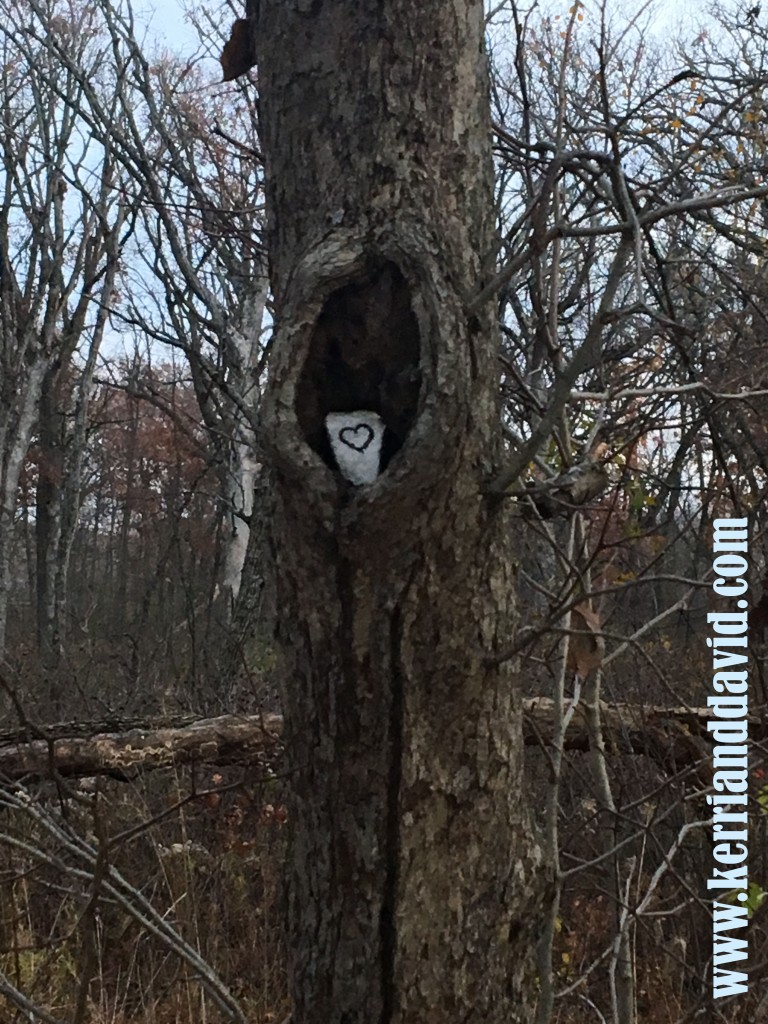
The tree stands beyond our back fence, its limbs spiral and twist, sculpted by time and the force of the winds roaring off the lake. Looking at her photograph, a silhouette against an evening blue sky, I remarked, “It’s a Jackson Pollock painting.” She looked again at her photograph through the lens of my remark, nodding.

Nature sculpts the tree that catches the photographer’s eye, her photograph invokes images of a drip painting. “…interaction is the fundamental reality of the universe, that there are no entities as such…”

We do ourselves a great disservice ignoring interconnection in service to our separation.

It’s human: we need to make sense of things so we compartmentalize. We object-ify, detaching tree from time and wind from photographer, assigning all to discrete little box-identities, placing emphasis on the noun rather than on the interplay, the intertwining verb. In our minds we stop the motion, sever interrelationship into distinct pieces, so that we might convince ourselves that we have a grasp on “reality”. In creating objective “reality” we blind ourselves to the greater mutuality.

Science dissected the world-body into parts which led to the smallest objective part, called a quantum, and discovered it’s a slippery devil, energy, that can only be described subjectively. It can only be known through its relationships. Mutuality.

I’ve yet to hear an adequate definition of the word “woke”. Maga world flings it liberally and with sharp derision to describe all manner of “progressive” ideals, yet stutters when asked what it means. It’s an umbrella term, a catch-all, like the grainy photograph of the Loch Ness monster, shaky proof of something to be feared but mostly unknown. In fox land, this Loch Ness monster is called “socialism”.

To Maga world I offer this definition of Woke: greater mutuality. Woke, like a quantum, cannot be objectified just as compassion cannot be fully defined. It can be experienced. It is an energy, connective tissue.

Woke flies the flag of equality. Woke understands that the suspension of due process for any single person is the suspension of due process for all people. Woke understands that prosperity reserved for the few means poverty for the many. Woke intends shared prosperity, an equal playing field, helping hands. “Float all boats” is a Woke ideology. Woke is not a hand-out, it is a help-up. A moral center – also known as mutuality – is Woke; we can be our brothers’ and sisters’ keeper or we can be their persecutor. Keeper or persecutor: both describe a kind of relationship.

Woke is what defines Maga just as Maga is now clarifying Woke. Maga desires separation. It strives for elevation above others; legislated privilege. Woke desires equality. It strives for a more perfect union: legislated inclusion. The promise of possibility.

We do ourselves a great disservice: we are neither red nor blue. We are not conservative nor progressive. We are not Woke or Maga. Those terms are boxes that ignore the fundamental truth of our – or any – nation. We are interconnected. We are a relationship.

Remove environmental protections and all of the air we breathe and the water we drink will be polluted. Remove election watchdogs and all of our elections will be corrupted. Remove a commitment to truth and lies will define us and pull us apart.

After all, Maga is a made-up-media term just as is Woke. They are boxes meant to give us an enemy, the illusion of separation.

Democracy is not a “thing”, an object. It is a movement, a quantum. We know it by our interactions as defined in our Constitution. We know it as a place where bridges meet. Where people from many places come together.

Whether Maga or Woke, we will feel the loss of democracy equally just as we feel the disintegration of our values, our shared narrative, our aspiration for justice-for-all; mutually.

read Kerri’s blogpost about THE TREE
likesupportsharesubscribecomment…thankyou.

Walk The Path [David’s blog on DR Thursday]

It’s been awhile. I’ve fallen into an art book, Ancestral Modern: Australian Aboriginal Art. I bought this book after attending the exhibit at the Seattle Art Museum. It was – and still is – one of my favorite exhibits, reaching me on many levels. I went back again and again so I might spend quality time with a few of the paintings.

The paintings of the Aboriginal artists are mythologies, though not as we think of mythologies. They are more than dusty stories. Explanatory. They are active guides on a life path. Were I Aboriginal I’d “read” them. I’d know the stories so each piece would speak personally to me. The paintings would escort me along my life-path. Mythology as my story.

This is what amazed me most: many of the pieces were as abstract as a Rothko or Frankenthaler. Vibrant lines and color. They shimmered. Dreaming. Living foundational narrative carried in energetic swirls and dots of paint.

In my experience it is not uncommon in a gallery or museum to come across someone puzzling over a painting by a master artist and hear them say, “I don’t get it.” The abstraction is a closed door. “I could do that,” I heard a man huff while staring intently at a Jackson Pollock painting. The door is not closed between the Aboriginal artist and his or her community. The mythology has not broken down. The artist is not exclusively serving an individual expression, rather, they are maintaining an ancient connection, drawing from and carrying forward the deep well of communal story. “Meet Blue-Tongued Lizard Man…” Artists paying homage. Artists serving their role as keepers of the flame.

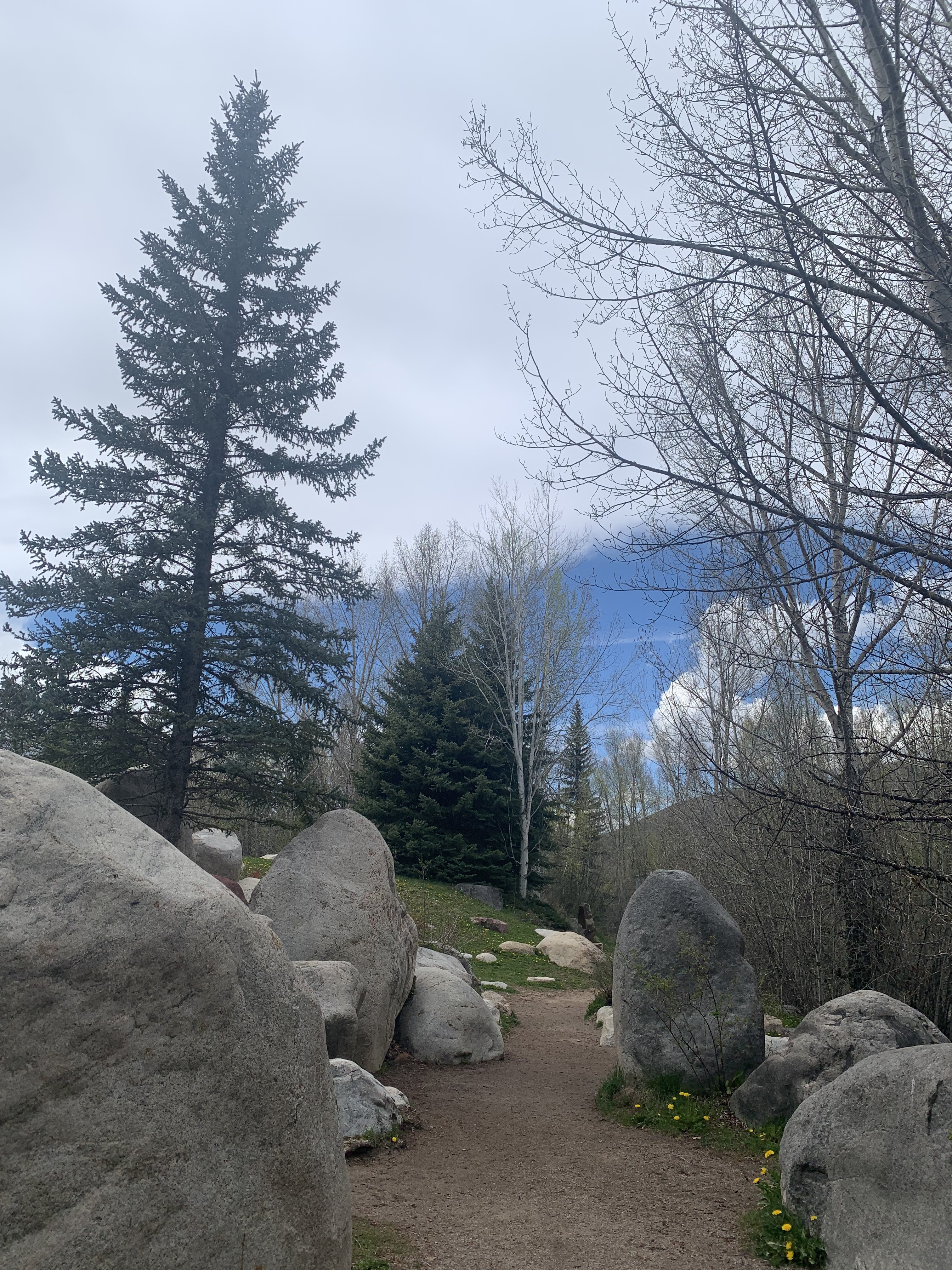
Kerri and I talked of our artistry as we walked the paths of the John Denver Sanctuary. He was a guide-star for her and continues to influence her work. Simple lines. Music that does not rely on acrobatics or embellishment. It was poignant that we had the sanctuary to ourselves. Sometimes it is nearly impossible to know whether or not our work-in-the-world reaches anyone or serves any real value beyond satisfying our imperative to create it. And sometimes, like that day walking the path through the sanctuary, the clouds rolling over the mountain, the Roaring Fork River singing at our side, the ancestry is clear. “This is where I come from,” she said. “This is where I belong”.

read Kerri’s blogpost about THE PATH

like. support. share. comment. subscribe. thank you.

See The Third [David’s blog on DR Thursday]

Rules of composition are really a study of human perception. It’s not the work of art that’s being examined, it’s the human being. Why do we consistently – universally – respond positively to visual compositions that follow the rule of thirds? Divide a composition into thirds, either vertically or horizontally, and then place focal areas of the “scene” at the meeting points of the lines. A professor in art and design school teaches the rule as a basic tenet, not because it was a concept that was invented but because someone, somewhere in time, noticed that people generally like their paintings, photographs, murals, quilts, architecture… when the focal point lands on one of the thirds. It was a discovery about the nature of people. Human nature.

Even the most abstract painters adhere to the rule of thirds. There is structure beneath seeming chaos.

There is something about humans and the number 3. The structure of a joke has three parts – the set-up, the detail, and the punchline. Most religions sport a trinity: father, son, and holy ghost. Brahma, Vishnu and Shiva. Buckminster Fuller’s Geodesic Dome is a festival of three. Pay attention and the rule of thirds pops up in everything from brain science to marketing messages. Triangulate and even the most lost hiker will be found.

When I first met Kerri I was disconcerted. Her compositional eye is infinitely better than mine. How could this musician come into my studio, snap a photo of my work-in-progress, and show me that her cropped version of my composition was infinitely better? What the heck? Her crops were never radical; simple adjustments merely. After I recognized how natural yet specific her eye sees the thirds – while I am clumsy in my seeing – in a fit of re-composing, I almost took a saw and scissors to my paintings. It was so obvious. Now, I ask her early and often to come into the studio and tell me what she sees (Imagine my horror when she stands silently for several moments and finally utters, “Well…”).

On the trail she stops often to “take a picture.” I play a game with myself. I look at where she aims her camera and then I predict where the focal point will land. Which third will claim the prize? I am almost never right but always delighted by what she shows me. “Lookit!” she says, smiling. A perfect third. Naturally.

prayer, 9″ x 24″ acrylic on hardboard

read Kerri’s blogpost about LACE AND SNOW

like. support. share. comment. many thanks

buymeacoffee is not a third. It is something else.

Babble [David’s blog on KS Friday]

This could be a Jackson Pollack splash painting or an x-ray of arteries, veins and capillaries. A winter sun attempting to reach through the cover of clouds and trees.

If I believe the forecast, as hard as it tries, the winter sun will not reach us today.

I’m paying attention to language a bit more than usual. Looking up through the veins and arteries of the tree, I ask myself: What could it be? What could be? What is “it”? I shiver and am reminded of a quote I used in my book. It is appropriate for our times:

“One must be leery of words because words turn into cages.” ~ Viola Spolin

Language Matters. A double entendre. One of my favorite. It’s right up there with my favorite double entendre title of a book: The End of Education. Classic Neil Postman.

The question is, in our day-and-age, amidst the torrent of words and the easy belief-systems that words construct, how to stay out of the cage?

It’s a question with roots back to The Tower of Babel. A human race united by a single language builds a tower that reaches into the heavens. It is a threat to Yahweh. To protect his status, he confounds their speech and scatters them around the world. Language is the barrier against unity.

A bramble of branches to a Pollock painting to the inner working of life-blood to a weather report and landing at last in the Tower. An epic journey in just a few words, reaching through metaphor and pattern.

Language can be a cage. It can also set us free. Language Matters. A double entendre.

Nurture Me/Released From the Heart © 1995 Kerri Sherwood

Kerri’s albums are available on iTunes and streaming on Pandora and iHeart Radio

read Kerri’s blogpost about WINTER SUN

like. support. share. comment. all words that describe actions that we appreciate.

buymeacoffee is. nothing more. nothing less.

Have Second Thoughts [David’s blog on DR Thursday]

A comment on how my brain works: I saw this photo and thought, “This is a record of a life path.” What? Where did that come from?

Note: I didn’t think “My life path.” My random reflection was in no way personal. Though, to be perfectly honest, I am only familiar with one life path and it is mine. This jumble of hose, running this way and that, lines running over and under, does vaguely resemble my movement in the world. Or a freeway interchange as seen from the air.

Note on the note: No life path is straight. Circumstance has a way of making lines into loops. Growth has a way of revealing side paths that surprisingly become main roads. Yes, I’m making the assertion that a straight life path indicates a boring-no-growth existence. It would be an excessively mean assertion except, to reiterate, no life path is straight. Loops and surprises. Forces beyond control, leading to the wild eye-and-heart-opening recognition that very little is under our control. Fantasies fall revealing a life that shimmers in its day-to-day-ness as it spirals uncontrollably through the universe.

My second thought: “This reminds me of a Jackson Pollock painting.”

Another comment on how my brain works like most other brains: Second thoughts usually make more sense than first thoughts. That’s the key to sense-making: second thoughts respond (or recoil) from the nonsense of first thoughts.

A note on first and second thoughts: It’s best not to give voice to first thoughts. Wait for the second, more sensical thought for show-and-tell. Editors are involved. You’ll have more friends that way. Also, the authorities won’t need to lock you up. So, forget what I said about life paths and selectively remember my second thought about Jackson Pollock.

Remember: I warned you. This is how my brain works.

[I wish you could see Kerri’s eye-roll as I read to her this post:-) ]

read Kerri’s blog post about THE HOSE

comment. support. share. like. all good things that we appreciate.

buymeacoffee is an online “tip jar” where you can support the continued work of the artists you appreciate.

Spread The Warm Disobedience [on Merely A Thought Monday]

The roads around here are a mess. There’s a major road-widening construction project that’s in its second year. Orange barrels, heavy machinery, multiple lanes too quickly squeezed into a single pathway (“Zipper merge!” we mock-shout and laugh, borrowing a phrase from Kirsten), lines painted and repainted making a Jackson Pollock mess of the guide stripes. People in the midst the holiday rush are amped-up angry drivers, impatient with the mess, leaning on their horns, cutting off other drivers to get-there-first.

Get-out-of-my-way meets the-season-of-giving. Defensive driving morphs into aggressive driving. It brings back memories of life in Los Angeles and Dwights-survival-advice: “You have to force traffic if you want to get anywhere alive,” he said. Hesitation is deadly. L.A.-style dog-eat-dog-driving has come to Kenosha, Wisconsin.

And then, when you least expect it, in the middle of the snarl, a person slows, makes space for a car trying to enter the fray at an impossible junction, and gestures, “Come in.” Their simple act, considering the needs of another, is shocking. ‘You first,” seems revolutionary.

My favorite part: it sends a shock through the roadway and ignites a momentary ripple of kindness. Drivers make space for other drivers. Courtesy returns for the blink of an eye before disappearing back into the fury.

Kindness ripples. It happens every time some brave soul slows down in the violent storm and realizes that they are not alone on the planet and wonders, “How can I help right now?” Their act of warm disobedience spreads.

read Kerri’s blogpost about KINDNESS

Choose The Lesser Chaos [on DR Thursday]

“If I choose abstraction over reality, it is because I consider it the lesser chaos.” ~ Robert Brault

And what isn’t an abstraction? Dealing with ideas rather than events? Not-the-thing-but-is referential-to-the thing?

Every word in every language is an abstraction. Every thought that zips through every brain is an abstraction. Not the thing but referential to it. The word “chair” is not a chair.

I caught myself in a sticky net. Not once, several times. I’ve tried again and again to paint “abstractions” only to whine, ‘I can’t abstract!” [insert laugh track]. A painting of something is, by definition, not the something. Picasso had a heyday playing with people’s minds around this idea, this abstraction.

After an unexplainable medical event, my doctor shrugged and said, “Sometimes there is no explanation. People like to rationalize things. They think if they can explain it, they can control it.”

Explain Pollock or Rothko. Diebenkorn’s Ocean Park series. Ellsworth Kelly.

And who wouldn’t rather spend time pondering the sense of Richard Serra than anything we read in the news?

read Kerri’s blog post about ABSTRACTION

earth interrupted © 2012 david robinson

Break It [on KS Friday]

Breaking space with a line changes the dynamic of the entire composition. I played with those dynamics for years. Vertical breaks. Horizontal lines that read like confused measure bars, segments of inconsistent time. Sometimes the lines tilted and pulled to the past. Sometimes they leaned into the future, urging the image forward. All of those interpretations were, of course, in my mind; I have no idea how others interpreted the lines on my canvases.

We are in the season of fog. Sometimes it’s so dense that we stand on the rocks and cannot see the water. Lake Michigan is hard to hide! The fog is a worthy magician.

The fog-magician also has the capacity of pressing three dimensional objects into seeming flat two dimensional images. The sudden silhouetting of the world pulls Kerri out onto the deck every time. “Can you believe it?” she asks, grabbing her camera and stepping through the door and into the fog. Dogga and I watch. We are happy in three dimensions and resist the call of stepping into flatland.

When she returns to our dimension, she shows us her photographs. “I love this one because the wire made a line,” she says. “It breaks the image.”

I smile. Vertical breaks in the composition. I say, “It reads like an abstract painting.” Three dimensions becoming two, a line breaking space, capping or pulling or simply interrupting.

Jackson Pollock believed his paintings were recordings of movement. Paint dancing. Who really knows how others interpret his paintings. Beyond the curator or art historian, who cares, really? The relationship between art and audience is meant to be direct, pure. No third party interpretation necessary.

“What do you think?” she asks.

“I love it,” I say. “It makes me want to paint.”

kerri’s albums are available on iTunes & streaming on Pandora

read Kerri’s blogpost about FOG

when the fog lifts/this part of the journey © 1998 kerri sherwood

Causal Your Effectual [on DR Thursday]

KDOT Underpainting copy

under-painting of One Chord Ahead

This is my version of under painting. It’s the base layer for what-comes-next. In school, they teach that under-painting is mostly monochromatic. It’s meant to give value definition and basic shape to an-already-determined composition. For me, it serves another purpose altogether.

It is true that I already know what this painting looks like when it is finished. I have the image in my head. It is also true that I have absolutely no idea what this painting will look like when finished. There’s a magic point in the process when the painting takes over and I follow the leader. I’ve learned that the real dance of artistry is to let both of these truths be…true. Know and not know. Lead and follow.

Under painting, for me, is psychological prep work, readiness to enter the paradox. It is my process of thinking-things-through so I can stop-thinking-things-through and enter the dance without focusing on the steps.

Causal and effectual. I first encountered these phrases when I waded into the world of entrepreneurs. They are process terms. Causal basically means that you begin with a goal in mind and map your steps to meet the predetermined goal. Effectual is the inverse. Looking at the maps (choices) and available resources, the goal is identified based on what’s available; the goal is fluid and changes as you progress.

Raphael was causal. Jackson Pollock was effectual. Maybe.

I laughed when I first heard the terms. They gave me some good language to use for my creative process. Causal/Effectual. Both/And. For me, one cannot live separate from the other. Start with an image in mind or start with a canvas, some paint, and see what happens. Either way, one process will inevitably cross paths with the other. Jackson Pollock, at some point in his random painting dance, became intentional and compositional with his spatter. Raphael, at some point in his tightly predetermined composition, allowed his brush to flow, to move intuitively, freely.

Under painting = I have to make color messes and utterly stifle a composition before I can stand at the edge, jump, and set myself free.


read Kerri’s blog post about UNDER PAINTING


their palettes website box copy


unfettered ©️ 2018 david robinson