Pluck The Symbol [David’s blog on DR Thursday]

Tonight, as we near the day of clover, the celebration of St. Patrick’s snake dance, we will make corned beef and cabbage for our weekly dinner with 20. There will be Guinness, too. The snakes in the story, by-the-way, are symbolic. There were no actual snakes in the region. Remember, as I will when tipping my Guinness, it’s a religious holiday though, through the advent of Guinness, pagans like me can play, too.

One of my favorite things about human beings is how blind they are to their natural curiosity. For instance, read the wikipedia entry for four-leaf clover! There’s layers and layers of data on the odds of finding a four-leaf clover. Sometimes curiosity looks like study. Sometimes it looks like science. Or engineering. It’s one of my least favorite things about human beings: we can kill the spark, snuff the magic of the curious story-telling-mind, by how we tell the story.

Believe the snakes are literal and you miss the point of the story and misunderstand the reason for the holiday. The same is true with arks filled with animals and the Red Sea parting. Metaphors made literal: the apple remains uneaten. Knowledge dies on the vine.

Symbols open stories. Symbols make the story universal which is impressive if you stop and think about it. How can two people, living in two different cultures, who don’t share a common language, understand in-a-flash the same idea? Symbol. Metaphor. Heart openers. Mind expanders. Experience joiners.

In the epic of Saint Patrick, as a pagan I’d be one of the metaphoric snakes driven into the sea.

And remember, the data suggests that for every ten thousand three-leaf clover that you spy, you’ll find one stem with four. A symbol of good luck, no matter what the data suggests.
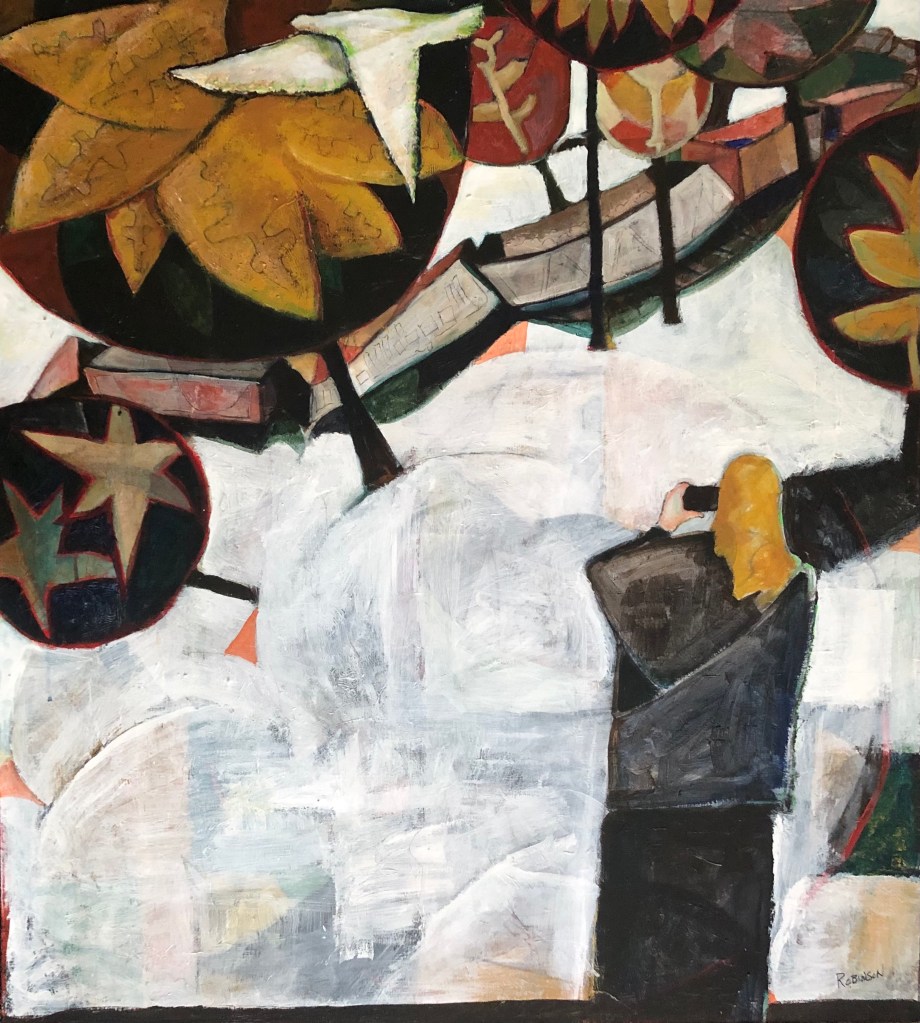
Train Through Trees, 51″x46″, mixed media

read Kerri’s blogpost about CLOVER

like. share. subscribe. support. comment. (thank you)

Stir It [David’s blog on Two Artists Tuesday]

Kerri explained to the woman at the shop that she rarely uses things for their intended purpose. For instance, we have a collection of old coffee pots that she uses as canisters in the kitchen. The end-table beside our couch is the drawer section of an old desk. It was sawed-off when she found it. Our walls sport old window frames and screen doors. We have a stack of old suitcases that we call “special boxes”. They hold the memorabilia of our life together: programs to performances, adventure day train tickets, cards from friends…

Things used as other things. It’s the hallmark of a creative mind. It’s the joy of her creative mind.

At the time, she wasn’t sure what she was going to do with the chunk of concrete. She just knew it had to come home with us. The woman at the shop had no idea what the chunk of concrete was originally used for – and the mystery made it more attractive to Kerri. It was signed and dated on the bottom. More mystery. More attraction. “What are we going to do with it?” I asked, wondering if I could actually lift it into the truck.

“I don’t know yet,” her eyes sparkled, the imagination-wheels turning. “Something.”

“Something,” I gasped, hoisting the chunk of concrete to the tailgate of the truck. I was grateful that it was round and rolled it the rest of the way into the bed. “You are something. You will be used for something.” I sat on the tailgate, catching my breath as Kerri and the woman disappeared into the shop to look at things-used-for-other-things.

I remembered once, running a spotlight for a show, the light broke mid-performance and I fixed it between cues with a frostie cup from Wendy’s, duct tape, and the sleeve of a jacket. It’s a valuable skill in the theatre: things used as other things. Ask any prop-master. The entire art form is recognizing the multitude of potential uses inherent in the most mundane objects.

My artist group once challenged me to explore beyond of my known art form so I sculpted crows from found objects. Wood, clamps and wire hangers. I loved it. It stirred my imagination.

Stirring the imagination. It’s what I appreciate about the home Kerri creates. Nothing is what it was intended to be. Everything is a wonder and can be transformed. Even a chunk of unidentifiable concrete. After a move into the house that made me appreciate the toil involved in building the pyramids, the chunk of concrete has now met its destiny. It is a side table and sports an old-school iPod sounddock. It couldn’t be more perfect. “I love it,” she says every day.

Me, too.

read Kerri’s blogpost about the CHUNK OF CONCRETE

like. share. comment. support. repurpose. imagine it.

buymeacoffee is anything you can imagine it to be.

Dream [on Not So Flawed Wednesday]

When does a dream turn into a goal?

Lately, I’m having conversations that confuse me. Business thinking, engineer minds, make models for creation. Creativity plans as action templates and guides.

Screen writers make plans, too. Step outlines. The difference is in the process. A creative mind makes models and plans with full intent to throw them away. To discover the best story, their plan involves making space for the better idea. Open up by tossing the model. Clear the deck by shuffling the plan. Sketches and rough drafts. It’s a conversation with the muse. Muses are notoriously structure resistant until the story makes an audience sit forward. Movement first. Then, the structure begins.

The engineer mind works in the opposite direction. The dream must wear the mask of a goal or it is considered invalid. Too squishy. Construction begins immediately with targets and tasks. Order. It is, in fact, the same process as the creative mind, only it is less forgiving of space. It forces the muse to move. Time is of the essence. Structure first. Then movement. Efficiency is a tree with shallow roots.

It confuses me. Dreams do not wear ties or leather shoes, yet, scrape the blueprint and you’ll find a dream every time. Perspective requires stepping away from the canvas. Standing too close for too long and loss of vision is the result. Every time. It’s not a mystery or voodoo. It’s physics. Great ideas and idea-break-throughs happen in the shower or walking on the trail. A clear mind. A different focus creates space. Too tight thinking, too close in for too long, sucks energy.

Once upon a time I worked with organizations and educators. They also confused me. Squeezing the air out of their space they’d gasp, “We can’t breathe.” A little bit of space, some play, a refocus on the relationships was good medicine. Fresh air. Step back and see the painting. The point of perspective is to see. The secret: permission to remove the status games and need to be an authority and, for a moment, reconnect the players to their dream.

At the nucleus of every goal beats the wild heart of a dream.

read Kerri’s blog post about DREAM

Feed It [on KS Friday]

“The devaluation of music and what it’s now deemed to be worth is laughable to me. My single costs 99 cents. That’s what a single cost in 1960. On my phone, I can get an app for 99 cents that makes fart noises – the same price as the thing I create and speak to the world with. Some would say that the fart app is more important. It’s an awkward time. Creative brains are being sorely mistreated.” ~ Vince Gill

I am the first in line to tell you that everyone has a creative mind. Everyone. That river of ridiculousness running between your ears is nothing other than creativity-run-amok. What else? Telling yourself that you are not creative is, in itself, a creative act. Seeds planted early in life grow into mighty obstructions. Creative wastelands are created. If you want to hear a terrific appeal to educators to nurture rather than stifle the creative mind, listen to Sir Ken Robinson’s 2006 Ted Talk. It’s appropriately titled “Do Schools Kill Creativity?”

I’ve listened to numerous school boards tell me how much they truly value the arts – until it’s time to pay for it. Sadly, it’s not a question of whether or not they value the arts; it’s that the arts, the creative minds, do not fit any of the standards of valuation against which all things are measured. They do not know how to value the creative minds that they steward. Arts organizations and artists, mostly, are not money makers. Creative minds, creative acts, do not fit in the boxes and are not measurable on standardized tests. Thinking outside of boxes is, after all, the point of a creative mind. Metrics and goals stop a creative mind and heart in its tracks. The cruelest thing you can ask any artist to do is write a grant.

And yet, an artist has to make a living. Yaki asked me if I had to choose between making a living and making my art, which would I choose? I answered, “Art, of course,” but that it was really a question of Maslow’s hierarchy: it’s hard to make art when you are not surviving. What I didn’t say is that his question perfectly captured the reason schools kill creativity and creative brains are sorely mistreated: it is assumed one must choose between. Making a living and thriving creativity are understood as oppositional.

How many parents have tried to dissuade their children from following their passion for the arts? How many times have I heard Kerri say of the stacks of music on her piano waiting to be recorded, “What’s the use?” How many times have I sat in my basement studio looking at my stacks and rolls of paintings and wondered, “Why bother?” We do it to ourselves, too.

And then, the phony metric falls and we breathe, pick up our brushes and sit at our keyboards. There is a river of riches that runs deeper than money. It is, after all, a creative act to kill a passion. It’s also a creative act to feed and nurture an artistic soul. Both. It’s what the school board doesn’t understand: the choice is not between making a living or living as an artist, the choice is between feeding inspiration, expanding a creative mind, or smothering it.

read Kerri’s blogpost about CREATIVE MINDS

Kerri’s albums are available on iTunes and streaming on Pandora

watershed/as it is © 2004 kerri sherwood

Move Toward Wholeness [on Two Artists Tuesday]

When I look at the bowl of green tomatoes, each plucked from the vine before we pulled the plants from their pots, still moving toward red ripeness, I think of Joe. He was fond of saying, “Life moves in the direction of wholeness.” It’s important to note that his fond phrase included nothing about outcomes. Joe was particular and knew that life is movement and not arrival.

I am revisiting the word ‘rehearsal’ these days only this version of rehearsal is not on the stage with creative minds. It is over Zoom with decidedly analytical minds. Actors in rehearsal halls move through a process of exploration that leads to specific choices. The goal, if there is one, is to embody a state of moving presence within a story. The analytic mind comes with a template overlay that is placed atop the experience before it actually occurs. The language reveals all: content items. Telemetry. The mathematics of movement. Rehearsal is predicated on precision.

As I’ve probably written ad nauseam, these minds are not in opposition. They are complimentary. Freedom of artistic expression comes from years of study of technique. The path to mastery winds through repetition and constraint. Saying more with less comes after a lifetime of saying less with more. The creative mind is one step closer to the senses. The analytic mind applies language, gives voice, to the experience.

Many years ago I participated in a workshop with an actor/director of Noh Theatre. The process was strict, exacting. The movements precise. There was no room for error. We, the participants in the workshop, knew we’d never achieve proficiency since it takes years and years of rehearsal to perform even the simplest of symbolic gestures. No one sings opera in a day. We did our best and failed and failed and failed. That was the point. That is always the point. Each failure is actually an exercise of muscle memory. The body learns. The mind is impatient. Rehearsal is rarely about the mind, despite what the mind insists. At the end of the day, our workshop leader gave a short demonstration of his art form. His ease of movement, born from years of repetition within constraint, was breathtaking. He was free.

Many years later I was helping John in his wood shop. He was a master wood worker. I watched him look over his lumber, preparing to build a cabinet. He ran his hand over the wood, feeling his way into his project. “Ah,” he said, laying his hand on a piece of cherry wood. “This is it.” John was like the Noh actor.

“How did you know?” I asked.

“I don’t know,” he said, “it just feels right.” Then he smiled and added, “Plus, I’ve built a lot of crap.”

Life, moving toward wholeness.

read Kerri’s blog post about TOMATOES