Care For Your Space [on Not So Flawed Wednesday]

It seems like such a simple concept. Tom taught it. So did Paul. And, since I was one of their students, I taught it, too. How you treat your space is a reflection of what you think of your art. The concept is universal. Replace the word “art” with “work” or “life.” You and your space are not separate. We worked hard at the theatre to become better artists and produce better plays and a significant part of that work was bettering and maintaining our artistic “home.” We were proud of our work and it showed -everywhere. Our “space” included our community and our art was meant to make it better.

Yesterday it was warm so we took a walk on a favorite loop. As we returned to the car we watched a man clean out his truck. He’d come to the park, not to walk or appreciate the quiet. His purpose was to dump his trash onto the paved lot. In an earlier time, pre-gun-gun-everywhere, we might have said something. Instead, we stared in disbelief. His space,I thought, does not extend beyond his truck. Neither does his community.

Yesterday, after the walk I received a text from Mike. He was a big part of my long-ago theatre. He’s realizing a dream and opening his own theatre. He’s led a company for a few decades but they didn’t have their own space. Now, they do. He – the artistic director – was mopping the floor and paused to send me a text. It’s the other part of the lesson from Tom and Paul. And Demarcus. And Quinn. There’s no hierarchy. There’s no above and below. Loving the space, loving the art that happens in the space: no separation. One and the same for everyone involved and everyone needs to be involved.

You and your space are not separate. The care you take of your outer space is equal to the care you give to your inner space. And, vice-versa.

[visit Justin’s to see how a company can make a better world]

read Kerri’s blogpost about NEAT EARTH

Step Out Of Line [on Merely A Thought Monday]

“…the fountain of creative work is an intelligent questioning of the rules.” ~Alan Watts, Tao: The Watercourse Way

“If someone tells you they know, they most certainly do not.” It’s not a direct quote from Quinn but it’s close enough. Art school almost snuffed the art in me; there were so many rules and nary a hint of curiosity allowed in the studio. I fled into the theatre after a single year for fear of losing my heart to a book of rules. My theatre professors were explorers of nature. Their refreshing mantra was, “Well, let’s find out!”

What if…? What happens if…?

Nature is boundless expression. Boundless expression is human nature, too, until it is taught otherwise. Boys don’t cry. Be a good girl. Sit in your desk. Follow the rules. There’s a right way. My way or the highway…So much effort to force nature – your nature, your curiosity, to stand on a line.

Einstein revolutionized our world because he dared to posit that Newton had it upside-down. Thank goodness, as Alan Watts observed, “The scientist and the mystic both make experiments in which what has been written is subordinate to the observation of what is.” In other words, they look beyond established belief, expectation and entrenched norms into what is.

What is? Curiosity. A desire to know what’s over that hill. No child begins their life-walk by desiring to color within the lines. Lines are a learned thing. The word “wild” was invented by people whose ancestors emerged from the woods and who have forgotten that they, too, are part of nature – so have become afraid of stepping into the woods. What might they – we – find there?

“It’s not an idea problem,” David Burkus wrote in the HBR, “It’s a recognition problem.” Stepping beyond the known – a great definition of curiosity – is too often seen as an aberration or an assault upon authority. Nip it in the bud. Forcing flow into a fixed state invariably causes idea-blindness and the imperative to think-outside-of-the-box. Innovations are too often smothered in the crib by “What we know,” or “We don’t do it that way.” Coloring in the lines, once ingrained, is a life-long-book-to-follow.

I wish I had a nickel for every time I’ve been invited into an organization or hired by a client to help them “see what they cannot see,” and then subtly or not-so-subtly, been rebuked for opening their eyes to what is in plain sight…or the availability of alternative paths. “We want a vital arts program but we only want art that entertains,” said the school board after the student play asked a serious question of their audience. “…the scholastic theologians would not look through Galileo’s telescope because they considered that they already knew, from Scripture, the order of the heavens.” (Alan Watts)

Think outside the box – as long as you stay within the model or the expectation or the rules. So many models. So many lines. So in love with the struggle and afraid of the simple, natural joy of curiosity. Bend your will to the line. See what you are supposed to see and look no further. What, exactly, are we trying to control?

read Kerri’s blog post about CURIOSITY

Feed It [on KS Friday]

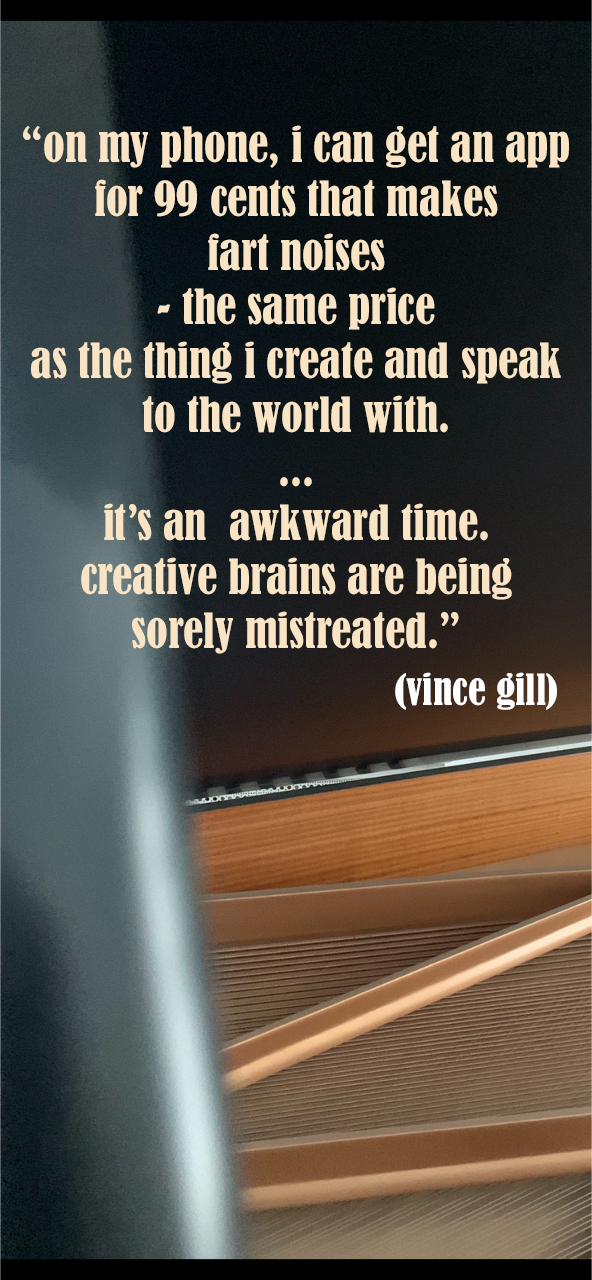
“The devaluation of music and what it’s now deemed to be worth is laughable to me. My single costs 99 cents. That’s what a single cost in 1960. On my phone, I can get an app for 99 cents that makes fart noises – the same price as the thing I create and speak to the world with. Some would say that the fart app is more important. It’s an awkward time. Creative brains are being sorely mistreated.” ~ Vince Gill

I am the first in line to tell you that everyone has a creative mind. Everyone. That river of ridiculousness running between your ears is nothing other than creativity-run-amok. What else? Telling yourself that you are not creative is, in itself, a creative act. Seeds planted early in life grow into mighty obstructions. Creative wastelands are created. If you want to hear a terrific appeal to educators to nurture rather than stifle the creative mind, listen to Sir Ken Robinson’s 2006 Ted Talk. It’s appropriately titled “Do Schools Kill Creativity?”

I’ve listened to numerous school boards tell me how much they truly value the arts – until it’s time to pay for it. Sadly, it’s not a question of whether or not they value the arts; it’s that the arts, the creative minds, do not fit any of the standards of valuation against which all things are measured. They do not know how to value the creative minds that they steward. Arts organizations and artists, mostly, are not money makers. Creative minds, creative acts, do not fit in the boxes and are not measurable on standardized tests. Thinking outside of boxes is, after all, the point of a creative mind. Metrics and goals stop a creative mind and heart in its tracks. The cruelest thing you can ask any artist to do is write a grant.

And yet, an artist has to make a living. Yaki asked me if I had to choose between making a living and making my art, which would I choose? I answered, “Art, of course,” but that it was really a question of Maslow’s hierarchy: it’s hard to make art when you are not surviving. What I didn’t say is that his question perfectly captured the reason schools kill creativity and creative brains are sorely mistreated: it is assumed one must choose between. Making a living and thriving creativity are understood as oppositional.

How many parents have tried to dissuade their children from following their passion for the arts? How many times have I heard Kerri say of the stacks of music on her piano waiting to be recorded, “What’s the use?” How many times have I sat in my basement studio looking at my stacks and rolls of paintings and wondered, “Why bother?” We do it to ourselves, too.

And then, the phony metric falls and we breathe, pick up our brushes and sit at our keyboards. There is a river of riches that runs deeper than money. It is, after all, a creative act to kill a passion. It’s also a creative act to feed and nurture an artistic soul. Both. It’s what the school board doesn’t understand: the choice is not between making a living or living as an artist, the choice is between feeding inspiration, expanding a creative mind, or smothering it.

read Kerri’s blogpost about CREATIVE MINDS

Kerri’s albums are available on iTunes and streaming on Pandora

watershed/as it is © 2004 kerri sherwood

Connect [on Merely A Thought Monday]

Last night we watched a documentary on the launch of the James Webb telescope, The Hunt for Planet B. One of the scientists said (I scrambled for a pencil but didn’t get the direct quote), “There’s something deeply human that needs to connect.” True. So true. So, we launch a miraculous telescope into space, far beyond the moon, and aim it at planets that might, just might have life forms capable of looking back at us. Not science fiction. Science. To connect.

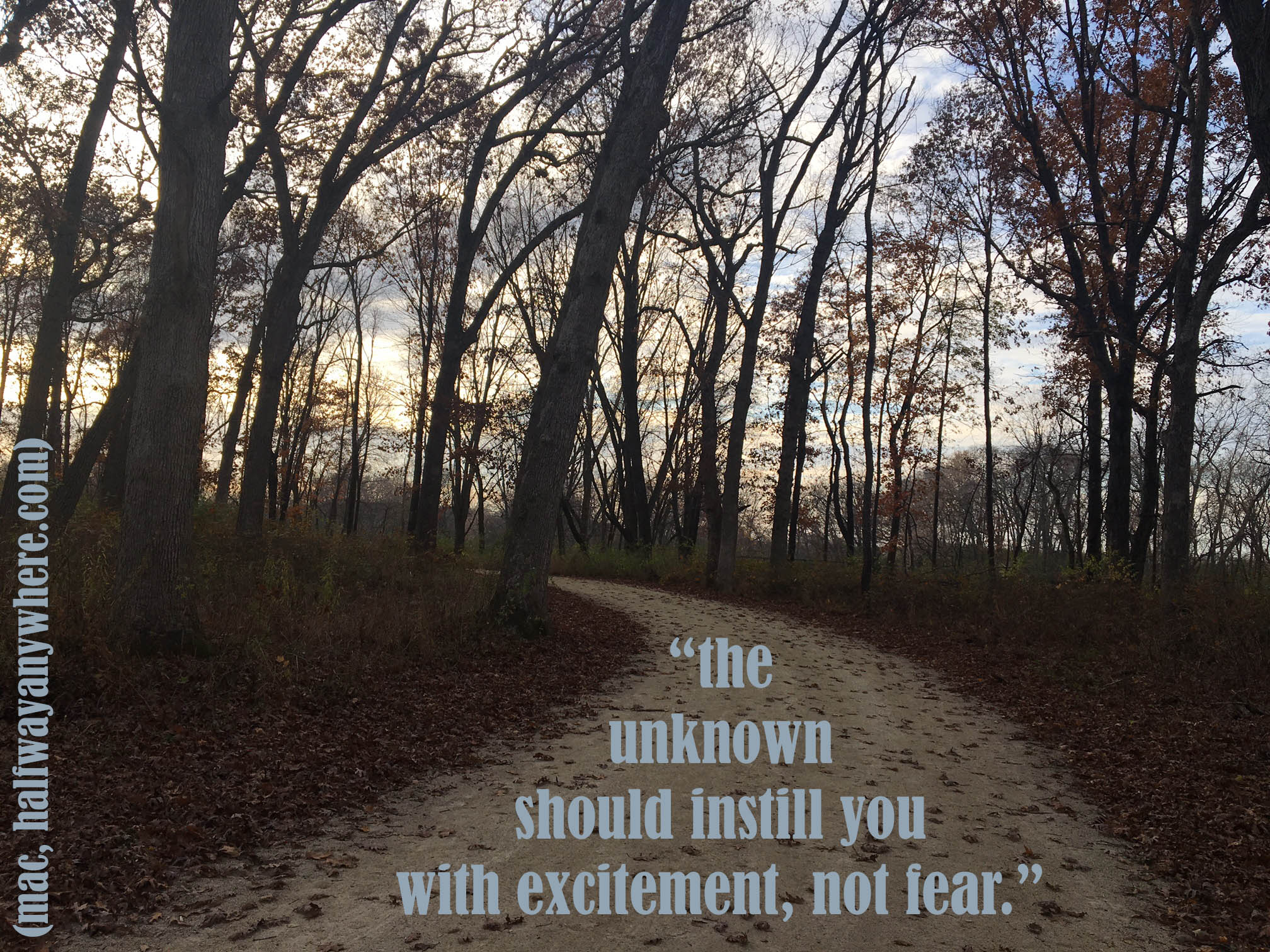
There’s a prerequisite to connecting: an intentional step into the unknown. It is as true when shooting telescopes into space as it is when trying to grasp “Who am I?” “Lao Tzu wrote, “When I let go of what I am, I become what I might be.”

Our ancestors painted the walls of caves, not for decoration, but for connection to “something greater”. It is the same reason folks fill up synagogues and mosques and churches and temples. To connect.

Art, science, and religion all serve the same deeply human impulse. To connect. To reach across time, to reach across space, to plumb the depths of inner and outer space, in order to connect. Legacy and imagination. Identity, tradition, progress toward…connection to something bigger, something better. We reach to grasp and breathe life into our best ideas, both future and past.

The first step of the entrepreneur, the artist, the scientist, the explorer, the dreamer…the human, is a step into the unknown, to question the limits of the known. What else? Leeches were once believed to be good medicine until some bright inquiring mind observed and asked, ‘I wonder it that is really true?”

Einstein dreamed a dream and, so, he reached through the math to connect to the inconceivable: light is the only constant. Time and space are malleable. Picasso, initially, hid his first cubist painting, not yet ready risk ridicule. And then, needing to connect to “what might be”, he turned it around, stepped into new unknown territory, and invited the world to see.

read Kerri’s blog post on the UNKNOWN

Move Toward Wholeness [on Two Artists Tuesday]

When I look at the bowl of green tomatoes, each plucked from the vine before we pulled the plants from their pots, still moving toward red ripeness, I think of Joe. He was fond of saying, “Life moves in the direction of wholeness.” It’s important to note that his fond phrase included nothing about outcomes. Joe was particular and knew that life is movement and not arrival.

I am revisiting the word ‘rehearsal’ these days only this version of rehearsal is not on the stage with creative minds. It is over Zoom with decidedly analytical minds. Actors in rehearsal halls move through a process of exploration that leads to specific choices. The goal, if there is one, is to embody a state of moving presence within a story. The analytic mind comes with a template overlay that is placed atop the experience before it actually occurs. The language reveals all: content items. Telemetry. The mathematics of movement. Rehearsal is predicated on precision.

As I’ve probably written ad nauseam, these minds are not in opposition. They are complimentary. Freedom of artistic expression comes from years of study of technique. The path to mastery winds through repetition and constraint. Saying more with less comes after a lifetime of saying less with more. The creative mind is one step closer to the senses. The analytic mind applies language, gives voice, to the experience.

Many years ago I participated in a workshop with an actor/director of Noh Theatre. The process was strict, exacting. The movements precise. There was no room for error. We, the participants in the workshop, knew we’d never achieve proficiency since it takes years and years of rehearsal to perform even the simplest of symbolic gestures. No one sings opera in a day. We did our best and failed and failed and failed. That was the point. That is always the point. Each failure is actually an exercise of muscle memory. The body learns. The mind is impatient. Rehearsal is rarely about the mind, despite what the mind insists. At the end of the day, our workshop leader gave a short demonstration of his art form. His ease of movement, born from years of repetition within constraint, was breathtaking. He was free.

Many years later I was helping John in his wood shop. He was a master wood worker. I watched him look over his lumber, preparing to build a cabinet. He ran his hand over the wood, feeling his way into his project. “Ah,” he said, laying his hand on a piece of cherry wood. “This is it.” John was like the Noh actor.

“How did you know?” I asked.

“I don’t know,” he said, “it just feels right.” Then he smiled and added, “Plus, I’ve built a lot of crap.”

Life, moving toward wholeness.

read Kerri’s blog post about TOMATOES

Learn Where To Listen [on KS Friday]

“Her mother told her she could grow up to be anything she wanted to be so she grew up to be the strongest of the strong, the strangest of the strange, the wildest of the wild, the wolf leading wolves.” ~ Nikita Gill

A long time ago I wrote and illustrated a children’s book about a young fox who had extraordinary abilities. Her talents made her an outlier in the pack, something strange, so they hammered her into compliance. She buried her gifts. The story is, of course, how she came to embrace her gifts despite the court of fox-public opinion.

Lao Tzu wrote, “Care about what other people think of you and you will always be their prisoner.” It is a lesson that every artist must learn. Do your work. YOUR work. Some will love it. Some will hate it. Some will walk by without a second glance. You can never determine what another person sees or thinks so waste no energy in that fruitless cause. Do your work.

It’s a tough lesson, a mammoth paradox, since we are, after all, a pack animal, a social being. An artist has no reason to work if there is no audience or community to receive the work. Traditionally, artists live on the edge of the community so they can both see in and express what they see but also serve as a channel to what lies beyond the spiritual perimeter. The tightrope walk is about belonging while marginalized enough to remain clear-sighted. The artist must step back from the painting in order to see it.

I’m enjoying a slow read through Kent Nerburn‘s book, Dancing With The Gods: Reflections On Life And Art. Master Miller recommended it and I’m finding the simple wisdom of an artist-elder a refreshing daily meditation. Were I to write a sequel to my long-ago-children’s-book, it would be about this: coming back to your gift is not a one-and-done affair. It is a cycle. We embrace it and run from it and embrace it and lose it and find it and smother it and resurrect it and step back and look at it. Again and again. To become the strangest of the strange, the wildest of the wild, is not an achievement, an arrival platform, it is a relationship. Yes, with the community, but it is mostly a walk with your self and what lies beyond that spiritual perimeter. It is ongoing. Never static. Somedays you are the strongest of the strong. And, on other days, you are empty and weak. Full spectrum palette. The only way to know and reflect all of the colors of life is to experience them firsthand. And, so, it is imperative to learn where to listen, where to invest your tender care.

The gift grows as more colors enter the paint box.

read Kerri’s blogpost about HER MOTHER TOLD HER

Kerri’s albums are available in iTunes or streaming on Pandora

Compose [on DR Thursday]

Many years ago I attended a workshop facilitated by Sam, a brilliant landscape painter. I was delighted and amused when he demonstrated his technique. Rather than paint what he observed, he took great pleasure in rearranging the elements. He moved the trees, altered the hills, relocated the barn. He laughed while mixing up his elements. His eyes sparkled with mischief. Rather than a workshop on painting, the day became an exercise in joy-in-art. Seeing and playing with what we see.

This morning I read that the word ‘composition’ means “putting together.” Definers-of-art-terms associate composition with freedom. “The artist has freedom when choosing the composition of their artwork.” It is a mistake to believe that compositional freedom is the sole province of an artist. If the mind is a canvas then thought is a composition. It is patterned and composed. Arranged and rearranged. We choose where we place our focus. Point-of-view is cultivated, it is not a default setting. We design the story-we-tell-ourselves-about-ourselves. And, then we project it onto the world.

The trick in both art and thought composition is not to wear ruts in the road. Sam was joyful in his art because he was constantly challenging and engaging with what he saw. Art was fun, not morbid tradition. Art was delight-full, not rule-bound or laden with the pressure to capture. Recall that stepping out of the rut was the first lesson in Julia Cameron’s The Artist’s Way. Morning pages and artist’s dates are meant to both see the ruts and open new paths. The same process applies to the thought-canvas. See the rut. Step out of it.

As Sam taught me so many years ago, seeing and playing with what we see begins with letting go of what we think we see. It begins with a blank canvas, an unfettered mind, and the freedom to choose the composition.

read Kerri’s blog post about COMPOSITION

Unfettered ©️ 2018 david robinson

Step Beyond Words [on Two Artists Tuesday]

“Truth is a pathless land.” ~ Jiddu Krishnamurti

I have done my share of seeking and, also, my share of not finding.

I believe that I began painting because, while doing it, while lost in the discovery of an image, I experienced truth – or something close to it. Always in quiet studios. Always beyond the place of mind chatter. Something “bigger” washed through. Something beyond words.

That must be why I associate truth with silence.

All around I hear people proclaiming transparency. No hidden agendas. Everything up-front! As Quinn used to say, “If they have to tell you that they are being transparent, it’s a good bet that they are not.” Words, words, words.

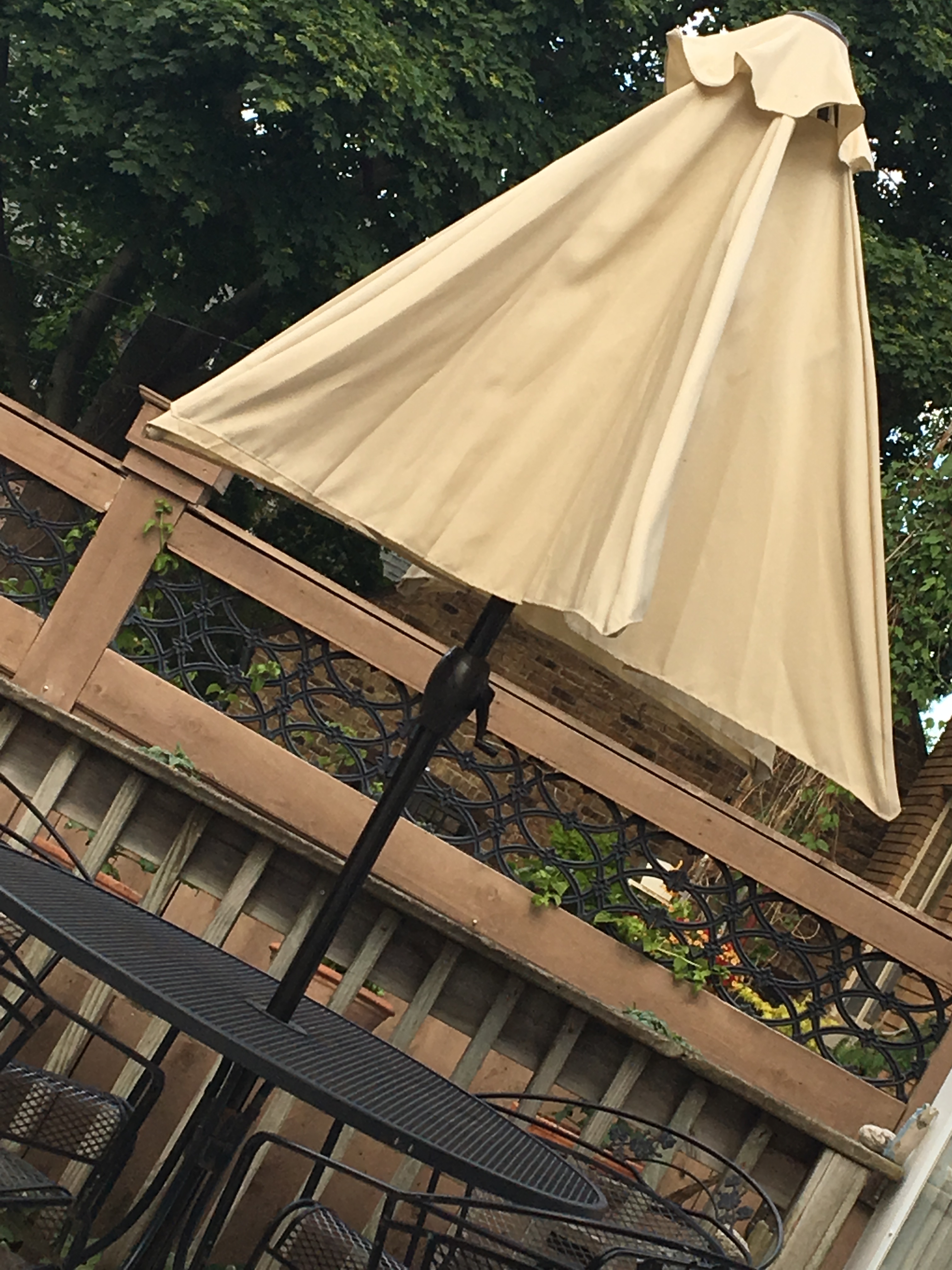
Many evenings we sit on our back deck. The umbrella shields us from the heat. We watch Dogga run circles, dig holes, and bark at squirrels. The birds perch at the feeder or drink from the pond. A chipmunk dashes across Barney’s keys. The crows call from the treetops. The sun drops behind the trees. The mosquitoes come out; our cue to go in.

So much life! And not a single word required though, clearly, it is more than tempting to try and describe it. Try is the best I can do.

I often remind myself that I have never lived this day and will never again live this day. No trail to follow even when I think I know what will happen next. I don’t. That’s the truth.

read Kerri’s blog post about THE UMBRELLA

Step Across [on Two Artists Tuesday]

We just spent a few minutes looking at the Melange archive. This is week 177. One of the gifts of blogging-your-random-thoughts-five-days-a-week is that people write back. A particular post hits a nerve. Agreements and disagreements. My story invites your story and, occasionally, you share the details. Lydia knows that I am in an artistic dry spell so she is sending me inspiration and encouragement. I could not be more grateful.

We keep a running count of the countries that show up in our analytics. 72 to date. “Who do we know in Pakistan?” Kerri asks. We take delight in the thinnest threads of relationship that are now woven through our story: if Alex in Malta doesn’t “like” one of my posts by day’s end I worry about Alex in Malta. Or, I wonder if what I wrote was substandard. The same goes with Dwight – but I know Dwight – and can hear his mighty laughter in my head. I’m glad his laughter is so deeply ingrained in my being. If he doesn’t “like” a post, it’s a sure bet that he’s helping someone in trouble and can’t be bothered to read at the moment.

Kerri and I sit next to each other when we write. The rule is that we can’t peek. We start with the same prompt and write whatever bubbles to the top. Sometimes it is remarkably similar. Sometimes it is a different universe entirely. And then, we read to each other. And talk. She always begins her reading with a disclaimer. I always need a bit of editing. When I read to her, she holds up a finger with each misspelling or grammatical gaffe, so she can remember how many corrections need to be made. Occasionally I make it through an entire reading with no fingers.

When I imagine my perfect life it has, at its center, a long table where we gather together and share meals and stories. It occurred to me a few weeks ago that I have, in metaphor, created my long table. MM sends stories and connected thoughts, Judy affirms, Horatio lets me know when a thought lands in his court. Each painting, each post, each composition, each cartoon that we create, is an invitation to come to the table.

Looking out to look in. Looking in to reach out. An artist’s life is nothing more than stepping across separations. I am fortunate to have so many helping me step. I am fortunate to have so many bringing their thoughts and hearts to the table.

When Kerri first showed me this photograph, I didn’t see the ladybug. I was thrown into a memory. Kit Peak observatory, looking through the eyepiece of a telescope into a star cluster. I never felt so small yet so connected. Her photograph evoked the same feeling. The flower seen up close is a radiant sun. The image almost knocked me over. And then, there was a ladybug. An explorer. So small, so big. Riding the petal, surfing the radiant light.

It’s enough to make me want to write.

read Kerri’s blog post about LADYBUGS

Appreciate The Marks [on DR Thursday]

Life leaves marks. When I look in the mirror these days, I see my grandfather staring back at me. Or, to be more accurate, I see aspects of both of them, all akimbo in a variation that I now recognize as “me.” The topography of DNA, crafted by my unique life, now sketched into my mask.

Quinn left marks in me. So did Tom. And Doug. And Kathy. I could go on. The list of amazing humans who had a hand in shaping my perception, molding my thinking, in informing my walk through this world, is lengthy. They are my fortune, the gold in my pocket. Their marks serve as my credo, define my intentions. Their marks have become the scale upon which I weigh value and importance. Laughter, according to their marks, carries enormous weight.

As we carried boxes out of the house, I couldn’t help but notice marks on the walls, scuffs on the floor. Each marked a memory. When the movers lifted the couch, its impression in the carpet was deep. It had sat in the same spot for years. In its absence, the entire space reeled. Soon it would find a new equilibrium as another family sculpted the now empty space. They will, no doubt, remove the carpet. The impression is too deep, the placement and accompanying memories are not theirs. Erasure is the necessary first act of new inhabitants. Eliminate the marks. Paint. Sand. Demo. And freshen. Clean the palette.

Leigh is an authority on rock art. Cave painting. The marks left by humans. Prophesy and map. Ritual and graffiti. Not all cultures are obsessed with leaving marks. Many try not to. My relationship to my marks, my paintings, changed the day I helped carry Duke’s brilliant paintings out of his basement. He’d passed and now the question was, “What do we do with all of his paintings?” I knew, someday, someone would ask the same question of my paintings. Carrying his paintings up the stairs and stacking them in the truck, I became less invested in the notion that my paintings, my marks, need matter. They no longer need to transcend me. They are immediate, fulfilling for me and perhaps me alone. That is enough. Bits of ego easily fall off when the perspective of age comes calling, when the marks are undeniable.

Marks fade. Life is what is happening now. A cliche’ that could not be more relevant. The couch, seemingly so permanent, will someday be hauled out. The marks will remain for a while. Only a while. And new life will move in and fill the old space, as it should.

read Kerri’s beautiful blog post on IMPRESSIONS