Sing, “EEE-AAAWWW!” [on Two Artists Tuesday]

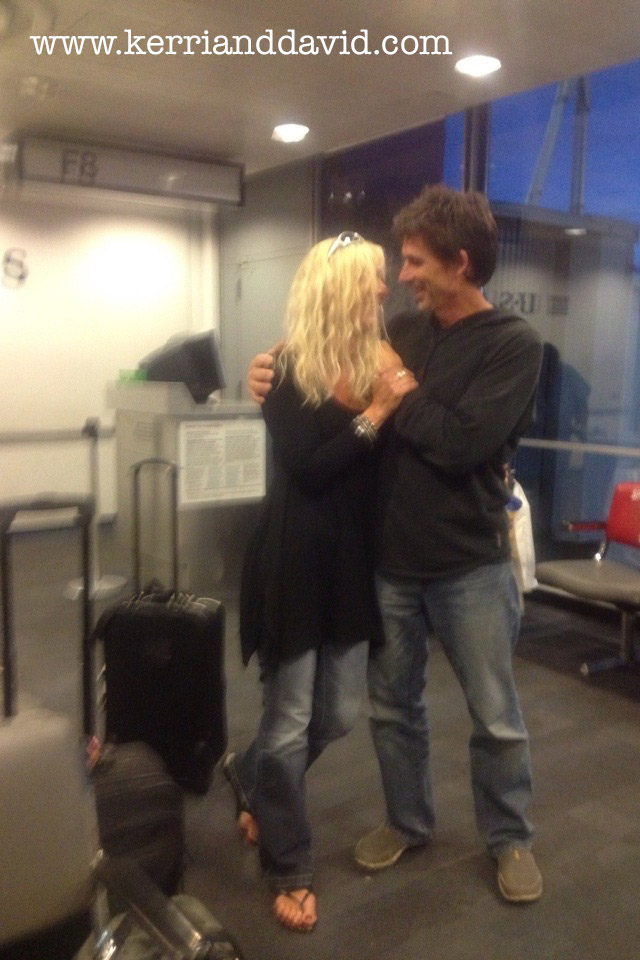
Drive across the country with Kerri and one thing is certain to happen: the moment she sees a donkey, she bursts into a rousing chorus of “EEE-AAAWW-EEE-AAAWWW!” She loves donkeys. She wants one. Or two. “They’re like big dogs,” she assures me. I have my doubts but I confess to picking up her quirk. Now, if I spot a donkey before she does, I point and launch a festive “EEE-AAAWW!”

Bill and Linda have two donkeys. We arrived after dark so had to wait until morning to go to the barn for a donkey-confab. She wiggled all night with excitement. “Smack-dab material,” I thought. I’ll be drawing cartoon donkeys soon. I can’t wait to figure out how to make the Kerri-cartoon character wiggle in anticipation.

Linda knows of Kerri’s donkey-love so she had donkey treats ready. I stood back and watched. “This is my future,” I thought. “Can I have another?” Kerri asked and Linda smiled, handing over the plastic container of orange donkey-cookies. Those lucky donkeys hit the cookie lotto.

Donkey cookies. Who knew! There’s more amazing wonders in this world than any of us can comprehend. Stand outside of anyone’s world, peer in at their passions, and you’ll have to try hard not to drop your jaw in fascination. From inside their world, the quirk seems boringly normal. I try to remember that when people stand agog at something in my world that seems normal-to-boring. “What’s the big deal,” I think.

People are great at reducing the magic in their lives to seem insignificant. I’m a “people” so, like all people, am guilty of my own diminishment. Beware of the word, “normal.”

Bill and I bumped fists. We are brothers-in-quirk. While Kerri and Linda stuffed the donkeys with cookies, Bill and I talked about the-things-that-come-out-of-our-mouths that get us into trouble. We think they are obvious. Ordinary. But, the response to our commentary indicates otherwise. He just retired from a board position and, his peers, in their farewell speech, described him in two words, both beginning with the letter “o”: outspoken and opinionated. All laughed. “It’s true!” he said, “And I’m proud of that,” and added, “No one wants to be a rubber stamp.”

What a perfect summation. EEE-AAAWWW-EEE-AAAWWW. Donkey cookies! Magic-in-the-ordinary. No one wants to be a rubber stamp.

read Kerri’s blog post about DONKEYS!

Keep The Embers Glowing [on Two Artists Tuesday]

If you encourage us to talk about porches of our past, we’ll tell a tale of sitting in the rocking chairs at our airbnb in the mountains of Colorado, one evening, watching the traffic go by, accidentally drinking the whole bottle of wine (at 10,000 feet), “walking” down the street to get a burger, and instead, finding ourselves at the center of what the locals called “experimental drink night.” I’m sure, to this day, they laugh at the two black-clad tourists who were too polite to turn down what came out of the bartender’s blender. We dialed 20 at 1am and too loudly told him the tale. Good friends will listen to anything that comes out of your mouth at anytime, day or night, and 20 is the best.

Last night, sitting on our airbnb porch in this North Carolina mountain town, sipping a glass of wine, watching the traffic go by, I “remembered” that night. This is our first venture out – just for us – since COVID washed over our lives. It’s become habit to plan our travel path – through an ordinary day or, in this case, miles from home – with minimal human contact as a top criteria. Watching the traffic go by, I thought about that, too. Now, we’d never stumble down the street to get a burger. We’d sit tight – as we did last night – and make ourselves a meal.

As part of our meal, we lit a few luminaria. We brought a few sacks and candles with us. I realized that we’re keeping a tradition going, however small, so that one day we’ll tell the tale of how we kept our holiday traditions alive – traditions that were once about gathering together, traditions that were meant to bring people into proximity to each other rather than carefully maintaining distance. Our tradition always includes candles. Luminaria. Fire and light. One day – someday – the light we place on the porch will include other people. For now, we keep a small flame to keep the tradition intact.

We’ve started a new tradition that I adore: pop-up dinners. We carry with us a small bistro table and two folding stools. They are lightweight and, in a moment, can appear anywhere. Last night – our last night here – they popped up on our porch. We made a special dinner, surrounded ourselves with luminaria, and watched the world go by. We greeted the people who walked by. We shouted greetings over the traffic across the street to the old guy who’s so beautifully decorated his house for the holidays. He loved our lights. We loved his. At a distance.

We keep the flame alive. We keep the embers of tradition glowing. We’ve established new variations on our adventure theme. Experimental drink night was a one-off affair. Pop-up dinners are here to stay. Be careful what tales you inspire us to tell. Someday, when we’re all together on the porch, we’ll give you an ear-full.

read Kerri’s blog post about LIGHT

See The Life [on Two Artists Tuesday]

There was a transformation the moment we raised the branch and secured it in the pot. “It looks happy,” Kerri said. I was thinking the exact same thing. This broken branch, muddy and discarded and sad, we brought into the house, trimmed it, lifted it, and positioned it, was instantly revivified. The moment was palpable.

“Are we just making it up” she asked.

“No,” I responded, not certain what, exactly, I was seeing, but this branch was suddenly full of life. It was warm and energetic where, only a few moments before, it was downcast. “I think it likes being here.”

We stood and stared and tried to make sense of what we were seeing. “This would make a good children’s book,” we said at the same moment. Happy, happy, happy.

We added a few simple lights, a single ornament, but mostly we let it be. Its happiness is decoration enough.

We visit our tree during the day. Its exuberance is infectious. Before retiring each night, we turn off all the lights in the house except for the tree. We sit with it and drink in the warm feeling it radiates.

“That tree is like good sculpture,” 20 said, admiring it. “It reaches,” he added. Good energy.

We remain amazed. We’ve not yet grown used to the sudden metamorphosis. I hope we never do. It’s become more than a symbol for the season. It’s a possibility. A promise. A reminder.

read Kerri’s blog post about THE TREE

Look To The Field [on Two Artists Tuesday]

“…if you observe your mind very quietly without giving explanations, if you just let the mind be aware of its own struggle, you will soon find that there comes a state in which there is no struggle at all, but an astonishing watchfulness. In that state of watchfulness there is no sense of superior or inferior, there is no big man or little man, there is no guru. All those absurdities are gone because the mind is fully awake; and the mind that is fully awake is joyous.” ~ Krishnamurti, Think On These Things

Saul told me to look beyond my opponent to the field of all-possibilities. He even gave it a location, a hundred feet beyond where he stood. We were doing an exercise called push-hands and, as a tai-chi master, he was teaching me not only where to place my focus but also where to place my belief. It took me a few years to grok: believe in resistance and resistance will appear. Call it an opponent and you’ve defined the relationship and, therefore, your choices. An obstacle is only an obstacle because it is identified as so.

I met Kerri because my world collapsed. Did my world collapse or did it open? Saul would say, “Neither.” Energy is energy. It moves and we give story to the movement, thereby shaping it. Storytelling is more powerful than we know.

Saul might as well have said, “The opponent lives in your mind. Look beyond your mind. Look beyond the story.” It’s a good practice to have an experience before naming it. It’s a better practice to have an experience and not name it at all. I’m not there yet, though I can see the field that Saul recommended. It exists beyond my definition-noise.

Saul threw me across the room yet never touched me. He laughed. I wanted to ask, “How did you do that?” but I already knew what his answer would be: “I didn’t. You threw yourself.”

read Kerri’s blog post on this Two Artists Tuesday

tree and sky © 2021 kerri sherwood

Attend To Beauty [on Two Artists Tuesday]

We are fans of ornamental grass. They line our walkway and populate the area along the fences. DogDog’s round-about sign is now nearly obscured, standing in the middle of tall grasses.

Some folks cut back their grass plants at the end of the season but we let ours stand through the winter. The reason has nothing to do with the health of the plant and everything to do with aesthetics. There are few things more beautiful than ornamental grasses aglow in the winter sun. I have been brought to tears watching the dance of the grasses, alight in pink and orange against the cold blue of a snowy afternoon. Magic beings swaying. [My grass-inspired-tears brought Kerri to consider that my heart just might not be made of cardboard (single ply) after all].

We attend to beauty, not because we are artists but the other way around: we can’t help but attend to beauty and that is what makes us artists. Yamaha paid Kerri a great compliment when she said of our home, “Everywhere I look I see something beautiful.”

Saturday, while raking the leaves, the air was crisp and birdsong, so unexpected, called to me to listen. As I stood listening to the birds, a breeze caught the grasses and they bristled, caught the wind and swayed. I dropped my rake and watched the performance, birds singing to the modern dance of grasses.

Our mail carrier broke my revelry with a greeting. She said, “I’d rather be doing my job than yours. I hate raking leaves!” I laughed. The color of the leaves, the sound, the fall smells. The performance. At that moment, I felt like the luckiest person alive.

“Oh, I don’t mind it,” I replied. “Actually, I’m enjoying it.”

“Well,” she said, “It’s a good thing then. I think I’ll stick to the mail.”

Yes. It’s a good thing. A very good thing, indeed.

read Kerri’s blog post about GRASSES

Go To The Shoe Room [on Two Artists Tuesday]

When I managed the theatre conservatory at PCPA Theaterfest, I occasionally gave backstage tours. It was great fun because the favorite stop on the tour – on every tour I gave – was the shoe room. Visitors always enjoyed standing on the stage, they were impressed with the scene and costume shop, they delighted to watch the prop master at work, but the moment we entered the shoe room, they were transcendent. Wide-eyed and giggling, pulling period shoes from the shelves to show their companions, it was as if they’d entered a candy store. The magic was released through the shoes.

The shoes, I suspect, harkened back to a time of dress-up. Childhood. The shoes touched their spirit of play. They beckoned to be worn and, as any actor knows, the shoes will inform how a character moves. The sooner you don the shoes, the sooner you will “find” the character. The shoe room was a portal to possible-other-lives.

I am more enamored by sketches than I am by final drafts. I delight in watching master craftsmen and craftswomen work. Theatre artists do not create illusions, they provide access to other worlds, unknown paths. They invite us to the shoe room to try on another life, even for a moment. The process, to me, is more beautiful than the performance.

As we walked the paths of the Botanical Gardens, the technicians were preparing for the festival of lights. Walkie-talkies crackled. Connections were checked. Battery packs were carefully placed. Multi-colored light strands ran like rivers up the trunks of trees. E-candles on armatures floated in the waterways. Magic was in the making. During the daylight, the entire expanse of the Garden is backstage – exposed wires and explicit design. At night, the mechanics will fade behind the light curtain. Backstage will become fore-stage. The light will invite us into another world. The light will touch the spirit of play.

I have always believed that people, lurking behind those serious faces, really just want to play. It’s the reason I kicked off my shoes every time I entered a room to do a facilitation. Lose your shoes and it’s no longer a serious affair. Play threatens. Play is suddenly a real possibility. The spirit of play cracks even the most harden entrenchment. Play necessitates collaboration and sharing. Pirates and Princesses need mates and parrots and knights in order for the world to be complete. Lawyers will take off their ties and wear them as headbands when the shoes come off and the serious topics are approached in socks and bare toes.

I recently – as we all have – been privy to an endless contentious debate about what this nation needs to do to get back on track. I believe it is not so complicated. We can carry on our oh-so-serious-division, but the single rule should be that no one can open their mouth – politician, pundit, and pedestrian alike – before first taking off their shoes.

read Kerri’s blog post about LIGHT STRANDS

Move Toward Wholeness [on Two Artists Tuesday]

When I look at the bowl of green tomatoes, each plucked from the vine before we pulled the plants from their pots, still moving toward red ripeness, I think of Joe. He was fond of saying, “Life moves in the direction of wholeness.” It’s important to note that his fond phrase included nothing about outcomes. Joe was particular and knew that life is movement and not arrival.

I am revisiting the word ‘rehearsal’ these days only this version of rehearsal is not on the stage with creative minds. It is over Zoom with decidedly analytical minds. Actors in rehearsal halls move through a process of exploration that leads to specific choices. The goal, if there is one, is to embody a state of moving presence within a story. The analytic mind comes with a template overlay that is placed atop the experience before it actually occurs. The language reveals all: content items. Telemetry. The mathematics of movement. Rehearsal is predicated on precision.

As I’ve probably written ad nauseam, these minds are not in opposition. They are complimentary. Freedom of artistic expression comes from years of study of technique. The path to mastery winds through repetition and constraint. Saying more with less comes after a lifetime of saying less with more. The creative mind is one step closer to the senses. The analytic mind applies language, gives voice, to the experience.

Many years ago I participated in a workshop with an actor/director of Noh Theatre. The process was strict, exacting. The movements precise. There was no room for error. We, the participants in the workshop, knew we’d never achieve proficiency since it takes years and years of rehearsal to perform even the simplest of symbolic gestures. No one sings opera in a day. We did our best and failed and failed and failed. That was the point. That is always the point. Each failure is actually an exercise of muscle memory. The body learns. The mind is impatient. Rehearsal is rarely about the mind, despite what the mind insists. At the end of the day, our workshop leader gave a short demonstration of his art form. His ease of movement, born from years of repetition within constraint, was breathtaking. He was free.

Many years later I was helping John in his wood shop. He was a master wood worker. I watched him look over his lumber, preparing to build a cabinet. He ran his hand over the wood, feeling his way into his project. “Ah,” he said, laying his hand on a piece of cherry wood. “This is it.” John was like the Noh actor.

“How did you know?” I asked.

“I don’t know,” he said, “it just feels right.” Then he smiled and added, “Plus, I’ve built a lot of crap.”

Life, moving toward wholeness.

read Kerri’s blog post about TOMATOES

Reach Purely [on Two Artists Tuesday]

“Art, as best practiced and understood over the centuries, is a spiritual as much as technical pursuit.” ~ Kent Nerburn, Dancing With The Gods

It was disconcerting. It still is. The illusion was so distinct that I had to show the book to Kerri and ask if she saw it, too. Each morning I read a few pages from Kent Nerburn’s book. This morning, in a chapter entitled The Divine Thread, I turned the page and a single paragraph, just a few sentences, was printed in a font twice the size as anything else on the page. I read it a few times since the author had given the section such obvious emphasis. After the I finished the chapter, I looked back to reread the oversized section – and it was printed in the same size font as everything else. It wasn’t emphasized at all. The shock of it made me dizzy.

“Art, however, does create this touch. It speaks in different voices, different rhythms, different languages. There is no place in the human heart it cannot reach.”

Paul taught his student-actors that they had an obligation to something greater. “When you choose to get on the stage, you have the power to impact other people’s lives. Do not take that responsibility lightly.” Your art, your creation, if purely intended, will reach the heart of another – purely. Even the loneliest painter knows the transcendence of the expansive energy that comes through in the moment of creation. Transcendence is all inclusive.

I have been humbled by the great artists I’ve known. Teachers, mentors, and others. I’ve been humbled by their humility. Tom, a brilliant director of plays and believer of possibility, influenced more artists than any person I know. He was tortured by the size and scope of his gift. At the end of his life, sitting before a fire in his cabin, he was, for a moment lost in thought. I watched his revelation come to the surface. He looked into his wine and said, “I think I did my best work when I was a just starting, when I was second grade teacher. It was pure imagination. I had no idea what I was doing. I just knew that we could have fun telling stories and going on adventures where our imaginations led us. It was pure.”

I met a few teachers who’d been second grade students in that classroom of long ago. They told me that year changed their lives. They touched his heart and he touched theirs. Shrunken heads and planning expeditions to the Amazon. Maps and budgets and “What do we need to bring to survive?” They spent weeks preparing for “blind day,” an exploration of the world through the full scope of senses. “What could we learn if we didn’t rely on our sight? What would we need to prepare to help each other?” he asked. Pure.

For our wedding, Julia made for us a small box with a Klimt’sThe Kiss” decoupaged on the lid. Inside, she placed a few Euros. A metaphor. Great love as a container for great adventure. We placed the box in our sitting room in a spot where we see it everyday.

Kerri knelt on the dock to get this photograph of the water. “The color!” she gasped. Pull up an image of “The Kiss” – or any of Klimt’s paintings for a closer inspection and you’ll see this water pattern. Klimt might have painted it. He studied swirls in water, swimming color on the reflection of the surface. I’m certain of it.

Great love. Great adventure. Tom. Julia. Paul. Art that is pure. My head spins. There is no place in the human heart that art cannot reach.

read Kerri’s blog post about WATER

images of water © kerri sherwood 2021

See The Dance [on Two Artists Tuesday]

“You can only push the truth down for so long, and then it bubbles back up.” ~ Cassandra Clare

“Oh, for the wonder that bubbles into my soul.” ~ D.H. Lawrence

Last night we made a fire in the fire pit. We decided to have a pop-up dinner by the fire so we set up our table, lit candles, poured some wine, and brought our dinner out under the stars on a chilly October night. There wasn’t a cloud in the sky so we looked at the stars. We wondered if the brightest lights were planets.

There are many, many works of art from a genre in the Middle Ages known as the Dance Macabre. Dance with death. The scary images were meant to remind people of life’s fragility, its passing nature. They were also meant to point out the obvious: we are all united in our final destination. No one is better or worse than any other in the grand scheme of things, in the Dance Macabre. In the Middle Ages, the allegory was meant to suggest it was best to aim your focus at the afterlife. Do good works as an investment in your future or go to the fiery place below.

Were I to paint a series of Dance Macabre images today, my intent would be the exact opposite: aim your eyes at this moment. There is nothing more precious or wonder-full than this moment. If there is a heaven, it is now. And, it will go unnoticed if the dance is not acknowledged. There is no sadder phrase on earth than, “Same-old-same-old.”

According to some cultures, I am now in sacred space. I’m seeing all things relative to my dad’s recent passing. Sitting by the fire, our dinner complete, we talked about his death and my inability lately to invest too much emotional energy in anything. Things that would have upset me a few months ago barely register. I’m watching the usual list of anxieties and worries drop off. Why would I give an ounce of my wonder to something so…small? Perspective is the gift of the dance macabre. Clarity of sight and intention comes with this kind of perspective.

We clinked our glasses, the cold night and the heat from the fire colliding around us under the stars. DogDog slept on the deck, a few feet away. We realized our moment. Fully. Magic was alive, bubbling everywhere.

read Kerri’s blog post about BUBBLES

Listen To Claude [on Two Artists Tuesday]

In his 60’s, the famous Impressionist painter Claude Monet went blind. Cataracts were removed, restored his sight, but also changed his capacity to see color. He painted in blues because he couldn’t perceive red and yellow. He was not fond of the paintings that he produced. He painted what he could see. Historians, on the other hand, credit his blue paintings as an important link to abstract painting.

We never really know the impact of our actions or our work.

The path paralleled a stream. As we walked up the mountain, she stopped often and took photographs. The sun on the water was enticing so she aimed her camera at the stream. “Look!” she said, showing me. “These look like abstract paintings!”

“They look like Monet,” I said. “Gorgeous.”

Whether they know it or not, artists are always having conversations with their artistic ancestors. I was amused at the idea that Kerri and Claude were having a chat. The world of a master painter, living before ubiquitous photography, meets they eyes of one who sees and quickly captures.

I was also amused that, through Kerri’s picture, Claude and I were having an exchange. “I love your blues,” I say. Claude responds, “Ah, but it’s the reds and yellows that make the blue so vibrant. Contrast principle,” he winks.

Excited, she returned to the stream to take more photos.

I turned my face to the sun. I breathed in the mountain air, the aspen leaves fluttering. I have not finished a painting since the pandemic began. “I feel empty,” I say to Claude.

“We paint what we see, ” Claude whispered. “Sometimes we simply cannot see.”

“Yes,” I said, “I am blind. But my cataracts are not in my eyes.”

“No,” Claude replied. “You are not blind, you see well enough. You’ve closed your eyes.”

“Lookit!” Kerri smiled, “These are so cool!” She shows me more water close-ups, a symphony in orange, blue and gold.

“Don’t worry,” Claude smiled. “When you are ready, you’ll open your eyes again. You’ll see a whole new world. New colors and shapes. More than blue.”

“You think so?” I ask.

“Isn’t it beautiful!” Kerri glowed.

“Do you see?” he smiled and faded into the photograph.

“Yes,” I laughed and nodded, “It’s really beautiful.”

read Kerri’s blog post about MONET WATER

images of water © 2021 kerri sherwood