Do Anything Else

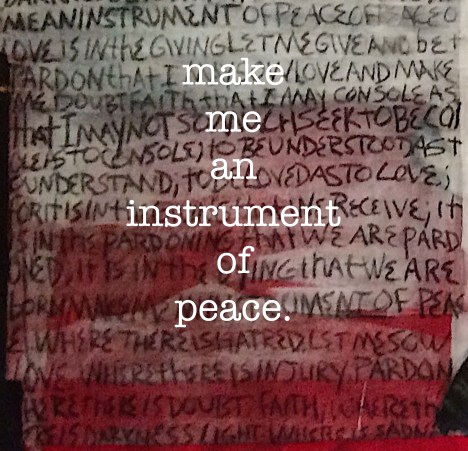
sharpersquareinstrofpeacewordsonlyjpeg

It occurs to me now that all along I’ve been asking irrelevant questions. Or, perhaps framing my questions too narrowly. For instance, years ago I went to graduate school to study systems because I wanted to follow a question that reached deep into my life and identity as an artist: can a mythology be rekindled once it has died? Art, after all, is one of the primary life-keepers of a culture’s story and the beating heart of the story is its mythology. And, according to all indicators, our mythology is mostly dead [as Joseph Campbell said, for evidence of our mythological demise, all you need to do is look at the news]. So, the younger version of myself wanted to understand the purpose of my life as an artist if, indeed, I was in service to a dead mythology. Heady questions, yes? Relevant questions?

In the early 1990’s I was invited to a photographer’s studio to see the “newest thing” in photography. The photographer had a new “program” called Photoshop. Before my eyes he “photoshopped” me into a picture, a place I’d never before visited. Today, all of this seems commonplace. Now, any 5 year old can manipulate an image but at the time a photograph stood for proof that something had actually happened. A photograph could not lie. It was evidence of truth. That day, standing in the photographer’s studio, I realized that the old reliable anchors for truth no longer existed. What was our anchor?

The truly significant events in our lives rarely come in with a roar.

We’ve been hearing a lot lately about fake news – as if this was a new phenomenon. It brings to my mind a terrific book written in 1985 by Neil Postman, Amusing Ourselves To Death. Here’s bit from the first page:

“Our politics, religion, news, athletics, education, and commerce have been transformed into congenial adjuncts of show business, largely without protest or even much popular notice. The result is that we are a people on the verge of amusing ourselves to death.”

I suppose fake news refers to something wholly concocted but I’d argue that when news agencies pander and promote themselves to conservative or liberal viewpoints, when ratings drive content, it’s all fake news. News with an agenda is…not news. It is, however, dangerous to a democracy and no longer free (as in free press, a cornerstone of our democracy). Historically, newspapers have always had a point of view but there was some attention paid to what was printed as news. Opinion was confined to an editorial page. When the line between true and concocted is blurred, when a populace cannot discern between entertainment and substance, it no longer has the capacity to make sound (read, “informed”) judgments. Worse, it is gullible, gossip-eaten and infinitely manipulate-able. It is, as Neil Postman wrote, entertaining itself to death.

I recently wrote about the absence of recognizable communal anchors (mythology) and the dangers of a community with nothing but the soft soil of belief and opinion as its driver. Is planting a personal-truth flag and defending its territory all that is left to us?

What else can we do? Now, there’s a relevant, open-ended question! Roger once told me that he would never be able to understand suicide. He said something like, “In that moment, rather than take your own life, why not do anything else? Why not make any other choice?” Another relevant question!

What else can we do? In the face of our own entertainment-driven suicide, why not do anything else? Turn off the blather, go outside, meet your neighbor, tell stories of your children or your ancestors. If common ground can’t be found it can certainly be created. Inhabit something bigger than opinion. It’s less entertaining but certainly more useful. Great art – no matter the form- lives in those bigger fields.


MAKE ME AN INSTRUMENT OF PEACE – GIFTS

to kickstart your peace, listen to this:

for PEACE on iTunes, go here (track 5 on the album AS IT IS)

Save

Save

Save

Save

Save

Save

Save

Listen To Randi

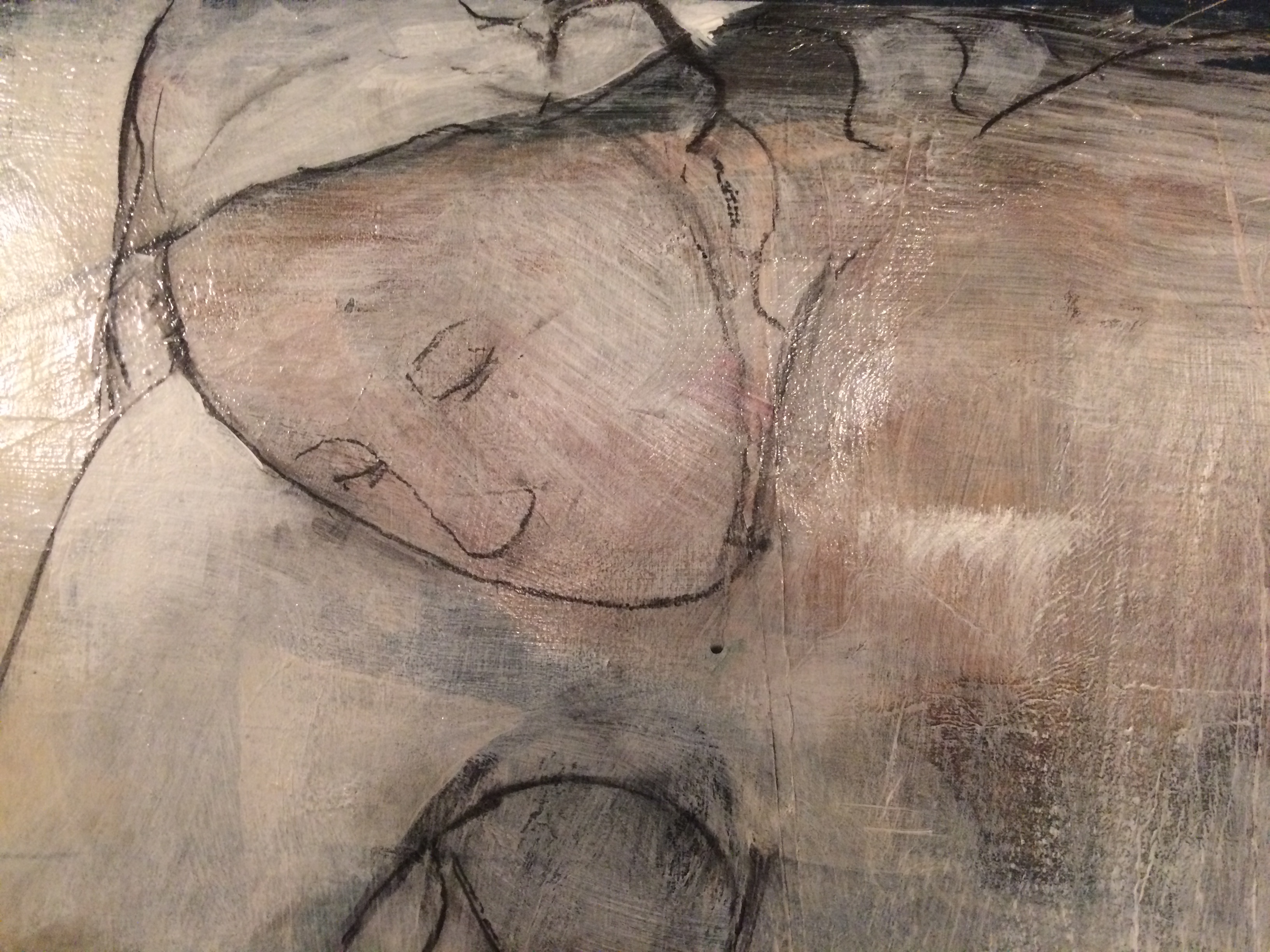
a detail from my latest painting in progress

a detail from my latest painting-in-progress

Randi is wise. Though, like all truly wise souls, she is completely unaware of her wisdom. She knows that she takes great delight in learning new things. She knows that her curiosity is boundless. She knows beyond the platitude of the sentiment that each new day is an opportunity to renew. Each new day is a step into unknown territory and, for Randi, there is no sense in taking timid steps. There is no sense in trying to make the day fit into a preconceived “normal.” There is no sense in watching the dance. Dance!

She squeals with pleasure when she hears a word used beautifully. “I am a lover of words!” she exclaims. She knows that words are powerful and when used beautifully will define beautiful experiences. She uses her words to define life beautifully. And, because she understands the power of words – and the brevity of life, she also understands the imperative of telling others what they mean to her. She has no problem expressing love.

another detail

another detail

We took a rare opportunity to see her, swinging north to Buffalo after traveling to Boston to celebrate Thanksgiving with Craig and Dan. At dinner, we talked of new relationships and new work and new phases of life. We talked of the necessity of creating balance amidst the tug and push of this fast moving life-river. Randi smiled, “I once heard someone speak about attempting to balance life and they said something that changed how I see it. They said that when yearning to balance the many aspects of our lives it is most often not balance we seek! It’s integration! Rather than try to bring all these separate pieces of life into a balancing act, why not integrate them into a unified whole!” She clapped her hands as if having the revelation all over again. “It’s integration, wholeness that we desire!”

Wholeness is another word for presence, and presence is the goal of the performers’ art. Quinn, another wise person, used to tell me that all spiritual teachings speak of finding the middle way, the path between poles or opposites. “Zealots miss the point!” he’d say. Life is not found in the extremes, in the separations, in the fragmented, or the isolationist’s dream. Those are aims of the controller. The rule bound. The real balancing comes in the letting go. As Randi reminded us, it is found in the integration, the middle way, the whole.

the whole

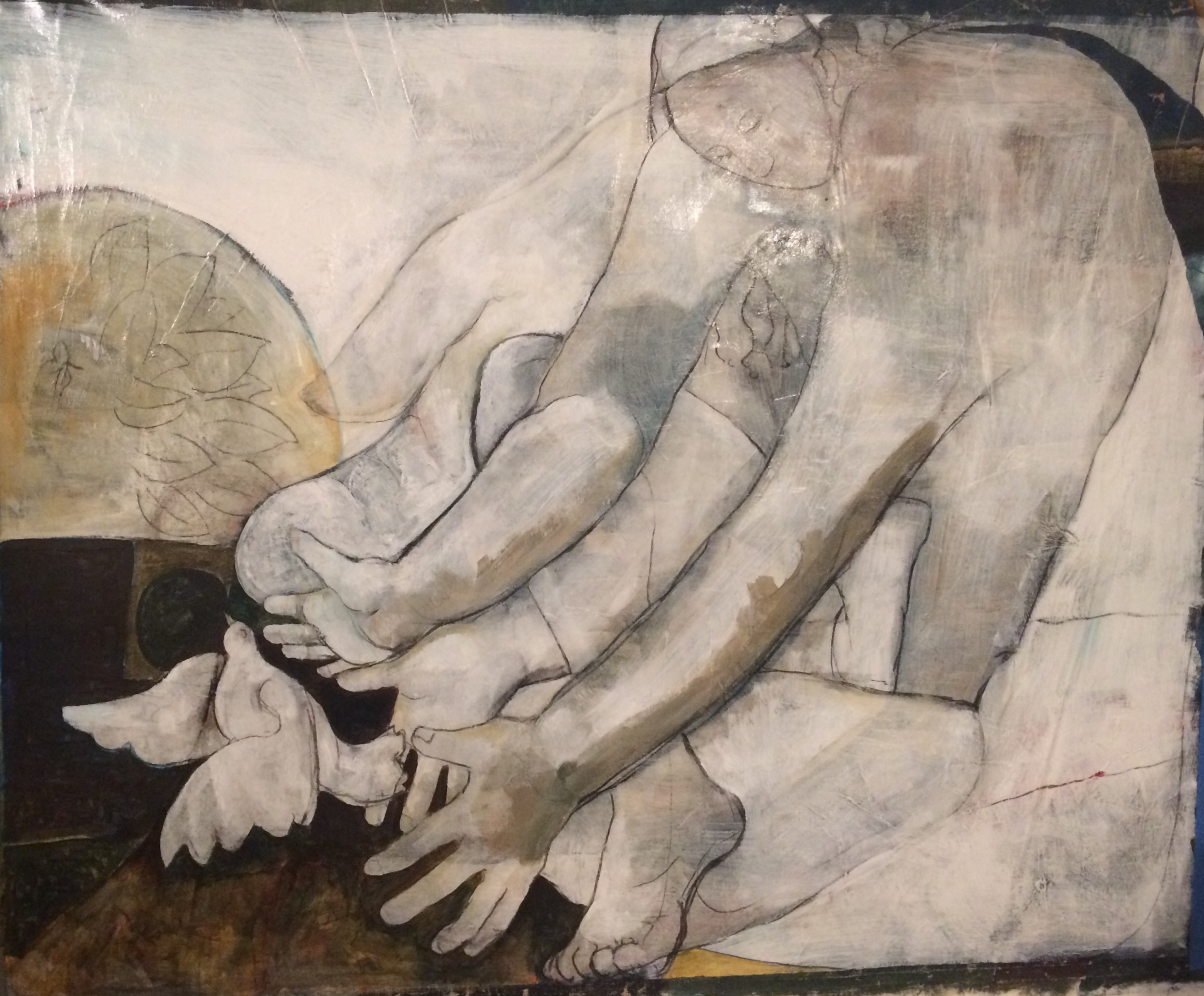
the whole painting as of 12.1.16


Save

Use Reason

Step Into Unknown with Sig“When a speaker who does not know the difference between good and evil tries to convince a people as ignorant as himself, not by ascribing to a poor beast like a donkey the virtues of a horse, but by representing evil as in fact good, and so by a careful study of popular notions succeeds in persuading them to do evil instead of good, what kind of harvest do you think his rhetoric will reap from the seed he has sown?” Phaedrus by Plato


The woman walked to the end of the small pier and started to weep. It was a cold day and windy. Kerri and I maintained silence as we passed. The woman was making an appeal to her god. She asked the stormy lake and angry sky, “Why?”

Belief is a powerful thing.

Beth believes that the universe was created 6,000 years ago. Even though the gasoline she pumps into her car is evidence to the contrary, nothing will shake her firm belief. No amount of science, data, or experience can crack her conviction to what she believes.

At first glance Beth might seem an oddity but she is actually more representative of the norm. Consider this quote published this morning in our local paper. It’s an editorial from the Los Angeles Times entitled, “The ‘fake news’ dilemma.” “Some observers argue that the public’s receptivity to fake news is a sign that we live in a ‘post-factual’ society, with people who are mainly interested in information that comports with their preexisting notions.” In other words, no amount of science, data, or experience can crack our convictions to what we believe. And, like Beth, we do not want to hear [or consider] anything that challenges our beliefs. Rather than question, we plant our belief-flag and defend the territory.

Flag planting makes for good ratings. Conflict is an easier story to sell than compromise so it is not surprising that we have news sources that blatantly cater to our preexisting notions. Division makes us a good market and infinitely manipulatable.

Certainly defending the territory of unquestioned belief feels good. Righteousness, blame and gossip always feel good. There’s no responsibility required! Here’s another bit to consider from the editorial: “The problem is obvious: When surveys by the Pew Research Center find that 62 percent of U.S. adults get at least some of their news from social media, and 20 percent of social-media users say the things they read online have changed their views on an issue or candidate, the electorate is all the more vulnerable to a disinformation campaign. By Buzzfeed’s count, the 20 most popular fake-news stories in the last three months of the campaign were shared more often on Facebook than the top 20 stories from leading mainstream news sites.”

What prayer do we have when we are too…lazy…incapable…. to discern gossip from news, belief from fact [dear reader help me find a word other than fact].

For me, the top spot on the hierarchy of beliefs-that-blind is the “pre-existing notion” that we human beings operate from reason. Reason requires doubt, questioning, listening, and reaching for the perceptions of others. Reason, like heart, is a commons. It thrives on honest debate and will have nothing to do with individual or collective rigidity. We are not born with it, however we are born with the capacity to engage it. It is not something any single individual attains – it is not attainable – it is relational – it requires multiple perspectives and continued conversation. It requires a step into the  unknown.

Thoughts Babble Hearts Speak


Save

Save

Let Life Come Through

a sketch: Dancing At Crab Meadow

a sketch: Dancing At Crab Meadow

Kerri works on her “un-cantata.” She plays a short section from a piece and it captures my attention. I put down my pencil, close my eyes, and listen. I am inking a cartoon, preparing a proposal. It is mechanical work, rote. I have learned to use this stage of the process as a kind of pay-attention-exercise. It is only tedious if I slip into the illusion that I’ve drawn this line before; I have not, just as I have not lived this moment before.

Artistry is often like laying bricks. Repetition is rarely sexy but beautiful creations come from it. I know that in my repetition I am “putting the lines in my body,” building muscle memory.

I have not heard Kerri play this piece and I find myself savoring it. I love it when she plays. The first time she played for me I was stunned into silence. “Something came through you,” I tell her. “It was enormous.” I often tell her the story of the first time I heard her play. I tell her the story so she will play more. I tell her because I know that music wants to come through her like images want to come through me. “You have to go to the piano,” I say. “Let it come through you.” She responds, “Let’s take a walk.” And we walk. Life comes through.

Neither of us spends as much time in the studio as we ought. Our walks, however, are extraordinary.

We went to a funeral on Saturday. We will attend another funeral tomorrow. There have been many, many in the past few years. I suspect that we are of the age that funerals become common. I have been paying attention to the eulogies with some fascination. They have become life-giving or at least revealing of what actually gives life (and what does not). In the many eulogies I’ve heard, the lives recounted, I’ve yet to hear about the big house, the luxury car that was bought, the clothes or jewelry that the deceased strove to possess. I never hear about the accumulations, the stuff or achievements. I hear warm stories of relationship. I hear of family dinners, trips to the lake, walks in the woods, laughter and lessons. I hear stories of life’s repetitions, the holiday feasts, the coffee sitting, the small moments, the messy moments that amount to time spent together. The walks.

Life comes through.

See The Sacred

First Anniversary Sunrise

First Anniversary Sunrise

“…it seems to me absurd to consider problems about other beings while I am still in ignorance about my own nature. Phaedrus by Plato

I’m sitting alone in a sanctuary and thinking about sacred spaces. Here’s the thing I’ve come to understand about sacred spaces: slower motion is required to experience the power of the place. People in a hurry to get somewhere have little or no access to the sacred. Race through a meadow and you will miss it. Sacred spaces do not lose their power; people lose their access to the power of the space.

Once, many years ago in Bali, I made it a practice to walk the same pace as my Balinese hosts. To me, they moved at an impossibly slow pace. As an American, patterned to be forever in a hurry, I walk quickly “to get” somewhere else. There must always be a goal to achieve, a destination to reach. The Balinese were not patterned for transit but for presence. Over time, as I picked up their rhythm of movement I also picked up their pattern: it is possible to walk in presence. It is possible to be where you are with no imperative to get somewhere else – even while walking. It is possible to be in your life instead of racing through it.

A most amazing thing happens when “being here” becomes primary to “getting there”: everything becomes sacred space. Slow down enough and it is possible that you will recognize yourself as a sacred space.

After returning home from Bali I was able to sustain my capacity to move slowly for only a few months. It is easy to move slowly and be present when the culture you are in is patterned for presence. It is an entirely different challenge to move slowly and be present in a fast moving river. In the months after returning home I was either trampled or the cause of others (trying to navigate my slow movement) being trampled. We are not nearly as separate as we think we are. As I resumed my American pace I also dropped my capacity for presence and lost my lens on the sacred.

A recent surgery has necessitated slower moving. I have, in these past few weeks, found myself walking once again like a Balinese. I’ve stepped out of the fast moving river. Yesterday, standing on the back deck, I watched Dog-Dog delight in chasing squirrels. I listened to Kerri talk on the phone with a friend. I felt the sun on my face. There was no other place on earth I would rather be. There was nothing necessary to achieve.

Learn To Question

My best place for asking questions

My best place for asking questions

20 (aka John) tells me that his coworker, Amy, aged 22, will have answered all of life’s questions within the next three years. He assures me that she will share her answers when she has them. “We just need to hang on for another three years,” he quips, “…and it’ll all make sense!”

The admitting nurse at the surgery center feels like a threshold guardian. She said, “People who pass through here learn just how little they actually control in life. Surgery is humbling. I’m here when their illusion of control bursts. That moment is hard.” She was quiet for a moment and added, “What gets me is all these people in the world who think they have all the answers – and they think their answer has to be the answer for everybody. All these rules made up by all these people who think they have the right answer for everybody! That’s why people are killing people everywhere.”

“It sounds like more people ought to have surgery!” I tease.

“You got that right,” she said, handing me my gown, hairnet and blue booties. “Put one of these on and you realize how little control you actually have; in this place none of your answers matter and none of your rules apply!”

It should be a mantra for educators and the only argument necessary to dismantle a test-driven system: Life is always found in the direction of the question. At best, answers are relative – and the best answers, if understood, are simply doors to more questions. Learn to question.

The best art follows the same mantra. It steps into big questions, wanders into unknowns and complexities. It tests and tries, explores and experiments. It leads us to explode our answers and like a good trickster does not allow us to hold our gods too tightly. It begs us to question.

“Shall we tell Amy that there are no answers?” I ask 20.

“Nah. Why spoil the surprise.”

From the archives. This one often calls to me

From the archives. This one often calls to me

Save

Sit In The First Seat


a detail from my latest painting

a detail from my latest painting

I am living this story, as are we all. I am a lover of story so I count myself fortunate enough to know that I am living it. It’s one of the grail stories. Here’s the section of the story that I am now living:

The knight who cannot be beaten (he has a magic sword) is knocked from his warhorse. A warrior, a man with no armor or shield, no protection, emerges from the woods, challenges the knight, and in a single blow, unseats him. That’s not the worst of it: the knight’s magic sword shatters. And, that’s not the worst of it. His armor, his trusty protection through the many wars in the wasteland, pins him down. Like a turtle on its back, he is defenseless. His magic sword, his trusted armor, all that he has relied on, all that he’s built his identity and purpose upon, betray him. He is stunned. He is lost. He closes his eyes and awaits his death.

Death does not come. Well…

another detail

another detail

The warrior, the man with no armor, does not finish the job. He disappears without a trace leaving the knight stranded but alive. The knight opens his eyes and somehow manages to sit up. He weeps because his endless efforts to save the world have come to naught. In fact, fighting ogres seemed to produce more ogres! He removes his armor. He is no longer a knight. He is no longer capable of saving the world. He is, for the first time since his childhood, unprotected. He is, at last, purpose-free.

Nothing is more frightening – or useful – than to drop the armor of purpose and take a good hard look at what lives beneath all that forged metal.

...and another

…and another

At first his lack of identity drives him crazy. He has no answer to the cocktail party question, “So, what do you do?” He feels naked and exposed. Fortunately, a teacher, a hermit, emerges from the woods to help him navigate the crazies. Namely, the hermit helps him by not answering his endless questions. The hermit helps him understand that the world never really needed him because the world was never really broken. The hermit helps him relax and see beyond all of his thinking. He realizes that the wasteland came, not because the world was broken, but because he believed himself to be broken, somehow lacking.

In a life of chopping wood and carrying water he sees that his purpose has nothing at all to do with doing – or roles or achievements. He sees that the road to the grail castle is blocked so long as he believes he is defined by a role or a bank account or lost in a made-up purpose. When he drops his need for importance the grail castle appears.

...and another

…and another

Satori, in all the stories, knocks seekers from their ponies. It stops all pursuits. It pops the illusion of a purpose-driven life. It necessarily strips the seeker naked.

We are all seekers at some point.

When you are required in the workshop to write your epitaph or are somehow forced to articulate what was most important in this life, the doing, the list of achievements, the purpose-drive will always take second seat. HOW you did what you did, the relationships you tended or ignored, the moments you appreciated or missed, will sit squarely in the first spot.


as yet unnamed

as yet unnamed


Save

Save

Let Go

Dog-Dog three years ago

Dog-Dog three years ago

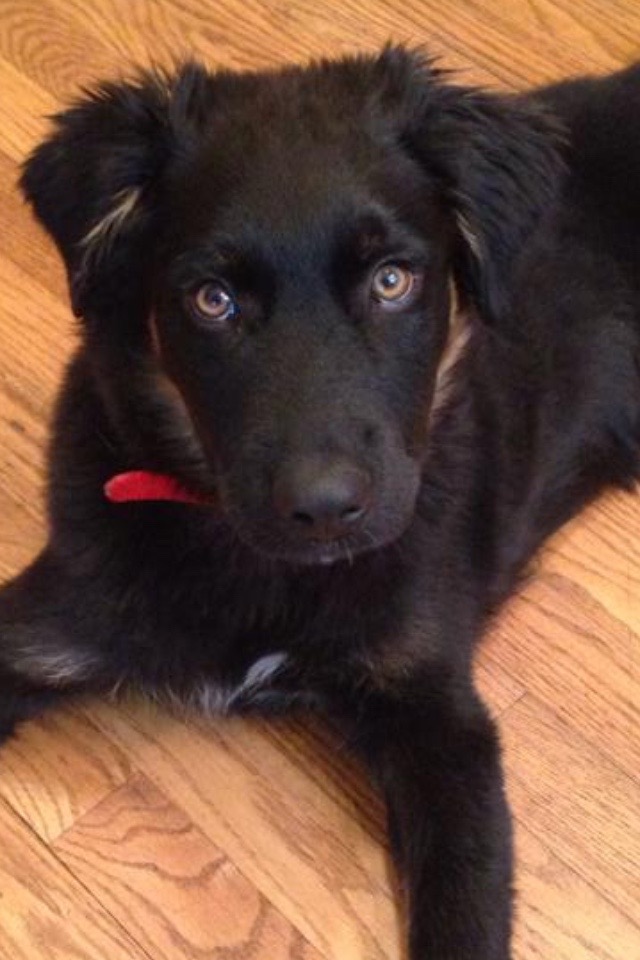
Tripper Dog-Dog-Dog is now three years old. His birthday is July 4th so he believes all the ruckus and fireworks are for him. Of course, we do not dissuade him from his delusion. Country-wide festivities seem appropriate for the birth of any creature. It is a miracle no matter how you story it and ought to be outrageously celebrated.

Marilyn invited us to her family picnic. It was a riot of volleyball and bag toss, not to mention the best cheeseburger I’ve ever eaten. It was a great time! We sat at the table for elders. In the midst of feeling honored to be included at the grown-up table (I feel like I ought to be seated with the kids at the card table), I was shocked to realize that I was sitting with my peers. I am now of a certain age…. Some delusions pop themselves.

On Sunday at the holiday carnival as we watched the Pier Pups distance jump into a pool, Brad and I had one of those broad and deep conversations that keep me thinking for days. Among many things, we rolled around the idea of what it means to achieve, what it means to be successful. I’ve discovered, as my teachers told me I would, that ideas of success and fulfillment are different at each stage of life. Now, I’m successful if I’m quiet inside, if I do not let one of these too-fast-days slip by unappreciated. Some delusions are shed like too-much armor.

There is the moment that the unbeatable knight is knocked off his horse, the moment when Sisyphus, so strong, knowing and independent, doesn’t know what to do and his only recourse is to ask for help. His life depends upon it. To gain all, so the stories remind me, we must first lose it all. Like them, each time I think I have control of my destiny, I am summarily reminded of my delusion. Control is nothing more than just another story. Let go.

My greatest teachers in one pix

My greatest teachers in one pix

This morning, talking about all that has happened in three years, my wife looked at me through the steam of her coffee and said, “Time just keeps moving. You’d think it would slow down or take a vacation every once in a while.”

Dog-Dog now-a-days

Dog-Dog now-a-days

Start Walking

photoTell Me. How can I be a learner?

My mind went absolutely blank, and I heard myself saying, Its simple. To be a learner youve got to be willing to be a fool. ~George Leonard, Mastery

I used to do a lot of work in education. My career in the theatre took a sharp left-hand turn when I started consulting with schools. The puzzles that plagued educators seemed to me easy to address. To be human is to be curious. Tickle the curiosity, begin the story and get out of the way.

Tom once told me that teaching is about relationship (not control). He also told me that the best teaching/learning needed to be directly applicable; it had to be immediate. It had to be real. It had to matter – to both the teacher and the learner. The trick is to extend the mattering into greater and deeper levels of abstraction.

An emphasis on testing is an emphasis on knowing. Great learning places the emphasis on not-knowing. It reinforces the pursuit and dispels the notion that knowledge is something achievable. Worthy questions always open more worthy questions. To be human is to be curious. To be alive is to wonder what is on the other side of the hill and then take a step toward it.

The fool George Leonard references isn’t “ the unthinking person,” it is “the carefree fool in the tarot deck who bears the awesome number zero, signifying the fertile void from which all creation springs, the state of emptiness that allows new things to come into being.”

Emptiness. Not knowing. Relationship. Mattering.

Step Into Unknown with SigThe question, “How do we/I do it?” is a great step-stopper. It is the leading edge of every personal and organizational stagnation excuse. We don’t know how. I’ve come to believe that it isn’t a natural question but is learned behavior. It is an emergency brake installed by a system that values right answers over great questions.

My wife and I have a short-hand phrase, Beaky’s Wheelchair, to remind us when we stall, that “how?” is something that can only be known after the fact. No one knows “How?” at the beginning. Beaky needed an electric wheelchair to be mobile and the world of insurance/medicare was standing still. After months of waiting, with no clue which direction to begin, we started making calls. We met every “no” with a “why not?.” We asked a multitude of foolish questions. We learned. And learned some more. Within a matter of weeks, Beaky had her wheelchair.

How do you play the guitar? Paint a picture? Bridge a conflict? Transcend a limit? Know one knows. Tickle the curiosity, let go of any notion that you need to know how, and start walking.

text from Krishnamurti as it appears in my painting

the text from Krishnamurti as it appears in my painting


Save

Save

Save

Save

Unify

a watercolor from 2003, House On Fire

a watercolor from 2003, House On Fire

Stay with me. I actually have a point.

If ever I teach actors again, or coach people in any endeavor, or communities/businesses seeking betterment, I will only have two things to teach: 1) Grounded-ness and 2) Focus placement on the unifiers. These two concepts are really  one looping concept but for ease and the sake of being understood, I will offer them independent of one another.

As focus placement goes, an actor on the stage has two options and depending on the focus placement they choose, they will either create the play or destroy it. A focus on how they look or sound or feel destroys the play. It is a self-focus in an art form of relationship (all art forms are made vital in relationship). A self-focus breaks the relationships and effectively locks the audience out of participating in the story. It makes the actor giddy with fear, easily distracted, alone. Conversely, the actor can focus outside of themselves, on the other actors on the stage, on the energy between, on their pursuit. An outer-focus creates relationships and serves as a magnet that pulls audiences into the story. It facilitates participation, creates relationship, and shared experiences. It unifies. Literally.

The actor who listens to him/herself pulls up their root. They unground themselves. The actor whose focus is outward, who is actively pursuing relationship, creates grounding. In fact, they must be grounded to create vital relationships. It is a first principle. Grounded-ness begets grounded-ness; it unifies. It strengthens. It invites. It clarifies truth.

The same principles apply off the stage or out of the studio. It is, however, more complex off the stage. It is much, much, more sticky.

And here’s the point: It has been said that nothing is better at uniting a community than having an enemy. It’s true. A common enemy provides an outer focus. It provides another team to defeat. It works so well that leaders across the ages, leaders who would otherwise look insipid, leaders who, like a bad actor, have a self-focus, a control need, have concocted all manner of enemies. It is a deflection. It works for a short while but what starts as false unity strips a community of its true binder. It separates and splits. It diminishes. It destroys.

Here’s the sticky part. One of the oldest tricks in the book for controlling a community is to split them, to locate the enemy within the community. And then, for good measure, magnify the split. In the early colonies – that ultimately became The United States of America – it was a strategy known as The Giddy Masses (see Ronald Takaki’s excellent book A Different Mirror). Make the people giddy with a false enemy. Uproot them. Deflect them so they cannot join in relationship and be strong as a community. Self-focused leaders cannot survive a unified, healthy populace. It is a strategy: separate the people so they cannot see the movement of power.

Today I started to read the news but stopped after only a minute. Building walls. Expelling Muslims. Enemy creation everywhere! Fox news and MSNBC are great giddy creators. It’s a bad story poorly told. It weakens all players. The primary actors do harm to their audience. Grounded-ness, a first principle, can only come to all when the actors choose to focus on the relationships, see the unifiers, to create rather than destroy. Groundedness comes when the audience engages, questions what they are being told and open (rather than close) their minds.

Grounded-ness. Focus placement on the unity. The principles that make great art also make great society. Fear, the province of the bad actor, the lot of a passive audience, although temporarily effective, can only destroy the play.

Save

Save