Chew On It [on Merely A Thought Monday]

The first and most important question of the day is, “What is nougat?” I’ve always been more of a peanut M&M’s guy or, these days, a straight-up almonds, sea salt in dark chocolate lover. I’m currently accepting donations of Chocolove’s Salted Almond Butter in Dark Chocolate. You should be, too.

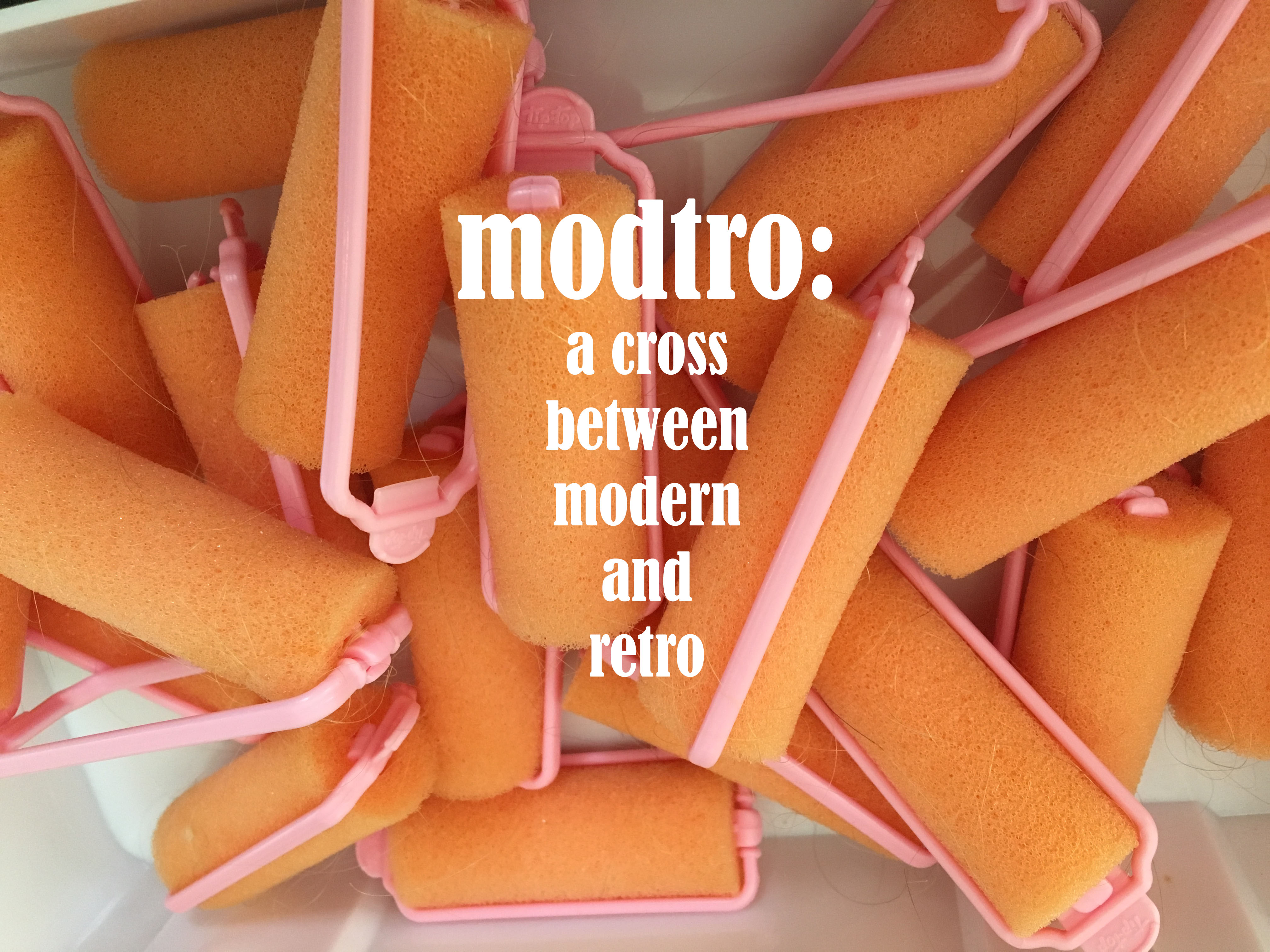
So, what is nougat? Originally it was honey, nuts, and egg whites but in this era of “it’s-better-not-to-know-what-I-just-put-into-my-mouth-and-called-it-candy,” I wonder what passes for nougat? I only ask because I’d never heard of a Charleston Chew so, to understand the reference, I looked it up. When I read that a Charleston Chew is, “…flavored nougat covered in chocolate flavored coating…” I immediately spotted the word “flavored” twice in the same sentence. If the chocolate isn’t really chocolate then what are the odds that the “flavored” nougat is really honey, nuts and egg whites?

To borrow and bastardize a bit of Hamlet”To eat; perchance to savor: aye, there’s the rub.” Kerri assures me that a Charleston Chew is yummy. Who cares what’s in it if it makes my toes wiggle with satisfaction? It’s the inverse argument of all those nasty foods adults made us swallow as children: who cares if it’s good for me if it makes me gag? Make me go hungry and send me to my room! Please! Caring adults forget that kids squirrel away and hide Charleston Chews beneath the mattress so banishment to the bedroom for not choking down brussel sprouts is tasty a reward.

This is key to understanding why people do what they do: we know what’s in a brussel sprout*. We have no idea what’s in a Charleston Chew. We’ll clamp down our jaws or pitch public fits rather than eat what’s good for us. Yet, we’ll happily binge on mystery snacks that are certainly no good for us but, damn-do-they-taste-good. Insight: humans are not rational beings. We puff up and proudly defend all manner of thought-nougat but can’t be bothered to look up the source or verity of the dreck we’re feeding on.

Of our current dilemmas, there is one thing that is certain: we can’t Charleston Chew our way out of this.

Take heart. There’s always Chocolove.

[*now that I’m rumored to be an adult I love roasted brussel sprouts]

read Kerri’s blogpost about CHARLESTON CHEWS

Know Their Name [on Merely A Thought Monday]

As I let Dogga out each morning, I stand for a few moments and listen to the birdsong. Our particular spot on the earth is alive with birds: starlings, finches, sparrows, robins, hawks, crows, owls… The Mourning Doves always stop my motion. Their song is hypnotic.

The pandemic changed – and continues to change – many things. Our world became significantly smaller. The table in the sunroom. The backyard. Our trails. As someone with his head in the clouds I am a dedicated generalist. I have always appreciated bird song yet never, not once, thought of identifying the specific birds and their song. “Sparrow? Finch? Who cares! They are beautiful and that’s enough for me! I spend too much time in my left brain as it is! The last thing I want to do is categorize the birds!”

COVID changed that. Sitting on the back deck or at the COVID table staring out the window for hours on end, our relationship with the birds grew. From general appreciation to specific experience. From passive appreciation to personal connection. We began to see nuance. Pattern. We wanted – and want to know more about these beings that sing us awake each morning, that alert us to changes in the weather, that signal alarm in the neighborhood.

While visiting the Botanical Gardens, Kerri found a small book, coded by color, that identifies the birds in our region. In a flash we can open the book and identify the bird. “Hey! Look! That’s Paul!” I say.

“Stop!” Kerri scowls. “It’s Martha. Paul’s on the fence.”

Just kidding. House Sparrow. Carolina Wren. My favorite to pronounce is Grackle. Great-tailed Grackle to be exact. I’ve decided that, were I to somehow achieve tough-guy status and ride a Harley to breakfast, my motorcycle-dude name will be Grackle. “Hey, Grackle,” the waiter will say, as I come through the door en route to my usual stool. “Hey,” I respond. Motorcycle-dudes named Grackle are birds of few words.

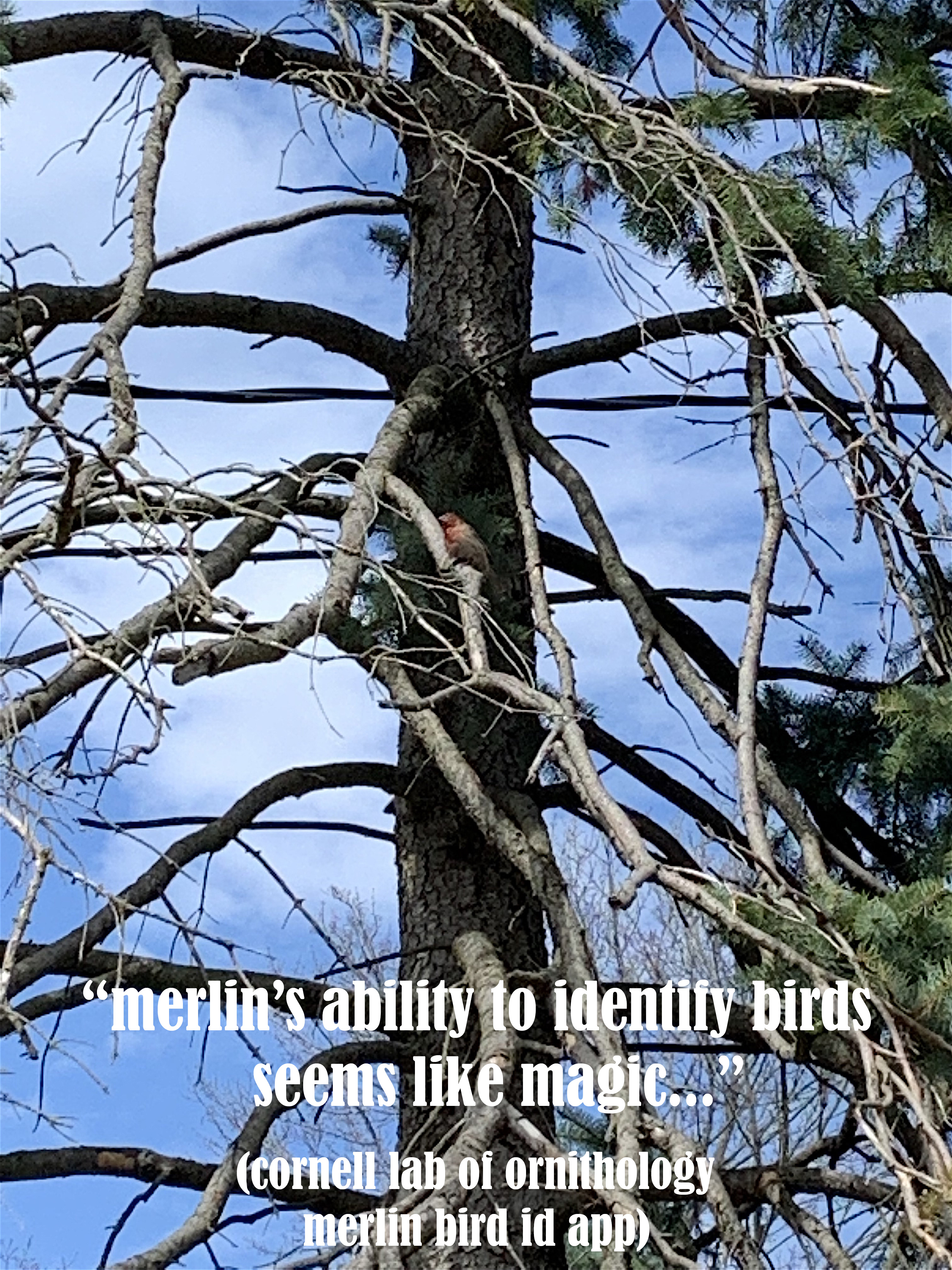
Deb showed us an app. Merlin. It identifies birds by their song. Now, armed with our book from the Botanical Garden and our Merlin app, when I ask, “What’s that?” Kerri – who is always alarmingly way ahead of me – has the answer. “Eastern Towhee,” she says.

“You’re making that up!” I cry, knowing she can’t stand to be challenged so will immediately jump to prove to me that she is right (it’s my secret fast-track to knowledge).

“Look it up!” she insists, showing me both the book and the Merlin return.

“Wow,” I say. “Towhee. Who knew. Maybe my pen name should be Grackle Towhee!”

She yanks the book from my hands. “Oh, Look!” she exclaims. “Merlin has identified you: Midwest DoDo.”

read Kerri’s blog post about BIRDS!

Tell The Full Story [on Merely A Thought Monday]

If you Google Harriet Beecher Stowe you’ll come across a confounding question: Did Harriet Beecher Stowe cause the Civil War?

Think about it. Tease it apart. If the question doesn’t make you shudder ever so slightly, you’re not paying attention to the happenings in our day.

A woman in 1851, a full seventy years before women in our nation had the right to vote, wrote a book depicting “the harsh conditions experienced by enslaved African Americans.” She did not write a fantasy. She wasn’t concocting a circumstance. She wrote a book “which highlighted the evils of slavery.” She called attention to a moral horror story.

The question jumps the long and legislated history of slavery in the land of all-men-are-created-equal. It ignores the economic engine that made enslavement of human beings an institution in our nation. It suggests that shining the light, calling attention to the immorality, not the immorality itself, caused the war. The slavery wasn’t the cause, the industry and economics and political drivers had nothing to do with the war. Looking at slavery, calling attention to it, was.

If we close our eyes it doesn’t exist. If we ban the books it will not be part of our history. It’s a game we play with infants. It’s the puerile mentality of Fox news.

“Since January of 2021, 42 states have introduced bills or taken other steps that would restrict teaching critical race theory or limit how teachers can discuss racism or sexism, according to an Education Weekly analysis.”

To be clear: “Critical race theory is an academic concept that is more than 40 years old. The core idea is that race is a social construct, and that racism is not merely the product of individual bias or prejudice, but also something embedded in legal systems and policies.”

Why do we work so hard to cover our eyes and plug our ears? The path to health begins with admitting and taking a good hard look at the disease. Slavery is a part of our history. As is Jim Crow. The Civil Rights Movement. Red lining,…Black Lives Matter. A clear narrative path.

Isn’t the frenzy to introduce bills restricting discussion about our history yet another example of racial bias embedded into our policies? We are watching critical race theory in action.

Talking about what ails us isn’t the cause of our division. Our inability to fully look ourselves in the mirror and acknowledge all aspects of our story – perpetuates our dis-ease. We would do well to revisit the Serenity Prayer and muster our courage.

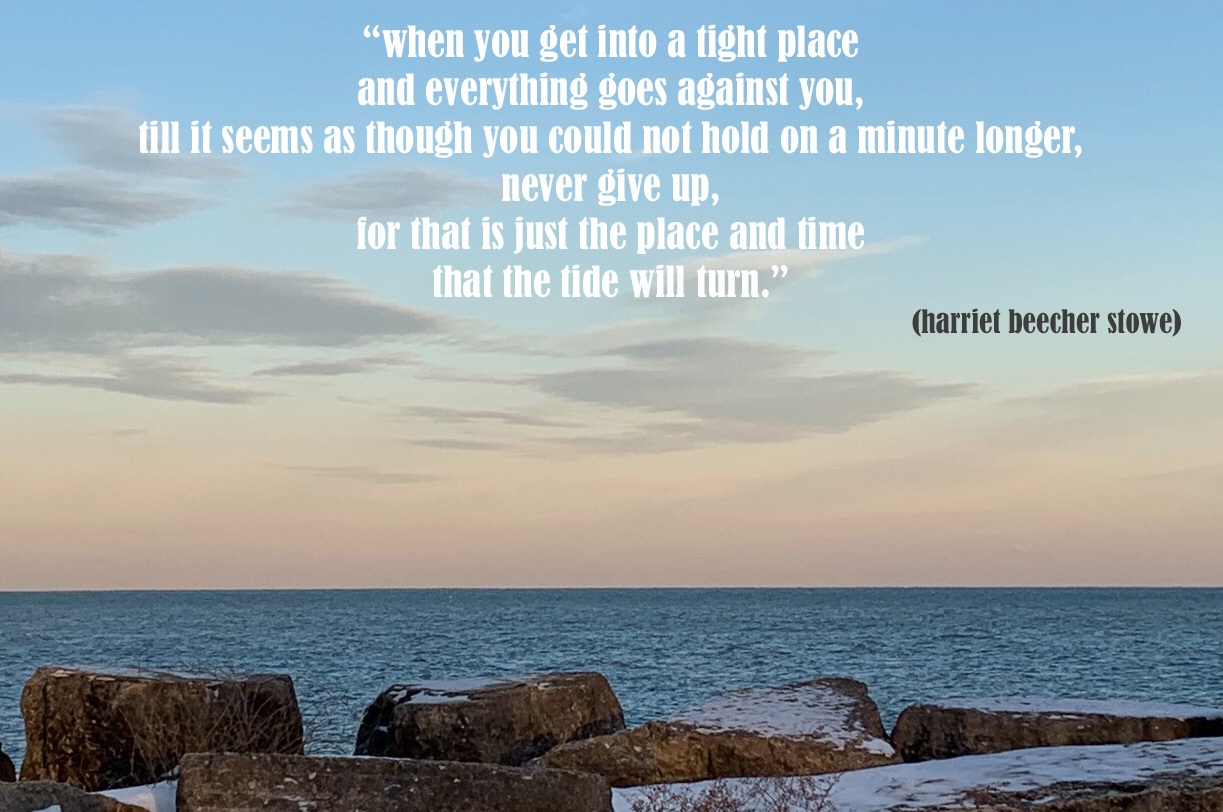
According to Harriet, there is hope. There will someday come a place and time that our tide turns, a time when we can without fear or shame or legislation, look at each other and tell our full story.

read Kerri’s blogpost about THE TIDE TURNING

Collapse And Decide [on Merely A Thought Monday]

Brad calls it “paralysis by analysis”. Over thinking. Over researching. Reading every label. Considering every color combination relative to every other possible color combination. If you do some quick math, you’ll note that there are an infinite number of color combinations so arrival at a choice is a process of exhaustion. Waving the white flag. Conclusion via collapse. Decision by despair.

Neither Brad nor I suffer from this debilitating condition but both of our partners in life do.

It’s hard to watch. I learned at the very beginning to detach from the process. If I wait for the research and comparison phase to pass, if I say nothing until the desperation arrives, then I can tip the turmoil into a choice. And then I return to detachment because the paralysis has only reached its midpoint..

They say that summiting a high peak is not the dangerous part. Most climbers die on the return trip, the descent from the mountain. The same is true for analysis-paralysis-style-decision-makers. Once the decision is made, a river of decision-doubt and choice-remorse rushes in. The real paralysis happens after the decision is finally made. And revoked. And made again. And revoked. More spouses have collapsed on the way down from Mount Decision than on the initial ascent.

There’s a terrific scene in the movie About Time. The wife wants help from her husband in deciding which dress to wear to an important dinner meeting. She models dozens of dresses. He finds goodness in every option. She finds flaws in every dress. He becomes increasingly desperate, no matter what he says or enthusiastic support he offers, he finds himself swirling into the quagmire of no-good-answer.

I love that movie. Every time I watch that scene, I both howl with laughter and close my eyes. I know his desperation. I feel his fatigue. The minute she circles back and decides on the very first dress she modeled, with his wave of relief I whisper to the screen, “Now you’re really in trouble.”

read Kerri’s blogpost about DECISION FATIGUE

Reseed [on Merely A Thought Monday]

We pulled everything off the walls of the office. The photographs and posters of plays I’ve directed, Kerri’s first album, framed, a gift. Our poster announcing Beaky’s Books. “I don’t think the office should be about the past,” she said. “It’s time to make this space about our current work and the future.”

She chose a painting, Nap On The Beach, one of many created from our experiences together. She’s making a poster of Smack-Dab, our cartoon. Turning our eyes from what we’ve done, where we’ve been, who we were. We’ve changed. We want different things now. We work in different ways now.

She’s slowly cleaning out the house. I can’t help. This is something she must do by herself. Purging closets, the laundry room, the storage and work rooms. The year of water upended our house. Several times. It continues in the front yard, all the way to the street. When the ground settles, we’ll reseed the lawn. How’s that for a metaphor? When the ground settles, we will reseed.

It takes time for the ground to settle. It can’t be rushed. It should not be rushed. The same is true for cleaning out. We have new piles forming: what goes, what stays. I climb the stairs to the office each morning. When I come down again, she shows me the new space that she’s created from the day’s purge. It’s true on many levels. She’s creating space. Old baggage and burdens are going out with the old clothes and broken appliances. I can see it in her eyes. Space. Light. Like the house, she is beginning to breathe again.

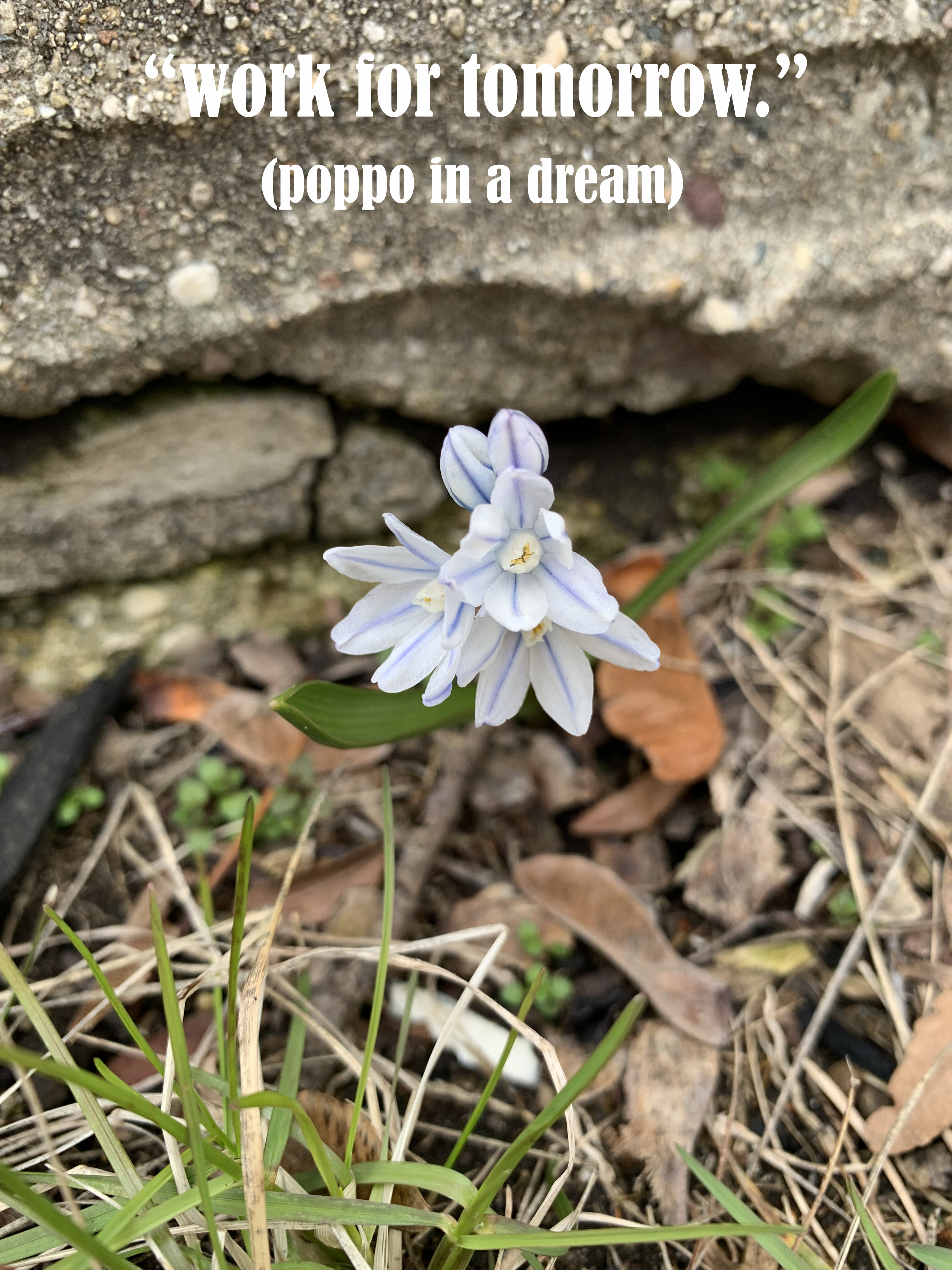
She told me about the dream, her father was setting up microphones. “What are you doing?” she asked.

“Working for tomorrow,” he said.

I had to work hard not to weep. She’s had a rough few years. “Your daddy’s talking to you,” I said. “Sage advice.”

She nodded. Her eyes turning from the pain and constraints of the injuries. Letting go of the past. “Work for tomorrow,” she smiled.

read Kerri’s blog post about WORK FOR TOMORROW

Make It Beautiful [on Merely A Thought Monday]

The media center was in the basement of the library. I left behind the bright New Mexico sun each day as I descended the stairs to my work-study assignment. In the days of cut-and-paste layout, 5 years before I touched a computer, part of my duties included readying the weekly campus newsletter. X-acto knives, glue sticks, blue non-photo pencils, liner tape were the tools of my day. I loved my work-study, not because of the work, it required hyper-attention to detail and ask anyone, I am not a detail-guy, but I knew my life was being changed under the careful tutoring of my boss, Brother Bill. His instruction had little to do with media and everything to do with orienting to life.

Each day at 3:00, Brother Bill would push a cart into the workroom laden with fresh strawberries or cookies and a pot of tea. “Tea time!” he’d announce and we’d stop work. We’d enjoy a cup of tea together.

It wasn’t the tea or the break in the day or even the laughter and enjoyment of each other’s company. Brother Bill was teaching us to make an event of the ordinary moments of our lives. To attend to the quiet beauty available in the details. Presentation mattered. The plates we used for our snack mattered. How we oriented ourselves to each other mattered. It wasn’t the grand gestures but the attention to the daily routines that transformed a life.

Occasionally he took his work-study students to dinner. Always to a fine restaurant so we might have the experience of – an experience of dining. Linens and wine pairing. Food to savor instead of snarf down. Lingering over coffee with laughter and conversation. Being no where else. Taste the moment. It was his single lesson, offered without instruction but by simple demonstration. Feel the sun. Take the time to fully fill out the experience. Fully attend to your moments and your attention will fully fulfill you.

Kerri and I end our work day with happy hour. A glass of wine and crackers and cheese, maybe a pear. Tapenade. One evening we realized that we had a cupboard full of beautiful plates and trays. “Why aren’t we using these for happy hour?” we asked. “What are we saving them for?”

I heard the voice of Brother Bill, “Make it beautiful,” he said. “It matters.”

read Kerri’s blog post about BEAUTIFUL PLATES

Stack The Impossible [on Merely A Thought Monday]

We watched the video of Jaxon climbing the ladder of the red plastic slide. His momma said, “Is that your big boy slide?” Jaxon said, “Big boy slide.” Pandemonium. “He said it!” his father exclaimed, “I think he said it!”

Big boy slide. A first phrase. The moment when what’s necessary becomes what’s possible. It’s something we take for granted every day. The utter impossibility of spoken language. Sounds uttered in sequence that somehow make sense. Of course, we’re also quite capable of stringing together sounds that make nonsense, too. Soon, Jaxon will ask his parents for the keys to the car and a wholly different kind of pandemonium will let loose. From climbing a ladder to driving the Volvo. The impossibilities stack one upon the other.

My mother is adjusting to life without my dad. She says often, “I don’t think I can take it, this loneliness.” She is doing what is necessary. In our last chat, she spoke of playing pickleball, of taking a walk, of meeting a friend for tea. Moving with intention out of the apartment to meet other people. The moment when the necessary becomes what’s possible. She will, I am confident, live her way into the impossible.

The impossible rarely happens in a snap. We live our way into it. Jaxon’s pronouncement and subsequent trip down the big boy slide was a long time coming, a step in the process worthy of celebration. And then, the miracles will keep coming. Full sentences. He’ll learn to write. Someday he’ll write love letters and drive the car to pick up his date. He’ll ask someone to marry him. The art of the impossible. This life.

And, the most amazing of the impossibilities, as we stack our lives with the formerly inconceivable, we grow less and less capable of seeing it. Perhaps that is necessary? How would we exist if we saw each other as keepers of the impossible? Experiencers of the unimaginable?

read Kerri’s blogpost about THE IMPOSSIBLE

Call It An Art Piece [on Merely A Thought Monday]

When the ancient television antenna tower fell in the windstorm, it snagged on the neighbor’s fence and tilted precariously above their garage. We did not know what to do – so we did what we always do in similar circumstances: we texted our tribe with a rousing, “HELP!!! And then we asked, “What do we do?”

No one had a clue. This was a first. The insurance company was certainly clueless. Their advice was to (I’m paraphrasing and scrubbing for courtesy) let it fall. The fire department didn’t know. We called a contractor friend who recommended finding a crane. We called tow trucks. We called antenna companies who told us that this problem was out of their league.

A single, sensible, and fantastic piece of advice came as it always does, from Master Marsh. “Just leave it and tell the neighbors it’s an art piece: The Death of Broadcast Television.” Had it not been dangerous, I’d have taken his sage advice. I’d have gone so far as to make a plaque for the base. I’d have sent out a press release. Our art piece might have one day been moved to the permanent collection at The Chicago Art Institute or been featured at Biennale Arte 2022. It would be necessary to compensate the neighbors for a piece of their fence – since it is a crucial element of the statement – but that is a minor detail and certainly worth sorting out for such a prestigious end to our dilemma.

It did make me wonder how many of my life’s tribulations would have been better solved with a bit of rebranding? Call it an art piece and make it all better with plaques emblazoned with clever titles. I laughed when I imagined moving through my life’s calamities as a gallery show. Children asking their grandparents, “What is broadcast?” The raging waterfall through the ceiling would be fantastic!

In the end, rather than art, we opted for a tree service. These amazing guys came, sawed up and carted away our precarious antenna in less than 30 minutes. An entire era of technology disappeared in less than half an hour.

As they say, in our times, the only constant is change and, if you keep asking the right question, “What do we do?” a proper answer is certain to find you. And, if not, there’s always the art route.

read Kerri’s blogpost about BROADCAST TELEVISION

Look At You Look At Me [on Merely A Thought Monday]

It’s taken me this long to discover the source of all cartoon characters: orchids. I’m not kidding. At a recent field trip to the Chicago Botanical Garden’s Orchid Exhibit, I was surrounded by brightly colored fantastic faces, playful and chuckling. “Look at this one!” Kerri exclaimed. “It’s the Imperial Margarine guy!” I thought it was a whacky Pope or funny Cardinal, but the idea was the same.

“The earth laughs in flowers.” Emerson’s quote was stenciled on the wall as we exited the exhibit. And the laughing flowers made me laugh. Truly. I felt like a little kid at Christmas. Surrounded by color and delight and whimsy, I found myself more than once pointing, “Look at this one! Oh My God!” And, I felt like the colorful faces were staring back at me, thrilled to tears by the odd looking human standing before them. I-look-at-you-look-at-me. “Look at that face!” they snickered.

The thought stopped me in my tracks and filled me with wonder. We personify everything, projecting our humanness into everything. The art of animation, the world of Disney, is rooted in our desire to project ourselves onto and into the world. Talking mice. Dancing candlesticks. Humpty Dumpty. Wise old trees. Wouldn’t it be lovely, and isn’t it hopeful, to think the world projects itself into us? I want the orchids to fill me with color and awe. To project themselves into me. I know the forests I walk through infuse me with quiet. I know Dogga pulls love from my deepest soul.

Participants. Relationship, rather than controllers. Dancers rather than dominators. Would we be so invested in killing each other for imagined supremacy if we allowed ourselves to laugh the laugh of the flowers? If we actually understood that nothing is forever, that our warmongering was at best delusional? That the single trait that makes us human is to turn and help someone in need? The very capacity that allows us to project ourselves into the orchids is the same capacity that makes it possible to stand in the shoes of the other. Empathy is a two-way street.

If the earth laughs in flowers, these days it certainly cries in humans. Yet, standing amidst the orchids, I looked at all the human faces, hundreds of people wide-eyed with wonder and alive with astonishment. The laughing orchids looking back at the astonished faces, open and vulnerable, and they were evoking those qualities from the crowd. Earth’s tears. So hopeful, these faces, drinking in each other’s beauty.

read Kerri’s blog post about FACES

Hold The Space [on Merely A Thought Monday]

When I met Kerri, the bar of acceptance I had to clear was not with her children, it was the enormous cat with the name of a rapper: BabyCat. If the sumo-sized cat had rejected me, I’d have been shown the door. Thankfully, BabyCat was merely indifferent to my presence so I got to stay. And, after a few years of kitty-aloofness, one night BabyCat crawled into my lap and I knew I was in for good.

Today, BabyCat would have been 13 years old. He left us in a flash almost a year ago though, to this day, I think I hear him upstairs. I’m not the only one: after breakfast every morning, a year later, Dogga returns to his B-Cat meet-up spot in the kitchen and waits for his pal to join him. With full bellies, they would meet, hang out in the kitchen, and sleep the morning away. Now, after a few minutes, Dogga retreats to the back door and pines.

Though Dogga and I miss our BabyCat, Kerri suffers most from his absence. Sometimes I find her standing still in a room, as if she is listening. I wait, holding the space. “I can’t believe he’s gone,” she says. He came into her life in a period of great upheaval and was her constant companion. Through the years that she lived in this big old house all by herself, she was never all by herself. She had her BabyCat. He had her. They were – they are – bonded.

It is the empty space, the surprising change of pattern, the absence of a normal daily sound: the heavy footed cat coming down the stairs to beg a treat, that makes us stop and listen, move to the back door and pine, or tell BCat stories. Today we light a candle and celebrate BabyCat. We pause to fill the empty space with memories and laughter of all we loved about our enormous tuxedo cat with the name of a rapper.

read Kerri’s blog post about BABYCAT