Live Life At The Pace Of A Letter [on KS Friday]

“…what we feel is always larger than our means to express it.” ~ Declan Donnellan

Ruby, like Columbus is winding down. The forwarded-email let me know that she enjoyed my letter but also that she was not getting out of bed. Over the weekend she did not want to eat or drink. Pete is in hospice care.

I’ve not heard from Mike in months. Like Ruby, she is in her 90’s and I often wonder how she is doing. She is made of sturdy stuff and has a curious mind but even those powerful forces are no match for the running sands.

Although we live in the age of email and text, fast communication, these dear ones are solidly old school. A letter. A stamp. A mailbox. News comes at a different pace.

Ruby wrote a letter. It was dated last October and was mailed sometime in April. She typed it because she feared that I would not be able to decipher her handwriting. I typed my reply because I knew for certain that she would not be able to read my scribbles. Although it was lost on my young ears, time is different when you age. Both more meaningful and less. I’m living my way into hearing the simple wisdom of elders.

Tom Mck and I used to sit on his porch and watch the sunset over the fields. One evening he told the story of a letter mailed to his great-grandfather Lak. The pony express took six years to deliver the letter. It had to come all the way across the country. It was from his siblings telling of his mother’s passing. Although six years in the past, the news was fresh to Lak. His grief, therefore, was timeless.

It is always a time of transition but, sometimes, it is simply more apparent than others. This is one of those times. There is a pandemic. There is civil unrest. Moral upheaval in the nation. I feel none of that as acutely or potently as I do Columbus taking a labored breath or Ruby no longer interested in eating. It is the reason we sit on the back deck each night, light the lamps, and, often in silence, we enjoy the evening as it wanes. Living life at the pace of a letter.

It’s not that there is nothing to be said, it’s that no words – no matter how quickly delivered or slow – can properly capture the enormity of this time, this inevitable rolling transition.

all of kerri’s albums are available on iTunes or streaming on Pandora

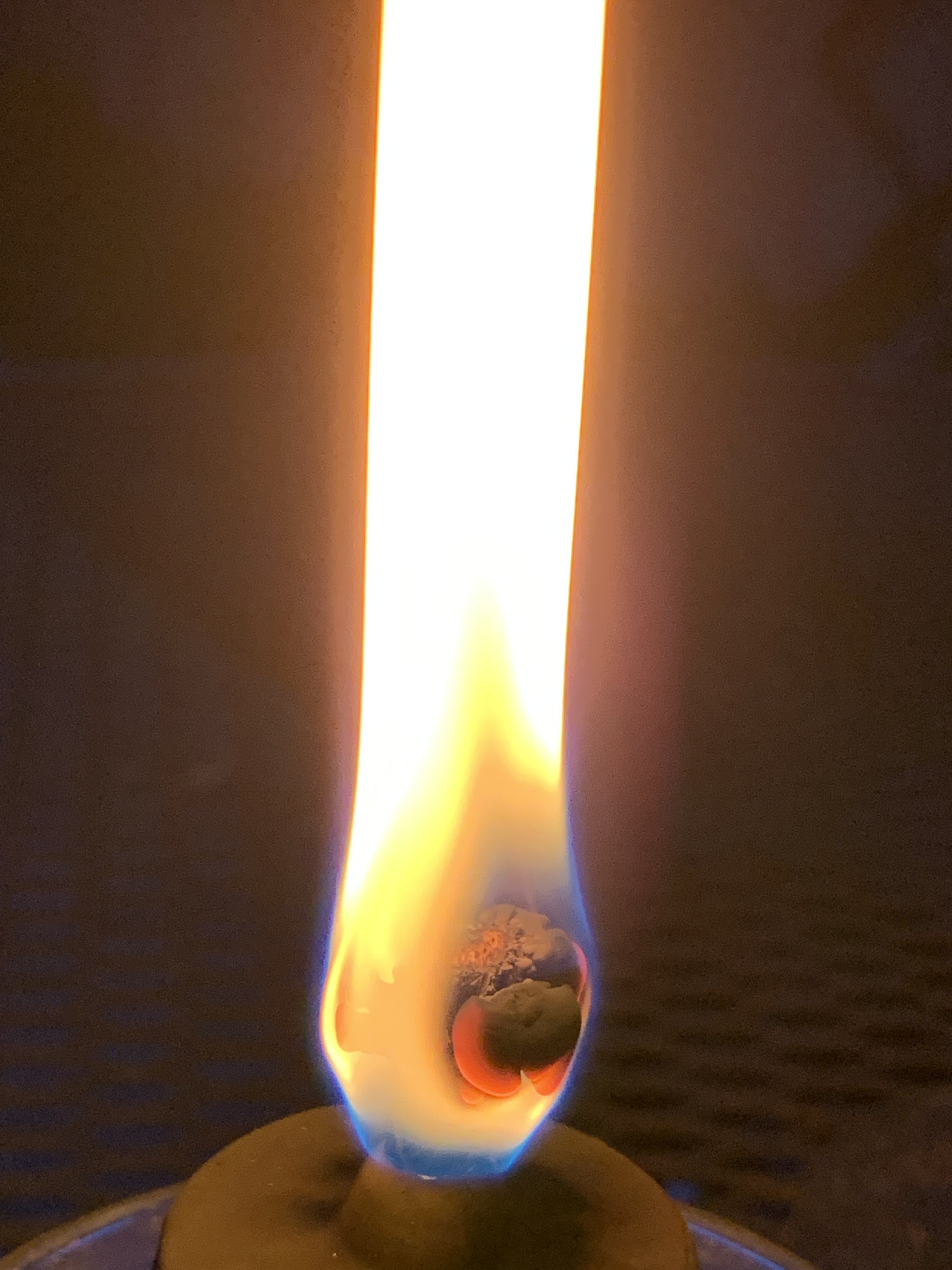
read Kerri’s blog post about THE FLAME

in transition/released from the heart ©️ 1995 kerri sherwood

Step Beyond Words [on Two Artists Tuesday]

“Truth is a pathless land.” ~ Jiddu Krishnamurti

I have done my share of seeking and, also, my share of not finding.

I believe that I began painting because, while doing it, while lost in the discovery of an image, I experienced truth – or something close to it. Always in quiet studios. Always beyond the place of mind chatter. Something “bigger” washed through. Something beyond words.

That must be why I associate truth with silence.

All around I hear people proclaiming transparency. No hidden agendas. Everything up-front! As Quinn used to say, “If they have to tell you that they are being transparent, it’s a good bet that they are not.” Words, words, words.

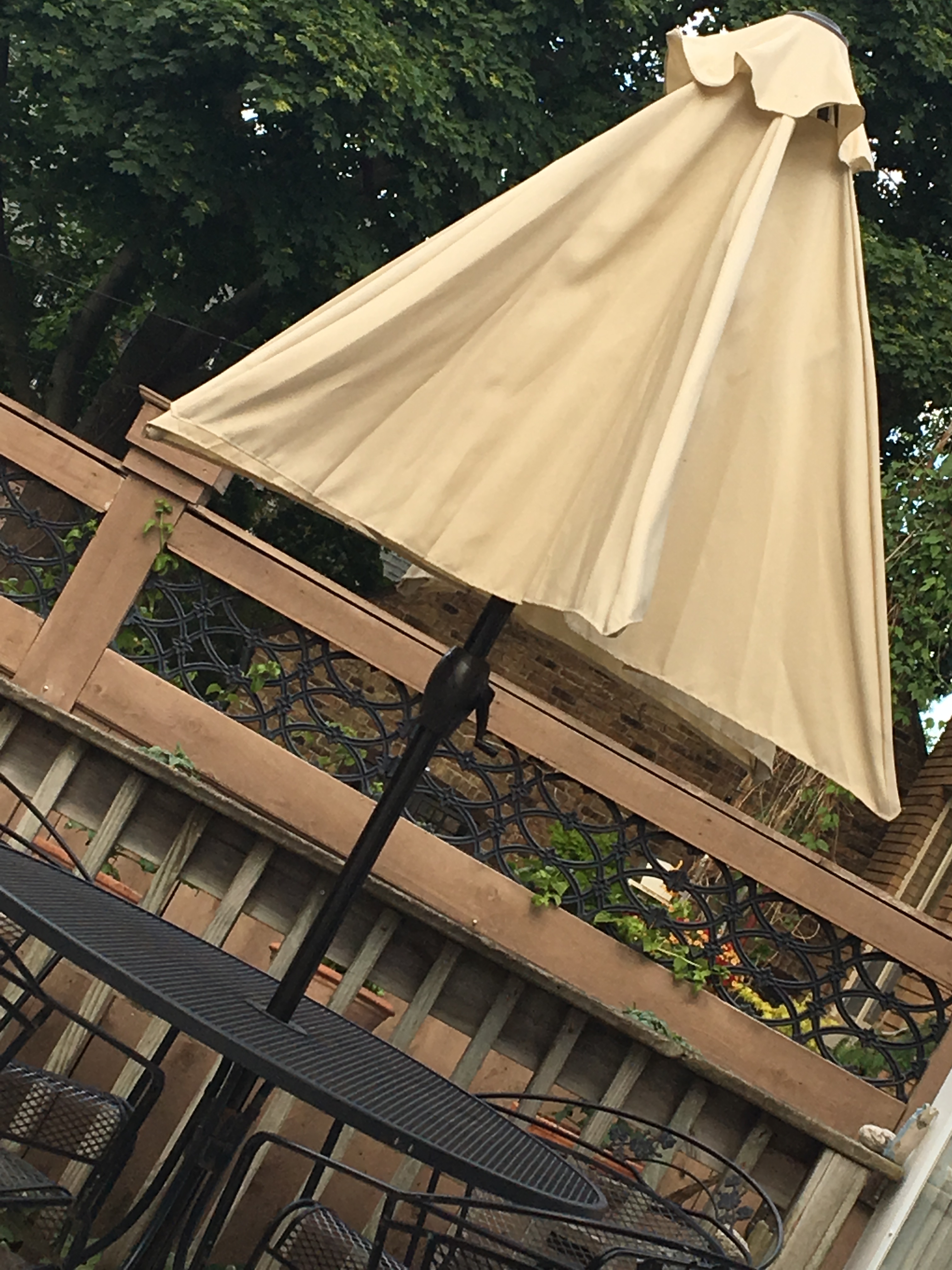
Many evenings we sit on our back deck. The umbrella shields us from the heat. We watch Dogga run circles, dig holes, and bark at squirrels. The birds perch at the feeder or drink from the pond. A chipmunk dashes across Barney’s keys. The crows call from the treetops. The sun drops behind the trees. The mosquitoes come out; our cue to go in.

So much life! And not a single word required though, clearly, it is more than tempting to try and describe it. Try is the best I can do.

I often remind myself that I have never lived this day and will never again live this day. No trail to follow even when I think I know what will happen next. I don’t. That’s the truth.

read Kerri’s blog post about THE UMBRELLA

Use Your Chalk [on Two Artists Tuesday]

There are two words floating around in my universe these days: structured and unstructured. Structured data. Unstructured data. Structured time. Unstructured time.

The world as seen through the Puritan lens gives great preference to structure. Unstructured anything is suspect. “Idle hands,” we are taught, “are the devil’s workshop.” Yikes. Apparently it’s dangerous to take a stroll, to sit and ponder, to clear the day and do nothing.

I suspect it explains why our notion of business is hyper-focused on the bottom line and often misses the value of relationships. Bottom lines are easy structure. Relationships, not so much. It is the same with test scores in education. Easy structure. However, stepping into the unknown – the very definition of learning – is largely eschewed because it begins in an unstructured pursuit. Creating the structure, making the meaning, discovering the connectivity is what our hearts and brains like to do. When learning isn’t merely a factory, when business is more than a bottom line, people prosper. They come alive.

Unstructured time. There was a time when time had no structure. Monks attempted to “keep” time by monitoring water through a bucket or sift sand through an “hour” glass. Sometimes the water froze in the bucket so the structure of evening prayer was disrupted. The sand clumped in the hour glass and the measure of time clumped with it.

There are moment on the stage when the actor forgets their lines. It’s called “going up” or “drying.” It is always, in the re-telling, the moment when everything becomes real, alive. It is the moment when the structure becomes unstructured. Hearts race. Eyes widen. The stakes are suddenly palpable. The actor breathes, stands in the vast unstructured universe, and the words return like a swinging bar to a high-flying aerialist. The play is infused with aliveness. Presence is mostly unstructured.

As is common in the structured and unstructured use of the English language, oppositions are easily constructed. Unstructured simply means the meaning has yet to be made. Structured data, structured time, are the tip of a largely unknown iceberg. Love, joy, despair, awe…the full spectrum of experiences, bubble in the unstructured spaces. Numbers can describe a moment in time, can orient for a moment, but will never “explain” yearning or desire or our fundamental need to tell stories (put structure on unfathomable experiences). Structure & Unstructure: they are dancing partners, not combatants.

Where do we come from? What are we here to do? I am going to die, what then? It takes a good deal of unstructured time to sit in these unanswerable questions. There are, of course, plenty of people who will gladly provide structure to your unanswerable – and therefore uncomfortable – questions. Perhaps that is why we adore our structure and demonize the empty spaces? Comfort. Ease.

Kerri cannot pass a hopscotch template chalked on the street. It’s almost automatic. Step, hop, hop, step, hop. The little girl in her connects to the child who chalked the squares on the sidewalk. A simple game. Play. It’s one of the things people do with unstructured time. Set challenges. Make up obstacles. Seek puzzles. Invent. Dream. Connect to the deeper places. Where’s the structured bottom line watching the little-girl-in-my-wife hop and skip and turn in the game-chalked-on-the-sidewalk? The laughter of remembering? The giggle and freedom of the woman hopping the scotch, just because she can?

read Kerri’s blog post about HOPSCOTCH

Run Through Norway [on Not So Flawed Wednesday]

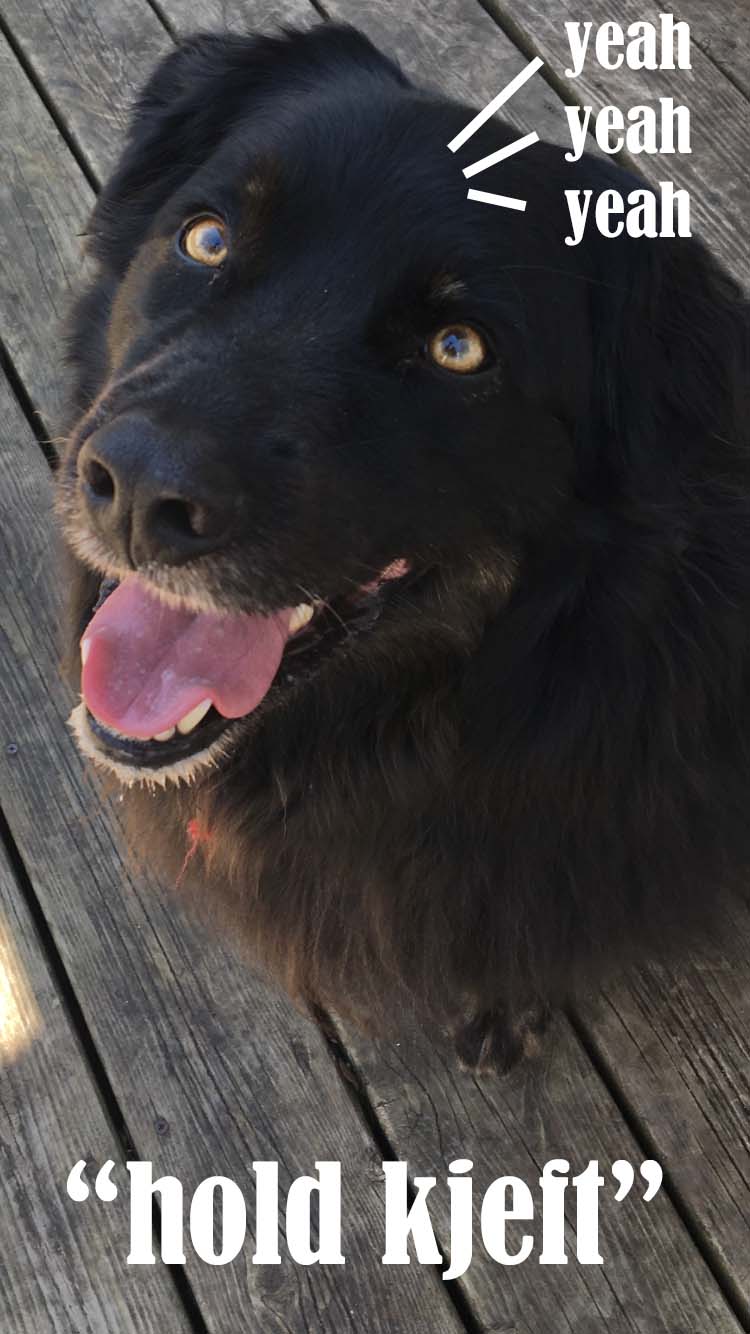
DogDog is a very vocal pooch. He sings his body electric, he gives full voice to his soul. There are times that I, with great delight, watch him run fence to fence, barking for the simple pleasure of making sound. He is a vocal hedonist.

Sometimes he barks and listens. He wants some dog out there to bark back, a pooch call-and-response. There is no better gift for DogDog than when one of his neighborhood pals barks in response. Pure pleasure, he runs circles around the yard. When his call does not evoke a response, he waits a few minutes and tries again. He is an eternal optimist.

DogDog knows when he’s NOT supposed to bark. Inside the house is a no-bark-zone. When Tim, the neighbor gets in and out of his car. When Lucky, the dog that recently showed up in the yard behind ours, comes to the fence. When we are in the car, going on errands, and he sees another dog; his body quakes with full-bark-desire but he knows better. Kerri taught DogDog a bit of Norwegian. “Hold Kjeft,” she says, when we he winds up for a good bark-in-the-car. DogDog hears Hold Kjeft and he moans and whines and complains. He performs a melodramatic Medea until something else captures his attention.

Initially, she didn’t use the phrase in any other situation. Norwegian was reserved for the car. Hold kjeft, in translation, means shut-up but for us it has become a preemptive command, “no bark.” Norwegian was so successful in the car that it has now spilled out into all other situations. She never has to raise her voice. She simply opens the back door, says, “Hold Kjeft,” and all barking turns to enthusiastic circle-running. It’s magic. It’s Norwegian.

It doesn’t work when I use it. For some reason that I can’t explain, my “Hold Kjeft” elicits howls of laughter from DogDog. He looks at me and, as if to make a point, “Your Norwegian is no good!” he barks in reply. And then, to sear in his criticism, he barks again. I revert to my Frankenstein English “No Bark!” DogDog immediately complies. “That’s more like it,” he wags and runs for the back door.

Language is a mysterious and magic beast. Lately, I’ve noticed, that when I am whining and complaining and feeling like performing my version of melodramatic Medea, a tiny voice in the back of my mind whispers, “Hold Kjeft!” So taken aback by the sudden whoosh of Norwegian, my performance is short-circuited. My mind shuts up.

I look to Kerri to suss out whether that tiny voice is hers or coming from some other mysterious source. She always appears to be innocent and asks, “What?” to my inquisitive stare. “Nothing,” I reply and look to DogDog, who wags and rolls for a belly-belly.

I suspect that, rather than DogDog, it is I who am being trained. Belly-belly. Hold Kjeft. I am suddenly suspicious about my overwhelming desire to wash the dishes. What is going on here?

There is only one thing of which I am certain: my path to inner quiet runs through Norway. Hold Kjeft! On me, Norwegian works.

read Kerri’s blog post about HOLD KJEFT!

Live A Sockdolager [on Two Artists Tuesday]

Word genius sends me a word everyday. Some I know. Most I do not. Yesterday, my word-of-the-day was sockdolager. Sockdolager is a word that, when typed, is unrecognizable to the vocabulary in my spellcheck and is adorned with a screaming-dotted-red-line meant to notify me that either I spelled the word incorrectly or it’s not a word at all. Language is a fickle companion.

In Seattle, when the rains clear, people are fond of saying, “The mountain is out.” Mount Rainier, hidden in the clouds, makes a grand – almost impossible – appearance when the weather clears. Where there was no mountain, suddenly a Titan appears. It is a sockdolager, an exceptional occurrence. A forceful blow. The first time I saw it I almost crashed my car.

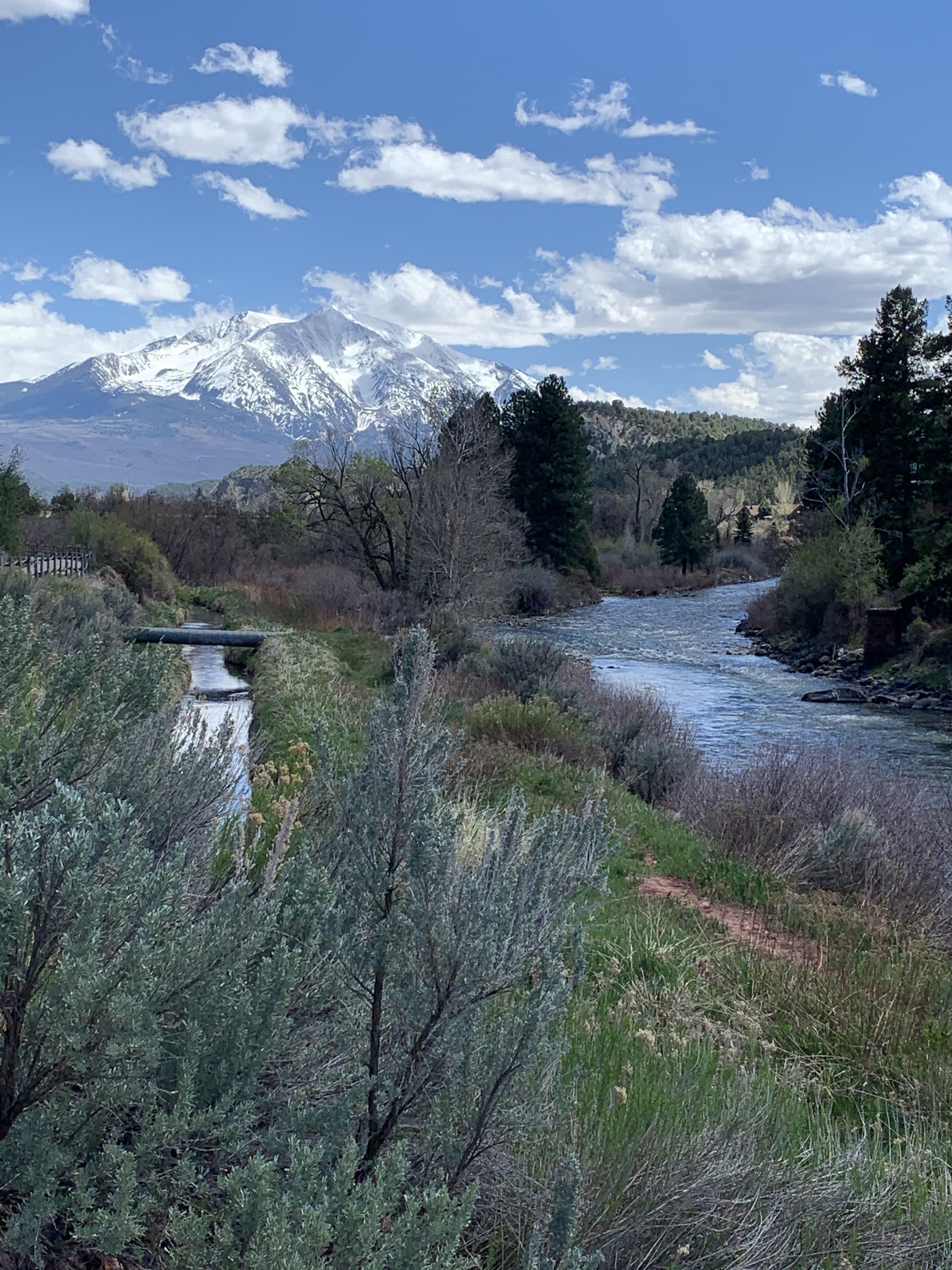
Mount Sopris hit us with a similar wallop. We arrived in Carbondale “in weather.” A day later, making a run to Main Street to meet Kirsten, we rounded a corner and nearly crashed the truck. There was a mountain towering over us where, previously, there was none. Clouds swirled around the summit. The late afternoon light made it glow. Sockdolager! Sockdolager!

I very much appreciate that my snotty spellcheck does not recognize or appreciate my use of sockdolager. No word can adequately capture the experience of being hit by a mountain. “Awe” is a word. So is “amazement.” They fall short, too. Language can reach toward but never quite touch that which it hopes to describe.

The day after the wallop we took a stroll on the Rio Grande Trail. We intentionally walked away from Mount Sopris, knowing that, at some point, to get back to our airbnb, we’d need to turn around and walk toward it. Like Orpheus leading Eurydice, we tried not to turn and peek but the majesty was too much. We’d giggle and turn and gasp. “My god!” we whispered.

We go to the mountains to remind us, to refresh our eyes and hearts and minds. This life. An exceptional event. A forceful blow. Grander than words can describe. Sometimes the mountain is hidden. Sometimes it shows its face. Either way, it never ceases to surprise you, to take your breath away. Sockdolager.

read Kerri’s blog post about THE MOUNTAIN

Make Belief [on Two Artists Tuesday]

“A great deal of intelligence can be invested in ignorance when the need for illusion is deep.” ~ Saul Bellow

In addition to meaning uneducated, it occurred to me that the word ‘ignorant’ also means to ignore. It’s an adjective, a descriptor. Someone who ignores is ignorant, is an ignorant. I looked up the root of the word to be sure. To disregard.

Early in the pandemic, we placed a table in our sunroom. We call it our pandemic table. In our isolation it helped us to end the day, looking out at the back yard, and watching the light wane. Through the spring, summer, and into the fall, we’d sit at the table and talk about the news of the day. We’d ramble on and on about our disbelief in the angry wave of intentional misinformation rolling over the country, the big things and small things people have to ignore in order to make belief. To support an angry illusion.

One evening, we shook our heads in utter incredulity as a member of our community re-posted a QAnon assertion that the CDC was exaggerating the numbers of COVID deaths just to make the then-president look bad. As proof, the post included a morbidity chart extracted from the official CDC website. We pulled up the website – it took less than 15 seconds – to see the extracted chart nestled on a page with multiple charts detailing comorbidity data; the many many ways that COVID kills. We felt compelled to write a note. It was too easy to debunk the assertion. We asked him to take a moment and go to the site, to look at all of the data. He was being fed a chart cherry-picked from a veritable mountain of information. Nothing was being hidden. No evil plot was in play. His reply was angry, defensive. He unfriended us. We’d done the unthinkable and revealed what he was ignoring.

We learned a lesson about the power of invested ignorance.

Over the year our pandemic table has changed. It’s been populated with sparkling lights and plants. A bonsai gardenia, a birthday present from Kirsten to Kerri sits next to the ponytail palm, both surrounded by succulents. It’s become a sanctuary. We’ve changed, too. We rarely give our time to shaking our heads in disbelief or pushing back against the non-sense things people-in-our-world believe. I’ve stopped exclaiming, “Check Your Sources!”

We occasionally comment about the big things and small things – the mountains – being ignored in order to sustain the modern bubbles of make-belief. The big lie. We are no longer shocked by the dreck that people swallow without question or thought. We’ve moved beyond our own naive illusion and admitted that many people simply do not want to know anything that might challenge their make-believe.

We sit at our pandemic table. We listen to the mourning doves. We eat our lunches looking out at the vibrant green returning to the backyard. We laugh at Dogga running circles in delight. We talk about replacing the very-worn rug beneath our feet. We appreciate the bonsai gardenia, checking the moisture of the soil. We celebrate when our friends and family are vaccinated. We know more than ever it is important to hold dear the baseline, to not disregard our responsibility to check our sources, to carry a healthy doubt about what we are hearing on the news, the story we are being told.

read Kerri’s blog post about BONSAI GARDENIA

See The Verb [on Not So Flawed Wednesday]

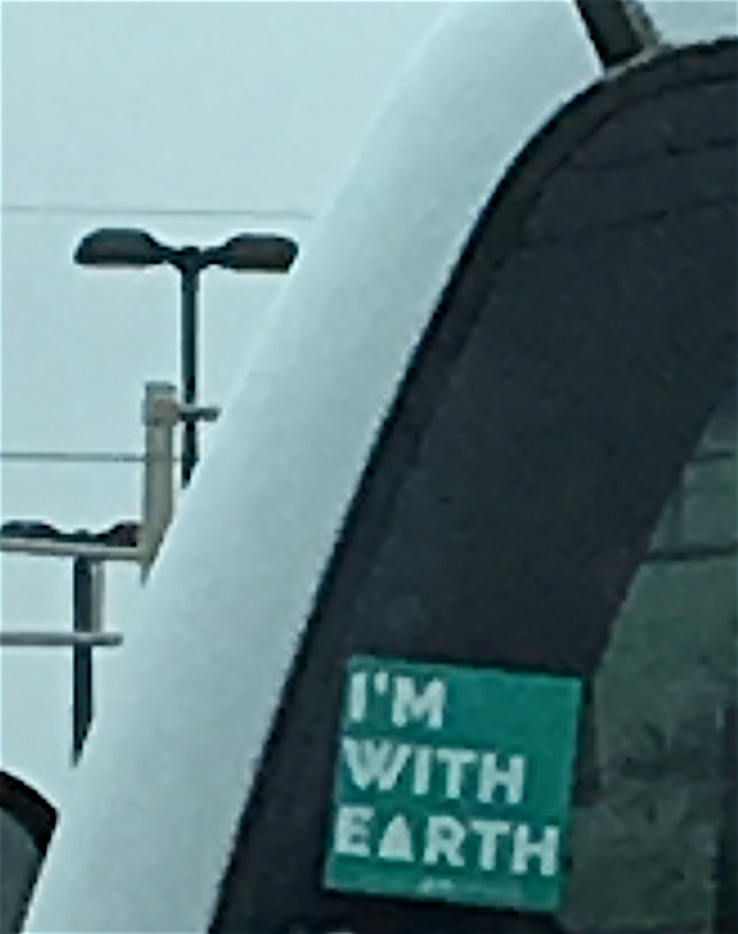
Random fact of the day: my waking thought this morning was about The Geography of Thought. No kidding. It’s a terrific book by Richard Nisbett. The subtitle is “How Asians and Westerners Think Differently…And Why.” Somewhere in the recesses of my brain I must have been pondering the bumper sticker we recently saw: I’m With Earth.*

One of the points made in the book, the one that permeated my dream state, is that different languages place different emphasis on different parts of speech. For instance, many Asian languages place emphasis on the verb. English speakers place the emphasis on the noun. In listening to mothers talk to their infant children, an English speaker will say, “Look at the red truck! Do you see the red truck?” An Asian mother will say, “Look at the red truck go!” Do you see the red truck go?”

Why does it matter where the emphasis lands in a language structure? Noun or verb?

The language we use shapes our thinking and seeing. It shapes basic worldviews. Earth as a noun or earth as a verb. Earth as a stand-alone-thing or earth as a moving interrelationship. These are vastly different worldviews.

This was my thought/image coming out of sleep: earth and sky. In a noun world, earth and sky are two distinctly different things. In a verb world, earth and sky are not separate things, they are verbs, actions, interplay of a dynamic relationship. In a noun world, I am also a distinctly different thing. In a verb world, earth, sky and I are not separate things, we are a dynamic inseparable relationship. We.

The bumper sticker is a declaration: I am with earth. It makes perfect sense in a noun world because it is also possible, in a perceptual world of separate things, to be against earth. Nature needs to be conquered, tamed. In a noun world, earth, once tamed, is a resource and resources are meant to be used. In a noun world, we are capable of believing that our actions have no impact on our environment. Action and environment are nouns, separate things.

In a verb world, what you do to the earth is what you do to yourself. No separation. In a perceptual world of relationship, of verbs, it is understood that your actions not only have impacts, your actions are impacts.

We woke to the news of yet another mass shooting. This one in Colorado. As usual, we know that our community and leadership will offer thoughts and prayers but nothing really – not really- will be done to address it. In a noun world, we protect the rights of the individual, the separate thing. In a verb world, there are no mass shootings. None. Violence done to one is violence done to all. In fact, more people are gunned down in the United States in a day than are killed by gun violence in Japan in a decade. The differing linguistic emphasis extends to differing understanding of rights and responsibilities.

Language matters. Where we focus matters. What we emphasize matters. The story we tell is determined by the language we use to tell it. I am with earth. Or, I am earth. I go to worship. I am worship. I seek purpose. I am purpose. Separation. Relationship. A whole philosophy of living reduced to a simple bumper sticker.

So, when we ask complex questions like, “Why can’t we do anything about gun violence?” or, “How is it possible that people in a pandemic refuse to wear masks to protect each other,” our answer is really very simple: our language makes it so.

Perhaps in a world of nouns a declaration is the best we can do. It is a step toward the middle way, a declaration of responsibility to the commons. Black Lives Matter. #MeToo. Stop Asian Hate. I’m With Earth.

*The “I’m with Earth” sticker is from the very cool company Gurus

read Kerri’s blog post about I’M WITH EARTH

Embrace Orbisculate [on Merely A Thought Monday]

A family is trying to get ‘orbisculate‘ into the dictionary to honor their dad who died of Covid-19

Compromise. Accuse. Jaded. Dishearten. Tranquil. Swagger. Mimic. These are just a few of the over 1,700 words that William Shakespeare invented or adapted. Making up words, playing with sounds and meanings and clever twists of usage was appreciated in his lifetime. Audiences went to hear plays like we go to hear concerts. The sound of the word was more important than the visual on the stage.

During Shakespeare’s lifetime, Robert Cawdrey toyed with a thing that would someday be called The Dictionary though it wasn’t something Will had to consider. Spelling was phonetic. Teachers did not think to circle his words with red pencil. That bit of standardization was still a few centuries away. Spend time within the unedited-for-our-eyes First Folio and you’ll find yourself sounding out words just as the poet did. Tasting the sounds. Shaping meaning in your mouth en route to making meaning in the world.

Language is fluid. Each year new words come into being and others drop from sight. For instance, our word “google” is a “creative spelling of the word googol, which implies an unfathomable number. It was coined in the 1930’s. Our version is in the dictionary as a verb: to search for information. And, you’ve probably already heard that it’s also a company that facilitates the search for information. Which came first, the verb or the company? Some words, over time, come to mean the opposite of what they originally meant. The archaic meaning of the word “egregious” is “remarkably good.” From remarkably good to outstandingly bad is quite a journey!

Definitions are discoveries and agreements made according to how we use the tasty sounds we call “words.” Each word comes into being from necessity.

Orbisculate is a tasty word that William Shakespeare might have created and enjoyed. But, he didn’t. Neil Krieger did. It is a word for juice squirting in your eye. Neil died of COVID and, to honor this good man and his good life, his family is attempting to get Neil’s good word into common parlance and, ultimately, to the dictionary. They are appealing to poets and pedestrians alike to embrace their necessity and use Neil’s word. If you visit their site, check out their 50 Goals. Never was a single word so lovingly brought into the lexicon. Help them if you will. Will would have. He’d have used orbisculate in one of his comedies. Or many of his comedies.

I have a sneaking suspicion, if they are successful in their quest, that, over time, orbisculate will come to have another meaning: an act of familial love.

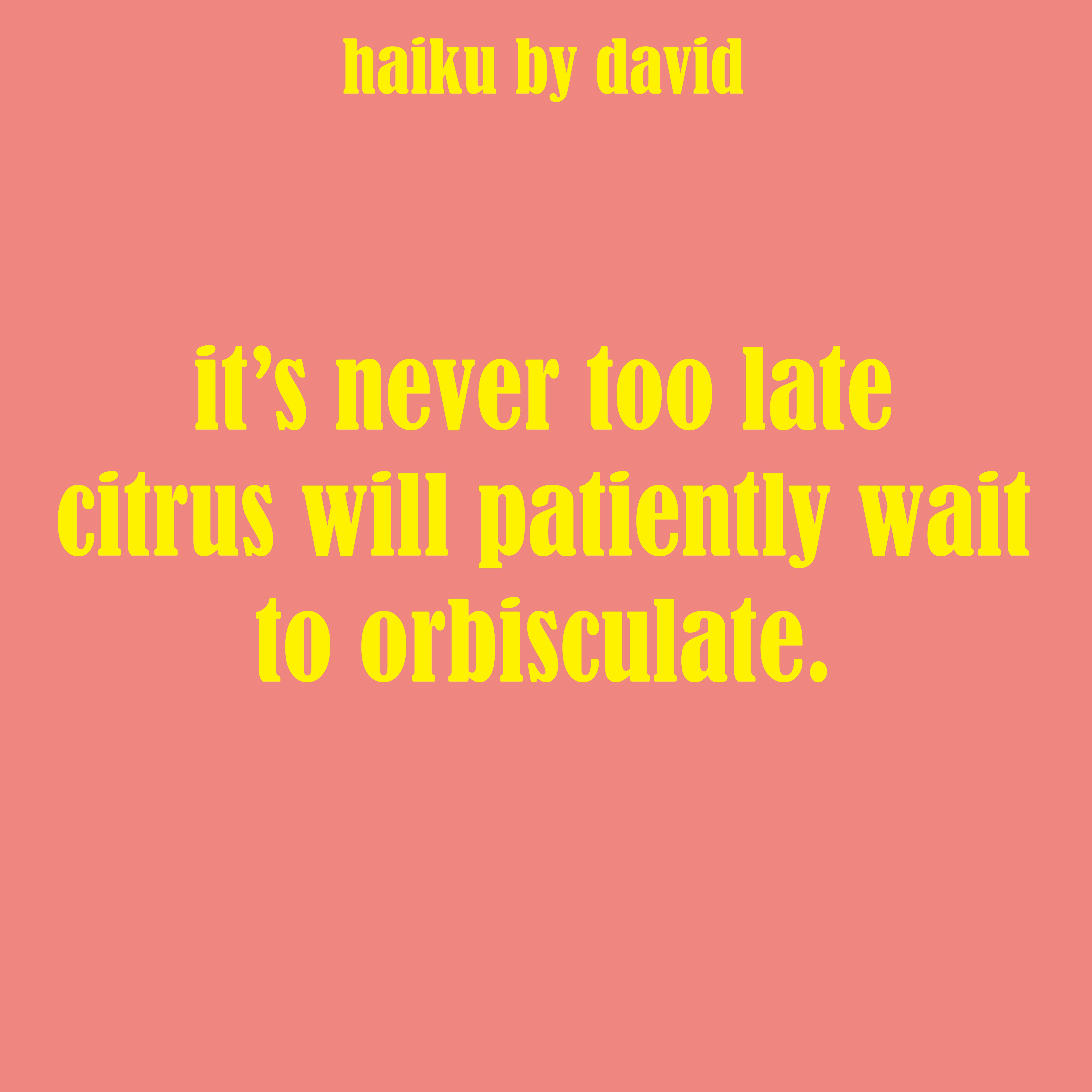
The Orbisculate haiku challenge! Here’s mine:

Now, it’s your turn. Make sure you let the family know.

read Kerri’s blog post about ORBISCULATE

Check Your Attribution [on KS Friday]

I have just had a front row seat to a full-blown, hyper-antagonistic, years-long, classic case of attribution-bias-escalation. It was [and is] ugly. The ripples are rocking boats, eroding foundations, ending friendships. The damage is thorough and, as is always true, infinitely avoidable.

Attribution bias. Making the assumption that you KNOW why someone did or said something. Assigning your reason to their behavior.

Years ago, a red faced executive called me, the consultant, in and fumed, “She said THAT to demean me!” I paused and asked, “Do you really know why she said it? Have you asked her what was going on from her point of view?” His blank stare told me all I needed to know. He would rather demonize her, be offended by her, than communicate with her. We sat down, drank a cup of coffee and decided that, rather than fume and escalate, rather than simmer in a victim-stew, he had at his disposal a better path. Communicate rather than assume, ask questions rather than blame, poison the well, and indulge in being offended.

It always amazes me how unconscious and/or resistant folks are to challenging their attributions. How eager they are to spin hard narratives and create vicious persecutors. How invested they become at being offended or otherwise insulted en route to being ‘right.’ It is monster-creation. It provides nothing more than a reason to draw a sword.

We do it so fast. Assume we know. And, once the attribution is made, we hold onto it as if it were gospel. It is easier to believe we know-all-things than it is to step out of the yummy-victim-archetype and ask a few simple questions, confess a few honest vulnerabilities. It is easier, more tasty, to take offense than it is to give consideration. Blame provides a great reason to never ask a question. Being ‘right’ is a hard stop to all inquiry.

In the canon of unconscious bias, attribution is one of the most-oft-used routes to really effective miscommunication. It makes mountains out of molehills. It makes muck from otherwise good working relationships. It savages careers. It makes vice presidents run to the phone and call consultants. It makes councils meet in secret and vote without investigation. It makes revenge a serious pursuit of otherwise grown-up adults. It makes weak leaders run for the basement and hide. It makes new-contract-creation and other tit-for-tat flexing a less-than-fun game of control. No one wins. No questions asked. It makes a hammer the only tool in the tool kit.

A few breaths to simmer down, the suspension of a snap-assumption, an honest “can I talk to you” conversation that comes with no blame and a wee-bit of vulnerability…could make a minor miscommunication remain minor. It could save all manner of hurt feelings, ill intention, relationship destruction, HR costs, separation agreements, litigation…all unnecessary wreckage that might have been avoided with an assumption-made-conscious, an attribution challenged. A simple word or phrase can usually be explained, “You took a bullet meant for someone else, I’m sorry.” Mountains return to molehills when we are willing to turn from our hyper-active-attribution-bias (“I’m right and I know it!”) and ask, “I’m not sure what just happened here. Will you help me understand?”

read Kerri’s blog post about ESCALATION

Hold Hands And Listen [on Not So Flawed Wednesday]

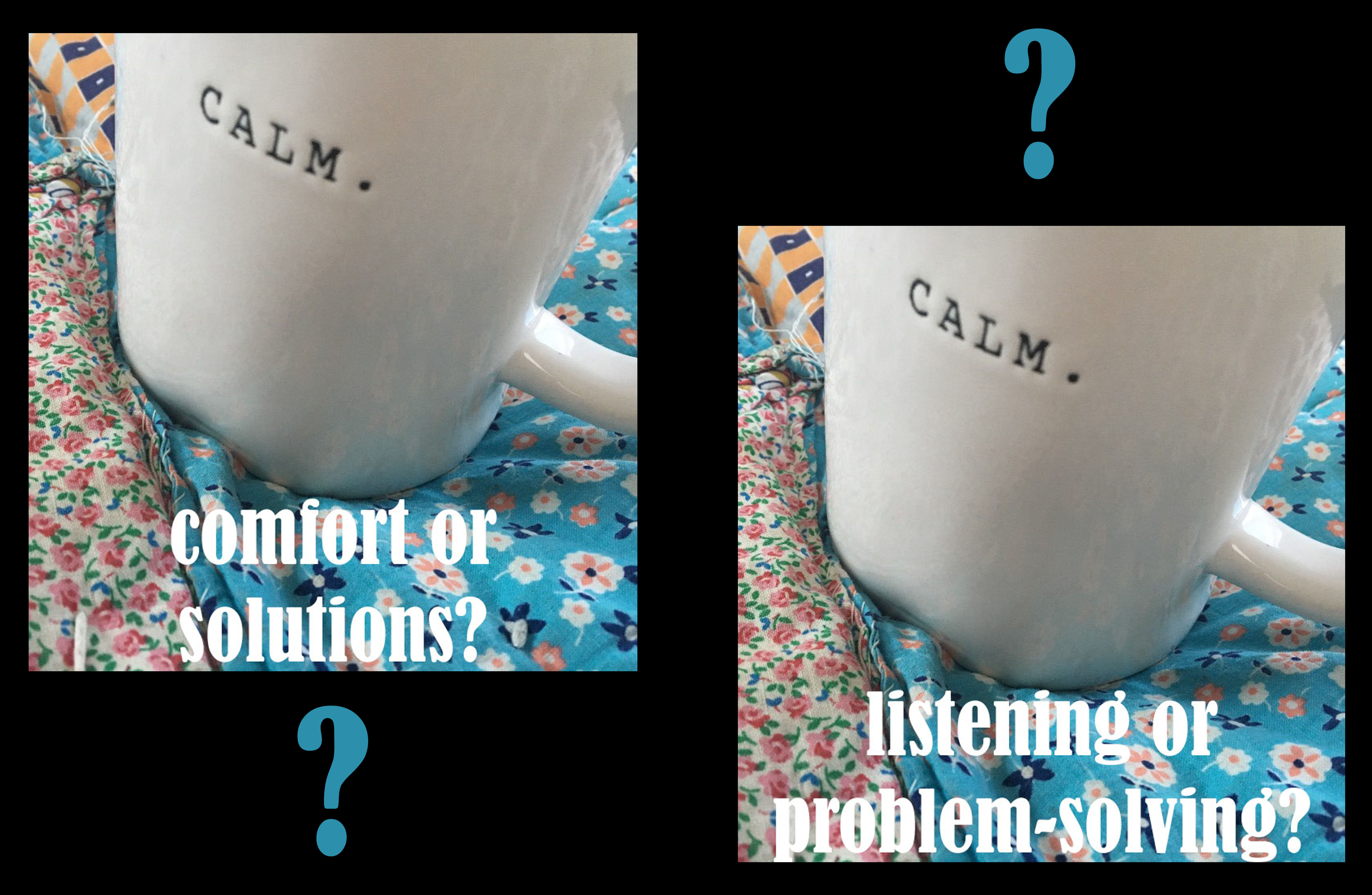
These words, posed as polar opposites, come from the world of relationship advice. The recommendation is to establish clarity. Before you get into trouble, define whether your mate’s need is to be heard or to hear advice, to receive solace or solutions. Offering a solution when the need is solace is not recommended. Knowing my snap-dedication to solving-her-every-need, Kerri will often cut me off at the pass with, “I just need you to listen.” My lending-an-ear is often the only thing she really needs.

I’ve always been a good listener but it is only recently that I’ve discovered that I cannot solve anything for anyone. I cannot spare anyone the necessity of walking through their life lessons. The solving is not mine to do. The discoveries are not mine to make. This comes as a great awakening to my third-child-in-the-family-peacekeeper-identity. It also comes as a great relief. Peacekeeping, as a role assignment, is impossible. It’s akin to herding cats. It’s best to let each cat find peace in its own way. In sitting still, in surrendering the impossible task, my peace, like a magic castle, appeared.

A few years ago, a friend, sensitive to Kerri’s grief, offered her this truism-nugget: there’s only one way to go through it and that is to go through it. Trying to spare or minimize her grief would be to rob her of the depths of her love. Feel the depths. Meet the monster that lives there. Emerge transformed or at least informed. It is how we come to fully know ourselves.

We are learning to walk together with no need to solve. I am learning to hold hands and listen. The walking together, the holding of hands, is essential. The words I spin around our challenges are rarely meaningful and never as necessary as attending to the simple essential of quiet presence.

read Kerri’s blog post about COMFORT OR SOLUTIONS