Blur The I [on Not So Flawed Wednesday]

We capture quotes all week. Some we see. Some we hear. Some find their way into the Melange. Most do not. We usually note where we heard or found the quote so we remember the context. It’s a practice. It’s not as if we are perpetually eavesdropping on conversations. We’ve simply tuned ourselves to immediately write the amazing words and phrases that catch our attention.

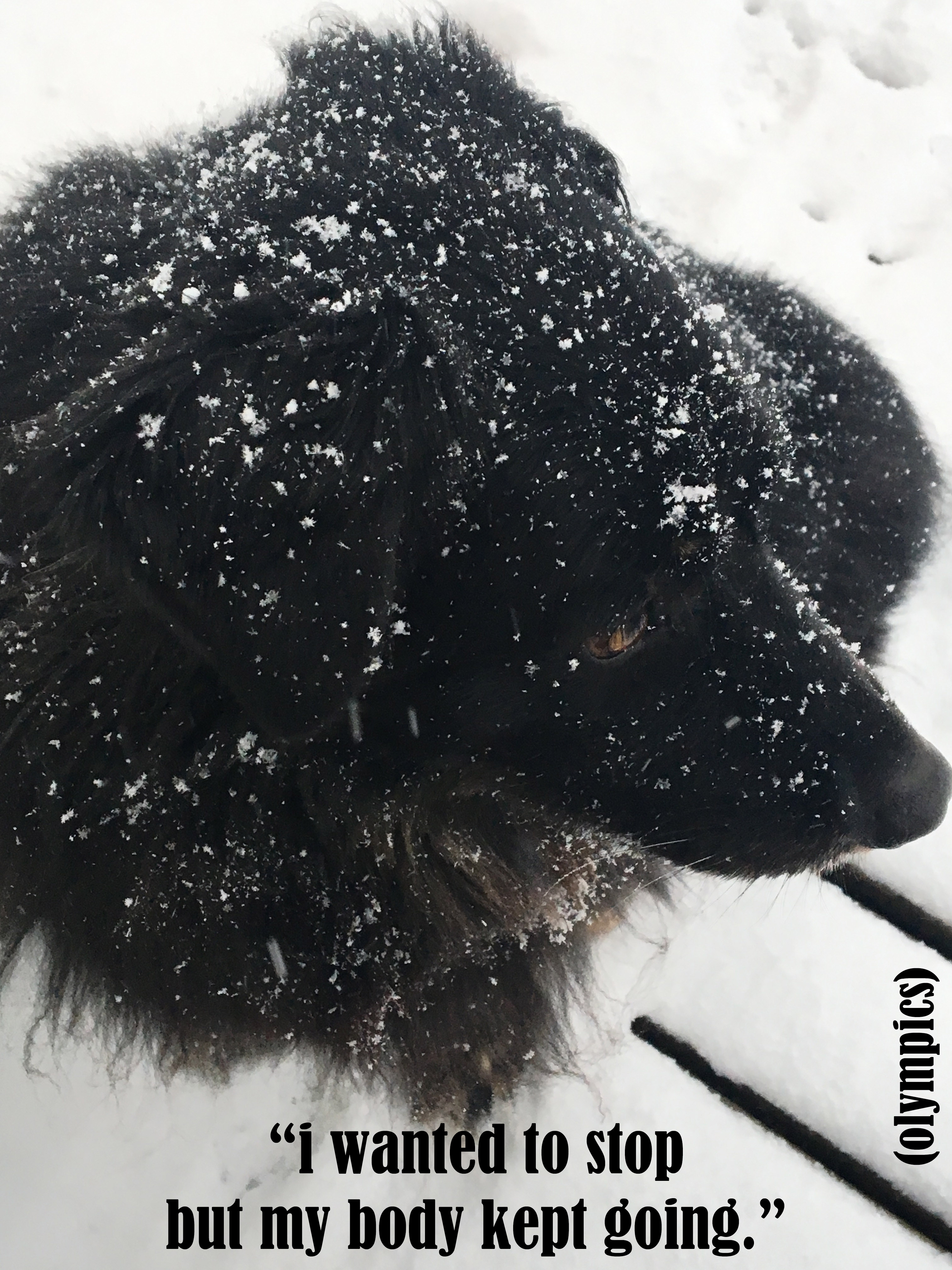
A common phrase is mind-over-matter. Athletes and actors and dancers are conditioned to ignore the limits of their bodies. To keep going. The mind as master over body. I loved this quote because it is the flip side. The mind, the “I”, wanted to stop but the body did not listen. It kept going.

Lately I’ve been reading about – so, paying attention to – the false separations that language necessitates: Mind and body are spoken of, thought of, as separate things. And, the question is this: where does one begin and the other end? Mind over matter. Body did not listen. I made myself do it. Once you start listening for it, it is ubiquitous. Exactly where is the line between “I” and “myself”? When your toe is in pain, isn’t your whole body is in pain? Follow your gut. What does your heart say?

When Dogga gets excited, his little body bounces. He runs in circles. He has to work hard to sit still. Say, “Do you want to go…” and he’s bouncing before the words “on errands?” reach his ears. He knows he won’t actually go on errands until he first sits on the rug. Eventually, he bounces his way into compliance. Control follows unbridled enthusiasm. Control is a means to an end. Rug before errands. Sit before snack.

Dogga might say, while bouncing enthusiastically, “I wanted to stop but my body kept going!”but I doubt it. Given his unified happy spirit, I’m certain the phrase would come out of his muzzle this way: I wanted to stop but I kept going. Watching him is like reading the I-Ching: no separation.

read Kerri’s blogpost about I AND BODY

Wander In Wonderland [on Two Artists Tuesday]

I’ve re-read his email several times. Skip’s explanation of the development of the computer. Subject/Object. Noun/Verb. Items/Action. It’s a story of cause and effect. This causes that. I’ve learned more from this single email than from my very expensive graduate degree. And, it’s sent me down the rabbit hole and I am currently in a world easily as miraculous as Alice’s Wonderland.

Does the moon cause the tides? It does if you are an English-speaker. Causation is the foundation structure of the English language. An action needs an initiator. The noun is king. He kicked. The sea rocked the boat. The moon causes tides. If you speak Mandarin, the moon and the tides are inseparable, not perceived or described as separate events but as interconnected. The same dance, differentiated forms.

Where does an action begin? A consequence end? I warned you. A rabbit hole.

Our perception of the world has everything to do with the language we use to describe it. Our creating of the world has everything to do with the language we use to imagine it. In a world where actions are separate from items, verbs from nouns, this causes that, it’s easy to believe that order is separate from disorder, cosmos is separate from earth, humans are separate from nature. Death is separate from life. Is it?

Each year that passes I’ve noticed the world of written communication includes more emojis and fewer words. Attention spans are shorter – mine, too. Tweet and text. Images carries the bulk of the message. If you could see the analytics on my blog you’d note that if I use more than 600 words, you are less likely to read what I write. We are slowly moving toward ideograms and slowly away from alphabets. Whatever will we do, what might we see, when nouns and verbs blend into image? When the eyes of dedicated separation begin to see through the eyes of interconnectivity – or, as Skip says, “When actions become central.”

It’s called a Wolf Moon, I read, because wolves are particularly loud and vocal during the first months of the year. One questioner asked if the moon causes the wolves to howl. Noun/Verb. Subject/Object.

read Kerri’s blogpost about THE WOLF MOON

Point The Way [on Merely A Thought Monday]

“You can accomplish with kindness what you cannot by force.” ~ Publilius Syrus

It’s one of the most interesting Wikipedia pages I’ve come across. Publilius Syrus. A life described in two sentences that conclude with this: “…but by his wit and talent he won the favor of his master, who freed and educated him. The rest of the page are maxims attributed to him. A Syrian. A Roman slave. An observer of human-kind.

We live in a world of ubiquitous maxims. They are posted everywhere, in stores, billboards, and elementary school signboards. Appeals to our better nature. Choose kindness. There are, of course, plenty of appeals to our worse nature, too. It’s as if our maxims are in a tug-of-war. I imagine that Publilius Syrus experienced in his short life both ends of the rope, the cruel and the kind, which is why he wrote so many maxims.

This quote came across my screen so I wrote it on a lilac colored post-it note and stuck it to my monitor. It may or may not be from Christina Wodtke: “When you make complex things, words eventually fail.” Life is a complex thing that words will always fail to describe or contain. The best a word can do is point to something, or the way to something. A maxim, an ideal, is, after all, a signpost, a direction. A choice of path. A point-of-view is created during those moments of choosing.

Kindness is not a thing. It’s not a word – not the word. The word simply points the way to something so complex, so boundless, that the word will always fail. But, we know it when we see it. We know it when we offer it. We know it when we receive it. We know with certainty when we choose it and when we do not.

read Kerri’s blog post about CHOOSE KINDNESS

Disagree [on Merely A Thought Monday]

Months later, she* is still angry with me. I asked her to “stop blowing me off.”

Some things need to be discussed and necessarily require entertaining differing points of view. Finding middle ground or considering alternate possibilities requires hearing what others have to say – and giving others the courtesy of hearing what you have to say. Her standard phrase of choice, when faced with an opinion or idea not her own, is this: “I guess we’ll have to agree to disagree.”

No. I don’t agree to disagree. Especially at the onset of a dialogue. I want to talk about it. I want to hear what you have to say and more importantly why you hold your point of view. I won’t agree to not hearing or being heard.

Opposing points of view, differing opinions, need not be conflicting. They can be highly generative. Mind opening. Thought provoking. “I’ve never thought of that,” is an expression that results when considering a different point of view. In ideal, our nation is based on the notion of two opposing points-of-view extending to each other the courtesy of listening and considering possibilities not yet seen. Yep. And, we are witness to what happens when one side (or the other) rejects the basic premise. Dismissiveness is the strategy of an empty suit.

Why assume conflict?

She followed “I guess we’ll have to agree to disagree,” with the real statement, her actual aim: “You do what you want. I’m going to do what I’ve always done and follow my plan.” In other words, she had no intention of hearing anything that did not support her plan. Why, then, I wondered, did she invite conversation?

When the only tool you have is a hammer, then everything looks like a nail. When the only door you have is a closed door, then every knock sounds like an intruder.

I laughed aloud when I read Bill Murphy’s article in Inc. Magazine about his pet-peeve phrase: “Look, I get it.” He writes, ‘”Look, I get it,'” is almost always inherently untrue…Even worse for our purposes, it’s woefully ineffective.”

It’s dismissive. Just as is “I guess we’ll have to agree to disagree.” The agreement she wanted was for me to agree to be dismissed. An agreement of silence. Why would I – or anyone – agree to that?

[* “She” is not Kerri. We hold each other in high esteem. It’s why the sign in our kitchen reads, “You are my favorite pain-in-the-ass.” We welcome our differing perspectives. Neither one of us dismisses the other nor tolerates being dismissed.]

read Kerri’s blog post about “LOOK, I GET IT.”

Gain The Force [on KS Friday]

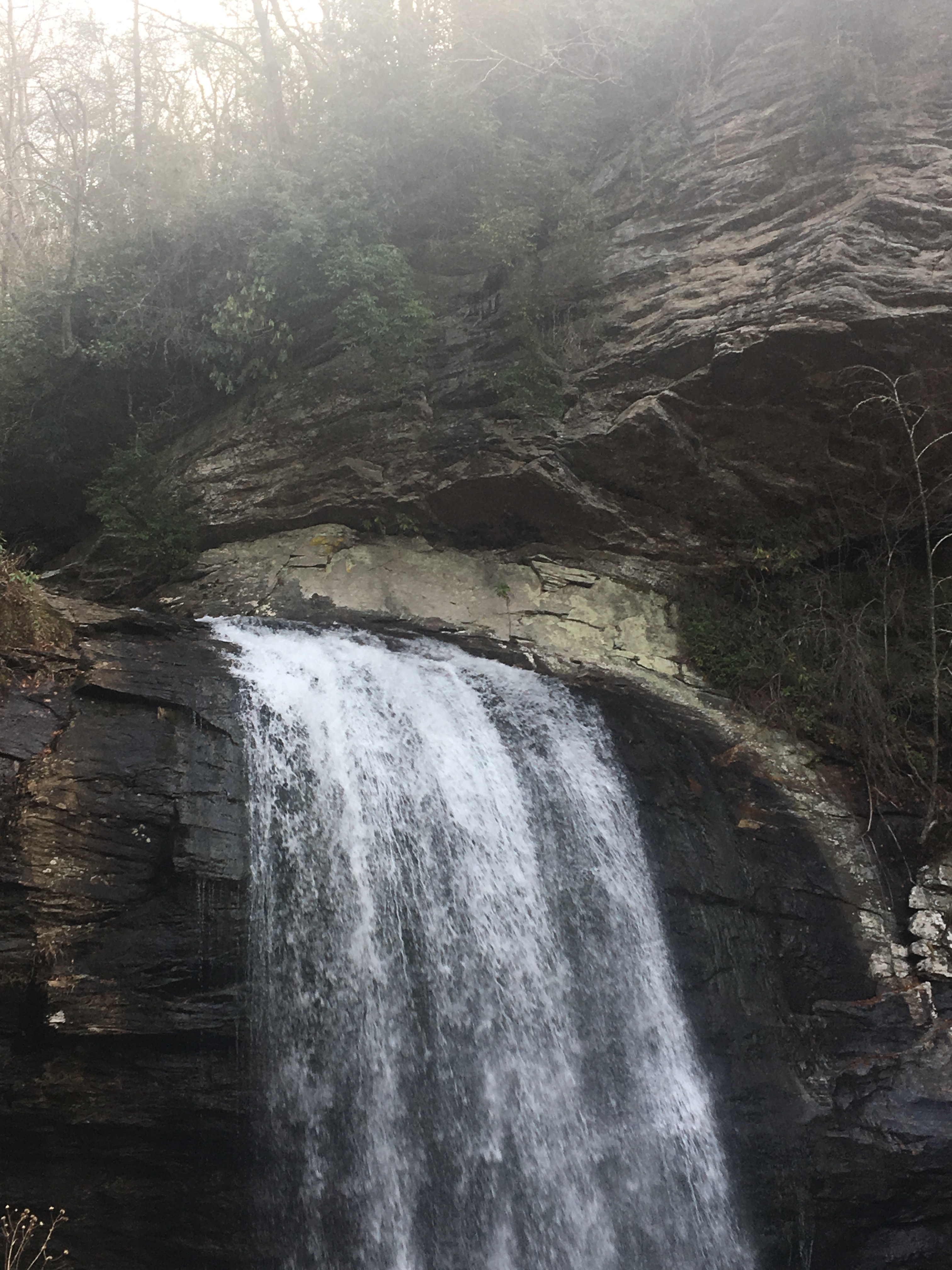
It seemed appropriate, in order to conclude our year of water, that we travel to visit a region of the country with 250 waterfalls. Of course, we didn’t know about the waterfalls until we arrived. Water, water everywhere. I howled with laughter and secretly affirmed that our unintentional pilgrimage to the waterfalls might appease the great WHATEVER and finally release us from water-resistance into the watercourse way.

I will someday look back at our journey to the falls and realize the extent to which we “let go.” It already serves as a marker, a breaking through the resistance and fight of the last chapter and into the next. The new chapter.

Yesterday, at work, I had the opportunity to tease apart a question en route to asking a better question. I am fortunate to have a team of collaborators that, instead of rejecting my alternate perspective outright, even amidst the frustration of my challenge of the norm, ask me to lean into it. My assignment was to return next week with a better question. I am a firm believer that the form of a question – the way that it is asked – determines the answers that are seen or – more importantly – not seen.

Better questions are like the watercourse way. They show up when, instead of swimming against the current, against “what is,” the swimmer/questioner turns and allows the current to carry them. Wu-wei. Natural action. Every creator knows the moment of frustration when trying to force something into being. More force can only produce more frustration. Or, it breaks something. The best thing to do, when force can only produce an eddy, is put down the brushes, step back, and look at what-is. Force never produces a better question. Stepping off the mountain so it becomes visible – or acknowledging the direction of the river’s flow and giving into it, always reveals new possibility.

It is what I remembered for myself at the waterfall. It made me chuckle, then, when my first moment back at work, I was doing for my team what I’ve done all my life: attempting to flip or free a perspective by lobbying for flow; acknowledge what exists-in-the-moment versus what we want to exist. The better question – for me – and others – is always found when we turn and gain the full force of the river.

[I can’t imagine a better piece of music to carry us into 2022. Give yourself a treat – truly – and listen to Riverstone]

read Kerri’s blog post about THE WATERFALL

riverstone/as it is is available on iTunes or streaming on Pandora

riverstone/as it is © 2004 kerri sherwood

Ask A Better Question [on Merely A Thought Monday]

This may be the height of cynicism but I don’t think so. Suddenly, as if dinged by a magic wand, we’ve entered that time of year when people remember to be kind. “After you,” the woman said, when I gestured for her to go first. The check out line was long so I had ample opportunity to witness the instantaneous return of the “After you!” It was ubiquitous. People were thinking of the needs of other people!

Later, we came to a four-way stop and everyone at the intersection waved for the other drivers to go first “Wow!” I exclaimed, “Just like the old days.” In my one-day anecdotal sample set, we’d just experienced more public generosity in an afternoon than we’d experienced in a very long time – twelve months to be exact.

It is possible, for the people in a nation newly-priding-itself on the depths of its divisions, to be considerate, one-to-the-other. If we are capable of a ritual-compassion-practice every year when Santa is looking, I have to believe that we can muster up some kindness and generosity of spirit in the eleven month gap between holiday seasons.

It was the day after Thanksgiving so it’s possible that the crowds were high on tryptophan, that the good mood and kindness I witnessed was turkey-induced. But, I don’t think so. I suspect the turkey consumption simply demarcates the time when we turn from our aggression-fantasy and consider our better nature. It simply feels better to lend a hand, to help another than it does to drive on top of someone’s bumper.

I appreciated the turn-of-question Kerri found in an article in Inc. magazine: instead of asking yourself, “What am I thankful for,?” a better question is, “What will I do to make others thankful?” The first question is a me-me-me question. The second turns the eye out, it first considers the needs of other people. It requires action, doing. What we experienced in the store, what we experienced at the four-way-stop, was steeped in asking the better question.

Sometimes the change we seek need not be legislated or debated or strategized; sometimes it is no more or less difficult than asking – and then practicing – a better question.

[Even though we’d hidden the store on our website, we’ve lately had a small run on Be Kind buttons. That, too, gives me hope that others out there feel as I do: a better world is not so far away. It’s as close as an act of kindness]

read Kerri’s blog post about A BETTER QUESTION

Stand In Time [on DR Thursday]

Stephen Hawking asked why we remember the past but not the future. Yesterday, in the middle of a meeting, I received a slack message with a sentiment from Russ Ackoff: entrepreneurs stand in the future and look at the present. I was fascinated by an article by Wade Davis, writing about a culture that experiences time as movement backwards; we row our way into the future.

Declan Donnellan writes that it is impossible to try and be present because we already are present. We live in it. We have to try very hard not to be present. In fact, we have to split ourselves in two halves. One looking backward. The other looking forward. We are, each and every one, Janus.

It is the time of year that time changes. It’s an odd ritual to “fall back” in time. What was 5 o’clock will soon be 4 o’clock, not because of a strange universal movement between planets and stars, but because we say so. A few states in the union don’t participate in the ritual so their time stays the same.

Time on a line. So many different realities, even in the most basic experience. Constructs of time.

I’ve read that old age is a return to childhood. Many, many great thinkers and writers from many disparate cultures tell us that we will journey through life and arrive where we began. The destination is ourself. Have you ever tried to describe your self and found the task impossible? Words simply cannot reach that level of complexity. There is a notion popular in the self-help world to define your life mission, your single life purpose. It’s meant to give you focus-of-action and certain-location on your line of time. It is also nearly impossible to articulate and becomes an exercise in metaphor selection. I’ve smiled knowingly as people in my past have asked, “Is this my mission or am I making it up?” The answer to both is, of course, yes. In a more universal peek, the exercise is meant to take you one more step around the circle that will bring you back to your self.

When I was doubting myself, judgmental because I “didn’t know” what I was doing, Quinn pointed to the tallest building and said, “The person on the top floor is just making it up, too.” He was standing in my future, looking back.

It’s just a matter of time.

Just.

read Kerri’s post about TEA LIGHTS

Greet The World © 2011 david robinson

See Through It [on Flawed or Not-So-Flawed Wednesday]

Light passes through. Transparent. Trans; across or beyond. A prefix of movement.

Last night we had snacks with some pals. Our conversation turned to politics and how resistant we are as a nation to tell our full story. Opaque. The opposite of transparent. Impenetrability of light. “It’s just history,” someone said. “History is history.”

Narrative. With a point of view. The winners of wars tell one story. The opposite side has another tale to tell. History is never just history. A country as deeply divided as ours is warring over its history. What happens if we actually tell our full story? Who are we if we acknowledge our shadow? Shine the light or snuff it?

Boiling our times down to the essence, we’d arrive at these two words. Transparent. Opaque. Isn’t it always the way that people who have something to hide proclaim transparency? Isn’t it always the case that people who lie claim to be holders of the truth? Opacity is a tricky business.

I recently watched again Simon Sinek’s first TED talk. He said, “There are leaders and there are those who actually lead.” We could call it a simple truth: we know those who actually lead because they boldly shine-the-light. They are not afraid of being seen or seen through. They are, however, a threat to those who call themselves “leaders,” those that fear the revelations of light. Reveal-ations. Those leaders will fight to-the-death to maintain their opacity. They will sacrifice the greater for the lesser if necessary to remain opaque.

We are watching – and participating in – history being written. Our question – as has been true from the beginning: will we shine the light without fear of transparency or hide behind the wall of opacity? It’s just history.

read Kerri’s blog post about TRANSPARENCY

Know Why [on Merely A Thought Monday]

I’m working with a software start-up company. Upon returning from travels I found our conversation has shifted into articulating mission and vision and purpose. None of us are keen about writing these kinds of statements but the exercise is useful and necessary. Why do we do what we do? What, exactly, do we do? In that order. Why. What.

Why? It seems as if this should be an easy answer. To support other people. To support other people in doing what they need to do.

I couldn’t help but think of our experience last week. We shared our story of breaking down in Hays, Kansas. It was late in the afternoon. It was the day before my dad’s funeral in Denver. We hobbled into the dealership. They were jammed with customers and couldn’t help us. There wasn’t a rental car to be found. It looked bleak. The dealer recommended a garage on the other side of town. Davis Automotive. We limped into their parking lot. We told our tale. They moved heaven and earth to help. Why?

It was nearing the end of their day. They, too, were jammed. Yet, they helped. They took the time. They made our problem theirs to solve. They took to heart my need to make it to my dad’s funeral. My need became their personal mission.

I returned to work with a new view on mission statements. They need not be lofty or abstract. In fact, they should be visceral. Tangible. Everyday. Support other people in doing what they need to do. Why? Because they need it. Just like I need it. Or you need it. These good mechanics fix cars. That is their “what.” Their “why”: help people get where they need to go. Help people do what they need to do.

Help people.

It’s how interconnection works. My mission is, in a real way, to make your path easier just as your mission is to make my path easier. I need mechanics because I do not have that mind or skill set. They need software designers because cars are computers and they can no longer diagnose problems without them. I am an artist, a teller-of-stories. Mechanics and software designers need my mind and skill set to remind them that, beyond their role, their mission, their job, they are human beings living a universal story. Nothing they do will matter, nothing I do will matter – ever – if it is not in service to the support of others’ growth, or need, or desire or fulfillment. I cannot be fulfilled if my work does not support you. And vice versa.

So, why are these good men and women, these software engineers and entrepreneurs creating their software? They see a real need. They see people struggling. And, like good mechanics who encounter a brokenhearted son en route to his dad’s funeral in a truck that will not run, they know exactly what to do. And, they know why.

read Kerri’s blog post about SERVICE

Look. Really Look. [on KS Friday]

“I carry your heart with me (I carry it in my heart).” ~ e.e. cummings

The ritual became real when Kerri asked the bride and groom to turn and look at the community of people assembled as witnesses to their wedding, “No, really look,” she said. Eyes met eyes. Family. Friends. The unspoken but oh-so-apparent moment: We’re here for you.

Rituals, like a good story, are about single moments. Everything builds to the moment. In the ceremony, Kerri told the couple that they would have days that they could not take their eyes off of each other and that they would have days that were…not so much, but in all of their days, through all of their challenges and celebrations, they would have this moment, and this single-moment, when all else dropped away, would carry them through everything: standing before their community of support, they looked into each other’s eyes and said, “I do.” I carry your heart.

Initially, when they asked her to perform their wedding, she was stunned. “Why me?” she asked. After their ceremony, unique in all the world, simple and profound, I wanted to ask but did not, “Now do you know why they asked you?” My wife understands the power of a moment, the deep river of a ritual, and the long ripples that simple words and intentional actions can send through the long-body of a lifetime.

“Are you ready?” she whispered to the couple when the music faded. “Yes. Oh, yes,” they replied.

read Kerri’s blog post about I CARRY YOUR HEART

Kerri’s albums are available on iTunes and streaming on Pandora