Meet The Saw [on Merely A Thought Monday]

As the magician saws the woman in half, he tells her that, “Magic is not an exact science.” It is among my favorite Flawed Cartoons.

“There’s nothing sadder than a forty year old production assistant,” she said, sipping her drink, looking across the room at a man she clearly thought was a loser. I was living in Los Angeles and was at a party with movers-and-shakers. The gathering also included a few of the people who carried the cables, loaded the trucks, moved the electrics – the lowest rung on the ladder. The runners. I swallowed hard. At the moment she said it, I was thinking the exact opposite. There is nothing more interesting than a forty year old production assistant. I wanted to be standing with the very man she considered a loser. He’d have stories to tell. Experiences to share. The movers-and-shakers bored me. Dulled by their dedication to security, thoroughly protected from the unknown or surprising experiences, they sneered at the people who’d actually lived. I found my way across the room and spent the rest of the evening sitting in the kitchen talking with a man who traveled the world.

Were I at the party today, she would look across the room at me and whisper, “Sad.”

Life is like magic. It is not an exact science. Ideals collapse. Dreams implode. Yet, the luckiest people I know are the few who have stepped out of their seats and volunteered to climb on to the stage. They’ve taken chances. Built wood buses or put their lifeblood into starting a theatre company or went boarding instead of dying in a cubicle. They’ve stepped beyond traditions and expectation. They’ve been cut in half, opened, challenged, surprised, disappointed, scared, triumphant, awed. They’ve learned. They’ve questioned their beliefs and perceptions. They’ve made titanic mistakes. They’ve stared down their demons. They’ve opted for curiosity rather than being right. They stepped off the edge. They followed, “What if…”

There’s no shortage of people who watch life from the safety of their seats. As Tom used to say, “They paint with a limited palette.” There are those lucky few who, if you see them at the party, most likely the people serving drinks, who’ve been cut in two and know from scary experience that there’s nothing more numbing or illusory than certainty. Follow them into the kitchen and ask about their lives. You’ll be amazed at the full spectrum of colors you find in them.

read Kerri’s blog post about SAWED IN HALF

flawed cartoon ©️ 2016 david robinson

Make Life Better [on Merely A Thought Monday]

Lately, the universe has pitched me headlong into a master class on efficiency. Maximum productivity with minimum wasted effort. A useful concept in certain arenas and an intensely destructive concept in others. For a person who’s spent his life in a study of curiosity, art, and the creative, it’s an unexpected study at this stage of the game. It is sometimes uncomfortable but I consider it an opportunity for balance. Artists rarely meditate on efficiencies. We’re more of a discovery clan and efficiency is generally the enemy of discovery. No one ever sailed to the edge of the world with efficiency-on-their-lips.

Once, I made the argument to a school board that daydreaming was highly productive. It seems a no-brainer to me that exercising the imagination should be highly valued in a learning environment. Einstein’s Theory of Relativity came to him in a dream about cows. It is not an accident that many insights and revelations come in the shower or while driving or peeling a carrot. Newton’s apple did not fall on his head while he was exercising maximum productivity. The mind, to be efficient, needs space to breathe, fields to roam. It is the most elegant of paradoxes but mostly lost on worshipers at the altar of efficiency. In the modern business world, efficiency is all about time since time is billable. You know the mantra: time is money. Do more with less. Somehow, we’ve turned that nonsense into a virtue, a thing to be desired. A reason to squeeze.

There’s another, more admirable side to efficiency-seekers. How to make work less arduous. Grease the wheels and remove the friction. Relieve the burden. Not faster but easier. Ann used to say, “Find a need and fill it.” She’d look at people toiling and ask, “How can I ease their struggle?” Beaky was that way, too.

Near our home there is a stretch of shoreline with an ineffective seawall. It was built with stones and debris that become projectiles when hit by forceful waves. The locals know to avoid that stretch during a storm. It’s deadly. After the storm, it has become our ritual to walk the path to see the destruction. It’s always impressive. How far can a wave throw a heavy stone? The answer: farther than you think. Mother Nature yawns when we think we can control her. The seawall has become my metaphor for human hubris but also masterful inefficiency. It would cost money to build a proper wall. So, instead, after each storm, crews collect the rocks and pile them back on the shore, readying them to be hurled by the next storm.

We saw a double-rainbow and turned toward the shore. Kerri never misses an opportunity to capture a little miracle or a slice of beauty. We parked in front of the seawall-of-inefficiency and I laughed out loud. A budding Banksy sprayed a message on the rubble: love. The secret message-maker could not have found a more appropriate word: Love. Can you imagine anything more inefficient and, at the same time, more potent? Love moves mountains but is not billable. It transcends time. What better reason to do anything? Well, perhaps reason has nothing to do with it and never has. Reason has the worshipers-of-the-efficient perpetually re-stacking stones.

It’s easy to be seduced but let’s face it, life reduced to billable hours is not life at all. On the other hand, there is nothing more inspiring, nothing more curiosity-invoking than asking, “How can I make life better for everyone?”

Love on a rubble pile. What could be better? On second thought, what could possibly be more efficient?

read Kerri’s blog post about LOVE ON A ROCK

See The Spaces [on DR Thursday]

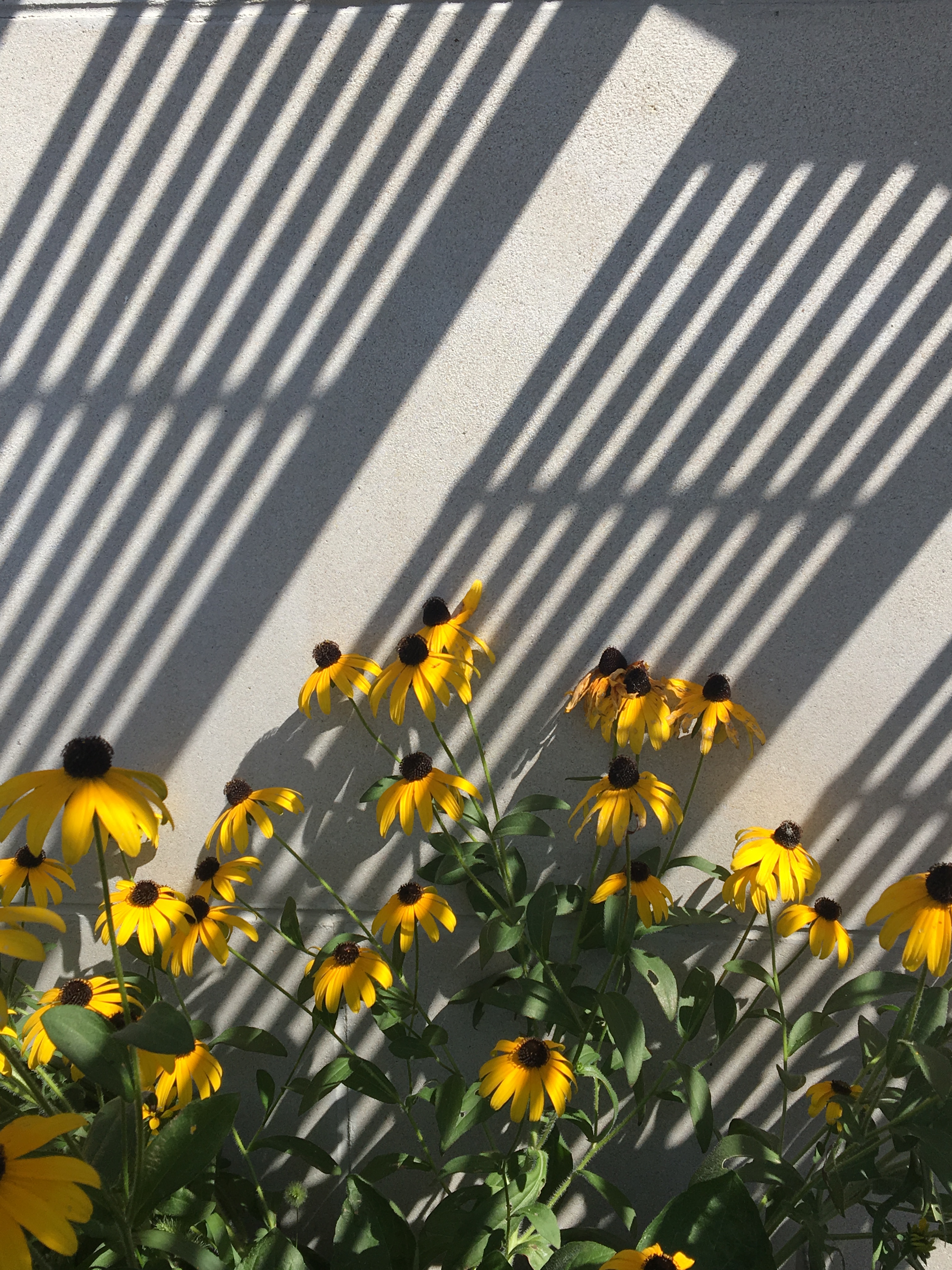
The space around and between. Shapes that share edges. Emptiness that provides definition. In art it is called negative space. Not-the-object. In art classes, students draw the negative spaces in order to see or to learn a new way of seeing. Try it. See the holes and the space around the leaves as primary. It’s not as easy as it sounds.

Some folks use the term “air space” because they get snagged on the word “negative.” It’s a term of opposition when set next to “positive.” Yet, just as there is an electric field that flows between negative and positive ions, electrons and protons, there is a field that flows between negative and positive space. Yin and Yang. A dynamic polarity. A creative field of movement and energy. The air space is alive because of the perceived opposition. The positive space is not visible without the negative.

When I was a consultant, I used the phrase “the space between” to imply relationship. There are people. There is the space between people. Relationship is invisible but it defines the people. Relationship illuminates the otherwise unknowable individual. They are impossible to separate. In a community obsessed with nouns, bottom lines, test scores and individual rights, the verbs and the relationships often go unnoticed and unappreciated. As if the negative space didn’t matter. The space between is where the movement lives and the problems are solved. It is where new seeing is possible. It is created and creative. The word “community” lives in the space between.

Try it. Take a day and focus on the space between. See relationship as primary. You may experience a whole new way of seeing.

20 sent this image,a memorial. It makes the point.

read Kerri’s blog post about NEGATIVE SPACE

iconic ©️ 2010 david robinson

Sit On The Curb [on DR Thursday]

As much as our wily-ole brains would like us to believe otherwise, we can be nowhere else but in the present. Everything else is imagination.

Years ago I belonged to a support group of independent consultants. We met once a month to discuss our business challenges, insights, and to give and receive some advice. One of the members of the group was a Byron Cady coach. I have no memory of the discussion that prompted her to offer this Byron-thought-metaphor: “If your house burns down, rather than race around in panic, the best thing you can do is sit on the curb and appreciate the moment.”

To the consumer-mind, wisdom often sounds like bad advice. That you are alive, that you have this moment, means that no real possession was lost. The question is, in the face of calamity, what will you make of the moment?

Brother Joseph told the story of holding a woman wearing expensive furs, each finger was diamond encrusted, as she died on the street. He was, in the moment, overwhelmed by the worthlessness of her stuff. The illusion of value once life has gone.

Life. This moment. Calamity is certain to come. Sit on the curb and see what is there, beyond what you think is there.

We’ve had our share of adversity these past few years. I would like to report that we laughed heartily in the face of lost jobs and broken wrists and pandemic madness and civil unrest. We did not. We shook our fists at the sky. We made up words and ran loops like Chicken Little. We invested in all manner of fear-of-the-future and ran from monsters-of-the-past. None of our racing around or fist-shaking brought comfort or change.

But, the moments that we took a breath, walked a trail or sat on the back deck and listened to the cardinals and crows, sipped hot coffee on cold mornings, held hands – sat on the curb and appreciated the undeniable truth of our moment: we have everything. We have this moment – the only moment of life that we’ll ever inhabit. We have each other. The rest, the fear of future, demons of the past, are pure imagination. In those moments, wrapped in a circumstance of calamity, we laughed at the beauty of it all.

read Kerri’s blog post about LAUGH IN THE FACE OF CALAMITY

Expect Surprise [on Not So Flawed Wednesday]

Walking through the Lake District in a driving rain, cold and soaked to the skin. Roger had a high fever and was near delirious. The hostel closed. We had to leave. It was miles to the next village. This day was not going according to plan. The trip was not going according to plan. It was the darkest moment in a series of dark moments. “What else could go wrong?” I asked. There was nothing to do but shiver and take another step. And then, unheard of at the time, an RV rounded the bend. The door popped open and a cheery voice asked, “Do you need a ride?”

I often think of that ride. That unlikely RV. Suddenly there were towels to dry ourselves. Aspirin for Roger. The mother of the clan took over and attended to my sick friend. Mugs of hot tea. We were delivered safely to the next village. They did not leave until they knew we had a warm place to stay until the rains passed. Something went right. It was breathtaking.

It was a life lesson for the younger version of me. My very own Aesop’s Fable. What looks like tragedy is often an opportunity, and vice versa. When it appears that things cannot get worse, they often do get worse en route to something better. The real lesson was to be in it, rain or shine. Joyful participation. I didn’t get the lesson right away. It took a few laps before it stuck.

That trip was decades ago and, to me, seemed ill-fated from the outset. But, when I think back on it, I remember the kind family in the RV, the man standing in line behind me who secured a ticket for me when I didn’t have enough money. The kindnesses too many to count. The utter shock of serendipity. What we needed always appeared somehow, in unexpected ways.

Quinn used to say, “Cultivate your serendipity.” Open yourself to chance, to the unexpected. Expect surprise.

read Kerri’s blog post about THINGS GOING RIGHT

Climb The Ladder [on Merely A Thought Monday]

Very few images are as potent as Tom Mck’s story of finding his 90 year old aunt Bunty on the roof of the farmhouse. There had been a storm. She’d hooked her cane on a rung and climbed the rickety ladder to make sure the shingles were intact, “Papa put a fine roof on this house,” she said, staring down at her alarmed nephew. Bunty was a farm woman. She saw no reason why she should not be on the roof. As the elder of the family, she was the keeper of the legacy. The house and ranch were the tangible creations of her ancestors and she was the steward.

Years later, when Bunty was gone and Tom was the ancestral steward, his task was untenable. The city was spreading like a fire, gobbling up farm land. He knew it was only a matter of time before the ranch was consumed. A Walmart was being built and he could almost see it from the porch. “What am I going to do?” he asked, knowing that he was the end of the line. His question was rhetorical. Sometimes the steward’s job is to close the door on an era. He knew what he had to do.

After Tom passed and the ranch was sold, I imagined him, like Bunty, standing on the roof of the farmhouse. He made sure that, as the land was lost, the legacy remained intact. He was strong, like Bunty. His ladder was rickety but he climbed it none-the-less. He made sure the shingles were intact. He met his task without self-pity.

I learned from him that life can forge you into strong metal or, if you choose, if you feel sorry for yourself, it can break you into tiny pieces. Jonathan told me that a tree must split its bark to grow and I understood that as a metaphor for aging. The bark splits because the spirit outgrows the body’s capacity to contain it. Beaky was like that. And, Dorothy. Mike. Grandma Sue. H. I admire them. Bodies break down. Aging hurts. Spirits, on the other hand, need not wither.

I’m told that, in her elderhood, Margaret stopped what she was doing each day to go out back and watch the sun set over the desert. She was made hardy by a hard life. She was made kind by how she chose to live within her hard life. Drying her hands, stepping out on the back porch, the sky electric with peach and pink, she met each sunset with gratitude. Intentional thankfulness for the day.

Gratitude is not a soft thing. It is an attribute of the strong. Hard won from a long life of choices. Bitterness is easy, a lazy thing. Climbing the ladder, standing on the roof, feeling the aches and the loses, facing the running sands with a smile and admiring the day’s end, celebrating the shingles that held fast through the storm and those who placed them, that takes grit. Courage. And, an understanding of the connected power and responsibility of standing in the long line of ancestry.

read Kerri’s blog post about STRONG WINGS

Appreciate The Moment [on Not So Flawed Wednesday]

Monumental moments in a life sometimes seem so small at the time. They pass as incidental but, in retrospect, are profound.

In his recent visit, Bruce and I reminisced about my inability and horror of singing. In the majority of my life, I couldn’t find a pitch if it was sitting on my shoulder. Kerri jumped into the conversation telling Bruce that I’d found my voice. Well, to be honest, she helped me find my voice. A patient teacher who simply taught me how to hear. Bruce’s mouth dropped open when I told him that I sang at my grandfather’s funeral. “It was terrifying,” I said.

“But you did it,” Kerri added.

When I met her, as I’ve previously recounted, I told Kerri that, “I don’t sing and I don’t pray.” And, then came the ukulele band. On the day I flew in for my third visit, Kerri picked me up from O’Hare and we rushed back to make the first rehearsal of her new group, the ukulele band. We met in the gardens of the Kemper Center, Lake Michigan humming by our side. She handed me a black uke. She taught the group to tune. We learned a chord or two. And picked and sang our way through a few easy songs. I dare anyone to avoid singing when they are in a group of silly colored ukuleles. It was my first of many lessons. I was having so much fun strumming, that I forgot that I was singing.

Such a simple moment. The beginning of challenging a faulty life-story. A self-imposed limit. Kerri was wise enough to know that I needed to begin with fun. Laughter is a great maker of courage. The first step.

Eight years ago. At the time it seemed so incidental. Following this amazing musician through her day. Playing along. Carrying her books. And, all along, it was her gentle way of saying, “Let’s challenge that obstacle. There’s a way around it and all you have to do is have fun and learn again to listen.”

read Kerri’s blog post about UKULELES

Consider The Revelation Necessary [on KS Friday]

An exercise that is designed for generic failure is also designed for specific success. And, so it is with the bridge. The instruction is simple: get everyone safely across the space. If anyone touches the floor, all must go back. Invariably, the first attempt is an abject failure. The group ignores the word “everyone” and, instead, opts to try and get themselves safely across the space. They believe the game is about them, that “winning” is a singular affair.

After being sent back to the beginning more than once, they come to a spectacular yet inevitable innovation: if they work together, crossing the space will be easy. It is only a matter of moments after their revelation that they, together, construct a secure bridge and are all safely standing on the other side of the room. Specific success wrought from generic failure. And, once they have their realization, they cling to it. They own it. They must, the stakes are raised, the rules are tipped against them during the ensuing phases of the exercise.

I’ve led this exercise hundreds of times. Every single time the group has the necessary revelation. They are not in the game alone. They can only “win” if they join together. If they build it together, everyone will safely cross the space. It gives me hope.

Last night, during the town hall, President Biden said something that ought to slap us from our divisive stupor. Xi Jinping and Vladimir Putin believe the 21st century belongs to the autocrats. The pace of change is moving too fast and democracies, in their divisiveness, move too slow. So far, we are proving them right.

Once, as an experiment, rather than set the challenge of the bridge, I forced the answer. The group did as I said but collapsed in the ensuing rounds. When I raised the stakes, the people gave up. The harder it got, the less they tried. They coalesced in apathy. They never made it across the bridge again, even though they knew how to build it.

This is what the autocrats do not understand. There is no ownership, no game, in a forced answer [educators could pay attention to this simple rule, too].

We are being divided through titanic campaigns of misinformation. And so, no one will make it safely across this time-space. Generic failure. Wade Davis wrote that we now live in a failed state and, so far, we are proving him right. But I have hope. The necessary revelation, the specific success, bubbles in the frustration. Those stoking the division, feeding fear, will have their day but, in the long run, the lie collapses, people join together and, like a prayer flag, build a bridge to ensure that all make it safely across. They recognize that they are not in this game alone. Winning is hollow if half the team is lost in the process.

This game, the bridge. The necessary revelation is in our nature; nature’s prayer flag. It gives me hope.

Kerri’s albums are available on iTunes or streaming on Pandora

read Kerri’s blog post about NATURE’S PRAYER FLAG

hope/this season ©️ 1998 kerri sherwood

Come To The Table [on DR Thursday]

Duke and Eileen sat at this table for many years. And, because St. Vincent de Paul wouldn’t take it for second hand sale because the top had dings in it, it rode around in the back of Big Red for many months. We forgot it was there.

When Covid roared in and the world shut down, we wanted to put a table in our sun room. That way, we could sit and look out at the day. We thought it would help buoy our spirits while in isolation. In the middle of wondering-out-loud where we could possibly get a table in a world-shut-down, we remembered that Duke and Eileen’s table was camping out in the back of Big Red. It was a perfect fit.

It began the transformation of a room that has become our favorite place in the house to sit and hang out. We’ve populated our former work table with plants. Duke and Eileen’s table is also home to many succulents and a Bonsai Gardenia sent as a birthday present from Kirsten and Chris. We resurrected an old fountain so the sound of peace is the sound of gurgling water. There are candles. Special rocks from special places. Water, earth, fire, and air; lots of air. We’ve created a sanctuary.

Watching Kerri and 20, Duke and Eileen’s son, sit at the table filling out paperwork for Eileen, I was struck by the circle coming back around, the story that this table might tell. 20, sitting at his mom and dad’s table, now center to our sanctuary, doing the work of a son to care for his mom.

It also occurred to me, standing outside, looking in at these two siblings-from-different-mothers sit at the table filling out forms (Kerri and 20 are truly brother and sister), that in the midst of “living in interesting times,” our response to the pandemic, to civil unrest, to our town literally being on fire, amid job losses and wrists breaking, has been to create a place of peace. A center of quiet around which the chaos spins.

“Make all the world your studio” was once – and still is – a mantra for me. And, now at the center of my spinning-world-studio is an intentional space, a bright and happy room bringing together all of the elements, built around the long history of comfort etched in the top of Duke and Eileen’s table.

read Kerri’s blog post about THE TABLE

meditation, 48x48IN, mixed media, 2012

meditation ©️ 2012 david robinson

Prove It [on Merely A Thought Monday]

I am about to prove that I am guilty of everything I accuse others of being. I am just as capable of surrounding myself with like-minded people as the next person. Let me explain:

I cheered when I read Marc’s response in the conversation chain. It was an appeal, an attempt to puncture a dedicated delusion, an untethered ideology. But, as is always the case when fantasy is met with fact, the holder of the fantasy vehemently defended and further retreated into their illusion. Confirmation bias.

Among my favorite phrases this week comes from a New Yorker article, Why Facts Don’t Change Our Minds. The phrase: the illusion of explanatory depth. Here are two quotes from the article:

“People believe that they know more than they actually do. What allows us to persist in this belief is other people.” In other words, we ally with people who hold a similar belief rooted in the same lack-of-knowledge. Apparently, as a species, we’d rather be reinforced in our ignorance than consider the possibility that we don’t know what we are talking about. Purple Kool-Aid is easier to drink than wondering if what we’re being told may or may not be truth. It explains the current GOP, Fox News, OAN, Ron Johnson, and the rest of the dangerous-national-clown-car.

Quote number 2: “As a rule, strong feelings about issues do not emerge from deep understanding.”

Strong feelings. Deep understanding.

In the canon of human self-aggrandizement, we delight in the narrative that we are primarily rational, that our reason, like a good border collie, has driven our emotions into safe containment. The opposite seems to be the case. Or, at best, we are a mass of contradictions.

There is a flip-side, a necessity woven into our contradiction that gives me hope. Strong feelings and deep understanding are not natural enemies and need not be pitted against each other. Think of it this way, no firefighter, in his or her right mind, would run into a burning building to save a life, if we were as rational and reasonable as we like to believe. They do, however, study fires beforehand to know how to run in, how to reach. They study the science. For every exploiter there is a matching story of a giver, someone whose strong feelings combines with their deep understanding in an effort to better the world, save a life, make things easier.

That which makes us crazy also makes us compassionate. How’s that for a statement of contradiction? Families fight each other until the forest fire threatens their house. Common cause and education are a great poppers of confirmation bias.

Some fires are manufactured with the sole purpose of exploiting confirmation bias. This kind of exploitation is dependent upon – and feeds upon – strong feelings with shallow roots in understanding. Ignorance. The big lie. Vaccine misinformation. Divide and conquer is always reliant on strong feelings intended to create blindness.

Some fires are real. And, the test of a real fire: divisions fall, eyes open, and people run toward the flames to help other people. It remains to be seen how hot and close the flames need to come before the confirmation bias burns off and we realize that we’re in real trouble, that science is real, and that the big trough of purple (red) kool-aid being proffered is doing the opposite of what it professes to do.

It may be in our nature to believe that we know more than we do, but, it is also in our nature, without concern or thought for our own safety, to reach for the drowning person. Deep understanding allies with strong feelings when people cared enough to learn how to reach, how not to become the person drowned by the drowning person.

Do you see it? I am an idealist. I want to believe in the goodness of humanity and the necessity of shared truth. Yet, despite powerful evidence to the contrary, I hold fast to my dedicated belief that we are capable of tipping toward love rather than falling toward hate, that, when faced with undeniable data, that we are capable of questioning our strong feelings en route to a deeper, shared understanding. We are capable of recognizing that the science that brought us the cell phone, satellites, allergy medicine, and electric light is the same science that brings us the data of climate change, and the best way to beat this pandemic. Cherry picking belief in science is…absurd and currently dangerous. Cherry picking news is equally as absurd and currently dangerous. From my idealistic mind, it is a necessity to ask questions, check sources, doubt belief.

We are certainly capable of knowing the real fires from the those fanned by the thought-arsonists. We are capable of questioning, of suspending our delusions. At least, I like to believe that we are. I, like you, surround myself with like-minded believers.

We’ve proven it again and again and again. When we recognize that the fire is real, our dedicated illusions burn the filters from our eyes, we transcend our little stories, and reach our hands with no thought of political alliance or other exploitative non-sense, to help dig our neighbors from the rubble.

read Kerri’s blog post about BASIC LOGICAL REASONING