Find It [on DR Thursday]

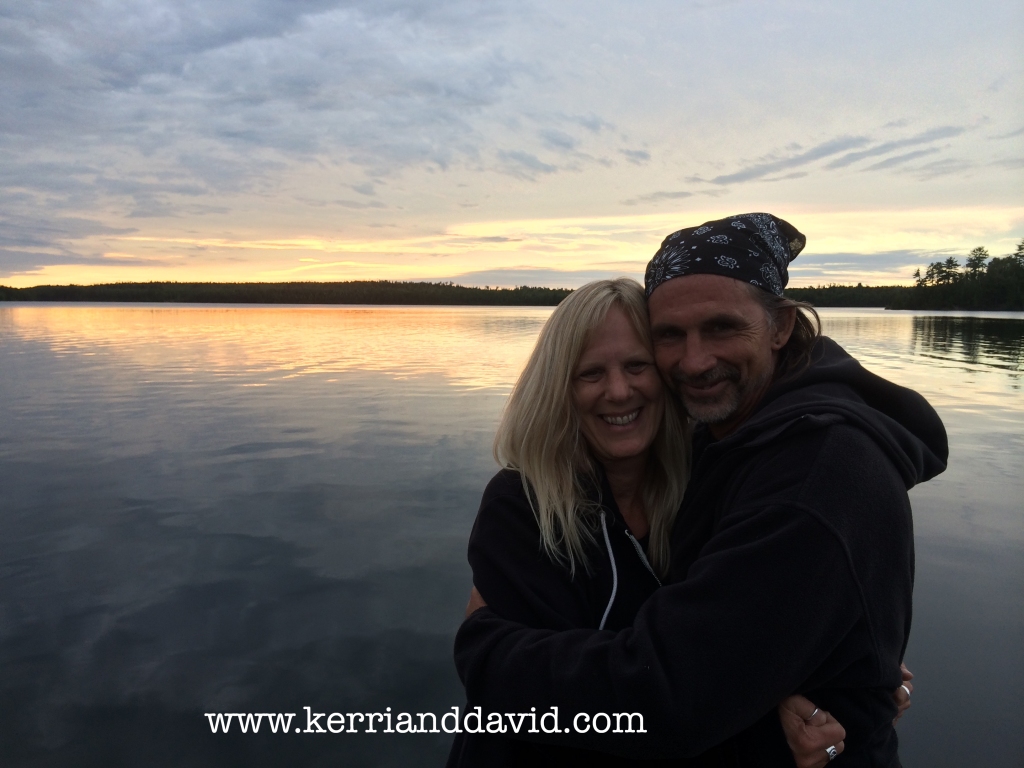
Although it probably does not appear this way to you, this photograph is the road back to my easel. It was an immediate inspiration. Kerri did not intend for it to spark the cold coals of my artistic fire, but it did. It was immediate. I couldn’t stop staring at it.

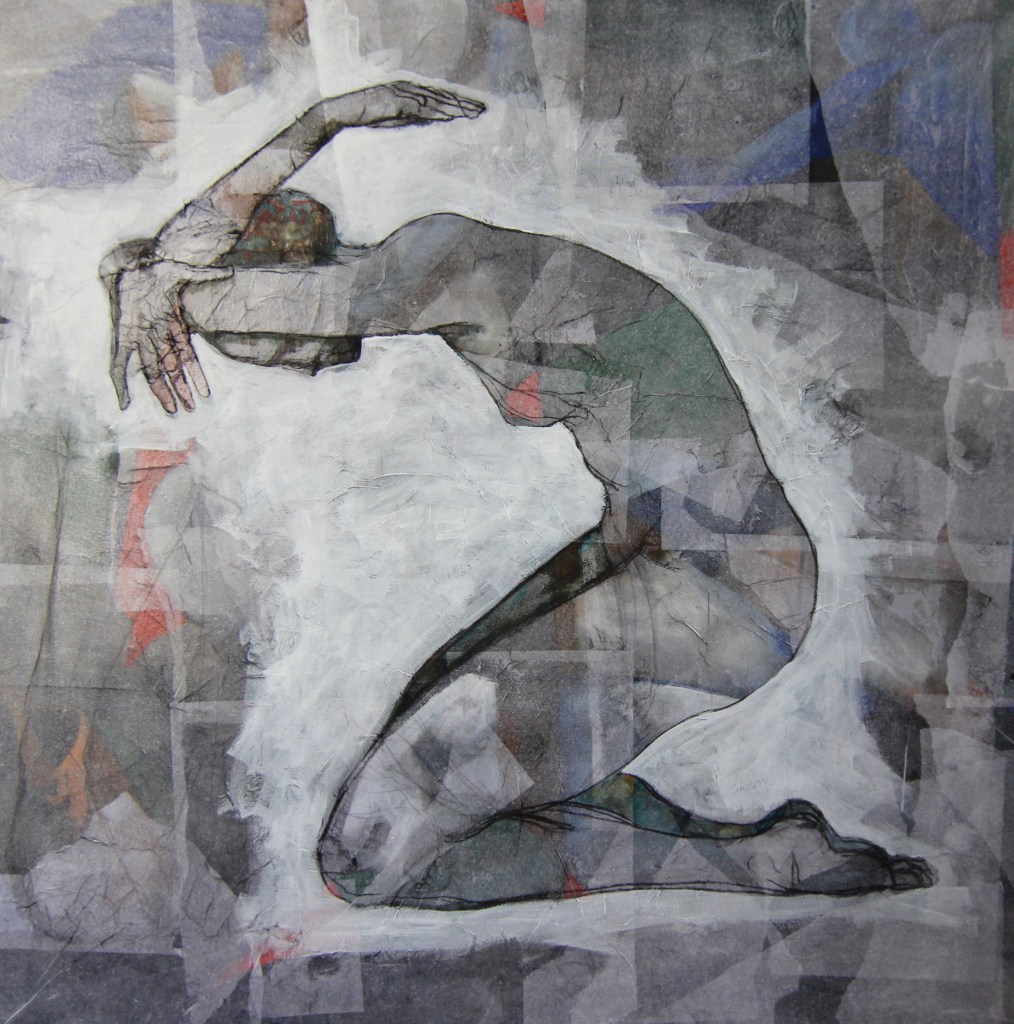
This painting is called Joy. Look at the floral shapes and lines both within and around the figure:

Joy, mixed media, 50x56IN

Many of my paintings of the past several years are floral wonderlands. They infuse the figures, they are bouncing balls of symbolic trees and oversized shrubbery. They remind me to have fun. To play and experiment. I must have forgotten all of that or turned away.

I hit a wall when I painted my red mess. It’s been on my easel for months. Beneath the red mess, the painting that I’d originally sketched on the canvas, is this:

I think I’d had too much of despair-and-comfort and needed to explode my themes. Thus, the red mess.

When Kerri showed me her photograph of tiny pink flowers, I saw the painting, this painting, complete in my imagination. Not despairing, but vibrant and subtle, alive with those amazing floral shapes, five-petal-bursts of life. Contemporary. Huge. Broad strokes. Almost a sculpture.

There is a story from Plato’s Symposium that I’m using as the basis for my script revision for The Creatures of Prometheus , the original human, cleaved by the gods because it was too powerful, searching through life to find its other half. This painting is (or will be) about the search for love, the transcendence of separation. Finding.

And, as you know, once it lives in the imagination, all that remains is the volition to get there.

read Kerri’s blog post about PINK FLOWERS

joy ©️ 2014 david robinson

Use Your Chalk [on Two Artists Tuesday]

There are two words floating around in my universe these days: structured and unstructured. Structured data. Unstructured data. Structured time. Unstructured time.

The world as seen through the Puritan lens gives great preference to structure. Unstructured anything is suspect. “Idle hands,” we are taught, “are the devil’s workshop.” Yikes. Apparently it’s dangerous to take a stroll, to sit and ponder, to clear the day and do nothing.

I suspect it explains why our notion of business is hyper-focused on the bottom line and often misses the value of relationships. Bottom lines are easy structure. Relationships, not so much. It is the same with test scores in education. Easy structure. However, stepping into the unknown – the very definition of learning – is largely eschewed because it begins in an unstructured pursuit. Creating the structure, making the meaning, discovering the connectivity is what our hearts and brains like to do. When learning isn’t merely a factory, when business is more than a bottom line, people prosper. They come alive.

Unstructured time. There was a time when time had no structure. Monks attempted to “keep” time by monitoring water through a bucket or sift sand through an “hour” glass. Sometimes the water froze in the bucket so the structure of evening prayer was disrupted. The sand clumped in the hour glass and the measure of time clumped with it.

There are moment on the stage when the actor forgets their lines. It’s called “going up” or “drying.” It is always, in the re-telling, the moment when everything becomes real, alive. It is the moment when the structure becomes unstructured. Hearts race. Eyes widen. The stakes are suddenly palpable. The actor breathes, stands in the vast unstructured universe, and the words return like a swinging bar to a high-flying aerialist. The play is infused with aliveness. Presence is mostly unstructured.

As is common in the structured and unstructured use of the English language, oppositions are easily constructed. Unstructured simply means the meaning has yet to be made. Structured data, structured time, are the tip of a largely unknown iceberg. Love, joy, despair, awe…the full spectrum of experiences, bubble in the unstructured spaces. Numbers can describe a moment in time, can orient for a moment, but will never “explain” yearning or desire or our fundamental need to tell stories (put structure on unfathomable experiences). Structure & Unstructure: they are dancing partners, not combatants.

Where do we come from? What are we here to do? I am going to die, what then? It takes a good deal of unstructured time to sit in these unanswerable questions. There are, of course, plenty of people who will gladly provide structure to your unanswerable – and therefore uncomfortable – questions. Perhaps that is why we adore our structure and demonize the empty spaces? Comfort. Ease.

Kerri cannot pass a hopscotch template chalked on the street. It’s almost automatic. Step, hop, hop, step, hop. The little girl in her connects to the child who chalked the squares on the sidewalk. A simple game. Play. It’s one of the things people do with unstructured time. Set challenges. Make up obstacles. Seek puzzles. Invent. Dream. Connect to the deeper places. Where’s the structured bottom line watching the little-girl-in-my-wife hop and skip and turn in the game-chalked-on-the-sidewalk? The laughter of remembering? The giggle and freedom of the woman hopping the scotch, just because she can?

read Kerri’s blog post about HOPSCOTCH

Root Into The Worth [on KS Friday]

As Tom Mck used to say, “There are only three people in the United States qualified to review plays and none of them live in Stockton, CA.” His point: it’s best not to read your reviews but, if you must, don’t invest in what you find there. Good or bad, the review has little to say about the work of the artist and everything to say about the mind of the reviewer.

To be an artist is to be vulnerable. Vulnerability is an especially complex skill to master when the work of an artist is an open invitation for commentary.

The worst play I’ve ever seen got a standing ovation the night I saw it. Some of the best work I’ve ever done drew little or no audience. I directed a play that regularly had half the audience storm out of the theatre in anger while the other half was on its feet cheering; which half should I believe?

Many years ago I directed a play. One of my leading ladies had a family friend who was the theatre reviewer for the local paper. After opening night, my actress’ fine performance started to twist and sour. It was a mystery to me how her good work could go so bad. Later I learned that she was taking notes from the family friend. She lost herself in the cloudy opinion of an other and her performance suffered for it. She suffered for it.

Artists – not unlike everyone else – like to be liked. Most wait tables or teach lessons so they can pursue the thing they love. I use the word “love” purposefully. Most are regularly asked to give away their love/work for free on the empty promise of “exposure.” As Kerri says, “It’s hard to pay your rent with exposure.” It’s very, very easy for an artist to feel undervalued in a world where money defines value – while constantly being asked to perform for free. It makes being-liked an especially dangerous value-default.

Some of the greatest artists I’ve known lived marginal financial lives; financial success evaded them – but they knew without doubt the single secret that kept their work vital all of their lives: they alone were the judge of whether or not their work was good. They alone knew the pure driver of their pursuit. They knew the real danger of an artist’s life is to lose the purity of their artistic driver in the swamps of “being liked” or getting good reviews. They worked hard to stay centered and avoid becoming dancing bears at the circus.

It was Tom’s greater point: only you – the artist -will know if your work is good or not, if you’ve truly found and pushed your edge or discovered new territory. You will know when your work is shallow. No accolade can change that. You will also know when your work is exceptional. No criticism can change that. Its best to root into the worth of your pursuit, to grow and learn, rather than gorge on the ever-abundant-opinions of others. Good or bad. Moose or pig.

read Kerri’s blog post on MOOSE IN HEAT

all of kerri’s albums are available on iTunes & on Pandora

Draw A Chalk Circle [on Merely A Thought Monday]

There are charts for everything. Definitions and distinctions of value meant to clarify but, in the end, make life seem more and more farcical. For instance, we recently were directed to a worker’s compensation website and learned that losing your hand in an accident is worth 400 weeks of [minimal] compensation. The dominant hand is worth more than the non-dominant hand. Fingers have less value-in-weeks than a thumb. Just imagine the guys-and-gals-in-suits sitting around a conference table discussing the value of a human hand as expressed in weeks. Sometimes I’m certain that we live inside the mind of Gary Larson.

Is it no wonder that we are confused about the value of a human life? We have actuaries calculating human-life-value and making smart looking tables with support graphs to answer this most fundamental question. I’m certain that those guys-and-gals-in-suits sitting around the conference table would come up with a different answer if it was their hand or fingers or toes or life on the chopping block. If it was their child’s eye or foot. Charts, like all data points, are not personal.

We awoke this morning to the news that the latest mass shooting (if 4 or more people are shot it is, according to the FBI, considered “mass”) was in our town. We are number 47 since March 16. March 16 is the date of the mass shooting in Atlanta; 8 people were killed. Here are some nifty and comprehensive charts on gun violence in America.

When I was in elementary school we did safety drills, crawling under our desks, in the event of an atomic bomb drop. Although I was certain that my desk was not going to protect me in the event of an atomic explosion, I was comforted by the knowledge that the enemy was far away, external. Now, our children in elementary school do active shooter drills and they, too, know that their desks offer little protection. But their predicament is dire: the enemy they face is right here. It is everywhere, internal. Sitting under my desk I knew there was an entire military machine between me and the potential dropper of atom bombs. Sitting under their desks, our children know with certainty that there is nothing, not even legislative will, standing between them and the ubiquitous shooter.

I once listened to an author speak about the difficulty of writing a farce about the USA. He said, “Before you can a publish the book, the fictional farce that you’d written will have actually happened.” Our scary farce: the only answer we can muster to daily mass killing in schools, grocery stores, work places, concerts, houses of worship…the only idea that the markets will support in an out-of-control gun culture, is more guns. Sales charts and political donation data drive policy to dedicated inaction. [For some lightheartedness in the midst of this dark-and-dismal post, go here. I laughed aloud when I heard comic Steve Hofstetter riff on gun control.]

What is the value of a human life?

We had a lovely conversation in the grocery store. An accidental path crossing with friends. Sue remarked, as we compared life experiences, that our personal challenges are meant to remind us that we are still here.

What is the value of a human life as determined by those of us who are still here?

Bertold Brecht wrote a play called The Caucasian Chalk Circle. Two women claim to be the mother of a small child. A judge has to settle the case. He has a small circle drawn on the ground. The child is placed in the circle. The judge instructs the women to stand on opposite sides of the circle, each taking one of the child’s hands. The woman that successfully pulls the child from the circle will be declared the mother. One woman quickly yanks the child from the circle. The other will not pull. She refuses. She cannot do harm to her child. She proves herself to be the true mother.

I wonder what we might value if we could put down our charts and data points and amendments-as-seen-in-isolation-from-all-the-other-amendments, step beyond our abstractions, and draw a simple circle in the dirt. What might we discuss if we placed a small child in the circle, and considered the value of that one precious life? My bet is that none of us would yank that child out of the circle of life. We’d do everything imaginable to protect the child from harm. To keep it safe. Sales graphs and actuary tables and every other dehumanizing analytic would drop away. We would, in considering the beating heart of our public dangers, make the safety of the child, of every child, our personal challenge. It would slap us awake and remind us that we are still here. Alive. And, as custodians of the circle of each and every actual life, we are responsible to and for each other.

read Kerri’s blog post about STILL HERE

Live By Increments [on KS Friday]

In this case, healing is incremental. One degree at a time. Her doctor told to be patient. “Expect no more than 5 degrees a month,” he said.

After her fall, the second fall, the one on a newly-mopped-but-unmarked-wet-floor, she had a mere 6 degrees of movement in her right wrist. She showed me her range of motion and the movement was so minuscule that I had to ask, “Did you move yet?” Her stare told me that I probably could have asked a better question.

Years ago, preparing to direct a play, I did research on medieval torture devices. You’d be surprised at human ingenuity when it comes to inflicting pain. The device that Kerri uses between occupational therapy sessions to aid in the recovery of her increments looks a lot like the machines I researched so long ago. It has cranks and dials. Straps. It finds the edge of possible movement and then, with one teeny-tiny turn of the dial, stretches a fraction beyond the previous possible. Increments of possibility achieved through increments of pain. Human ingenuity cuts both ways, to the creation of promise as well as pain.

In this part of our journey, we have learned to live by increments. Our journey of a thousand miles truly begins, each and every day, with a single step. The torture device, as we lovingly call it, serves as a mechanical reminder that the greatest triumphs are often the smallest. 5 degrees a month. It’s a reminder that it is best not to rush. One tiny turn of the dial at a time. Each new increment is cause for celebration. My composer wife, in these hard-recovered-increments, steps toward her piano, toward her promise, each day, one step closer.

kerri’s albums, including THIS PART OF THE JOURNEY, are available on iTunes

read Kerri’s blog post about INCREMENTS

this part of the journey ©️ 1997, 2000 kerri sherwood

Borrow A Cup Of Belief [on Merely A Thought Monday]

The sun is streaming through the windows. It is an immediate spirit lift. We sip coffee and our conversation wanders in no particular direction.

We inevitably discuss of the absence of normal, our rolling wave of disruption. “I wonder what will happen this week?” We laugh, “Knock on wood!” For a moment we sit in silence. We’ve stopped asking, “What else can happen?” We keep the question to ourselves. We’ve grown superstitious.

For us, this pandemic time will always be known as the era of disruption. All recognizable patterns are shattered. New patterns have yet to find a foothold. Each day a tumbling unknown.

I often write about “not knowing.” It is the land where learning becomes possible. The first caveat: Have the experience first and make meaning second. The second caveat: Suspend your judgements and learn. Both are rooted in the intentional suspension of knowing. Open to life.

We are definitely having experiences. We are careful not to arrive too soon at meaning.

Yesterday I read that, when life tosses us the uncontrollable, we default to imaginary controls. We do the dishes, we vacuum the rug, rather than face what is out of our control. There is great comfort in the imaginary.

Sometimes belief in yourself is hard to come by. “Knowing” that you can do it. “Knowing” that you can stand firmly in the “not knowing” is never a given. Especially in times of continuous disruption. It is only after the fact that you “know” with certainty that you can do it. “One step at a time,” we chant.

It is, in these times of disruption, that we borrow belief from each other. You tell me that I can do it. I tell you that you’ve got this. Others “know” what we do not. They see our fortitude. We see theirs. It is why human beings are a herd animal; we come to know ourselves through the eyes of the other. We go next door to borrow a cup of belief.

Beaky’s note now sits on Kerri’s bed stand. A treasure newly found in a long forgotten purse. One of our imaginary controls, cleaning out the closets, produced this gem. Beaky, no stranger to disruption, reaches across time and the threshold to offer timely encouragement, “I know you can do it.”

“Momma says we got this,” Kerri says. If I’ve learned anything, it’s to never argue with Beaky.

read Kerri’s blog post about KNOWING

Look To The Hand [on KS Friday]

This is the year of the hand. Not ox or rat or snake or dragon. Hand. Not merely as a symbol but as an overriding metaphor for our latest circle around the sun. And, like all good metaphors, “hand” is complex and signals more than one level of meaning.

You’d be amazed what you cannot do when both your hands are immobilized, when both your wrists are broken, when your thumbs are bound in plaster. So, the first level of meaning in our metaphor of “hand” points to all the things we take for granted. Try and wash your hair without your wrists. Try and cut a piece of bread without the use of your hands. Try to open a door without your thumbs. The failure of proper appreciation for simple function. There’s nothing like a good hard tumble, complete with casts, to revivify genuine indebtedness to the temple of the hand.

I’ve read that an opposable thumb is a physical adaptation that helped humans survive – and thrive – in our many habitats. In addition to all the things we take for granted (and now fully appreciate), our “hand” metaphor-of-the-year also reaches into the wonders of adaptation. I watched with utter amazement, two weeks after her fall and with no time off extended to her, my wife played the piano. Standing across the room you’d never know that she was in casts. This woman, who could not button a shirt, somehow, managed to play. To make music. To open hearts. Standing behind her, I was slack-jawed at the contortions required, the adaptations necessary, to reach the keys. Spread a thick layer of pandemic on top of lost jobs and injury, and the year of the hand is a miracle of rolling adaptation. An affirmation of the possible.

And, while considering miracles, I would be remiss if I did not mention the mittens. Gloves are not made for hands-in-casts. To keep hands warm while walking-through-winter we tried a succession of thick socks, borrowed mittens, and other inventions that included sacks, wraps and duct tape (I’ll leave it up to your imagination to fill in the gory details) – none of which did the simple job of keeping fingers warm. We visited multiple sporting good and camping supply stores and found possible solutions but they were not in the budget. Not even close. The year of the hand is, above all, a year of tenacity. One step at a time. Keep walking. Keep looking. Keep trying. And then, one day, an after Christmas sale brought to us, as Kerri likes to call them, her miracle mittens. They are easy to slide onto injured hands and over splints. On sale they were within our reach. “My hands are warm,” Kerri purrs as we crunch through the snow. “It’s a miracle.”

The year of the hand. Filled with appreciation for all that what was once taken for granted. Adaptation in circumstances that we might once have called impossible. Tenacity. There’s always a way. And, if we forget that we can do almost anything regardless of the fury that surrounds us – and we sometimes forget – all we need do is take a breath and look at our hands.

read Kerri’s blog post about MIRACLE MITTENS

Listen To The Painting [on DR Thursday]

Surrender Now, 24 x 24IN, mixed media. 2016

This painting is called Surrender Now. In this moment. in my life, I can think of no more appropriate sentiment. Surrender. Now.

The playwright John Guare wrote that it is necessary to write ten bad pages to write one good one. I am the visual artist proof of his thought. In my life I have painted a lot of crap and will continue to do so. This painting is one of my good pages, one of my good paintings. I’m doubt if my ratio is as good as ten-for-one but, mostly the ratio doesn’t matter. As Tom McK said, “A writer writes, a painter paints.” The rest is not really that important.

The great gift of being a painter is that your paintings talk back to you. Sometimes they are sassy. Sometimes they are sage. This one is the latter. It reminds me in times of contention to open my hand rather than make a fist. It reminds me to let go. Palms to the sky.

So much these days is out of my control. I suppose that is always true but currently it is in my face. The castle crumbles. So, I look to the painting for solace. The advice is abundantly clear.

read Kerri’s blog post about SURRENDER NOW

surrender now ©️ 2016 david robinson

Start Thinking [on DR Thursday]

“As Huxley remarked in Brave New World Revisited, the civil libertarians and rationalists, who are ever on the alert to oppose tyranny, ‘failed to take into account man’s almost infinite appetite for distractions.”‘ ~ Neil Postman, Amusing Ourselves To Death

Any day now I’m going to watch the 1976 movie, Network. It’s the film equivalent of a crystal ball to our current predicament. A veteran news anchorman loses it on air, threatens to kill himself, but instead goes on a full-blown rant. The network’s ratings skyrocket. An ambitious producer recognizes and exploits the opportunity by creating more and more outrageous programming. Fact falls prey to profitable fiction sold as truth. Ratings imperatives eclipse the north star of accuracy-in-reporting. Roger Ailes created his Fox News Network on the same premise; no veracity necessary. People like a good train wreck, just ask Jerry Springer. It is why the nation is so divided. The blues use news to sort out the lies; the reds use lies to siphon off the truth.

“Contrary to common belief even among the educated, Huxley [Brave New World] and Orwell [1984] did not prophesy the same thing. Orwell warns that we will be overcome by an externally imposed oppression. But in Huxley‘s vision, no Big Brother is required to deprive people of their autonomy, maturity and history. As he saw it, people will come to love their oppression, to adore the technologies that undo their capacities to think.” ~Neil Postman, Amusing Ourselves To Death

Neil Postman wrote Amusing Ourselves To Death before Facebook and Twitter were glimmers in their inventors’ eyes, before the internet hit the personal computer, before multiple channels on cable networks. We have, as Postman wrote, an infinite appetite for distraction with nary a need for honesty. And, as we are witnessing, distraction has arrived in the halls of Congress. We’ve now a party in government that actively shuns verity and raises funds on peddling fallacy.

“When a population becomes distracted by trivia, when cultural life is redefined as a perpetual round of entertainments, when serious public conversation becomes a form of baby-talk, when, in short, a people become an audience, and their public business a vaudeville act, then a nation finds itself at risk; culture-death is a clear possibility.” Neil Postman, Amusing Ourselves To Death.

We are a nation that finds itself at risk. In my post yesterday I wrote that I no longer wonder how a society can willingly and knowingly take itself down. We have front row seats. And yet, the road to our recovery is as simple (and as difficult) as a collective valuing of the truth over ratings or poll numbers or bubbles. We worship at the wrong altar. We are inundated with info-dross. We would be better off if ratings plummeted every time a pundit ranted, a politician bullied, or a commentator lied. We’d be better off if thinking, if fact-checking, was a prerequisite to posting or tweeting or speaking. We’d find ourselves in a shared center, a place of possibility built on a generous commitment to probity.

“For in the end, he [Huxley] was trying to tell us what afflicted the people in ‘Brave New World’ was not that they were laughing instead of thinking, but that they did not know what they were laughing about and why they had stopped thinking.” ~ Neil Postman, Amusing Ourselves To Death

read Kerri’s much more positive post on LEARNING FROM TV

Weigh The Actions [on DR Thursday]

“Look K.dot!” I said, “Everything will be ok!” We saw it writ large on a wall as we drove into Chicago.

I’m generally a positive guy and usually side with DogDog but lately I’m lining up with BabyCat. Because we read it on the wall, because we wish it was true, does not make it so.

These days I think we are in trouble.

Never in my life did I think I’d see an entire political party stoop to the 3rd grade level of “The Dog Ate My Homework” style excuses. Their Big Lie, as we all know, as was witnessed by the entire world, led to an insurrection, a violent attempt to overturn our election. Apparently the crowd was infiltrated by rabid liberals, there’s heaps of evidence of election fraud if only the dog hadn’t eaten it. The wicked cabal of baby-eating Democrats that dug a maze of tunnels under the Capitol – one spoonful at a time, Shawshank Redemption style, so no one noticed, is to blame.

It’s an accountability-free-zone with nary a brain cell to be found anywhere. Or spine. Or ethic. Or reality.

It would be fantastically funny were it not so scary. It’s a plot that John Grisham would have tossed out as too absurd yet, here we are. Childish minds hang onto lies when confronted with truths. They double down. I did, when I was ten years old and was caught with my hand in the cookie jar. I swore to the end that my older brother made me do it even though he was not home at the time. I’d maintain my excuse to this day except that I grew up. I learned, in growing up, that it is best to address the truth rather than double down on a lie.

Yesterday we saw the Grand Old Party fall yet another notch. Blame. Demonize. Their lie-loud-or-go-home pact is very much intact. Even an insurrection, an assault on their very lives and the Constitution they swore to uphold will not leverage an iota of responsibility or truth from their ranks. “The neighbor kids came in the house and broke the vase! It wasn’t me. I swear it.”

James Russell Lowell wrote that “all the beautiful sentiments of the world weigh less than a single lovely action.”

Do not get lost in the words. Pay attention to the actions.

The Oregon legislature joined the Arizona legislature who joined the Republican Senators in their “false flag,” it’s-not-our-fault, “Elvis-made-us-do-it” campaign. Action: to blame. Action: to excuse. Action: to deflect. They magnify their excuses through the fox. The dog ate my homework. The socialists are coming! We, the righteous, were infiltrated, by evil-doers and not responsible for our actions. They made us do it!

Lying is an action.

And the child-minded listen and fume and point their fingers, erect their gallows, and beat the police with their flags. That is the point of the lie. Action: to incite.

Action: to retain power at all cost.

At all cost. The cost is mighty and it is not okay. Just because it is writ large on the wall does not make it so.

I’m with BabyCat. I think we are in trouble.

read Kerri’s more uplifting post about OK

shared fatherhood 2 ©️ 2017 david robinson