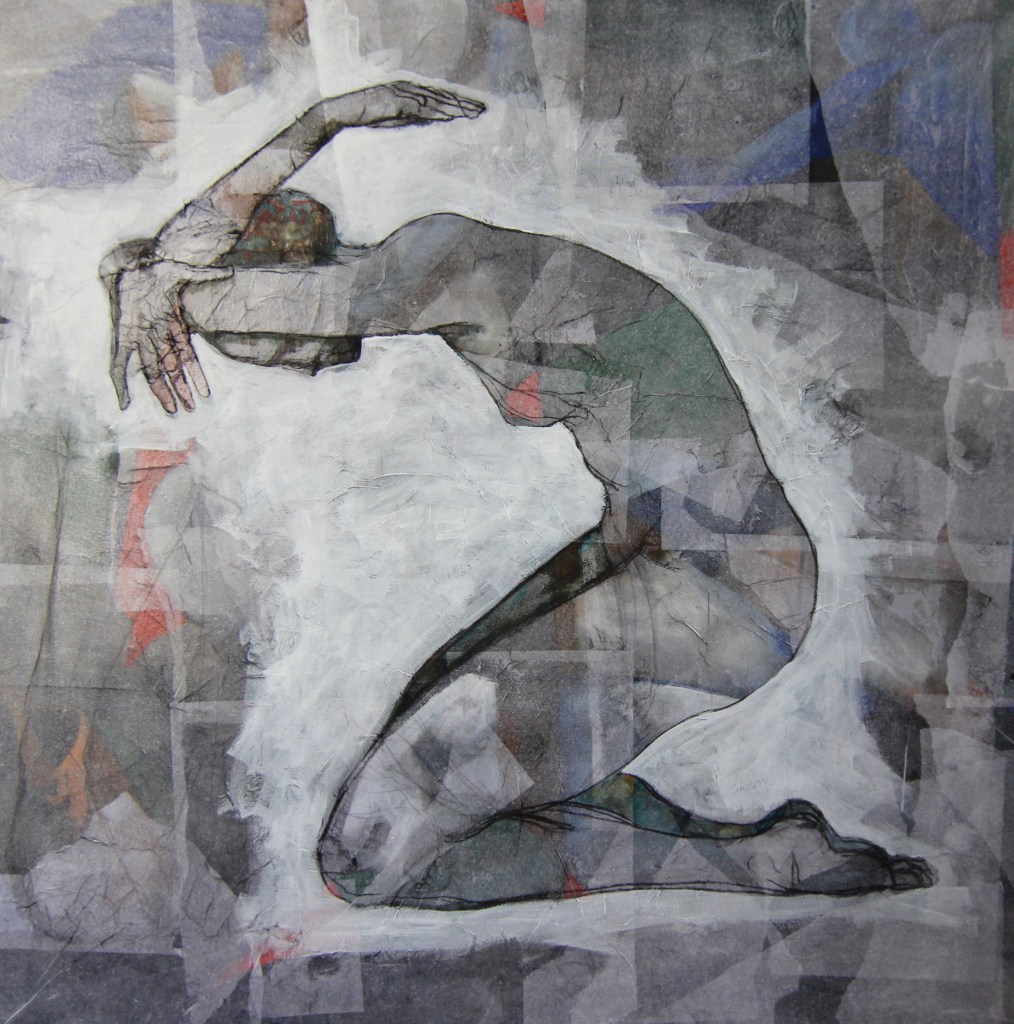
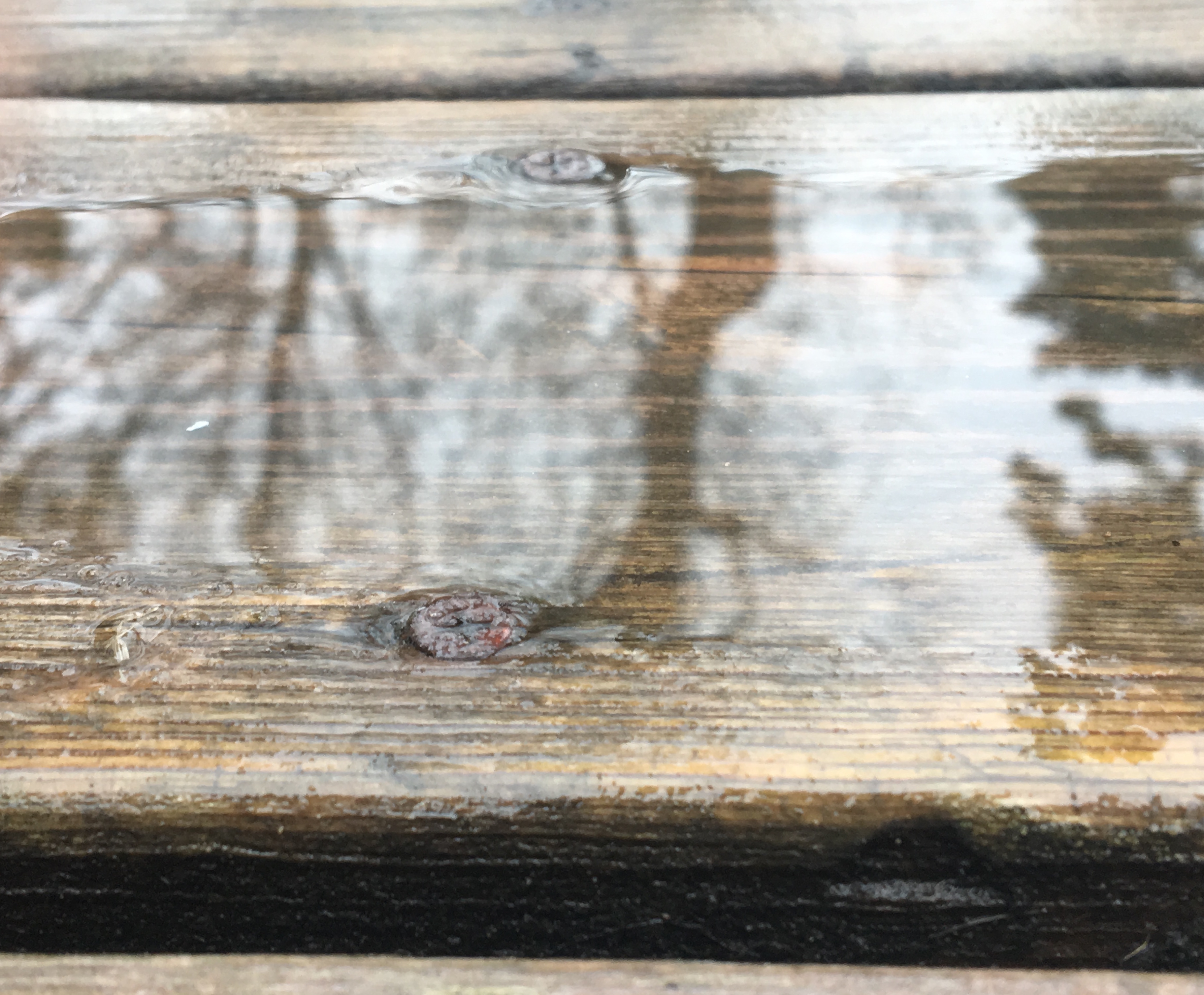
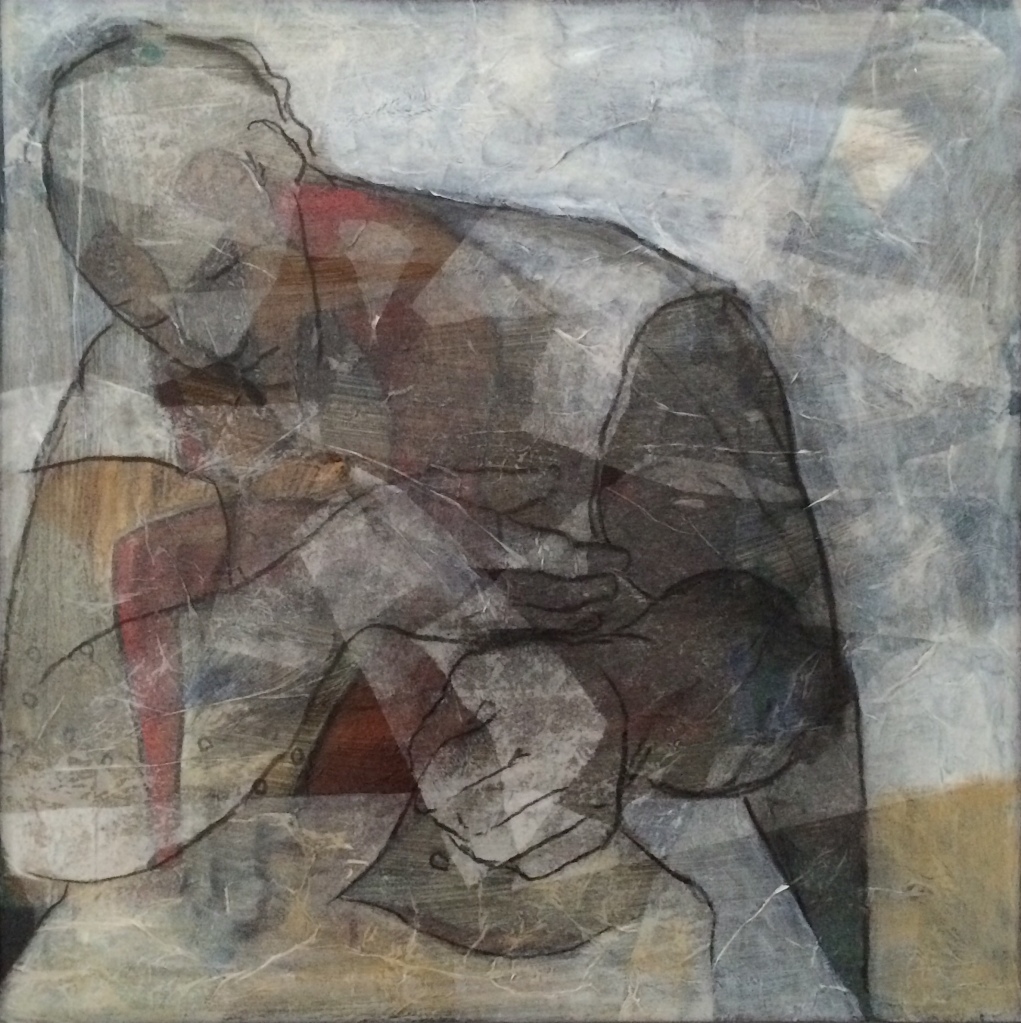
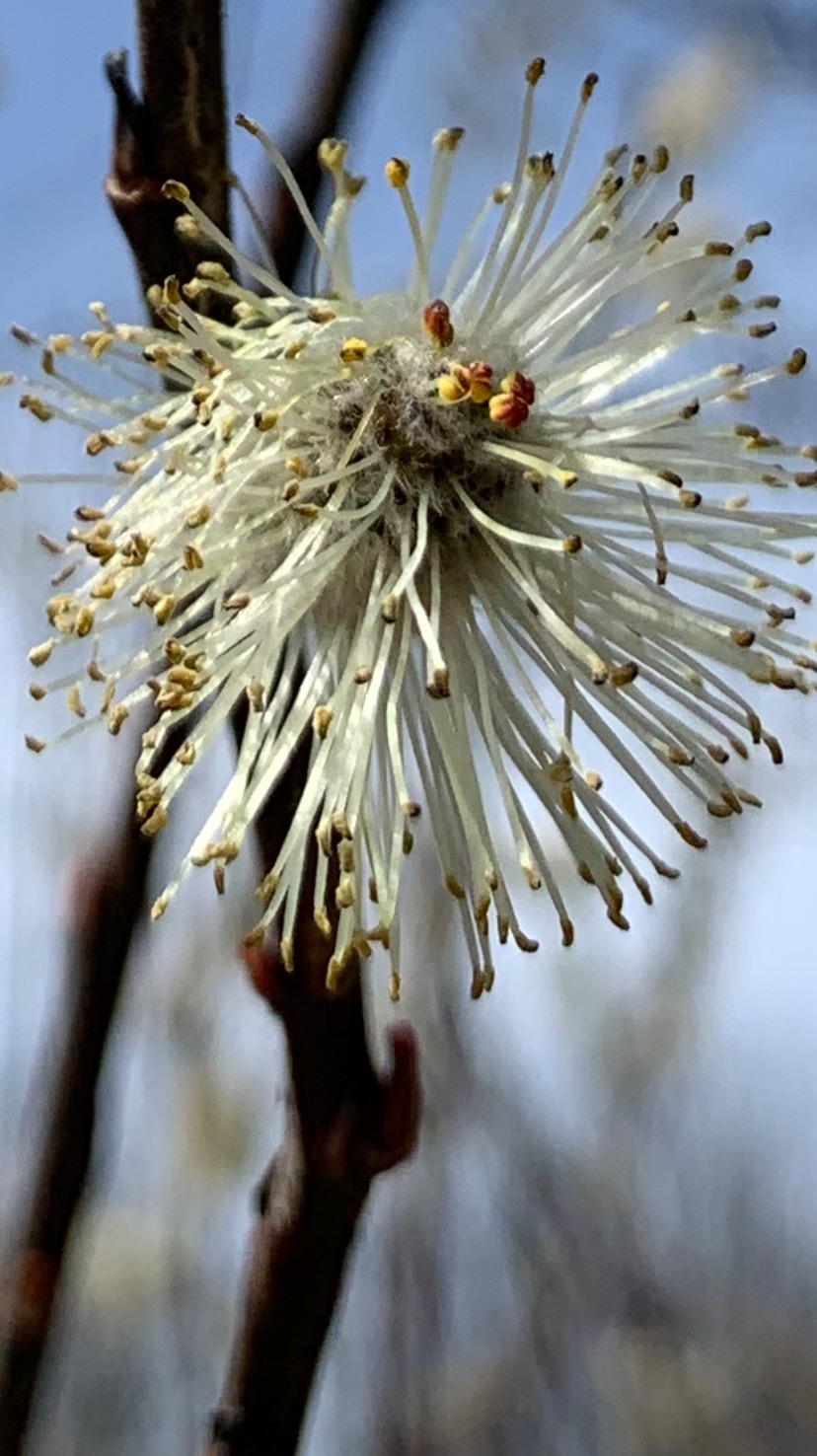
Imagine The Possibilities! [on Two Artists Tuesday]

Mastering others is strength. Mastering yourself is true power.” ~ Lao Tzu

I’ve had this quote sitting on my desktop for months. I’ve been on a Lao Tzu kick, a Kurt Vonnegut kick, a Rainier Maria Rilke kick…all at the same time. They are, not surprisingly, in alignment on many topics, among them self-mastery. “The secret?” they whisper. “Stop trying to control what other people think or see or feel and, instead, take care of what you think and see and feel.” Their metaphoric trains may approach the self-mastery station from different directions but the arrival platform is the same.

It’s a universal recognition: take the log out of your own eye.

Sometimes a penny drops more than once and so it is with Saul’s advice to me. “Look beyond the opponent to the field of possibilities.” “And, just what does that mean?” you may shout at your screen. It sounds like new-age hoo-haw.

Ghandi said, “Nonviolence is the weapon of the strong.” It is the height of self-mastery to bring ideas to the table rather than a gun. It is the height of self-mastery to bring to the commons good intention and an honest desire to work with others to make life better for all. Power is never self-generated but is something created between people. Power is distinctly different than control. Power endures since it does not reside within a single individual. Power lives, as Saul reminded me again and again, not in throwing an opponent but in helping the opponent throw themself. “Focus on the possibilities,” he said again and again. Throw yourself to the ground often enough and, one day, it occurs that there may be another way.

Work with and not against. It seems so simple. The bulb hovering over my cartoon head lights-up. Work with yourself, too, and not against. Place your eyes in the field of all possibilities. Obstacles are great makers of resistance, energy eddies and division. Possibilities are expansive, dissolvers of divisiveness.

I am writing this on the Sunday that Christians celebrate their resurrection. The day that “every man/woman for him/herself” might possibly and-at-last-transform into “I am my brothers/sisters keeper.” All that is required for this rebirth is a simple change of focus; a decision to master one’s self instead of the never ending violent attempt to exercise control over others.

It’s the single message, the popcorn trail left for us by all the great teachers. Instead of fighting with others, master yourself. Imagine the possibilities!

read Kerri’s blogpost about THE CEILING LIGHT

Know The Poem [on KS Friday]

“Spring has returned. The Earth is like a child that knows poems.” ~Rainier Maria Rilke

“First robin!” she said.

“What?”

“First robin. That means spring is here!” she looked at me with “duh” eyes. I was new to Wisconsin so the rituals were not yet known to me. I did not yet understand that in this strange land a water cooler is called a “bubbler” and that cheese curds are sacred food. Before the week was out, I’d heard it three times from strangers. “First robin!”

Years ago, during my first winter in Seattle, after months of gray, the sun came out for an hour and all the people working downtown poured out of the tall buildings and stood facing the sun. They moaned with satisfaction. “What’s this!” I exclaimed. Weird behavior. The next year, after months of dreary gray, the moment the sun peeked from behind the drab curtain, I ran out of my apartment to revel in the return. Leaning against a brick wall, eyes closed, feeling the warmth on my face and the heat reaching my bones, I knew this was my passage to becoming a “local”. I moaned with satisfaction.

Poetry is visceral. It has it roots in the moans of sun drinkers and robin-seers. The green pushing up from dark soil. The smell of spring or the first hint of warmth on the winter wind. Words cannot capture feelings but isn’t it glorious that we try?

We were walking the neighborhood on a cold afternoon. She squeezed my hand and pointed. “First robin,” I said and she smiled. “Spring.”

Now, doesn’t “First robin. Spring!” sound like a grand start to a poem of renewal? Ahhhhhh, yes. A hint of warmth on the wind, harbinger of green shoots reaching. Someday soon, sun will call me out of hiding and color my pale face.

read Kerri’s blogpost about FIRST ROBIN

Kerri’s albums are available on iTunes and streaming on Pandora

baby steps/right now © 2010 kerri sherwood

Dream [on Not So Flawed Wednesday]

When does a dream turn into a goal?

Lately, I’m having conversations that confuse me. Business thinking, engineer minds, make models for creation. Creativity plans as action templates and guides.

Screen writers make plans, too. Step outlines. The difference is in the process. A creative mind makes models and plans with full intent to throw them away. To discover the best story, their plan involves making space for the better idea. Open up by tossing the model. Clear the deck by shuffling the plan. Sketches and rough drafts. It’s a conversation with the muse. Muses are notoriously structure resistant until the story makes an audience sit forward. Movement first. Then, the structure begins.

The engineer mind works in the opposite direction. The dream must wear the mask of a goal or it is considered invalid. Too squishy. Construction begins immediately with targets and tasks. Order. It is, in fact, the same process as the creative mind, only it is less forgiving of space. It forces the muse to move. Time is of the essence. Structure first. Then movement. Efficiency is a tree with shallow roots.

It confuses me. Dreams do not wear ties or leather shoes, yet, scrape the blueprint and you’ll find a dream every time. Perspective requires stepping away from the canvas. Standing too close for too long and loss of vision is the result. Every time. It’s not a mystery or voodoo. It’s physics. Great ideas and idea-break-throughs happen in the shower or walking on the trail. A clear mind. A different focus creates space. Too tight thinking, too close in for too long, sucks energy.

Once upon a time I worked with organizations and educators. They also confused me. Squeezing the air out of their space they’d gasp, “We can’t breathe.” A little bit of space, some play, a refocus on the relationships was good medicine. Fresh air. Step back and see the painting. The point of perspective is to see. The secret: permission to remove the status games and need to be an authority and, for a moment, reconnect the players to their dream.

At the nucleus of every goal beats the wild heart of a dream.

read Kerri’s blog post about DREAM

Look Out [on Two Artists Tuesday]

Perhaps the most useful and profound lesson I’ve learned happened under the water. I was doing my first night dive. I was scared. I was not yet a confident diver. As we descended the world became inky black. All I could see was where I pointed my light.

It was that simple. I can see where I point my light. That’s it. And, more to the point, I choose where I point my light. I have the capacity to choose what I see. I can…and have…chosen to focus on hardship and lack. I can…and have…chosen to focus on what I love. On any given day my focus bounces full spectrum between complaint and appreciation. And then I remember: it’s my light, where do I want to aim it?

There’s a second aspect of the lesson. My focus is a beam. My light is not all encompassing. Each of us looks at life through a soda straw. None of us has the big picture. That’s why the commons is so important. In order to know what to do, we need to bring our many perspectives together to approximate something close to a full picture. Rather than fight about disparate points of view – who is right – it’s more useful to try and assemble all of those differing views, like the pieces of a jigsaw puzzle, into a bigger picture. No one wins when the pieces refuse to interlink.

With two broken wrists the cello became impossible to play. It has sat in her studio, the case unopened, since her fall over two years ago. I remember the day we bought it. We were early in our relationship, not yet married. I knew she was having cello dreams. We went to the music store for some other purpose, I can’t remember. The cello was sitting in the corner. She sat. She began to play. It was a perfect fit. And, although we could not afford it, we also could not leave it behind. It was a perfect fit.

Our lives these past two years have been a descent into dark water. We’ve worked hard to shine our light at our good fortune in a dark and inky landscape. As we make our way back to the surface, we are cleaning out. Taking stock. “The cello needs to be played,” she said, deciding to sell it. “I’ll never be able to play it, now.” She took photographs of her cello. Sent out a message through the network.

At the end of the day she showed me the photo. Edges. The view from inside the empty cello case, looking out. A slice of the world visible outside the case.

What’s “out there” is rarely clear. We see a small slice. It tickles our curiosity. The cello dream moves on making space for…? Who knows? We can’t see that far. In the meantime, we keep our eyes and hearts uplifted as we slowly kick our way back to the surface.

read Kerri’s blogpost about EDGES

Break It [on KS Friday]

Breaking space with a line changes the dynamic of the entire composition. I played with those dynamics for years. Vertical breaks. Horizontal lines that read like confused measure bars, segments of inconsistent time. Sometimes the lines tilted and pulled to the past. Sometimes they leaned into the future, urging the image forward. All of those interpretations were, of course, in my mind; I have no idea how others interpreted the lines on my canvases.

We are in the season of fog. Sometimes it’s so dense that we stand on the rocks and cannot see the water. Lake Michigan is hard to hide! The fog is a worthy magician.

The fog-magician also has the capacity of pressing three dimensional objects into seeming flat two dimensional images. The sudden silhouetting of the world pulls Kerri out onto the deck every time. “Can you believe it?” she asks, grabbing her camera and stepping through the door and into the fog. Dogga and I watch. We are happy in three dimensions and resist the call of stepping into flatland.

When she returns to our dimension, she shows us her photographs. “I love this one because the wire made a line,” she says. “It breaks the image.”

I smile. Vertical breaks in the composition. I say, “It reads like an abstract painting.” Three dimensions becoming two, a line breaking space, capping or pulling or simply interrupting.

Jackson Pollock believed his paintings were recordings of movement. Paint dancing. Who really knows how others interpret his paintings. Beyond the curator or art historian, who cares, really? The relationship between art and audience is meant to be direct, pure. No third party interpretation necessary.

“What do you think?” she asks.

“I love it,” I say. “It makes me want to paint.”

kerri’s albums are available on iTunes & streaming on Pandora

read Kerri’s blogpost about FOG

when the fog lifts/this part of the journey © 1998 kerri sherwood

Love The Wreckage [on DR Thursday]

It sounded like a thousand bees hitting the glass, trying to break the pane to get inside the house. Hail. Little pellets driven by the wind, appearing from nowhere. The last time I’d looked out the window it was sunny. And then, the rain. I stood at the window and watched the water find its path of least resistance from sky to glass pane to ground.

I was grateful for the bees hitting the window. The hail called me from the other world and back into this reality. When I work I tend to be too focused. I’ve always been that way. If I’m painting or – these days – assembling Powerpoint slides to map an idea or make a point – I am no longer available in this world. In my past life, you could come into my office or studio and sing an aria and I’d miss it. My focus was like a fortress.

Years ago when I lived in L.A., my friend Albert would “drop by” my studio every afternoon and make me join him for a cup of coffee. He was the best of friends. He knew I would not – or could not – come out of my other world without some prompting. He was like the bees hitting the window. Intentional hail. He’d sit with me, sipping coffee until I once again became verbal, until I wandered out of the fortress. I think he saved me. It’s too easy to get lost in a fortress.

Yesterday Kerri and I had a “talk.” I confessed that moving to Kenosha was like being a brakeless semi-truck hitting the sands of a runaway truck ramp. Full stop. Pieces of me flew everywhere. All momentum stopped. Wreckage and a broken nose. And, there, the lessons began.

I fought hard to keep the fortress intact but there were too many pieces scattered across the gardens. Light was pouring in. Focus became less about blocking out disturbance – disappearing – and more about attending. Giving attention. There’s a balance and for me it is a high wire act everyday. Learn to walk the wire of presence rather than disappear into a myopic fortress.

Pieces scattered akimbo do not reassemble but they do provide nutrients to the soil for new growth. Spring is calling. New shoots of green are poking from the crusty ground. The hail calls me from my creation. The fortress was a dark place. I much prefer the ruins and the budding gardens fed by the driving rain.

read Kerri’s blog post about RAIN

in dreams i wrestle with angels © 2017 david robinson

Create Something [on DR Thursday]

“Here we are, trapped in the amber of the moment. There is no why.” ~ Kurt Vonnegut

I’m on a Vonnegut bender. Lately, I’ve fallen into his quotes and I think I’m about to re-read everything he wrote. Standing on the threshold of synesthesia, he submitted his master’s thesis in anthropology on the shapes of stories. It was rejected by “the committee” as being too simplistic, but embraced by the world after he achieved success as a writer. The man was as witty as Quinn and a definite stander-on-the-margins of society, reflecting back both its beauty and brutality.

Trapped in the amber of the moment. Gorgeous. And, standing at the center of the moment, all the explanations necessarily fall away. There is no “why” because there is no separation, no other place to be or person to become. The committee would reject the notion outright since committees are dedicated to explanations and justifications. The elevation of one idea above another. The writer, the artist, serves a different master. “Practicing an art, no matter how well or badly, is a way to make your soul grow, for heaven’s sake.” Yes, another Vonnegut quote. Create something. Soul growth rather than reasoning.

At the center of the moment there is no why. There is no space for puzzling-it-out. There is simply this: a rousing and rowdy “why not!” Blue sky. Tall grasses dancing. Feel it. All of it. No single explanation can possibly contain it.

read Kerri’s blogpost about GRASSES AND SKY

prayer of opposite © 2004 david robinson

Let Fly [on Two Artists Tuesday]

“We have to continually be jumping off cliffs and developing our wings on the way down.” ~ Kurt Vonnegut, If This Isn’t Nice, What Is?: Advice For The Young

It is now my opinion, based on life’s experience, that it you don’t find the cliff, the cliff will find you. Wing development is the name of this game. Hide in the closet, bury your head in the sand, drink yourself to oblivion, pretend the monster is not at the door, and you’ll discover in your last moments that looking the other way was, in fact, your cliff.

Master Marsh once asked me why I had the need to run and jump off every cliff. At the time I said, “I don’t know!” My latent response comes straight from Vonnegut: wing development. Apparently my wings took their sweet time developing and needed some extra cliff-age. And, as we all know but are too polite or arrogant to admit, wing development never ceases. There’s always another cliff until there’s not.

We had a rare warm day so took a walk on our favorite trail. The brilliant raw sienna of the empty pod caught Kerri’s eye. While she took photos of the pod I thought about the thousands of seeds it once held that took flight on the wind. A few certainly found fertile soil. Most did not. That’s the idea behind Kurt Vonnegut’s advice. Don’t hoard your idea seeds. Put them out. Audition for the play. Submit your story. Offer your idea. There’s great truth to the advice: your job is to put it out there, not to decide whether or not it is good enough. Explode the pod rather than protect the seed.

Greg recently told me said, “it doesn’t have meaning until it’s published.” He wasn’t speaking about publishing in a newspaper or by Random House. Sending an email is an act of publishing. To text is to publish. Greg was referring to sharing. It has no meaning until it is shared. And, sharing your creations can be -and often is – vulnerable and scary. Giving a speech is terrifying to most people. Dancing, painting, composing a song, playing a solo, offering your idea in a meeting…all are acts of publishing. All are potential cliffs to jump off.

Explode the pod. Let the seeds fly. The wind will carry them. Some will find fertile soil. Most will not. Wing development is easier when you realize that you are a pod of ideas and not a judge of worth or value.

read Kerri’s blog post about THE POD

Turn Toward It [on KS Friday]

This is what he wrote. “The irony I feel is that the world is lost on the artistic temperament of these students.  They don’t seem awake to all that’s going on.” He’s directing teenage students in a play. He was my student thirty five years ago and reached out to me. We compared notes of the production I directed when he was a teenager, and the production he’s directing now. The world has changed mightily. His production will be viewed through a wholly different lens.

I flipped his phrase over in my mind. Artistry is to be awake to all that’s going on. And, awake is not a steady state. It’s not an arrival platform. It’s a relationship between the inner and the outer. What I know about that relationship is that sometimes you need to look away. His students have drilled for active shooters in the hall since they were in kindergarten. Mine couldn’t have imagined it. His students are navigating a pandemic, they’ve never known a world pre 9/11, they live in a country that is eating itself alive. My actors had easier access to what was going on. What was going on was closer in, more immediate and less abstract. They were not looking at a world-wide horror story or lost in the morass of social media. Cell phones were science fiction to my cast. My actors looked at each other and not at their screens.

Stories are about something. We just watched Erin Burnett’s interview with a Ukrainian husband who lost his wife and children to a Russian mortar attack. A month ago, violent death was nowhere on their radar. They were making dinner, going to school, doing homework, late for work. Erin Burnett began to cry and thank goodness. Humanity breaks through and we awake to what’s going on – really going on. We should all be weeping with Erin Burnett and this man.

Sometimes I feel as if I am looking for the small beautiful moments. I am trying to root my day in the explosion of color, the pastel sky, Dogga in the sun. Holding hands. Cooking dinner together. I am trying to be awake to what is going on, the anger and division and warmongering and carelessness as we soil our nest – without it frying my insides. Holding hands is just as real. Reaching toward our neighbors is also what’s going on.

Stories have to be about something and most often stories are about transcendence. Waking up to what is going on is less about waking up – we already know – and more about fully acknowledging it, facing the full picture and turning toward it rather than running away. But, before that final act, that moment of deciding enough-is-enough, before we are willing to blink open our eyes, we pretend the problem is non-existent or small. We ignore the obvious. 500 year storms every year. A family killed by a mortar shell. We bury our faces in our phones, we ban critical race theory, and toss our attention in a Twitter reality or a Tik-Tok diversion.

I wanted to write back and suggest that the world is not lost on the artistic temperament of his students, it’s simply too hard to look at the world so they are choosing to look away. That’s what their play will ultimately be about.

read Kerri’s blogpost about COLOR!!

Kerri’s albums are available on iTunes & streaming on Pandora

the way home/this part of the journey © 1998 kerri sherwood

Look Around [on DR Thursday]

My sketchbooks are punctuated by weird landscapes. It was a practice. When I felt the need to draw regularly, to exercise my artistry, I worked on compositions for future paintings. And, when I had no idea what to draw, no composition in my head, I sketched my weird landscapes. They were fun and I got lost in them.

There was a blowback effect. I’ve never been a landscape artist. I considered my weird landscapes as not-serious exercises. Yet, they were made of scribbles and patterns and it became a game to collect patterns from nature. My not-serious exercises required me to look around. To get close. To look at the edges and splashes and etchings available in nature. To see. My weird landscapes became eye-opening meditations.

There are miracle-patterns in bark. Orchids, I recently learned, are a master-class of pattern, shape, and color. It is impossible to find a hand painted brush and ink painting as perfect or as spontaneous and lively as the strokes on the rattlesnake plant. Go to the garden if color combinations are in question.

I will never invent anything as imaginable, as impossibly beautiful, as what already exists in this world. I will never produce any painting as glorious as the paintings in nature. The best I can do is play. Look and marvel. And isn’t that a great relief?

read Kerri’s blogpost about RATTLESNAKE PLANT

eve © 2006 david robinson