Read A Tiny Note [on Two Artists Tuesday]

I was still in shock. It was late, beyond midnight. The roosters were watching for the sunrise. The ritual I’d witnessed that night blew the metaphoric wheels off my car. Wave after wave of knife-wielding priests ran at the Rangda, a priest chosen for the evening to wear the mask, to enter the trance and become the demon. The priests stabbed the Rangda but to no avail. The blades bent. They were repelled. Eventually, all entered the trance and turned the knives on themselves, taking the energy, the protection of the Rangda, into their bodies. Into the community. No one was injured. Peace was made with the Rangda. Balance was affirmed.

I held one of the knives after the ritual was complete. It was not a stage prop. I could not have bent the blade on my chest without doing injury to myself.

Budi explained it all to me. I had so many questions. In his culture, the dark forces are not to be resisted or banished. There is no hell separate from heaven. Evil and good are not compartmentalized. There are energies, some dark and some light. There is no need to make peace with the light. The necessity is to face and make peace with the dark. Balance is created, an intentional relationship with a dynamic whole. It’s a dance of responsibility, a balance of dark and light. The middle way.

Balance.

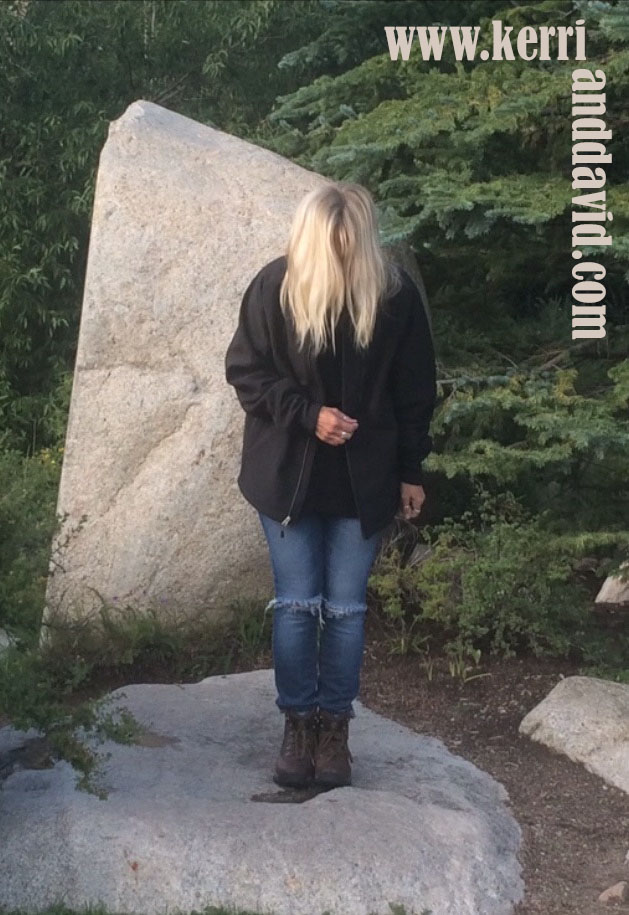
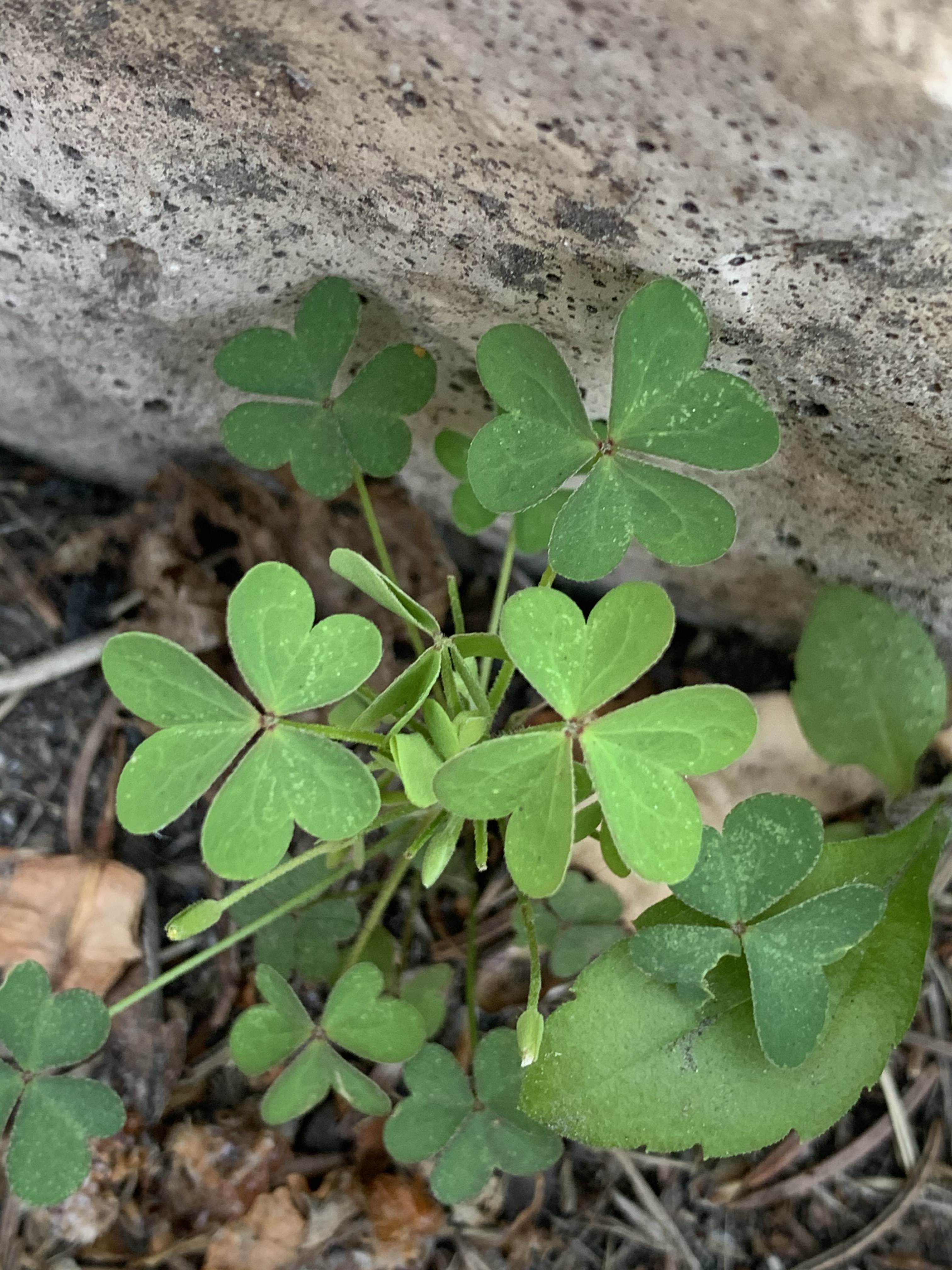
I loved this photo when Kerri showed it to me. Clover. You can’t tell but it is tiny. It is bursting from beneath the stone that serves as the step onto our deck. It made we wonder if the fairy people were close at hand. They serve, in the western tradition, a similar role to the Rangda in Bali. Nature spirits. It was most important to keep in the good graces with the Fairies. Honor their places. Respect and maintain the balance. According to tradition, they went into hiding, they left because we assaulted their spaces; we came to value the path of resources, mining, deforestation, fracking, damming…over the path of balance.

This tiny breath of clover. I sat on the stone last night. The air was cool after a humid and hot day. DogDog was doing his rounds. I had not thought of the Rangda in years. A tiny community on a tiny island. The “mayor” of the town introduced the ritual to us as their art. “We have so little to offer you,” he said in his broken English, “but we bring you our most prized offering, our art.”

Art. A prized offering. The dance of energies, an intentional relationship with the dynamic whole. An ongoing ritual of balance. It was the first time I witnessed a community that had yet to exorcise its art from the sacred. It bent knives. It restored balance. It belonged and gave deep meaning to every member of the community.

Tiny. Like the Fairies or the community on the island. A simple respect for what is good for the whole. Balance is expressed in the tiny things, the choices of where to walk, what to say. What helps in the long run. What does not. What gives meaning and cohesion to a community. What does not.

Budi would caution us with COVID and guns and a globe that is weirding and warming, “Rangda is ignored,” he’d say.

“Yes,” I’d reply, “the fairies have gone into hiding.”

But, all is not lost. They left a tiny note at our back door. Balance, it reads, is a relationship, an intentional act. It is an ongoing ritual, a tiny sacred thing.

read Kerri’s blog post about CLOVER

Tether Well [on KS Friday]

It’s official. YouTube has blocked forever our channel for the crime of using Kerri’s music. It’s happened before on other platforms so we’ve actually grown accustomed (sadly) to the loss. She is the composer, the performer. She holds all of the copyrights. We’ve learned that it is impossible to fight with an algorithm. I suspect that our appeal never met human eyes otherwise where is the sense? The algorithm wrote back assuring us that our claim was reviewed thoroughly but their decision stands. Vanish-ment.

Our vanish-ment is only one of the many examples of my latest fascination: what gets between you and your soul? What gets between you and your sense-making? What gets between you and your voice? In other words: what is real and what is not?

On a grand scale, we are alive at a time when deep fakes can put words into the mouths of anyone. We are witness to propaganda tv perpetuating fantastic lies, inserting themselves between people and their common sense. It is important to note that just because you believe it does not make it true. In fact, in today’s day-and-age of easy belief in the outlandish, it is a best practice to check everything you hear. It takes a bit of time – but only a bit – to tether yourself to reality. It takes no time at all to swallow the fables, conspiracies, and cotton-candy-illusions, currently blasting fire-hose-style across the e-waves.

“There is only one good, knowledge, and one evil, ignorance.” ~ Socrates

Anger and hatred are great mind foggers. They are easily-fed-fires-fueled-by-the easily-led. Make no mistake, the purveyors of propaganda see their audience as nothing more than firewood and depend upon dedicated ignorance and unquestioned belief. Those who stoke the fires generally revel in standing between people and their sense, people and their souls. Arsonists always have an agenda.

I’ve always understood that meditation and education share the same intention: remove the noise between your self and your experiences. Discernment. Quiet the mind. Open the mind. Artistry, at its best, does the same thing. It exposes you, opens you, to your greater self, to the fields beyond ‘what you think is true.’ Revelation, reveal-ation. At their very essence, artistry, meditation, education…require a full challenge of belief; belief is the final frontier of white noise, a worthy and necessary din to challenge.

Barney, the piano, grows more beautiful with age. The plants and flowers are again growing around his base. Chipmunks and squirrels sun themselves on his lid. One of Barney’s functions in our life is to remind us of what is real. That’s also true of the rusting sunflower that now lives by Barney’s side. After our YouTube vanish-ment, we sat for a moment on the back porch. “Look at the wild geranium!” Kerri said. She jumped to her feet to take a picture. Have I mentioned that she is also a great photographer?

The artist is intact. More, she is full of energy and ideas. A channel may have closed but the essential remains. Nothing can stand between an artist and her artistry. Not really.

Kerri’s albums are available on iTunes or streaming on Pandora

read Kerri’s blog post about BARNEY

this part of the journey ©️ 1998 kerri sherwood

Ask The Gorilla [on DR Thursday]

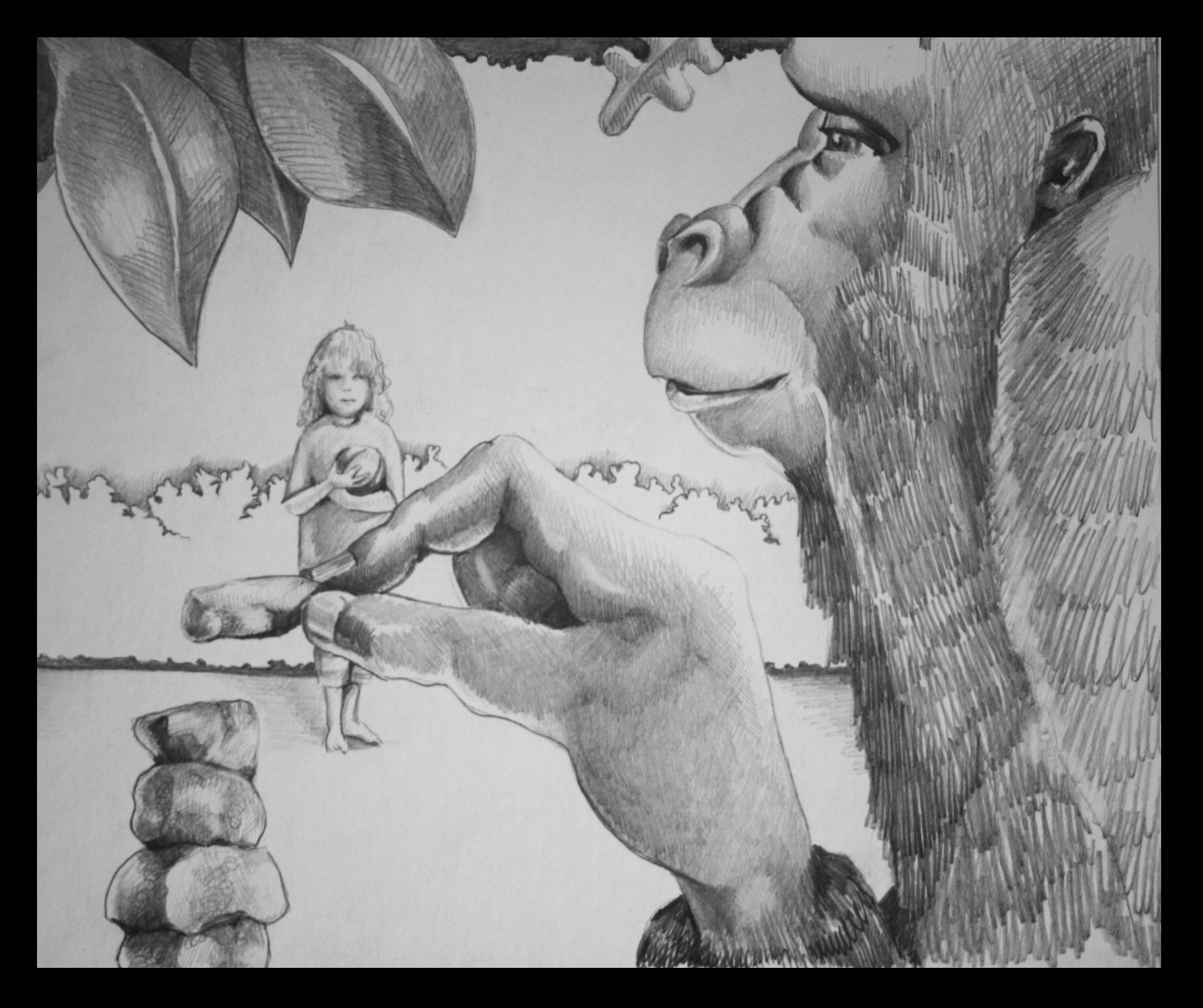
I’m not the first person to use a gorilla as the teacher in a story. This gorilla, in this story, is teaching the little girl the difference between playing-to-win and playing-to-become-a-better-player. The story begins when the girl asks the gorilla, “Do you want to play?” and the gorilla responds, “Well, it depends. What do you mean by ‘play’?”

It’s not a flippant question. It speaks directly to the “why” of what you do. The reason. Simon Sinek put this question at the center of his golden circle. James Carse wrote his philosophical masterpiece, Finite and Infinite Games, about this simple distinction.

Yesterday I had a conversation about success. A conversation about the difference between internal and external motivation. External motivators, like winning-as-your-why, are necessarily grounded in fear. What if you lose? Who are you if you fail? Winning at all cost will eventually lead to quagmires not unlike where the Republican party now finds itself. Obstruct. Lie. Gerrymander. Fix the vote. Fix the game. Any and all deeper value or ethic is sacrificed. There is always a cost when the “why” is as superficial as “to win.” The body seizes-up, loses its freedom of movement when fear of losing is the central driver of action. The nation-body, too.

The path to mastery cannot run through a win-lose “why.” Failure is an essential on a master’s path. Throw many pots, the metaphor from Art & Fear, is a mantra not only for artistic freedom, but for honing skills. Getting better and better at playing. See what happens. Playing to play, to become a better player, transcends and finally removes the word ‘failure.’ The body gains more and more freedom of movement when every action is a learning experience.

I wrote and illustrated this book back in my dark ages when I was facilitating diversity and inclusion trainings. Some companies hired us because they feared being sued. They feared losing money and had no real interest in diversity, inclusion, equality, fair play, betterment for their employees. They feared losing their privilege. Diversity initiatives ask that we stop rigging the game.

Other companies hired us because they truly desired to address the inequities in their organization. They wanted to step into their blind spots and see. They wanted to become better and better players in their communities. Early on we learned to distinguish between the fear-clients and those that were sincere. We became better players by choosing to work with organizations that were honest and sincere about their “why.” Players of infinite games.

I never attempted to publish Play-to-Play, my little illustrated meditation. Over the years I’ve given away some of the illustrations. It is one of the many stones I’ve stacked, pots I’ve thrown, the many projects and paintings that are literally stacked in my studio. It seems more relevant now than ever before. Yesterday, looking again at the illustrations, I told Kerri, “I should draw this again. I’m better now.”

She asked, “Why?”

I said, “Exactly.”

read Kerri’s blog post about STACKING STONES

play to play ©️ 2005 david robinson

Root Into The Worth [on KS Friday]

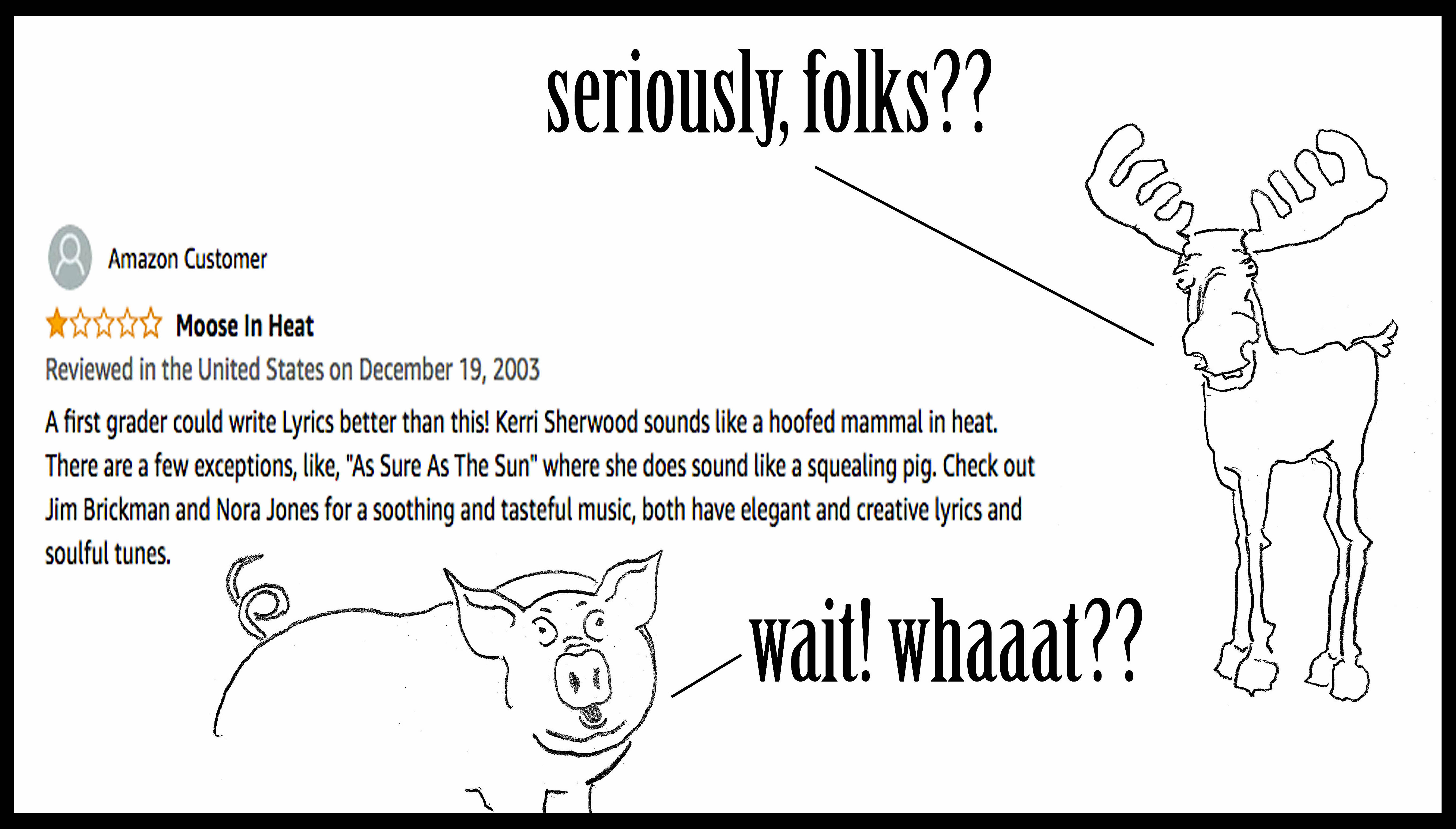
As Tom Mck used to say, “There are only three people in the United States qualified to review plays and none of them live in Stockton, CA.” His point: it’s best not to read your reviews but, if you must, don’t invest in what you find there. Good or bad, the review has little to say about the work of the artist and everything to say about the mind of the reviewer.

To be an artist is to be vulnerable. Vulnerability is an especially complex skill to master when the work of an artist is an open invitation for commentary.

The worst play I’ve ever seen got a standing ovation the night I saw it. Some of the best work I’ve ever done drew little or no audience. I directed a play that regularly had half the audience storm out of the theatre in anger while the other half was on its feet cheering; which half should I believe?

Many years ago I directed a play. One of my leading ladies had a family friend who was the theatre reviewer for the local paper. After opening night, my actress’ fine performance started to twist and sour. It was a mystery to me how her good work could go so bad. Later I learned that she was taking notes from the family friend. She lost herself in the cloudy opinion of an other and her performance suffered for it. She suffered for it.

Artists – not unlike everyone else – like to be liked. Most wait tables or teach lessons so they can pursue the thing they love. I use the word “love” purposefully. Most are regularly asked to give away their love/work for free on the empty promise of “exposure.” As Kerri says, “It’s hard to pay your rent with exposure.” It’s very, very easy for an artist to feel undervalued in a world where money defines value – while constantly being asked to perform for free. It makes being-liked an especially dangerous value-default.

Some of the greatest artists I’ve known lived marginal financial lives; financial success evaded them – but they knew without doubt the single secret that kept their work vital all of their lives: they alone were the judge of whether or not their work was good. They alone knew the pure driver of their pursuit. They knew the real danger of an artist’s life is to lose the purity of their artistic driver in the swamps of “being liked” or getting good reviews. They worked hard to stay centered and avoid becoming dancing bears at the circus.

It was Tom’s greater point: only you – the artist -will know if your work is good or not, if you’ve truly found and pushed your edge or discovered new territory. You will know when your work is shallow. No accolade can change that. You will also know when your work is exceptional. No criticism can change that. Its best to root into the worth of your pursuit, to grow and learn, rather than gorge on the ever-abundant-opinions of others. Good or bad. Moose or pig.

read Kerri’s blog post on MOOSE IN HEAT

all of kerri’s albums are available on iTunes & on Pandora

Set It Free [on DR Thursday]

Horatio told me that, according to the happiness index, the good folks in Iceland sit atop the happiness-mountain. One reason, he explained, is that they’ve removed failure from their national equation. They cheer the effort, not the outcome.

Removing failure from the equation is the main ingredient for fun and success in all arenas, especially the arts. It is impossible to learn color theory without making some extraordinary messes. Ask a dancer how many times they tried and fell before they made that astounding leap look easy. Throw many pots and, over time, mastery will come – and mastery is nothing more than the understanding that there is no such thing as failure. It is the feel and touch of a long relationship with clay that can only come from not being afraid to throw it, to see what happens if…

Sometimes, no matter how hard I struggle with it or adjust it, a painting just isn’t working. Usually it doesn’t work because I’ve forgotten the rule about failure-removal. My brush is too timid. My brain is in the way. And yet, sometimes, in the middle of a painting that isn’t working, there is a small piece, the actual inspiration for the painting, that isn’t stilted, that remains alive and free of my fear. It’s easy to see. It captivates my eye, a warm island in the middle of a frozen sea. Every so often, rather than paint over the whole thing, I’ll lift the island, cut it out, set it free from it’s too-labored surroundings.

“Brutal,” Kerri said. “I liked that painting.”

“I’ll do another,” I replied. And maybe, I thought, another and another and another. Who knows, learning to cheer the effort takes some not-so-serious practice. It’s the only road back to the freedom of finger painting and the joy of playing in the sand.

Beautiful K.Dot, 12 x 9IN, mixed media

read Kerri’s blog post about CUT OUT

beautiful k.dot ©️ 2021 david robinson

Look Closer [on Two Artists Tuesday]

Arnie recently sent me a book, Connection by Kristine Klussman. As is my practice these days, I’m reading it slowly, a few pages at a time. I recognize much of what she’s writing about: focus placement, meaning making, cutting through the ‘should’s’…all in the process of re-connecting to what is really important in this life. The book offers specific exercises and process steps to help readers take a closer look at their lives. To identify the gaps between espoused and lived values in order to make different choices and close the gap. Alignment.

In art school, the most valuable lesson (for me) was to learn to see beyond what I ‘think.’ I’ve written about the professor who asked us to look at our yellow #2 pencils and tell him what color were the pencils. A riot of eye rolling ensued but, in the end, he helped us to see that the simple yellow pencil was alive with green and purple and red. Our minds generalize. It requires a bit of slowing down and, dare I write, a bit of presence, to see and experience how rich and alive even the simplest things, a yellow pencil, really are. The dictum applies to each and every day of life, especially the days we generalize into boredom or “same-old-same-old.” Slow down. Look again. There’s more to the yellow pencil than you think.

When Kerri and I arrived home from our trip to move my mother into an independent living community, we poured a glass of wine and opened the box my parents had kept with the artifacts of my life. Old newspaper clippings of play reviews, playbills, gallery opening announcements, elementary school report cards, photographs that reached back through proms and school portraits to blurry black and white infant prints with “David, 4 months” scribbled on the back. It was a poignant exercise of pulling the life-camera in for a closer view. Life-fragments in a box are like the yellow pencil. They require a closer look.

I’ve always appreciated Kerri’s tendency to pull the camera in closer. She is forever taking photographs and then pulling the image this way and that, like so much taffy, looking for the most interesting slice, the most dynamic composition. In her photographic-push-me-pull-you, there is often a discovery. “Look at this color!” she’ll exclaim. Or, “Did you see this! Look at the spines on this plant!” She cultivates surprise. She understands that a closer look will always reveal tiny not-yet-seen-miracles.

Expecting surprise. Taking the time to look beyond yellow-pencil-expectations. Closing the gap between lived and espoused values. Slowing down just enough to realize that there is no such thing as “same-old-same-old.” These are age-old sage suggestions for living a rich and meaningful life. All of it, born of a tender, quiet suggestion to take a deep breath and have a closer look.

read Kerri’s blog post about A CLOSER LOOK

Laugh At Yourself [on DR Thursday]

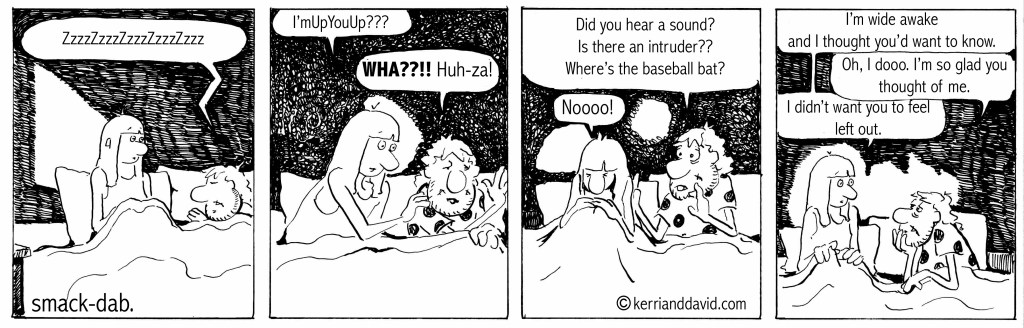
Had you come across our website during the era of The Roadtrip, a play that Kerri and I wrote from the several-months-email-conversation we had before we first met face-to-face, you’d have read this phrase: smack-dab in the middle of middle age…a true story of quiet hope and the arrival of life’s second chances.

Smack-dab. In the middle of middle age. We met. We married. We walk the neighborhood arm-in-arm. We write these blog posts each day. She brings her wise-eyes into my studio and I tell her what her music makes me feel and think.

For an intense year or so, we tried-like-crazy to syndicate a cartoon strip called Chicken Marsala, the imaginary child of two people who met smack-dab in the middle of middle age. In the course of writing and drawing Chicken, we also pitched a single-panel cartoon, Flawed, and another called At The Door. Chicken Marsala had several iterations because the syndicate liked it…almost. They asked for improvements though never specified what those improvements might be – in the writing? The art work? In this age of too much information, no answer ever came back to us.

In the face of unspecified and uncertain improvements, this ONE thing is certain: we generated a mountain of material in the hunt for the elusive improvement. Oh, and this, too: we laughed heartily at ourselves. The mountain of material was about us. We were poking fun at the things we do and say each day.

This morning I found Kerri furiously working at her computer guffawing. She’d pulled up the old Chicken file. There was an iteration of the strip that was pre-Chicken, the middle-aged couple prior to the appearance of their imaginary son. We sat this morning and laughed again at ourselves. These things actually happen and how joyful is it to chronicle yourself in-and-as a cartoon?

I suspect we are going back to the drawing board. This time, we’ll not hide behind our imaginary son. This time, we’ll pull the blankets on the source. Smack-dab. In the middle of middle age. Two artists met and got married. What could be a better set-up for ridiculousness?

read Kerri’s blog post introducing SMACK-DAB

*don’t believe a word she writes, she guffaws all of the time.

smack-dab ©️ 2021 david robinson & kerri sherwood

Consider The Intention [on Merely A Thought Monday]

My least favorite character in Romeo and Juliet is Capulet, Juliet’s father. A few years back I thought it would be a good exercise to tell the story from his point of view. In his world of privilege and order, he has an out of control daughter, a teenager no less, ignoring the rules of the house and society, having sex with the son of a sworn enemy. He imagines a better future for her (and himself) and has worked hard to protect her and match her with royalty. Like every parent I know, he just wants his daughter to behave and thrive.

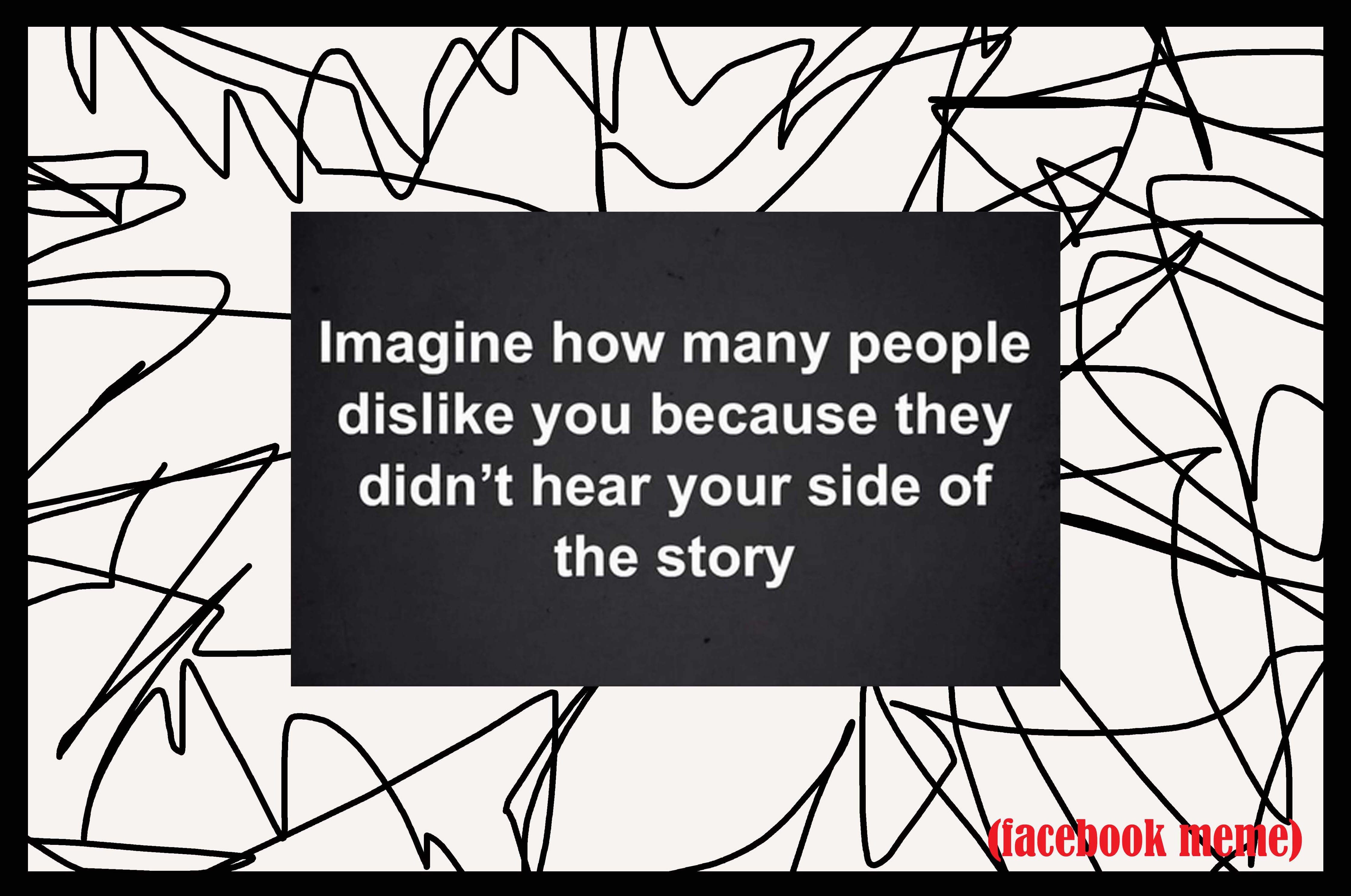
Every story has an agenda. That’s true of the stories we tell of ourselves at parties, it’s true of the stories we shout at each other when we are having fights, it’s true of the stories we tell when we are falling in love, it’s true of the stories we tell when breaking up. Every story has at least two sides and each side has an intention.

Stories are never neutral or passive. It’s precisely why Blind Justice is so important to the health and well being of a society: between two opposing/competing stories there is a point of equilibrium that we call “fact” or “truth.” Blind Justice carries a scale to symbolize that place of story-equilibrium, ideally free of status, privilege, sway…weighing the stories to arrive at fairness and equity.

Health is the capacity to consider the other side of the story.

It is the truly despicable character that steps with intention into the gap between competing narratives solely to create discord. To lie for gain. Iago is just such a character. He creates an illusion with no greater intention than to hurt, to destroy. Desdemona dies. Othello murders because he cannot see through the lie Iago is telling. Othello’s love turns to hate. He cannot or will not hear the other side, the love story, the truth of Desdemona.

Hatred is a territorial flag planted in a one-sided story.

The modern GOP is Iago. Othello is a cautionary tale relevant in our times. What or who will be murdered before the lie is laid bare?

I have always been a lover of myth and parable, stories that reach with intention to deeper truths. It is why I stepped into the theatre in the first place. Art, like Blind Justice, uses story to reach deeper truths, truths that can rarely be captured in words. It’s the paradox of art and truth is always found there.

No story has a single point of view. No truth is singular – that is the hallmark of the truly important challenges that every society faces. It is why successful governments tell their story with truth as their intention. It is why successful relationships sail through stormy seas. The intention is pure. The desire to stand in the shoes of the other-side-of-the-story is genuine and necessary in order for the relationship, the community, the country to thrive.

Capulet is not a bad man. He has good intention. The play ends when he becomes capable of standing in and considering the other side of the story. Hope and equity is the promise rising from the pain.

Iago, on the other hand, is a wholly different story. His play ends in a cage with a nasty celebration of the pain, death and havoc he’s wreaked, gloating about his capacity to snare others in his big lie. All are made fools.

read Kerri’s blog post about THE OTHER SIDE OF THE STORY

Appreciate The Marks [on DR Thursday]

Life leaves marks. When I look in the mirror these days, I see my grandfather staring back at me. Or, to be more accurate, I see aspects of both of them, all akimbo in a variation that I now recognize as “me.” The topography of DNA, crafted by my unique life, now sketched into my mask.

Quinn left marks in me. So did Tom. And Doug. And Kathy. I could go on. The list of amazing humans who had a hand in shaping my perception, molding my thinking, in informing my walk through this world, is lengthy. They are my fortune, the gold in my pocket. Their marks serve as my credo, define my intentions. Their marks have become the scale upon which I weigh value and importance. Laughter, according to their marks, carries enormous weight.

As we carried boxes out of the house, I couldn’t help but notice marks on the walls, scuffs on the floor. Each marked a memory. When the movers lifted the couch, its impression in the carpet was deep. It had sat in the same spot for years. In its absence, the entire space reeled. Soon it would find a new equilibrium as another family sculpted the now empty space. They will, no doubt, remove the carpet. The impression is too deep, the placement and accompanying memories are not theirs. Erasure is the necessary first act of new inhabitants. Eliminate the marks. Paint. Sand. Demo. And freshen. Clean the palette.

Leigh is an authority on rock art. Cave painting. The marks left by humans. Prophesy and map. Ritual and graffiti. Not all cultures are obsessed with leaving marks. Many try not to. My relationship to my marks, my paintings, changed the day I helped carry Duke’s brilliant paintings out of his basement. He’d passed and now the question was, “What do we do with all of his paintings?” I knew, someday, someone would ask the same question of my paintings. Carrying his paintings up the stairs and stacking them in the truck, I became less invested in the notion that my paintings, my marks, need matter. They no longer need to transcend me. They are immediate, fulfilling for me and perhaps me alone. That is enough. Bits of ego easily fall off when the perspective of age comes calling, when the marks are undeniable.

Marks fade. Life is what is happening now. A cliche’ that could not be more relevant. The couch, seemingly so permanent, will someday be hauled out. The marks will remain for a while. Only a while. And new life will move in and fill the old space, as it should.

read Kerri’s beautiful blog post on IMPRESSIONS

Touch The Walls [on DR Thursday]

A Haiku

I wander the house

touching boyhood memories.

Stories pour from walls.

read Kerri’s DR Thursday Haiku