Make Noise [on Merely A Thought Monday]

I am conflicted. I wrote a version of this post and then tossed it away. I’m trying to be less argumentative in my daily writing. And then, Toni Morrison collided with Albert Einstein:

“In times of dread, artists must never choose to remain silent… This is precisely the time when artists go to work. There is no time for despair, no place for self-pity, no need for silence, no room for fear. We speak, we write, we do language. That is how civilizations heal.” ~ Toni Morrison, No Place for Self-Pity, No Room for Fear

I am an artist. Is it argumentative, is it confrontational, to write what I see? Yes. Sometimes. Once, I saw a park service truck, on a trail, quickly backing up. The driver did not see the man in the wheelchair right behind his truck. I screamed and ran and banged on the side of truck until the driver stopped, a few inches from hitting the man in the wheelchair. Sometimes it is necessary to shout and make noise.

All of my life I’ve understood the first rule of being educated, namely, to check your sources, as simple sage advice. It’s a good idea, if you are going to anchor your identity in a narrative, to make sure that your narrative-of-choice is solidly anchored in verifiable substance. Doubt and questioning, used properly, are necessary tools of an engaged mind.

Years ago, Robert Cialdini wrote, “The world abounds with cults populated by dependent people who are led by a charismatic figure.” In other words, people are easily led and – as we have recently witnessed – with disastrous results. All that people ever need do to avoid a nasty drink of purple Kool-Aid is to check their sources. In our day and age it is almost easier to check the veracity of the story-we-are-being-fed than it is to be misled. Almost. One must first desire to be fed the truth, even if the truth challenges rabidly-held belief.

Checking takes less than a minute.

Just ask the now-jailed-and-soon-to-be-tried capitol insurrectionists claiming that they were led astray by a flimflam-president-man. The Big Lie was easy to check. It remains easy to check. Yet, none cared to check it or perhaps refused to believe what they found. Checking the lie, listening to the data, would undermine the tightly held power-narrative of an entire political party. A pathological lies requires more and more effort, more and more outrageous lies, to sustain itself. It should have been easier to check the story than it was to storm the capitol.

Now I see the first rule of being educated, the necessity of checking sources to verify fact, as a dire necessity. It is the flashing red warning signal to these de-united-united-states that there is a cliff ahead. It is no longer a sweet bit of sage advice; it is a survival imperative. Respect for the line – truth or fiction – will determine whether we as a nation unite and grow or divide and collapse.

Many years ago, Robert Cialdini also wrote,“Audiences have been successfully manipulated by those who use social evidence, even when that evidence has been openly falsified.” Openly falsified. He wrote those words decades before tweets, Fox News, and the mega-amplification of all the openly falsified big lies. His words might now serve as the sad single credo of the Republican party.

It is not shocking that a political party lies. It is most shocking how little the followers of the party care to check the sources of the enraged hype it daily swallows like so much anger-candy. Dependent people. Easily led. Believe wholeheartedly. Ever expanding lie. No facts necessary. It is far beyond Einstein’s observation of people doing nothing in the face of evil; our nation is in peril because the evil we face is an openly falsified narrative. So many of our people, so many of our leaders, know it is a lie, feed the division, and actively look the other way.

read Kerri’s blog post about DOING NOTHING

Snap [on KS Friday]

“Whenever the question comes up,/ the poets all say the same thing:/ the only poem we are interested in is in the next room,/ the one not written, the poem of tomorrow.” ~ Billy Collins, The Next Poem

I am trying not to focus on the next. The next chapter. The next day. This is a day of my life even if it is unfolding in a time of pandemic, of jobs lost, careers collapsed, broken-wrists-not-healing and my father’s slow disappearance.

Yesterday was hard. I made it so. Even before noon I was wishing the day away. I was anxious to get to the next. To stick a fork in it. Then, when the truck wouldn’t start, it was all too much. I could have shaken my fist at the sky but instead I decided to stop trying to be someplace else. I decided to feel the hurt. Be in the day.

I miss my studio. That’s not quite right. I miss myself in my studio. I miss how I feel when I am working in it. Timeless. In that place, there is no next. In that place, I feel good, all things become possible. It is a staircase away. These days, it might as well be on the moon.

Mary Oliver wrote, “Next time what I’d do is look at/ the earth before saying anything.” This seems to me, as I approach a birthday, an age marker, a sunrise unlike any other, to be sage advice. See the miracle before I diminish it with my thinking, before I jam it into sackcloth with my opinions.

Once, on a bitter cold day, feeling blue, I leaned back against a red brick wall and closed my eyes. I felt the sun warm my bones and, in a snap, wanted to be no where else on earth. Try as you might, you cannot take that from me, the sun. The warmth against that wall. The absence of next. The boundless power of the snap.

read Kerri’s blog post about NEXT

Recognize The Art [on Flawed Wednesday]

The snow was too dry. My snowman fell apart when I put the head on. “It doesn’t have to look like a snowman to be a snowman,” Kerri said to cheer me up.

“Maybe it’s modern art!” I quipped, using my if-it’s-a-mess-call-it-art default statement. As I walked down the trail, away from my unsuccessful snowman, I wondered when incoherence had become included in my definition of art.

I am and have been these many months doing some soul searching and life review. Walking down our snowy trail I remembered working with a dying theatre company. The first step in restoring their health and vitality was to help them face a simple truth: that they made the “art” did not necessarily make the “art” good. In fact, the “art” could not be good until their criteria for “good” wasn’t about them.

The challenge with “art” in the modern era is that it is nearly impossible to define. For purely masochistic reasons I looked up the word ‘art’ in the dictionary and nearly fell asleep before I finished reading the definition. “A diverse range of human activities involving the creation of visual, auditory, or performing artifacts…” Artifacts? The last lap of the definition reads, “…intended to be appreciated primarily for their beauty or emotional power.”

Beauty. Emotional power.

Of course, the contemporary world is awash in conceptual art and I read in my dictionary that this form of art, dating back to Duchamp in 1917, “…abandoned beauty, rarity and skill as measures.” Bananas taped to the wall. Statements.

Beauty abandoned. No emotional power necessary. But still “art.”

Art is, I’m told by historians and other scholars, a mirror of society. It is reflective of the era in which the artist lived. What a society values is made apparent in their art. It’s true.

Art, I believe, has a power and purpose far beyond mere appreciation. It is more than a mirror. It generates identity. It pulls disparate individuals to a common center. It affirms connectivity. It awakens us – and provides access to – that which is greater than any single individual. It bonds. It affirms. It transforms.

I wonder if our art, often so unrecognizable, sometimes incomprehensible, dependent upon curatorial interpretation, not concerned with beauty or rarity or skill or any other discernible measure, is not the perfect reflection of us. Narcissistic. Statements. Each day I am, like you, met by a tsunami of stories in the daily news revealing our collective confusion, our collapse of values, a commons at war with itself fueled by leaders stoking division for personal gain. Bananas taped to the wall. It is – we are – in our daily tales – so conceptual – so void of beauty or rarity or recognizable skill or measure – that it requires an anchor/curator to tell us why it – or we – might have meaning.

And then, just when I wonder if we are hopelessly lost, Amanda Gorman stepped up to the mic. The one true test of artistry is that we know it when we see it. No curator necessary. We are, we were, for a moment, bonded together in a way that no politician, no historian, no concept will ever understand or achieve.

I see it alive in Mike, and David, and Mark, and Chris. It glistens every time Kerri sits at the piano or composes a poem. It is not a mess though sometimes skill meets a happy-accident and, like penicillin, something healing emerges.

When we are washed away into the annals of time, what will be our art-love-letter to the future? What legacy – and art is a legacy – will we leave behind? What will I leave behind?

read Kerri’s blog post about SNOWMAN

for kicks, Kerri made a Snowman mug. Go here to get it

Defy Augury [on Two Artists Tuesday]

It lifted my spirits. David sent a short video, a snippet of a play. He called it “Sofa Shakespeare.” Using small toys from his son’s collection, he performed – and filmed – a puppet version – of Act 5, Scene 2 of Hamlet. “…we defy augury. There is special providence in the fall of a sparrow….” He’s a professor of theatre, a director and playwright, a major member of my inspiration-tribe. He is a bubbling wellspring of the creative.

We have a periodic-ongoing-for-years-conversation about Hamlet. The play is special to both of us. I’ve had two runs at Hamlet. Both were significant. Both productions popped open new doors of understanding for me. Both productions also came to me just before the floor-of-my-life collapsed. I’ve come to think of Hamlet as an omen. If today I was approached to direct it, I’d say “Yes,” but, inwardly, I’d think, “Uh-oh.” I would defy augury. Like Hamlet, I’ve come to realize that I have little or no control over my fate.

Later in the day, after Sofa Shakespeare, Kerri and I hit the trail. The sky stopped me in my tracks. It was winter-radiant. I felt as if I was standing between heaven and earth. Staring at this magical sky, Kerri asked, “What do you think is going to happen?” Our lives, like so many others during this pandemic, have been blasted into utter uncertainty. We ask this question daily, “What do you think will happen?”

“I don’t know. Something will happen. That’s for certain,” I respond. She punches my arm.

“Not helpful!” she grimaces.

Making choices. Making peace with your choices and your fate. Chasing ghosts. Asking the ethers for more information. “What does it mean?” Trying to decipher whether the ghost you chase is “a spirit of health or goblin damned.” Whether your ghost brings “airs from Heaven or blasts from hell…” What will happen?

Continuing down our snowy trail, more words from Hamlet rolled to the front of my brain. These words come at the beginning of the play: “There are more things in heaven and Earth, Horatio/Than are dreamt of in your philosophy.” At the end, “We defy augury.” This great magical world is beyond our capacity to grasp. Still, we must try. And, like Hamlet, the best we can do is arrive at peace with our uncertain fate.

“If it be now, ’tis not to come; if it be not to come, it will be now; if it be not now, yet it will come – the readiness is all.” Hamlet. Act V, ii

read Kerri’s blog post about HEAVEN AND EARTH

Emerge Changed [on KS Friday]

This moment “is the place of pilgrimage to which I am a pilgrim.” Paul Murray

Columbus’ journey into dementia has reminded me once again that time is not a linear thing. We cycle as surely as the tides, the seasons, the days that move into night and back again. Each and every moment a pilgrimage, as poet Paul Murray writes, in which we are both pilgrim and the target of our pilgrimage. We journey to discover ourselves. As Columbus moves deeper into his world, I know the separation, the distance from him that I experience is necessary. He must walk alone into this season of his pilgrimage.

Walking the snowy trail a few days ago I asked Kerri about the experience of losing her father, I asked if it necessitated a life review. She told me that, when she thinks of her dad, she is filled with the impression of who he was; she rarely thinks or even remembers events. She viscerally feels his love. She knows his spirit. “I never think about his achievements or how much money he made – all the stuff we get lost in,” she said, “but I fully remember who he was.”

We are in transition. All jobs lost. Broken wrists challenging artistry as it was. Every day it begs us to consider who we are within our circumstance. Who are we if we are no longer that? “Our spirits are high. We take one day at a time,” I just wrote in a letter. It’s true. That is who we are. That, at this present moment, is all we are. Pilgrims walking.

I am, like my dad, in a “winter” in the cycle of time. He pulls in. I am also pulling in. To rest. To reflect. To rejuvenate. Pilgrim and pilgrimage, both. Each moment an unbroken circle. Each moment in transition. The old shell is too small. Someday, it will of necessity split. Columbus will emerge changed into his new world. I will emerge changed into mine.

in transition/released from the heart is available on iTunes

read Kerri’s blog post about IN TRANSITION

in transition/released from the heart ©️ 1995 kerri sherwood

Conceal To Reveal [on Two Artists Tuesday]

When I was tilting at windmills, one of my favorite things to facilitate was mask work. I brought masks to lawyers, to CEOs, to teacher’s, government workers, elementary school students, corporate trainers, business coaches and sometimes to actors. There’s nothing better than a mask to pop open possibilities and challenge petrified thinking.

Masks conceal and reveal. They serve the paradox and, therefore, are tapped into the root of truth.

It’s impossible to work with masks for long before realizing that the faces we wear everyday are also masks. We “put on” a smile. We attempt to hide what we feel by the mask we manufacture. Some faces freeze in masks of indifference or masks of disdain. We perform ourselves, and craft our masks accordingly.

Many cultures around this world believe the mask opens a communication with the gods. Don a mask and something bigger-than-you speaks through you. When I paint I often have that feeling. Artistry sometimes means getting out of the way so the creation can flow.

It’s why I brought masks to lawyers and CEOs and corporate folks and teachers. To introduce them to the fields that bloom beyond their need to control. So much of their lives, so many of their problems and challenges were wrestling matches of control. They were actively creating the obstacles that they desired to remove.

What do we actually control when we harden our faces over what we feel? What do we gain by attempting to control what others see or think or feel? We are makers of our own prisons. We are deluded by our fantasy that we have the capacity to determine what others see. The only control we exert is upon ourselves.

The mask work makes abundantly clear that control is not power. Power – creativity – flows. It is the dance of the artist to master technique, to learn control, and then transcend it. To get out of the way.

My favorite moment, with every group, in every circumstance, came when the masks released the people and they slowly, respectfully said goodbye and removed them. Their faces was also mask-less. It was like seeing infant’s faces. Bright. Open. They would, for a few brief moments, look at each other, unmasked and unprotected. Simply astonished at being alive, together, in the world.

read Kerri’s blog post about MASK

Follow The Conversation [on Merely A Thought Monday]

I met Horatio on an airplane. With his wife, Teru, we were seatmates on a flight from Washington D.C. to Seattle. I’d just finished facilitating a workshop at the Smithsonian about story, he was stepping toward directing films, and Teru is passionate about writing life histories. We talked about storytelling clear across the country and our conversation continues to this day.

David and I sat next to each other at a conference. I’d only just moved to Seattle, I knew no one. I saw a sign for the conference and wandered in. It was my good fortune to pick a seat next to a brilliant visual and theatre artist. We started talking about life and art. Years later, every gallery I enter, every play I attend, I have conversations with David in my mind – and hurry home to write him or call him and share what we talked about.

To this day, MM is my greatest collaborator. We used to sit in my office and dream big dreams – and then go out and make them happen. He is the ultimate player-of-infinite-games, playing-to-play. When I need my mind opened, my pot stirred, or my obstacles surmounted, I turn to MM.

I was visiting Tom McK at his ranch. When he asked me to help him tell a story I had no idea that his simple question, the story that he needed to tell, would take more than a decade and would only be possible after his death. His story became my story to tell.

It was Tom’s story that I told to Horatio that day on the flight from D.C. to Seattle. It was multiple good conversations over many years with David about writing plays that finally brought me to clarity. MM was my constant companion. With his band, Mom’s Chili Boys, he composed the music that supported the telling of Tom’s story. He built the world of the play and then, together, we stepped into the world and fulfilled Tom’s request.

Fortuitous seat assignments on a flight. Following an impulse into a conference and taking any old seat. Playing an infinite game. One good conversation, again and again, and nothing will ever be the same.

read Kerri’s blog post about ONE GOOD CONVERSATION

Take The Opportunity [on Two Artists Tuesday]

Paul used to teach his actors that, in choosing to step onto a stage, they had a profound responsibility. “Never underestimate your power to influence another person’s life,” he’d say. I took his lesson and passed it along to my students. I hope that a few of my students took Paul’s lesson and, in turn, passed it on. You have a responsibility.

Another lesson I learned, this time from Jim, was that great acting is about standing in truth. “Acting is the honest pursuit of an intention in imaginary circumstances.” Honest pursuit. It’s a misunderstanding to equate the art of acting with pretending. The circumstances are pretend. Actors are meant to be portals to a shared story, a channel to a common experience. They transport. They transform. “Never underestimate your power…”

John O’Donohue writes that the soul does not inhabit a body. It’s the other way around: bodies live within the soul. We only think we are isolated individuals, bubbles. The bubble is singular, soul, and we play our small dramas within it. We fill our bubble by how we stand in it, by what we bring into it. There is no on-stage or off. It’s all the stage.

The other day I was exhausted. I was standing on the edge of despair when my phone dinged. It was Rob. “What kind of wine do you like?” he texted. The edge disappeared.

From across the country, MM sends me cartoons that make me smile. Horatio sent an episode of The Twilight Zone. “You gotta watch this,” he said. David sends photos of Dawson at the easel. There is nothing so freeing to an aging artist than to watch a child draw. No limits.

The bubble is singular. The soul of the earth. These good friends, living honestly on the stage, have no idea of their profound impact and influence on me.

These days, when I think of my good teachers and dedicated mentors, when I think of Jim and Tom McK and Paul, I know that, were I to teach again, I would add a small caveat to our legacy-lesson. I’d say, “In choosing to step onto the stage, you have a profound responsibility and opportunity: never underestimate your power to influence another person’s life.”

Take the opportunity. Each and every moment. Ripples sending ripples.

read Kerri’s blog post about SOUL OF THE EARTH

See It For What It Is [on DR Thursday]

In the aftermath of my calls with Horatio I often feel as if I’m descending the mountain, as if I’ve just spent a few precious moments with the wise being sitting at the top. He will no doubt frown at my assertion because, as he says, he puts his pants on one leg at a time just like everyone else. Pants or no pants, Horatio is clear-seeing. He is in-sight-full.

This morning he interrupted my diatribe about the insurmountable dangers of competing information bubbles. “We have to stop the narrative of polar-opposites,” he said, “We’re not a polarized nation. We’ve been invaded by opportunists.”

His point was simple and distinct: It’s not a two-way street. PBS is not the polar opposite of FOX. CNN is not in an apples-to-apples comparison with the likes of OAN. “PBS has a virtuous intention. CNN has a virtuous intention,” he said, “The same cannot be said of FOX or NewsMax or Limbaugh and all the rest. They are opportunistic predators.”

Waging war on truth for profit is not the same as attempting to report the truth.

Horatio continued, “PBS or CNN might be feckless or inconsistent, they may get things wrong, but they are not predatory. They serve a decent intention and the same cannot be said of FOX.”

“The incentive for hucksterism is vibrant in the United States. Apply game theory,” he quipped. “The incentive for waging war on us and our institutions for personal power, personal gain and financial benefit is great. It’s been with us for a long, long time and is now perfected to a fine art. We are living in a confluence of hucksters.”

Josh Hawley. Lindsey Graham. Marco Rubio. Ted Cruz. And all of those who voted not to certify a legitimate election, even after a violent insurrection on the Capitol driven by their willing support of fabrications. Opportunistic predators all. Yes, a confluence of hucksters.

He paused. “We are not radicals,” he sighed. “We’re not being radicalized. PBS and CNN – the NY Times – are not the ideological polar equivalent of FOX or Limbaugh. They are not attempting to radicalize us or disseminate lies for power, profit or position. We have to stop it. We have to say it differently. The press needs to say it differently. Call it out. The press, the real press, not the hucksters, are keeping the world alive. They’re doing the work and the work is often dangerous. It’s inspiring.” he said. “We are living in a golden age of the press. The real press as distinct from the opportunists, the predators.”

They are not the same. Horatio is right.

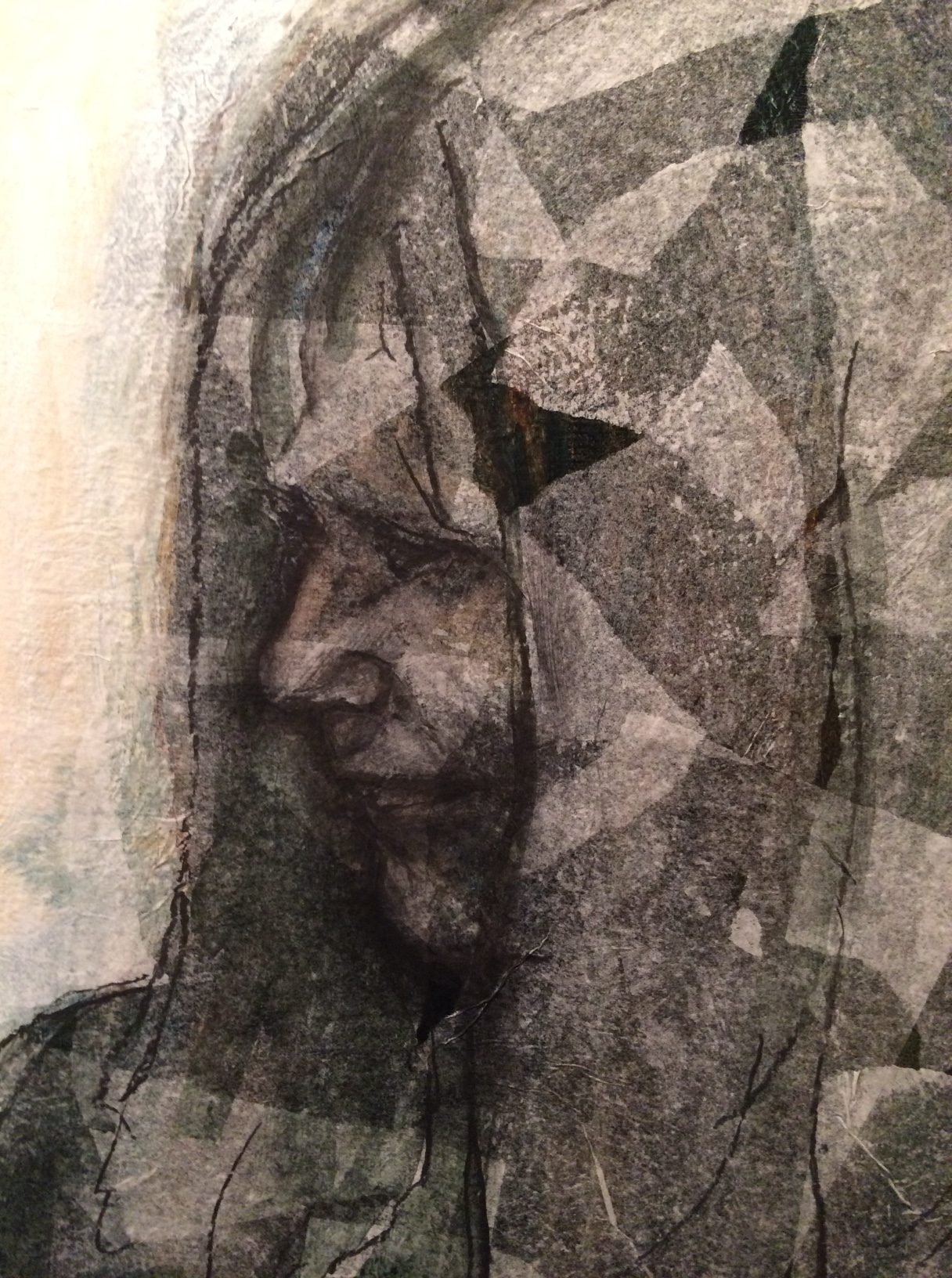
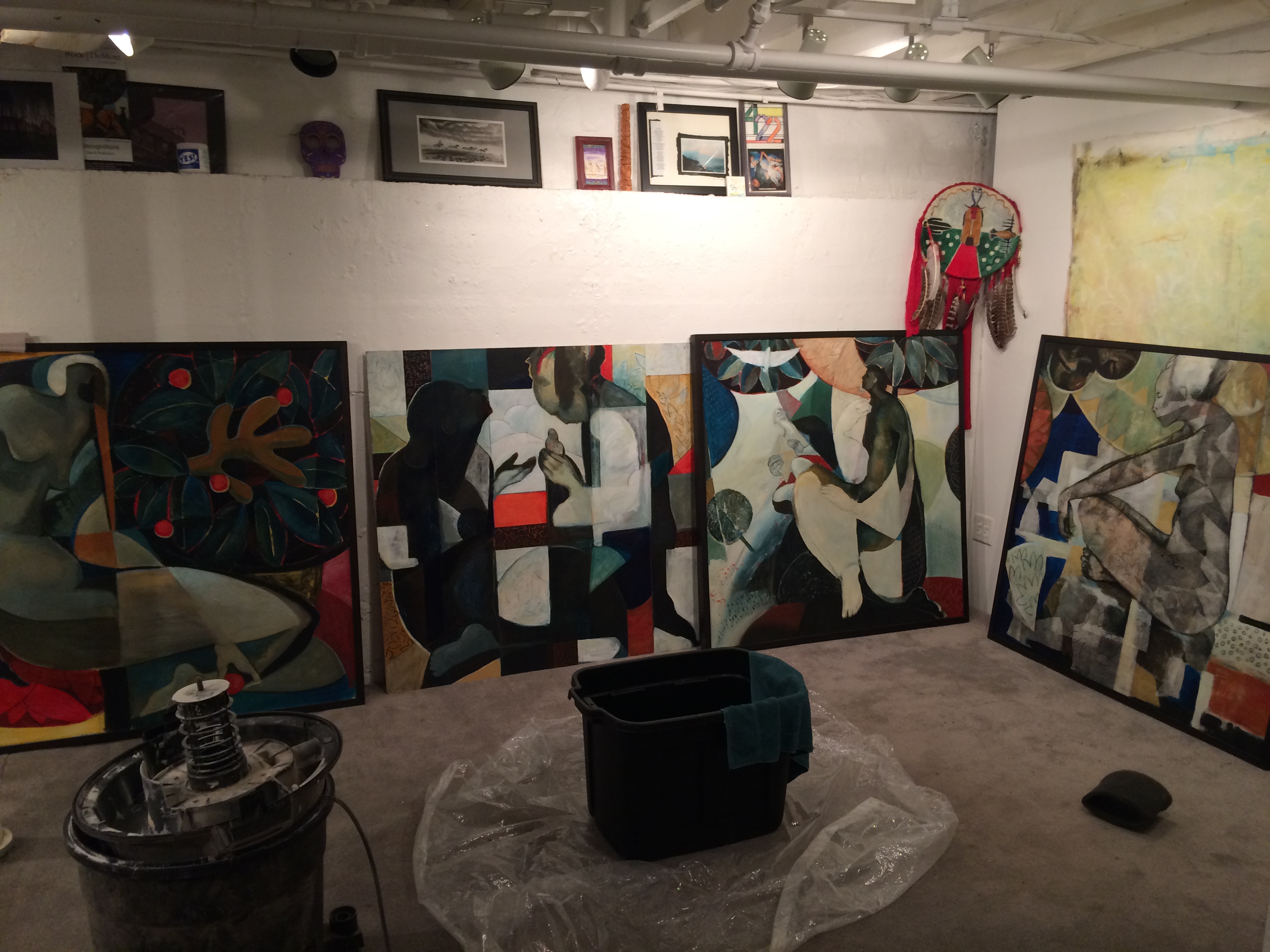
After our call I went into the studio to find a painting to use in the Melange, something I’ve not used before. “Use this one,” Kerri recommended. It’s one of many I painted of the same theme. “It’s timely,” she said.

Yes. Timely.

read Kerri’s blog post on the UNTITLED PAINTING

untitled ©️ 2019 david robinson

Witness The Generosity [on Merely A Thought Monday]

You know the ritual is over when the sacrifice is made. Sometimes the sacrifice is literal, an offering of thanks to the greater powers. A life given for life received. It’s the elemental story cycle with gratitude as the final act.

Sometimes the sacrifice is unconscious and, therefore…unconscious. Unseen. Not felt.

In the weeks before the holiday, the delivery trucks were ubiquitous, zipping this way and that. The deliverers-of-packages worked overtime to ensure all good things arrived on time. We tracked the good people hauling our packages to remote destinations, a luxury of the modern world. As I stroll down my street this week I see, post-holiday, the garbage collectors are working overtime, mechanical arms groaning and methodical, clearing the mountain of debris, boxes, empty bottles (I contributed my share), wrapping paper and remnants of our ritual. Our offering of thanks to the greater powers leaves a mighty litter trail.

The day after Christmas, at the mouth of the lot where we park to hike our trail, the discarded trees were already stacking up. Kerri speculated that the people who enjoyed the trees must certainly be going on travels. Why else would they discard their trees so fast? “Or,” she speculated, “maybe they’ve had them up since the first of November. Maybe they are ready to move on.”

The sacrifice is too easy. It’s piled on the curb. It’s hauled away.

Despite how this reads, it is more meditation than criticism. This holiday season was one of my favorite precisely because we could take nothing for granted. 2020 was brutal for us as it was for many. With our patterns blown to bits, with our security nowhere to be found, our community fragmenting, with no easy choices, we were – and are – conscious of every single step. We are grateful for every moment of heat in the house, for every kindness that has come our way, for every small kindness we’ve been able to offer. We imbue our meals with a deep thankfulness that we did not a scant one year ago.

Why is it that gratitude is so easy when everything else is hard – and why is gratitude merely lip-service when everything is easy? It is, I suspect, why our congress can’t move to help a struggling populace; they have it too easy to identify with the people they represent. We are too easily taken to the curb, to readily swept away.

It has been my role in this lifetime to walk the margins and look inward at the mechanics of my community. To see. It’s the role of the artist to see the patterns, the shapes and colors of their culture and reflect them back, to make conscious what is too easily ignored. To bring the heart, the eye and the mind to the ugly as well as the beautiful.

By the backdoor of our house are bags we’re filling with crackers and peanut butter, socks and sweatshirts. The bags are for the army of people appearing on our streets with signs that read “Homeless” or “Hungry.” It’s not that I am a fan of hard times, I am not, but I’m grateful for what these times are evoking in me – in us. It’s waking us up, helping us reach to others rather than push them away. It’s moving us to see and wildly appreciate our simple abundance.

In the early days of this new year, with the glitter all but swept up, the champagne bottles hauled away, I am moved to tears at the acts of generosity I’m experiencing and also seeing pop up all around me. The holiday is over, the sacrifices made, but the generosity-of-spirit continues. It’s rising in hard times. It’s there. It’s everywhere, if you care to see it.

read Kerri’s blog post about DISCARDS