Find The Way Home

holdtheworldinpeace-lowerfontcopy-jpeg“Our search for truth must be wide open, even when it takes us in directions we preferred not to go. This is the difference between propaganda and truth. Propaganda has a certain end in mind, and so it marshals and manipulates the ‘facts’ to support its conclusion. Truth weighs evidence, seeks proof, is appropriately skeptical of authoritarian claims, welcomes questions, and doesn’t fear dissent.” Philip Gulley, The Quaker Way of Living*

Kerri and I often read books aloud to each other. On cold winter days we sit beneath a blanket, Dog-Dog at our feet, BabyCat snoring by our side, sip coffee, and read. We like to discuss and compare perceptions, ask questions, and re-read passages for clarity or the simple poetry of the language. Sometimes we savor a book, moving through it slowly. Sometimes we devour a book and go back to reread especially potent sections.

Propaganda resists close inspection and must continually be defended. Truth welcomes doubt and skepticism; indeed it is best served by questions, suggestions, and corrections.”

I am guilty of burying my head in the sand. My move to Wisconsin came with an intentional unplugging from the news. I was tired of pundits shouting each other down. I was weary and wary of conversations with family and friends that seemed to be territory-guarding regurgitations of our news-channel-of-choice. I was using the language given to me by my news sources and rolled my eyes at the predictable language leveled by the “other” side. One day as I raged at family members to pay attention to how they were being manipulated by their news source, I thought that it was probably a good idea for me to do the same. At the time, unplugging, stepping out of the toxic stream, seemed the only option to clear my mind.

The search for truth begins within the seeker, for if we are not honest with and about ourselves, we will find it impossible to be honest with and about others.”

On a recent trip to Indiana, Bill and Linda suggested a book for us, The Quaker Way Of Living by Philip Gulley. They read it with their church group and found it compelling, especially given our corrosive political climate and collapse of civil discourse. We bought it when we returned home and a few days ago started reading it together. We couldn’t put it down. It asks some powerful questions. It doesn’t pretend to have answers [that, I’ve learned, would be the antithesis of the Quaker Way] but it does speak directly to the quandaries of personal and communal integrity in a climate of self-righteousness, blame, and distrust. It is hopeful and funny and places the onus of creating a better world squarely on the shoulders of each and every one of us. It reminded me that burying my head in the sand is not very useful while also affirming that their are options beyond planting a flag in the sand.

“To say a person has integrity means several things. Most commonly, we mean the person is honest, that his or her word can be trusted…. But there is another level of meaning that has to do with the integration of our values and lifestyle. In that sense, to say we have integrity is to say the separate parts of our lives combine to form a unified whole. What we believe is consistent with how we live. Our beliefs influence the work we choose, the way we use our time and spend our money, the relationships we form and the goals to which we aspire. This integration is critical for inward peace.”

While reading, I’ve been thinking a lot about a conversation I had a few years ago with Jim Marsh, one of the people I most admire in this world precisely because he walks his talk. He told me of an issue in his community that had deeply concerned him and that he’d been grousing about for long time. One day he’d had enough and to move forward he recognized that he had three options: First, to stop complaining (he said, “to just shut up.”). Second, to move away. Leave. Get away from the source of his irritation. That didn’t seem like a healthy option. The third was to strap on his boots and do something about it. To act instead of complain. But, (and here’s the reason why I adore him) not to act against, but to work to create what he wanted. His responsibility was not to fight or resist. It was to create.

“We preserve our integrity and wholeness when we are aware of what threatens it and then choose to act deliberately and prudently when tempted. When we fail to do this, we disintegrate, creating a chasm between who we are and who we wish to be.”

I practice tai chi and had the good fortune to have, for a few years, a master teacher, Saul, whose teaching transcended the specifics of tai chi. He was teaching me how better to live. One day, while I was in a fit of resistance, he quietly showed me the power of looking beyond my “opponent” and placing my focus, instead, in the field of possibility. I understood (intellectually) that the opponent was always of my own making and my dedication to having an opponent (inside or out) would always pull me off balance. In other words, as long as I invested in resistance I would always pull myself off balance.

“Integrity isn’t conditional…There is a seamless nature to integrity that transcends situations and relationships. Integrity does not present one face in public and another in private. It delights in transparency, having nothing to hide.”

Now, with my head freshly out of the sand, I understand Saul’s teaching beyond my thinking (I’ve had a lot of time to meditate on things with my head in the sand) and, taking my cue from Jim, I recognize that I have three options but only option-number-three holds the promise of integrity. The best news: no one creates alone…

*all quotes in this post are from the chapter on Integrity from The Quaker Way of Living by Philip Gulley
screen-shot-2017-01-13-at-4-42-11-pmprints/bags/mugs/cool stuff

kerrisherwood.com

THE WAY HOME on itunes – Kerri Sherwood-Track 13 on THIS PART OF THE JOURNEY
Save

Save

Do Anything Else

sharpersquareinstrofpeacewordsonlyjpeg

It occurs to me now that all along I’ve been asking irrelevant questions. Or, perhaps framing my questions too narrowly. For instance, years ago I went to graduate school to study systems because I wanted to follow a question that reached deep into my life and identity as an artist: can a mythology be rekindled once it has died? Art, after all, is one of the primary life-keepers of a culture’s story and the beating heart of the story is its mythology. And, according to all indicators, our mythology is mostly dead [as Joseph Campbell said, for evidence of our mythological demise, all you need to do is look at the news]. So, the younger version of myself wanted to understand the purpose of my life as an artist if, indeed, I was in service to a dead mythology. Heady questions, yes? Relevant questions?

In the early 1990’s I was invited to a photographer’s studio to see the “newest thing” in photography. The photographer had a new “program” called Photoshop. Before my eyes he “photoshopped” me into a picture, a place I’d never before visited. Today, all of this seems commonplace. Now, any 5 year old can manipulate an image but at the time a photograph stood for proof that something had actually happened. A photograph could not lie. It was evidence of truth. That day, standing in the photographer’s studio, I realized that the old reliable anchors for truth no longer existed. What was our anchor?

The truly significant events in our lives rarely come in with a roar.

We’ve been hearing a lot lately about fake news – as if this was a new phenomenon. It brings to my mind a terrific book written in 1985 by Neil Postman, Amusing Ourselves To Death. Here’s bit from the first page:

“Our politics, religion, news, athletics, education, and commerce have been transformed into congenial adjuncts of show business, largely without protest or even much popular notice. The result is that we are a people on the verge of amusing ourselves to death.”

I suppose fake news refers to something wholly concocted but I’d argue that when news agencies pander and promote themselves to conservative or liberal viewpoints, when ratings drive content, it’s all fake news. News with an agenda is…not news. It is, however, dangerous to a democracy and no longer free (as in free press, a cornerstone of our democracy). Historically, newspapers have always had a point of view but there was some attention paid to what was printed as news. Opinion was confined to an editorial page. When the line between true and concocted is blurred, when a populace cannot discern between entertainment and substance, it no longer has the capacity to make sound (read, “informed”) judgments. Worse, it is gullible, gossip-eaten and infinitely manipulate-able. It is, as Neil Postman wrote, entertaining itself to death.

I recently wrote about the absence of recognizable communal anchors (mythology) and the dangers of a community with nothing but the soft soil of belief and opinion as its driver. Is planting a personal-truth flag and defending its territory all that is left to us?

What else can we do? Now, there’s a relevant, open-ended question! Roger once told me that he would never be able to understand suicide. He said something like, “In that moment, rather than take your own life, why not do anything else? Why not make any other choice?” Another relevant question!

What else can we do? In the face of our own entertainment-driven suicide, why not do anything else? Turn off the blather, go outside, meet your neighbor, tell stories of your children or your ancestors. If common ground can’t be found it can certainly be created. Inhabit something bigger than opinion. It’s less entertaining but certainly more useful. Great art – no matter the form- lives in those bigger fields.


MAKE ME AN INSTRUMENT OF PEACE – GIFTS

to kickstart your peace, listen to this:

for PEACE on iTunes, go here (track 5 on the album AS IT IS)

Save

Save

Save

Save

Save

Save

Save

Use Reason

Step Into Unknown with Sig“When a speaker who does not know the difference between good and evil tries to convince a people as ignorant as himself, not by ascribing to a poor beast like a donkey the virtues of a horse, but by representing evil as in fact good, and so by a careful study of popular notions succeeds in persuading them to do evil instead of good, what kind of harvest do you think his rhetoric will reap from the seed he has sown?” Phaedrus by Plato


The woman walked to the end of the small pier and started to weep. It was a cold day and windy. Kerri and I maintained silence as we passed. The woman was making an appeal to her god. She asked the stormy lake and angry sky, “Why?”

Belief is a powerful thing.

Beth believes that the universe was created 6,000 years ago. Even though the gasoline she pumps into her car is evidence to the contrary, nothing will shake her firm belief. No amount of science, data, or experience can crack her conviction to what she believes.

At first glance Beth might seem an oddity but she is actually more representative of the norm. Consider this quote published this morning in our local paper. It’s an editorial from the Los Angeles Times entitled, “The ‘fake news’ dilemma.” “Some observers argue that the public’s receptivity to fake news is a sign that we live in a ‘post-factual’ society, with people who are mainly interested in information that comports with their preexisting notions.” In other words, no amount of science, data, or experience can crack our convictions to what we believe. And, like Beth, we do not want to hear [or consider] anything that challenges our beliefs. Rather than question, we plant our belief-flag and defend the territory.

Flag planting makes for good ratings. Conflict is an easier story to sell than compromise so it is not surprising that we have news sources that blatantly cater to our preexisting notions. Division makes us a good market and infinitely manipulatable.

Certainly defending the territory of unquestioned belief feels good. Righteousness, blame and gossip always feel good. There’s no responsibility required! Here’s another bit to consider from the editorial: “The problem is obvious: When surveys by the Pew Research Center find that 62 percent of U.S. adults get at least some of their news from social media, and 20 percent of social-media users say the things they read online have changed their views on an issue or candidate, the electorate is all the more vulnerable to a disinformation campaign. By Buzzfeed’s count, the 20 most popular fake-news stories in the last three months of the campaign were shared more often on Facebook than the top 20 stories from leading mainstream news sites.”

What prayer do we have when we are too…lazy…incapable…. to discern gossip from news, belief from fact [dear reader help me find a word other than fact].

For me, the top spot on the hierarchy of beliefs-that-blind is the “pre-existing notion” that we human beings operate from reason. Reason requires doubt, questioning, listening, and reaching for the perceptions of others. Reason, like heart, is a commons. It thrives on honest debate and will have nothing to do with individual or collective rigidity. We are not born with it, however we are born with the capacity to engage it. It is not something any single individual attains – it is not attainable – it is relational – it requires multiple perspectives and continued conversation. It requires a step into the  unknown.

Thoughts Babble Hearts Speak


Save

Save

Walk Through The Firewall

from my narrative series: Sleepers

from my narrative series: Sleepers

The text read something like this: There are some things in life you cannot circumnavigate. You can only move through them.

Carol told me that each year there is a growing change in her students. There is a gap between their generation and ours – and it is alarming. She teaches young actors at a college for the arts.

“What’s the difference? “ I asked, “what’s the change?”

“They are increasingly more and more medicated,” she said. “Through their whole lives, since they were small children, they’ve been reinforced through medication that their emotions, what they feel and how they express it, are bad. To teach them to be actors, to be authentic on the stage, to allow that what they feel is necessary and good, is nearly impossible when they are drugged to prevent them from feeling anything.”

She paused for a moment and added, “I can’t ask them to get off their drugs. I can only help them consider that their feelings, their emotions, are not the enemy but the route to truth.”

I offered that the drugs serve as a firewall that keeps them from themselves. It dulls them from the full range of life experiences. Years ago, when I was working in the schools, I experienced the first wave of kids drugged into compliance. It seemed that the solution for almost everything was medication. Their attention was either in deficit or their behavior obsessive and, either way, meds were the answer.

We talked of the other firewalls, the drugs that numb us or distract us from a full range of life experiences. Television in excess is the most obvious. And then there is the downside of social media; disconnection in the guise of connection.

I shared that, on my move to Wisconsin, I decided to unplug from the daily news. For me, it was serving as a firewall against the essentials of life. Too much adrenaline and fear numbs us. It makes us close, shut down. I felt that the noise was doing the opposite of what it pretended. I suspected that I was less informed by listening to the onslaught of opinion-masked-as-news. I realized that I was agitated all the time by the battling correspondents and felt infected by the us-and-them picture they were painting of the world. When minor events are elevated to disaster status the real disasters pass unnoticed. Everything evens out. All colors of life reduce to bland gray.

Now that I’m through the firewall the events of real importance are evident beyond the chatter. If I really need to know it, I hear about it. In unplugging, I am actually more informed. And then there is this: without the incessant chatter, my artistry is coming through with clarity and potency. In seeing more clearly I can see my self more clearly. When not dulled or distracted by the noise, the full range of sound and color has re-emerged. The lesson: this world does not need fixing or changing or improvement. Neither do I.  It is gorgeous and profound when we are able to live unafraid of what we feel.


See Again and Again

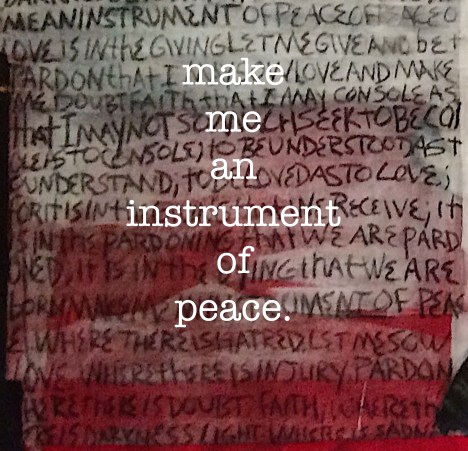
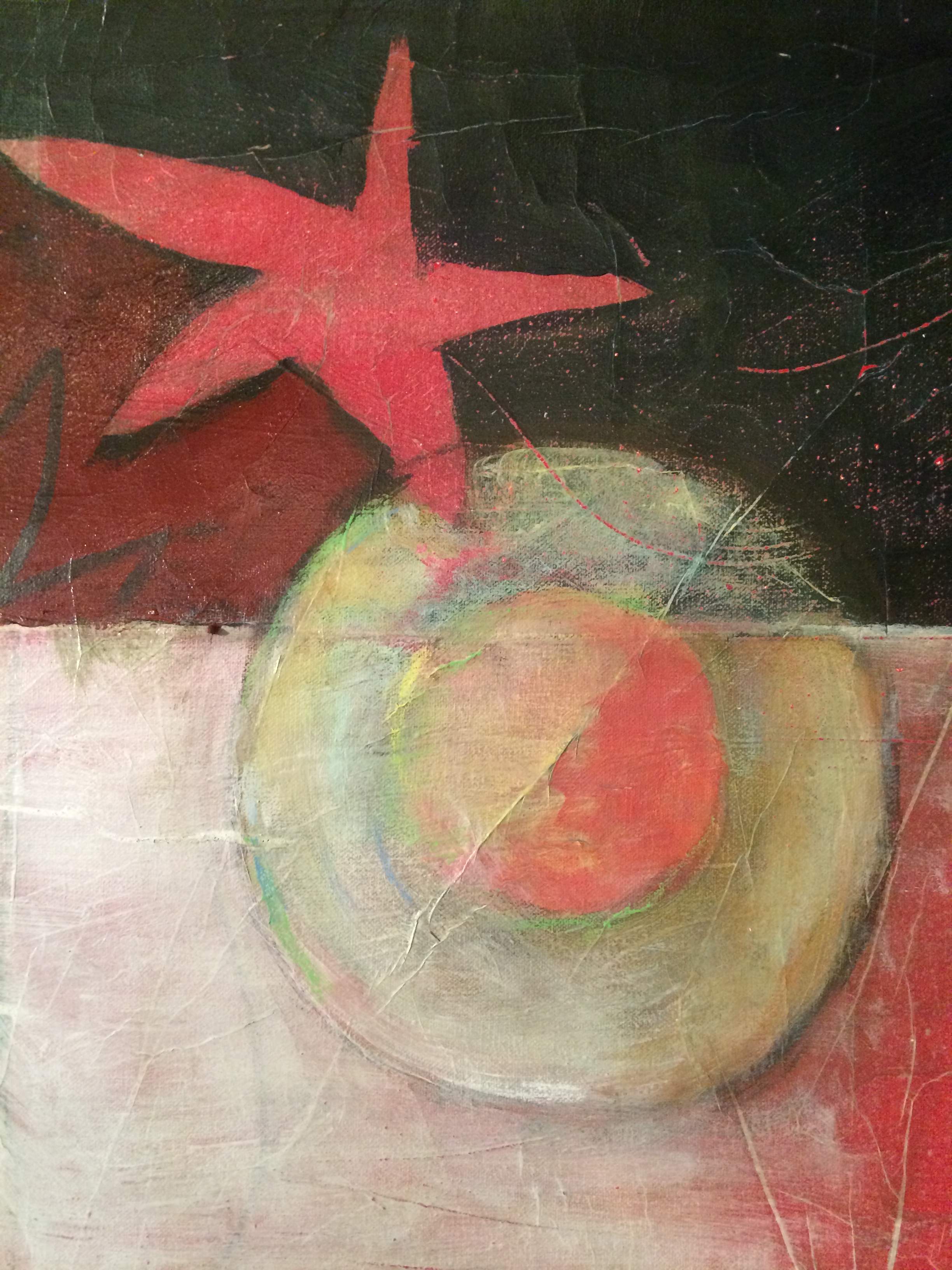
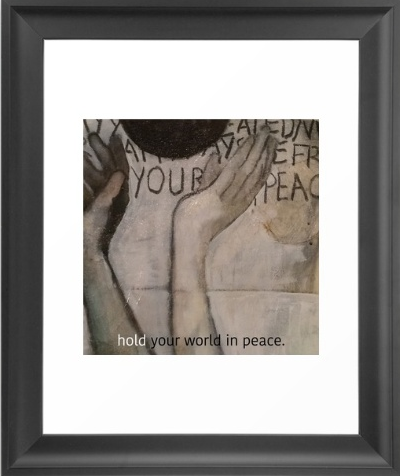
A detail from my painting, An Instrument of Peace

A detail from my painting, An Instrument of Peace

It has become my habit, when I finish a painting, to take photographs of sections of the piece. It helps me see it again. Often, I like these detail photographs as well or better than the painting. There are always discoveries in the details.

My paintings always surprise me. Years ago, I was showing my paintings to Jim Edmondson and he asked why all of my pieces had three spheres in the composition. I didn’t know what he was talking about. He laughed, our roles reversed, and he began showing me my paintings; each piece included three distinct spheres. I literally did not see them. They were apparent only after he made me look at sections of the paintings. I was both shocked and delighted. Perception is not universal.

Another detail from An Instrument of Peace

Another detail from An Instrument of Peace

The mastery of art (the mastery of life – same thing) is to transcend the notion that you “know” and that what you know is “right.” Krishnamurti wrote that, the moment you judge something, you cease to experience it. The fullness of life is in the experience and not the translation of the experience. All of us assume that we see the whole picture. We assume that we see is reality (truth) – and that reality (truth) for me must be reality for you. It is not. To have an “open mind” and “clear vision” is to release the notion that there is one truth, one way of seeing.

Once, I directed a production of God’s County by Steven Dietz and I knew it was a good production because half of the audience left angry and the other half left inspired. One play, many interpretations and the interpretations were, like all things we name as reality, rooted in each individual’s personal experience. What matters is not that our interpretations need to be the same, but a recognition that what you see is just as valid as what I see. As my friend Joe once said, “We come to know ourselves through other people’s eyes.”


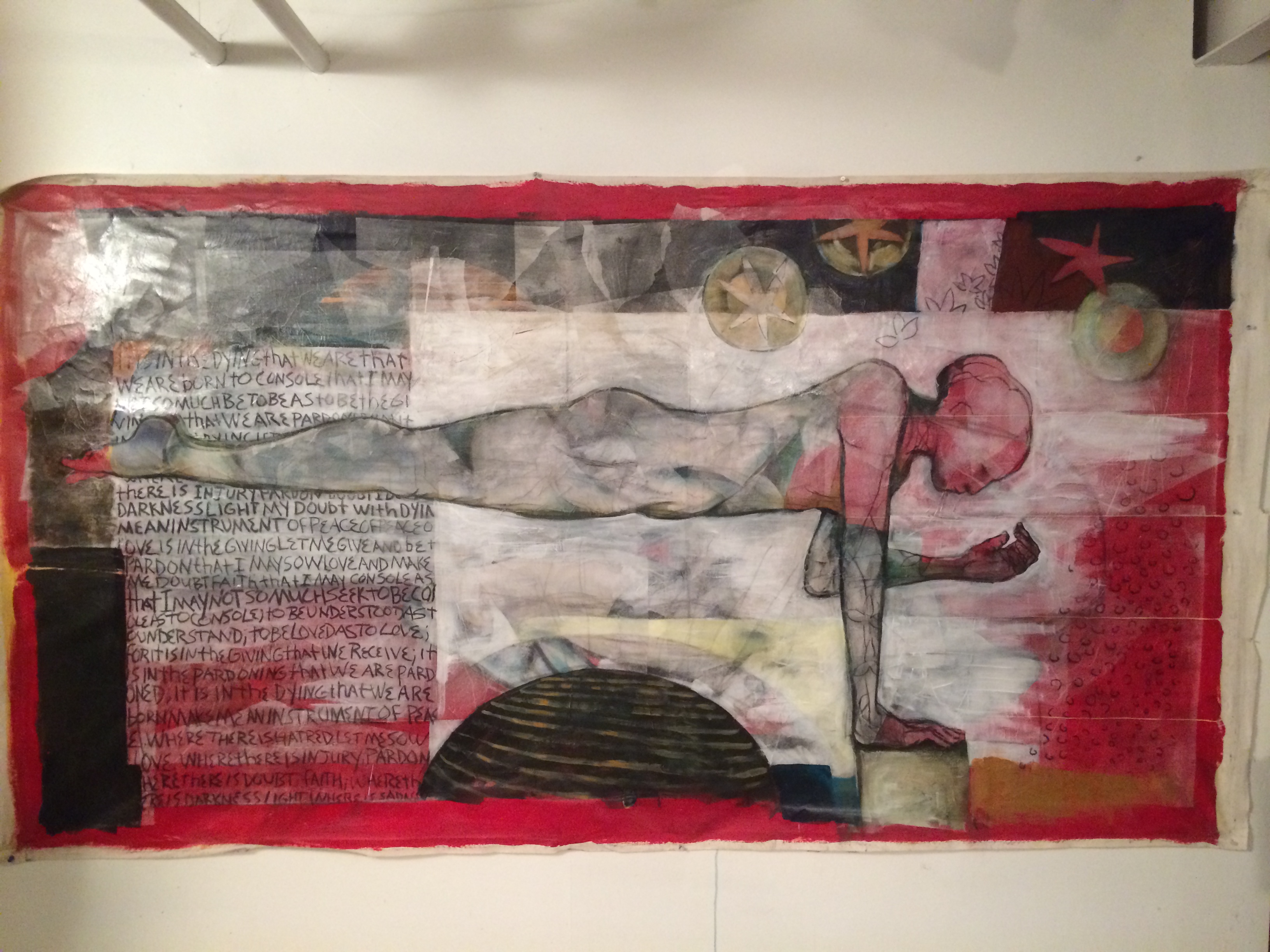
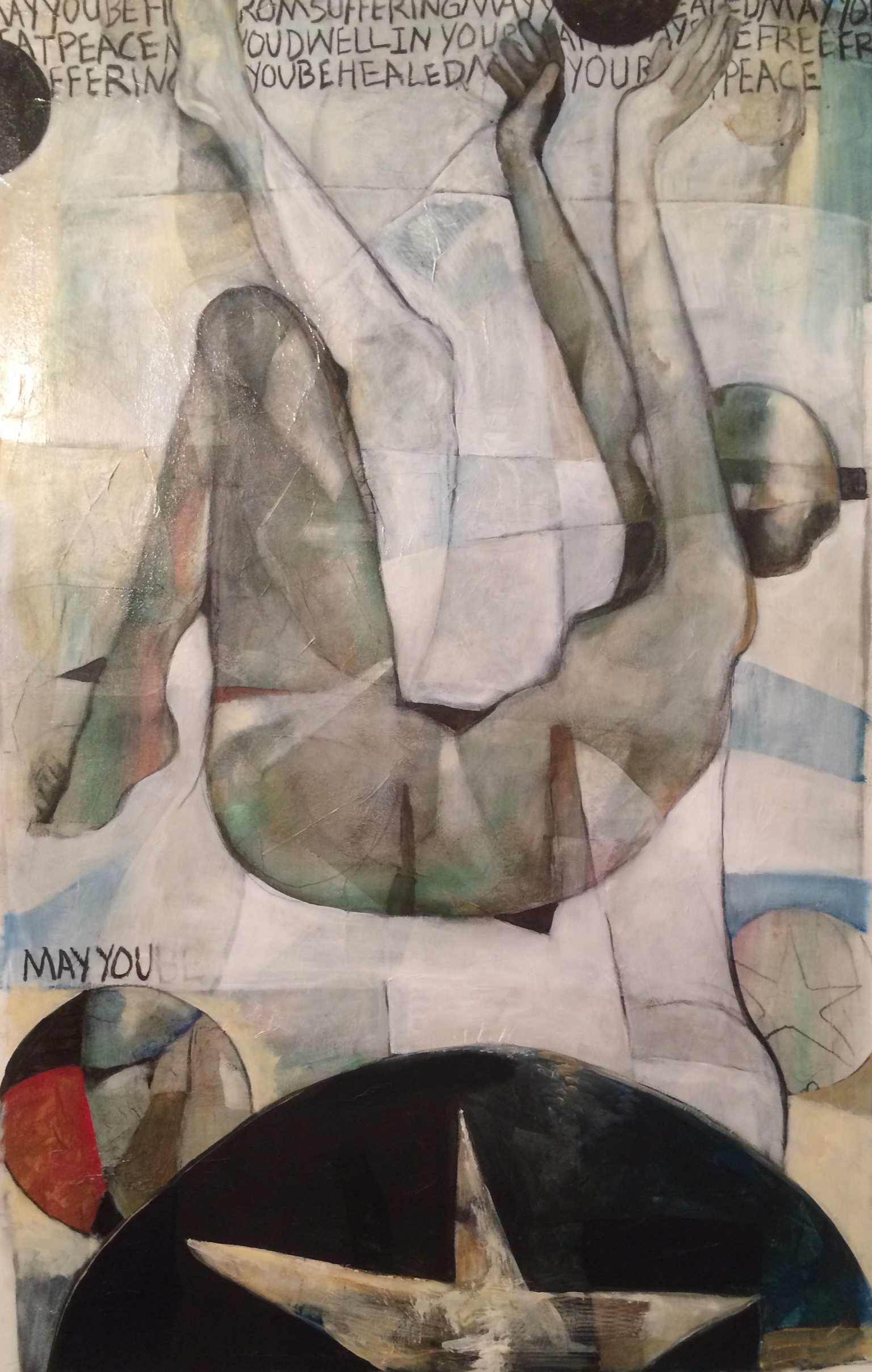
An Instrument of Peace

A rough shot on the studio wall of An Instrument of Peace

title_pageGo here to buy hard copies (and Kindle) of my latest book: The Seer: The Mind of the Entrepreneur, Artist, Visionary, Innovator, Seeker, Learner, Leader, Creator,…You.

For all digital forms, go here (Leanpub)

Speak Your Truth

old photo of an old watercolor. I did this painting sometime in the 1980's

old photo of an old watercolor. I did this painting sometime in the 1980’s

Words hook me and lately I’ve been paying attention to the difference in the phrases:

  • Speak the truth, and
  • Speak your truth

One word makes a world of difference! Literally, an entire world of differentiation is made in one little word. “The” truth or “your” truth?

Outside of every courthouse in America is Lady Truth wearing a blindfold and holding a tipping scale. The idea is that truth is objective and fact based. Truth, so the symbol implies, is blind to any personal consideration and justice is equal to all who enter the marble courthouse. It’s a concept that was firmly ensconced in the age of reason with roots running back to the Greeks: truth is something neutral, measurable, concrete, fixed, and external. In such a construct, inner truth is suspect because it is subjective and, at best, fluid.

I’ve sat on a few juries and was reinforced in the notion that the lawyer who told the better story always wins. Truth in the courthouse was as malleable as truth outside the courthouse. The point of the whole exercise, a prosecution and a defense telling opposing stories to a captive group of citizens, is an exercise in subjectivity. Whose version of truth do the captive citizens embrace? Truth, in the courthouse, is an agreement.

Also, there are a myriad of forces at play in the epicenter of the symbol and few are fixed, blind, or measurable. For instance, a public defender with a mountain of cases does not stand a good chance against a modestly prepared prosecution. The story is already tipped when the circumstance of the play is “someone stands accused….” If truth were fixed and measurable, millions of Americans would not be glued to their televisions each night watching Law & Order. Truth makes for good drama because it is a matter of perception. Truth is perception.

We live in the age of news as entertainment (I’d make an argument that we’ve digressed into the age of news as marketing ideology – but that is a post for another day). For instance, listen to the news as told by MSNBC and then flip your dial to FOX NEWS and you’ll see what I mean. Then, for grins, listen to the same series of stories as reported by the BBC. We regularly apply two words when debating our news-of-the-day that make me shake my head with despair: slant and spin. Truth is what we want to believe – or, more to the point, what others want us to believe.

And therein lies the hook. Because we hold dear the notion that truth is neutral, external, and objective, despite overwhelming evidence to the contrary, we are willing to abdicate personal truth. We blunt the inner guides for what we are told to think, feel, and believe. We become passive. If truth is fixed and external then the inner voice is all but meaningless. Self-doubt is the blossom. The symbol of blindfolded Truth is accurate but it is a different kind of blindness. Seeing is as much internal as external. Experiences are interpreted; there will always be conflicting points of view. That means there will be multiple truths. Always. Isn’t that the definition of subjective?

The only real measure that matters is inner truth. At the end of the day, in the dark of your private space, there is no one other than yourself to ask (and answer) the question, “Did I speak truth or did I spin things.” Words matter. Words create. Truth is the name we give things.

title_pageGo here to buy hard copies (and Kindle) of my latest book: The Seer: The Mind of the Entrepreneur, Artist, Visionary, Innovator, Seeker, Learner, Leader, Creator,…You.

Go here for all forms of digital copies

Go here for fine art prints of my paintings

Eve, by David Robinson

Eve, by David Robinson

Revisit And Revise

Pidgeon Pier (Alan and David on the Sound) by David Robinson

I used this painting as the cover image for The Ground Truth. I call this painting Pigeon Pier.

With the success of my book, The Seer, I’ve been revisiting some previous manuscripts and ebooks. I have a lot of them, mostly unpublished and unseen. One of my favorites, and one that I am considering revising and releasing, is called the Ground Truth. The ground truth is a military term and denotes the difference between the truth as seen by the generals in the war room (an abstraction) and those actually doing the fighting on the ground (actuality). I gave the book the subtitle: Six Dynamic Relationships That Will Change Your Life. Marketing claims are usually brazen. The book is really about how to orient to personal truth.

As I’ve been revisiting the book, I’ve also been revisiting several of the concepts in it. One concept that has been much on my mind lately is the Hero and the Anti Hero. Here’s an excerpt from The Ground Truth defining the concept:

In a small notebook with a red cover I found a drawing. The image is horizontal on the page. On the far left I wrote the word “Hero” and scribbled a circle around it. On the far right I wrote, “Anti-Hero” and also scribbled a circle around it. The circle with the Hero and the other with the Anti-Hero are connected with a line. The drawing looks like a cartoon barbell. I must have been explaining this to someone; I can tell by how emphatically I scribbled the circles.

The Hero and The Anti Hero was a revelation that Harald shared with me a few years ago. Harald’s first language is German so he used the term Anti-Hero instead of villain or devil or “big dog yapping in my brain.” I like Anti-Hero because it is actually more appropriate than any term I might have used.

He told me that he’d spent much of his life trying to rid himself of his inner Anti-Hero. It had consumed much of his life, this powerful inner voice of self-criticism and judgment. It plagued him and the more he resisted the Anti-Hero the stronger it became. One day, exhausted by his inner turmoil he had an epiphany. He realized that the way to rid himself of this Anti-Hero was to stop expecting to be a Hero. In fact, his expectation of being a savior, being perfect, being everything to everybody was the very thing that fueled the Anti-Hero. Letting go of the Hero dissipated the power of the Anti-Hero and what was left was…human. Beautiful, flawed, funny and messy, Harald was a human no longer at war with himself.

Internal warfare causes split intentions, split intentions create internal warfare. It’s a feedback loop. As Harald discovered, trying to be the Hero in the eyes of everyone else split him into two pieces: the unreal expectation (Hero) and an ever-vigilant judge (Anti-Hero). Harald was attempting to control what he could not control: the expectations and responses of other people. His happiness was contingent upon the responses of others so he was constantly measuring his worth against others responses: The actor (Hero) and the measurer (Anti-Hero). The internal warfare was inevitable.

In the next few days I’ll write more on The Hero and the Anti Hero, and what a few years and new eyes have brought.

title_pageGo here for my latest book

Yoga Series 7Go here for fine art prints of my paintings

Sound Glorious

687. Join me in inspiring truly powerful people. Each day I will add a new thought, story or idea to support your quest and mine.

Today as I walked north on 5th Avenue from the International District toward downtown, I went through a short tunnel or underpass. A young woman was standing in the center of the underpass, singing without inhibition. The acoustics were magnificent. Rather than singing a lyric, she was vocalizing, celebrating the range and depth of her voice. She saw me smile and stopped long enough to say, “Don’t I sound glorious!” She did.

One of the members of the coaching class I co-teach is a reverend. In class this week she offered us a biblical image for standing full and alive in personal truth: standing naked and unashamed before god. She asked, “What must it feel like to stand naked and unashamed before the world?” I thought of her question the moment I heard the young woman singing unashamed and fully exposed in the underpass.

Question: How do you know you are standing in your truth? Answer: you will find yourself singing your song at the top of your voice in a place that amplifies the sound and say with joy to a total stranger, “Don’t I sound glorious!”

Join The Symphony

685. Join me in inspiring truly powerful people. Each day I will add a new thought, story or idea to support your quest and mine.

The exercise in class was a word cluster, a free association exploration about stepping into personal truth. Afterward, Winifred shared an image that surfaced during her cluster. She told the group that it was as if every living being on earth was a musical note in a song. When she stepped into a global perspective, she heard all the notes combine into a chorus. As she moved further out into a more universal perspective, the planets had songs and everything combined into a symphony of notes, high and low and everything in between.

According to her revelation, no note was insignificant; the symphony, to have full power, needed all the notes – so to diminish or minimize her self was to diminish the voice of the symphony. She said, “The world needs our notes.” And then, after a pause, she added, “…within every individual is a universe and each emotion is like a single musical note. In order for an individual to fulfill their universal note, they must feel the full spectrum of music within themselves.” She said, “Even suffering is a note, a note necessary to complete the symphony.”

Her message: Living your truth means to play without inhibition in the symphony of the universe. We need your note to complete the sound.