Work Forward And Back [David’s blog on DR Thursday]

Writing the first draft of a play, I’ve just entered the “swimming upstream” step in the process. I’m working my way from back-to-front to make sure all the story dots connect. It’s detail work. It requires looking close-in. I used to hate this part of the process because I’d get lost. I’d forget what I was doing and prematurely rework sections. Painters ruin paintings when working too small too soon. Writers are subject to the same peril. Now, I adore this step. Life is funny.

A few years ago I realized that my change in process-love, my capacity to work in detail without getting lost, came when I stopped trying to race to the end. Now, I am in no hurry to finish. I want a full relationship with my story as it reveals itself to me. It is a child, holding my hand, guiding me to the wonders of the playground.

Working forward. Working backward. Stepping in and then stepping away, like the tides. Big brush washes first, attending to the overall composition. Structure. And then detail. It’s much like building a house. Foundations and then finishes.

I have learned from watching Kerri to use my camera to see detail. To step in and look. Seeing-as-a-relationship. To pay attention to the dew on the small pine, the reason it glistens. And then to step in further. The platitude: a single drop of dew contains an entire world. Beyond the platitude: step in and it’s possible to fall into another world. To experience the surprise available in the enormity of the minute. And bring back to the big, big world of hurry-here-hurry-there the astonishment that is found there.
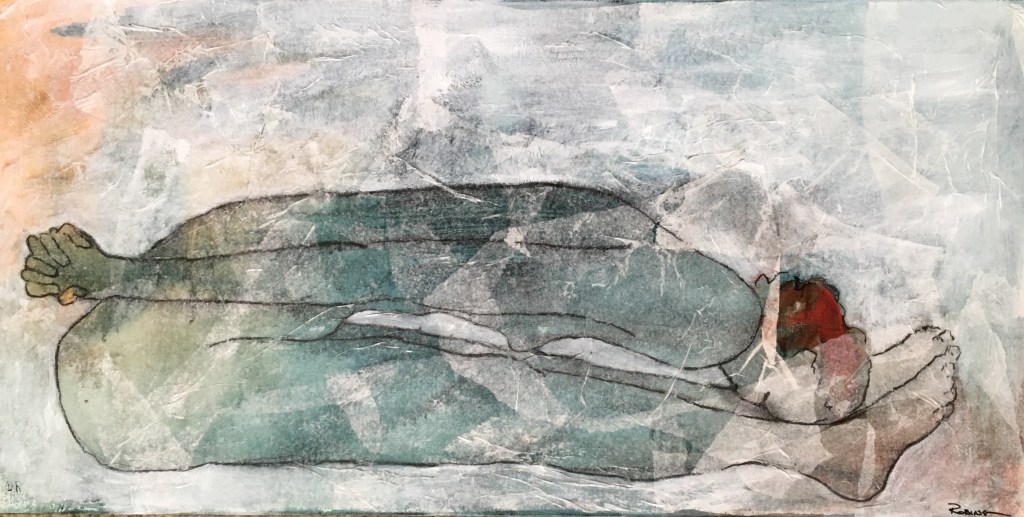
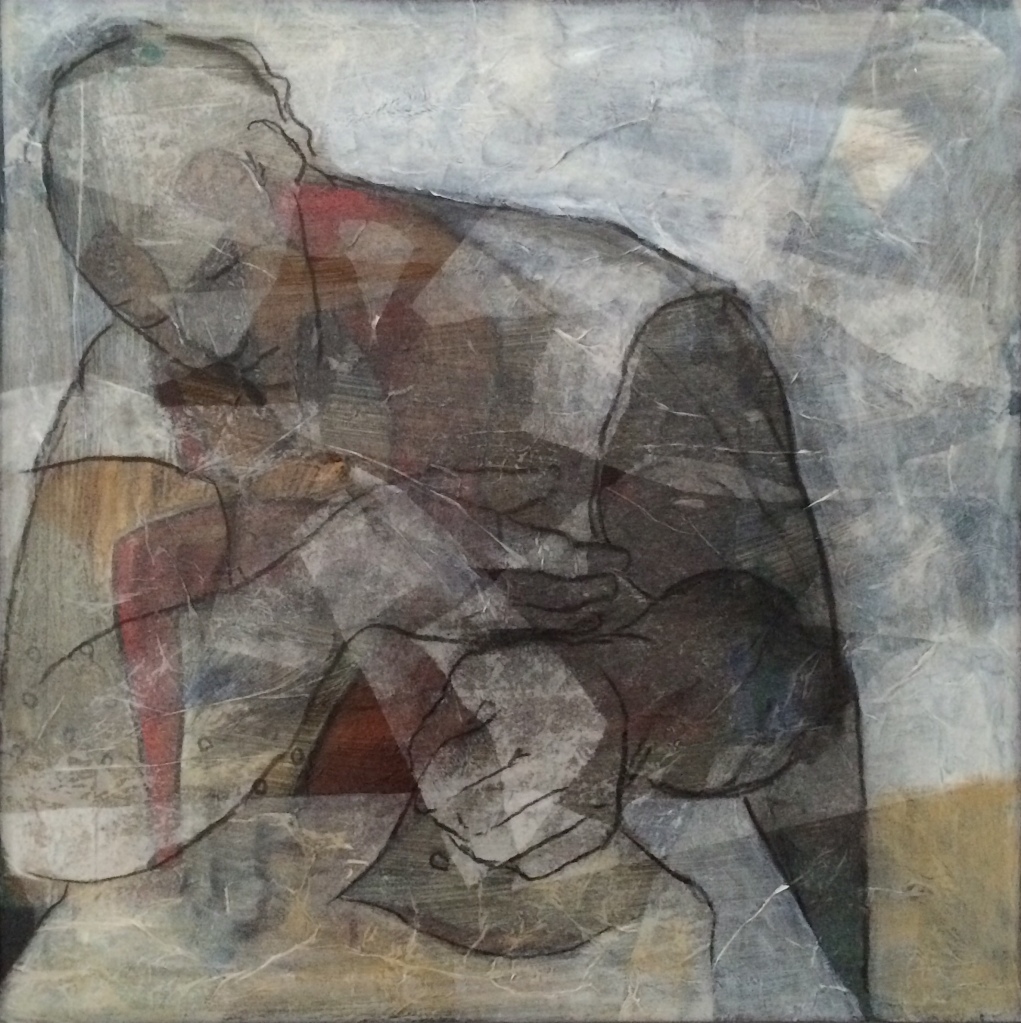
Forward Back, 18 x 36IN, mixed media on canvas

read Kerri’s blogpost about DEW

like. share. support. comment. thank you.

buymeacoffee is a dew drop in a sea of possibilities, a tiny window into the realities of another reality.

Follow The Map [on Two Artists Tuesday]

In the era when I was telling stories at conferences I liked to tell a particular tale of a woman on a quest. She didn’t know it but the many trials she faced on her journey gave her the exact knowledge she needed to confront her monster, complete her quest and return safely to her home. A field of shifting boulders. A dense impassable forest. A thicket of lost souls. She navigated all of them, learned from them, and returned home, changed by her experiences, wiser from her travails.

It’s most often the message in stories about quests. The journey changes us. We rarely understand the purpose or meaning of our passage until its conclusion. We only know we’ve changed after we arrive back from where we started. Then we can turn around and see.

Prior to the Brothers Grimm, there was no woodsman-savior in the tale of Little Red Riding Hood. A little girl sets out in life on a winding road to grandma’s house. It’s a metaphor. The little girl becomes an old woman. The wolf is metaphoric of time. The wolf “eats” all of us in the end. No woodsman can save us. No Hallmark ending is possible. What did Red experience on the way to grandma’s house?

It’s hard not to want to rush to the end. To know. There’s the fantastic story of the western businessman who wanted the Dalai Lama to tell him the secret of illumination so he could fast-track enlightenment, to achieve in a month-or-a-minute that which takes many lifetimes. Life lessons pay little attention to the demands of efficiency and effectiveness. Business, after all, is never just business.

Stages of development. Queen Anne’s lace. In its first year it is dedicated to sinking a taproot and developing a “rosette of basal leaves.” Creating a solid base. Only in the second year does it “send forth a flower stalk with blossoms.” It’s impossible to skip step one and arrive at blossoms. In truth, step one and step two are not really separate phases but are a single, gorgeous process of life’s renewal. I imagine that is what the Dalai Lama thought but did not say to the businessman.

In stories, the magic sword fails. Death knocks politely on the front door. The ogre stands in the path. The sphinx smiles and demands an answer. A young girl skips with Time along a winding road. A woman returns home, wiser from her experiences, changed by her journey.

Stories serve as universal maps, like taproots and basal leaves. They ground us. They can help us understand that the arrival we seek, the journey we take, is to ourselves. They can locate us on the winding road of life’s renewal.

read Kerri’s blogpost about QUEEN ANNE’S LACE

share. like. comment. support. it all helps us. thank you.

Emulate Martijn [on Merely A Thought Monday]

I have a theory about why so many of us are addicted to Martijn Doolaard’s weekly installments. He’s rebuilding two stone structures, turning them into cabins, on a remote mountainside in the Italian alps. He confirmed my theory this week at the very end of installment 76. Responding to a question from his viewers he said something akin to “I focus on the process and not on goals.”

It’s magnetic. Presence.

Effortless action is a concept in the Buddhist tradition and Martijn is a stellar example. The work is heavy, dirty and sometimes impossible, yet he rarely seems stressed or burdened. He is never in a hurry. He is present in his task. He’s not pushing for an outcome or holding himself to a schedule. He’s creating a process that is as elegant as it is efficient, fully engaging the task at hand. He’s a craftsman from another era. No resistance to “what is”. Consequently, he achieves more in a week than most people realize in a month.

And, amidst the dawn to dusk workdays, he films the process. Beautifully.

His work is his meditation.

Watching him build a stone arch doorway for his utility shed, I had a minor revelation. Most, if not all, spiritual traditions embrace a version of “make no assumptions.” The absence of assumption is presence. The lilies of the field. The release of control. Flow. The path of least resistance. Deal with what is there, not what you think is there.

We watch Martijn because we desire to know what he knows. We desire to work as he works. Why is he never exhausted? How is it possible for him to bake bread over a fire, make beautiful meals, after a full day of digging in rocky soil and hauling impossibly large slabs of stone?

Whether the task is answering 150 emails or lifting a one ton stone from the roof of a shed, his answer is abundantly clear. Make no assumptions. Release the notion of where you should be and be where you are. Beautifully.

read Kerri’s blogpost about NO ASSUMPTIONS

like. share. support. comment. thank you.

Collapse And Decide [on Merely A Thought Monday]

Brad calls it “paralysis by analysis”. Over thinking. Over researching. Reading every label. Considering every color combination relative to every other possible color combination. If you do some quick math, you’ll note that there are an infinite number of color combinations so arrival at a choice is a process of exhaustion. Waving the white flag. Conclusion via collapse. Decision by despair.

Neither Brad nor I suffer from this debilitating condition but both of our partners in life do.

It’s hard to watch. I learned at the very beginning to detach from the process. If I wait for the research and comparison phase to pass, if I say nothing until the desperation arrives, then I can tip the turmoil into a choice. And then I return to detachment because the paralysis has only reached its midpoint..

They say that summiting a high peak is not the dangerous part. Most climbers die on the return trip, the descent from the mountain. The same is true for analysis-paralysis-style-decision-makers. Once the decision is made, a river of decision-doubt and choice-remorse rushes in. The real paralysis happens after the decision is finally made. And revoked. And made again. And revoked. More spouses have collapsed on the way down from Mount Decision than on the initial ascent.

There’s a terrific scene in the movie About Time. The wife wants help from her husband in deciding which dress to wear to an important dinner meeting. She models dozens of dresses. He finds goodness in every option. She finds flaws in every dress. He becomes increasingly desperate, no matter what he says or enthusiastic support he offers, he finds himself swirling into the quagmire of no-good-answer.

I love that movie. Every time I watch that scene, I both howl with laughter and close my eyes. I know his desperation. I feel his fatigue. The minute she circles back and decides on the very first dress she modeled, with his wave of relief I whisper to the screen, “Now you’re really in trouble.”

read Kerri’s blogpost about DECISION FATIGUE

Peek Behind The Scenes [on Not So Flawed Wednesday]

I’ve tried to keep notes on my computer. I know that typing my notes into the digital world will make them searchable. Easier to find. It just doesn’t work for me. If I write with a pen on paper, I remember. Marking an important page with a Post-it note makes finding my notes faster than a search engine. It’s not that I am old school. I’m kinesthetic.

I’ve always kept notebooks. At this moment there are two within my reach. The Melange notes. On the desk in my office a is a notebook and three yellow pads. The yellow pads are a task-capture strategy. The notebook is idea capture. Quote capture. Thoughts-in-progress. The notebooks are like my sketchbooks, a place to work out my thought-compositions. They are the history, the breadcrumb trail of a project. For me, the riches are never in the outcome. The real treasures are alive in the notebook process paths.

I’d rather look at an artist’s sketchbook than the finished painting. I have a book of Picasso’s sketches that I treasure. Spend a few moments in Leonardo’s sketches or Michelangelo’s scribbles and you’ll forever toss away the notion of a mistake. Look behind the scenes at the process. A dancer will spend hours in repetition to incorporate a move into their body. The playwright will write hundreds of pages to arrive at a few, yet, those hundreds of pages are nothing less than reduction to essence. Refinement on the path of saying more with less.

Look behind to see the structure. Turn it over to see the pattern. I am, to this day, in awe of the Wayan Kulit master. I looked behind the shadow puppet screen to see the artist at work and, what appears in simple two-dimensions in front of the curtain, is a symphony of structure and improvisation. The man wore an oil lamp on his head to cast the light for the puppets, held a rock between his toes to tap, keeping time for the musicians seated behind him, all the while manipulating and voicing multiple characters, telling with simple clarity an epic tale. A lifetime of trial and error, complexity made simple, like a dancer, the story was deeply choreographed in his body. I wished I could have seen this elder storyteller-priest when he was young and developing his mastery. I’d love to see his notebooks.

I’ve recently had cause to return to my old notebooks. I marvel at the thought cycles coming back around. I’m taken again and again by the questions that still linger, and by those that seem antiquated. “How could I have not seen it!” I smile, knowing in just a few more drafts, a notebook or two down the road, the clarity would arrive.

A peek behind the scenes. It is for me, where the real beauty shines.

read Kerri’s blogpost about THE FLIP SIDE

Get Lost [on DR Thursday]

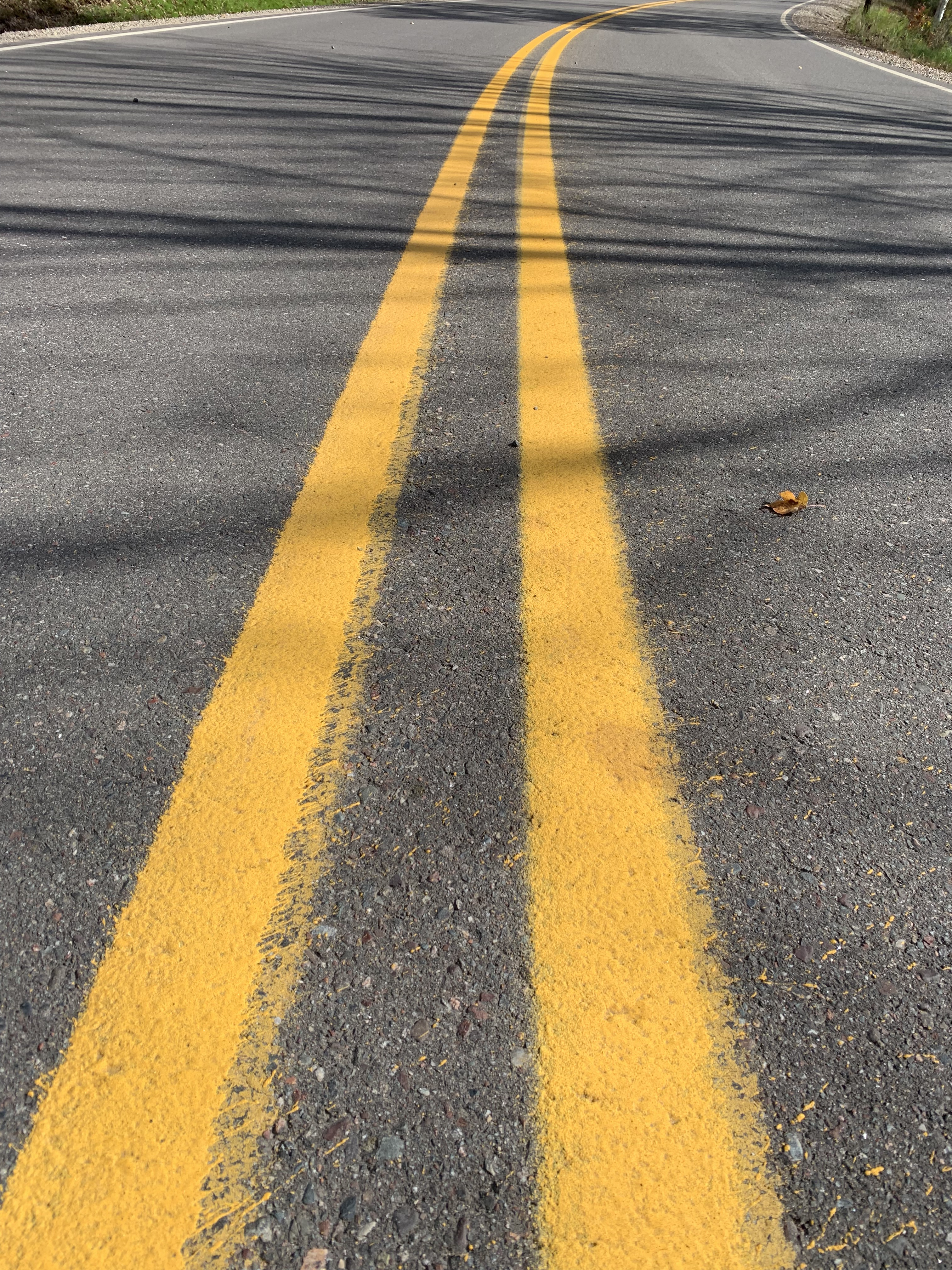
We delight in taking Sunday drives. Sometimes we have a destination but most of the time we have no idea where we are going. We head “out into the county,” the farm land, and with great intention, we get lost. “Left or right?” Kerri asks when we come to a crossroads. “Left.”

The goal is to “not know.” Drive down roads we’ve never experienced. There is a direct correlation between “not knowing” and “clear seeing.” When lost, we open our eyes. It’s something that every artist understands, “always-knowing-where-you’re-going” is a killer of the magic. It is the dividing line between art and craft.

I’m currently working with a team of analytical minds. “Lostness” is often interpreted as failure. It’s not welcome. But, to my great delight, even in the most analytic of creative processes, the engineers and entrepreneurs, shaking their fists at the sky when adrift, find their greatest magic arrives only after time spent wandering the wilderness.

After many twists and turns, rolling country roads and, “Which direction are we headed?”, we pop out of lostness and know exactly where we are. “Hey!” we laugh, “How did we get here?”

The art of getting lost. The art of exploration. The art of having an experience without a predetermined outcome. The art of having an outcome and letting it go, making space for something better. It is the art of cultivating surprise, allowing for the bigger idea to come through. “Left or right?”

It’s a practice. Learning-to-see and letting-go-of-needing “to know.” It’s the same thing. And, a great way to practice, is taking a nice Sunday drive.

read Kerri’s blog post about THE ROAD

pax © 2015 david robinson

Causal Your Effectual [on DR Thursday]

KDOT Underpainting copy

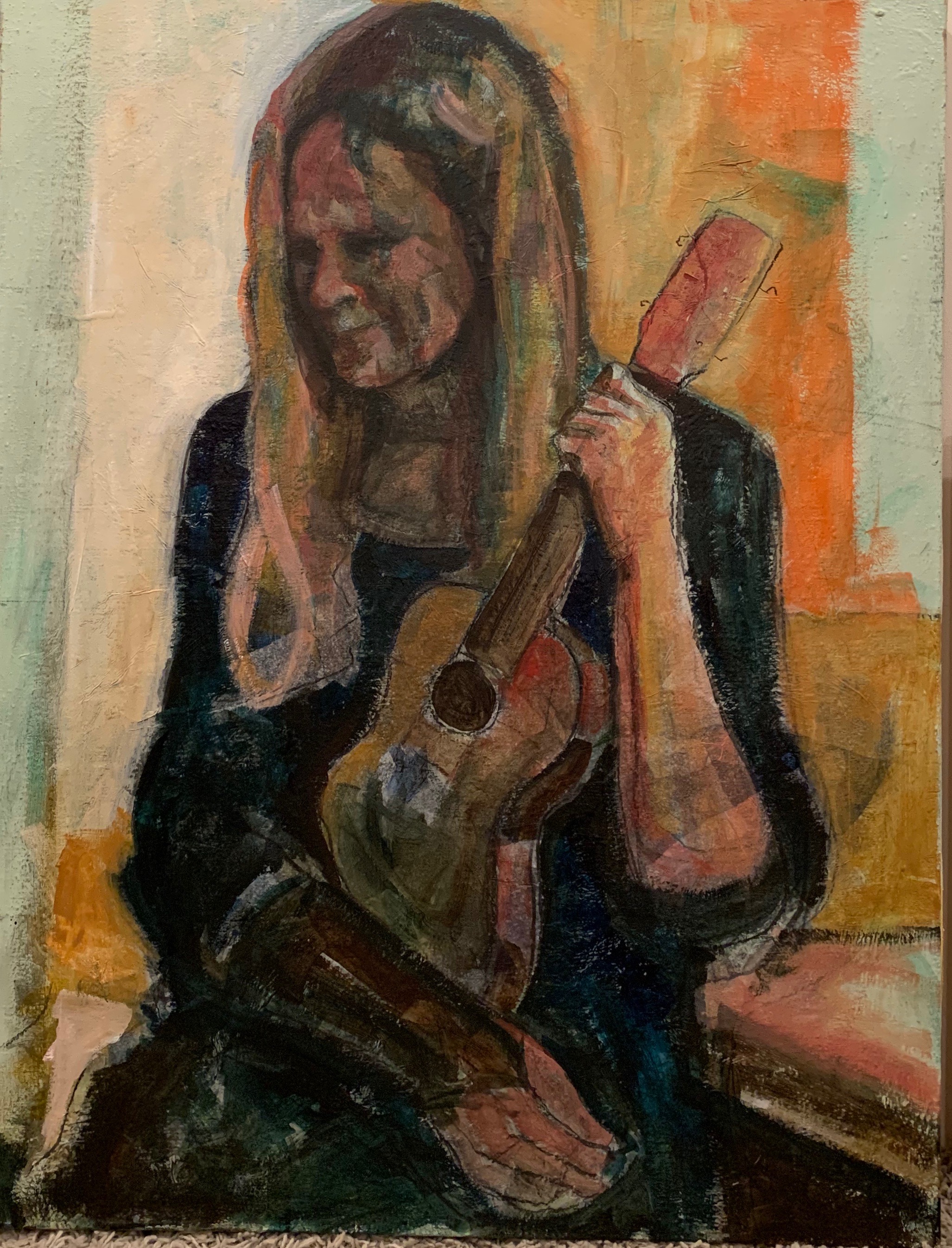
under-painting of One Chord Ahead

This is my version of under painting. It’s the base layer for what-comes-next. In school, they teach that under-painting is mostly monochromatic. It’s meant to give value definition and basic shape to an-already-determined composition. For me, it serves another purpose altogether.

It is true that I already know what this painting looks like when it is finished. I have the image in my head. It is also true that I have absolutely no idea what this painting will look like when finished. There’s a magic point in the process when the painting takes over and I follow the leader. I’ve learned that the real dance of artistry is to let both of these truths be…true. Know and not know. Lead and follow.

Under painting, for me, is psychological prep work, readiness to enter the paradox. It is my process of thinking-things-through so I can stop-thinking-things-through and enter the dance without focusing on the steps.

Causal and effectual. I first encountered these phrases when I waded into the world of entrepreneurs. They are process terms. Causal basically means that you begin with a goal in mind and map your steps to meet the predetermined goal. Effectual is the inverse. Looking at the maps (choices) and available resources, the goal is identified based on what’s available; the goal is fluid and changes as you progress.

Raphael was causal. Jackson Pollock was effectual. Maybe.

I laughed when I first heard the terms. They gave me some good language to use for my creative process. Causal/Effectual. Both/And. For me, one cannot live separate from the other. Start with an image in mind or start with a canvas, some paint, and see what happens. Either way, one process will inevitably cross paths with the other. Jackson Pollock, at some point in his random painting dance, became intentional and compositional with his spatter. Raphael, at some point in his tightly predetermined composition, allowed his brush to flow, to move intuitively, freely.

Under painting = I have to make color messes and utterly stifle a composition before I can stand at the edge, jump, and set myself free.


read Kerri’s blog post about UNDER PAINTING


their palettes website box copy


unfettered ©️ 2018 david robinson


Climb The Rough [on Not So Flawed Wednesday]

dontworry with frame copy

It’s an odd quirk but Kerri likes to watch mountain climbing documentaries before she goes to sleep each night. We’ve seen most of the world’s catalogue of climbing videos, Everest and K-2. I feel as if I’ve been to base camp. I sometimes shout at the screen, “NO! Don’t you know that the weather can turn on a dime!”

We’ve watched the story of the team that discovered George Mallory’s body. He fell and broke an ankle. Fatal on Everest. We’ve watched footage of Sir Edmund Hillary and Tenzing Norgay on their summit bid.  We’ve watched documentaries about the Sherpa people, the dangers of the ice fall, and the emergency doctors at base camp.

I tease Kerri and tell our friends that she needs to watch someone fall off a mountain before she can get to sleep. She protests, “I don’t need to see them fall!” The life and death struggle is soothing enough, a gentle entry into slumber.

The message from the climbers is as beautiful as it is simple: if you fear failure you shouldn’t climb mountains. You will fail far more than you succeed. You will attempt. You learn. You choose to be wise and live rather than push to the summit and then lose your life. It is the ultimate reminder that a healthy process is much preferable to the achievement of the goal. They remind us that most climbers die after the summit. They die coming down because they forget that the goal is not to summit, the goal is to summit safely and come back alive. The goal is life. The summit need not happen today. Live and take your chance tomorrow. The only failure on the mountain is to die when you didn’t need to.

It’s a great metaphor. Life is like that. No one does this life without more than a few rough patches, more than a few falls. When you recognize that everyone has a mountain to climb and, regardless of the mountain, it is all about learning, all about the experiences that may someday bring you either to the summit or to the recognition that the summit was actually never the goal. It’s about the appreciation of the experiences.

There will always be another goal. Another summit. However, the experiences you remember and appreciate will be the struggles. The easy stuff is easily forgotten. The hard stuff, facing the doubt, finding a new edge, makes for a great life story and helps us understand that we are far more capable than we at first realize. Everyone is far more capable than they imagine and would never go beyond the limits of their imagination without the rough patches on the way up the mountain.


read Kerri’s blog post about ROUGH TIMES


vailKdotDdot website box copy


Mix It [on DR Thursday]

palette copy

True confessions: I never clean my palette. I like the messy build up of color. I like the chunky texture. It serves as a gunky history of my work, a genealogy of paintings past. And then, over time, it becomes a tactile work of art in its own right. Unfettered by any of the mental gymnastics or over-ponderous considerations that plague my “real” work, it is the closest to child-mind that I will achieve. It is accidental. It is free.

This might be a stretch but it is, for me, nevertheless true. I love my palette because it is the place of alchemy in my artist process. It is the true liminal space. I begin with pure color. I smashed the pure color together with another color and transform it into a third color, the hue I intend. On a palette, color becomes intention. And then, once transformed, with a brush or knife I lift the color-intention from my palette and in an action that is often more responsive than creative, I place it onto a canvas. It transforms yet again relative to all the color it touches. An image emerges. More color is called for.

And, somewhere in this call and response of color, I become like the palette. The pass-through of alchemy, the door that color passes through en route to something beautiful. And, in the process, perhaps I, too, in my messy build up of life/color, grow closer to that child mind. Unfettered. Accidentally interesting. Free.

“You never know what is enough until you know what is more than enough” ~ William Blake


read Kerri’s blog post about my PALETTE


roadtrip reading website box copy


Horses FullSize copy

untitled, mixed media 48 x 48IN


Use 1000 Words [on DR Thursday]

Horses Morsel copy

Horses FullSize copy

this may or may not be complete. 48″ x 48″ as yet untitled

drc website header copy

read Kerri’s blog post about this PAINTING


oversizedjoy copley place website box copy