Listen To Randi

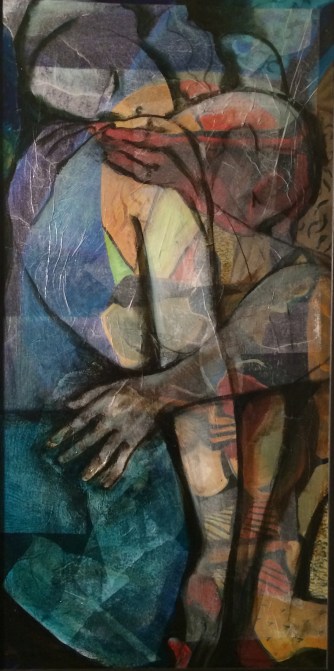
a detail from my latest painting in progress

a detail from my latest painting-in-progress

Randi is wise. Though, like all truly wise souls, she is completely unaware of her wisdom. She knows that she takes great delight in learning new things. She knows that her curiosity is boundless. She knows beyond the platitude of the sentiment that each new day is an opportunity to renew. Each new day is a step into unknown territory and, for Randi, there is no sense in taking timid steps. There is no sense in trying to make the day fit into a preconceived “normal.” There is no sense in watching the dance. Dance!

She squeals with pleasure when she hears a word used beautifully. “I am a lover of words!” she exclaims. She knows that words are powerful and when used beautifully will define beautiful experiences. She uses her words to define life beautifully. And, because she understands the power of words – and the brevity of life, she also understands the imperative of telling others what they mean to her. She has no problem expressing love.
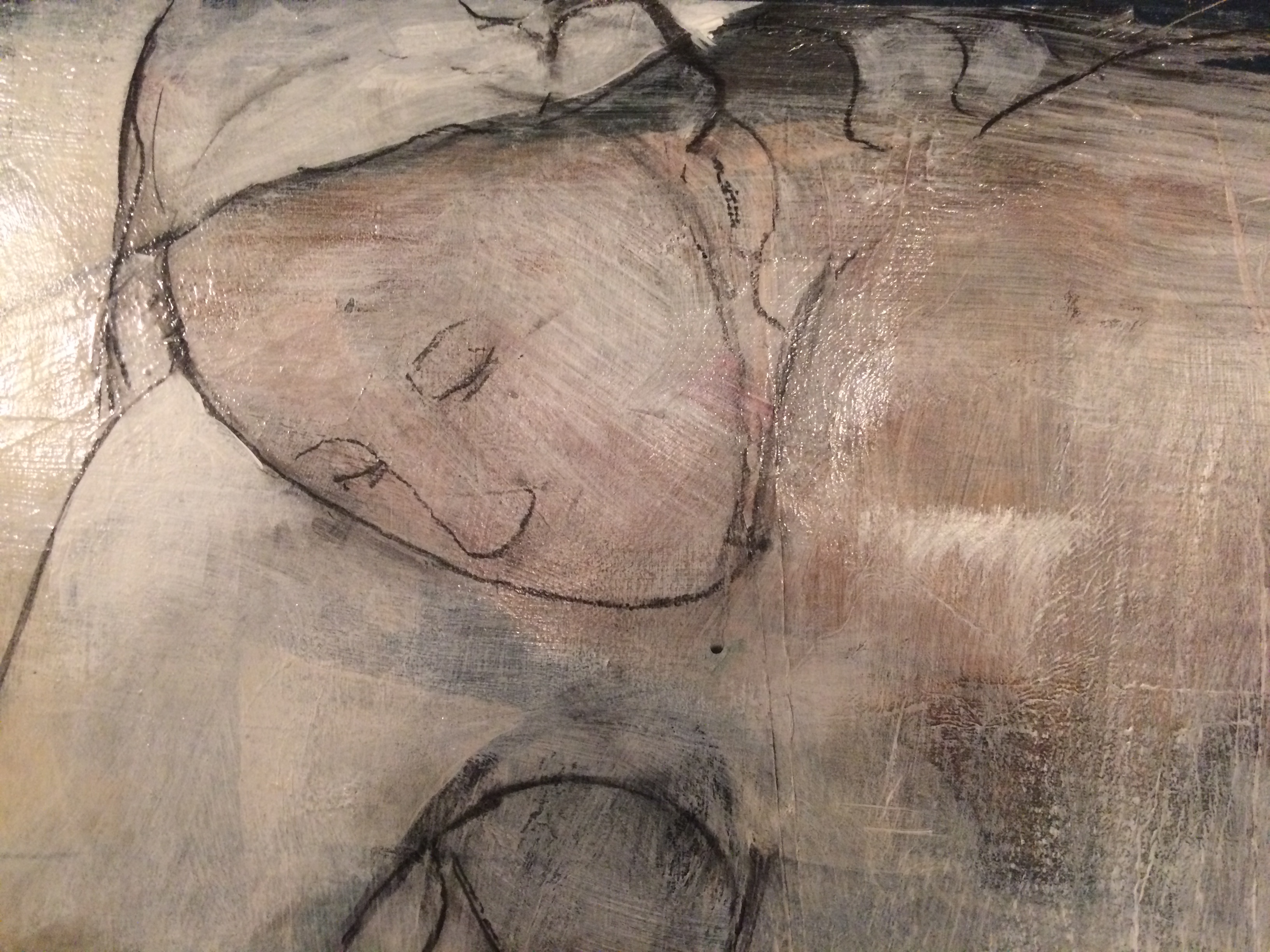
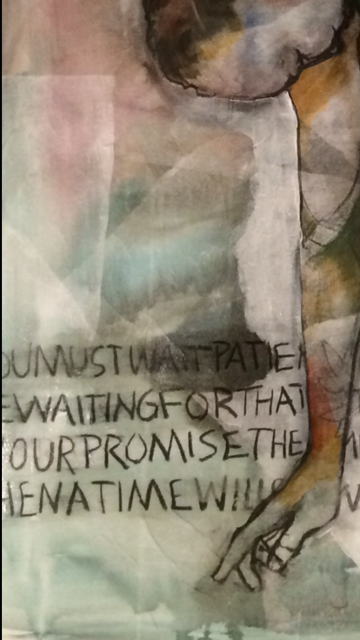
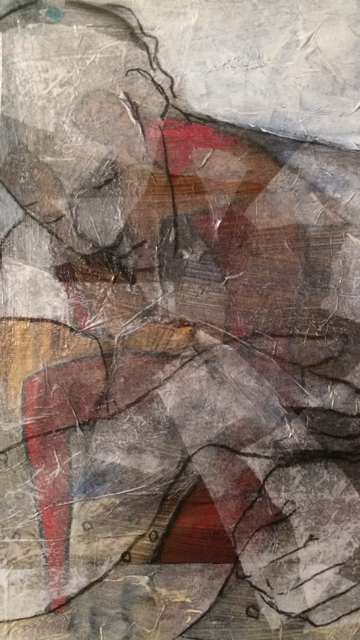
another detail

another detail

We took a rare opportunity to see her, swinging north to Buffalo after traveling to Boston to celebrate Thanksgiving with Craig and Dan. At dinner, we talked of new relationships and new work and new phases of life. We talked of the necessity of creating balance amidst the tug and push of this fast moving life-river. Randi smiled, “I once heard someone speak about attempting to balance life and they said something that changed how I see it. They said that when yearning to balance the many aspects of our lives it is most often not balance we seek! It’s integration! Rather than try to bring all these separate pieces of life into a balancing act, why not integrate them into a unified whole!” She clapped her hands as if having the revelation all over again. “It’s integration, wholeness that we desire!”

Wholeness is another word for presence, and presence is the goal of the performers’ art. Quinn, another wise person, used to tell me that all spiritual teachings speak of finding the middle way, the path between poles or opposites. “Zealots miss the point!” he’d say. Life is not found in the extremes, in the separations, in the fragmented, or the isolationist’s dream. Those are aims of the controller. The rule bound. The real balancing comes in the letting go. As Randi reminded us, it is found in the integration, the middle way, the whole.
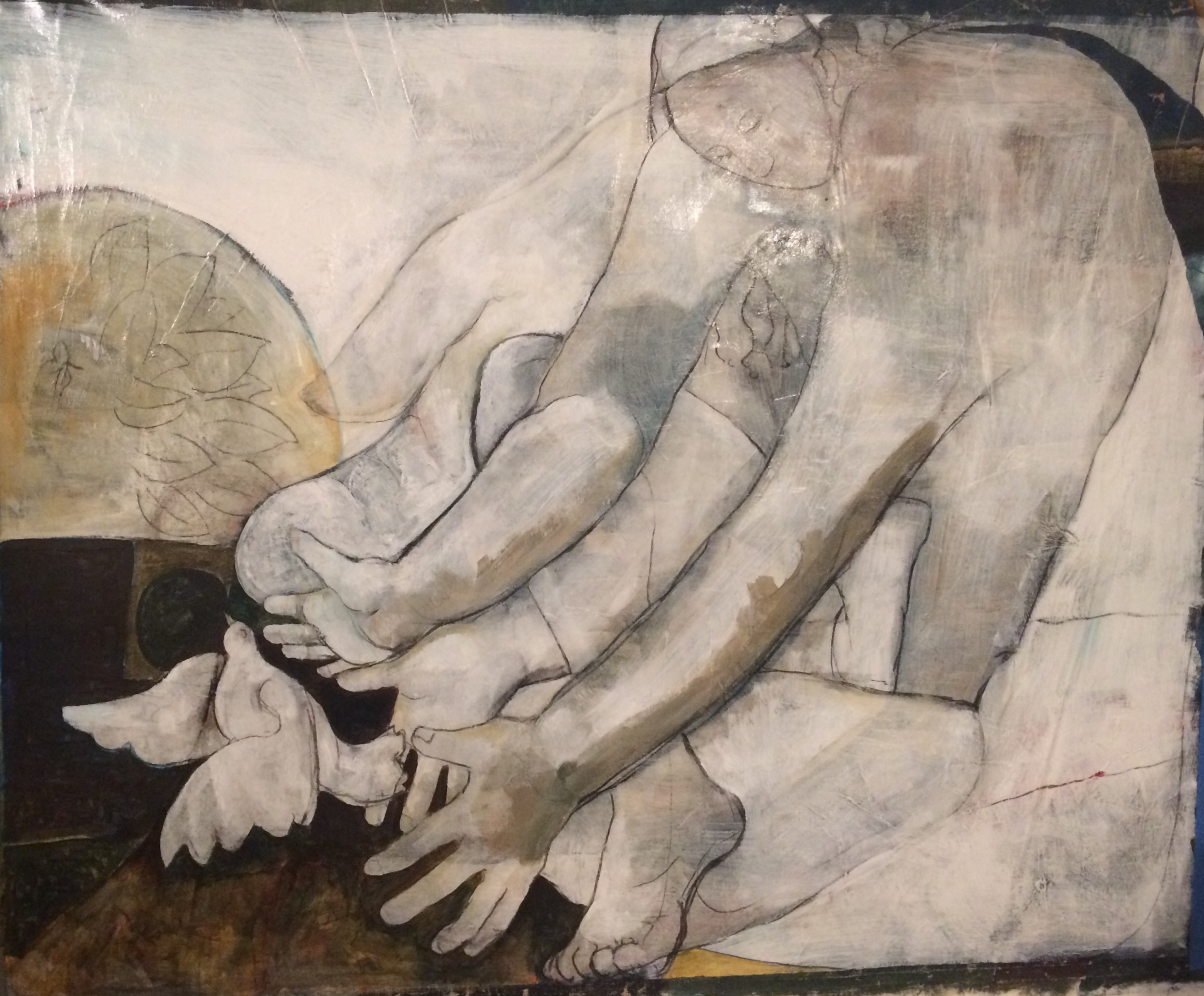
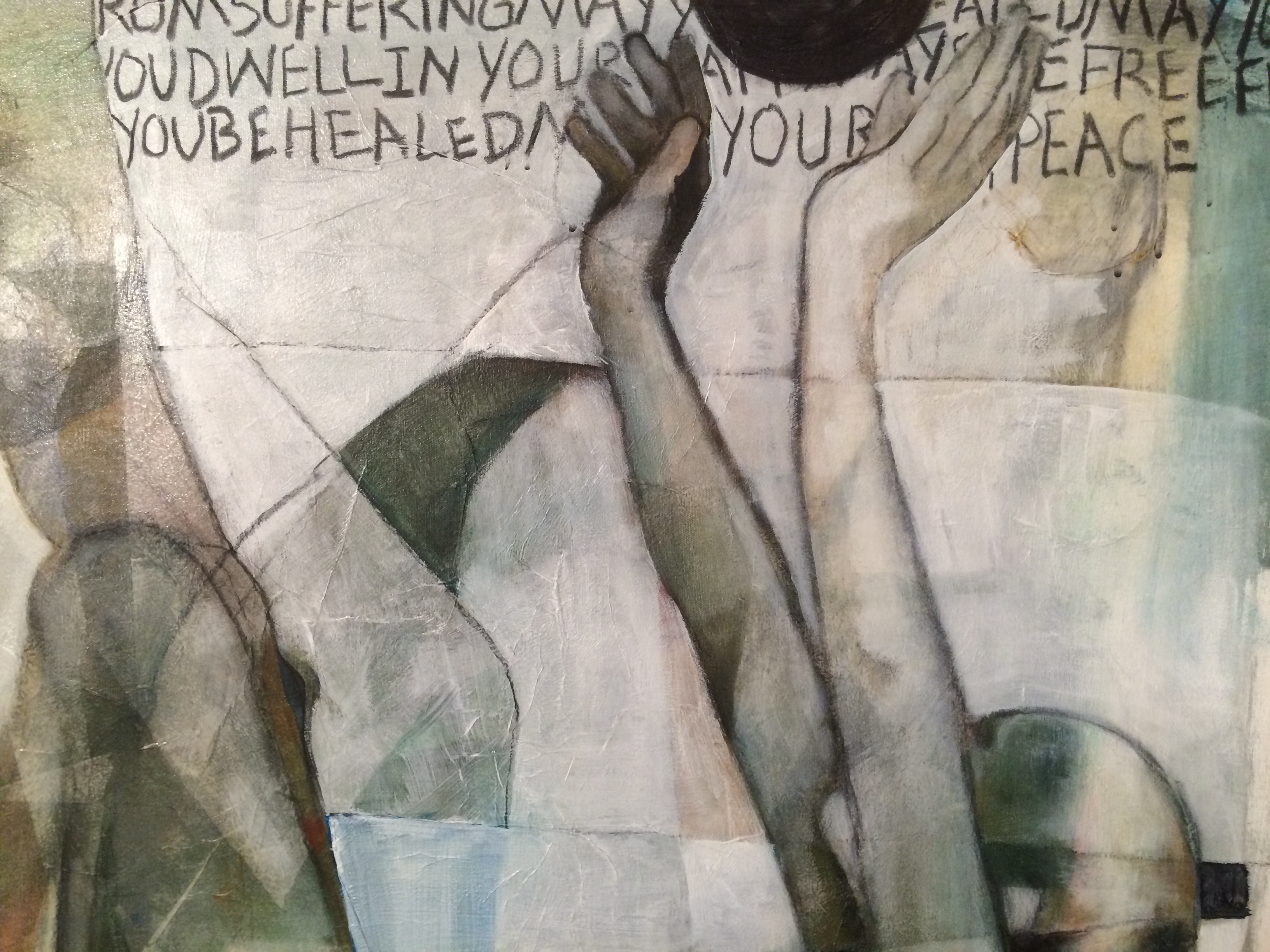
the whole

the whole painting as of 12.1.16


Save

See The Sacred

First Anniversary Sunrise

First Anniversary Sunrise

“…it seems to me absurd to consider problems about other beings while I am still in ignorance about my own nature. Phaedrus by Plato

I’m sitting alone in a sanctuary and thinking about sacred spaces. Here’s the thing I’ve come to understand about sacred spaces: slower motion is required to experience the power of the place. People in a hurry to get somewhere have little or no access to the sacred. Race through a meadow and you will miss it. Sacred spaces do not lose their power; people lose their access to the power of the space.

Once, many years ago in Bali, I made it a practice to walk the same pace as my Balinese hosts. To me, they moved at an impossibly slow pace. As an American, patterned to be forever in a hurry, I walk quickly “to get” somewhere else. There must always be a goal to achieve, a destination to reach. The Balinese were not patterned for transit but for presence. Over time, as I picked up their rhythm of movement I also picked up their pattern: it is possible to walk in presence. It is possible to be where you are with no imperative to get somewhere else – even while walking. It is possible to be in your life instead of racing through it.

A most amazing thing happens when “being here” becomes primary to “getting there”: everything becomes sacred space. Slow down enough and it is possible that you will recognize yourself as a sacred space.

After returning home from Bali I was able to sustain my capacity to move slowly for only a few months. It is easy to move slowly and be present when the culture you are in is patterned for presence. It is an entirely different challenge to move slowly and be present in a fast moving river. In the months after returning home I was either trampled or the cause of others (trying to navigate my slow movement) being trampled. We are not nearly as separate as we think we are. As I resumed my American pace I also dropped my capacity for presence and lost my lens on the sacred.

A recent surgery has necessitated slower moving. I have, in these past few weeks, found myself walking once again like a Balinese. I’ve stepped out of the fast moving river. Yesterday, standing on the back deck, I watched Dog-Dog delight in chasing squirrels. I listened to Kerri talk on the phone with a friend. I felt the sun on my face. There was no other place on earth I would rather be. There was nothing necessary to achieve.

Cut A New Path

ComfortNow

The latest in my Held In Grace series. This is Comfort Now

It seems to me that most of our days on this earth are spent moving through patterns, conscious or unconscious. These patterns are the rituals of our lives. Some of the rituals are easy to see. For instance, what is the sequence of actions you perform before going to bed each night? What about your ritual of rising each day? The care and feeding of Tripper Dog-Dog-Dog and Babycat are central to my rising and retreating rituals each day. We move through the same actions every morning and evening and I delight in the warmth of the ritual.

Some of the rituals are not so easy to see. Researchers tell us that most of the thoughts we think every day are the same thoughts we had yesterday. We mostly think in patterns (it makes sense once you recognize that language is constructed of category and pattern). We talk to ourselves, cutting paths through the forest of our minds and, once we’ve established a trail, we like to stay on it. Easy is often unconscious. There’s nothing wrong with staying on the easy trail if the path you’ve cut, your repetitious thought-ritual, is self-loving. The rub: ritual paths of self-loathing and self-limitation are also easy, well-worn paths and that makes them both unconscious and hard to leave.

Cutting a new path through the mind forest begins with recognizing that new paths are always available. They just aren’t easy to establish. They require new practices. They require surrender and the first bit of surrender necessary for cutting a new path is the ritual giving-over of needing-to-know-anything; new paths, by definition are unknown.

New paths are not comfortable precisely because they require attention, consciousness.

My teachers taught me that all stories worth telling are stories of transformation. The main character or characters will know something at the end of the story that they did not know at the beginning and the new knowledge will be hard-won. That’s what makes the story worth engaging. Hamlet is a much different character in Act 5 than he was in Act 1. His peace was difficult to come by. He had to learn to surrender. To cut a new path he had to make a practice of peace.

The same ideal applies to the stories we live off the stage.


Stand In It

photo

a detail from a recent painting

A surprise package came in the mail. It was a gift from David, my artist’s artist. He sends me things to feed my artist soul, to stir my pot or help me sort out my dilemmas. This gift is more timely than most; it is especially relevant for me now. It is a book of photographs and essays by Walter Kaufmann called Time Is An Artist. I’ve barely cracked the cover and already know it carries the wind that will fill my becalmed life-ship.

This is a quote from the first essay: We always live at the limits, but we are rarely aware of it.

I woke up this morning awash with gratitude for a man who stood in line behind me at an airport ticket counter over 30 years ago. I was returning from Europe. I had a hundred dollars and some lose change in my pocket. I was exhausted. I’d flown from London and landed in a blizzard. My connecting flight from D.C. to Denver was cancelled. Because I was traveling on a cheap open-ended student ticket, the cancelled flight meant I was stuck with no way home. I didn’t know what to do and was too tired to sort it out. I was desperate and lost in my desperation. That’s when the man tapped me on the shoulder. He was a guy in a rumpled business suit. That’s all I remember about him. He was also trying to get home. He’d just heard someone mention an airline offering a cheap flight to Denver. It was $89.00 ($100 with tax). I ran for the ticket counter and snagged one of the few remaining tickets.

That’s it. That’s what I remember about this man who tapped me on the shoulder. To him it was probably a little thing. To me it was enormous. I needed hope beyond desperation. I was investing in a story of limitless problems and was met with a moment of generosity.

It seems that I am in a life course, a graduate school for detachment. Last night P-Tom shared a quote that was important to him when he was doing his chaplaincy in a hospital: Don’t’ just do something, stand there (a reversal of the known quote). Stand there. Amidst the grief and the loss and the mess, sometimes it is essential to do nothing but offer presence. The man at the airport gave me his presence. Beyond his situation he was listening to my struggle.

Detach from your story and the gift will be gratitude. What rolls through our minds is nothing more or less than a story. Eckhart Tolle tells us the story is a force that pulls us out of the Now. Carlos Castaneda writes that Don Juan taught him 3 steps on the warrior’s path: Detach. Make a choice. Own the choice. One of the primary reasons people meditate is to quiet the mind. In the quiet it is possible to see the story as just that, a story. Detachment, in this sense, is not disengagement from life or cold aloofness from reality. It is the doorway to life. Stand in it and not the story of it.

Gratitude lives in the Now. Where else?

photo-2

another detail from another painting. kerri says this one looks like gratitude

The man at the airport was on my mind because I have learned in this life-course that gratitude is best served in thimbles: the taste of the pear, the sun on your face. The man tapping your shoulder, “Hey, I just heard….” I thanked him before running but the real gratitude came later. Gratitude came again this morning because I was telling stories of the good angels who’ve populated my path.

Real gratitude for this life lived perpetually on the edge is often lost when the expectation-bar is set too high. To be grateful for your life – your whole life – is… an abstraction. It requires a story that pulls you away from this bite. It is a bucket too big. Savoring is a slow affair, available in the smallest taste, right now.


Taste It Fully

ice circles on the lake

ice circles on the lake

We heard the angry barking of crows before we saw them. They were haranguing an owl. It flew into a tree only a few yards in front of us. For several moments, through the ruckus of the crows, we stared at the owl and it stared at us. Time stopped. Nothing else existed. The owl’s eyes, our breathing, the crow’s chorus.

For our wedding gift, H and Teru sent several collections of poetry, “Manuals on marriage,” they wrote in the note that came with the poems. Kerri and I are savoring the poems, reading one or two aloud to each other every day. They are a source of warmth and inspiration during these cold dark winter months. A poem cannot be rushed or read merely. It must be slowly tasted. It is meant to be entered like a meadow; to be experienced. Try to make sense of a poem and you will miss it. Just like life.

She said, “inner quiet is low maintenance,” and I laughed. Yes it is. The trick is in getting quiet. It is not something that can be found or achieved. It is not a place or a state-of-being. It is what happens when you stop looking for it. Like the hermit says to Parcival when the Grail Castle suddenly reappears, “Boy, it’s been there all along.”

For years Sam the poet was afraid of his poems. Like all great art, his poems, his art, revealed the artist, and so he kept them locked up, un-tasted. He came alive and supremely dissatisfied when he finally unleashed his poetry. He let himself want more but also refused to let himself experience more; one foot on the gas, one foot on the brakes. To taste fully one must be willing to be tasted.

A snippet of a poem (a koan imbedded in a poem), RELAX by Ellen Bass:

The Buddha tells a story of a woman chased by a tiger.
When she comes to a cliff, she sees a sturdy vine
and climbs halfway down. But, there’s also a tiger below.
And two mice – one white, one black – scurry out
and begin to gnaw at the vine. At this point
she notices a wild strawberry growing from a crevice.
She looks up, down, at the mice.
Then she eats the strawberry.

Taste your moment. Taste it fully.

I wrote in my black and red notebook a simple recognition. The field of possibilities cuts both ways: in your despair you must remember that anything is possible. In your joy you must remember that anything is possible. Tiger above (the past), tiger below (imagined future). Do not reject your moment or attempt to hold on to it – both are methods of missing the moment. Taste it regardless of the circumstance. Taste it fully.


Create A Purpose

photo-2In the sixteenth hour of our drive to the mountains, to keep us awake, Kerri and I began a rousing game of This-or-That. “Frosted Flakes or Lucky Charms?” Frosted Flakes all the way; those little marshmallow things get wonky in the milk. It’s amazing what you learn about yourself and others when the world of infinite possibilities is reduced to two choices. The game soon escalated to the impossible with pairings like “Coffee or Chocolate?” Real life penetrates the game when the only possible answers are, “It depends!” or “Both!”

Since our drive to the mountains I’ve been paying attention to how often people unwittingly play the This-or-That game, pretending that there are only two choices and, further, pretending that the choices are distinct and knowable. Democrat or Republican? Communities collapse when they forget that the important stuff is unanswerable. The important stuff is a moving target and requires conversation, debate, and comes along with multiple points of view. Two sizes do not fit all bodies.

I’ve also been playing my own inner game of This-or-That, purposefully choosing impossible pairings. Order or Chaos? It seems like a no-brainer until you dive in a bit deeper.

My favorite version so far is the Purpose-of-Life category. I picked a most lofty purpose: Illumination – and matched it with the utter absence of purpose. And, of course, I came to, “It depends!” or “Both!” I sprang my line of reasoning on Kerri (she thought we were going to talk about what to make for breakfast. She’s grown quite used to my surprise topics so she rolled her eyes, sipped coffee, and listened, knowing that no breakfast choice would be possible until after I unpacked my game).

No matter which spiritual tradition I read, the final point seems to be presence (living fully – aware of your moments). And in practice, presence becomes possible when thought is either transcended (meditation) or focused (prayer). Meditation and prayer are both purpose-full. Thought needs transcending and/or focus because it is mostly a babbling brook of nonsense or, better, a brook of babbling nonsense. It’s a lot of made up stuff that often takes the form of a game called This-or-That (I win/I lose, I’m right/I’m wrong, Us/Them). The game, as is true of all forms of interpretation, gets in the way of direct experience. It interrupts presence.

Detach from the babble. Meditate. Or recognize that it’s all made up and focus what’s made up. Pray. In either case presence comes through the recognition that it is all made up. The hitch: every notion of purpose, then, is also made up. There isn’t one. But, having a purpose is required to come to the recognition that there is no purpose. It’s a loop. It’s all creativity. It’s all imagination.

Spectrums and polarities are often cycles in disguise. They are both/and. They are yin and yang (not Yin or Yang). Illumination or Purposelessness? It depends. Both. Order needs chaos just as much as chaos needs order. The question is, what do we want to create? Why, a purpose, of course! So, let’s see what’s needed and decide to address it.

“My imagined purpose is breakfast,” Kerri sighed at the end of my rambling dissertation. “Pancakes or an egg scramble?”


Walk The Line Where Sky Meets Earth

TODAY’S FEATURED THOUGHT FOR HUMANS

Walk the line where earth meets sky

There is a concept that shows up in one form or another in all spiritual traditions: find the middle way. Finding the middle way is simply another way of saying ‘presence.’ Be present. Be where you are, not in the past, not in the future, here, in the middle place. Move out of the distant poles of right and wrong, us and them, red and blue, and walk in the actual, the present, instead of the conceptual. Deal with what’s in front of you instead of what you think is there. It’s a sound business practice, too. Guiding people to the middle way, to the line where sky meets earth, IS the artist’s job.

FOR TODAY’S FEATURED PRINT FOR HUMANS, GO HERE.

Dance Without Effort

my mud-slog

my mud-slog

Last night I painted badly and I did it intentionally. I went down into the cool of the basement studio to escape the heat and humidity. A new canvas was stapled to the wall, gessoed and ready to go. I picked up my brushes, squeezed paint onto the palette and began working.

Many years ago I made the switch from oils to acrylics because the fumes were making me ill. It was a happy accident. Acrylics required me to work fast and fast meant I had no time to think. I learned by default that I am a much better artist when I’m not laboring over the details. Sometimes the process feels like an invocation. Sometimes the process feels like a rolling mess that morphs and morphs until the final moment when, like focusing a telescope, the image becomes crystal clear.

My paintings are generally big. They demand a full-body engagement, painting-as-dance. I know I am working well when I lose track of time, when the dance overtakes me, and the line between painting and painter disappears. It is pure magic: a place free of thought-obstacles.

Last night there was no magic. When I was younger the slog sessions would depress me. I believed I had to have magic all of the time and felt despair when, instead of magic, I danced knee-deep in mud. It took a long time for me to appreciate the necessity of the mud dances. Painting badly is, of course, necessary to paint well. In fact, I now know that there is no such thing as painting badly just as there is no such thing as perfection. Saying more with less is a life-long learning process for all artists. Freedom of expression is a yoga, a practice. It has as much to do with muscles as it does with minds. It is a yoga of brevity. It is as efficient as breath. It is a paradox of stepping out of the way so that you can fully step forward.

I once saw an exhibit of the hundreds of sketches and studies John Singer Sergeant did before painting El Jaleo. I loved it. He drew the same thing over and over again. He painted again and again the smallest detail. He was putting the image into his body. He was teaching his muscles to flow without tension. The finished painting (the last thing in the exhibit) was thrilling. It is a celebration of brevity, free motion without mental intervention. It made me dizzy. It made me cry because I knew how devoted he was to his practice to say so much with so little. I knew how many hours of effort it took for him to dance so effortlessly.


Wake Up To Your Dream

a detail of my latest painting

a detail of my latest painting

Oscar said, “I’m way too busy. I have too much to do.” He’s a junk guy, a scrapper and we’d just pulled a piano out of the back of his old truck.

“”That’s better than the reverse problem,” I said. “Too much time and nothing to do.”

Oscar smiled. “My grandfather always told me that sleepers wind up with nothing but dreams.” He added, “I’m trying to teach that to my son.” His son, a strapping young man, rolled his eyes.

It was a nice sentiment, a worthy lesson, and like all sticky-note wisdom, the flip side is usually also relevant. Sleepers wind up with nothing but dreams. People without dreams wind up walking through life asleep.

Once long ago I walked through a house with a realtor named Hans. The place was crammed with piles of stuff, stacks of books and mountains of magazines. I felt claustrophobic and couldn’t wait to get outside. Standing in front yard, having escaped, I said, “I don’t know how people live like that.” Hans replied, “Everyone has their heaven. What looks like hell to you is heaven to them.”

Everyone has their heaven. Everyone has their hell. Isn’t it a good bit of sticky-note wisdom to remember that heaven does not look the same to all people? And, to some people, depending upon how present they are, heaven is here and now. The same sticky-note applies to hell in the here-and-now.

Flipping to the weather channel I found, instead of the weather, an episode of Why Planes Crash (answer: the weather!). A flight attendant who’d survived a crash said, “When the plane is going down, people get religion really fast.” I thought, I bet the opposite sticky-note is also true. Religion is rule bound and usually comes with an in-crowd, a right way, or a chosen people. When the plane is going down I’ll bet all the rules go out the window (so to speak), the divisions become meaningless, and what people get is how precious, unique, and vast is their life – and all of life, for that matter. They don’t get religion, they “get” life. Ric Elias was in the plane that landed on the Hudson River. For him, going down in the plane served as instant clarity. He left the plane knowing without doubt what mattered. He no longer needed to be right. He no longer had time for negative energy. He no longer had time to be too busy. He woke up to his dream.


Be Mortal

a detail from my painting, John's Secret

It was after 2am and, at first, I thought the screams were human. I was writing at the kitchen table and the screams brought me to the front door. My neighbor’s light came on. Faces peeked out of the window. They thought the screams were human, too. Kerri was suddenly standing behind me. “It’s a rabbit,” she whispered. “They scream like that when they are being killed.” She was quiet for a moment and added, “It’s awful. It’s the sound they make when they are trying to hold onto life.” The screams stopped. The neighbor’s light flicked off. They recognized the sound, too, and went back to sleep.

Kerri returned to her call. She was on the phone with a friend in distress. I remained at the door and stared into the dark night. It was silent. It was as if all of nature had stopped to listen to the screaming. Even the wind was still.

The fox pranced from the darkness into the center of the street. It was vibrant, sated. It stopped and was immediately still when it realized it was being watched. It stared at me and I stared at it. I’ve rarely looked for so long into the eyes of something so wild. Neither of us moved for several seconds. And then, as quickly as it had emerged from the darkness, it bolted and vanished.

My only thought came like a mantra: it knows that it is mortal and I do not.

Earlier in the day I’d read a passage from Tales of Power by Carlos Castaneda. I’m completing my once-a-decade rereading of his first three books. I’m reading them very slowly this time, bit-by-bit, and sitting with what I read. The passage that rang my bell this day was this [I’m made some cuts for brevity]:

“Your reason is telling you again that you are immortal,” he said.

“What do you mean by that, Don Juan?”

“An immortal being has all the time in the world for doubts and bewilderments and fears. A warrior…knows for a fact that the totality of himself has but a little time on this earth.”

…”But, Don Juan, my point is that I’m always under the impression that I’m doing my best, and obviously I’m not.”

“It’s not as complicated as you make it appear. The key to all these matters of impeccability is the sense of having or not having time. As a rule of thumb, when you feel and act like an immortal being that has all the time in the world you are not impeccable; at those times you should turn, look around, and then you will realize that your feeling of having time is an idiocy. There are no survivors on this earth!”

Staring into the eyes of the fox I was shocked out of my immortality. Acting like an immortal being, having all the time in the world to indulge my doubts and fears or dream of greener pastures knocks me out of presence. Staring into the eyes of the fox I, for a brief moment, understood that being fully present in my life had nothing to do with achievement. Presence is not something to strive for and attain like a new car. It is not a study and the path to it cannot be found in a book. Presence is what we are. It is something we forget when we think we have all the time in the world.

The fox does not know time. The fox does not know judgment or indulge in doubt or entitlement. It literally has no time for that. It does not need to story its actions. It lives with what is, not with what it imagines.