It looks like Persephone is back from the underworld. Or at least she is on her way. Demeter, her mother, goddess of all things that grow in nature, is starting to celebrate.
Persephone is early and, although Demeter, like all mothers, is over-the-moon with excitement with the early return of her daughter, the rest of us should be wondering “What’s up?” When those fickle gods change pattern this dramatically there’s good reason to wonder when the storm will arrive. Balance is off; things are about to tilt.
This morning I opened the back door to let the Dogga out and was completely captivated by the bird song. The full chorus was singing and they were glorious. In truth, the full chorus has been singing the sun up every morning for the past several weeks. Spring arrived in February. I am often awake when the first bird, the early soloist, takes the stage. I wonder if they know. Listening to the birds, looking at my untouched snow shovel resting by the back door, I thought about my dear friend in Reno who wrote, “We never get this much snow…”
Balance. Persephone ate six pomegranate seeds, the fruit of the underworld, so a bargain was struck: for each seed consumed she must spend a month in the underworld. Six months in the underworld. And, six months in the light with her mother, the earth celebrating their reunion. Six and six. This year, the bargain must have collapsed since we are three and nine. What about the other three seeds?
Posted on December 22, 2023 by davidrobinsoncreative
When I was a wee-turnip I found a textbook on the shelf from a course my dad took in college. Comparative religions. It’s a big-big book full of many-many comparisons. It now resides on my shelf. This book sparked a life-long fascination for me. The universal nature of myth and story across individual cultures and how these stories and symbols are, over time, pulled and twisted like taffy, co-opted, integrated and sometimes claimed as the private property of religion x or y.
Today, as I write this, we sit squarely on the solstice. I thought a few tidbits of story-symbol might be fun to visit so, together, we might taste the taffy.
In Italian tradition, La Befana is the goddess of the solstice. She rides a broom through the skies leaving candy and presents to the good little boys and girls. As a broom-riding pagan goddess, she predates Saint Nick by more than a few centuries. The Christian tradition snagged her and after a bit of twisting, she became a character in the Magi story. On a cold, cold night she gave shelter to those three wise-men but declined to join them on their quest because she had unfinished chores. After they left she had a change of heart but couldn’t find the manger on her own so she gave the gifts she had in tow to the nice children she met during her manger-search.
On the solstice, the goddess Isis gave birth to her son Horus, the sun god. Leta gave birth to Apollo on the solstice. The Persian god of light, Mithra, was born on the solstice. These births were technically virgin births since the conception in every case was immaculate. Egyptian. Greek. Persian. These stories predate the Christian story by centuries. It’s a ripple across time and culture of the same human impulse: after a long dark season to celebrate the return of the light.
We lose more than we know when we – to borrow a great term from Joseph Campbell – concretize a symbol. The stories and myths are meant to open us to greater unity with each other and the world we share. They are not meant to be taken or understood literally. Holding them literally slams the door on their greater meaning and unifying power. It renders them a possession, a plot point on a map.
On this winter solstice I can imagine no greater gift to this divided world than to recognize we are, through our unique symbols and characters, telling the same story, yearning for the same possibilities, sharing the same ideals whether they soar through the air on a broomstick or in a sleigh, both rides brimming with toys for good girls and boys. We borrow each others best ideas and ideals, rewriting them to fit our unique audience. From Isis and Horus to Mary and Jesus, it’s time once again to celebrate the rich warm return of the light through our myriad forms and cultural traditions, to feel the push and pull of something ancient and deeply human. Together.
The simple daisy is central to our relationship mythology. She held a daisy the first day I met her at the airport. A few weeks later I flew in a second time to test whether or not I’d merely imagined the power of our first meeting – and she met me with an armload of daisies. She carried daisies the day we were married. On special days we opt for daisies over roses every time [note: daisies are nigh-on impossible to find in February. The only time I sent Kerri roses for Valentines Day they arrived exploded; naked stems in a pile of rose petals. No doubt a message from Daisy].
Each year on the trail we await the arrival of the first daisy. “LookIt!!!” Kerri sings, “It’s here!” Simple joys. Simple celebrations that touch back to our root-story. I delight that we attend to and nurture these source connections. With intention we keep them open and vibrant. It is how we “story” our life, translating moments like the first daisy sighting as an affirmation or our togetherness. A powerful meta-story: Mother Nature says to us, “This is good.”
The other day, walking through Costco, we passed the flower cooler. Kerri was having a-very-bad-no-good-day. Hot steam was swirling above her head. Small children sensed the coming cauldron and scurried from the aisle. I ducked into the flower-fridge hoping to find a bundle of daisies in the hope that they might help her find more peaceful thoughts. There were none but to her puzzled look I said, “I wanted to give you some daisies.”
The impact was immediate. Daisy-calm washed over her, squelching her inner fire. She smiled. Our root story rushed in, a restorative perspective that released her monster-mind-madness. It is the power of a well-tended root story. Peace of mind in the midst of a storm. Mother Nature reached through Costco’s concrete floor, wrapping us in daisy-magic, reaffirming, “This is good.”
Posted on November 21, 2022 by davidrobinsoncreative
He began with silence. He looked them all over, one fox at a time, and his eyes looked deep into theirs. Lucy wanted to hide when his eyes came to her but instead she fell into his gaze. He seemed to be listening. Then, he made up his mind, and in a voice that was both powerful and quiet, he said, “Words are strong magic, misused they are tragic, but handled with care they bring insight and good cheer. So listen, dear friends, listen with care.” ~ Lucy & The Waterfox
“Choice” is a very powerful word. Perhaps one of the most powerful.
Lucy was a story I told many years ago at a conference of healthcare workers. Actually, it wasn’t the primary story; it was an addition. The organizers asked if I had a second story in my bag o’ tricks and I’d just written Lucy.
After the conference I illustrated and self-published it. It was the early days of self-publishing so the layout is wonky. I’ve never really liked how the book looks. I’d turn Kerri loose on it if we were bored and didn’t have other things to do. We’re not bored.
Lucy makes two choices in the story. The first is to hide her special talent. To conform. The second is to own her special talent. To take flight.
She achieves both choices through the intervention of others. The first choice was made with the help of social pressure; who doesn’t want to belong, to fit in! To conform. This choice nearly kills her. The second is made with the help of a storyteller, a role model. Who doesn’t want to fulfill their passion! Follow their bliss? This choice fills her with life.
I’d write a sequel but it’s already imbedded in the first book. What happens to Lucy when she chooses the left hand path? She becomes, as all artists do, the carrier of the story, the mythologist and mythology of the pack.
Sometimes it doesn’t feel like a choice. To hide your fire. Bend to pressure. To burn brightly. Follow an inner imperative. Yet they are choices, both.
“Lucy was a red fox who lived as other red foxes do, playing in the fields and forests. But Lucy had a secret. She could fly. Not a run-and-jump-to-this-rock kind of fly. No! She could fly like a bird…”
I confess to seeing this contrail and thinking it might be Apollo’s chariot. Of course, if it was Apollo’s chariot then we’d all be in really big trouble. The sun seems untethered from the chariot. Depending on how the myth is told, the sun is either being pulled by the chariot or the sun IS the chariot and, either way, if you are seeing what I am seeing, Apollo has lost control.
Of course, the other side of my brain always kicks in and I think to myself, “Apollo flipping across the sky, gripping the reigns, sans chariot, is not a bad metaphor for these troubled days.” In addition to riding the chariot/sun across the sky, Apollo is symbolic of reason and logic. All things illuminating.
Our world is upside down. Fact is assailed as fiction. Conspiracy theories are traded like baseball cards to deflect attention from the actions of a feckless president pushing disinfectant as a pandemic cure while science bites its tongue for fear of offending him. Blame inhabits the vaunted seat of responsibility. A good portion of the population willingly and knowingly plants their heads in the sands of propaganda. Reason is shunned. Questioning and perspective are rejected. Sand is preferable to logic. We’ve reduced our hallowed ideal of jurisprudence to base partisanship; justice is no longer blind but sees in shades of red or blue.
Apollo twirls like a kite, hanging on for life to his mighty horses as they race across the sky, wild-eyed, in no particular direction.
I’ve shown this painting more than a few times and it always generates interest. More people have considered buying this painting than any other in my catalogue. Yet, it remains the bridesmaid. Angels At The Well.
What a crazy title! I can’t remember why I painted it or why I thought angels at a well was such a compelling subject. In fact, I chose it for this week’s Studio Melange because I pulled it out of the stacks and thought, “Really, what a bizarre subject! What was I thinking?”
In mythology, wells are sources of rejuvenation, places of fate, the future can be read in the waters, omens uttered, they are holy, cursed, or a place where wishes are cast. Spirits get caught in them. Stories begin or end at the well. They reach into the earth, the element of water disappearing deep into the element of earth.
Angels are messengers (remember that the next time the postal person delivers the mail). They are liaisons between gods and people, between the vertical and the horizontal realms. They meet you at the crossroads. They stand watch. They announce. They fall.
Perhaps symbol collision is why Angels At The Well piques so much curiosity but is consistently left behind? What kind of well? What kind of angel? And, maybe that is why I found it compelling enough to paint. Or, it occurs to me that it might be this: drop a pebble into the well. Listen how long it falls. With the splash will come new knowledge, an answer to a wish, a question, or there may be no splash at all. Then what?
Posted on February 19, 2019 by davidrobinsoncreative
On the high shelf above our sink are 3 tin letters that spell the word ‘Joy.” They’ve lived up there for a long time and have, until recently, been faithful spellers of joy. Lately, the tin “J” has lost all sense of balance. Either that or it has developed narcolepsy. Either that or it has a drinking problem. Either that or it’s developed a dreadful case of self awareness and, like a shy two year old, is hiding behind the “O.” In any case, our “Joy” now routinely defaults to “Oy.”
We’re sailing through some choppy waters so it’s tempting to assign too much meaning to our “Oy.” After finding the “J” once again laying down on the job I said, “Maybe that’s the universe talking to us.” Kerri punched me in the arm. She said over her shoulder as she left the room, “You better knock on wood.” Apparently the universe listens but does not speak. To be safe I did as she suggested and knocked on the cupboard.
And in the end, the love you take is equal to the love you make. ~ The Beatles
Isn’t there is some truth to the notion that what you put out into the world is related to what you get back from it? Of course, then there is this little pinch of conundrum: bad things happen to good people. Also, true. In story terms, it’s called competing narratives. Many people have spent their lives attempting to reconcile or explain this beautiful opposition.
Kerri came back into the kitchen, grabbed a chair , jumped up and returned the “J” to its sober position. “Joy” once again reigned in our kitchen. Perhaps there is no connection at all between what you put out and what comes back to you. I am certain it is one of those great unknowable questions that make believers believe, professors write, preachers pronounce, and seekers seek. I am also certain that, in the moment, the only thing that really matters is our capacity to see the “J” amidst the “Oy” and stand it back up again.
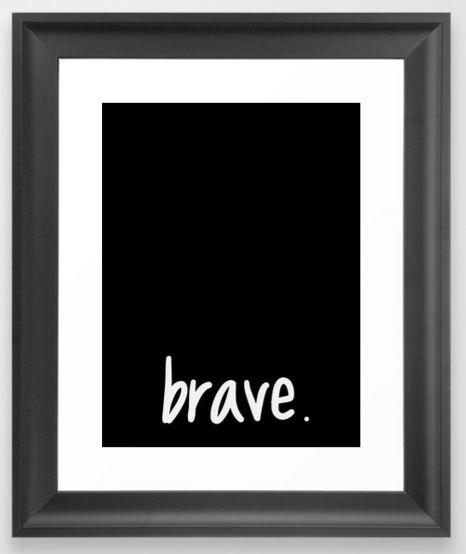
Jim told me that he was suspicious of this culture that seems to need to plaster messages on the wall, on shopping bags, or indelibly tattooed on body parts. Begin Anywhere. Live Loud. This life is not a dress rehearsal. Peace. Home. “It’s too simplistic,” he says.
So. Brave.
Are we branding our lives, marketing our selves to ourselves? Are these ubiquitous expressions reminders? Encouragement? Aspirations? Desires? Statements of intent? Flags planted in the metaphoric sand? Are these flags too simplistic?
Joseph Campbell once said that to find more-than-ample evidence of the collapse of our unifying culture/story (our mythology) one need look no further than the daily news. Violence and division dominate our day. It is the seedy sensational story we tell to ourselves. It seems we’ve traded the commons for higher ratings. The common good falls apart in the face of the lobbyist’s payout. Can there be a center when another set of ubiquitous expressions dominate our dialogue: tribalism, polarization, fake news. Us. Them. Again, more flags planted in the metaphoric sand and are they also too simplistic?
On the stage, when actors have no direction and lose sight of the common story they might otherwise tell, they default to a condition lovingly (yet accurately) known as “Save-your-ass-theatre.” It is every man/woman for him/her self. It a group of artists on stage feeling isolated and all alone but pretending to be together. It is fear with a thin smile pasted on its face. It is awful to watch. And, it is easily remedied: save-someone-else’s-ass. Instead of pushing your drowning mate down so you can reach air, lift them up so they might breathe. They will immediately return the favor. Restore the commons. Step back into the common story.
The opposite of fear is not courage. It is community. Bravery is nothing more than the choice to stand in fear and reach. Cowardice is the choice to stand in fear and pummel. Fear that flourishes in isolation dissolves in the common story. From the studio melange on this Tuesday we offer the only flag worth planting in the sand: be brave enough to turn to the center. Reach. Help someone find air. Is it too simplistic?
I dug out an old drawing this morning. I’ve been thinking about it for days and finally decided to heed the impulse and find it. I drew it years ago, a study for a large canvas I intended to execute but the timing wasn’t right or the thought was not complete. I can’t remember. It would have been a statement piece, based on a myth. Polynieces and Eteocles, two brothers fighting for control of the kingdom after the death of their father, Oedipus. They refused to share the riches. They lost sight of the kingdom in their lust for control and killed each other in their battle. Both lost.
I remembered the drawing after reading the daily news. It popped into my head as an image that seemed relevant as I listened to the intensity and insanity of the blues and the reds. These days I hear a lot of rhetoric about what is good for “the American people” and I am certain – it is among the dwindling things I am certain of – that these diverging rhetorical paths are not good for anyone. The kingdom is nowhere to be found, so lost are we in the power struggle, the alternative-truth-games and all of the accompanying hyperbole.
Recently 20 came over for dinner. He read to us a disturbing article from the newspaper and asked, “So, do you think we have it all upside down?” It was, of course, a rhetorical question. The article was from a February 12th issue of The New York Times, Husbands Are Deadlier Than Terrorists, by Nicholas Kristof. It was an appeal to stay focused on what matters in the midst of so many smoke-and-mirror-power-play intentions. It was a plea to not be lost in the diversions:
“Consider two critical issues: refugees and guns. Trump is going berserk over the former, but wants to ease the rules on the latter….In the four decades between 1975 and 2015, terrorists born in the seven nations in Trump’s travel ban killed zero people in America, according to the Cato Institute. Zero.
In that same period, guns claimed 1.34 million lives in America, including murders, suicides and accidents. That’s about as many people as live in Boston and Seattle combined.”
It’s also roughly as many Americans as died in all the wars in American history since the American Revolution….”
There is, admittedly, much to fear in this world but it is rarely where we pin the blame. Insanity almost never recognizes itself.
According to the myth, Oedipus put a curse on his sons. That was the reason they could not peacefully share the rule of the kingdom. It was a curse. They couldn’t help it. So, it was their fate. No lesson learned. No growth possible.
We have a long legacy of using inequity to create and reinforce division. Perhaps that is the curse we inherited? That is the “reason” we cannot find common ground and shared governance? Is it our fate to murder each other and project the danger onto the people least capable of defending themselves: the current wave of immigrants? It seems lazy but certainly appears to be effective.
It might now be time to execute my painting. I’ve lately been focusing on grace and images of internal peace. I seem to be out of accord with the times in which I am living. According to the data we are killing each other faster, more efficiently and more eagerly than any external threat. All the while our ruling class seems singularly devoted to keeping us in primary color-coded camps rather than working with the creative tension that moves divisions in a unified direction. And, we seem singularly devoted to playing along, not a hint of purple to be found.
Art is, after all, an expression of who we are and I can find no other more relevant American image. It will, of course, be a symphony of reds and blues.
Posted on December 10, 2016 by davidrobinsoncreative
It occurs to me now that all along I’ve been asking irrelevant questions. Or, perhaps framing my questions too narrowly. For instance, years ago I went to graduate school to study systems because I wanted to follow a question that reached deep into my life and identity as an artist: can a mythology be rekindled once it has died? Art, after all, is one of the primary life-keepers of a culture’s story and the beating heart of the story is its mythology. And, according to all indicators, our mythology is mostly dead [as Joseph Campbell said, for evidence of our mythological demise, all you need to do is look at the news]. So, the younger version of myself wanted to understand the purpose of my life as an artist if, indeed, I was in service to a dead mythology. Heady questions, yes? Relevant questions?
In the early 1990’s I was invited to a photographer’s studio to see the “newest thing” in photography. The photographer had a new “program” called Photoshop. Before my eyes he “photoshopped” me into a picture, a place I’d never before visited. Today, all of this seems commonplace. Now, any 5 year old can manipulate an image but at the time a photograph stood for proof that something had actually happened. A photograph could not lie. It was evidence of truth. That day, standing in the photographer’s studio, I realized that the old reliable anchors for truth no longer existed. What was our anchor?
The truly significant events in our lives rarely come in with a roar.
We’ve been hearing a lot lately about fake news – as if this was a new phenomenon. It brings to my mind a terrific book written in 1985 by Neil Postman, Amusing Ourselves To Death. Here’s bit from the first page:
“Our politics, religion, news, athletics, education, and commerce have been transformed into congenial adjuncts of show business, largely without protest or even much popular notice. The result is that we are a people on the verge of amusing ourselves to death.”
I suppose fake news refers to something wholly concocted but I’d argue that when news agencies pander and promote themselves to conservative or liberal viewpoints, when ratings drive content, it’s all fake news. News with an agenda is…not news. It is, however, dangerous to a democracy and no longer free (as in free press, a cornerstone of our democracy). Historically, newspapers have always had a point of view but there was some attention paid to what was printed as news. Opinion was confined to an editorial page. When the line between true and concocted is blurred, when a populace cannot discern between entertainment and substance, it no longer has the capacity to make sound (read, “informed”) judgments. Worse, it is gullible, gossip-eaten and infinitely manipulate-able. It is, as Neil Postman wrote, entertaining itself to death.
I recently wrote about the absence of recognizable communal anchors (mythology) and the dangers of a community with nothing but the soft soil of belief and opinion as its driver. Is planting a personal-truth flag and defending its territory all that is left to us?
What else can we do? Now, there’s a relevant, open-ended question! Roger once told me that he would never be able to understand suicide. He said something like, “In that moment, rather than take your own life, why not do anything else? Why not make any other choice?” Another relevant question!
What else can we do? In the face of our own entertainment-driven suicide, why not do anything else? Turn off the blather, go outside, meet your neighbor, tell stories of your children or your ancestors. If common ground can’t be found it can certainly be created. Inhabit something bigger than opinion. It’s less entertaining but certainly more useful. Great art – no matter the form- lives in those bigger fields.












 The Direction of Intention