The Only Question [David’s blog on KS Friday]

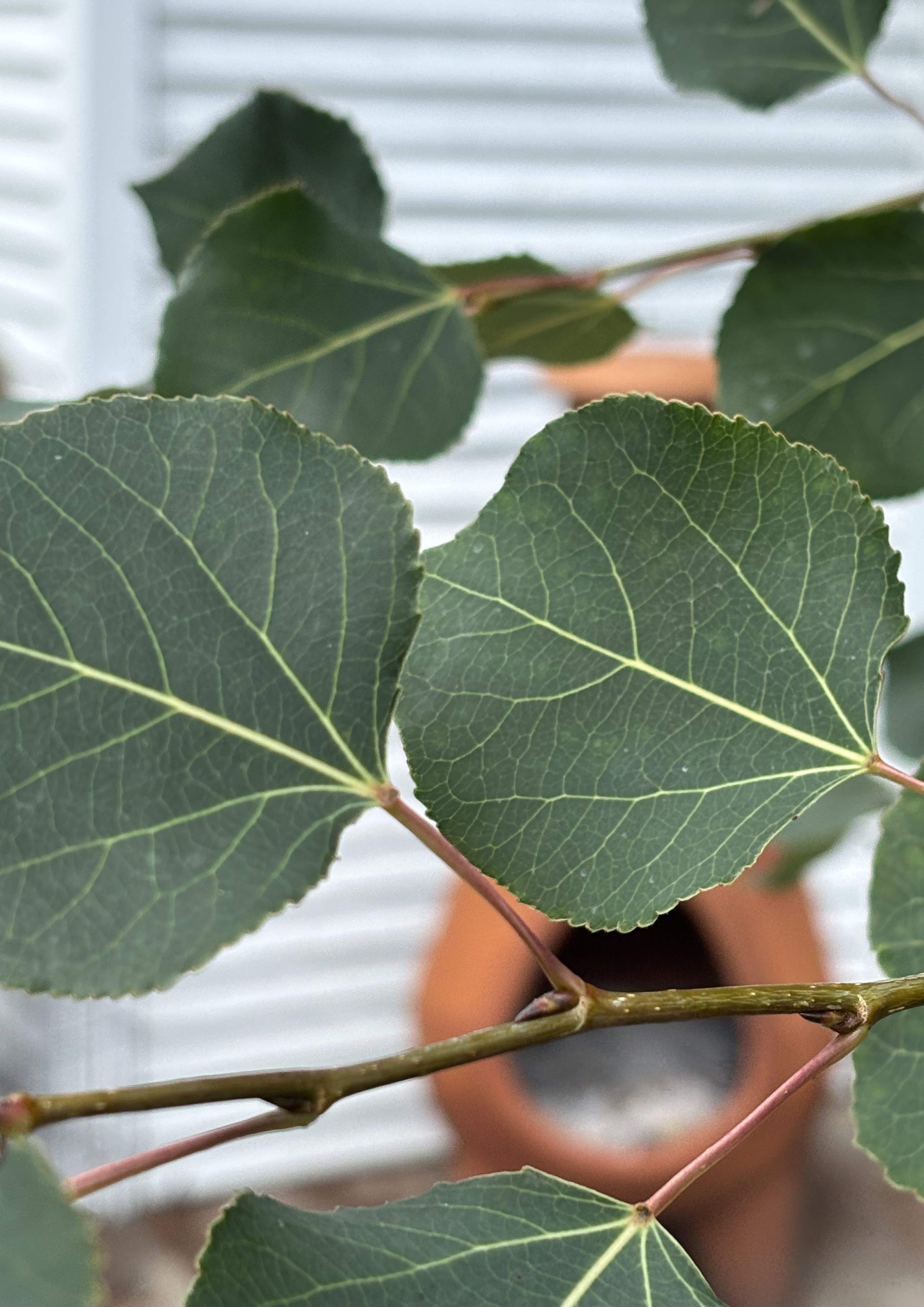
Breck the aspen tree is no longer a sapling. Since May she has grown a few feet taller. Her trunk is now the sturdy stock of a mature tree. Her bark is taking on the whitish hue of mature aspens. We stand at her base, crane our necks looking up, and marvel. In a few short months we have watched her come-of-age.

In a contentious time, an age of the disappearance of justice and the rise of a criminal, Breck is a reminder for us of all that is good. When we need a dose of sanity, when we need a reminder that nature takes little notice of human folly, we sit with Breck. We allow ourselves to be soothed by the comforting shimmer of her quaking leaves.

Joseph Campbell wrote The Hero With A Thousand Faces in 1949. I almost spit my coffee this morning when I read, “The tyrant is proud and therein resides his doom. He is proud because he thinks of his strength as his own; thus, he is in the clown role, as a mistaker of shadow for substance; it is his destiny to be tricked.”

I know it is a mistake to conflate myth with biography, yet, have you ever read a more perfect description of our authoritarian wanna-be?

Myth meets the historical moment. The tyrant is a clown. He is a mistaker of shadow for substance. He thinks his strength is his own. His destiny is to be tricked. Campbell also wrote that, in the mythic cycle, the tyrant, “usurps to themselves the goods of their neighbors, arise, and are the cause of widespread misery. They have to be suppressed.”

Usurping to himself the goods of his neighbors? Check.

The cause of widespread misery? Check.

In mythology, the tyrant is the harbinger of the hero’s rise (note: the hero need not be a male). “The great figure of the moment (the tyrant) exists only to be broken…The ogre-tyrant is champion of the prodigious fact; the hero the champion of creative life.”

The word “prodigious” in this sentence = unnatural, grotesque.

Locked in a shadowy lie-about-the-past with a monstrous clown? Or, progressing forward toward actual possibilities? We are a nation quaking to come-of age.

The tyrant exists only to be broken – and it makes sense in mythology and in the patterns of history. Breck can only grow in one direction. The same is true of us. The only question is how much damage will the tyrant do before we-the-people, the actual hero in our tale, awaken, open our eyes and rise?

WATERSHED on the album AS IT IS © 2004 Kerri Sherwood

watershed,(noun): an event or period marking a turning point in a course of action or state of affairs.

Kerri’s albums are available on iTunes and streaming on Pandora

read Kerri’s blogpost about BRECK

likesharesupportcommentsubscribethankyou

The Door [David’s blog on Two Artists Tuesday]

“Follow your bliss and the universe will open doors where there were only walls.” ~ Joseph Campbell

We leaned an old door against the garage. The towel rack serves as an excellent perch for birds. Initially, we entertained the idea of hanging a basket of flowers from the rack but abandoned the idea. As time and weather peel back the layers and reveal the door’s history, we are delighted that we left well-enough alone. The door is beautiful and needs no adornment.

I am rereading The Hero With A Thousand Faces, Joseph Campbell’s masterwork introducing us to the idea of a monomyth: the story-pattern found universally in folklore, myths, religious narratives…across cultures. The human journey. This time through I am slow-reading the book, taking in only a few pages a day – or sometimes if it strikes me I linger on a single paragraph. In this phase of my life I am less interested in consuming information and more wanting to savor what I read. I am not trying to “get there” or to “achieve” or ascend the heights of knowledge mountains. I am in favor of strolling and appreciating.

Sitting on the step of the deck, watching Dogga explore the crab grass, I realized that we placed the door directly opposite of Barney the piano. And, because my mind is savoring mythic journeys I was amused at the creation of our unintentional sculpture. Music is Kerri’s bliss. Since she fell and broke both of her wrists the door has been mostly closed. Recently she cleaned out her studio. It feels good in there! There’s light and space and new energy. Occasionally, spontaneously, she will run in and play for a few minutes. Dogga and I exchange a knowing look: the muse is calling.

There was certainly a departure from the known. There have been challenges – more than I care to count. Like Barney and the door, the old world collapses, layers peel away, revealing history long unattended. In the collapse the purest form emerges and finds new light. Though the journey is not yet complete, I am witness to her transformation.

We placed an old door opposite of Barney. Where once there was only a wall, I have faith that this door will open. She will return to the land of the known, and as the monomyth foretells, she will bring with her a boon, a special gift gained from her arduous journey.

read Kerri’s blogpost about THE DOOR


likesharesupportcomment…thankyou.

A Place Called “Home” [David’s blog on KS Friday]

“We need, in love, to practice only this: letting each other go. For holding on comes easily; we do not need to learn it.” ~ Rainier Maria Rilke

I’ve never been a big fan of the holidays. Most of my life I’ve lived far away from family. Most of my life I’ve been a wanderer, detached from any meaningful feeling of “home”. I’ve never been a believer in any religious tradition though I understand to my bones the deeply human necessity of celebrating the solstice, observing with ritual the return of the light. It’s mythic, this annual journey through the darkness and back into the light.

It’s an experience common to all people on earth. No matter the story wrapped around it – birth or rebirth or journey or emergence – the commemoration of light’s return springs from a shared human experience. Literally and in metaphor, our lives parallel the movement of our planet around the life-giving sun. Would that we could recognize our sameness instead of fight over our perceived differences!

As I’ve previously written, the moment I stepped into this house was the first moment in my life that I felt “home”. In my imagination I saw the word “home” written on the wall. As a dedicated wanderer it frightened me. Now, more than a decade later, I am grateful for the intense struggle the wanderer-in-me fought and lost to finally – finally – arrive home.

We decorate our house for the holiday over many days. It is a work in progress that is both intentional, improvisational and responsive. We discover as we go. This season, in a nation filling itself with darkness, we have more reason than ever to create a space in our home that celebrates the return of the light.

We are also learning, in the midst of this looming shadow, how to fill ourselves with light. How to let go. We are learning how to stand in a center of intentional light in the midst of the swirling darkness. We are more than ever understanding the necessary delineation between solid-center and fluid-circumstance, how to root in the center without grappling with the passing state of affairs.

As we clean out, as we practice letting go of our stuff, both literal and metaphoric, we also decorate. We create a beautiful space, simple and warm, a place called home, safe and solid, where we turn to the sky and witness the return of the light.

The Lights on the album of the same name © 1996 Kerri Sherwood

Kerri’s albums are available on iTunes and streaming on Pandora

read Kerri’s blog post about DECORATING

likesharesupportsubscribecomment…thank you.

Enter Happiness [David’s blog on Not So Flawed Wednesday]

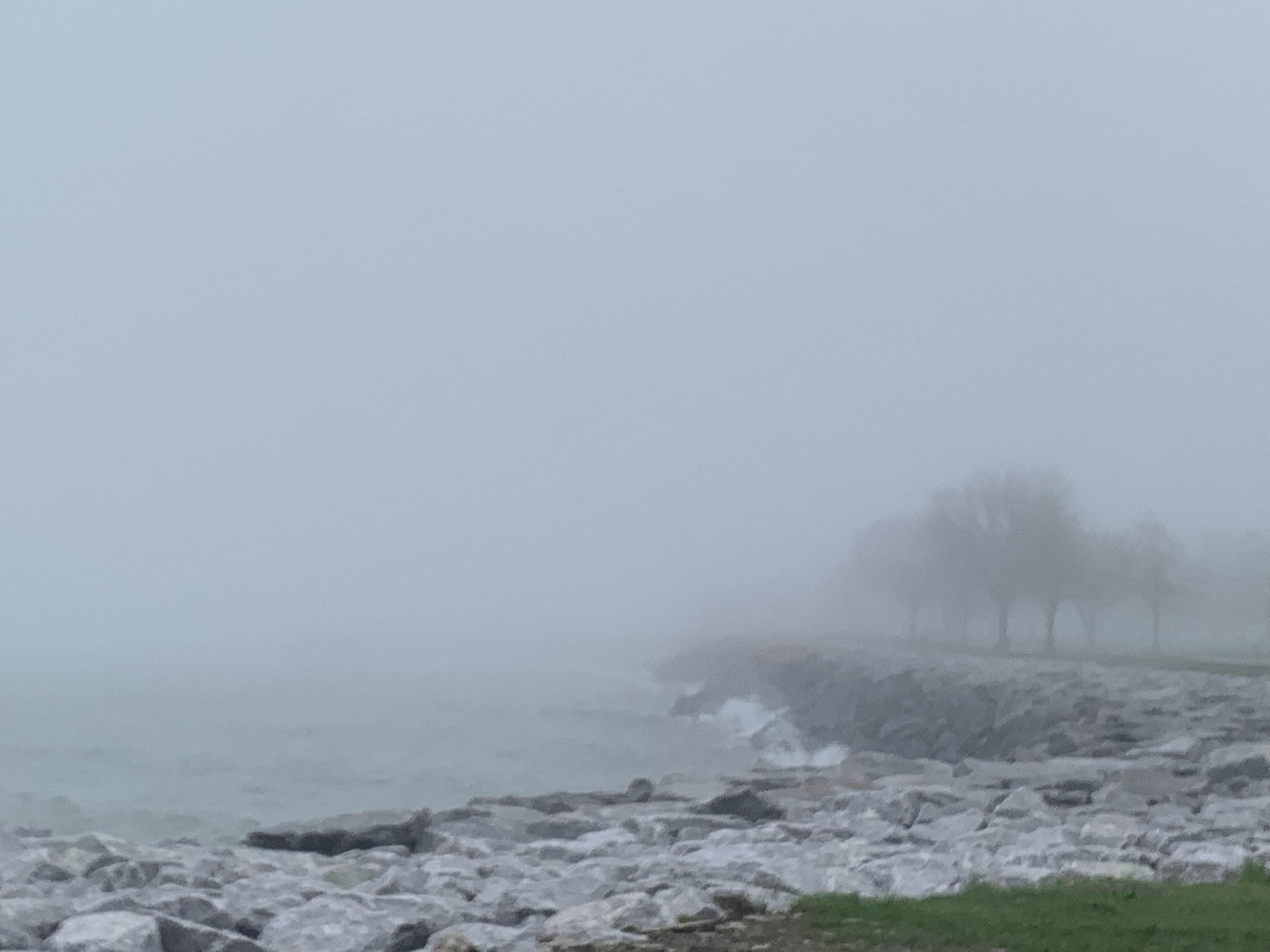
The day brought to mind Avalon, the mythical island hidden from sight by the spells of the wise women who rule there or perhaps by charms cast by King Arthur’s sister, Morgaine. It is where Arthur was taken after he was gravely wounded in battle. To heal or to die. It depends on which version of the legend that you read. As I watched her take the picture I wondered if Avalon could pop-up off the coast of Lake Michigan. If it can be spelled and disappear from sight it certainly can be spelled to appear wherever Morgaine chooses. Magic is magic. Possibility is open-ended until doubt or belief renders it otherwise.

While I was studying the photo, pondering what I might write, Kerri played a song by John Denver. I didn’t recognize it and looked over her shoulder. It was the last song he wrote before he died. Yellowstone (Coming Home). He did not know it would be his last song. He had no expectation of dying on the day his plane dropped from the sky into the ocean. I have sometimes wondered what would be my last painting or the final piece I might write. In my imagining, I always know. “This is the last,” I think and set down my brush, one more step in preparing to enter the mist.

I read somewhere that the real key to happiness is to lose your self-importance. It’s counter-intuitive in a culture that identifies through individual achievement. Climbing the ladder. Top dog. Happiness as a by-product of achievement and possession. Yet, it seems simple if you think about it. Happiness, not as an acquisition but as as an aspect of presence. Happiness enters when we are present in our moment and, in order to actually be present in the moment, the eyes and heart and mind need to let go of the desire to be other places, future or past. Happiness finds us when enough is truly enough and everything else, all the imagined importance, the yearning and the lack, disappear into the fog of time’s illusion.

read Kerri’s blogpost about FOG

like. share. comment. subscribe. support. thank you!

Animate! [David’s blog on Merely A Thought Monday]

Hydro: relating to water.

Hydra: a problematic many-headed serpent in Greek mythology. The problem: every time some hero tried to cut off one of its heads, the old head was replaced by two. The original myth behind compounding interest. Hercules finally rid the world of the monster. You’ll have to read the myth to find out how. I don’t want to spoil it for you.

Hydra lived in Hydro. Water serpent. In the 18th century Linnaeus named a water critter after the mythic serpent because, when severed, the critter regenerates a new part. Language is an amazing thing, drawing connections in many directions across eons of time. All words, like all people, have origin stories.

And this brings me to the flask. My first flask, pocket-sized, was a gift for participation in a wedding. It was often filled with spirits. To be clear, the spirits my flask contained were distilled and not ghost-ish or soul-like, though both the distilled and the ethereal notions are capable of the same outcome: animation.

This flask, my Hydro Flask, is reserved for coffee exclusively. Coffee is also a source of animation. It brings me to consciousness each morning.

Anima. From the latin: life or soul.

Coffee. From the pot: life-giving. Soul restoring.

My flask keeps my morning soul-juice hot for a long, long time. It’s small but it’s mighty. Herculean, one might say.

read Kerri’s blogpost about HYDRO FLASK

like. scream. run away. share. comment, though be nice. support. or just accept our gratitude for reading what we write.

buymeacoffee is an opportunity for you to support the work of non-linear thinkers. It is cleverly disguised as a water feature, though in truth it is a soul restorer.

Share The Symbols [David’s blog on KS Friday]

When I was a wee-turnip I found a textbook on the shelf from a course my dad took in college. Comparative religions. It’s a big-big book full of many-many comparisons. It now resides on my shelf. This book sparked a life-long fascination for me. The universal nature of myth and story across individual cultures and how these stories and symbols are, over time, pulled and twisted like taffy, co-opted, integrated and sometimes claimed as the private property of religion x or y.

Today, as I write this, we sit squarely on the solstice. I thought a few tidbits of story-symbol might be fun to visit so, together, we might taste the taffy.

In Italian tradition, La Befana is the goddess of the solstice. She rides a broom through the skies leaving candy and presents to the good little boys and girls. As a broom-riding pagan goddess, she predates Saint Nick by more than a few centuries. The Christian tradition snagged her and after a bit of twisting, she became a character in the Magi story. On a cold, cold night she gave shelter to those three wise-men but declined to join them on their quest because she had unfinished chores. After they left she had a change of heart but couldn’t find the manger on her own so she gave the gifts she had in tow to the nice children she met during her manger-search.

On the solstice, the goddess Isis gave birth to her son Horus, the sun god. Leta gave birth to Apollo on the solstice. The Persian god of light, Mithra, was born on the solstice. These births were technically virgin births since the conception in every case was immaculate. Egyptian. Greek. Persian. These stories predate the Christian story by centuries. It’s a ripple across time and culture of the same human impulse: after a long dark season to celebrate the return of the light.

We lose more than we know when we – to borrow a great term from Joseph Campbell – concretize a symbol. The stories and myths are meant to open us to greater unity with each other and the world we share. They are not meant to be taken or understood literally. Holding them literally slams the door on their greater meaning and unifying power. It renders them a possession, a plot point on a map.

On this winter solstice I can imagine no greater gift to this divided world than to recognize we are, through our unique symbols and characters, telling the same story, yearning for the same possibilities, sharing the same ideals whether they soar through the air on a broomstick or in a sleigh, both rides brimming with toys for good girls and boys. We borrow each others best ideas and ideals, rewriting them to fit our unique audience. From Isis and Horus to Mary and Jesus, it’s time once again to celebrate the rich warm return of the light through our myriad forms and cultural traditions, to feel the push and pull of something ancient and deeply human. Together.

this season/this season © 1998 kerri sherwood

Kerri’s albums are available on iTunes and streaming on Pandora and iHeart Radio

read Kerri’s blogpost about THE HOME IN THE TREE

like. share. support. comment.

buymeacoffee is a surgically implanted intention, a medicinal tradition stretching back eons to a time when beauty and analytics held hands and shared meals. together.

Be The Storm [on Chicken Marsala Monday]

inspirationisa WITH EYES jpeg copy 2

“It is a sacred art that deals with revelation rather than observation.”~Jamake Highwater, The Language Of Vision

Tom used to say, “A writer writes and a painter paints.” Those are wise words grounded in the mechanics of art. Simply show up. Do the thing. Nuts and bolts. That’s the first step. Show up at the easel, on the dance floor, at the piano, at the writers desk and begin. Tom was a teacher and over his life heard an overabundance of excuses, reasons ‘why not.’ Said another way, he advised his students to stop thinking about it and do it. “Get out of your own way,” he’d counsel. That’s the second step. Horatio calls this step ‘trust-your-work.”

Show up. Do the thing. Get out of your own way. Trust your work.

And, what happens with trust? When the artist can get out of his/her own way, the sacred art, the art of revelation becomes possible. It’s a beautiful paradox. Show up and get out of the way. And, between those two actions, those crackling oppositions, a greater force, inspiration, gathers and releases like a storm.

if you'd like to see more CHICKEN... copy

FALL50%OFFSALE copySeptember 1 – 16

read Kerri’s blog post about INSPIRATION IS A GATHERING STORM


www.kerrianddavid.com

facebook logo copy 2

inspiration is a gathering storm ©️ 2016/18 david robinson & kerri sherwood


Make Purple

Polynieces and Eteocles

I dug out an old drawing this morning. I’ve been thinking about it for days and finally decided to heed the impulse and find it. I drew it years ago, a study for a large canvas I intended to execute but the timing wasn’t right or the thought was not complete. I can’t remember. It would have been a statement piece, based on a myth. Polynieces and Eteocles, two brothers fighting for control of the kingdom after the death of their father, Oedipus. They refused to share the riches. They lost sight of the kingdom in their lust for control and killed each other in their battle. Both lost.

I remembered the drawing after reading the daily news. It popped into my head as an image that seemed relevant as I listened to the intensity and insanity of the blues and the reds. These days I hear a lot of rhetoric about what is good for “the American people” and I am certain – it is among the dwindling things I am certain of – that these diverging rhetorical paths are not good for anyone. The kingdom is nowhere to be found, so lost are we in the power struggle, the alternative-truth-games and all of the accompanying hyperbole.

Recently 20 came over for dinner. He read to us a disturbing article from the newspaper and asked, “So, do you think we have it all upside down?” It was, of course, a rhetorical question. The article was from a February 12th issue of The New York Times, Husbands Are Deadlier Than Terrorists, by Nicholas Kristof. It was an appeal to stay focused on what matters in the midst of so many smoke-and-mirror-power-play intentions. It was a plea to not be lost in the diversions:

            “Consider two critical issues: refugees and guns. Trump is going berserk over the former, but wants to ease the rules on the latter….In the four decades between 1975 and 2015, terrorists born in the seven nations in Trump’s travel ban killed zero people in America, according to the Cato Institute. Zero.

            In that same period, guns claimed 1.34 million lives in America, including murders, suicides and accidents. That’s about as many people as live in Boston and Seattle combined.”

           It’s also roughly as many Americans as died in all the wars in American history since the American Revolution….”

There is, admittedly, much to fear in this world but it is rarely where we pin the blame. Insanity almost never recognizes itself.

According to the myth, Oedipus put a curse on his sons. That was the reason they could not peacefully share the rule of the kingdom. It was a curse. They couldn’t help it. So, it was their fate. No lesson learned. No growth possible.

We have a long legacy of using inequity to create and reinforce division. Perhaps that is the curse we inherited? That is the “reason” we cannot find common ground and shared governance? Is it our fate to murder each other and project the danger onto the people least capable of defending themselves: the current wave of immigrants? It seems lazy but certainly appears to be effective.

It might now be time to execute my painting. I’ve lately been focusing on grace and images of internal peace. I seem to be out of accord with the times in which I am living. According to the data we are killing each other faster, more efficiently and more eagerly than any external threat. All the while our ruling class seems singularly devoted to keeping us in primary color-coded camps rather than working with the creative tension that moves divisions in a unified direction. And, we seem singularly devoted to playing along, not a hint of purple to be found.

Art is, after all, an expression of who we are and I can find no other more relevant American image. It will, of course, be a symphony of reds and blues.


Save

Paddle On

photo-3We’d been out in the canoe for more than an hour. The morning was warm and the water was still. We hugged the shore, cruising the lily pads. Dan told us some of the lily pads were over 150 years old. I was amazed at their capacity to reach through time but also reach through long stems to the water’s surface to drink the sun.

The turtle emerged from nowhere. It appeared from the depths, through the lily pad stem forest, and rose to within inches of the surface. It was big for a lake turtle, perhaps the size of a dinner plate. I let my paddle trail in the water. It was so close I could have reached into the water and touched it. We glided forward and turned the canoe so Kerri might see it but the turtle had already disappeared.

the view from the canoe

the view from the canoe

Turtle is perhaps the oldest known symbol for the earth. In many traditions, turtle carries the world on her back; the earth is her shell. She is a great reminder to go slow and persevere, to live grounded amidst the chaos of life. She symbolizes patience and ease. I was struck by how similar are the symbols of turtle and lily pad. Peace. Ease. Both are extraordinary symbols of grounding or rooting. Both cross the boundary of elements: the turtle lives in water and land. The lily pad reaches through the water to find air and sun. Both inhabit the depths and reach to the surface.

It feels as if I came into this world with art already in me. From an early age I drew pictures, not because I wanted to but because I had to. Like the lily pad, I was reaching for something unknown. I drew the same images over and over again: a cabin in the woods, eyes, clowns. I wasn’t drawing to master the image, I was drawing and painting in order to reach beyond the image. There was something there, beyond, deep in the depths, a root, rich soil, the void. There was a force behind the image that pulled me. My artistry felt like a descent into the caves of the ancients, a search for sources mythological.

Sometime during these past few years, the direction of the pull reversed itself. Like Orpheus in the underworld, I turned around. I walked toward the surface. In essence, the pull to the depths became a reach to the light. The sun called. Balance, in this life, at long last necessitated light and warmth.

Tom once told me that inheriting his family’s ranch and subsequently finding a trunk hidden in the wall of the house containing his ancestors possessions served as an affirmation that he had finally come home. Sitting in the canoe, the turtle rising by my side, I felt the affirmation. I am now only inches from breaking the surface. I drink the light because I know the depths and am adept at walking in the dark unknown.

the first layer of  under-painting for the next piece

the first layer of under-painting for my next piece

I am working much slower now. I am in no hurry to get anywhere. And my art, my life, is the better for it.


Tell A Good Story

The Storyteller emerges from the forest. Lucy & The Waterfox

The Storyteller emerges from the forest. Lucy & The Waterfox

Over the years I’ve tried countless marginally successful ways to define for others what I do. It would seem obvious: I am a painter. I am a writer. Oh, and a theatre artist. And a consultant. And I’ve maintained a coaching practice. I’ve worked in education, the corporate world, with non-profits, and with entrepreneurs. So, in conclusion, I do too many things.

Well, that’s not exactly true. I do one thing. I deal in story.

I speak the language of story and that is confusing in any arena. What does it mean? Such a simple word, story, and yet it can mean so many different things. For instance, a truism in effective, transformational coaching is that the story doesn’t matter. By story, coaches mean the circumstance; in transformation, in the fulfillment of potential, the details of what happened – the story – are not useful. The circumstance story usually equates to blaming or endless attempts at self-fixing. The circumstance story gets in the way of growth. It is an anchor in the sea of dysfunction.

I don’t work with circumstance stories.

By story, I mean inner monologue, the-story-you-tell-yourself-about-yourself. By story, I mean the language that we use within ourselves to articulate belief. I work with the orientation story, the personal and communal mythology. Rather than get in the way, the orientation story defines the way. It defines what we see. It defines our relationship with time, with nature, with god, with community: it is the lens through which we make meaning. I help people change their lenses. Try explaining that to a CEO!

Last year, when Skip and I shuttered our business, I also shuttered my coaching practice. I ended my corporate work. Much of it came to feel like wearing an ill-fitting shirt –or a host of ill-fitting shirts – so I decided to clean out the closet. I wanted to drop all the definitions, the old forms, to make space for the new.

Last week I decided it was time to peek into the empty closet. And, as serendipity would dictate, I happened to be reading Frank Delaney’s engaging book, The Last Storyteller. On page 99 of this fictional tale, this is what I read:

“…every legend and all mythologies exist to teach us how to run our days. In kind fashion. A loving way. But there’s no story, no matter how ancient, as important as one’s own. So if we’re to live good lives, we have to tell our own story. In a good way. A way that’s decent to ourselves.”

I threw my head back and laughed. There is no story as important as one’s own. To live a good life we have to tell our own story in a good way. And then, there was this:

“…I don’t give anybody advice. All I do is release the good thinking that’s already inside of you. You’re the one who acts on your own advice, and I have the pleasure of helping you reach those thoughts about yourself. So it’s not me helping you. It’s you helping you.”

Ask me today what I do and I will say, I write. I paint. Ask me for more detail and I’ll open the book to page 99.

[to be continued]

title_pageGo here to buy hard copies (and Kindle) of my latest book: The Seer: The Mind of the Entrepreneur, Artist, Visionary, Innovator, Seeker, Learner, Leader, Creator,…You.

All digital forms of The Seer can be found here