See Beyond [on DR Thursday]

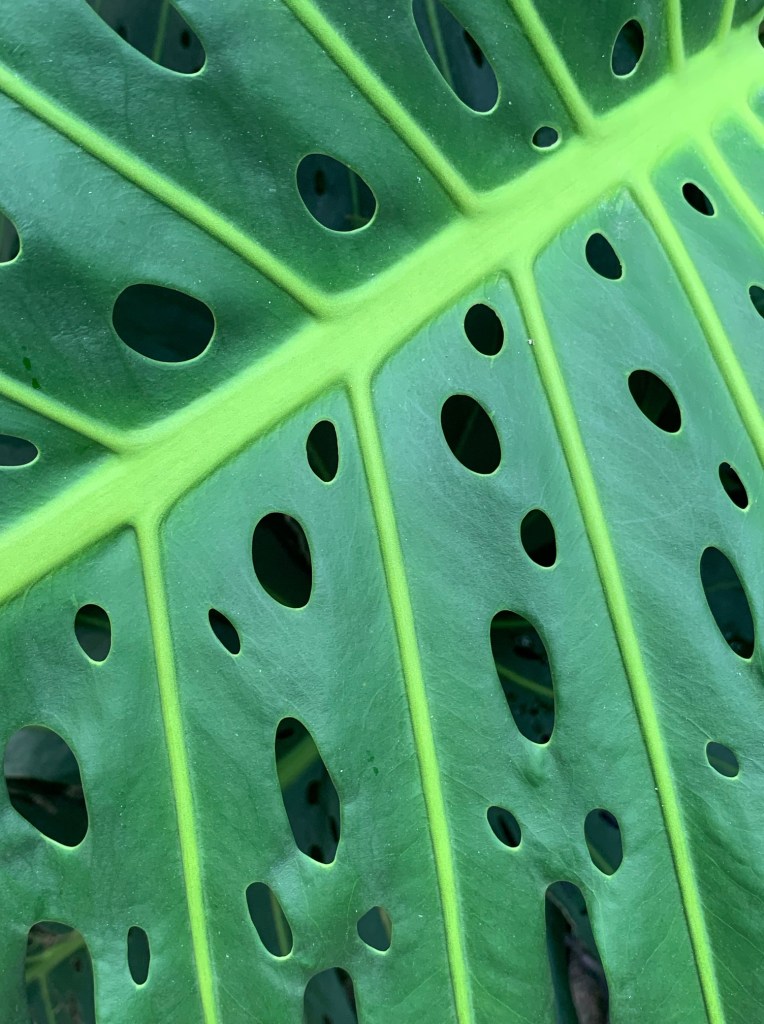
I am amazed by nature. We learned in our visit to the botanical gardens that plants in tropical climates are a study in waterproofing. Waxy leaves prevent excess water from accumulating. Holes allow water and sunlight to pass through. It’s a masterclass in protection from algae. Adaptation, not resistance. Working with rather than fighting against.

My adult life has been a meditation on whole systems – which is quite simply a study of perception. It takes a human mind to separate the leaf from the branch from the trunk from the root. Separation and categorization is how we make sense of things. Analysis requires breaking-it-down. It’s easy to forget that those distinctions are in our minds and not in the world we observe. There is no separation of leaf from rain, not really. There is movement. Concert. Equilibrium.

Understanding requires reassembly.

To live creatively is to discover rather than invent. Thank goodness for the scientists teasing apart, deconstructing, uncovering, analyzing. I would not be alive today without their passionate pursuit.

And, while the scientist dissects, the artist reassembles. The reach for wholeness, the pull toward universal experience that cuts across division…I thank goodness each day for eyes that see beyond the separations, the capacity for utter delight and awe – standing in a garden – staring at a leaf made colander over eons of time.

read Kerri’s blogpost about HOLES IN LEAVES

eve © 2006 david robinson

Make [on Two Artists Tuesday]

“The origami crane has become a symbol of peace.”

Fold 1,000 cranes and your heart’s desire will come true. Legend will have it so. In Japan, the crane is a symbol of good luck and long life.

Making something into something else. Folding paper into cranes. It is, perhaps, the quality that defines us, makes us human. We turn the flow of water into the force driving the mill. We study patterns in stars and translate it into navigation. We smelt ore and hammer the elements again at the forge to make iron. We use the iron to make trains.

We make.

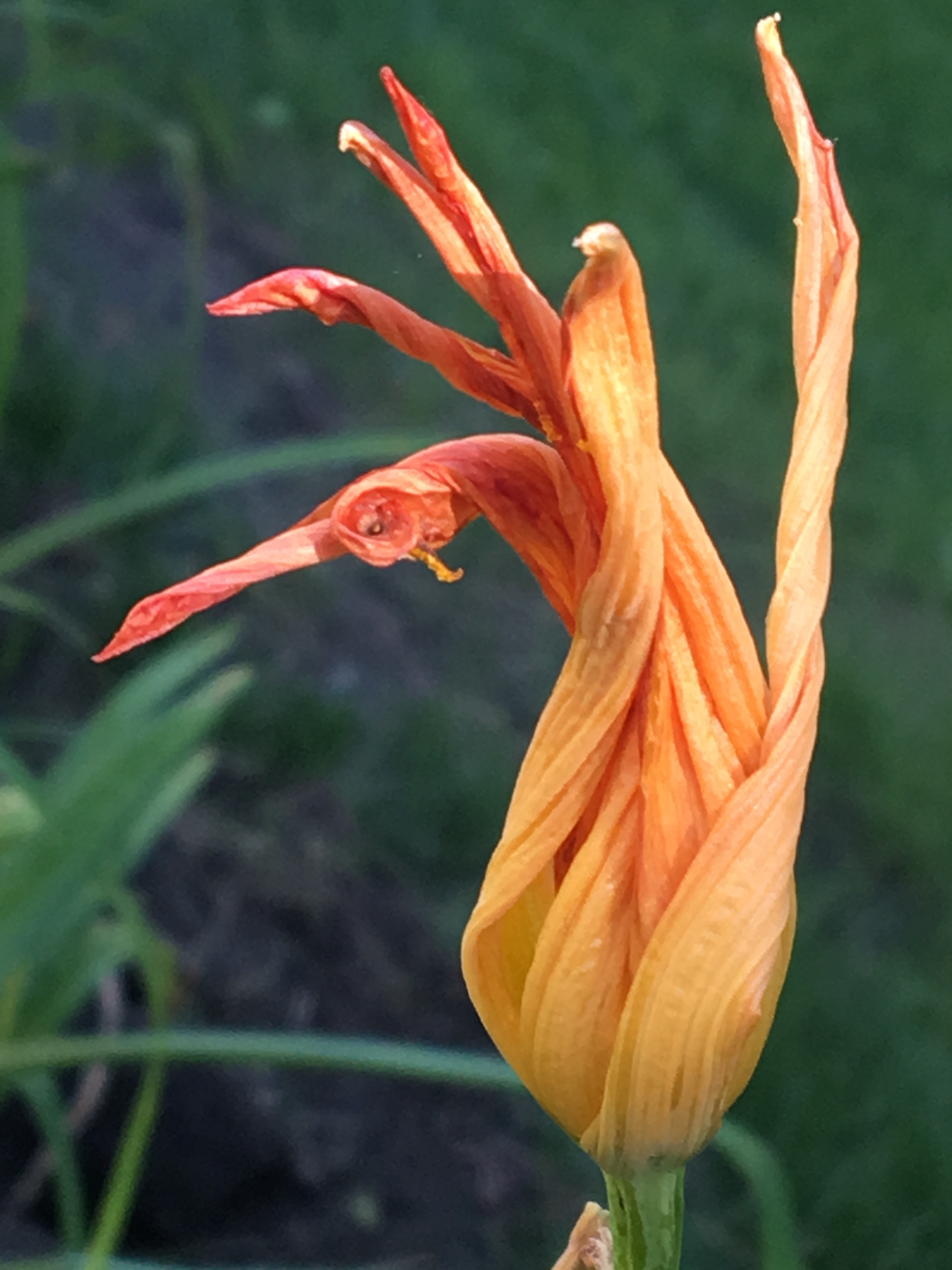
We look at flowers and see cranes. We look at clouds and see wild horses. We look at blank canvas and see possibility.

We make stories.

Our storymaking cuts both ways. We look at others and see friends; we look at others and see enemies. Either way, our looking is not passive. We make stories. We make connections. We make divisions.

We make wishes. Fold 1,000 cranes and your heart’s desire will come true.

Reach your hand to help. Slap a hand away. Either way, it depends on what story you see. What you want to make.

The story we create.

Folded paper. A symbol of peace.

read Kerri’s blogpost about CRANES

Live Like. Reach For. [on Merely A Thought Monday]

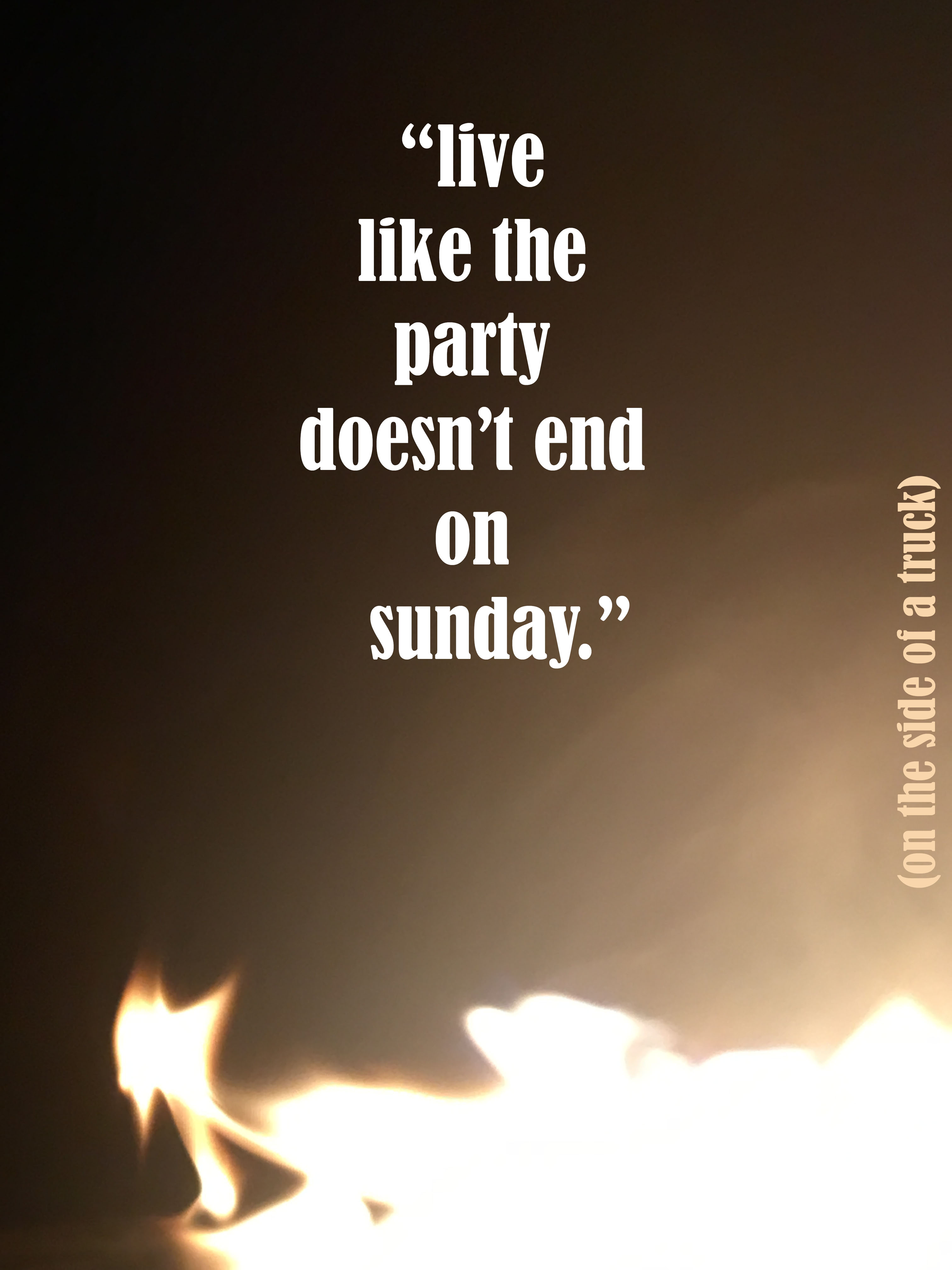
These messages are everywhere! Marketing tags, song and book titles, posters and billboards. memes. A sentiment also found in poetry, plays, and religious texts. Live like…

Live like you were dying (title of a studio album by Tim McGraw)

Live like a monk (title of a book by Daniele Cybulskie)

Live like there’s no tomorrow (A ubiquitous quote and set up for follow-up sentiments like, “Tomorrow may never come!”)

Live like.

Live. No guarantees. Dance like no one is watching. Be here now. If I was the rain.

It’s the message human beings like to deliver to other human beings. Don’t waste your one precious life. Realize it. Consider the lilies.

So the story goes, the Buddha was asked, “What’s the biggest mistake we make in life,” His reply: “The biggest mistake is to think you have time.”

It’s as if we were trying to wake each other up. Or, wake up to each other. It’s as if we need to say, “Don’t miss it!” It’s as if we are asking, “Will you help me see it?”

These days there’s plenty of fear-mongering spinning around the word “woke.” I wonder at this collision of universal message and partisan agenda. After all, what is the opposite of “woke”? Why would anyone want to walk through life dulled or asleep? Why would anyone want to walk through life with their eyes closed, uneducated, filled with answers but empty of questions? Why would anyone want you to close your eyes and mind and heart to the fullness of life?

An amazing thing happens when near death kisses open the eyes: all the perceived divisions drop away. People throw themselves on bombs to save other people, people give up their seat on the life boat and, in those moments, skin color, sexual orientation, or politics matter not at all. In Highland Park, while the bullets were flying, decisions made in helping others to safety and the promise of one-more-day-of-life had nothing to do with division.

In the real moments, the awake moments, people reach for other people.

Perhaps that is why we are appealing to each other in beer commercials and bibles, lyrics and legislation, to wake up.

read Kerri’s blogpost about LIVE LIKE

Look Up. Look Higher. [on Merely A Thought Monday]

“And men are so poor in intellect that a few cold chills down their spine will be enough to keep them from ever finding out the truth about anything.” ~ Thomas Merton, The Seven Storey Mountain

This will read like a blazing generality and I do not intend it to be so. Some of the best people I have known are readers of the book(s). They learned along the line to read their book(s) as metaphor instead of literally, as a history. There are, after all, many paths up the same mountain.

As for me, I was cured of religion when I was a boy but it’s taken a lifetime to understand what and why – and to find language to express what should (to me) be obvious to all.

It only takes a moment to lift your eyes from the book and look up – all the way up to the sky. The book is a human invention, as are the gods and the stories of the gods told in them. The sky, on the other hand, complete with stars and suns and universes beyond imagining, are not human inventions. The book lives in the human mind. That which the book is meant to illuminate is…wholeness…all around us. We are part of, not separate from. That’s it. It’s that simple. The game of separation and unity.

We are part of, not separate from. This word “Love” is unity, the absence of made-up-separations.

The book will have you believing that your body and its myriad of impulses are, like nature, in need of taming. Separation from yourself. The book will promote the notion of a chosen few, the singular path, a destiny that is manifest. Separation from other. Elevation for team-white. Moral authority for team-straight. It’s probably good to feel above others and certainly feels powerful to believe yourself keeper of the book’s rules. Isn’t it blatantly obvious that the rules were/are made by men to justify, as-the-voice-of-god, all manner of privilege and cruelty? Separation, separation, separation.

Here’s what I understood as a boy: any god that promotes separation in any form is very small, indeed, and probably not worth worshipping. At the very least it is a man-made god meant to make folks feel better about their obvious impermanence in an infinite universe.

There’s so much in this life worthy of our worship.

Whether or not we walk as one or decide to beat the hell out of each other for the color of our skin or the natural orientation of our sexuality has nothing to do with the vast universe outside of the book. We create the separations to justify our fear or to protect our property.

We are completely capable of love. We are completely capable of reaching across the unknown and living our short time on this earth in full support of the rich myriad of wonder and diversity expressed through us in this infinite possibility called life.

The book is an abstraction. The person standing before you is not.

Love is love. Love is not separation or division or privilege or a skin color or gender or sexual orientation. Love has nothing to do with how much money you have or do not have. Separations are the province of small people inventing small gods for very small reasons – so they can feel good about being separate and small.

Love is love.

read Kerri’s blogpost about PRIDE

Turn Toward It [on KS Friday]

This is what he wrote. “The irony I feel is that the world is lost on the artistic temperament of these students.  They don’t seem awake to all that’s going on.” He’s directing teenage students in a play. He was my student thirty five years ago and reached out to me. We compared notes of the production I directed when he was a teenager, and the production he’s directing now. The world has changed mightily. His production will be viewed through a wholly different lens.

I flipped his phrase over in my mind. Artistry is to be awake to all that’s going on. And, awake is not a steady state. It’s not an arrival platform. It’s a relationship between the inner and the outer. What I know about that relationship is that sometimes you need to look away. His students have drilled for active shooters in the hall since they were in kindergarten. Mine couldn’t have imagined it. His students are navigating a pandemic, they’ve never known a world pre 9/11, they live in a country that is eating itself alive. My actors had easier access to what was going on. What was going on was closer in, more immediate and less abstract. They were not looking at a world-wide horror story or lost in the morass of social media. Cell phones were science fiction to my cast. My actors looked at each other and not at their screens.

Stories are about something. We just watched Erin Burnett’s interview with a Ukrainian husband who lost his wife and children to a Russian mortar attack. A month ago, violent death was nowhere on their radar. They were making dinner, going to school, doing homework, late for work. Erin Burnett began to cry and thank goodness. Humanity breaks through and we awake to what’s going on – really going on. We should all be weeping with Erin Burnett and this man.

Sometimes I feel as if I am looking for the small beautiful moments. I am trying to root my day in the explosion of color, the pastel sky, Dogga in the sun. Holding hands. Cooking dinner together. I am trying to be awake to what is going on, the anger and division and warmongering and carelessness as we soil our nest – without it frying my insides. Holding hands is just as real. Reaching toward our neighbors is also what’s going on.

Stories have to be about something and most often stories are about transcendence. Waking up to what is going on is less about waking up – we already know – and more about fully acknowledging it, facing the full picture and turning toward it rather than running away. But, before that final act, that moment of deciding enough-is-enough, before we are willing to blink open our eyes, we pretend the problem is non-existent or small. We ignore the obvious. 500 year storms every year. A family killed by a mortar shell. We bury our faces in our phones, we ban critical race theory, and toss our attention in a Twitter reality or a Tik-Tok diversion.

I wanted to write back and suggest that the world is not lost on the artistic temperament of his students, it’s simply too hard to look at the world so they are choosing to look away. That’s what their play will ultimately be about.

read Kerri’s blogpost about COLOR!!

Kerri’s albums are available on iTunes & streaming on Pandora

the way home/this part of the journey © 1998 kerri sherwood

Step Back And Realize [on Flawed Wednesday]

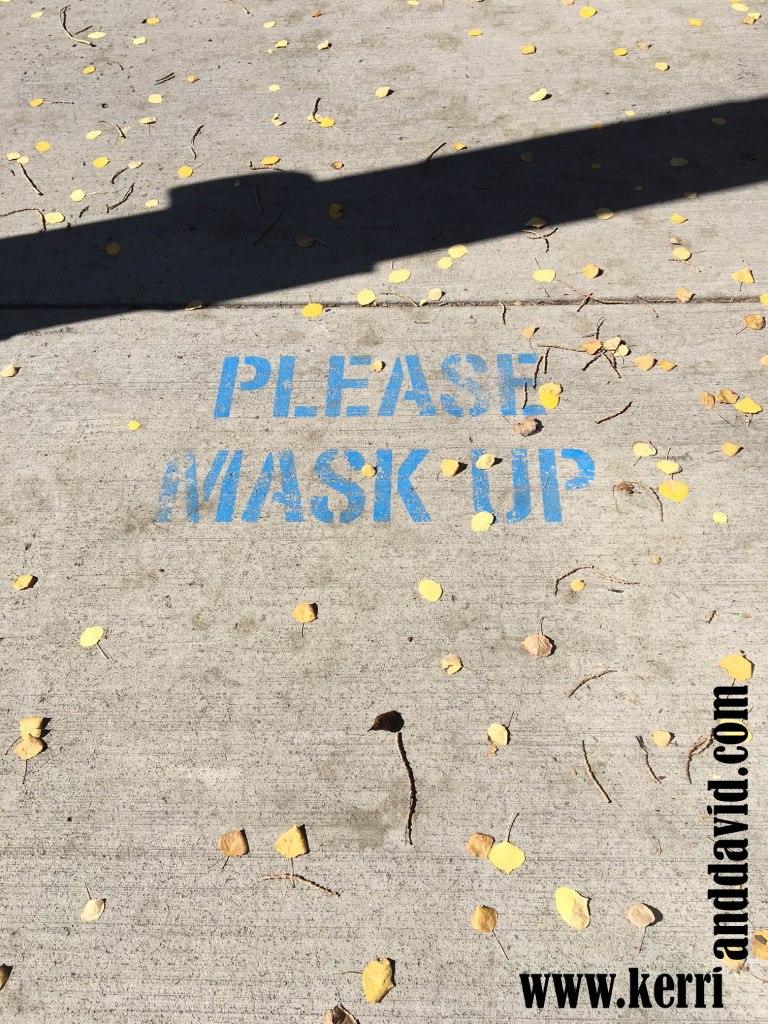
If you are like us, every day brings another report of a friend or loved one who has Covid. As someone recently said to me, “With Omicron, it’s only a half degree of separation between you and someone who’s carrying the virus.” I’d say, given the wave of people we know falling sick and reporting positive test results, it’s true. It’s no time to let down your guard.

On Saturday we watched a documentary film, The First Wave. It’s a film everyone should see. It chronicles the first few months of the pandemic in a New York hospital. It is shocking how, in a few short years, we’ve normalized hospitals being overrun. How removed we, the populace, are from the tangible horror of this pandemic. Refrigerator trucks used as temporary morgues. We stand today at 865,000 deaths and counting. People. By comparison, 620,000 people died in the Civil War. 418,500 US citizens, military and civilian, died in World War 2. We ought to be grieving instead of dividing. We ought to be reaching to help rather than peacocking our politics. This film will slap you awake. It will help you step back and realize what we – all of us – are passing through. It might help you grieve.

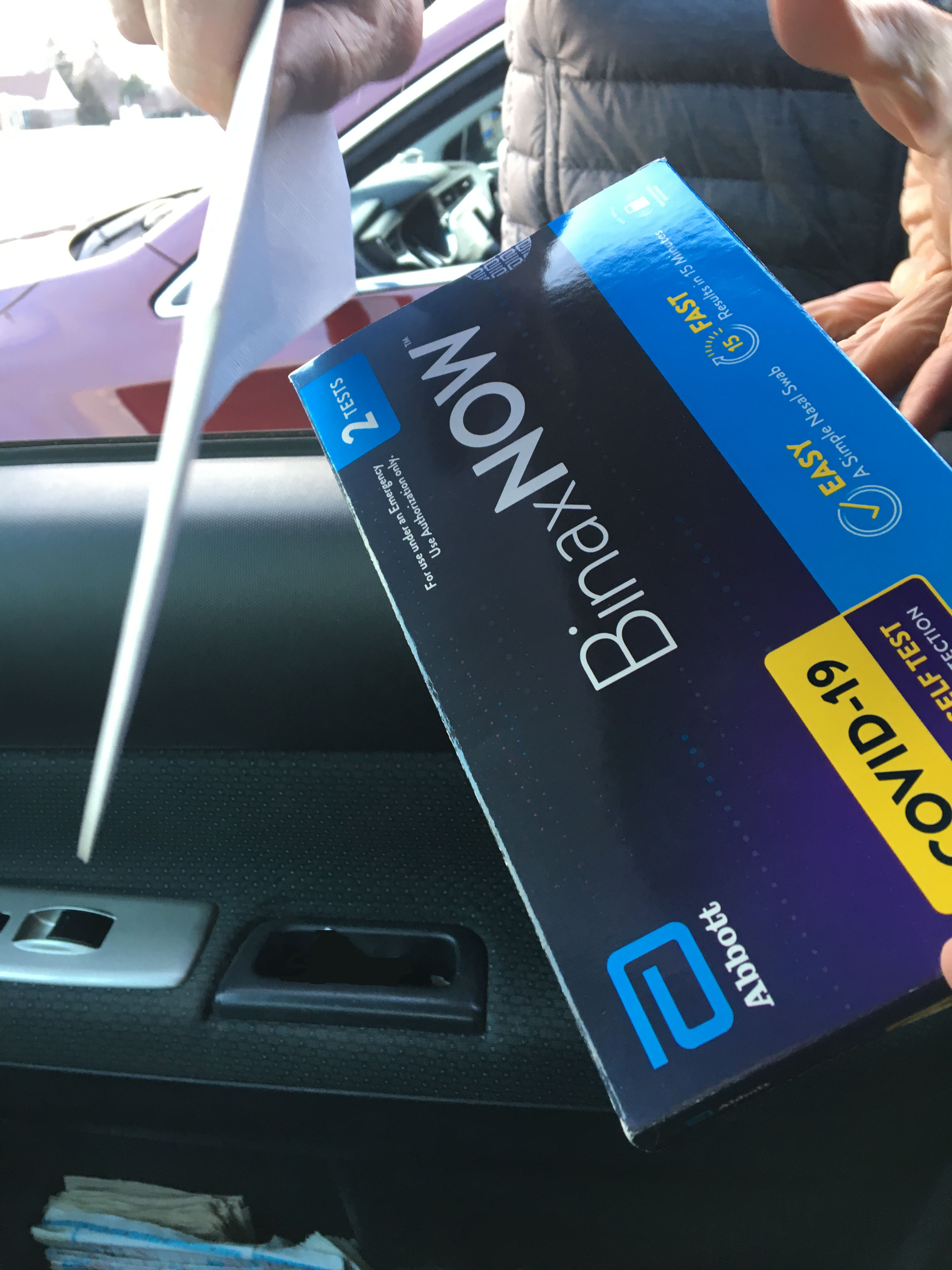
Kerri tells me that the woman in the next car thought she and 20 were doing a drug deal. He felt sick, needed a test and could find none. We had a few so they met in a parking lot to make a safe pass. While making the exchange, he handed her an envelope. Money for the phone bill but I’m sure it looked suspicious.

It reminded me of the time, many years ago, that Sam asked me to meet him in a parking lot. He rolled down his window and passed to me a sheaf of poems. The window went up. I was to tell no one. It was terribly vulnerable for him to share. I cried the day he published his first book of poetry. It was a titanic journey from fear-of-certain-shame to proudly publishing his beautiful work. He was transformed.

I imagine someday we will stand and look back at this titanic journey. I hope that I remember with fondness the story of Kerri and 20 making an exchange in the parking lot, the women one-car-over shocked by what she thought she was seeing, and we smile. Transformed. Remade as better people in a better community making better assumptions of each other. Stronger.

For now, as the credits rolled on The First Wave, we looked at each other and together said, “I’m exhausted.”

read Kerri’s blog post about THE EXCHANGE

See The Subtle Color [on Not So Flawed Wednesday]

“The most colorful thing in the world is black and white, it contains all colors and at the same time excludes all.” ~ Vikrmn

I loved watching Kichom facilitate groups. His specialty was impasse. He spent years developing and refining processes that opened pathways in hopelessly divided communities. He helped them find a third way. His was not a process of compromise. I’d describe his work as escalation-to-breakthrough. In minds and hearts entrenched in black-and-white, he’d reveal the nuance of color. He loved the moment when eyes-squeezed-closed-against-possibility opened ever so slightly to see.

Kichom understood that, to fully open a story, it was necessary to first look at the full story.

I often think of Kichom and wonder what he would do if these un-united states were his client. I wonder what he say to a nation built on slavery that refuses to discuss something as simple (and obvious) as critical race theory. Every healing path begins with acknowledgement of the wound. Perhaps Kichom would tell me that our current escalation might very well lead to a breakthrough. That is my inner idealist speaking.

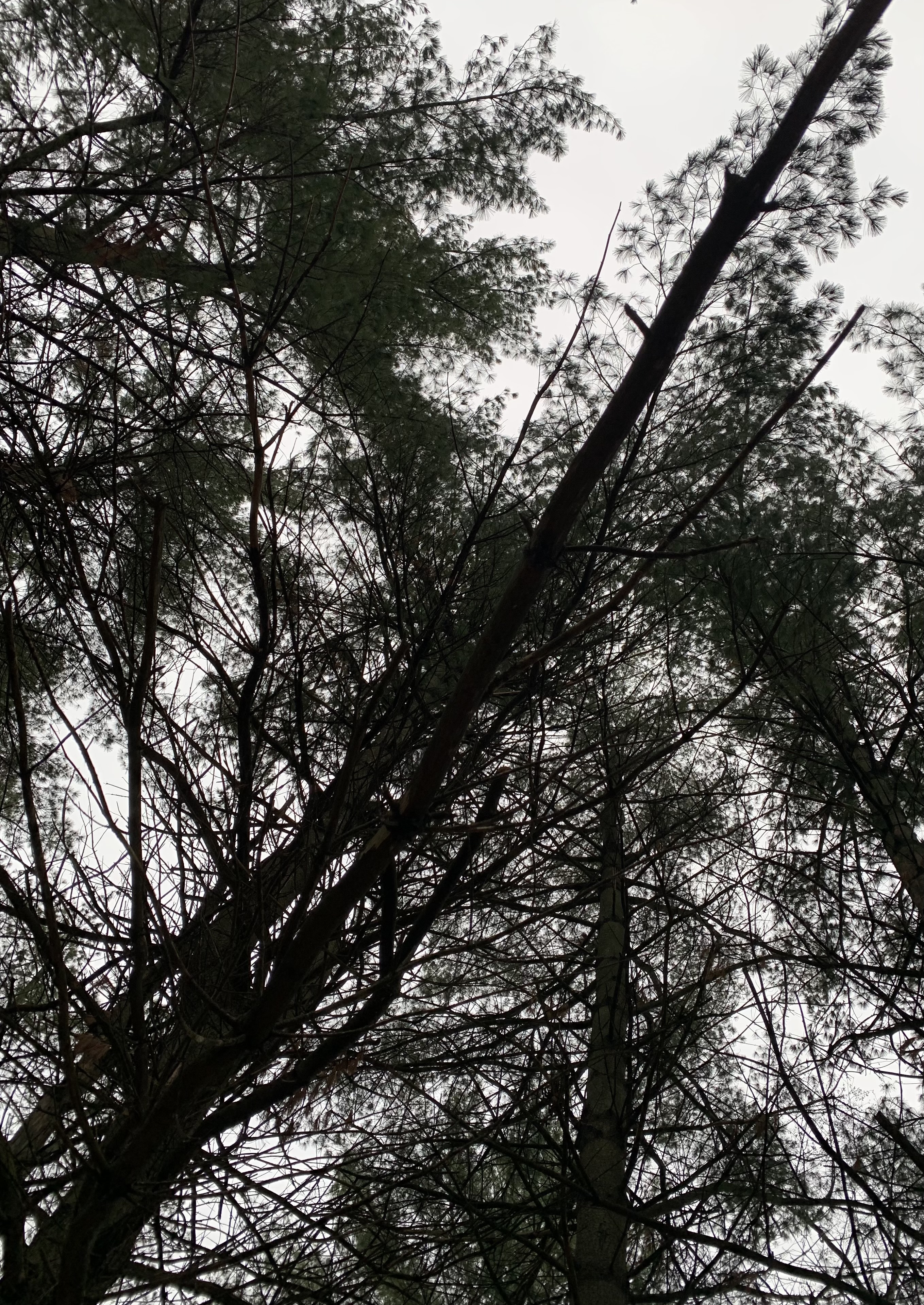
It was a very cold day. Even wearing gloves, the tips of our fingers were growing numb. When Kerri said she wanted to leave the trail and step into the grove of trees, I jumped up and down to stay warm. She waded into the thicket, took off her gloves, and pointed her camera to the sky. A few minutes later, as I jumped up and down, she waded back through the thicket to the join me on the trail. “Isn’t this cool!” she exclaimed, red fingers holding the camera for me to see. “People will look at this photo and think it’s black and white but it’s not! It’s winter!”

Looking at the photo, divided on the diagonal, I heard Kichom’s laughing voice. “It’s never black and white,” he giggled. “It only seems that way. Keep looking and soon the eyes will open to a world filled with subtle color.”

It’s something to be hoped for. The opening of the eyes. The acknowledgement of a problem. A good hard look at the full story. A breakthrough in a community that is dedicated to seeing in black and white.

read Kerri’s blog post about BLACK AND WHITE

Throw Some Light [on KS Friday]

“The principles of true art is not to portray, but to evoke.” ~Jerzi Kosinski

Out of seeming chaos, pattern is found. And, from pattern, chaos is born. It’s a creative cycle. I spent some time this week swimming up the river of systems theory, synthesis instead of analysis. The means of production in an agrarian economy; the means of production in an industrial economy; the means of production in an information economy. The relationship between the methods and materials, the behaviors and the purpose, systems take on a life and energy of their own. The toil to feed more people led to toil to automate to relieve manual toil, led to automation to relieve intellectual toil, will lead to… we can only imagine. And, we do imagine: imagination is the relationship between the present and the future. Stand back and you’ll see, amidst the mess and chaos, we attempt to evoke a better world.

It is not a coincidence that a banana taped to the wall is considered art in an age in which Tucker Carlson is considered a source of truth. Ironically, in the golden age of information, we are befuddled by vapid minds and empty suits. Bananas and duct tape. Shock without substance can only evoke anger and will illuminate nothing. Anger for anger’s sake can only destroy. There’s no nourishment in all of this anger candy but it is certain to lead to national-diabetes and rot our teeth.

Marcel Duchamp, at the beginning of the last century, entered a toilet as sculpture in an art exhibit. He lived and worked in the age of industry at the threshold of mass production. His gesture had purpose and aesthetic framing. What was formerly craft and individual creation was now stamped into being on an assembly line. That’s old news to us but, in his time, it was a shocking revelation. A world war was raging. The collision of old practices meeting new technology was playing out on the battlefield. His exhibit entry evoked questions about loss and gain in the dawn of a new world order.

Sometimes it seems that we are spiraling into chaos. Polynices and Eteocles, brothers who will not compromise, kill each other in a battle for dominance. All lose. A father’s curse fulfilled. In our great art, the work that evokes truth and throws light to our hearts and minds, we have all the guidance we need – if we choose to pay attention. Yesterday I wrote to Mike that it seems we will need to walk the path of Romeo & Juliet: “Two households, both alike in dignity…”will lose their children to violence rather than sit down at a table and earnestly talk. And, when it is too late, when the primary is lost, the formerly indignant will sit and mourn together.

Chaos. Pattern. Sometimes the pattern is chaos. The children die. The mother takes her son across state lines with a big gun and pretends, after he murders people with his big gun, that his crime was self-defense. Bananas taped to a wall. A judge who broadcast to all that a guilty verdict might trigger his decision for a mistrial. He’ll just wait and see if he agrees with the jury. So, here we are. Lady Justice takes off her blindfold and takes sides. Is there a more profound statement of ethical collapse? In the age of information, misinformation gets equal billing; anger-candy.

What might Duchamp put on his pedestal today? What might evoke an honest conversation, throw some light and love, on what is lost and what is gained?

read Kerri’s blog post about FIRE AND SMOKE

Kerri’s music is available on iTunes and streaming on Pandora

See The Point [on Merely A Thought Monday]

“When we are no longer able to change a situation, we are challenged to change ourselves.” ~ Viktor Frankel

There is a new mantra cycling through my circle of friends. Once, highly frustrated with people refusing to participate as a community in the relatively benign measures necessary to end the pandemic, they’ve now forged their frustration into a different shape: there’s no point in trying to change “them.”

The circle is closed. Or, perhaps, it has been closed all along. Us. Them.

We spent the weekend in a special cabin with The Up North Gang. Walks in the woods. Pontoon boat rides seeking a sunny spot to anchor. Friends that heal what hurts. Laughter and wine. Occasionally, our conversation wandered into politics and pandemics, usually spurred by a local man posting cryptic and apocalyptic messages from deep within his conspiracy well. He is one of “them.”

“How can he believe this stuff?”

“Imagine everything he has to ignore to believe this stuff!”

“He’s always been a bit kookie.”

“There’s no point in reasoning with him.”

“There’s no point in writing a response, he’d just deny the facts, the court cases, the data, the science, the…”

There’s no point. That’s the mantra. There’s no point.

Us and Them. Together in the same boat. One half trying to rock the boat. The other half trying to keep it from flipping.

Exhaustion? Surrender?

“It’s like they’re drowning in bad information,” she said,

He replied, “And, there’s no sense throwing them a rope, they’d refuse to take it.”

“We have thrown them a rope,” she added. “It’s called the vaccine.”

We laugh a sad laugh, shaking our heads. What’s the point?

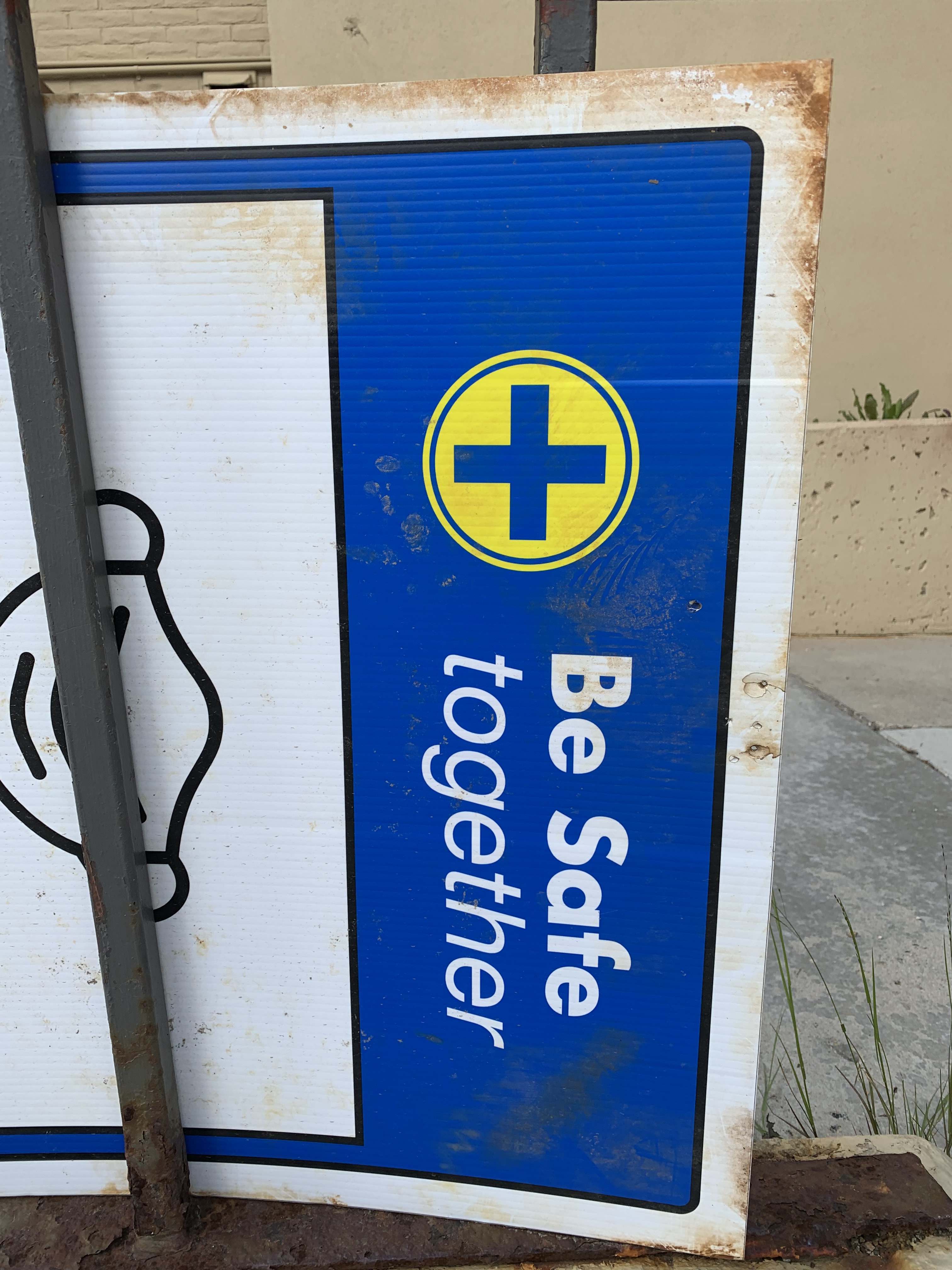
read Kerri’s blog post about Safe Together

Let’s Get On With It [on Not So Flawed Wednesday]

It was a national campaign of the US Department of Homeland Security. If you see something, say something. The enemy is here. It is us. We pulled it from an episode of Grace & Frankie. Old folks have hair that grows in places it ought naught. Frankie plucks a hair from Grace’s chin. “How long has that been there?” Grace exclaims. “Frankie, if you see something, say something!”

Yesterday, I had a collision of experiences at the courthouse during my jury pool swim. First, I read an article in The Atlantic, by Tom Nichols, Afghanistan Is Your Fault. He wrote, “The soldiers who served overseas in those first years of major operations soon felt forgotten. ‘“America’s not at war” was a common refrain among the troops. “We’re at war. America’s at the mall.”’

He continued, “A serious people—the kind of people we once were—would have made serious choices, long before this current debacle was upon them. They would today be trying to learn something from nearly 2,500 dead service members and many more wounded. They would be grimly assessing risk and preparing both overseas and at home for the reality of a terrorist nation making its way back onto the international map.

Instead, we’re bickering about masks. We’re holding super-spreader events. We’re complaining and finger-pointing about who ruined our fall plans.

Next, I was among the many chosen for voir dire (the jury selection process). I was in the last group selected so the odds of my serving on the jury were slim. I sat in the courtroom and watched an amazing moment unfold. The judge said something that all Americans should hear. It aligned perfectly with Tom Nichols’ thoughts. A potential juror, a young man, claimed serving on a one-day trial would create hardship. He’d miss a day of work. The judge questioned him to get more context and then sat back, considered for a moment, and said this:

“Democracy is hard work. When I was young, there were three things that we had to do: pay taxes, honor the draft if called, and serve on a jury if called. All of those things create hardship. Taxes aren’t easy. The draft changed the lives of thousands of young people. Serving on a jury interrupts life. It creates hardship. Giving of yourself to the common good means serving something greater than yourself. It is an interruption. Today, there are only two of those things because there is no draft. My point is, giving of yourself to make this gorgeous system work is not easy. It is hard work. It creates hardship to ensure that our system, the oldest democracy in the world, thrives and survives for the next generation.”

America is at the mall. Meanwhile, democracy is hard work.

For a serious people, there is a center to our commons and, keeping it alive, takes a bit of self-reflection and sacrifice. Giving of yourself to the common good means serving something greater than yourself.

Divided we fall. It is a cliche’ but could not be more relevant.

The enemy is here. It is us. Bickering about the lesser while the greater slips from our fingers. “If you see something, say something” is predicated on an assumption: we are in service to something greater than ourselves. We are on the same team with a common, shared interest.

The judge sat back in his chair after his lecture and asked the young man, “Are you less capable of handling hardship than anyone else in this room?”

“No, sir,” the young man sat back in his chair, resigned.

“Good!” the judge exclaimed. “Now, let’s get on with it.”

read Kerri’s blog post about SEE SOMETHING, SAY SOMETHING