Consider The Fact [on Not So Flawed Wednesday]

In writing yesterday about the frogs arising from their eradicated landscape, I realized our front yard has become a bit of a metaphor. It, too, was eradicated. In the past two years it has been blasted to bits, trenched by too-large machines, huge mounds of earth and debris left behind to molder. After a prolonged battle, the digger of trenches and leaver of mounds returned with a different batch of too-large machines and quickly scraped away the mounds and all the living things, tossed some seed, spread some hay, and tacked some netting to the ground to keep the seed from blowing away.

A metaphor of our life. Eradicated landscape. Willy-nilly seed.

Yet, just as the frogs filled us with awe at their resilience, we are amazed watching determined shoots of hardy green reach through the disruption. Each patch of green perseverance fills us with giddy hope. New life is coming!

“We are like that,” we affirm.

We are not alone in our renewal. We are surrounded by a mighty community. Dan shares his grass-mastery and guides us toward lawn renewal. Dwight shares his wisdom and encourages us toward soul regeneration. 20 keeps us laughing and our hearts light. Brad and Jen walk each step with us. There is more support than we can count, more friendship than we can believe, both near and from afar. Abundance.

Abundance. Beyond metaphor, it is the fact of our life.

read Kerri’s blogpost about GREEN

Lean Into The Questions [on Merely A Thought Monday]

A theme that surfaces in my conversations with Rebecca is how unsafe people feel – especially women – to ask questions. At work. At school. Asking a question is too often misunderstood as a challenge to authority. It’s dangerous. Smile. Be silent.

I suppose authority has always been thin-skinned though the idealist in me wants to believe that we’re all in this together. I know without doubt – as we all know – that the way forward is through the field of questions. The best answers open doors to better and better questions. Anyone afraid to be questioned and insisting that their answers are absolute – full stop – should inspire dread.

After eight years on the job, Kerri was handed a contract with the mandate to sign it. She asked a few questions. The description in the contract didn’t align with the reality of the job she was performing or the previous agreements made with her supervisors. Authority did not respond well to her questions. The ensuing assault was incessant. Bullying. Dangerous. For awhile she tried to comply with the only advice offered her: smile sweetly. I wondered, if a man was being similarly pummeled, would he be offered the same advice? When Kerri finally stopped smiling and stood solidly with her questions, she was branded “belligerent” and “uncooperative.”

I doubt a man would be similarly pummeled. To this day, I wonder at all the men and women in the community who watched the pummeling and said nothing. As witnesses to the danger in asking a question, they held-their-tongues. I suppose they learned their lesson. Ask no questions. See no evil. Hear no evil. Look away. Speak no truth.

And, while they weren’t looking, their community fractured and fell apart. All were diminished. Thugs count on division; it’s their secret sauce for establishing control. They engender silence. It’s how they maintain their authority.

And, isn’t that the true danger. We don’t want to bring the the wrath of the gorilla upon ourselves so we “get on board” or “toe the party line.” Smile sweetly. Pretend the bully isn’t beating the woman into submission. Make the assault her fault. She brought it on herself.

Kerri’s experience is a microcosm. The bullies have the microphone. World-wide, authoritarianism is on the rise.

If ever there was a time to lean into the questions, it is now. If ever there was a time to ask aloud, “What are we doing?” and “Why are we doing it?”, it is now. Together, asking questions capable of leading to answers that open doors to better and better questions. We have no shortage of persecutors beating down questioners while screaming that they have all the answers and their answers are absolute.

Perhaps the questions we need to ask together are simple: Is this who we are? Is this who we want to be?

read Kerri’s blogpost about SMILING

Ask A Simple Question [on DR Thursday]

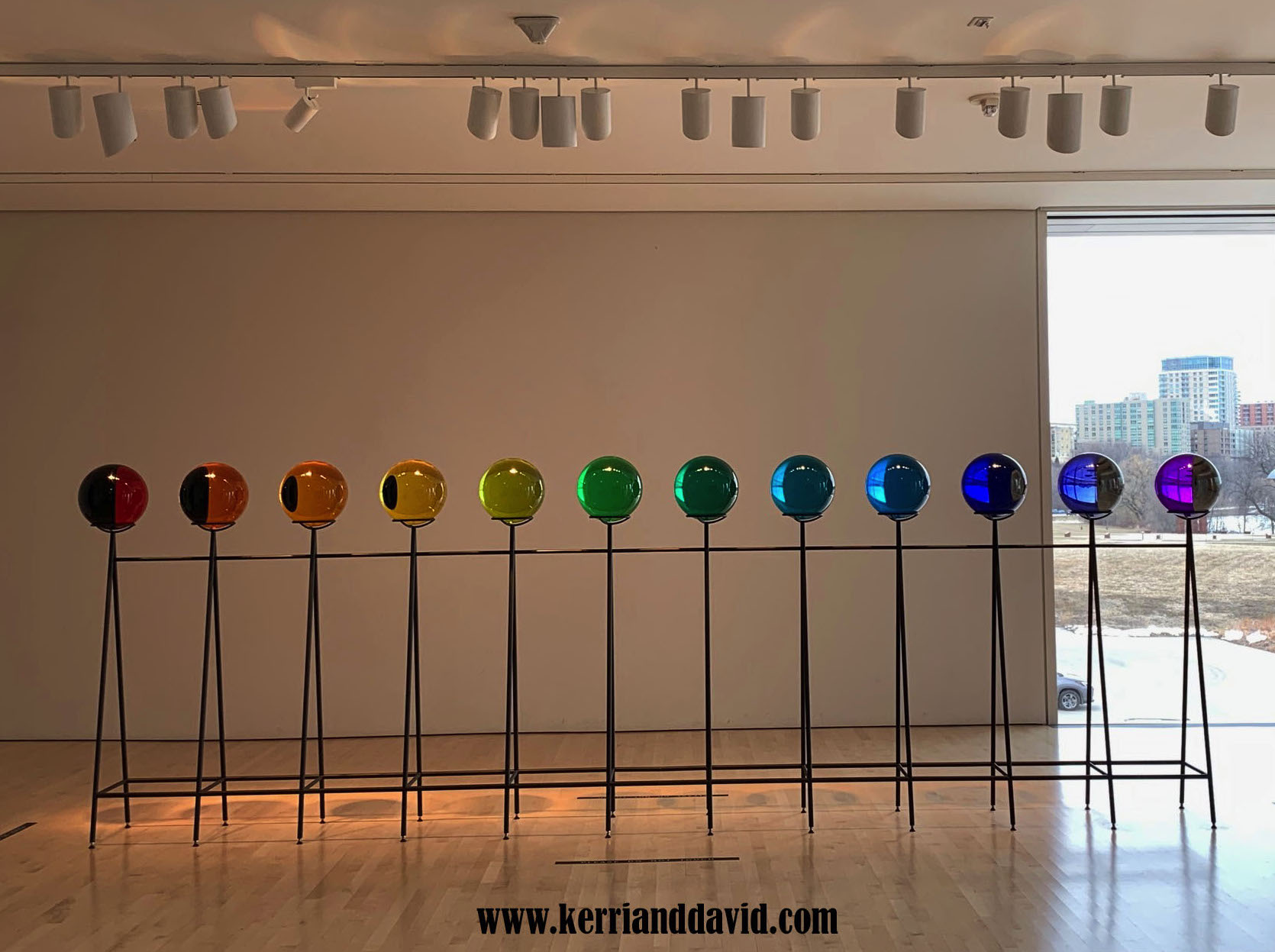
It’s existential. What you see changes depending upon where you stand. That’s true when engaging any piece of sculpture. It’s true when engaging anything in life. Point-of-view is fluid and relational. This sculptural reminder is Olafur Eliasson’s Rainbow Bridge.

In another era of my life facilitating diversity and inclusion workshops, the same surprisingly simple concept was usually a revelation to people. What you call “normal” is merely a point-of-view. Most importantly, it’s not everyone’s point-of-view. Your “normal” is unique to you, not universal. Most hopeful: it’s not fixed in stone. It’s changeable. Relational. Capable of growth. A mature point-of-view recognizes that it need not, it cannot, be the center of the universe. A mature point-of-view necessarily asks an all important question: “What do you see?”

It’s not only possible to look at the same sculpture and see a myriad of differences, it’s necessary. It’s human. Sharing what we see is how we, together, create community. A common center is created by a circle of differing points of view. A common experience is borne of sharing disparate points-of-view of the same event. A common center is made functional when everyone in the circle is capable of asking with sincerity a simple question: What do you see? It is made vibrant when everyone in the circle expects the answers to be different than their answer.

Art is one way of responding to the simple question.

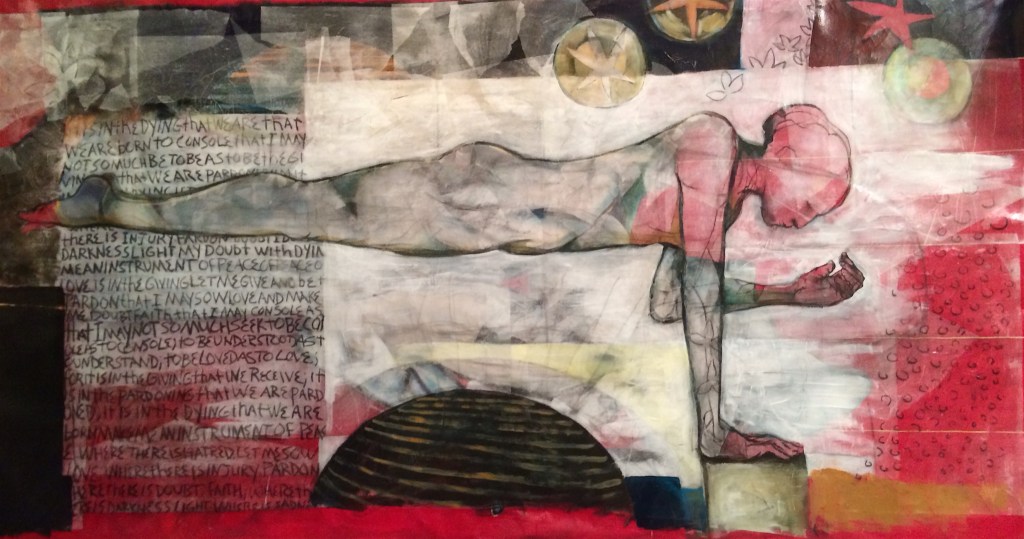
Instrument of Peace, 48x91IN, mixed media

read Kerri’s blogpost about RAINBOW BRIDGE

instrument of peace © 2017 david robinson

See The Frame [on DR Thursday]

The lake was angry. Had you dropped me in from outer space I’d have sworn I was standing on a beach of the stormy Atlantic Ocean. “I just can’t capture it,” she said, after snapping several photographs. The roiling waves hit the shore with thunderous power and intensity. I felt it in my chest. Distilling the energy within the frame of a photo sublimated the dramatic waves to an everyday image. The frame successfully abolished the fear and eliminated the awe.

On the trail this past Sunday, he quipped that the world as we knew it began its decline when CNN invented the 24 hour news cycle. It’s a lot of time to fill and, to keep people hooked (ratings), the importance has to be exaggerated. When everything becomes ‘Breaking News,’ the really important stories are lost amidst the manufactured dross. Scrolling through our news app this morning I felt as I once did while waiting in line at the grocery store check-out surrounded by the screaming headlines from The National Enquirer. Sorting to the grotesque. Manufactured awe has successfully amped up our fear. A very strange frame, indeed.

The real power of a frame-of-reference is that it is mostly invisible yet it determines the potency of the composition. Focus is largely a function of frame. I’m in the habit of taking “snippet” shots of my paintings. Altering the frame of what I see helps me…see. It promotes inquiry.

A fluid frame is like an open question. It facilitates engagement. A fixed frame does the opposite. It closes the question options: yes or no. A 24 hour news cycle necessarily defaults to a fixed frame. It pretends to be inquiry while promoting dogma. If you wonder why we are at each other’s throats, why we’ve reduced ourselves so severely to a community defined by two primary colors instead of the full palette available in our color-full nation, do an experiment: pay attention to the story-frame you are being fed.

Ice crystals formed on our kitchen window during the latest storm. Kerri rarely takes a single close-up. She takes many shots of the same subject. In a digital age, she is also able to pull a single photo into several different focuses and takes screenshots of the possibilities. A fluid focus. She composes. She questions. She asks. It’s a pure artist’s action. Turning to me she never asks, “Which is better?” Instead, knowing the power of a frame and with full respect for the difference that I might perceive, she asks, “Which do you like and why?”

joy. 50x56IN mixed media

Two frames. Can you see them? [the new site is like a good wine…taking its time to mature]

read Kerri’s blogpost about ICE

joy © 2014 david robinson

Rake The Ritual [on DR Thursday]

It is that time. The ritual of the green bags. They are green because they are biodegradable, an important detail in the ritual cycle.

The rite unfolds over the course of several weeks. Each household in our tree-lined neighborhood, according to their own special timing announced to them by the trees, shuffles into the fallen leaves with implements of collection or whirring blowing machines. They sculpt the leaves into piles. They scoop the leaves into green bags. They pile the green bags at the curb.

Some prefer to place the bags in a perfect curbside line. Some prefer to stack the bags. Later, an orange truck (our ceremony is punctuated with secondary colors!) rumbles slowly down the street, acolytes jump from the truck and collect the bags.

The communal bags are taken by the orange trucks to a community field where they are stacked high into transformational mounds. Over the winter, over time, the mounds slowly reconstitute. They compost. The green bags dissolve. The contents of the bags compact, heat, and join, becoming vibrant rich soil.

Energy changing form.

There is a matching ritual in the spring. The people, according to their own special timing announced to them by their flower beds, leave their houses and bring shovels to the mounds of soil. They collect buckets and truckloads of the former-leaves-now-earth, return home and dig the new soil into their gardens. The planting marks the beginning of the next cycle. As shovels turn earth, the trees bud, new leaves, future soil, pop green and tender on the branches.

A perfect life cycle. A time honored autumnal observance. The ritual of the green bags.

read Kerri’s blogpost about GREEN BAGS

Meditation, 48x48IN, mixed media

meditation © 2012 david robinson

Beg A Good Question [on Merely A Thought Monday]

She stopped, turned and went back to the truck. “What are you doing?” I asked. She pulled her camera from her purse and snapped a photo of the Sara Lee truck. She showed me the photo and slid her phone back into her purse.

“I thought this would make a good blog photo,” she said, adding, “If it wasn’t a marketing phrase it would beg a good question.”

How should goodness taste?

How should equality look?

How should community sound?

How should generosity smell?

How should love feel?

We experience the world through our senses. And then we make a story of what we sense. Senses first. Story second. It’s how the brain works. The language capacity, putting words to experience, is essentially a translation function. It does not lead, it follows. It’s why, for the most part, we choose the story we tell.

The word that strikes me the most on the bread truck photo is “should.” How should goodness taste?

How does goodness taste? To you?

How does equality look? To you?

For you, what’s the sound of thriving community?

To me, generosity smells like fresh baked bread and hot dark coffee. You?

And love? There are no words. But you know it when you feel it.

read Kerri’s blogpost about GOODNESS

Go It Together [on Flawed Wednesday]

“The problem is that this fluidity is not a choice we are free to make. Despite the unifying patriotic rhetoric that permeates the United States, on some level Americans are not really fooled: at bottom, each person knows he or she must continually “reinvent themselves,” which is to say, go it alone. America is the ultimate anticommunity.” ~ Morris Berman, Dark Ages America: The Final Phase of Empire

I laughed aloud when I read this quote. It reduced to a simple phrase what I believe is the collective experience of being an American (U.S.) in the 21st century. Together, we go it alone.

“Going it alone” is, of course a delusion shared by cowboys, republicans, and guys that put big tires on their trucks. After all, someone had to make the tires. And the truck. And pave the road. Using tax dollars since the roads are public and maintained by the collective. All of the chest-thumping expressions of individuality are, after all, firmly rooted in the lives and labors of others.

It only takes a minute to tease apart the loose fibers of the go-it-alone mythos. The problem is that one must want to think it through and, in our current spiral into stupidity, thought is shunned. So is history. At the core of anti-community is the absence of critical thought and a bucket of denial.

[Sidebar: this reminds me of a favorite phrase that, one day, popped out of Jim’s mouth: because you think it, does not make it so. Because you believe it, does not make it so.]

In my current state of residence, the governor, a democrat, asked the legislature, a randy band of republicans, to meet for a special session to discuss the ills that currently plague our community. The randy band gaveled open the session and then, as is its custom, immediately gaveled it closed. Legislators that refuse to discuss issues or policy. Sitting in the people’s house, obstruction is the only card in their deck. Not a single idea or impulse to serve the public in the randy band and their lock-step rugged individualism.

It is the sign of our times. Going it alone together is an ugly race to the supremacist bottom.

The cure for what ails us lives in the space between the gavels. Genuine discussion of the real challenges that face the community. An acknowledgement that driving the big cowboy truck adorned with big cowboy tires is only possible on the public road made viable by the shared effort of hundreds of fellow citizens. All of the Fox-driven drivel and religious right propaganda is never going to change the fact that we are all in this together. We can choose to be a failed state in a dedicated anti-community or we can thrive in the post colonial-era by bringing all ideas, all points-of-view, all people, to the common table for a wee-bit of collaboration, compromise, and long-needed-real-live-bona-fide-communal-reinvention.

read Kerri’s blogpost about MASKS OPTIONAL

Live The Words [on Merely A Thought Monday]

We awake each morning to birdsong. I imagine the birds’ song raises the spirit of the sun. Or, the birds sing because the sun raises their spirits. Both are good stories.

When I was in college I had a professor who seemed a bit radical. Now I recognize that he was not radical. He was a scientist and his data was prophetic. He was sounding an alarm for his students, knowing that his students could not yet hear him. He was the first person to introduce me to the notion of climate change. At the time, the world was still smarting from the oil crisis of the 1970’s. One day in class he said, ‘If you think the oil wars are bad, just wait until the water wars.” I heard his voice this morning while looking at photographs of Lake Mead and the river Po. Dwindling water meets rising population. Panic is in the air. In the meantime, Australia is drowning. Desperation is on the rise.

I like to imagine the birds raising the sun while the sun raises the song in the birds. It’s a story of interconnectivity. It’s to understand the question, ‘what causes what?’ – as a two way street. You impact your environment and your environment impacts you. Or, better stated, you and your environment are not separate events. (“The love you take is equal to the love you make.” ~ The Beatles)

Though he never used the word, “interconnectivity” was the construct my seeming-radical professor was asking us to consider. He understood that his students were products of a long tradition of disconnection. A dedicated delusion of dominance over nature ruled our construct and he was attempting to puncture that absurdity bubble. Pour toxins into your river and your water will poison you. Pour carbon into your air and your air will eventually pour carbon into you.

The same applies to governance and society in general. What we pour into it is what we will experience as it. H wrote that, “Politics is simply the exercise of being a good neighbor for the sake of the neighborhood.” Interconnectivity. For the sake of the neighborhood. Demonize your neighbor and they will, in turn, demonize you. Refuse to listen to your neighbors and they will refuse to listen to you. Pour guns into your community and your community will inevitably aim its guns at you. Lie to gain power and the lie will gain power over you.

Pour support, service, acceptance, consideration…into your community and it will respond in kind. “Do unto others as you would have them do unto you,” is not so complicated a concept when seen through the lens of interconnectivity. Kindness begets kindness. Acceptance begets acceptance. Honesty begets honesty. Intend it. Practice it.

These are easy words to say. Living the words is quite another story. Unless you happen to be a bird, singing the sun awake as the sun pours its rejuvenating warmth over your song.

read Kerri’s blogpost about THIS DAY AND AGE

Embody The Symbol [on DR Thursday]

Everything in the Japanese Garden is symbolic, intentional. Pine trees represent longevity. Rocks, I’ve learned, represent the bones of the earth. They are as necessary in the design as are the “ephemeral blooms of the iris, rhododendron, and plum.” The symbol is not complete without both.

“The ephemeral existence of human life and the timelessness of nature.” Balance.

Entering the small yard of the Shoin House at the Chicago Botanical Garden is instantly calming for me. The small house is designed to “merge the outdoors with the indoors.” It is closed to the public but always beckons. I want to sit in the alcoves and write. Or do nothing at all. In the garden, I am instantly “connected.”

“Connectivity” is a word that has moved to the center of the work that I am currently doing. Amidst our ubiquitous capacity to share (Facebook, Instagram, Tiktok…email, chat, tweet, slack, text…) we are less and less connected. As Neil Postman wrote, we have made the irrelevant relevant and the relevant irrelevant. We share but do not connect. Shared information is not – and never will be – shared meaning.

Symbols empty of meaning when a community ceases to understand, honor, tend or acknowledge the significance of the symbol. And, symbols are the glue of a community. They are the physical, tangible location of an ideal. Disconnect from the symbol and the house falls apart.

I think that is why I am drawn to the Japanese Garden. There, beauty is intentional. The symbols are so well tended, so intentional, that one need not know the specific meanings to enter the symbol.

And, that’s the point. Connectivity happens when people, together, embody their symbols. They enter them. They become embodiments of their symbol(s).

It is the artist’s job to bring people into a shared moment. To give them access to a unified experience. To help them transcend the splinter symbols that divide – and see them for what they are. To help people step back and take a good look at what they, together, are creating. A garden? A desert? Balance? Imbalance?

read Kerri’s blogpost about THE ROCKWAY

prayer of opposites © 2006 david robinson

Re-Connect [on Merely A Thought Monday]

The latest addition to my “Terms in this Unknown Land” document is TL;DR. Too-Long-Didn’t-Read. I laughed aloud when I heard this new acronym in a meeting. If there is a sign of our times, an identifying marker of our era, it is this: TL;DR.

We communicate through text and emoji. Chat. Twitter is a thing because it mandates brevity. Scrolling the news app is a study in cramming the full story into a brief headline. Marketers have mastered the 5 second ad. Businesses are liberal in their use of “narrative” and “story” but have no time to actually hear one. A short synopsis will have to do. Get to the point.

As a member of my culture I find that I scan more than I read. If I can find it on Youtube, I’d rather watch it than read about it. When I began writing blogposts ten years ago, the “rule” was 800 words or less. The rule has adjusted with our attention spans and now the target is between 400 and 600 words. Often, when I receive links to articles, they come complete with an estimate of how many minutes are required to read them. Yesterday, I read advice from a marketing guru that suggested we restrict paragraphs to two sentences or less; more than two sentences is a red flag: too much information. Less than two sentences is…a sentence.

So much information is coming at us all the time, we have no time or thought-space to take it all in. I wonder if we can discern relevance from dreck. A quick look at our leaders leaves me with a resounding “No!” Relevance is lost in the dreck and, since they represent us, they are us, our information inundation has rendered our attention spans tiny and blunted our acuity. We are awash in information while wisdom has gone missing.

Each week I attend meetings; the central concern is explicitly or implicitly about helping people connect. It reminds me of the conversations I heard in graduate school: while living in a city of a million people, the concern was about how to create community. So many people. So little community.

I ponder these things every day. With our ubiquitous technology, we couldn’t be more connected. Through social media, I know what people had for dinner or what cute thing the kids said. I receive advertising that confirms my devices are listening to me. Yesterday, for-the-hell-of-it, I said, “Machu Picchu.” Today I am awash in travel ads for Peru.

We are connected. Connection to everything is connection to nothing. Relevance is hard to discern in a tsunami of information masking as connectivity.

Relationships – real relationships – take time. Values cannot be communicated in a text. They must be demonstrated and deeply rooted in lived narrative. Stories that carry relevance cannot be well-told in synopsis. Opinions are so easy to tweet. Dreck is easy to fling. It is not the capacity to share that we lose in the crush. It is not connection. It’s the capacity to be present. With presence comes the capacity to listen. Presence is not in a hurry to be some other place.

Rich connectivity requires more than quick consumption of information. Sharing, real sharing, the kind beyond pressing a “send” button, is a two-way street between people who have the time to invest in each other. Once, it was called relationship.

TM;CL. Too much. Can’t listen.

read Kerri’s blogpost about TL;DR