The Pizza Thing [David’s blog on DR Thursday]

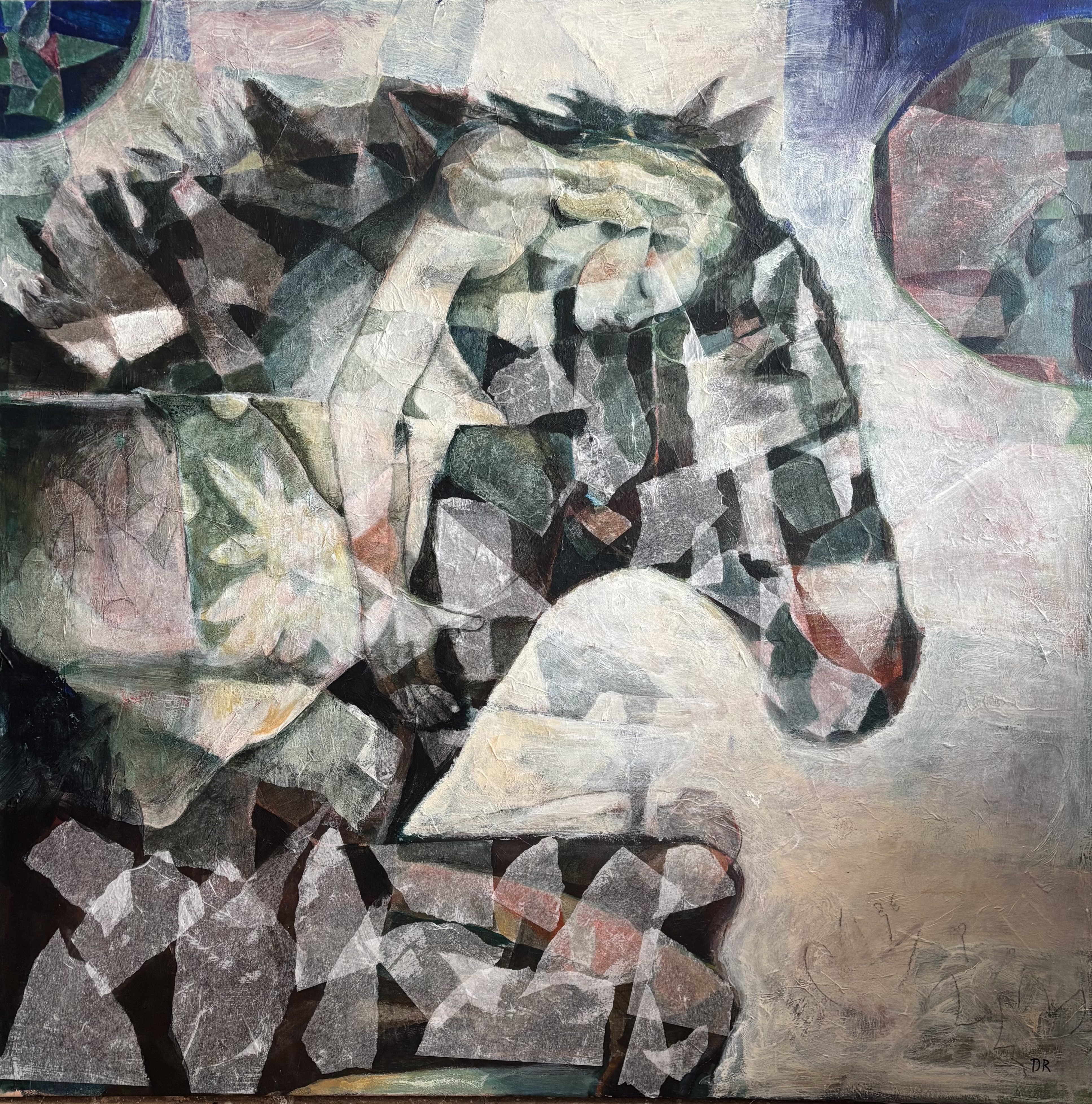
My latest painting I did for Kerri. It is a painting of invocation. I did not paint it from knowledge or plan. I felt my way through it.

On the day I thought I’d completed the painting I asked her if she wanted me to make any changes. After staring at the image for a few minutes she said, “I love it,” and then asked, “But what’s up with the pizza thing?”

In the many art openings I’ve had in my life I’ve learned that what I paint is rarely the whole of what a viewer sees. I used to be surprised by what others saw in my paintings but now I expect it.

“Pizza thing?” I asked.

“You know, the thing they use to put pizzas in the oven. A paddle.”

“Where is it?”

She pointed to a series of connected shapes on the canvas.

Once someone sees something in an abstract image – like a dragon in a cloud – they can never again not see it. I knew the painting was not-yet-done. She would always see a pizza paddle in the painting if I didn’t alter the shapes. “Do you want me to change it?” I asked. She nodded, afraid I was offended.

It is the great challenge of perception: people rarely look in the same direction and see the same thing. We do not share experiences until we…share them, talk about them, compare notes, come to a common perceptual ground.

A younger me would have defended the painting as I saw it. This older version of me feels no need to defend what I see since I don’t expect others to see what I see. I want to learn what they see. I want to step into a common ground, a space of collaboration. That doesn’t mean that I necessarily must change the painting. It does, however, afford me the opportunity to make it better if I so choose, if my question, “What do you see?” actually opens my perspective.

It’s why I feel the need to shout into the winds of our current political and national circus. It is unimportant whether or not we see eye to eye. It is most important that we share notes, ask questions, discuss discrepancies…discern what is fact from what is fiction. We have to want to step into common ground.

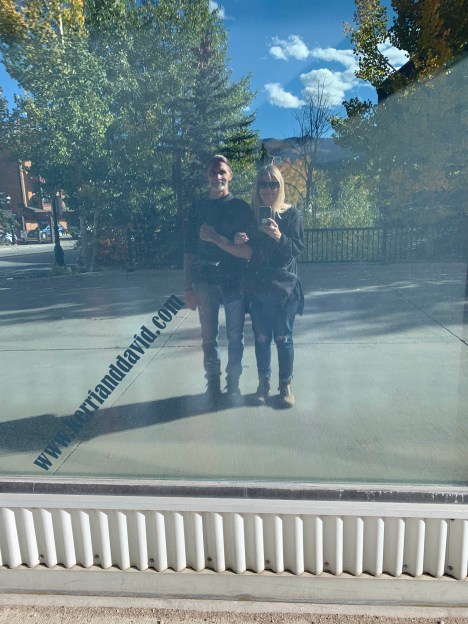
When we walk she often stops and aims her camera at the ground. “What do you see?” I ask.

She snaps the photo and shows me the screen. “A heart,” she smiles. “Do you see it?”

“Now, I do.” I say. I would have stepped over the stone and never seen the heart. And aren’t I fortunate to walk through life with someone who is surrounded by hearts and takes the time to show me what I do not see?

In Dreams She Rides Wild Horses (finished, without the pizza thing)

read Kerri’s blogpost about HEARTS

likesharecommentsupportsubscribe…thankyou.

The Greatest Weapon [David’s blog on Merely A Thought Monday]

The timing was uncanny. While on a slow walk in the park, deep in a conversation about our discouragement – no, our despair – for loved ones sucked down and seemingly lost in the dark, angry MAGA hole, we passed a group of girls engaged in an emphatic conversation and overheard the phrase, “I don’t know you like that!”

The phrase came like a slap. Kerri took out her phone to capture the slap in her notes. “That’s exactly it,” she said. “That’s precisely what is so troubling. It’s what I want to say: I don’t know you like that.”

I am lately haunted by the words of H.G. Wells: “Civilization is in a race between education and catastrophe. Let us learn the truth and spread it as far and wide as our circumstances allow. For the truth is the greatest weapon we have.”

There is a reason that the template outlined in Project 2025 includes the elimination of the Department of Education. There is a reason that governors in red states are (and have been) waging a war on education. Educated people ask questions. Educated people check the veracity of statements hurled their way. They take time to check facts and sources of information. In a democracy, an educated populace would never sign on with an autocrat exploiting their anger. They’d ask questions of their anger -and so would be impervious to exploitation. An educated populace would demand ideas from their leaders, respectful debate, reasonable compromise, adherence to the Constitution. They’d demand the same of themselves. An educated populace would see through the ugly name-calling and victim-squeals of a would-be dictator. An educated populace would pay no heed to the cries of “fake news” because they’d have learned to check it out for themselves. They’d hold news organizations to a higher standard. They’d care enough to question and verify information before jumping onto a hate-train. In fact (hear those two words) they would not so easily jump onto any train other than the truth-train because they were dedicated to living-in-facts that transcend bubble-gossip and tribal tittle-tattle.

This morning I had an HGTV revelation about our current political choice. It’s my latest metaphor illuminating the dangerous nonsense running around our nation in a red hat. I’ve learned in my HGTV viewing that demo-day feels good, takes very little time, very little thought, and requires only a sledgehammer. Anyone can do it. Destruction is easy. On the other hand, building the house is hard. It takes ideas, time, thought, planning, cooperation, collaboration, flexibility, knowledge, well-researched choices, skills, process and patience. Wisdom. All are the results of education.

Destruction is not complicated. It asks no questions, requires no learning. Destruction is the center of the red hat campaign.

Creating something beautiful and long-lasting is hard. It takes skill, the capacity to question and learn from mistakes. It takes a plan, forward thinking, and complex considerations, not fantasies sought in the rearview mirror of some imagined sitcom past. And it is never done. Building a better house is the center of the blue team’s campaign.

The red hat and company certainly espouse a plan, Project 2025, but an educated person would only need to ask the authors of the plan a pair of questions before rejecting it outright: 1) Why would you tear down the shining-city-on-the-hill and replace it with a dark prison? 2) Why are you trying to hide your plan from voters?

People I love, those caught in the undertow of the red swirl, empty of fact but full of shared-victim-anger, gulping and then spewing mouthfuls of toxic-fox-swill, waving their flags, raging with a dedicated ignor-ance…I don’t know them like that. I wonder how they came to know themselves like that.

Let us learn the truth and spread it as far and wide as our circumstances allow. For the truth is the greatest weapon we have.”

Let us learn about truth: Truth is not what we hear or see in the stream. It is not something verified by people passing memes around our social bubbles or validated because we share the same opinion and invest in the same misinformation sources that cater to our opinions. Truth is what we find when we question what we hear. It is verified by exiting our bubbles and questioning what we think we know, examining the foundation of our likemindedness. Truth is learned when we fact-check our own opinions and especially challenge our rigidly held beliefs. Rigidity is a red flag, a marker that something false is hiding.

I have learned to remember this: an opinion shared with great passion or rage is still just that – an opinion. Any strong belief held without question or reflection is, in fact, weak and makes us easily exploited, easily led. Lemmings. Fools. Learning the truth requires constant effort and personal responsibility – especially in our age of easy misinformation. In learning truth, our greatest weapon, there is never a need to fill the communal cup with fear-mongering. Truth dispels fear. It dissipates gossip, and, because it demands personal responsibility, affords no room for blame.

Truth is a common center. Education, the art of questioning and discernment, is the compass that gets us there.

read Kerri’s blogpost about I DON’T KNOW YOU LIKE THAT

like. share. comment. subscribe. support…thank you.

Small Ripples [David’s blog on Merely A Thought Monday]

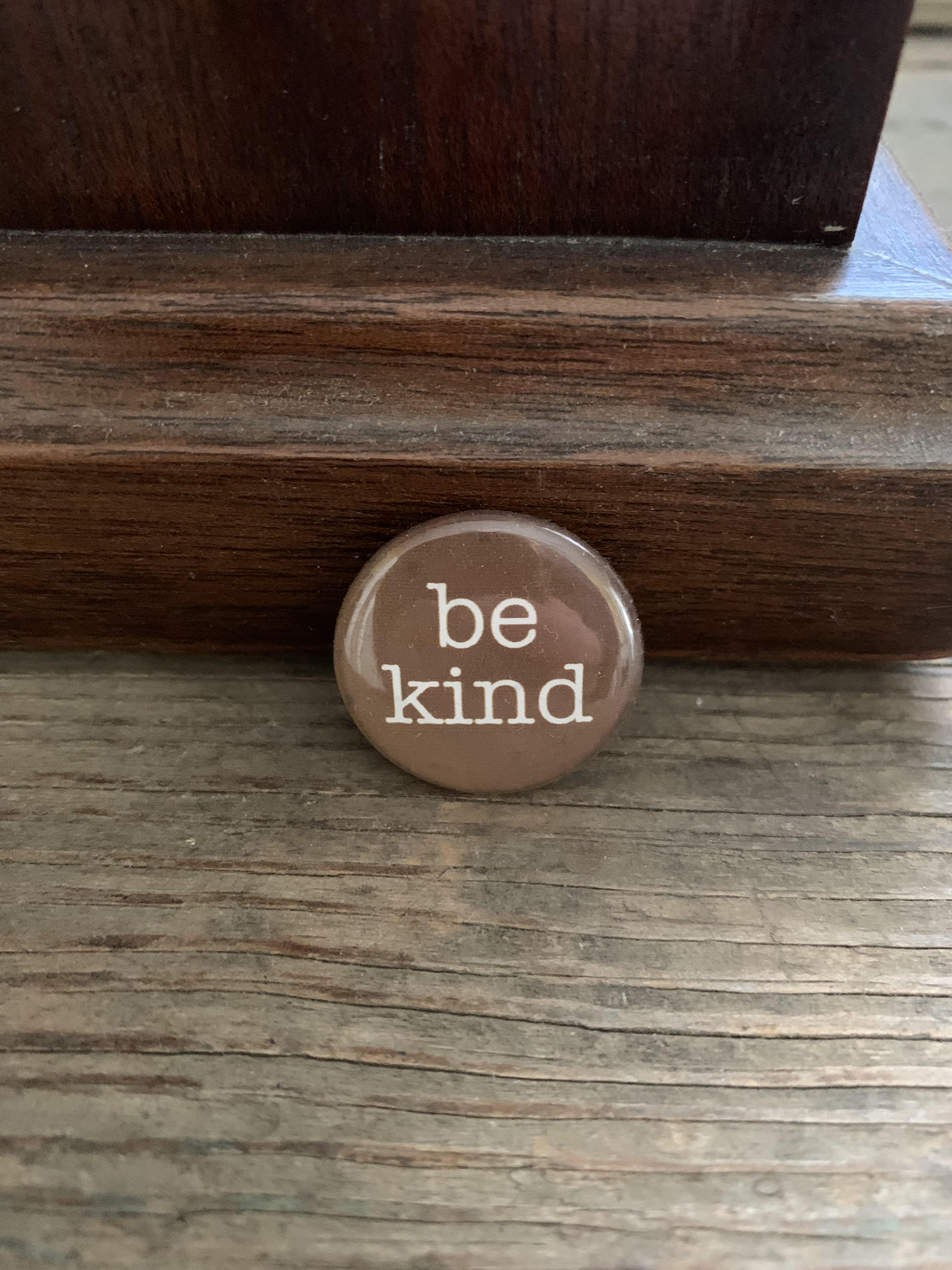
We made them for a Wednesday evening film, part of a series, when we were running a performing arts center. The film was Wonder. The message was kindness. We chose that film because the local arts community had a history of being particularly unkind to each other.

Theirs was an age-old challenge: the tension between the old and the new. The conservative impulse colliding with the necessity of progress. There were territories claimed. Feelings maimed. Status games abounded. As newcomers to the community and managers of the newest facility, we were the rope in the tacit tug-of-war. We experienced both ends of the spectrum: incredible kindness. Breathtaking mean-spiritedness.

None of it was personal.

Art is never supposed to be competitive. Great art creates generous audiences for everyone. COVID ended our time there but in our brief window, we acted as peacemakers. We heard the complaints. We helped vent the pressure. We found avenues to collaboration. We drew clear boundaries. We tried hard to be impeccable to our word: say what we mean and mean what we say. Averting confusion in a community versed in double-speak.

The buttons were available beyond the screening to anyone who wanted them. It felt yummy and subversive to show a film about kindness, about looking beyond superficial appearances to find the rich beauty in others.

I’d forgotten about the buttons. So much has happened in our lives since our time at the performing arts center that I’d almost forgotten about our varied experiences and the lessons we learned there. The buttons still exist on our site. We put them up after Kerri designed them, and although everything else has dropped out of our store, the buttons remain. An epicenter, perhaps. And, thank goodness. Recently a school was organizing a Be Kind Week. They found our buttons and, in some small way, it feels extraordinarily satisfying that our buttons, borne of our desire to break through walls of discord, are now supporting their kindness initiative.

Small ripples. Simple intentions.

read Kerri’s blogpost about BE KIND

Be Kind Buttons

like. share. support. subscribe. comment

Unfurl [David’s blog on Two Artists Tuesday]

I’m proud of her. Twice this week Kerri has fact-checked friends on FB who posted articles riddled with misinformation meant to rile. It took her less than a minute each time. In posting a link to the fact-check, she wrote, “Please check your information before you pass it on. xo”

It seems like such a small thing but it’s lately apparent that it’s becoming everything:

We forget that democracy is not a thing. It is an idea. It is an action rather than a noun. We forget that our democracy is young. Very, very young.

It worries me when I hear politicians making laws placing limits on the discussion of ideas at school. It worries me when I read that parents want teachers to teach “only the facts”. In today’s bubble-discourse it is a valid question to ask, “Whose facts?” Discerning between fact and fiction requires minds and hearts capable of questioning, capable of challenging the “facts” they are being fed. The notion of the purpose of education as a feeder-of-facts is nothing less than a sign of moral and mental decay. This is especially true in our great age of information with its ever-present shadow of rampant misinformation.

Democracies collapse when ideas and ideals are no longer debated, when winning-at-any-cost overshadows compromise, when respect for divergent points of view is overrun by intolerance. Healthy democracies are an ongoing tug-of-war; creative tension generated by a lively and respectful exchange of perspectives. This requires a system of education that nurtures these qualities and capacities.

Democracies collapse when they aim for an end result rather than steward a living process.

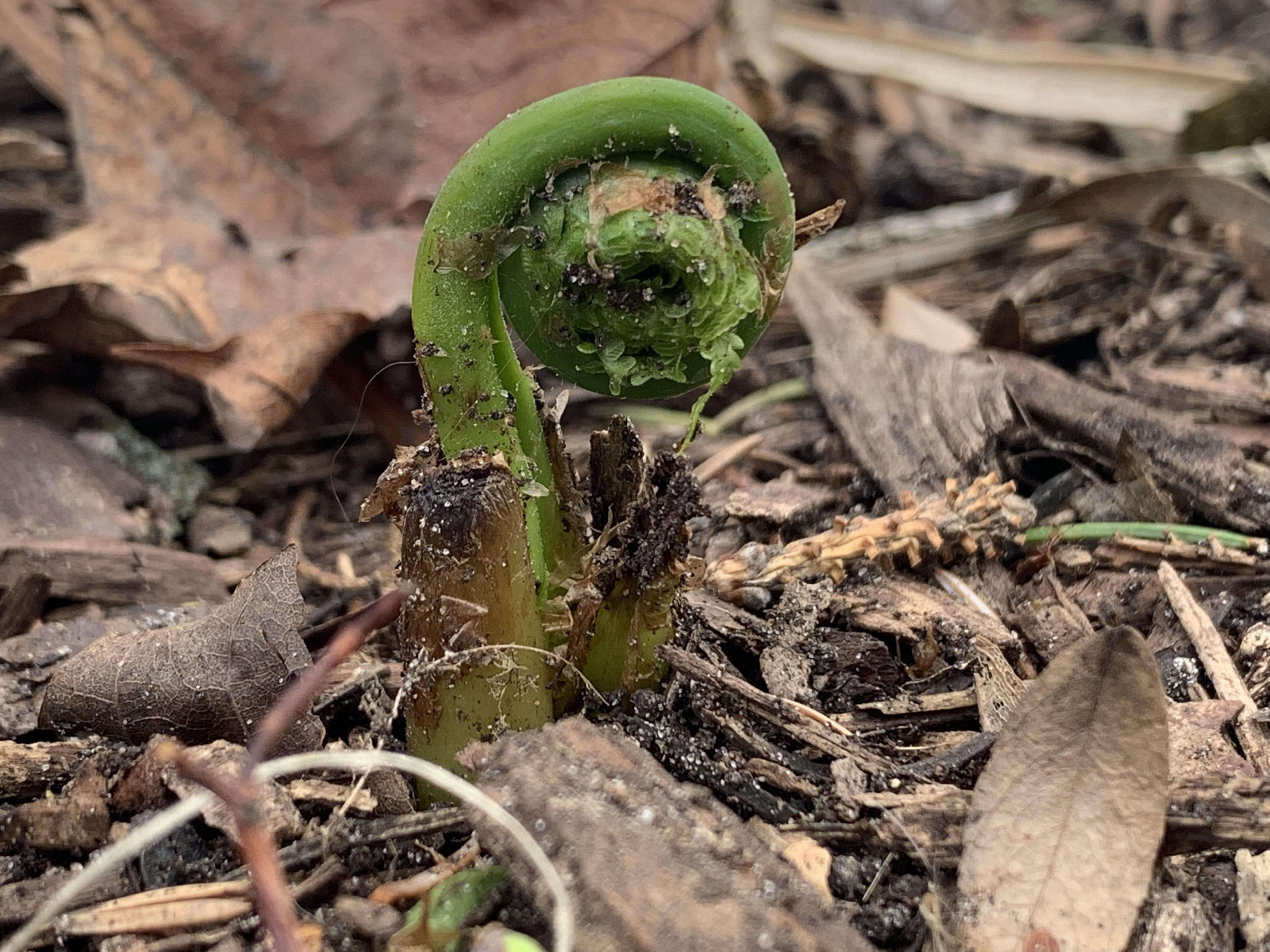
The point of education in a democracy is to consciously and carefully unfurl young minds so they might become active questioners, expansive thinkers, participating citizens in an ongoing experiment in a complex system called democracy, capable of stewarding their communities forward through an ever-changing world toward the promises inherent in the IDEA: equality, inclusion, governance by the people, for the people.

I would hope that we become capable of grokking governance-by-the-people which necessitates a people educated in ideas, reinforced in their curiosity and capacity to question, to converse and debate complex issues, capable of discerning ruinous power-over-agendas from the central idea enlivening their budding democracy: power with.

read Kerri’s blogpost about FERNS

like. share. support. subscribe. comment. many thanks.

Flawed [David’s blog on Merely A Thought Monday]

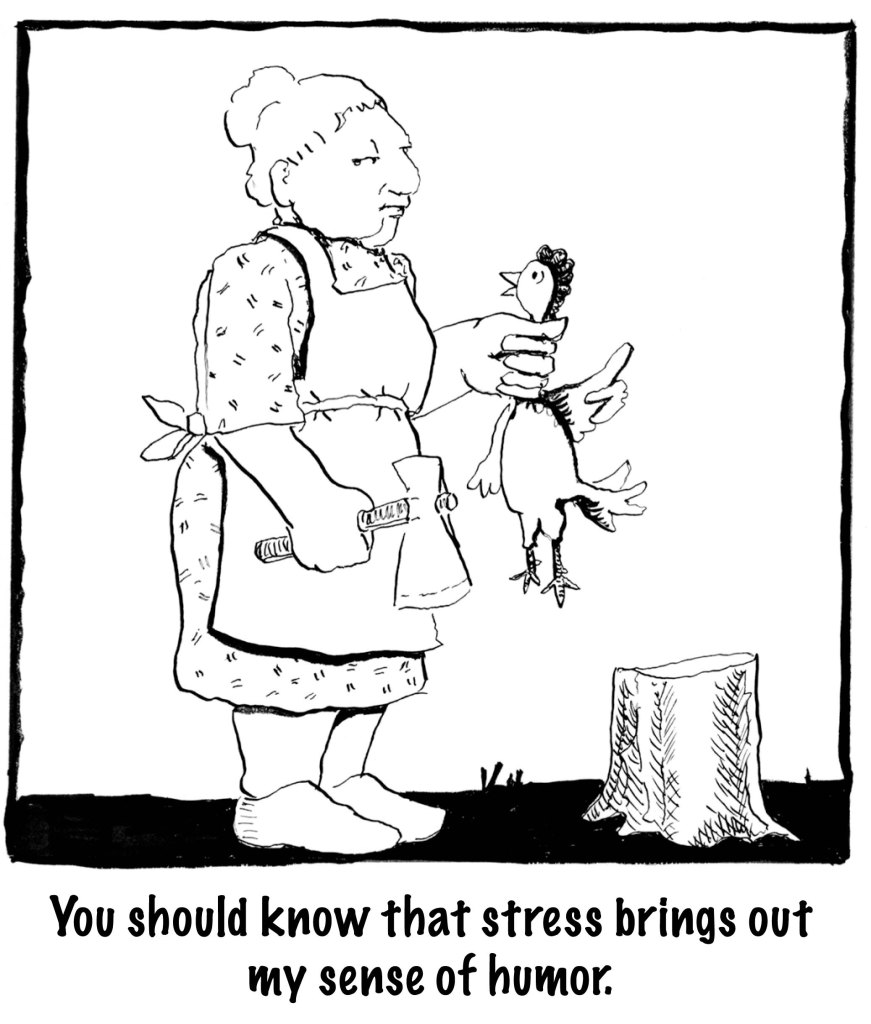
Over time I have grown more and more fond of our cartoon, “Flawed.” It was initially a collaboration between Kerri, 20, and me and was the source of great hope (we attempted to syndicate it) and many giggles. It was also the origin of our Wednesday melange posts: the prompt for Not So Flawed Wednesday was a Flawed Cartoon.

I noticed that writing and drawing a cartoon transforms you into a dedicated ethnographer. It necessitates paying attention to the world unfolding around you. It transforms you into a collector of the beautifully ridiculous.

The material has to come from somewhere. While we were producing Flawed, we’d move through our days with paper and pencil at the ready or we’d whip out our phone, add a note, send an email or text to ourselves. “What’d-ya see?” was a regular question. Everything was fodder for Flawed. A simple trip to the grocery store became a rich expedition for cartoon possibilities.

While hyper-focused on the actions playing out all around us, one thing became abundantly clear: people are flawed. Thank goodness. All of us are pushing our individual carts through life, gathering our stuff, stacking our importance, wishing other people would get out of our way – until we need them – and then we are grateful for their assistance. We rarely see that we are shopping together, all sharing the same store, the same road, all attending to our aloneness in the midst of abundant and ubiquitous support.

No one is perfect. No one has answers to the big questions. No one is free of flaws or quirks or trespasses or cracked-yearnings. It’s possible that our flaws are what bind us. Wabi-sabi. We are kintsugi held together, made better and stronger by the pure gold of our imperfections. That was – that is – the idea behind Flawed Cartoon.

A few Flawed Cartoon Designs on Society6

read Kerri’s blogpost about FLAWED

like. support. share. subscribe. comment. thank you!

Incite Some Deviance [David’s blog on Merely A Thought Monday]

I searched for it but couldn’t find it. A short clip of Carl Sagan placing life on our tiny planet into the perspective of the enormity of the universe. A little sun in a galaxy of suns in a universe of billions and billions of galaxies. Through this lens, it is mind-boggling, the hubris necessary to believe we are the center of it all.

Initially this morning, I wrote a post about grace but cut it. I asked a question about the collision of values: loyalty-to-a-group smacking down telling-the-truth. It’s a uniquely human dilemma. The insistence upon tribe, Us-and-Them, spins some very dark necessities. I tossed it because grace was overshadowed by gloomy.

This is what I intended to write: on this tiny blue ball there is a group of Us defined as “All Humans”. Loyalty to this group is understood as idealistic. How can we possibly reach across so many imagined boundaries? What would we do with a definition of Us that was all inclusive? We would invite grace. Float all boats.

Each year, everywhere I wander, I am steeped in songs-of-the-season that appeal to the best of our nature. Peace on earth. Goodwill. Love one another. Perhaps we should listen to the lyrics of these songs. They are written by us for us as an appeal to our idealism, a sentiment central during this season of light’s return. Peace. Peace. Peace. We should “take it to heart.”

Let’s face it, loving one another is deviant if it is all inclusive.

It’s a reach, I know, but it’s really not so hard to imagine Us in the context of this vast universe, on this tiny ball spinning and spinning around our minuscule sun, one of billions and billions and billions. In such a context, the boundaries-in-our-minds dissolve and invite a different set of questions to arise: How can we better share this blue dot together? Conflict makes money yet collaboration creates possibility.

Pouring a little light into so much dedicated tribalism is deviant. It requires a touch of dignity. Pouring light into darkness is called Grace. Grace, in the face of so much division, is deviant.

When I cut my initial post I wondered what it would take to breach the code of tribe, reach beyond the singing platitudes, and incite some deviant behavior like peace-on-earth and all-inclusive love-of-one-another.

read Kerri’s blogpost about DEVIANT BEHAVIOR

like. share. comment. support. lending a hand to anyone is a way to support us. think on it.

buymeacoffee is a force like gravity helping the artists you appreciate keep their feet on the earth.

See More. Know Less [David’s blog on Two Artists Tuesday]

“(What makes his world so hard to see clearly is not its strangeness but its usualness). Familiarity can blind you too.” Robert Pirsig, Zen and the Art of Motorcycle Maintenance

Red and green. Oppositional on the color wheel yet understood as compliments. They set each other alight.

I am certain the longer I walk this life the less I know. How much time did I spend trying to get-there-fast? How much life did I give to my attempt to attain the mountaintop before I realized that there wasn’t one? How much hubris did I exude believing “my” work might change the world before I was humbled sufficiently to see that the world was changing me? Is there such a thing as “my” work? I have lived a life rich in collaboration. Who hasn’t?

And, how fortunate am I that life has routinely tossed me out of my “comfort” zone? Don’t get me wrong, I would appreciate a bit of smooth sailing with ample provisions but the ongoing absence of “normal” makes eyes-wide-open a necessity. There is no missing how interdependent we are, how utterly interconnected, when here-and-now is the only place we can clearly see.

read Kerri’s blogpost about RED AND GREEN

like. share. support. comment.

buymeacoffee is. nothing more. nothing less

Steward The Radical [on Merely A Thought Monday]

I’m reading Gordon MacKenzie’s brilliant book, Orbiting The Giant Hairball: A Corporate Fool’s Guide To Surviving With Grace. There’s plenty to love in this little book that extrapolates beyond the corporate cubicle. This morning I laughed heartily when he compared two organizational systems, the pyramid and the plum tree. Traditional versus Holistic. Mechanistic versus Organic.

For me, the point of his Fool’s argument, sketched on yellow-pad-paper, comes down to this: the traditional pyramid, a hoosegow of compartmentalization, kills collaboration and snuffs the creative. It is purposeful division. The holistic plum tree, an integrated dynamic continuum, enhances collaboration and stimulates the creative. He draws an arrow pointing to the words “Enhancement of collaboration,” and writes, “This is radical.” [his underline]

It might seem radical to suggest that a system that intends collaboration is radical until you consider our current state of affairs. The latest attack on “the woke” by “the traditional” is, in essence, a pyramid that fears a plum tree. Pyramid people have an investment in exclusion, in standing on the top. Supremacy, white or otherwise. Keeping the cubicles intact, keeping the hierarchy in place.

Plum tree people, the proudly “woke,” reach across and eliminate division because they recognize the truth and power of the continuum, “integrated in a single creative ecology” otherwise known as a “community.” It is the opposite of supremacy. Float all boats.

There’s a race to the bottom in these un-united united states: the recent scrubbing of diversity, equity, and inclusion initiatives, the banning of books, red-legislators knocking themselves out trying to bleach our history, bury our past, snuff a questioner’s right to question (i.e. to learn), eliminate a woman’s right to choose; to squeeze gender-identity into a too-tight-airless-box…

In this environment, to suggest a system that intends collaboration, a system that enhances collaboration, is radical. Of course, democracy, by definition, is a system that intends collaboration. It is a system that needs collaboration to survive. It is a plum tree. The real and present danger of the pyramid, as Gordon MacKenzie points out: a pyramid is a tomb.

Democracy is radical. That people of diverse backgrounds and orientations might come to the table together with full respect for their differences – in fact a celebration of their differences, and intend to create “a more perfect union” is-as-has-always-been, a bright star to follow. It is a radical dream that demands open eyes, the capacity to ask questions of ourselves and each other, to tell our full history, to consider the perspective of all the human-beings sitting across the shared table. A radical dream, an ongoing creation stewarded into the future by the radical collaborators, keepers of the dream, the proudly woke.

read Kerri’s blogpost about PROUD BUTTONS

if you like it, like it, share it, comment or buyusacoffee. As always, thank you for reading what we write.

Juxtapose [on DR Thursday]

Our meeting seemed destined. I’d just moved into my apartment in Seattle on Queen Anne hill. It was a beautiful sunny morning and I decided to explore the neighborhood so I walked down the hill to The Seattle Center. I laughed when I saw a sign for a theatre conference so I went in the Intiman Theatre to check it out. There was an open seat. I sat down next to David. He was the first person I met in my new town. We’ve been fast friends ever since.

Although we’ve had few shared projects, he is among my most prized artistic wise-eyes. If I want an honest opinion about one of my pieces, he’s among the top of my go-to list. If I need some fresh air blown into my muddled brain, some playfulness infused in my too-serious-process, there is no one better to call.

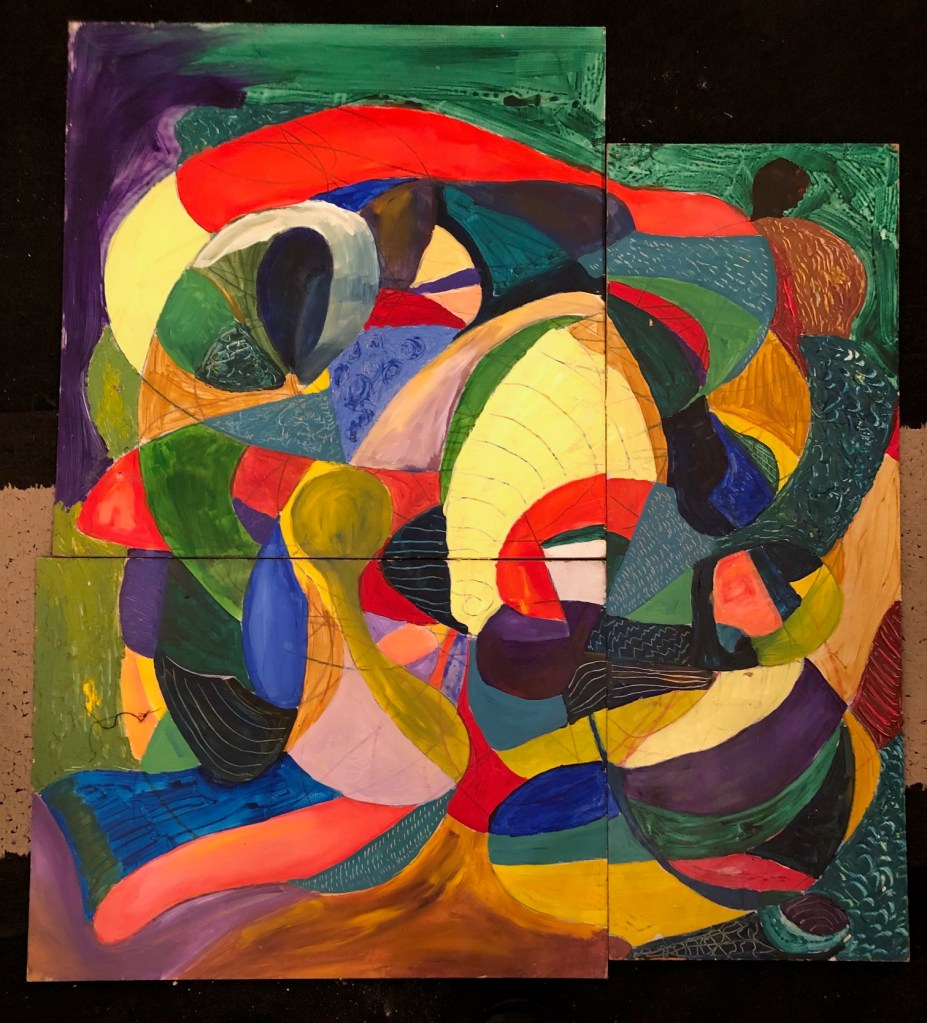
One night, early in our friendship, we did a painting together. We tossed three pieces of masonite onto the floor; we started painting on opposite sides and worked to meet in the center. It was a riot of fun. It was an exercise in juxtaposition. My-action-inspires-your-action. Artistic call-and-response.

I’ve kept those three pieces of masonite these many years. Occasionally over the years, I remove the protective wrap and reassemble the pieces on the floor. I snap a photo and send it to David. “Do you remember this?”

Juxtaposition. Proximity of color-to-color, image-to-image. Comparison and contrast. It is how color works. Ask Seurat. It is the essence of painting. How purple illuminates green. It is the essence of artist community. Artists elevate the work of their peers. Inspiration is a blossom of proximity. Collaboration. How does my work inflect upon the story of yours?

Diversity of color. Diversity of approach. Diversity of perspective. It is how healthy community works – artistic or otherwise. Uniformity spells the death of progress, the end of invention and creativity.

The cold rainy weather broke and the sun emerged. Finally. We walked our trail. We soaked up the sun. She gasped, let go of my hand and raced away. I know that means a photo op has been spied. “Don’t you love this!” she exclaimed, pointing to the budding crimson flower against the coarse wood. “They are so beautiful together!”

david & david, acrylic on masonite. fun on board

read Kerri’s blogpost about TRILLIUM

Like it. Share it. Coffee-life-support. All are greatly appreciated.