Pivot [on Two Artists Tuesday]

Art In Me copy 3

I learned many things following Skip through the curious world of technology entrepreneurism. Peculiar terms like ‘incubator” and “accelerator,” once reserved for premature babies or the gas pedal in my car, were reassigned to ideas: ideas in need of nurturing or, more remarkable, ideas pumped up with steroids and released ravenous upon investors (who were also ravenous but more composed by virtue of their power position).

Among the most important lessons was this: despite the best incubation, even with warp speed acceleration, the best idea, the best product, was probably obsolete the day it hit the market. Someone, somewhere in the world, had already improved upon it. A better mousetrap has little or no shelf life. And so, I also added to my vocabulary a new understanding of the word ‘pivot.’ I love how similar an entrepreneur’s terminology is to a ballet dancer. Pivot, move, fluid, flow, swivel, turn, revolve. Keep your center. Keep your eyes on the spot or you will grow dizzy and fall. The spot is not the individual product, the single idea. It is the business spawned from the idea. It is the ongoing relationship with relevance/obsolescence.

Those in my age group are distinguished by our dance with obsolescence. Graphic designers, publishers, musicians, educators,…artists. We are distinct in having one foot in an analog world – I prefer easel and canvas to stylus and computer screen –  and the other foot in the digital tsunami. The art is innate. Relevance is another story entirely. Reinvention (another word for pivot) is a necessity. Entrepreneurs and artists are not so different.

After seeing our melange post on Surfing Uncertainty, Master Marsh  reflected that surfing uncertainty was more than a design, it was my credo. Horatio jested that I was either a dilettante-from-hell or a bodhisattva. I laughed. Illumination seems a bit out of my reach. I think technology makes dilettantes of us all!

if you'd like to see TWO ARTISTS copy


read Kerri’s blog post about ART ALREADY IN ME

 

www.kerrianddavid.com


facebook logo copy 2


i was came into the world with art already in me ©️ 2016/2018 kerri sherwood & david robinson


Have Wings [on DR Thursday]

wings copy

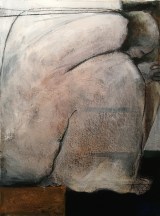
This painting jumped to the canvas fully formed. It announced itself and I simply opened the door. It was not what I’d intended  to paint when I entered the studio. I had a wholly different idea In Mind. I’ve learned that the best work has very little to do with what I have In Mind. The best work comes from the other place, the place available when Mind steps out of the way.

Meditation, prayer, inner reaching….is a theme I loop back to again and again. Lately, I’ve been pondering what happens when we cease searching for peace and instead simply bring it. What if prayer/meditation was not a quest for center, a search for inner peace or quiet mind? What if there was no separation? What if prayer/meditation was a bringing to the surface of the peace that already exists? What if you need not search for it because it is already here? What if, like this painting, that place is available when we stop listening to a Mind that tells us the center is lost, that peace is somewhere over there?

I suspect my pondering produced this painting. Kerri calls it Winged.


read Kerri’s blog post on WINGED


www.kerrianddavid.com


winged ©️ david robinson & kerri sherwood


Sit By The River

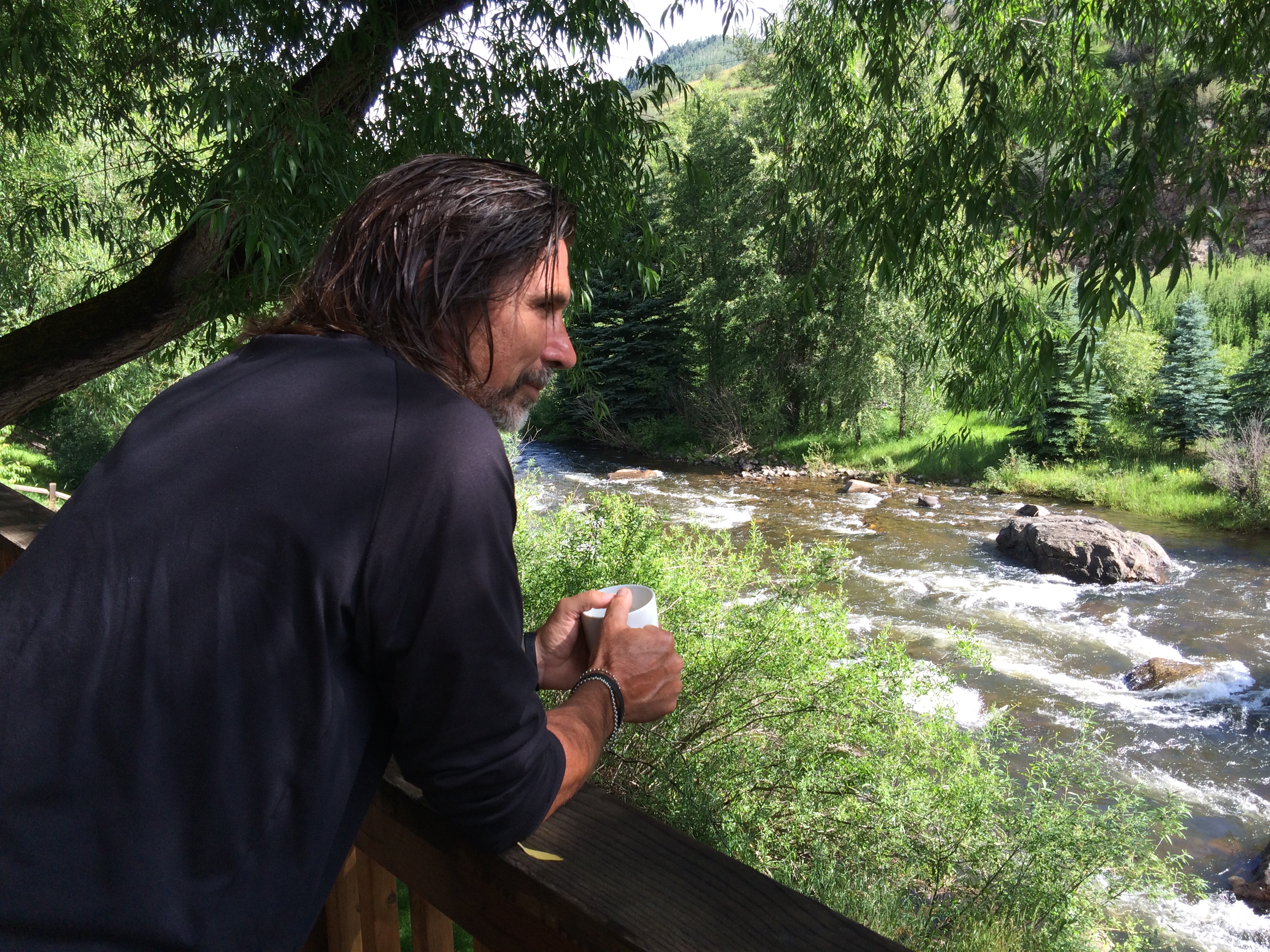
photoThe back deck of the Minturn Inn overlooks the Eagle River. We sit in the sun and are mesmerized by the sound of the rushing water. It is liquid peace. In this moment I believe that people seeking to develop a meditation practice should begin sitting by a river. The water easily carries away all thought and worry.

The river is a great giver of perspective, a great deliverer of presence.

I am struck by this power of the river – and it is a power. We easily grasp nature’s power when a tornado levels a town or an earthquake devastates a city but forget that there is a flip side, a quieter side to nature’s ominous power. There is a vast quiet. In our world peace seems nearly impossible to achieve yet in less than a minute, sitting by the river, I am steeped in peace. That is an awesome power!

I once read (somewhere) that we have a vibrant internal compass capable of ringing true from false, right from wrong. If we make a choice that is out of our integrity, the compass spins wildly out of control, setting off an unstoppable inner monologue, a great inner debate. If the choice is in alignment, the moment passes unnoticed. True north is known by the absence of spinning. Inner quiet is an affirmation. Nature – including our inner nature – doesn’t lie.

Sitting on the deck, breathing in the mist and peace of the rushing water, I know that what’s most important in this life, the real art, happens in the quiet spaces, the moments that thought cannot penetrate, the spaces that require no definition or justification. They are the moments ripe with gratitude. They are the moments dripping with appreciation. I know that all the debates and disagreements and defenses are paper tigers. I also know that this peace is not the province of the river. It is, in fact, available all the time. The river simply reminds me to hush up and listen.

Stand Rooted

I awoke this morning with this phrase hanging in my dream space: you can’t control your circumstance but you have infinite control over who you are within your circumstance. It is a well-worn phrase for me, like an old sweater, relevant to much of the teaching, coaching and facilitation I’ve done. It is useful to remember when the hurricane hits or the job disappears or life seems to be a festival of obstacles. The ability to discern between circumstance and personal center is of great value. It is a skill that lives atop of Maslow’s hierarchy.

A work in progress: K.Dot & D.Dot See An Owl

A work in progress: K.Dot & D.Dot See An Owl

We have these words in our canon of health: centered, grounded, rooted, conscious, present…. They are all terrific metaphors, earthy with eyes wide open. Flip them over and you get a good sense of what happens when you confuse your self with your circumstance: off center, uprooted, ungrounded, unconscious, not here; up in the air with eyes squeezed shut.

There is a Buddhist phrase that I appreciate: joyful participation in the sorrows of the world. It is necessary to know the difference between self and circumstance to really grasp the meaning of this phrase. Life is going to bring you trials, tribulations, and lessons. You can never know what is just around the corner. As Kerri often reminds me, it is what you don’t know that makes you grow. So, when the storm comes, participate. Stand in it. Love life in all of its forms and textures.

So many times when working with business clients I’ve had to say, “Don’t eliminate the wolf from your story.” In the story of Little Red Riding Hood, the wolf moves the story forward. In fact, without the wolf, there is no story. In business as in life we attempt to protect ourselves from the wolf. We resist the very thing that can bring growth and renewal. Circumstance is often the wolf. The storm comes. The relationship suffocates. The wolf always creates movement where the energy is stuck. It is uncomfortable. It hurts. It is scary. Yes. So, participate. Engage. Be-with-it. Within the circumstance, within the storm, learn to stand rooted, centered: earthy with eyes wide open.

The circumstance will pass and you will remain. You will know more. You will have grown. This simple understanding, that you are separate from your circumstance, allows for the joyful part of participation. Joy lives at the choice point. The world is and always will have plenty of sorrows to help you grow. Things happen. The question is, “How do you choose to participate?”

Go here to get my latest book, The Seer: The Mind of the Entrepreneur, Artist, Visionary, title_pageSeeker, Learner, Leader, Creator…You.

Or, go here for hard copies.


Tap Into It

775. Join me in inspiring truly powerful people. Each day I will add a new thought, story or idea to support your quest and mine.

What is the original “why?” What is your reason for doing what you do? During a break in the Design for Demand class I eavesdropped on a conversation between Skip and one of his students. The student asked, “Isn’t making money the reason “why.” It can be a reason. It’s not the reason.

Before the break the students were doing business pitches followed by a discussion about their reasons for creating the business. Skip showed them Simon Sinek’s terrific TED talk explaining what distinguishes a great business from a mediocre business. In the talk Simon explains his golden target with the reason “why” occupying the center. A great business operates from why. How and what occupy the middle and outer rings of the target. Mediocre businesses confuse their what and how with why. This might seem obvious but it’s not.

In another class, I recognized that the MBA students think the single reason they are getting a degree is to get a better job. They’ve confused their why with the what. Getting a better job can be a reason. It’s not the reason. K-12 education believes that the purpose of education is to raise test scores. They’ve confused why with how – and it is debatable whether raising test scores is a viable how. In our lives we have an abundance of “how and “what” reinforcement. It is no wonder we sometimes misplace our why.

In the modern age, people without a clear understanding of their “why” will generally buy something to fill the void. It is a temporary hit but delays the recognition that there is nothing substantial driving their life. Or, they’ll numb themselves, distract themselves or sabotage themselves. Either way, the “why” gets lost in the “what.”

Everyone has a why. Sometimes you have to wipe off a layer of dust or muster enough courage to look beyond the purchases. It is there. It’s waiting to be sourced. If your current answer to the question, “What’s the point?” is to raise your test score or to get a better job, stop and ask yourself, “What else is true?” Look beneath the superficial and you will find a spring that will rejuvenate you and keep you nourished for the arc of your life. Tap into it.

Occupy Your Center

773. Join me in inspiring truly powerful people. Each day I will add a new thought, story or idea to support your quest and mine.

Robert is a gifted actor, director and teacher. We had a long conversation yesterday about actors and acting. He said that the art of acting is unusual because young actors in training don’t always recognize the necessity of technique. So, for instance, an opera singer would never expect to advance in his or her career unless they had rooted their voice in solid technique. A pianist would not expect to become a concert level musician without a solid technique. As Robert said, “Many young actors believe that if they feel it, if they connect the dots from feeling to feeling then they are acting. “Anyone can emote and call him or her self an actor,” he said, “but acting requires just as solid a technique as any other art form. It’s just not as expected or understood.” Robert recently told a young actor, “It does the audience no good if you feel it but they aren’t invited to participate.” Technique facilitates participation because it frees the artist to be present. The point of any art form is to share, to include, to transport. Artistry is never about the artist. It is always about the relationship.

Today in tai chi Saul-The-Chi-Lantern paired the beginners (me) with the more advanced students. We were doing a simple push hands exercise that I recognized as the technique beneath the practice. I had a revelation that shocked me to the core and inspired me to teach it to every artist that I know. In push hands, the idea is to empty of all resistance, to drop deeply into your center and use your partners force to knock them off center. As the advanced students told me, “The point of the exercise is to fail. Failing is the only way to find your center and empty yourself of opposition.” My revelation was this: opposition (resistance) is the act of giving another person responsibility for your balance. Literally, you invest your balance in their center. It is visceral. My partners easily tossed me off balance because I easily gave away my center every time I resisted them. When I (occasionally) found my center and emptied myself of resistance, I entered a balanced fluid center that shocked me in its potency.

I left tai chi today and went to see a student production of a Shakespeare play. The rivers of my conversation with Robert and my tai chi revelation met as I watched the young actors push and force and resist and reach for feelings. They did not know to include me. Their play was about them, not the story or the opportunity for relationship with me, the audience. Yet, the paradox, the moment of truth came after the play when I listened to their investment in what the audience thought of their work. They gave me their center because they shut me out of their play. Had I cared I could have easily tossed them off balance. As I left the theatre I thought, “Someone needs to teach them how to fail.” In that direction technique is found. In that direction is learning.

I wished the young actors had access to Robert or the advanced students in my tai chi class. If I keep at it in fifteen years or so I might have the capacity to keep my center. The young actors need to pretend that they can do it all now. They are oriented to the test (performing the words with feeling) and not the mastery.

Even though I know the 37 moves that constitute the tai chi form, I am only now capable of beginning. At this age, I am finally capable of understanding the relevance and necessity for solid technique.

Stop Pushing

633. Join me in inspiring truly powerful people. Each day I will add a new thought, story or idea to support your quest and mine.

I love when lessons come in clusters. Sometimes it seems the week has a theme that will keep coming until I pay attention.

This morning, Saul-The-Chi-Lantern gave us an article from a magazine about yoga injuries. “It’s never good to push too far, to try and be a super person,” he said. He asked us to face the mirrors in the room and guided us though a series of minimal movement exercises. “Find the edge of your movement and learn that edge.” As we moved through the exercises he told stories of dancers and martial artists that left their center, that strained their bodies beyond what was natural and sustained career ending injuries. He told us of a doctor he once knew that treated joint and spinal injuries with the minimal movement exercises we were doing in class. “The edge moves. You gain flexibility by finding the edge, working with it, and not by forcing yourself past it.”

“Power comes from relaxation, not through resistance,” he said as he demonstrated a martial arts move. “If someone punches, I am most effective with the least amount of energy,” he said, showing a simple twist of his arm to deflect a blow. To meet the force with force will knock me off center. It will hurt!” he laughed. Power is not resistance. Power is relaxation.

Earlier this week I worked with a class of entrepreneur’s preparing for their investor pitches; they were working really hard to be memorable. They were tense, pushing. I told them that in a past life I used to audition actors, sometimes I’d see dozens of people in a single day. I told the class that I’d never remember the actors who worked hard, who tried to get me to remember them; the actors I remembered where simple, honest, centered, and clear. The actors I remembered were relaxed. Minimal effort. Easy. Powerful. The actors I remembered were honest.

Yesterday, Judy-Who-I-Revere, after listening to my tale of woe said, “You don’t need to work so hard. You already have everything you need. Relax; you can stop pushing.”

When Saul started his lesson this morning I smiled, thinking, “Alright already! I hear it! I’ll stop pushing. I will relax.” I am a slow study and sometimes it tickles me that I make the universe work so hard to teach me….

Receive The Gift

617. Join me in inspiring truly powerful people. Each day I will add a new thought, story or idea to support your quest and mine.

Push hands is a core practice in Tai-Chi. It is a done facing a partner, forearm-to-forearm, feet rooted to the floor, moving to sense the center of balance of the other person. If it were a game, the objective of push hands would be to knock the other person off balance.

I am a novice and am learning that the skill is to not assert force, which seems counterintuitive. In my western mind, if I am to knock my partner off balance, I need to push; I need to assert. It’s called push hands, after all! But that is not the case. As Saul-the Chi-Lantern says, push hands is a “listening energy.” Pushing with force knocks you off balance, not your partner. Listen. Feel. Stay rooted in your center. The skill is to feel my partner’s center and the moment they move off their center, I help them, no force necessary. I use my partner’s energy, helping them move further off center, moving them in the direction they are already going – off balance.

There are life metaphors a-go-go in push hands. Today there were two in particular: first, it is too easy for me, the novice, to focus on the moving hands and forget about the still center. The power is not in the moving hands, the power is maintained in the still center. A powerful person is not distracted by the moving pieces – we live in fast-river world with no end of rapidly moving pieces – it is easy to lose center with so much pulling at our attention. A variation on lesson one: a powerful person does not push with their arms (that is to assert force, thus throwing myself off center); a powerful person pays attention to and operates from their center. They sense. They feel. They listen. They move from their center, not from their extremities. The mind wants to assert, to force, to achieve; the mind is all about moving from the extremities. Power is in process. To force is an attempt to control; the moment I attempt to control, my partner supports my attempt and launches me across the room.

The second lesson was even more potent for me: power doesn’t feel powerful. It feels like helping. Push hands is a great exercise in creating power-with; there is no defeat, no winner and loser, there is a greater and greater capacity to listen, to embody a potent center, to support your partner in occupying their center. As Saul-the-Chi-Lantern often says, “Learn to receive the gift.” Translation: occupy your center; stop trying to make things happen; surrender your need to resist: Listen. Participate. Use what is right in front of you and amplify the energy. Help your partner stay in their center is the best way for you to learn to inhabit your own.