Become Simple Enough [on KS Friday]

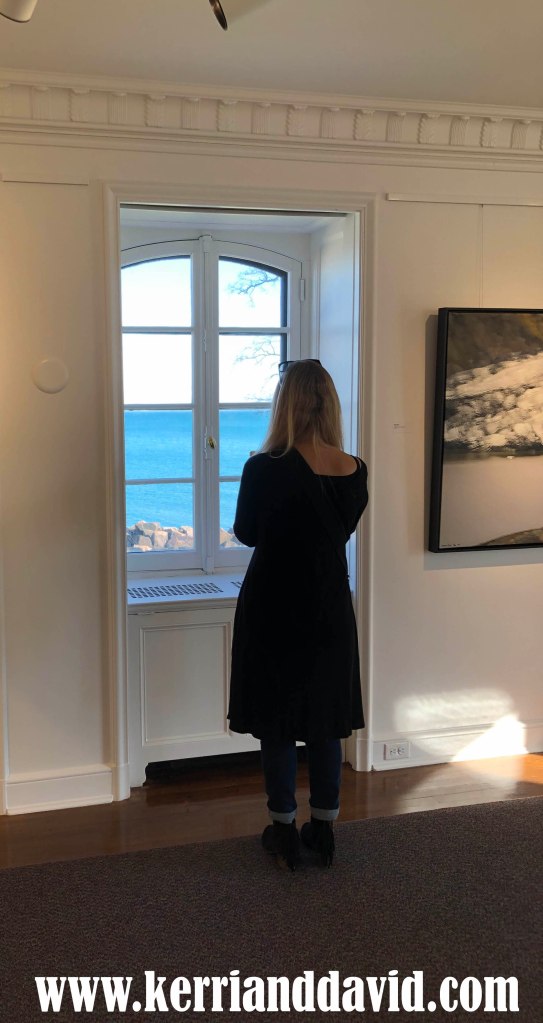
I took a photo of Kerri taking this photo. There’s nothing more inspiring to me than watching an artist at work. Her focus was singular. Pure. I saw her “see” this possibility. She turned, left the reality that the rest of us occupied, and approached the window as if it was an animal in the wild. Carefully, quietly. Reverently.

Her photo immediately brought to mind Ellsworth Kelly’s Austin, his temple of light. The vibrant squares of color. Someday we will make a pilgrimage to the Blanton Museum to stand in Austin and, in that moment, I will remember Kerri’s window.

In a world of just-get-to-the-point, time-is-money, and bottom-lines, and the centuries-old-delusion that we are rational beings and the analytical is supreme, an artistic heart and mind is an outlier. We use too many words. We are not reserved in our gesticulation. We express what words cannot reach because we see what lives beyond words. And, developing eyes-that-see takes time. Ellsworth Kelly designed his Austin in his last years. It takes years and years to become simple enough to see the sacred.

Recently we were told, not for the first time, “So many people want what you have but they don’t want to pay for it.” Kerri and I looked at each other. Her great pet-peeve, the pinnacle of all pet-peeves, is how often she’s been asked to play, not for money, but for exposure. She’s considered by Yamaha, the maker of fine pianos, to be one of their select artists, a modern master. Yet, all of her life, with frightening regularity, she’s heard, “It will be good for you!” the face smiles, “It might lead to something.” Yes. It does lead to something: more people wanting what you have but not willing to pay for it. Point in any direction to anyone who’s achieved the pinnacle of their career, and imagine asking them to perform surgery or keep the books or go to trial or build the house for exposure. Can you imagine? She – we – have heard it throughout our lives.

And, when she turned and saw the window, her sudden awareness shocked the people in the gallery into silence. Everyone turned, made space, and watched. She had no idea that she was on stage. Pure. And, without exception, everyone in that room wished they could see what she was seeing. They wished they could see how she was seeing. Sacred. It takes a lifetime. Austin. The window. Priceless.

read Kerri’s blog post about THE WINDOW

Kerri’s albums are available on iTunes and streaming on Pandora
Move Toward Wholeness [on Two Artists Tuesday]

When I look at the bowl of green tomatoes, each plucked from the vine before we pulled the plants from their pots, still moving toward red ripeness, I think of Joe. He was fond of saying, “Life moves in the direction of wholeness.” It’s important to note that his fond phrase included nothing about outcomes. Joe was particular and knew that life is movement and not arrival.

I am revisiting the word ‘rehearsal’ these days only this version of rehearsal is not on the stage with creative minds. It is over Zoom with decidedly analytical minds. Actors in rehearsal halls move through a process of exploration that leads to specific choices. The goal, if there is one, is to embody a state of moving presence within a story. The analytic mind comes with a template overlay that is placed atop the experience before it actually occurs. The language reveals all: content items. Telemetry. The mathematics of movement. Rehearsal is predicated on precision.

As I’ve probably written ad nauseam, these minds are not in opposition. They are complimentary. Freedom of artistic expression comes from years of study of technique. The path to mastery winds through repetition and constraint. Saying more with less comes after a lifetime of saying less with more. The creative mind is one step closer to the senses. The analytic mind applies language, gives voice, to the experience.

Many years ago I participated in a workshop with an actor/director of Noh Theatre. The process was strict, exacting. The movements precise. There was no room for error. We, the participants in the workshop, knew we’d never achieve proficiency since it takes years and years of rehearsal to perform even the simplest of symbolic gestures. No one sings opera in a day. We did our best and failed and failed and failed. That was the point. That is always the point. Each failure is actually an exercise of muscle memory. The body learns. The mind is impatient. Rehearsal is rarely about the mind, despite what the mind insists. At the end of the day, our workshop leader gave a short demonstration of his art form. His ease of movement, born from years of repetition within constraint, was breathtaking. He was free.

Many years later I was helping John in his wood shop. He was a master wood worker. I watched him look over his lumber, preparing to build a cabinet. He ran his hand over the wood, feeling his way into his project. “Ah,” he said, laying his hand on a piece of cherry wood. “This is it.” John was like the Noh actor.

“How did you know?” I asked.

“I don’t know,” he said, “it just feels right.” Then he smiled and added, “Plus, I’ve built a lot of crap.”

Life, moving toward wholeness.

read Kerri’s blog post about TOMATOES

Reach Purely [on Two Artists Tuesday]

“Art, as best practiced and understood over the centuries, is a spiritual as much as technical pursuit.” ~ Kent Nerburn, Dancing With The Gods

It was disconcerting. It still is. The illusion was so distinct that I had to show the book to Kerri and ask if she saw it, too. Each morning I read a few pages from Kent Nerburn’s book. This morning, in a chapter entitled The Divine Thread, I turned the page and a single paragraph, just a few sentences, was printed in a font twice the size as anything else on the page. I read it a few times since the author had given the section such obvious emphasis. After the I finished the chapter, I looked back to reread the oversized section – and it was printed in the same size font as everything else. It wasn’t emphasized at all. The shock of it made me dizzy.

“Art, however, does create this touch. It speaks in different voices, different rhythms, different languages. There is no place in the human heart it cannot reach.”

Paul taught his student-actors that they had an obligation to something greater. “When you choose to get on the stage, you have the power to impact other people’s lives. Do not take that responsibility lightly.” Your art, your creation, if purely intended, will reach the heart of another – purely. Even the loneliest painter knows the transcendence of the expansive energy that comes through in the moment of creation. Transcendence is all inclusive.

I have been humbled by the great artists I’ve known. Teachers, mentors, and others. I’ve been humbled by their humility. Tom, a brilliant director of plays and believer of possibility, influenced more artists than any person I know. He was tortured by the size and scope of his gift. At the end of his life, sitting before a fire in his cabin, he was, for a moment lost in thought. I watched his revelation come to the surface. He looked into his wine and said, “I think I did my best work when I was a just starting, when I was second grade teacher. It was pure imagination. I had no idea what I was doing. I just knew that we could have fun telling stories and going on adventures where our imaginations led us. It was pure.”

I met a few teachers who’d been second grade students in that classroom of long ago. They told me that year changed their lives. They touched his heart and he touched theirs. Shrunken heads and planning expeditions to the Amazon. Maps and budgets and “What do we need to bring to survive?” They spent weeks preparing for “blind day,” an exploration of the world through the full scope of senses. “What could we learn if we didn’t rely on our sight? What would we need to prepare to help each other?” he asked. Pure.

For our wedding, Julia made for us a small box with a Klimt’sThe Kiss” decoupaged on the lid. Inside, she placed a few Euros. A metaphor. Great love as a container for great adventure. We placed the box in our sitting room in a spot where we see it everyday.

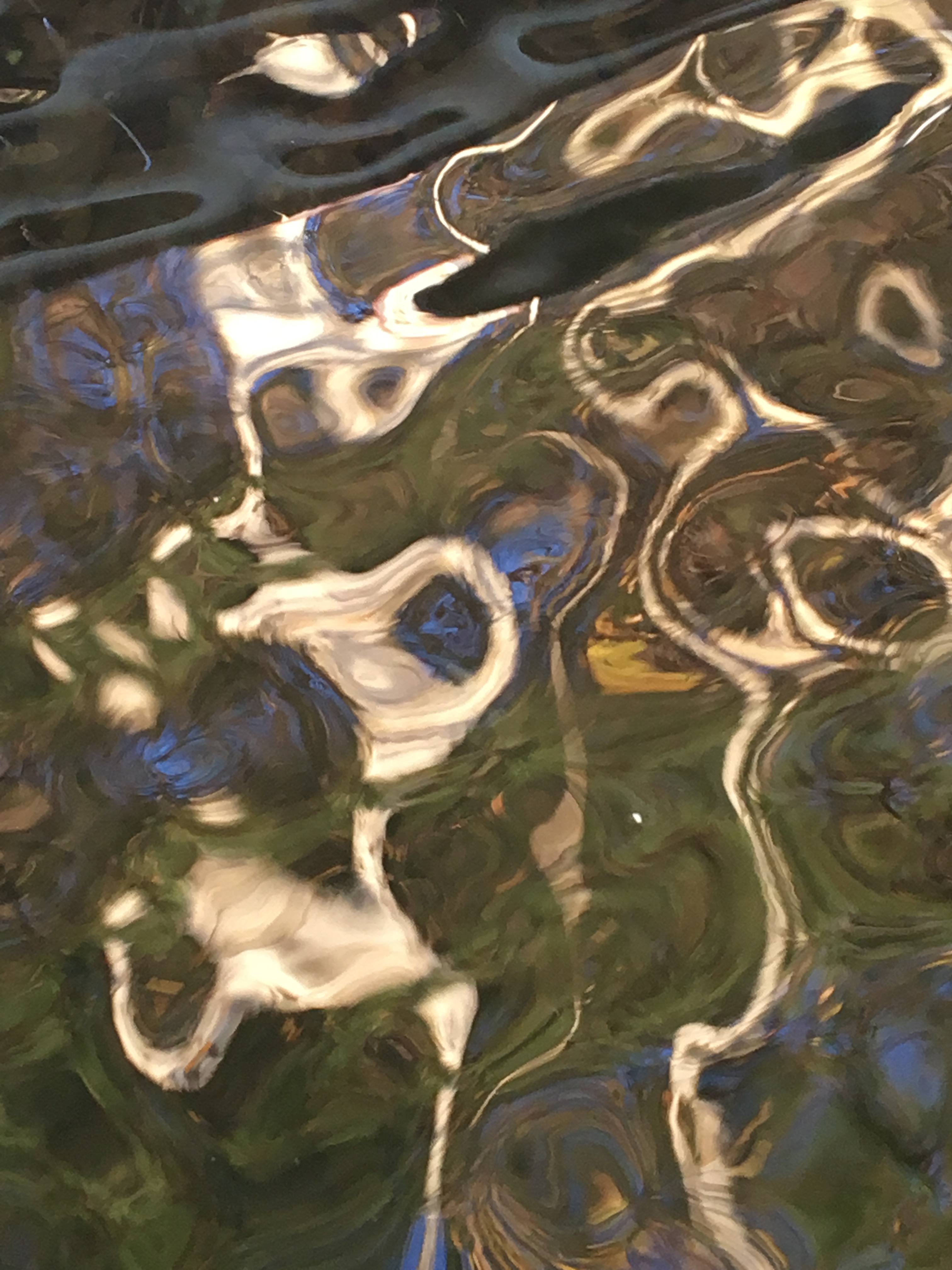
Kerri knelt on the dock to get this photograph of the water. “The color!” she gasped. Pull up an image of “The Kiss” – or any of Klimt’s paintings for a closer inspection and you’ll see this water pattern. Klimt might have painted it. He studied swirls in water, swimming color on the reflection of the surface. I’m certain of it.

Great love. Great adventure. Tom. Julia. Paul. Art that is pure. My head spins. There is no place in the human heart that art cannot reach.

read Kerri’s blog post about WATER

images of water © kerri sherwood 2021

Go To The Mountains [on DR Thursday]

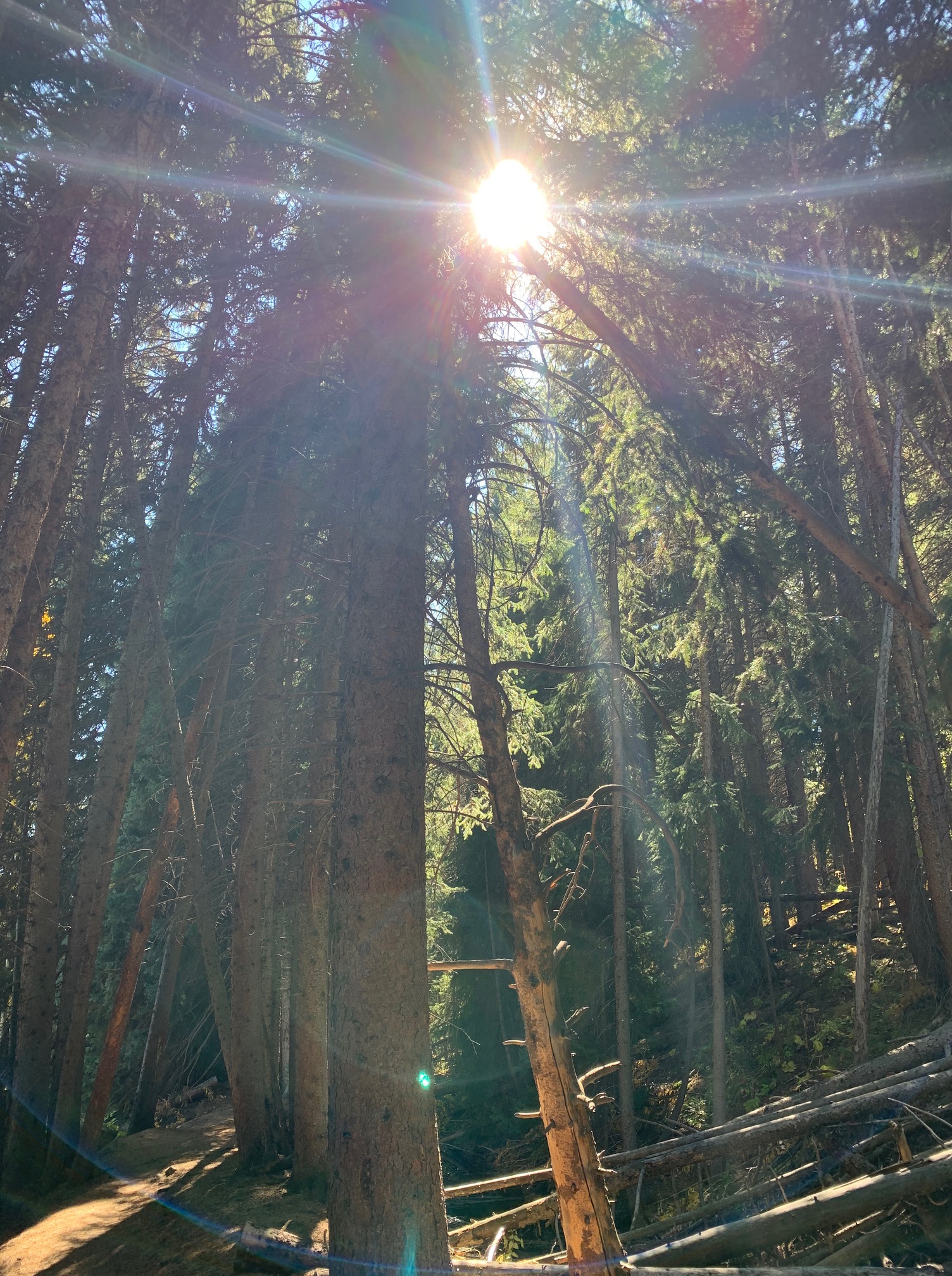
For Mike, it was the ocean that called. For me, it was the mountains. When Columbus passed, more than a service, more than any gathering, I needed a walk in the mountains. I needed the quiet of aspen, the smell of pine. A moment in time, time that keeps moving through the monumental and the everyday. The trees and stream were here before I was born and they will be here after I am gone. I went to the mountains for perspective.

I am working with brilliant people. We are developing something that we hope will help people. Our conversations are genuine. Our intentions are pure. And, yet, how easily do we get lost in the minutiae. How often do we spin out into abstraction. Right now I have a unique perspective on life. I am in no hurry to get anywhere. I easily let go of my end of the rope in any potential tug-of-war. Will what we create actually help others? That is like asking, “Will they like my painting?” That is not for me to decide. Mine is to paint it. All I know is that our conversations are genuine. Our intentions are pure. None of the rest really matters.

I’ve decided to put two paintings into a local show. I’ve only shown and sold online since moving to Wisconsin eight years ago. I was tired. Before I moved, I had paintings in galleries or office spaces or bars or restaurants every single day for over a decade. I was moving or mailing paintings all of the time (and my paintings are mostly large). Once, I took 15 paintings, loaded on a cart, on the light rail. I arranged for a truck that did not show up and I had to deliver the paintings that day, within a specified time-window. I wheeled 15 large paintings down the street, onto an elevator and maneuvered them onto the train. The train-police came to make sure I meant no harm. We had a nice chat and I showed them my work. We laughed heartily at my delivery method. I wheeled them off the train and through a neighborhood to the gallery. “I’ll never do that again,” I said to the train-police when I wheeled my empty cart back onto the light rail. It all seemed so necessary, important.

A specified time-window. We only have so much time. The clock is ticking. The funds may run out. Will we get there in time? Will our/my work matter? Is the message clear? What is the message? What am I willing to do and not do?

And, so, I went to the mountains for perspective.

read Kerri’s blog post about PERSPECTIVE

Chasing Bubbles © 2019 David Robinson

Glance Sideways [on Not So Flawed Wednesday]

It came as quite a shock. Our beloved plant, Snake-In-The-Grass, was hosting a community of Gnomes and Faeries. We haven’t actually seen the Gnomes and Faeries – they are notoriously hard to spot. They are not fond of human beings since we are famously territorial and also so easily eschew our imaginations. Fearing all things “wild,” we generally erect fences and street lights, build dams and make management plans for “nature.” If we could see them, I suspect we’d notice how often they roll their eyes at us.

When I was playing the role of consultant in public school systems, I took note of a central mandate of the adults, playing the role of teacher or administrator: clamp the imagination of the young people, those imaginers playing the role of students. The students would enter the system with wide-open imaginations, free from limitation, and the oldsters found it necessary to kibosh or contain that wide-open meadow. This is not meant to disparage those actors playing the role of adults; when young, they’d been recipients of the imagination whammy, too. They were simply carrying on the tradition. The imagination is apparently considered a wild-thing so necessary of damming.

Dammed imaginations do not die, they distort. Imagination, as a wild thing, will run in circles when put in a cage. It will gnaw its leg off when caught in a snare. It will invent monsters and madness as it paces to-and-fro. It will get angry as it descends into madness. You might say that millions of Americans are gnawing their legs off, angry at the swirl of dark imagining run amok in their caged craniums, seeking reasons and someone-to-blame for their dark imagining. The caged imagination will lead all the lemmings over the cliff with the shout, “Where we go one, we go all!” It seems that we are awash in imprisoned imaginations howling to be freed.

I took it as a positive sign that the Gnomes and the Faeries took up residence in our house under the good protection of Snake-In-The-Grass. While the world outside our doors goes deeper and deeper into the cage-of-its-own-creation, the world inside our house seems to have become a refuge, a safe haven, for those beings still alive in their imaginations.

David recently wrote that he was dedicating himself to being a better artist. He’s been making art with his son again, a wild imaginer that has pulled his daddy (and me, too) out of our cages and into the open meadow. I can’t wait to see what David will do next. Who he will now become. What role he will shed. He’s already a great artist so the possibilities are…wild.

I confess that I regularly wander into the sunroom and glance sideways at Snake-In-The-Grass. Sideways – so they say- is the only way we humans can catch a glimpse of the Gnomes and Faeries. I want them to know that I’m looking.

read Kerri’s blog post about TINY MUSHROOMS

Compose [on DR Thursday]

Many years ago I attended a workshop facilitated by Sam, a brilliant landscape painter. I was delighted and amused when he demonstrated his technique. Rather than paint what he observed, he took great pleasure in rearranging the elements. He moved the trees, altered the hills, relocated the barn. He laughed while mixing up his elements. His eyes sparkled with mischief. Rather than a workshop on painting, the day became an exercise in joy-in-art. Seeing and playing with what we see.

This morning I read that the word ‘composition’ means “putting together.” Definers-of-art-terms associate composition with freedom. “The artist has freedom when choosing the composition of their artwork.” It is a mistake to believe that compositional freedom is the sole province of an artist. If the mind is a canvas then thought is a composition. It is patterned and composed. Arranged and rearranged. We choose where we place our focus. Point-of-view is cultivated, it is not a default setting. We design the story-we-tell-ourselves-about-ourselves. And, then we project it onto the world.

The trick in both art and thought composition is not to wear ruts in the road. Sam was joyful in his art because he was constantly challenging and engaging with what he saw. Art was fun, not morbid tradition. Art was delight-full, not rule-bound or laden with the pressure to capture. Recall that stepping out of the rut was the first lesson in Julia Cameron’s The Artist’s Way. Morning pages and artist’s dates are meant to both see the ruts and open new paths. The same process applies to the thought-canvas. See the rut. Step out of it.

As Sam taught me so many years ago, seeing and playing with what we see begins with letting go of what we think we see. It begins with a blank canvas, an unfettered mind, and the freedom to choose the composition.

read Kerri’s blog post about COMPOSITION

Unfettered ©️ 2018 david robinson

Light The Dark [on DR Thursday]

Strong contrast between light and dark: chiaroscuro. Renaissance painters loved it. The word ‘chiaroscuro’ literally means light-dark.

Today is Stephen’s memorial service. It is across the country or I would be there. I confess, I am haunted by Stephen’s death. When Mike wrote to tell me of Stephen’s passing, he told me that he was at peace when he died.

I’m not sure why his passing has hit me so hard. The last time I saw Stephen was 1998. He was following MM like a puppy. They were working on a set construction project. That’s what I remember. He was 14 years old, so, in my mind, he is frozen at 14. He was one of a pack of brothers that formed a solid core of Dimension’s Theatre Project, a theatre program that I spent more than a decade resurrecting and nurturing into artistic vitality. Stephen and his brothers were present in its heyday. For me, it was an artistic and learning laboratory, a place of spirited artistic creation. I loved every minute of it.

Of the brothers, I knew Stephen the least. I worked most directly with his older brother, Greg. I prided myself that Dimensions was a safe space. Artists, especially young artists, are vulnerable. They need to know that they can make strong offers, take chances, find their edges, without shame. That means living in and creating a culture of mutual support. The person selling the tickets mattered just as much as the actor on the stage. Every member of the community was directly responsible for the health and well-being of every other member. It is the philosophy I inherited. It is the philosophy I carried forward.

Mike took the reins of Dimensions when I left. He carried on the tradition, made it his own, Changing Faces Theater Company. Mike knew the artist that Stephen would become. The musician. The designer. The man who cared for the health and well-being of others, artistic and otherwise. Mike knew the dark and the light of Stephen’s short walk on the earth.

Usually, when I am confused or need to sort out my heart, I take a break and visit the pond. Magic, the frog, lives there. He’s a good hider but every few days comes out for a visit. After Mike’s news, confused at the depth of my confusion, I went to the pond and hung out for a few minutes with Magic. Dogga was running circles, making my visit safe from marauding squirrels. The sun was down.

“Look at this picture!” Kerri smiled. She’d caught Magic in chiaroscuro, made more dimensional and full in light-dark.

“It’s beautiful,” I said, looking at the photograph.

Light-dark. The Renaissance masters loved it. I smiled this morning when I read Stephen’s obituary. It began with a quote, something he must have often said. His words brought to me what I couldn’t find at the pond. Peace for Stephen. “Proper lighting can change the world.”

read Kerri’s blog post about MAGIC

surrender now ©️ 2016 david robinson

Look Again [on DR Thursday]

I’m not sure when I started using floral shapes and imagery in my paintings. There was Sam The Poet and Eve, trees as symbol.

Sam The Poet, acrylic, 48 x 48IN
Eve, acrylic on hardboard, 48 x 48IN

I know my sketchbooks began filling up with flower shapes and symbolic landscapes. Petals appeared throughout my Yoga Series. Leaf and flower shapes found their way into the bodies as well as the surrounding spaces.

Joy, mixed media, 50 x 56IN

I played with tissue paper over color as a ground for the images. When Tony recently visited my studio, he said my paintings were sculptural, visually commanding. I wrote his words on a scrap of paper since artists are mostly terrible at describing their work. He is an artist so he knows that the proper answer to the question, “Tell me about your work?” is “Go look at it and then you tell me about my work.” He didn’t ask the question; he went straight to the looking.

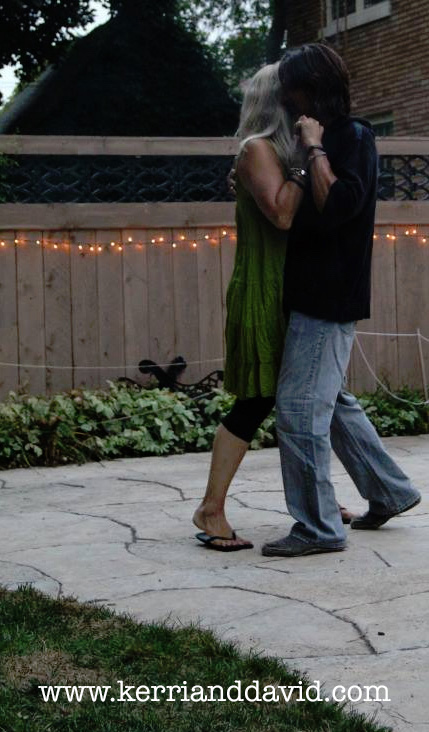
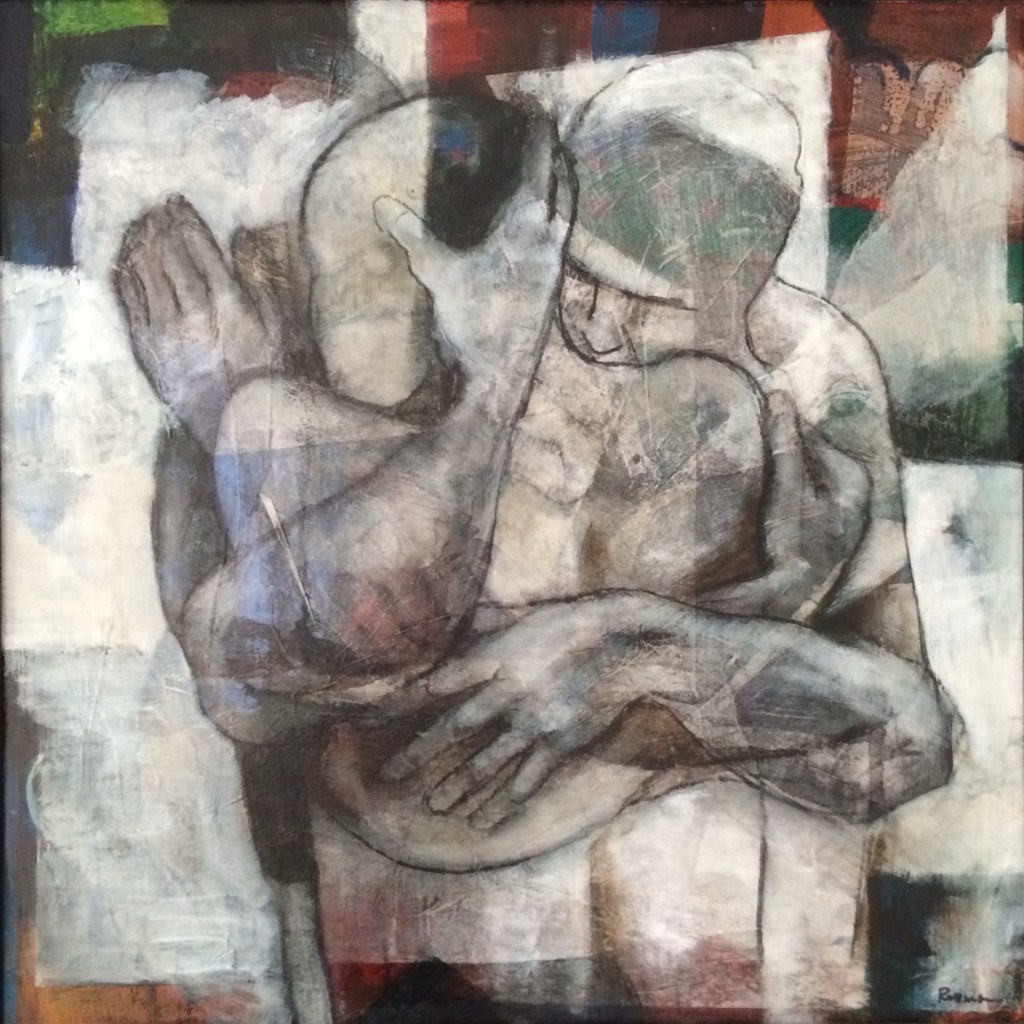
Tango With Me, mixed media, 39 x 52IN

We walked down a path at sunset. Kerri saw the sunflowers and I knew a photo op had arrived. “You should use this as your Thursday post,” she said, showing me her photo, “because your paintings always have flowers in them.”

Well, good enough, then. Sunflowers, shape and symbol, will find their way into the next painting, I’m sure of it.

read Kerri’s blog post about SUNFLOWERS

copyrights for all paintings in this post, 2010 – 2021, david robinson

Expect Surprise [on Not So Flawed Wednesday]

Walking through the Lake District in a driving rain, cold and soaked to the skin. Roger had a high fever and was near delirious. The hostel closed. We had to leave. It was miles to the next village. This day was not going according to plan. The trip was not going according to plan. It was the darkest moment in a series of dark moments. “What else could go wrong?” I asked. There was nothing to do but shiver and take another step. And then, unheard of at the time, an RV rounded the bend. The door popped open and a cheery voice asked, “Do you need a ride?”

I often think of that ride. That unlikely RV. Suddenly there were towels to dry ourselves. Aspirin for Roger. The mother of the clan took over and attended to my sick friend. Mugs of hot tea. We were delivered safely to the next village. They did not leave until they knew we had a warm place to stay until the rains passed. Something went right. It was breathtaking.

It was a life lesson for the younger version of me. My very own Aesop’s Fable. What looks like tragedy is often an opportunity, and vice versa. When it appears that things cannot get worse, they often do get worse en route to something better. The real lesson was to be in it, rain or shine. Joyful participation. I didn’t get the lesson right away. It took a few laps before it stuck.

That trip was decades ago and, to me, seemed ill-fated from the outset. But, when I think back on it, I remember the kind family in the RV, the man standing in line behind me who secured a ticket for me when I didn’t have enough money. The kindnesses too many to count. The utter shock of serendipity. What we needed always appeared somehow, in unexpected ways.

Quinn used to say, “Cultivate your serendipity.” Open yourself to chance, to the unexpected. Expect surprise.

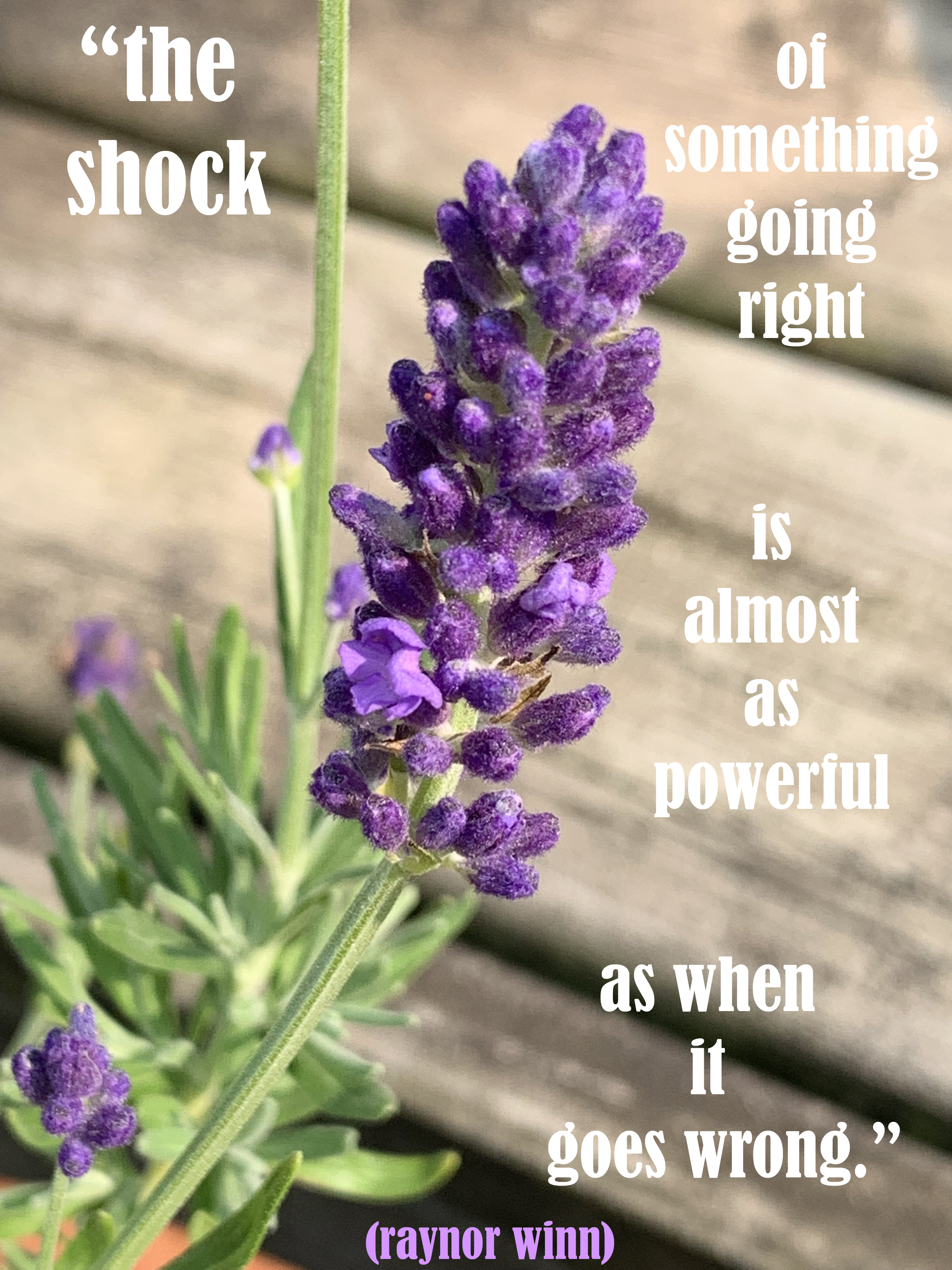
read Kerri’s blog post about THINGS GOING RIGHT

Pull The Weeds [on KS Friday]

My very first painting teacher offered me some sage advice. I was painting figures while the rest of the class worked on landscapes. Being the odd-child-out I assumed something was wrong with me. She said, “Tree painters are a dime a dozen. Someday, being the only one will seem like a gift so ignore what they are interested in and paint what is interesting to you.” Jospeh Campbell said, “Follow your bliss.” It’s the same advice that Jackie Fry gave to the boy-version of me.

I never imagined myself with a back yard. And, now that I have one, I find it a place of rest and peace. This is a confession that I’ll never admit to in the future: weeding is meditative. Each day I find myself taking a few moments to go out and yank the invaders out by the roots. No thought. No other thing to do. I simply tend the garden, knowing I am accomplishing nothing since weeds are good at growing and more will appear tomorrow. We are strange allies, they provide me with a daily meditation.

If I was as an art teacher, I’d send my students into my back yard. Nature is a masterful teacher of color. Orange and green. Highlights of yellow. Barney provides subtle blues, purples, and pinks. The orange and green of the lily pop against the purple and blue of the aging piano. Warm colors come forward. Cool colors recede. It’s all there.

I read somewhere that, as an artist, “to discover” is more potent than “to invent.” See what is there, beyond what you think is there. Everything is fluid so the discoveries are endless. While I weed the sun passes beneath a cloud. Everything changes. The sun reappears and the colors change again. Not the same. Different. I’ll never be able to capture it and that is the best held secret of an artist. Another wisdom from Jackie Fry: you will never succeed. Art is a relationship, not a transaction. So, no pressure. It is a relationship, complex and dynamic. It is not about capturing an image. It is about freeing your sight and possibly freeing the sight of others. Facilitate discovery. Play to play, to become a better player. Open a small door to peek into the vast inner universe.

It’s a paradox. It’s impossible to eradicate the weeds. That is not why I pull them. It’s impossible to capture life in an image. ‘Capturing’ is not why I paint. Relating is why I paint. I do it because I’ll never create anything more beautiful than the Tiger Lily dancing with Barney. I paint so that I might see and share in the dance.

ALWAYS WITH US on the album AS IT IS by KERRI SHERWOOD

Kerri’s albums are available on iTunes and streaming on Pandora

read Kerri’s blog post about the TIGER LILY

always with us/as it is ©️ 2004 kerri sherwood