Set It Free [on DR Thursday]

Horatio told me that, according to the happiness index, the good folks in Iceland sit atop the happiness-mountain. One reason, he explained, is that they’ve removed failure from their national equation. They cheer the effort, not the outcome.

Removing failure from the equation is the main ingredient for fun and success in all arenas, especially the arts. It is impossible to learn color theory without making some extraordinary messes. Ask a dancer how many times they tried and fell before they made that astounding leap look easy. Throw many pots and, over time, mastery will come – and mastery is nothing more than the understanding that there is no such thing as failure. It is the feel and touch of a long relationship with clay that can only come from not being afraid to throw it, to see what happens if…

Sometimes, no matter how hard I struggle with it or adjust it, a painting just isn’t working. Usually it doesn’t work because I’ve forgotten the rule about failure-removal. My brush is too timid. My brain is in the way. And yet, sometimes, in the middle of a painting that isn’t working, there is a small piece, the actual inspiration for the painting, that isn’t stilted, that remains alive and free of my fear. It’s easy to see. It captivates my eye, a warm island in the middle of a frozen sea. Every so often, rather than paint over the whole thing, I’ll lift the island, cut it out, set it free from it’s too-labored surroundings.

“Brutal,” Kerri said. “I liked that painting.”

“I’ll do another,” I replied. And maybe, I thought, another and another and another. Who knows, learning to cheer the effort takes some not-so-serious practice. It’s the only road back to the freedom of finger painting and the joy of playing in the sand.

Beautiful K.Dot, 12 x 9IN, mixed media

read Kerri’s blog post about CUT OUT

beautiful k.dot ©️ 2021 david robinson

Imagine It [on Flawed Wednesday]

Malidoma Somé wrote that a society with locks on its doors is a sick society. Something has broken down when a home needs protection from the other members of the community. Acquiring stuff takes precedence over honoring your neighbor. Can you imagine living in a community built upon mutual respect and trust, that valued and protected its members over its acquisition of stuff? Pie-in-the-sky? That might be the problem: we can’t imagine it.

Societies betray themselves. Despite the values inscribed in library cornices, despite the commandments we hold up as sacred ideals, we lock our houses against each other. We turn away when we see a person in need, their cardboard sign an appeal for help. The gap between the espoused and lived value-set is wide. In a society that claims greatness but practices mediocrity, is it no wonder that so much energy is dedicated to perpetuating a big lie? The lie is not the exception, it is the norm. The lock on the door.

Apparently, there is so much road rage on a particularly beautiful stretch of road rolling into Aspen, Colorado, that signs are posted giving travelers the number to call when the need for help is dire. Societies betray themselves. Why would a road through so much beauty, a road that dead ends in to some of the world’s great ski areas, a place where the elite retreat for some peace and quiet, why would there be so much rage on the road to such a place?

It must be a metaphor.

We tell a good story, that all are created equal, but we fight like hell to keep the full story untold. It’s happening now. Again. Still. Why are we so afraid to tell the whole story of a nation touting equality but built upon slavery and a rolling metamorphic racism? Like an individual, a society can’t address its problem until it admits it has one.

Gaps between espoused and lived values usually fill up with rage. Our gap is textbook. So many guns, so many locks on the door, so many patterns of violence and suppression that repeat over and over again.

Can you imagine living in a society that was proud of its story and need not dunk it in a lie? Or feast on an orgy of guns in order to feel potent and protected? Or post signs warning of the ubiquity of rage? That just might be the problem: we either can’t or won’t imagine it.

read Kerri’s blog post on ROAD RAGE

Look Closer [on Two Artists Tuesday]

Arnie recently sent me a book, Connection by Kristine Klussman. As is my practice these days, I’m reading it slowly, a few pages at a time. I recognize much of what she’s writing about: focus placement, meaning making, cutting through the ‘should’s’…all in the process of re-connecting to what is really important in this life. The book offers specific exercises and process steps to help readers take a closer look at their lives. To identify the gaps between espoused and lived values in order to make different choices and close the gap. Alignment.

In art school, the most valuable lesson (for me) was to learn to see beyond what I ‘think.’ I’ve written about the professor who asked us to look at our yellow #2 pencils and tell him what color were the pencils. A riot of eye rolling ensued but, in the end, he helped us to see that the simple yellow pencil was alive with green and purple and red. Our minds generalize. It requires a bit of slowing down and, dare I write, a bit of presence, to see and experience how rich and alive even the simplest things, a yellow pencil, really are. The dictum applies to each and every day of life, especially the days we generalize into boredom or “same-old-same-old.” Slow down. Look again. There’s more to the yellow pencil than you think.

When Kerri and I arrived home from our trip to move my mother into an independent living community, we poured a glass of wine and opened the box my parents had kept with the artifacts of my life. Old newspaper clippings of play reviews, playbills, gallery opening announcements, elementary school report cards, photographs that reached back through proms and school portraits to blurry black and white infant prints with “David, 4 months” scribbled on the back. It was a poignant exercise of pulling the life-camera in for a closer view. Life-fragments in a box are like the yellow pencil. They require a closer look.

I’ve always appreciated Kerri’s tendency to pull the camera in closer. She is forever taking photographs and then pulling the image this way and that, like so much taffy, looking for the most interesting slice, the most dynamic composition. In her photographic-push-me-pull-you, there is often a discovery. “Look at this color!” she’ll exclaim. Or, “Did you see this! Look at the spines on this plant!” She cultivates surprise. She understands that a closer look will always reveal tiny not-yet-seen-miracles.

Expecting surprise. Taking the time to look beyond yellow-pencil-expectations. Closing the gap between lived and espoused values. Slowing down just enough to realize that there is no such thing as “same-old-same-old.” These are age-old sage suggestions for living a rich and meaningful life. All of it, born of a tender, quiet suggestion to take a deep breath and have a closer look.

read Kerri’s blog post about A CLOSER LOOK

Take A Second Chance [on Merely A Thought Monday]

This is a story about second chances. Both of us had first go-rounds and neither went according to the dream. The gap between life and dream is sometimes daunting, vast. But, the good news with all-things-daunting is that, if you are lucky – and we are, you emerge on the other side, not only with a better sense of humor, but an understanding of the hard work it takes to make dreams a reality. Or, said another way, you live into a better sense of yourself. Kerri and I could be the poster children for people who’ve crossed the gap and come out laughing.

Early in our relationship we danced in the living room to Rascal Flatt’s song, The Broken Road. After our dance, we spent a long evening talking about our broken roads. There’s something powerful (and telling) about two people who willingly pull out their broken pieces and spread them across the table for the other to see, not for a pity-party but to say without shame, “This is me. This is what I’ve done and where I’ve been. I don’t want to hide any of it from you because I want you to see me, barnacles and all.” It is the mark of the tribe of second chances. Vulnerability as a strength.

In a second chance you have the opportunity to discover yourself anew. That might sound thrilling – and it is in retrospect – but it requires a good deal of hot fire to burn away the former shell. It’s as if the rules of life that have always applied, the rules that have always provided orientation to the game-of-life suddenly no longer apply. Trying to hold onto the old version is like trying to hide the fact that you are aging. It’s impossible. We started collecting our beautiful moments of denial and rude-awakening because, well, they were and are funny. For instance, I looked in the mirror one day and saw my grandfather staring back. It happened overnight and I was horrified! I spent the rest of the day looking for soft light so I might delay Kerri seeing my new grandfatherly face.

Second chances come to all of us. We have friends and family in our circle that are recent empty-nesters. The kids are gone. The house is quiet. They are asking two questions: 1) Who is this stranger sitting across the table? And 2) Who am I, the person looking back at the stranger across the table? Like us, they are walking through the rule changes, the body changes, the purpose changes, the identity changes. We hope that they, like us, recognize their barnacles as a shared map forward, a reason to bond and learn each other, and themselves, anew.

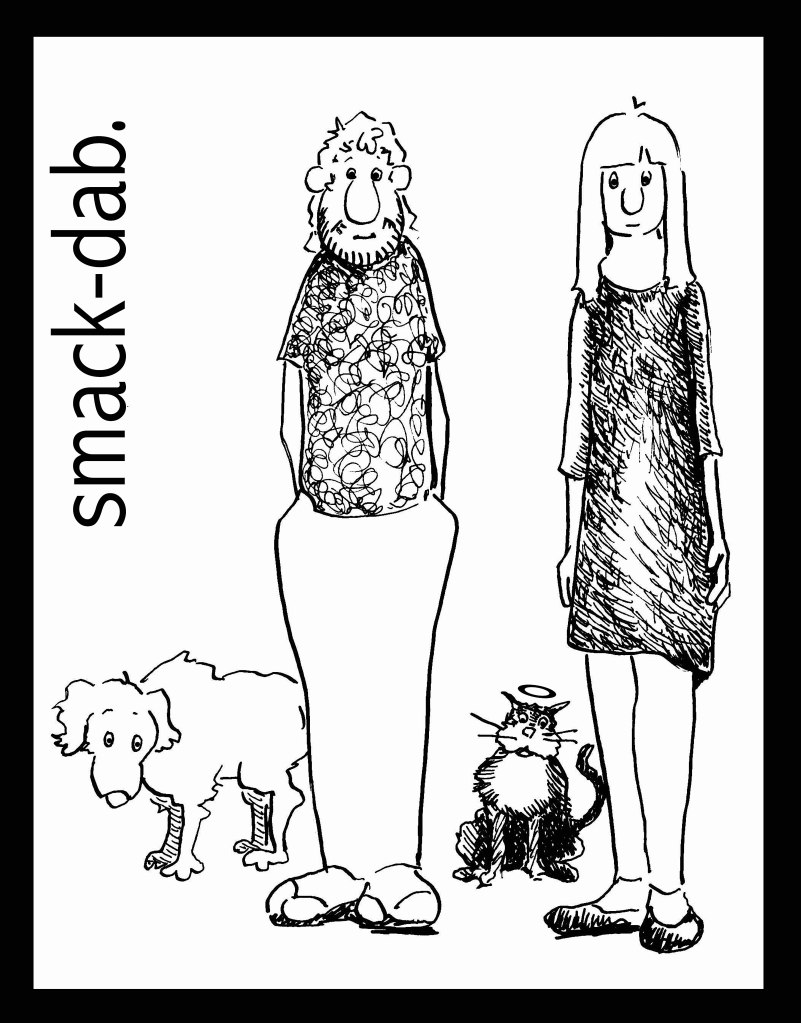
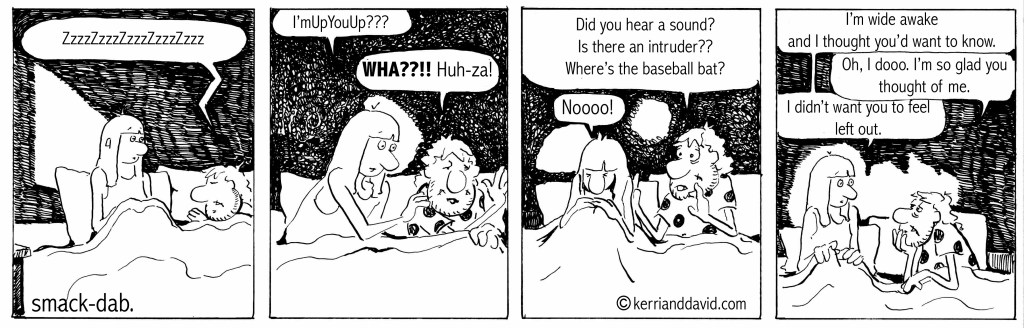
That’s the reason and the story behind our comic strip SMACK-DAB. Like us, it is a second run at a good idea only this time, less armored. For now, we’ll publish a new strip every Saturday. Our chronicle of second chances. Smack-dab in the middle of middle age. The laughter and good love that comes from splaying all the broken pieces across the table and saying, “This is me and I want you to know and share every last shard. For the rest of my life.”

Every long lost dream led me to where you are
Others who broke my heart, they were like Northern stars
Pointing me on my way into your loving arms
This much I know is true
That God blessed the broken road
That led me straight to you
~ Bless The Broken Road, Rascal Flatts

read Kerri’s blog post about SMACK-DAB.

saturday morning smack-dab.

It’s true. She is a suds-wonder-of-the-world. Nothing else needs to be added except that I am smack-dab in the middle of gratitude that it is toothpaste and not werewolf-sign.

smack-dab. ©️ 2021 kerrianddavid.com

Count What Is Right [on KS Friday]

As I came up through the garbage layer of sleep, that half-awake state where all the gunk of being human floats like detritus on the ocean awaiting consciousness’ return, I thought, “I want to have a full day in which I make no diagnosis. In other words, solve no problems, make no judgements, resolve no issues…A mindful day.

Mindfulness is only mindfulness when there is no judgment or discernment or necessity involved. Have the experience, make no meaning. Try it. It’s hard to do. Minds like to story things. I know that, later today, I will sit at the drafting table, script and draw the next batch of images for my latest project – try doing that without judgment or discernment!

Somewhere in my dark and sordid past I realized that I never had a problem or a stress that I didn’t create. The Greek tragedy, the absolute imperative, the all-too-important-agendas were not happening outside of me. I was making the agendas and lists, storying myself into rushing around or fighting back against ogres of my own making. Minds like to story things and conflict is the driver of story. Yearning meets obstacle. Desire meets impediment.

Why not make up a better story? Be careful! There’s an all-important caveat, a prerequisite in telling a better, stress free, story: it only becomes possible when the teller of the story relinquishes their oh-so-important-self-importance. Better stories are lived off the pedestal. Better stories, stress free, are available to tell when the teller realizes that their season on this earth is a passing thing and the notion of leaving a lasting mark just might be hubris.

I’ve been enjoying the reemergence of the hosta plants this spring. They are intrepid. They spread easily. Not so long ago their spiky heads jabbed up through the earth. They looked like little spearheads. DogDog had to dance between them. Overnight, the soldiers-beneath-the-soil transformed as their spears unfurled into tiny variegated leaves. A day later, or so it seemed, the tiny leaves swelled into thick dense clusters. Every year the hostas claim a bit more of the yard. People in these parts dig them up and give them away to their neighbors and friends when they realize that the hostas are taking over and will soon be spreading into the house.

I confessed to Kerri yesterday that I was, very intentionally, counting what is right in the world. It will come as no surprise to you that the list of what is right in the world greatly outstrips what is wrong. The hostas of my mind are the generosities and kindnesses. I want to be overrun by them. The little things. It will also not come as a surprise to you that, if you start counting what is right in your world, you’ll discover that the vast majority of what you find are the simple, the ordinary. The everyday. Kerri and I make dinner together. DogDog leads me to the gate when I’m taking out the trash. Feeling the breeze on my face as I open the door first thing in the morning. The first sip of coffee.

What is right in this world includes Kerri’s music. There is nothing I love so much as when she plays. She didn’t pick this composition for today’s melange. I wanted to hear it. That’s all. That’s enough. Right Now. It’s another name for mindfulness. It’s on the list, like hostas.

right now is available on iTunes

read Kerri’s blog post about HOSTAS

right now ©️ 2010 kerri sherwood

Laugh At Yourself [on DR Thursday]

Had you come across our website during the era of The Roadtrip, a play that Kerri and I wrote from the several-months-email-conversation we had before we first met face-to-face, you’d have read this phrase: smack-dab in the middle of middle age…a true story of quiet hope and the arrival of life’s second chances.

Smack-dab. In the middle of middle age. We met. We married. We walk the neighborhood arm-in-arm. We write these blog posts each day. She brings her wise-eyes into my studio and I tell her what her music makes me feel and think.

For an intense year or so, we tried-like-crazy to syndicate a cartoon strip called Chicken Marsala, the imaginary child of two people who met smack-dab in the middle of middle age. In the course of writing and drawing Chicken, we also pitched a single-panel cartoon, Flawed, and another called At The Door. Chicken Marsala had several iterations because the syndicate liked it…almost. They asked for improvements though never specified what those improvements might be – in the writing? The art work? In this age of too much information, no answer ever came back to us.

In the face of unspecified and uncertain improvements, this ONE thing is certain: we generated a mountain of material in the hunt for the elusive improvement. Oh, and this, too: we laughed heartily at ourselves. The mountain of material was about us. We were poking fun at the things we do and say each day.

This morning I found Kerri furiously working at her computer guffawing. She’d pulled up the old Chicken file. There was an iteration of the strip that was pre-Chicken, the middle-aged couple prior to the appearance of their imaginary son. We sat this morning and laughed again at ourselves. These things actually happen and how joyful is it to chronicle yourself in-and-as a cartoon?

I suspect we are going back to the drawing board. This time, we’ll not hide behind our imaginary son. This time, we’ll pull the blankets on the source. Smack-dab. In the middle of middle age. Two artists met and got married. What could be a better set-up for ridiculousness?

read Kerri’s blog post introducing SMACK-DAB

*don’t believe a word she writes, she guffaws all of the time.

smack-dab ©️ 2021 david robinson & kerri sherwood

Run Through Norway [on Not So Flawed Wednesday]

DogDog is a very vocal pooch. He sings his body electric, he gives full voice to his soul. There are times that I, with great delight, watch him run fence to fence, barking for the simple pleasure of making sound. He is a vocal hedonist.

Sometimes he barks and listens. He wants some dog out there to bark back, a pooch call-and-response. There is no better gift for DogDog than when one of his neighborhood pals barks in response. Pure pleasure, he runs circles around the yard. When his call does not evoke a response, he waits a few minutes and tries again. He is an eternal optimist.

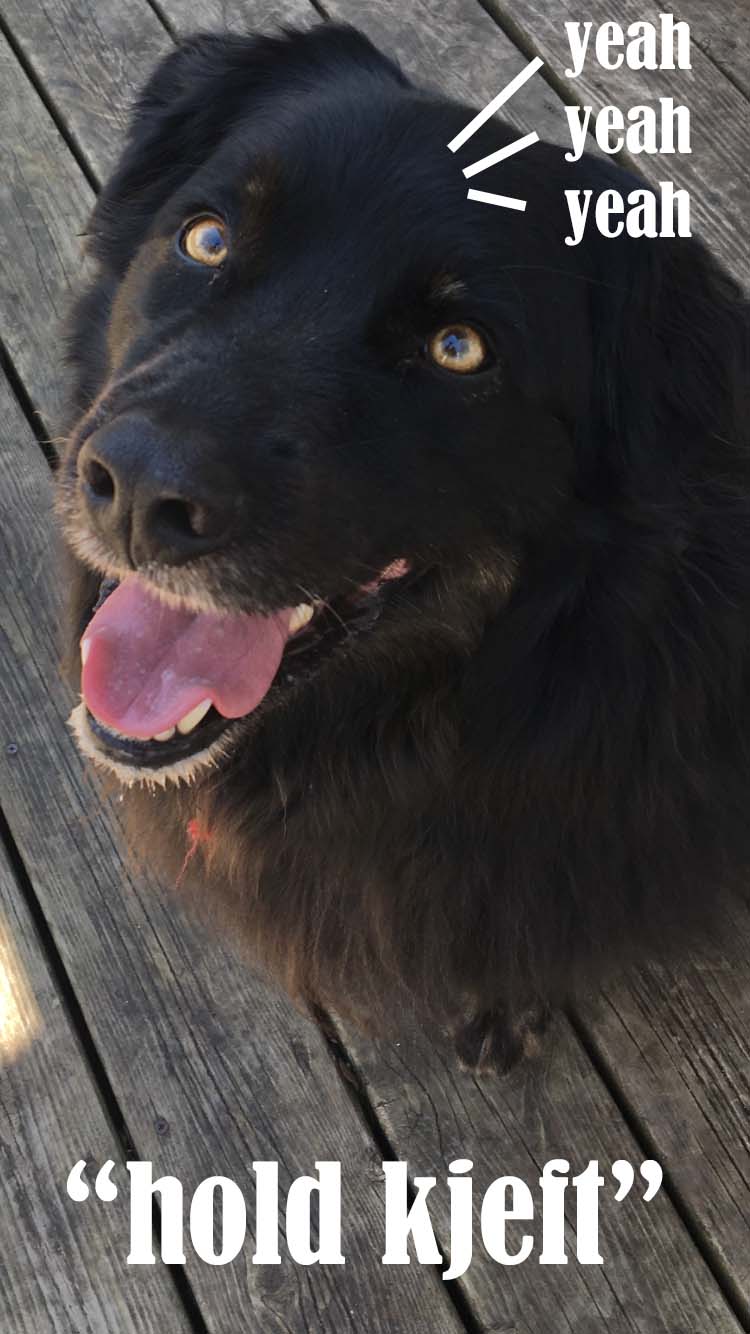
DogDog knows when he’s NOT supposed to bark. Inside the house is a no-bark-zone. When Tim, the neighbor gets in and out of his car. When Lucky, the dog that recently showed up in the yard behind ours, comes to the fence. When we are in the car, going on errands, and he sees another dog; his body quakes with full-bark-desire but he knows better. Kerri taught DogDog a bit of Norwegian. “Hold Kjeft,” she says, when we he winds up for a good bark-in-the-car. DogDog hears Hold Kjeft and he moans and whines and complains. He performs a melodramatic Medea until something else captures his attention.

Initially, she didn’t use the phrase in any other situation. Norwegian was reserved for the car. Hold kjeft, in translation, means shut-up but for us it has become a preemptive command, “no bark.” Norwegian was so successful in the car that it has now spilled out into all other situations. She never has to raise her voice. She simply opens the back door, says, “Hold Kjeft,” and all barking turns to enthusiastic circle-running. It’s magic. It’s Norwegian.

It doesn’t work when I use it. For some reason that I can’t explain, my “Hold Kjeft” elicits howls of laughter from DogDog. He looks at me and, as if to make a point, “Your Norwegian is no good!” he barks in reply. And then, to sear in his criticism, he barks again. I revert to my Frankenstein English “No Bark!” DogDog immediately complies. “That’s more like it,” he wags and runs for the back door.

Language is a mysterious and magic beast. Lately, I’ve noticed, that when I am whining and complaining and feeling like performing my version of melodramatic Medea, a tiny voice in the back of my mind whispers, “Hold Kjeft!” So taken aback by the sudden whoosh of Norwegian, my performance is short-circuited. My mind shuts up.

I look to Kerri to suss out whether that tiny voice is hers or coming from some other mysterious source. She always appears to be innocent and asks, “What?” to my inquisitive stare. “Nothing,” I reply and look to DogDog, who wags and rolls for a belly-belly.

I suspect that, rather than DogDog, it is I who am being trained. Belly-belly. Hold Kjeft. I am suddenly suspicious about my overwhelming desire to wash the dishes. What is going on here?

There is only one thing of which I am certain: my path to inner quiet runs through Norway. Hold Kjeft! On me, Norwegian works.

read Kerri’s blog post about HOLD KJEFT!

Live A Sockdolager [on Two Artists Tuesday]

Word genius sends me a word everyday. Some I know. Most I do not. Yesterday, my word-of-the-day was sockdolager. Sockdolager is a word that, when typed, is unrecognizable to the vocabulary in my spellcheck and is adorned with a screaming-dotted-red-line meant to notify me that either I spelled the word incorrectly or it’s not a word at all. Language is a fickle companion.

In Seattle, when the rains clear, people are fond of saying, “The mountain is out.” Mount Rainier, hidden in the clouds, makes a grand – almost impossible – appearance when the weather clears. Where there was no mountain, suddenly a Titan appears. It is a sockdolager, an exceptional occurrence. A forceful blow. The first time I saw it I almost crashed my car.

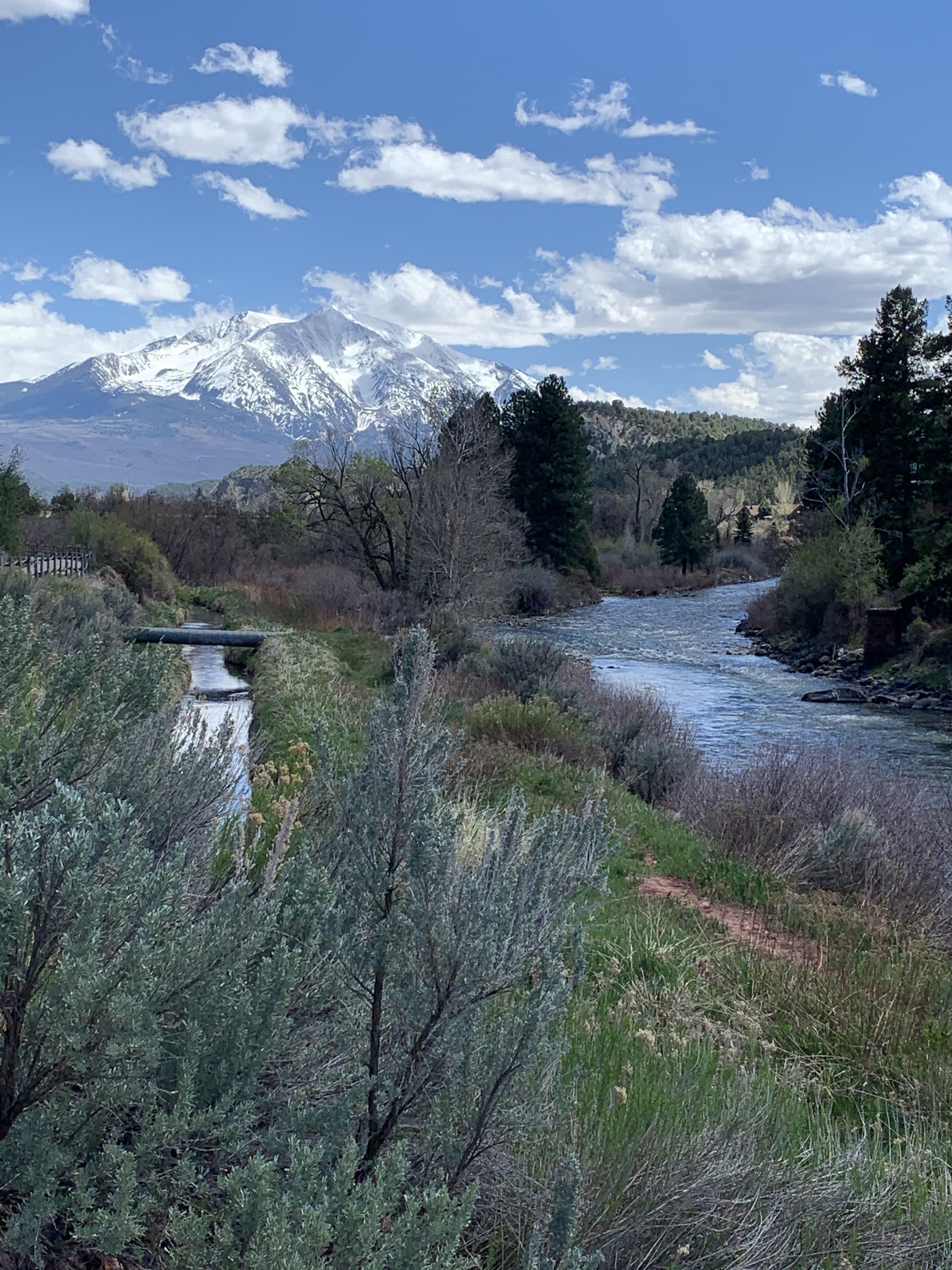
Mount Sopris hit us with a similar wallop. We arrived in Carbondale “in weather.” A day later, making a run to Main Street to meet Kirsten, we rounded a corner and nearly crashed the truck. There was a mountain towering over us where, previously, there was none. Clouds swirled around the summit. The late afternoon light made it glow. Sockdolager! Sockdolager!

I very much appreciate that my snotty spellcheck does not recognize or appreciate my use of sockdolager. No word can adequately capture the experience of being hit by a mountain. “Awe” is a word. So is “amazement.” They fall short, too. Language can reach toward but never quite touch that which it hopes to describe.

The day after the wallop we took a stroll on the Rio Grande Trail. We intentionally walked away from Mount Sopris, knowing that, at some point, to get back to our airbnb, we’d need to turn around and walk toward it. Like Orpheus leading Eurydice, we tried not to turn and peek but the majesty was too much. We’d giggle and turn and gasp. “My god!” we whispered.

We go to the mountains to remind us, to refresh our eyes and hearts and minds. This life. An exceptional event. A forceful blow. Grander than words can describe. Sometimes the mountain is hidden. Sometimes it shows its face. Either way, it never ceases to surprise you, to take your breath away. Sockdolager.

read Kerri’s blog post about THE MOUNTAIN

Consider The Intention [on Merely A Thought Monday]

My least favorite character in Romeo and Juliet is Capulet, Juliet’s father. A few years back I thought it would be a good exercise to tell the story from his point of view. In his world of privilege and order, he has an out of control daughter, a teenager no less, ignoring the rules of the house and society, having sex with the son of a sworn enemy. He imagines a better future for her (and himself) and has worked hard to protect her and match her with royalty. Like every parent I know, he just wants his daughter to behave and thrive.

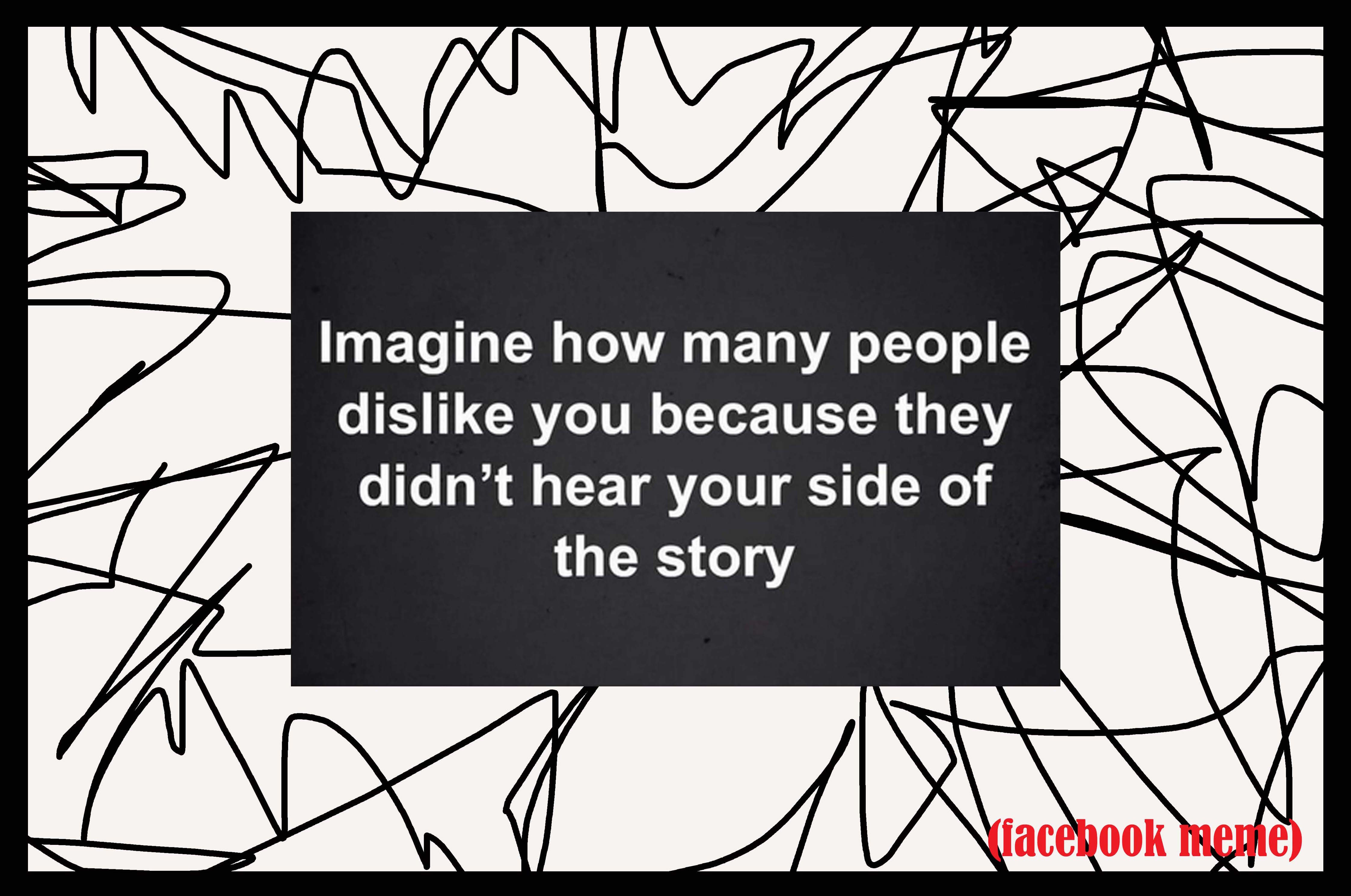
Every story has an agenda. That’s true of the stories we tell of ourselves at parties, it’s true of the stories we shout at each other when we are having fights, it’s true of the stories we tell when we are falling in love, it’s true of the stories we tell when breaking up. Every story has at least two sides and each side has an intention.

Stories are never neutral or passive. It’s precisely why Blind Justice is so important to the health and well being of a society: between two opposing/competing stories there is a point of equilibrium that we call “fact” or “truth.” Blind Justice carries a scale to symbolize that place of story-equilibrium, ideally free of status, privilege, sway…weighing the stories to arrive at fairness and equity.

Health is the capacity to consider the other side of the story.

It is the truly despicable character that steps with intention into the gap between competing narratives solely to create discord. To lie for gain. Iago is just such a character. He creates an illusion with no greater intention than to hurt, to destroy. Desdemona dies. Othello murders because he cannot see through the lie Iago is telling. Othello’s love turns to hate. He cannot or will not hear the other side, the love story, the truth of Desdemona.

Hatred is a territorial flag planted in a one-sided story.

The modern GOP is Iago. Othello is a cautionary tale relevant in our times. What or who will be murdered before the lie is laid bare?

I have always been a lover of myth and parable, stories that reach with intention to deeper truths. It is why I stepped into the theatre in the first place. Art, like Blind Justice, uses story to reach deeper truths, truths that can rarely be captured in words. It’s the paradox of art and truth is always found there.

No story has a single point of view. No truth is singular – that is the hallmark of the truly important challenges that every society faces. It is why successful governments tell their story with truth as their intention. It is why successful relationships sail through stormy seas. The intention is pure. The desire to stand in the shoes of the other-side-of-the-story is genuine and necessary in order for the relationship, the community, the country to thrive.

Capulet is not a bad man. He has good intention. The play ends when he becomes capable of standing in and considering the other side of the story. Hope and equity is the promise rising from the pain.

Iago, on the other hand, is a wholly different story. His play ends in a cage with a nasty celebration of the pain, death and havoc he’s wreaked, gloating about his capacity to snare others in his big lie. All are made fools.

read Kerri’s blog post about THE OTHER SIDE OF THE STORY