Lay It To Your Heart [on Two Artists Tuesday]

“This entire week is about noticing,” Kerri said, looking at the week’s photos we’d just uploaded into our site. Sometimes the melange has an intentional theme and sometimes a theme announces itself. Our lives have become about noticing. I suspect all of our writing is, in one way or another, about noticing.

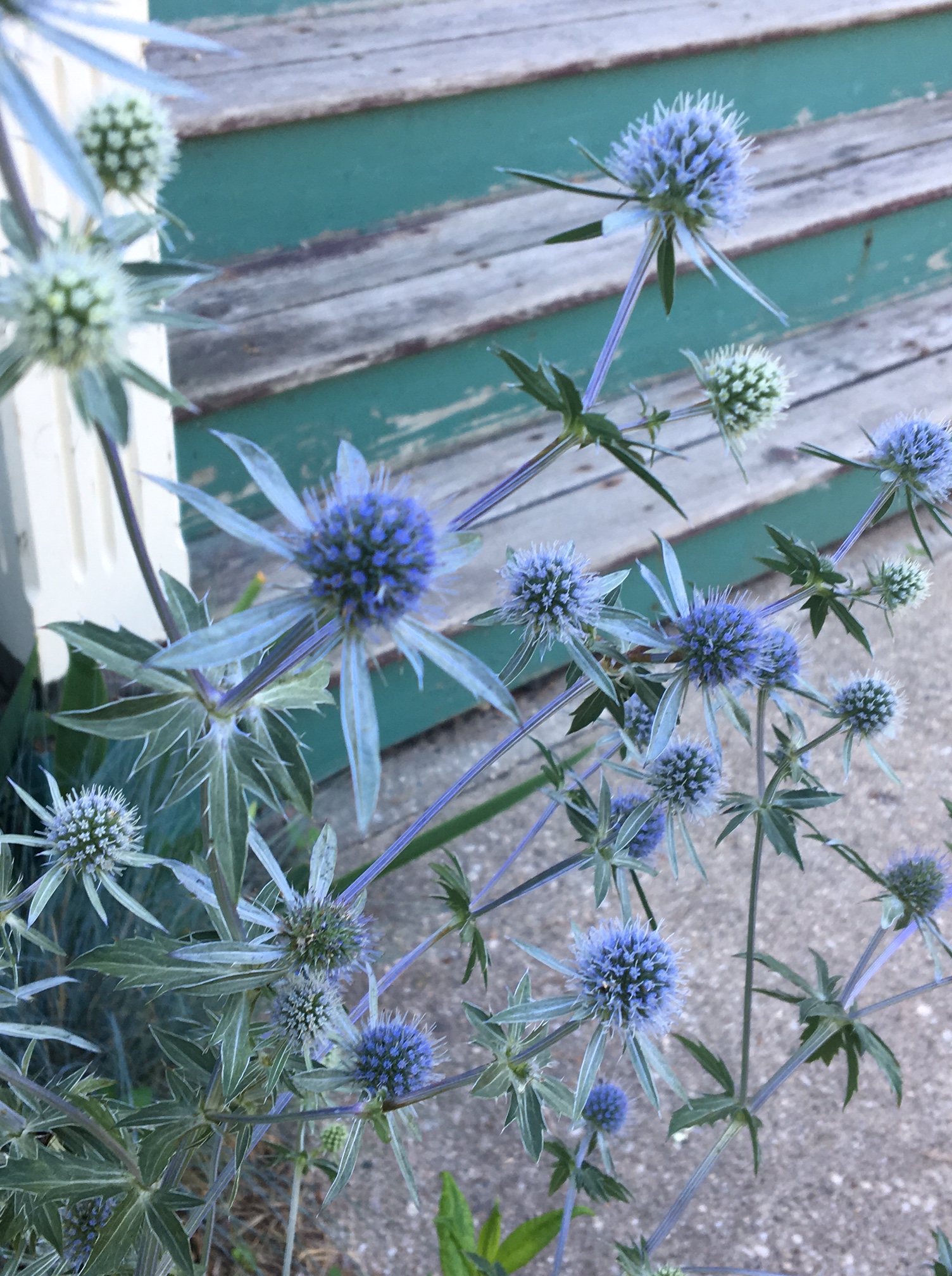
This is Blue eryngo. Flat Sea Holly to the poet. Eryngium planum to those more interested in species categorization. Shakespeare would know it as a thistle, a cure for love sickness. “And lay it to your heart.”

The evening breeze turned our steps toward the marina. It was a brutally humid day and we were restless in the air’s oppression. Arm in arm we talked of how long it had been since we wandered in this direction. It used to be a daily stroll but more recently we’ve sought trails away from people. The forest quiet rather than the crowds at the shore.

The color of the plant stopped us. I felt as if I was looking at a magical universe of purple-blue planets or something more likely found under water. While Kerri snapped photos I marveled at the color. The shape of the leaves reaching from the thistle center. Little blue suns.

Our chance encounter with the Flat Sea Holly blew some nice air into our sails. We walked on talking about the gift of noticing, taking photographs, how to be better artists, amazing sights all around.

Shakespeare’s thistle cures more than lovesickness. We lay it to our hearts and it lifted our humid-heavy- spirits.

read Kerri’s blogpost about FLAT SEA HOLLY

Live Inside The Altar [on Merely A Thought Monday]

Dear reader, you have done me a great service. You’ve connected my past to my present.

I’m not sure why but, initially, I numbered rather than named my blogposts. My 623rd blog post was about a practice I’d all but forgotten. Building an altar of gratitude.

Someone out there read #623 so it popped up in my analytic. “This is old!” I thought, staring at the screen. A numbered post! Another era. “I wonder what I was writing about?”

2012. Thanksgiving. Among the darkest days of my life and yet, on that day, I was deeply, profoundly grateful. Life had chased me to a cliff. There was nothing to do but leap. I remember like it was yesterday wandering the streets of Seattle placing notes of gratitude in the cracks of walls, at bus stops, at coffee shops. I felt as if I was invoking. I wanted a better world. If I wanted it, I needed to offer betterment to the world. It was a prayer. A weaving. It was the last time I built my “altar of gratitude.”

A year later I lived in an entirely different world. Everything went to ashes.

2022. Kerri and I are walking our trail. We’re giggling because we just planted a painted rock in the elbow of a tree. “Do you think someone will find it?” her inner 5 year old asks, too wiggly with excitement to stand still. I expect her to skip in circles of enthusiasm.

“Yes,” I laugh. “Someone, someday, will find it.”

As I reread #623 I realized that, in rising from the ashes, I was no longer building my altar on a single day in a single season. I was no longer invoking gratitude. I was no longer hoping for a world that might someday come into being.

I am creating it. Not on a single day or special occasion. I’m practicing gratitude every day. I’m living gratitude every day. Painting rocks, making dinner, watching sunsets, buying groceries, writing blogposts.

Because you sent #623 back to me, a marker in time, I’ve realized I’m living inside my altar. All the world….

read Kerri’s blogpost about EXPLORE

Shimmy Dance [on DR Thursday]

Barney the piano has been in residence for over 7 years. His sound board was ruined and he was on his way to the junkyard when Kerri intervened. She played him on his first day here. He gave sweet voice for a few musical lines and then went silent. We’d occasionally wander out and press his keys but he was absolute. He was finished with his former purpose and ready for the next chapter.

Over time he lost his facade. The white veneer peeled from his keys and exposed the wood beneath. His decorative layer also began to curl. Pieces fell in strips like bark from a tree, exposing the rougher wooden structure.

Chipmunks have taken up residence. The squirrels glory in sitting high on his bald pate while lecturing Dogga. He’s beginning to sag in his middle and sink into the ground. He has been home to flower pots and once acted as our herb garden. Currently, we’re on the prowl for an appropriate chandelier to hang above him. I understand that pianos, at any age, love a good chandelier.

Barney has become an institution in our backyard. A fixture. I mow around him and never give it a second thought. We turn on the sprinklers to water the grass and water Barney, too. The first time we watered Barney, 7 years ago, Kerri cringed. It seemed sacrilege to spray a piano with water. She couldn’t look and retreated into the house. Now, Barney and the grass are one.

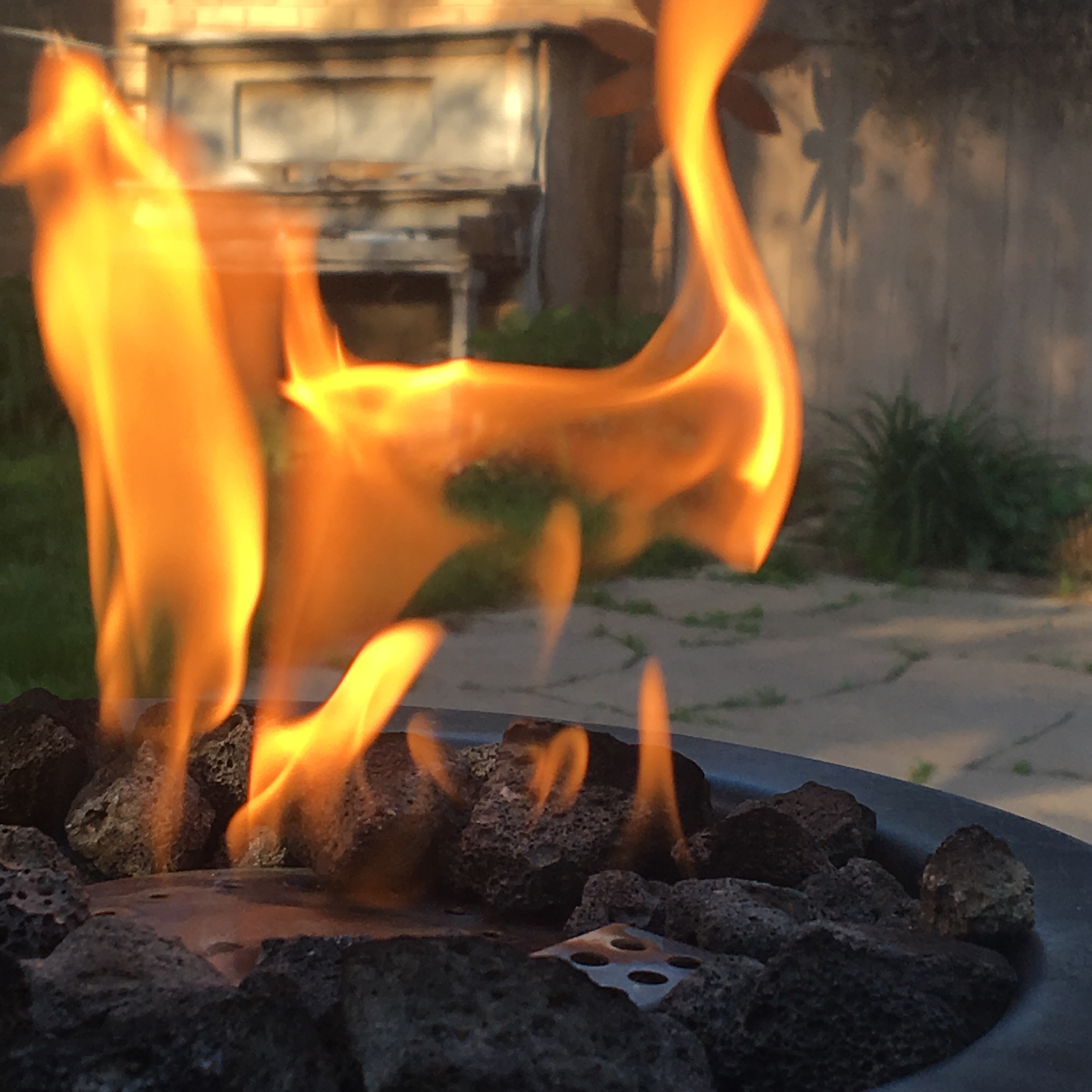
Sometimes at night we sit on the deck and watch the daylight wane. The pond light is on a timer and illuminates the fountain. The shadows dance on Barney. If we sit in the right spot, it seems the fire from our small tower dances in time with the fountain shadow on Barney. Fire and water move in a perfect shimmy dance. The elements come together. Alchemy.

Sitting in the waning light, watching the dancers dance with Barney, I’m reminded that magic is happening all around us. Everyday. Every moment. And, if I stop moving long enough to pay attention, I can see it. Barney also reminds me that we are never the same moment to moment. The changes are visible over time – long periods of time, but the movement is continuous. Slow. Joseph Campbell said that the universe creates forms and take them down. Creates forms, takes them down. Barney was once a piano. Now? To us, he is many, many things.

read Kerri’s blogpost about BARNEY AND FIRE

Give It Perspective [on Not So Flawed Wednesday]

“Awe” is one of those complex words that contains its opposite. Wonder and dread. Astonishment and fear. Respect for the power of nature. Reverence. It’s a full-spectrum word.

Awe is what you feel standing at the ocean shore, knowing the waves will rush in long after you are gone. Water pulling at your ankles. Toes in the sand. Staring into eternity.

Awe is a perspective-giving word. It makes us both tiny-in-the-universe and fortunate-beyond-words, all in the same moment.

Once, I stood on a mountaintop in the bitter cold of dawn. The sun broke over the horizon and washed over me with a wave of warmth. Life-giving. Literally. I stopped shivering when the sun touched my bones. Filled with awe, I started to laugh and cry. Beautiful, magnificent and painful.

We stood on the deck and watched the cloud tower above us. Threatening and astonishing. She showed me the photo. “The wire makes it,” she said holding the screen so I could see it, “It gives it perspective.”

Perspective. Correct regard for the truly awesome power of nature.

read Kerri’s blogpost about TOWERING CLOUD

Overflow With Artistry [On Two Artists Tuesday]

Sitting amidst the boxes that currently fill my studio space, I realized that I’m rolling into the third year since I’ve completed a painting. I’ve been staring at the same canvas set on my easel for a very long time. Broken wrists, the pandemic, another broken wrist, lost jobs and economic free fall initiated an era of blank canvases.

I’ve done this almost every day for two years. I stand at the edge of the boxes. I look at the large canvas layered with undertones of red, covered with layers of tissue, preparing the ground for the image. Charcoal sketch marks barely visible, images I drew and wiped away. I suppose it’s not accurate to say the canvas is blank.

My sketchbook is closed. It sits on the table next to the easel. If I opened it, on the last pages, I would find rough sketches for the painting. Ideas in rude pencil scribbles.

Memory is an organizing principle. A story plot line. We make sense of today based on how we organize our memories into a tellable tale. Looking at the canvas is like looking into a mirror and I ask myself what made me pick up a pencil the very first time. The small-boy-me was seeking. “Running or seeking?” I ask. My studio has always served as a sanctuary. A place where I found quiet, made sense of the chaotic world. “Running or seeking?” I ask again.

Staring at the canvas I should feel loss but I don’t. Each morning, Kerri and I sit next to each other and write. This is the 232nd consecutive week that, five days a week, we’ve written together. She edits what I write, makes suggestions, and I do the same for her. We produce a cartoon every week. For my work I’m also drawing a series of cartoons that, after I script and draw final drafts, I hand them off to Kerri. She digitizes them and, quite literally, adds elements that improves them. I’m not empty of artistry but full to overflowing. I no longer need to retreat to enter my sanctuary.

It’s hard to know where my work ends and hers begins. They are ours. A perfect collaboration. Two as one.

Last week we had a fence installed. Invasive neighbors, throwing rocks at Dogga, lobbing toys into our pond, we’d finally had enough. The fence felt like reclamation of space. The impact was immediate. We hadn’t realized how completely the space invaders – like broken wrists and job losses, had interrupted every rhythm and pattern of our life. Basking in our space – our space – Kerri started to laugh and point. Two birds, lawn art purchased in a small town on our long drive from Seattle, always in our yard but always barely seen, we’d hastily placed them next to the new fence. “Two birds, one shadow,” she said, jumping up to snap a photo.

“Two birds. One shadow,” I repeated her words. I’ll take it as an affirmation. A new fence. A new era. All the world is my studio. My sanctuary. It’s what the small-boy-me was seeking all along.

read Kerri’s blogpost about TWO AS ONE

Be Different [on Merely A Thought Monday]

Inadvertently, 20 did me a great favor. On the day Kerri and I married, he carried a concealed camera and captured conversations and special moments of our ceremony. In his footage is a short exchange he had with my dad. My dad said of me, “He’s his own man.”

To that point in my life I’d wondered what he thought of me, my winding career path, my free-form seeming-feral existence. “He’s his own man,” brought me peace.

Once, during a conference that we led, Alan told me I should dress differently. “People would have more respect for you,” he said. Once, trying to fit in, I wore a suit to a facilitation and Rich told me I should dump the suit and dress as myself. I’ve awarded him the blue ribbon for best advice.

In my consulting life I wore clogs. I hated shoes with strings. The first thing I did at every job was kick off my clogs. You’d be surprised how invested people in power suits are in their footwear. You’d be heartened how human they become when they unlace and kick off their shoes. It’s like removing a mask.

People hire me because I am different. Because I see differently. My difference is my gift, the epicenter of what I bring to the world – and that is true of all people.

In a culture that prides itself on its individualism, it’s always been amusing to me how invested we are to “fit in.” Shopping at the right store, wearing the right clothes, we gush about our wild nature while synching tight the corporate tie. To “dress for success” means to fit a prescription, to NOT stand out. Business casual. The real real. All houses must look the same. Revealing behavior betrays the swaggering rhetoric.

Our individualism is at best a thin veneer. In truth, we fear difference. I dare the court of Supremes to uphold a coach’s right to pray before the big game on the 50 yard line if he’s Sikh. Or Muslim. Or Hindu. Or Buddhist. My son is gay. He lives a constant, never-ending battle to defend his difference. Why?

“But the truth is, I am different,” I said to Kerri who was red-faced with anger at the email from the concrete sub-contractor. He turned down the job to replace our bit of sidewalk, broken out during the waterline repair. Among his reasons, “…and he seems a little different.” He was referring to me.

“I’ve dealt with that my whole life,” I said as she furiously typed a reply. “It’s not a big deal. I’m an artist.”

“It is a big deal,” she snarled, typing harder, faster.

Listening to her ferocious key-pounding, I had a sweet wave of appreciation for her. In a lifetime of “different”, it is a rare and precious moment that someone vigorously defends your difference. Rather than hammer you into creased dockers, lace-up shoes or the right haircut, a furious defender was unfamiliar. She, too, is different and knows the bruise of the shame-hammer. I suspect we’ve all experienced its sting.

In my head, I heard my dad say, “He’s his own man.” Peace. I am what I am and the people who love me wouldn’t have me any other way. That makes a difference. All the difference.

This I know: it’s nice – so nice – not to be alone in my difference.

read Kerri’s blogpost about DIFFERENCE

Intend Renewal [on DR Thursday]

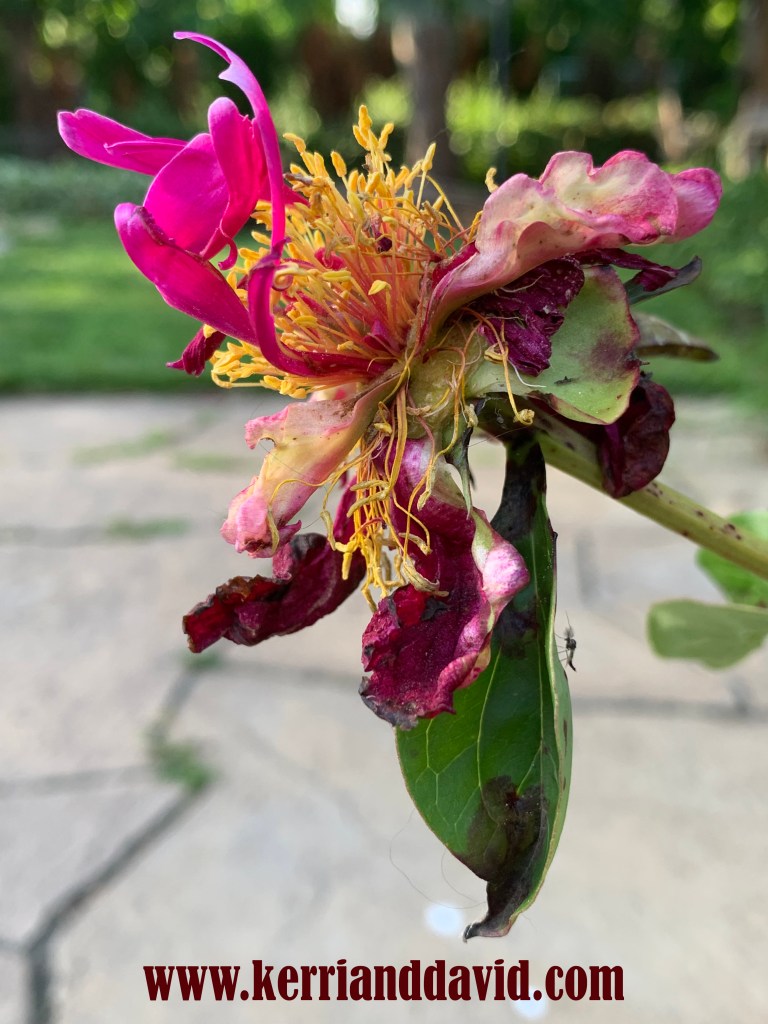
Context is everything. When we chose this picture for our Melange, I thought I’d probably write about renewal. Out of devastation, a phoenix rises. Or, perhaps the kind of renewal that doesn’t just happen but requires a bit of scraping, new soil, scattered seed, and hay-net to prevent the birds from feasting on the seed. Intentional renewal.

Context. Between the day we chose this photo and this cool quiet morning that I’m attempting to write about it, the mass shooting at Highland Park happened. I’m finding it nearly impossible to write about renewal.

Highland Park is not far away. We attend the annual art fair on their small-town Main Street. We’ve driven through 4 times in the last two weeks.

We were about to go out the door and walk to our local 4th of July festival when the news arrived. We looked at each other, no words necessary. We kicked off our shoes. We decided to stay home. Going to a place where people congregate – like grocery stores or elementary schools or places of worship or movie theatres or parades meant to celebrate our “independence” – seemed unsafe.

Context.

HIghland Park was one of three locations in the USA that experienced mass shootings on the 4th of July. No, check that. Four locations. Even as I type, Kerri brought news of the mass shooting that happened here – not so many blocks away – on the 4th. Staying home was a good choice. Oops. Check that. More news. There were eight. Oops (again). Check that. Eleven.

I cannot write about renewal but, for the third time this week, I am tapping out thoughts about interconnectivity.

It is a trick of language to say, “I broke my toe” and believe that only the isolated body-part called “toe” is injured while everything else is fine. Except it’s not fine. An injury anywhere to the body is an injury to the whole body. Everything is impacted. Everything adjusts. The pain-impulse you feel in your toe has already completed a round trip to your brain. Your posture adjusts so expect your hip or back to be sore tomorrow. Your spatial awareness goes on high alert: it’s best to avoid toe contact with any immovable object. If you desire to understand interconnectivity, consider how your whole body might respond if you happen to stub your seeming-isolated-and-already-broken-toe. Whole body response. Imagine it.

There have been over 300 mass shootings in the United States this year. So, the single most puzzling comment to come out of HIghland Park? “How could it happen here?” As if “here” is somehow isolated from Uvalde or Buffalo or Boulder or…it’s a long list and growing.

The whole nation-body is injured. It’s the illusion of isolation that underpins the mad-thought that more guns, unrestricted, are a solution to gun violence. Build a fortress? Isolate? Better doors? Arm yourself? It’s only the toe.

Where exactly is the boundary of “here?” And why would it be okay for “it” to happen “there”?

We’re all here. There is no “there” that is “safe.” Context is everything.

Perhaps I am writing about renewal. The intentional kind that requires some leadership scraping, new soil, seed, and a whole-body community united and relentless in their demand for proper protections from the insanity of guns.

read Kerri’s blogpost bout NEW GRASS

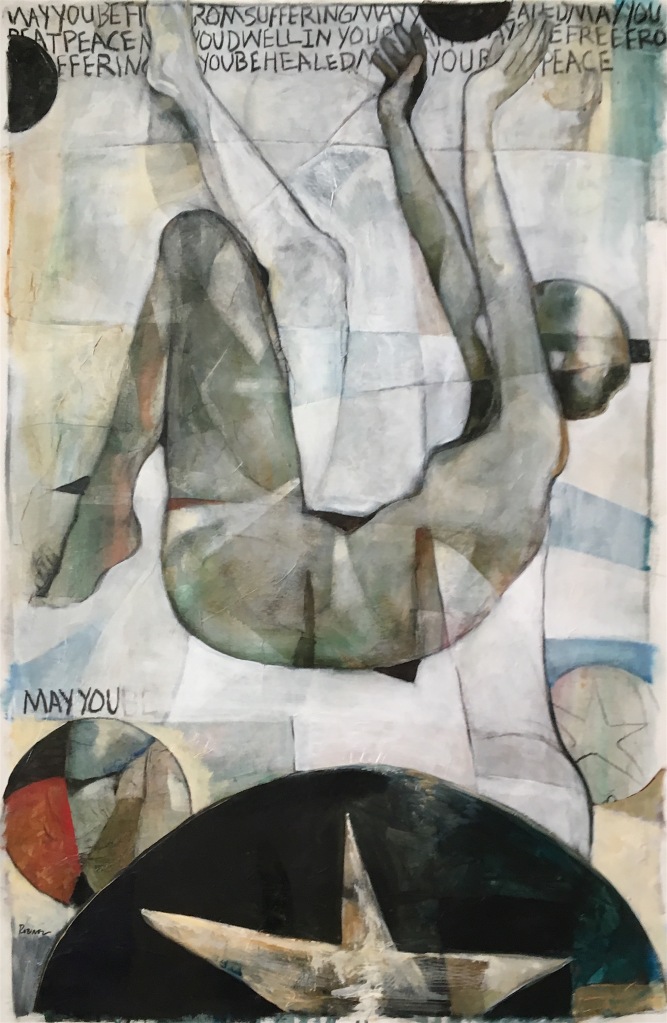
may you © 2015 david robinson

Go It Together [on Flawed Wednesday]

“The problem is that this fluidity is not a choice we are free to make. Despite the unifying patriotic rhetoric that permeates the United States, on some level Americans are not really fooled: at bottom, each person knows he or she must continually “reinvent themselves,” which is to say, go it alone. America is the ultimate anticommunity.” ~ Morris Berman, Dark Ages America: The Final Phase of Empire

I laughed aloud when I read this quote. It reduced to a simple phrase what I believe is the collective experience of being an American (U.S.) in the 21st century. Together, we go it alone.

“Going it alone” is, of course a delusion shared by cowboys, republicans, and guys that put big tires on their trucks. After all, someone had to make the tires. And the truck. And pave the road. Using tax dollars since the roads are public and maintained by the collective. All of the chest-thumping expressions of individuality are, after all, firmly rooted in the lives and labors of others.

It only takes a minute to tease apart the loose fibers of the go-it-alone mythos. The problem is that one must want to think it through and, in our current spiral into stupidity, thought is shunned. So is history. At the core of anti-community is the absence of critical thought and a bucket of denial.

[Sidebar: this reminds me of a favorite phrase that, one day, popped out of Jim’s mouth: because you think it, does not make it so. Because you believe it, does not make it so.]

In my current state of residence, the governor, a democrat, asked the legislature, a randy band of republicans, to meet for a special session to discuss the ills that currently plague our community. The randy band gaveled open the session and then, as is its custom, immediately gaveled it closed. Legislators that refuse to discuss issues or policy. Sitting in the people’s house, obstruction is the only card in their deck. Not a single idea or impulse to serve the public in the randy band and their lock-step rugged individualism.

It is the sign of our times. Going it alone together is an ugly race to the supremacist bottom.

The cure for what ails us lives in the space between the gavels. Genuine discussion of the real challenges that face the community. An acknowledgement that driving the big cowboy truck adorned with big cowboy tires is only possible on the public road made viable by the shared effort of hundreds of fellow citizens. All of the Fox-driven drivel and religious right propaganda is never going to change the fact that we are all in this together. We can choose to be a failed state in a dedicated anti-community or we can thrive in the post colonial-era by bringing all ideas, all points-of-view, all people, to the common table for a wee-bit of collaboration, compromise, and long-needed-real-live-bona-fide-communal-reinvention.

read Kerri’s blogpost about MASKS OPTIONAL

Consider The Symbol [on DR Thursday]

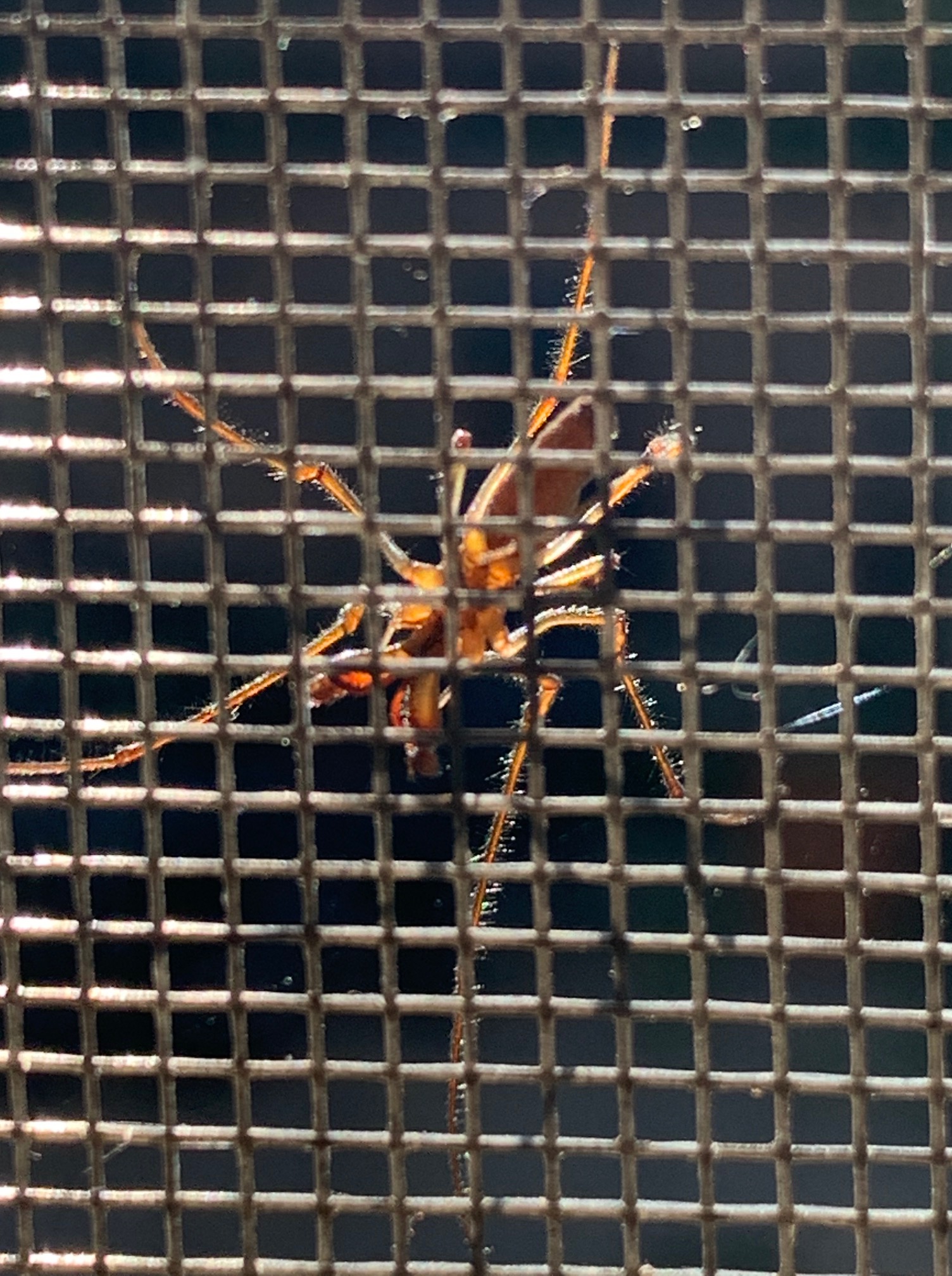
Because it is outside, she grabs her camera. Were it inside, I’d hear the special scream saved for spiders and I’d come running. The power of a screen, flipping fear to fascination. “It’s amazing,” she said and cringed.

Spider symbolism – like all vital symbols – carries the power of a complex split-metaphor. On one side of the screen they are toxic, malicious, potential bringers of slow venomous death. On the other side of the symbol, they are world creators, weavers of life and interconnectivity. Certainly, they are central characters in this world-wide-web that we enjoy.

In this era, we attempt to restrict our symbols, preferring them to be absolute, one-sided, either this or that. Symbols never work that way. They lose their power when cut in half. To be potent, a symbol must embody both sides of the moon. Limiting a symbol to only one side flattens it, robs it of dimension, renders it useless. The real power of the symbol ignites when both aspects are understood and embraced. Symbols are polarities.

We would be wise, in our nation, to look at both sides of our symbols. Our history, embodied in our symbols, is both shining and dark. Vapid fear-stories like “replacement theory” fester in a flattened symbol culture, a half-told history. Ugly nationalism grows in the spaces left empty by a cleaved symbolism, a highly-edited narrative.

Gaze through the screen at both sides of the symbol, and a fuller, richer, more color-full story emerges. An honest narrative.

Nations, like people, become healthy when they embrace all sides of their story, the dark side and the light, when they acknowledge both aspects of their symbol, when they take responsibility for their actions, the venomous and the virtuous alike.

read Kerri’s blogpost about THE SPIDER.

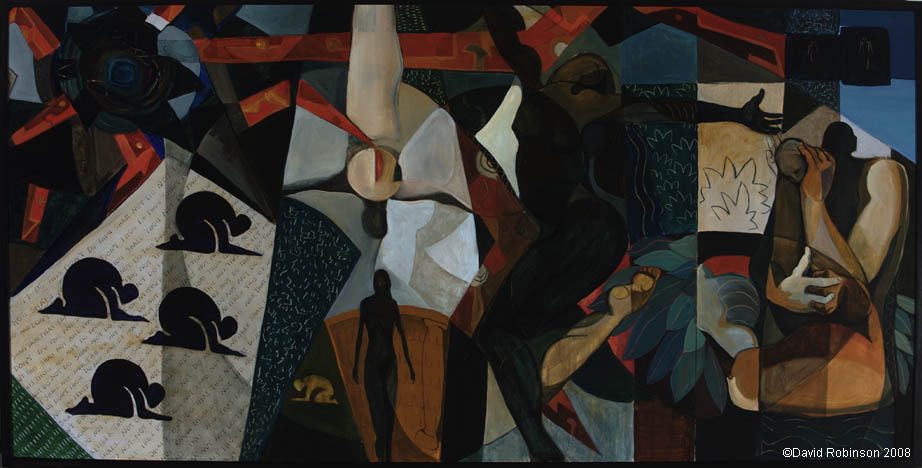
Prometheus Resurrection © 2008 David Robinson

Sing The Song Of Simple Lessons [on Not So Flawed Wednesday]

This is a song about the simple lessons. The amusing and eye-opening answer to “because we’ve always done it this way.”

As a budding young artist I was frustrated because my charcoal lines were not as alive or fluid as the masters I so admired. I wrestled and strained and struggled to achieve “alive” lines, doubling down on my technique, my personal bridge to nowhere, as if doing more of the same, rife with inner turmoil and tension, might achieve my aim of ease.

Watching me struggle, amused by my absolute dedication to doing the same old thing in the same old way, as if I might accidentally squeeze out a new result, my art teacher, a wisened older woman full to the brim with laughter and humility, came to me, took the charcoal from my hand, and showed me how to hold it, not like a pencil, but like a flower. My lines were instantly alive. My teacher laughed at my amazement.

New ways – better ways – are rarely discovered on a tension path. Why is it that we look in the same drawer multiple times when we’ve lost our keys?

We have, for years, made lunches from yummy food wrapped in a corn tortilla. More often than not, our food falls to our shirt, our plates, the floor, because the tortilla splits. “We have to do something different,” Kerri says each day as her tortilla disintegrates. Dogga delights in the mess and recovers the spoils that hit the floor. Day after day, year after year, the tortilla struggle has been a part of our lives.

During a recent visit, Kirsten, watching our struggles, shook her head, sighed and asked, “Why don’t you use two tortillas?” It was a revelation. A simple change that never occurred to us, babies of depression era parents.

“Two tortillas!” Kerri exclaimed. “Yes!”

I nodded with satisfaction. A better life, a cleaner meal, was in reach! Less mess in our future!

Two tortillas. Hold the charcoal like a flower. Revelations born of ease and the obvious answer.

Someday we will learn (or not): No stress necessary. Relax. Insight sings the song of simple lessons.

read Kerri’s blog post about Two Tortillas