Surface The Pattern [on DR Thursday]

Steve read my book and said he didn’t really understand the thing about pattern. His comment at first surprised me but then I realized he was actually reinforcing the point: we are unconscious to our patterning. We think in patterns. We see in patterns. Culture is pattern. Pattern is invisible and making it visible is a necessary first step in change processes.

The people who surface pattern are often seen by the mainstream as deviant or rebellious. Women demanding equal pay are attempting to make a pattern visible. The BLM movement is attempting to make a cultural pattern visible. Shining a light on longstanding oppression is never welcome in the halls of power.

The people who work to repress the visibility of cultural pattern, conserve the norms, generally claim a righteous superiority. They are keepers of the culture and feel threatened, even victimized, by the sudden visibility of cultural pattern. Exposure is always a threat to the existing pattern and no one relinquishes power or privilege without a fight. The current raft of voter suppression laws – made possible by the fantasy of a stolen election – is a great example. The Big Lie is a textbook example of how far people in power will go to hide a privilege-norm. It is, for us in these un-united states, not a new phenomenon; it is a longstanding well-guarded pattern.

Change happens when the patterns are surfaced. There will always be a tide that rises to extinguish the light of exposure. In the long run, those hardy voices that were, at first, branded as deviant or dangerous, we come to honor and respect. They refused to be silenced. We claim them as our heroes. MLK. Gandhi. Rosa Parks. Cesar Chavez. Susan B. Anthony. There are so many. It is no easy task to surface the patterns. The path of a light-shiner is dangerous and difficult.

John Lewis gave great advice for those dedicated to surfacing unconscious patterns: “Get in good trouble, necessary trouble, and help redeem the soul of America.” He also said that, “…transformation will not happen right away. Change takes time.”

Opening eyes to unconscious pattern, to what is obvious yet unseen, is an artist’s path. Seeing beyond what you think you see…seeing beyond your field-of-dedicated-belief, being curious enough to question what you are being told – can you imagine anything more necessary – more vital – in our age of rabid-misinformation and desperate-pattern-suppression?

read Kerri’s blog post about PATTERN
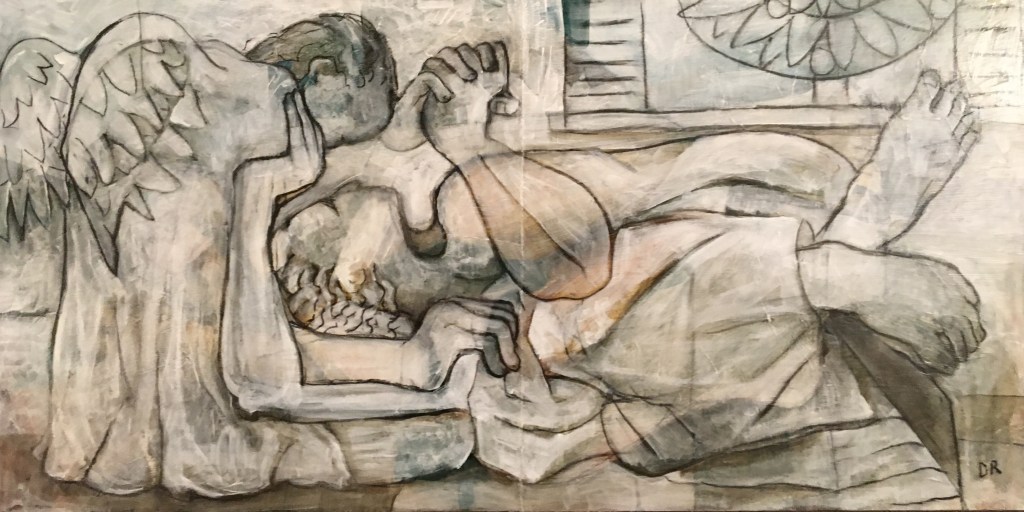
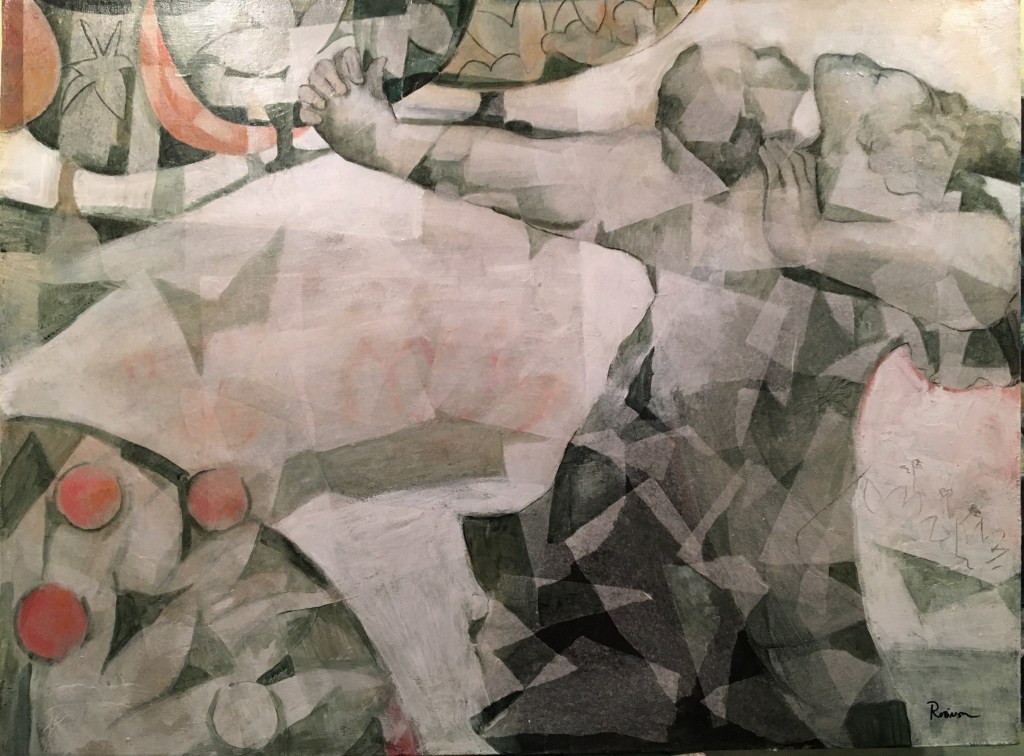
in dreams I wrestle with angels ©️ 2018 david robinson

Feel The Rhythm [on Not So Flawed Wednesday]

We lay awake in the night listening to the waves pound the shore. Boom. Rest. Boom. Rest. This lake that is sometimes glassy-in-stillness can rival the Atlantic Ocean in restlessness. It has many moods. It can turn on a dime. I have found great peace walking the shores. I have stood in awe as it blasted those very same shores, hurling boulders with ease.

When we were fortunate to live for a summer in the littlehouse, right on the lake. Kerri had to adjust to the constant sound. Her musician’s ears were caught in the rhythm of sound lapping the shores. Nature’s metronome. We teased about parking a piano on the back deck so she might compose an album of pieces set to the lake’s pulse.

The most striking visceral-revelation that I brought back from Bali is that we function together. Just as I am impacted by the lake, my pace and rhythm are impacted by the people around me. No one is an island. David Abram wrote in The Spell of the Sensuous that it is nearly impossible to meditate in the un-united states. We are an angry frenetic lake, fast moving wave. Changeable. I will always remember pausing at the custom’s gate re-entering the country. It was too much. Finally, I stepped through the doors and felt sucked into a chaotic turbulent whitewater river. It was months before I adjusted, before a walk down the street didn’t feel like a fist fight.

Columbus (my dad) would sit for hours each morning, on the porch. Listening. When I was younger I wondered what he was listening to – or for. He grew up in Iowa and came into adulthood moving to the rhythm of the corn. He lived his adult life in Colorado. It was a different rhythm, the metronome of the mountains. For many years he yearned to live where he understood the rhythm. He was, I think, listening for the corn.

When I return to Colorado I feel an immediate recognition. The mountains are the rhythm I was born into. Alignment. My original dance was a mountain dance.

Kerri and I are both transplants to the lake. Perhaps that is why we hear it so clearly. Jim E. told me that people go to the shore to stare into the infinite. We listen to the lake with the same awareness. The lake was here before me. The lake will be here after I am gone. The mountains, too. We are, of course, delusional to entertain the idea that we control it – nature. That we are somehow separate. Sometimes I think it is the artist’s job to bring proper perspective to the community, to pop the separation-notions – even for a moment – out of ego-brains.

This lake could hurl me like a pebble. It also brings peace to my soul. Stillness. We are not as distinct as we want to believe. That recognition is the single greatest blessing of artistry. It’s a circle dance. Just as my dad is disappearing back into the corn, I, too, will someday rejoin my original rhythm and fold back into the mountain.

read Kerri’s blog post about THE LAKE

Honor Difference [on DR Thursday]

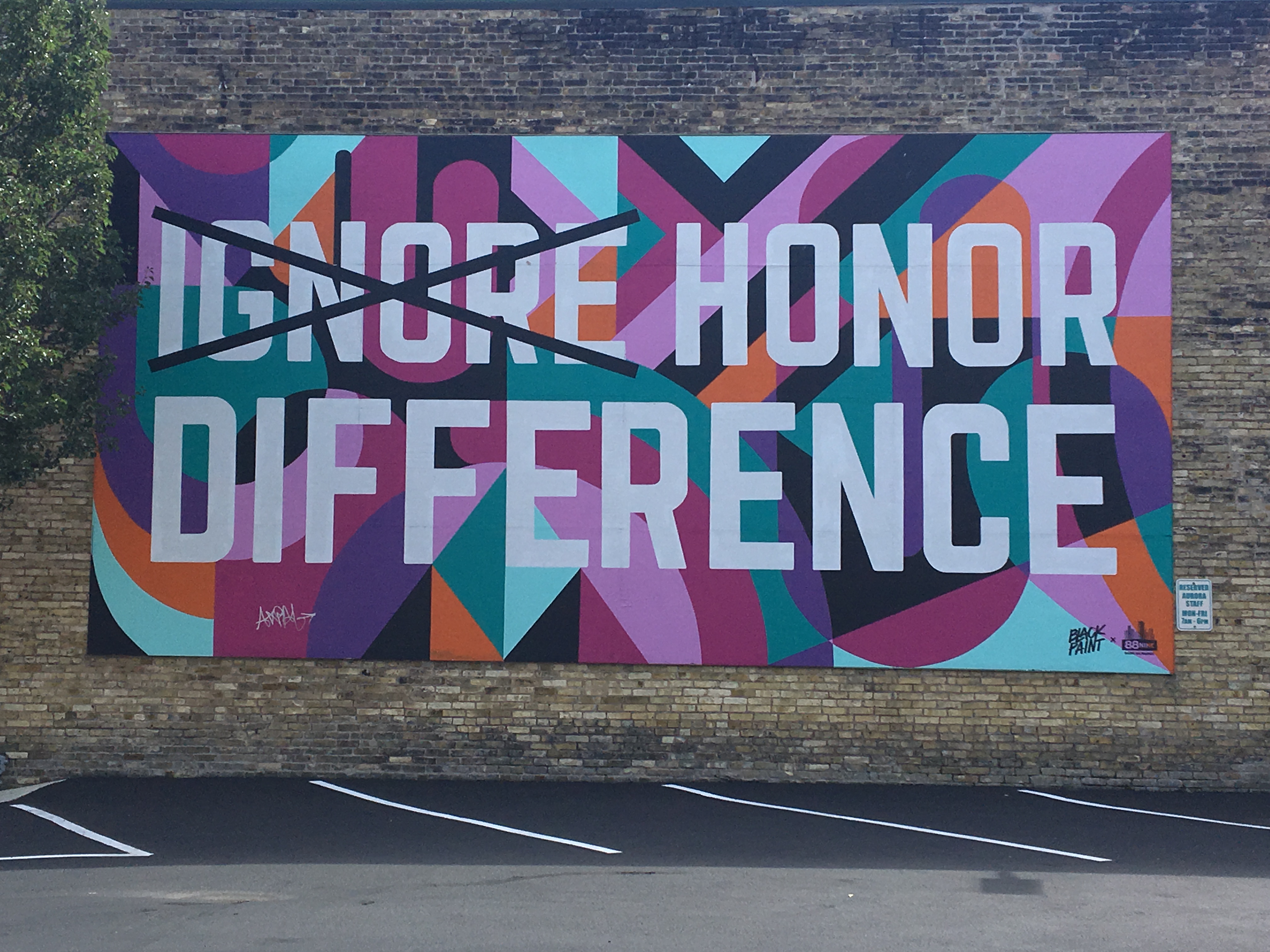
A Double Haiku:

Honor Difference.

A mural in Milwaukee.

Heart of the ideal.

Infinite palette,

Many hands, many painters,

Eyes that choose to see.

Read Kerri’s blog post about Honoring Difference

helping hands ©️ 2012 david robinson

Stand In The Narrow Place [on Merely A Thought Monday]

“Western civilization has been a 2,000 year long exercise in robbing people of the present. People are now learning the joys that hide in the narrow place of the hour glass, the eternal moment.” ~ George Leonard, Mastery

The observation has become something of a yearly ritual. Every 9/11, I hear or participate in this conversation: one day, people got out of bed, drank their coffee, brushed their teeth and went to work or boarded an airplane. And then, they never came home.

We are fairly smothered in sentiments about appreciating life, seizing-the-day, living in the present moment, take nothing for granted… “You never know.”

Quinn gave me his copy of Mastery. As was his practice, he underlined significant passages in red pen – and the book was a festival of underlined passages. For years I kept the book on my desk or beside my bed. I’d flip it open and read the red sections. They served as a daily meditation. They gave my busy mind something generative and hopeful to occupy.

George Leonard called presence, “the plateau.” Eckhart Tolle calls it “the now.” In one of the gospels NOT included in the bible, Jesus is reported to have said, “The kingdom of heaven is on earth but men do not see it.” The Way of the Buddha leads to the present moment.

What do we see if we stop thinking long enough to experience the present moment?

2996 people died in the terrorist attacks on 9/11. These people could do nothing about what happened to them on that day. They brushed their teeth. They left for work or got on an airplane.

“You never know.”

This year, there was a new river-of-thought that ran through the annual ritual observation: the daily COVID death toll last week in these un-united states was above 1,000 a day. On January 7th, 2021, 4,147 people died of COVID. In the divided-united states, more than 660,000 people have died of COVID. World-wide 4,550,000 people have perished.

It’s impossible not to look at the numbers and wonder why-and-how we became our own terrorists.

In the past year, with the availability of a vaccine, with the proven effectiveness of masking and social distancing, these people, had they united with the help of their friends and neighbors, had choices. They – we – could have done everything to save their lives. We did not. We divided. 1000 yesterday. 1000 today. 1000 tomorrow. And growing.

Sometimes we know.

Appreciating life is – and always will be, at the narrow place of the hour glass – a community affair. In presence, on the plateau, the line between me and you blurs. It is the reason why all of those firefighters and first-responders ran into the towers that day. My life cannot be precious if I cannot see that yours is also precious. Why – on earth – on any given day – would I not do everything possible – anything possible – to protect your life? Why would you not do the same for me?

read Kerri’s blog post about BLESSINGS ABOVE GROUND

Compose [on DR Thursday]

Many years ago I attended a workshop facilitated by Sam, a brilliant landscape painter. I was delighted and amused when he demonstrated his technique. Rather than paint what he observed, he took great pleasure in rearranging the elements. He moved the trees, altered the hills, relocated the barn. He laughed while mixing up his elements. His eyes sparkled with mischief. Rather than a workshop on painting, the day became an exercise in joy-in-art. Seeing and playing with what we see.

This morning I read that the word ‘composition’ means “putting together.” Definers-of-art-terms associate composition with freedom. “The artist has freedom when choosing the composition of their artwork.” It is a mistake to believe that compositional freedom is the sole province of an artist. If the mind is a canvas then thought is a composition. It is patterned and composed. Arranged and rearranged. We choose where we place our focus. Point-of-view is cultivated, it is not a default setting. We design the story-we-tell-ourselves-about-ourselves. And, then we project it onto the world.

The trick in both art and thought composition is not to wear ruts in the road. Sam was joyful in his art because he was constantly challenging and engaging with what he saw. Art was fun, not morbid tradition. Art was delight-full, not rule-bound or laden with the pressure to capture. Recall that stepping out of the rut was the first lesson in Julia Cameron’s The Artist’s Way. Morning pages and artist’s dates are meant to both see the ruts and open new paths. The same process applies to the thought-canvas. See the rut. Step out of it.

As Sam taught me so many years ago, seeing and playing with what we see begins with letting go of what we think we see. It begins with a blank canvas, an unfettered mind, and the freedom to choose the composition.

read Kerri’s blog post about COMPOSITION

Unfettered ©️ 2018 david robinson

Offer The Chair [on Flawed Wednesday]

“Indeed, the effect of the forum is all the more powerful if it is made clear to the audience that if they don’t change the world, no one will change it for them.” ~ Augusto Boal, Games For Actors And Non-Actors

Many of my pals in the theatre turned their noses up at me when I began doing work in corporations. They thought I was yet another theatre artist doing improvisation-games with the terminally neck-tied. I was not. My work was more in the tradition of Augusto Boal than Keith Johnstone. Some of the best plays I’ve ever facilitated, some of the most profound pieces of theatre I’ve directed and witnessed, happened in board rooms, classrooms or conference spaces. Here’s how I know: the actors and audience were one-and-the-same. Their play was personal. When they left “the theatre” they did not leave the nice story behind and end the evening with a cocktail. They were disrupted. They had seen something that could no longer be ignored or deflected. The hard work was about to begin.

People yearn. People entrench. People plant their flags and claim the most ridiculous territory. I’ve seen teachers come to blows over an overhead projector. I’ve seen lawyers undermine colleagues to gain dominion over a swiveling chair. And, the chair or the projector are never really the issue. The issue is usually an abstraction. Pecking order. Boundaries. Alliances. People have killed each other over a pair of shoes. It’s not the shoes but the status the shoes represent. Abstraction and illusion.

People are generally unconscious about the reasons beneath their passions. I’ve met a score of dedicated meditation practitioners who meditate to control their thoughts rather than realize them. Once I led a group of teachers through the ritual they enact each morning before the arrival of their students. The question was, “What are you preparing to do in your day?” Their answer was unnerving and revolutionary: they were preparing to control the kids. Teaching and learning were secondary.

We are witness to a country-wide communal piece of theatre, an unconscious play. The issue is not the mask. The issue has never been the mask. The issue is, I suppose, people feeling out of control, imposed upon. Fearful. They are, with their bare faces, making a stand. Drawing a line in the sand. That “no one can tell me what to do” might as well be “I am losing control over my life.”

And, as is always the case, as with the office chair and the overhead projector, refusing to don the mask does not really address the real issue, it merely deflects it. The energy and action is focused on non-sense. And when non-sense rules the day, the action taken actually brings about the thing-most-feared. Loss of control. The pandemic continues, the children are being taken, the economy suffers, the community fractures. It’s a lengthy list.

The lesson in the office chair wars and the overhead projector games is always the same. No one wins. Everyone loses in a toxic tug-of-war. The chair might be yours today but it will be theirs tomorrow. The game only ends when one of the players offers the chair to the other or the projector becomes a reason to share. The same will be true of the mask wars. People will die, the pandemic will continue until the mask becomes a generosity. Then, low-and-behold, the virus will abate and real control over our destiny will be within our grasp.

I hope that, like the lawyers or teachers who were brave enough to walk into the real story, to stand face-to-face with a dysfunction, that we meet our story and ask, “Why would so many sacrifice so much over a little piece of cloth?” An overhead projector. A pair of shoes. A chair that swivels…

read Kerri’s blog post about MASKS

Decide To See [on Merely A Thought Monday]

My thoughts while watching the wedding:

Oprah asked Gary Zukav this question: Where is soul? His response: Where is it not?

Exchange the word ‘love’ for the word ‘soul.’ Where is love? Where is it not?

In the English language, words like ‘love’ and ‘soul’ are nouns. Things. And, things must have limits. It is a remarkable misunderstanding, a miracle of minimization. Love, the single hardest ‘thing’ to define, in fact, impossible to define, is undefinable because it is without limit. The best we can do is point toward love-made-visible. A newborn in the arms of its mother. The moment the couple, standing before their community, stares into each other’s eyes and promises, “I do.” Watching a sunrise on an anniversary. A mother dancing with her son, the groom.

Love is. Where is it not? That means, of course, that it is “in” everything, everywhere. The air we breathe. The thoughts we think. The actions we take, big and small. It is in how we treat our neighbors. In how we see ourselves. In how we report our news. In how we tell our lies and our truths. Love is.

It is the province of no-single-religion. In fact, it is where every religion on earth goes off the rails. To claim to be “the way” or “the one true…” is to attempt dominion over love. To place rules and boundaries on the boundless.

The question Oprah didn’t ask: if it is everywhere, in everything, in war and in peace, hate and acceptance, does it have any meaning at all? If it is ubiquitous, unchangeable and indescribable, why bother? Gary’s answer, I imagine, would be something like this: we choose the form we give to our love, do we not? We can choose to put the accent on unity. We can choose to put the accent on separation. Love is. We can choose to put the accent on division or we can choose to offer our support.

There is never more or less love. Isn’t that the point? Love is beyond definition. What changes is not the love or the amount of love. What changes is what we decide to see. What changes is how we decide to see, especially how we decide to see ourselves in this world with so many “others.”

read Kerri’s blog post about JUST LOVE

Unfold [on KS Friday]

September. The air was cool last night. We put on longer sleeves, sat on the deck and listened to the sounds of the summer night. Cicadas. The waves crashing into the shore. The bubbling of the fountain. Distant voices of others enjoying the evening. Dogga sighed and stretched, closing his eyes.

Stephen’s memorial, a gathering of friends and relations. At the same moment, across the country, a baby was born, a new little brother. On the same day, Kim completed another circle around the sun. I missed wishing her happy birthday. Celebrations of life wearing its many faces.

The chipmunks have discovered Kerri’s tomatoes. They are considerate thieves and take only one tomato at a time. Lately, a salmon-colored cardinal sits on the cage and pecks the leaves of the plants. The basil did well until the relentless heat and humidity, the torrential rains. It is ready to retire, old before its time. The crows swarm the hawk. The squirrels have shifted into overdrive, preparations for the coming season.

We stopped on our walk. Kerri approached the tree and snapped a photo of a bright crimson leaf, harbinger of fall. “So much has happened this summer,” she said. “I can’t believe it is already September.”

Textures. Colors. Sounds. Passages. Paying attention. It has us asking that age-old question, “What really matters?’

David sent a photograph. Dawson squeezed a whole tube of blue paint onto a canvas and, with a new cool art-tool, spread the rich thick paint, carving it into creation. An artist dad in play with his artist son.

That age-old question is so easy to answer, wearing longer sleeves, sitting on the deck on a cool summer evening. You can see it from “the plateau,” as George Leonard used to call it. Be in your moment, and you will see that the little things are really the big things. On the plateau, everything unfolds simply and with clarity. Friends gather. A baby is born. Blue paint squeezed onto a canvas.

UNFOLDING on kerri’s album AS IT IS

Kerri’s albums are available on iTunes or streaming on Pandora

read Kerri’s blog post on TEXTURES

unfolding/as it is ©️ 2004 kerri sherwood

Look Again [on DR Thursday]

I’m not sure when I started using floral shapes and imagery in my paintings. There was Sam The Poet and Eve, trees as symbol.

Sam The Poet, acrylic, 48 x 48IN
Eve, acrylic on hardboard, 48 x 48IN

I know my sketchbooks began filling up with flower shapes and symbolic landscapes. Petals appeared throughout my Yoga Series. Leaf and flower shapes found their way into the bodies as well as the surrounding spaces.

Joy, mixed media, 50 x 56IN

I played with tissue paper over color as a ground for the images. When Tony recently visited my studio, he said my paintings were sculptural, visually commanding. I wrote his words on a scrap of paper since artists are mostly terrible at describing their work. He is an artist so he knows that the proper answer to the question, “Tell me about your work?” is “Go look at it and then you tell me about my work.” He didn’t ask the question; he went straight to the looking.

Tango With Me, mixed media, 39 x 52IN

We walked down a path at sunset. Kerri saw the sunflowers and I knew a photo op had arrived. “You should use this as your Thursday post,” she said, showing me her photo, “because your paintings always have flowers in them.”

Well, good enough, then. Sunflowers, shape and symbol, will find their way into the next painting, I’m sure of it.

read Kerri’s blog post about SUNFLOWERS

copyrights for all paintings in this post, 2010 – 2021, david robinson

Be Indeterminate [on Two Artists Tuesday]

Through the good graces of our tomato plants, I’ve learned a few new concepts this summer. Determinate and indeterminate. Bush and vine. Determinate tomato plants (bushes) are bred to stop growing. Indeterminate tomato plants (vines) will grow indefinitely or until the weather conditions “are no longer favorable.”

Our plants are indeterminate. Each morning, Kerri visits our planting bench and checks her tomatoes. 20 taught her a few simple tending-rules and now, each morning, there are more and more little indeterminate miracles moving backward along the color spectrum, finally arriving at a brilliant red.

Life is indeterminate.

My new tomato-terms come just in time. My current project has me revisiting my past life as a teacher and facilitator. If I apply my new terminology to people I can’t help but think it is the lucky few who survive so much dedicated energy to stop the learning-mind in the name of education. The natural output of a system designed on manufacturing principles is to truncate the questioning mind by patterning the notion that there is a predetermined answer. It becomes a game of finding the answer that teacher wants – a closed loop – instead of an incitement of curiosity. Children are excellent game players and translate the gaming pattern into their now-dulled-adulthood.

There is a cycle apparent in all genuine learning processes. It begins with discontent. Curiosity is a movement born from some form of discontent. It leads to questioning. Questioning always leads to disturbance (the interruption of the known). And, just like that, out of the disturbance something new is seen, call it a breakthrough, call it an insight, call it new learning…Many classrooms – certainly the systems – are designed and organized to keep disturbances to a minimum. The mantra is ‘control’ rather than ‘inspire curiosity.’ Business has the same dedication.

We’re taught that disturbance is the sign of something wrong rather than the crusty earth breaking to reveal new verdant life.

Discontent leads to questioning, leads to disturbance, which leads to breakthrough. And, an insight will always lead to discontent. It’s a story cycle, where yearning meets obstacle. Learning is by definition uncomfortable and at its best when it is uncontrollable.

Last week I attended a meeting. My two companions and I brought our homework back to the team. One was content. The other two of us were filled with discontent. The leader of the session, at first, was angry. He did not get the result he’d anticipated from his exercise. “So, you two are telling me this process was worthless!” he raged. We’d spent our week questioning instead of answering. Discontent. Questioning.

“No! It was great!” we chimed in chorus. “Look at all the good information we uncovered!” It was a mess. Big disturbance. We cycled through our misalignment a few times, wrangling over perception and usefulness. More rage. And then…an insight. The breakthrough. All of the rage, all of the appeasing, began to flow in a single direction. A possibility took shape. A target materialized that was much better than the prescribed pursuit. Energy filled our zoom-osphere. Laughter. Excitement.

Learning. Indeterminate. Open questions. Hot pursuits.

I am drawn to and surrounded by the dedicated indeterminates; those who refuse to stop learning: David, Mike, Horatio, MM, Bruce, 20, Judy, and yes, Kerri…I am a very fortunate man to be surrounded by so many tomatoes moving their way backward along the color spectrum, not afraid to walk through their discontent toward bigger and bigger questions.

read Kerri’s blog post about TOMATOES