Trip And Trip Again [on KS Friday]

One of the advantages of having stepped in every pothole, tripped on every cobble, and made every mistake at least twice, is that I’ve learned about potholes, cobbles, mistakes, tripping and stepping where I ought not step. If I could boil down to the essence the single thing I’m beginning to grok it is this: life is not elsewhere.

I laughed aloud when I at last I realized the absurdity of “practicing mindfulness” as if it was something to achieve. Mindfulness arrives when the practice stops. Of course. Meditating for self-improvement, I’ve read, is a uniquely Western oddity. “Trying” to be present is ridiculous if you think about it. You are present. What else? Because your mind is running amok does not actually magically transport you to the past or the future. You are present with a mind that is running amok. Minds are like puppies: chase them and they run away. Stand still and they will eventually come to you.

Is any of this pothole wisdom helpful? Absolutely not. Like mindfulness, wisdom arrives when the obsession with knowledge-for-betterment ceases. I’ll let you know what that looks like when I stop trying to attain it. There’s no end to the tripping stones. I’ve learned that, too. Again and again. And again.

The best things in life are not achievements. They are relationships. Me to you. Me to me. Me to the world I am passing through, one moment at a time. With you. Stand still in the moment – you might as well since it is where you are – and you’re libel to experience all manner of beauty.

read Kerri’s blog post about SNOWFLAKES

Kerri’s albums are available on iTunes and streaming on Pandora

kindred spirits…away/released from the heart © 1995 kerri sherwood

What’s Now? [on Two Artists Tuesday]

After a fairly contentious conference I co-facilitated in The Netherlands, Kerri and I took the bullet train to Paris. It was early in our relationship and our first time abroad together. We couldn’t afford to get to Paris otherwise, so tagging a small vacation onto a work trip seemed foolish not to do. It was the perfect place at the perfect time. I released the conference friction the moment we stepped off the train. I didn’t know it at the time but on the streets of Paris I left behind a skin that I’d badly needed to shed.

We had limited funds so we bought baguettes and Camembert cheese, fruit, tarts from vendors and bottles of wine. We ate in parks. We wandered the streets. Climbed the hill to Sacre’- Coeur, visited Rodin, and tried to get lost. We fell exhausted into bed each night, full of art and sound and color and delicious wandering. One night we sauntered to the Arc de Triomphe and barely escaped a riot. Bus loads of police in riot gear appeared on the street and, wide-eyed, we slipped out of the crowd and hustled to find more peaceful rues. Paris now serves as a marker. There was before Paris. And after.

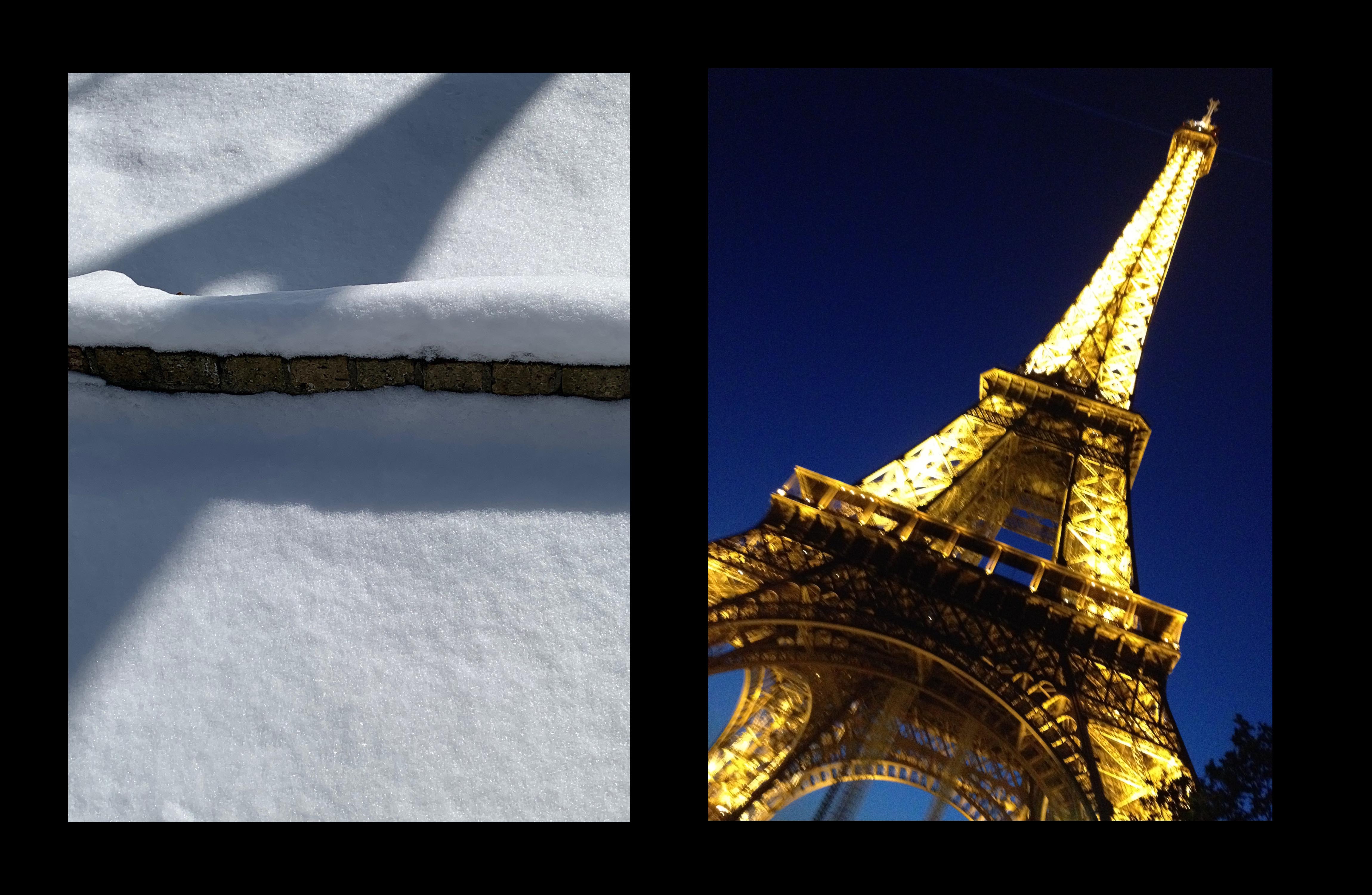
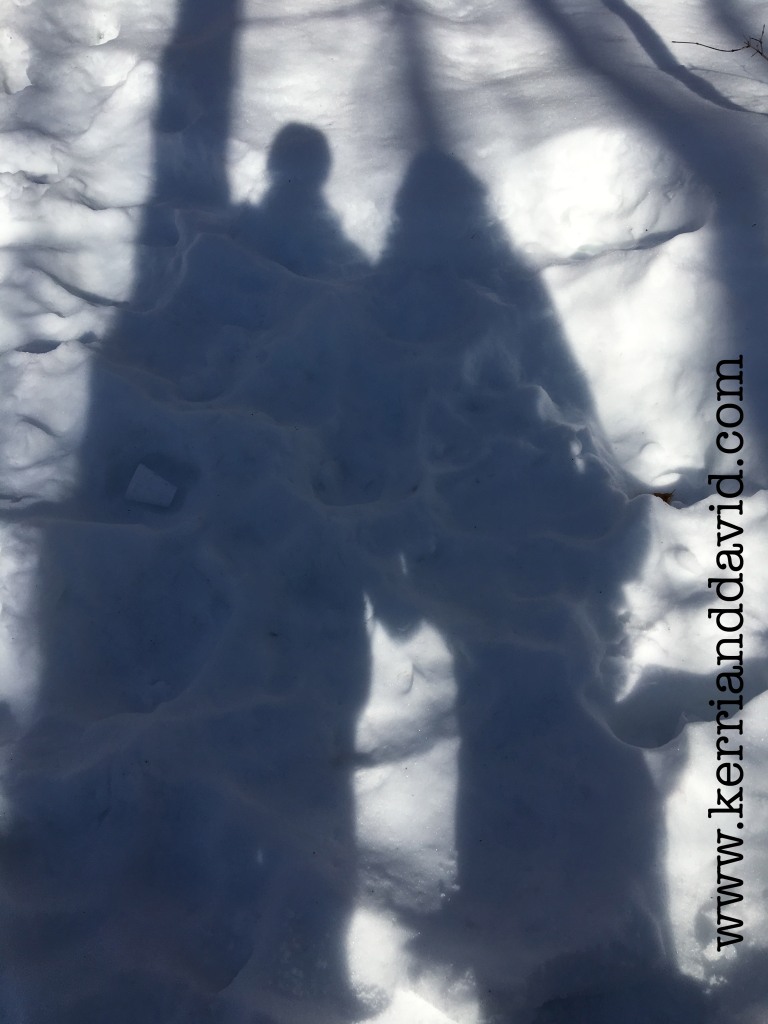
“This shadow looks like that picture I took of the Eiffel Tower,” she said, showing me the photo of the shadow. The angle is perfect. The shadow is appropriate. Shadows. What was. An outline of the people we were, reflected on the snow. And, the series of photos, shadows along the way, the surprising people we have lived-into since we wandered those streets, shedding old skin, and boarded a plane home with a a question, “What’s next?” What’s now?

read Kerri’s blog post about SHADOWS

Use A Bag [on DR Thursday]

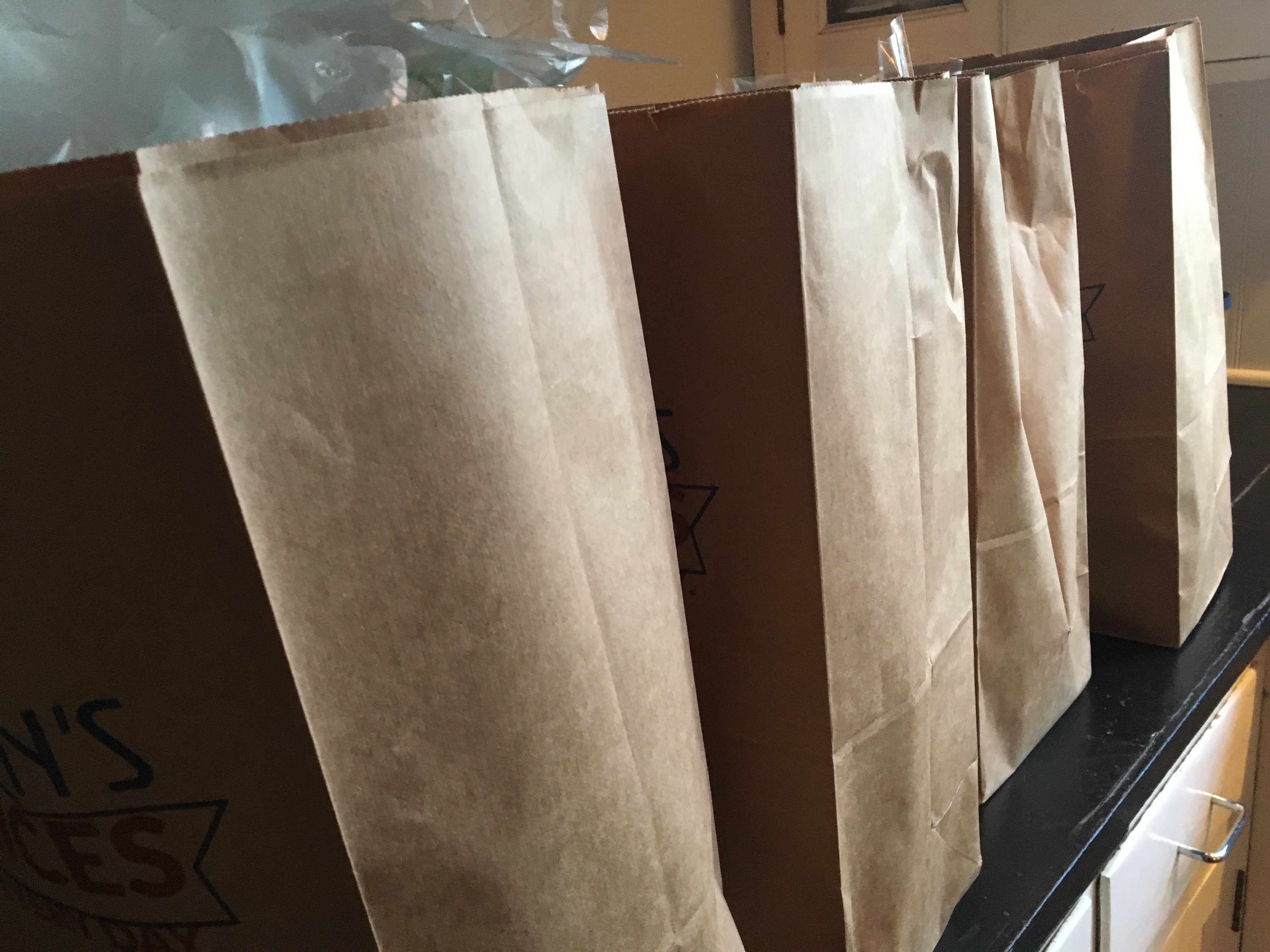
To Chris Crites, grocery shopping day is a feast. To Chris, these sacks are more than functional. They are more than ordinary shopping bags. These bags are canvas. They are opportunities for art. They are surfaces meant for brilliant mugshots. The underbelly of society made beautiful on brown paper sacks.

I’m not sure if it was Chris or the other artists in my Seattle pod that prompted me to experiment. One of my forays into “where will this take me” required paper sacks. Lots of paper sacks, torn to bits and pasted on a canvas. I drew and painted on top of the bits.

I forgot about my experiment until I met Kerri and one day unrolled all the canvas to show her what was in the pile. She cooed at my paper bag experiment. “This should be a series,” she said. “It should be called Earth Interrupted.” And, so it was.

I have (mostly) been a painter of people. I’ve learned that art – and theatre – for me are a means and not an end. In other words, I don’t paint because I want to master the craft of painting or make brilliant paintings. I paint to study people. I paint because it is a meditative space. I paint because I lose myself and enter someplace bigger. I paint because it helps me “to see.”

I completed six additions to the Earth Interrupted series and then stopped. I lost my way. That’s always been my experience when I abstract- when I leave the figure and mess with texture and shape. I know I’m not finished with it. Getting lost is part of the process.

Unloading the groceries last week brought me up short. I felt like Chris Crites. So much possibility sitting on the counter. So much material begging to be transformed.

Earth Interrupted I, mixed media, 48x53IN

read Kerri’s blog post about BAGS

earth interrupted I © 2012 david robinson

Step Out Of Line [on Merely A Thought Monday]

“…the fountain of creative work is an intelligent questioning of the rules.” ~Alan Watts, Tao: The Watercourse Way

“If someone tells you they know, they most certainly do not.” It’s not a direct quote from Quinn but it’s close enough. Art school almost snuffed the art in me; there were so many rules and nary a hint of curiosity allowed in the studio. I fled into the theatre after a single year for fear of losing my heart to a book of rules. My theatre professors were explorers of nature. Their refreshing mantra was, “Well, let’s find out!”

What if…? What happens if…?

Nature is boundless expression. Boundless expression is human nature, too, until it is taught otherwise. Boys don’t cry. Be a good girl. Sit in your desk. Follow the rules. There’s a right way. My way or the highway…So much effort to force nature – your nature, your curiosity, to stand on a line.

Einstein revolutionized our world because he dared to posit that Newton had it upside-down. Thank goodness, as Alan Watts observed, “The scientist and the mystic both make experiments in which what has been written is subordinate to the observation of what is.” In other words, they look beyond established belief, expectation and entrenched norms into what is.

What is? Curiosity. A desire to know what’s over that hill. No child begins their life-walk by desiring to color within the lines. Lines are a learned thing. The word “wild” was invented by people whose ancestors emerged from the woods and who have forgotten that they, too, are part of nature – so have become afraid of stepping into the woods. What might they – we – find there?

“It’s not an idea problem,” David Burkus wrote in the HBR, “It’s a recognition problem.” Stepping beyond the known – a great definition of curiosity – is too often seen as an aberration or an assault upon authority. Nip it in the bud. Forcing flow into a fixed state invariably causes idea-blindness and the imperative to think-outside-of-the-box. Innovations are too often smothered in the crib by “What we know,” or “We don’t do it that way.” Coloring in the lines, once ingrained, is a life-long-book-to-follow.

I wish I had a nickel for every time I’ve been invited into an organization or hired by a client to help them “see what they cannot see,” and then subtly or not-so-subtly, been rebuked for opening their eyes to what is in plain sight…or the availability of alternative paths. “We want a vital arts program but we only want art that entertains,” said the school board after the student play asked a serious question of their audience. “…the scholastic theologians would not look through Galileo’s telescope because they considered that they already knew, from Scripture, the order of the heavens.” (Alan Watts)

Think outside the box – as long as you stay within the model or the expectation or the rules. So many models. So many lines. So in love with the struggle and afraid of the simple, natural joy of curiosity. Bend your will to the line. See what you are supposed to see and look no further. What, exactly, are we trying to control?

read Kerri’s blog post about CURIOSITY

Look Again [on DR Thursday]

When I first moved by the lake I was astounded by the colors of the water. From deep turquoise to chocolate brown, azure with the sky, and foreboding green, it took my breath away. It changed every day and many times during the day. The lake is a festival of color.

When we stopped the car to take a picture I realized that I’ve stopped looking at the lake. It’s become normalized so I no longer see it. The day was frigid. I rolled down the window and the cold air stung our faces and made my eyes water. And, there it was. This vibrant lake, alive with color. Had the cold air not wrung water from my eyes, the beauty and power of this lake would have. Double tears.

There’s a moment in the Parcival tale that I appreciate. The knight has stripped off his armor and spent years in the woods with a hermit-master, chopping wood, carrying water, forgetting that he ever had a purpose. One day, he turns and sees the Grail Castle standing in the meadow. He’s shocked. He thinks he’s imagining it. The hermit laughs at him and says, “Boy. It’s been there all along.”

That’s how I felt looking at the lake. I rolled down the window and was bowled over by the color that has been here all along.

read Kerri’s blog post about THE LAKE

may you © 2015 david robinson

Find The Treasure [on Merely A Thought Monday]

Every so often in the grocery store I am struck by how many people are involved in making sure I – we – have food to eat. Pick any item from the shelf and work backwards. It was carried, priced, stocked, delivered, warehoused, produced, picked, manufactured, marketed, accounted, inventoried, scheduled. Imagined. And, I wonder, how many of the hundreds of people involved realized that their labor makes my life – our lives – better?

Sitting in front of my computer yesterday I was swirling in a thought-eddy. Attempting to map a workflow, the mechanics of a process, I was befuddled. There were too many variables. As is my practice when perplexed, I stood up and walked away. Halfway down the stairs my mind jigged. I re-remembered that the only thing that mattered in my silly map was the desire to make someone’s life better, someone I would never meet. I realized (again) that I didn’t need to figure it out. I shouldn’t figure it out. There was and is no single answer. Too many variables simply means I cannot know – but I can intend. I will “know” how it all works after the fact. I know that, if I keep focused on my north star, making a life better, then, at this phase, that is all I need to know. It’s an unbeatable criteria for clarifying what to do.

“Do you think someone found our buttons?” she asked. “Do you think they liked them?” On our last hike in North Carolina, she left a small sack of Be-Kind buttons in the knot of a tree. “I wonder who found them,” she giggled.

A small treasure left in the knot of a tree. A sack of potatoes found in the grocery store. Kindness. We get snarky when we divorce our actions – even the smallest action – from the very thing that makes them matter. We get lost when we forget how deeply interrelated are our every action and thought. Cause and effect, as Alan Watts wrote, are not sequential but simultaneous. If you think your actions do not matter or have no purpose, think again. If you think it does not matter how you treat others or that bottom lines are more potent than people, think again. It’s the miracle of a circle or a cycle: where does it begin? Where does it end?

read Kerri’s blogpost about BUTTONS IN A TREE

Connect The Poles [on KS Friday]

Though it is not, this could be a close-up of an x-ray. Arteries carrying blood away from the heart, veins carrying blood back to the heart, and the capillaries that connect the them. Outgoing. Incoming. And the connection between the two. And, as is always true of language, in the naming and the action-describing, the whole system is obscured. This part does this. That part does that. Mechanical mind applied to a miracle of pulsating life.

In North Carolina I overheard an old guy grousing about climate change. He is a sceptic. “There’s record snow in California!” he decried, “And, we’re having record heat here! You can’t have it both ways!” His reluctant listener bobbed her head. “It’s either warming or it’s not!” he railed. “Explain that to me!” Mechanical mind. Parts-thinkers cannot see the whole system. The capillary-word that tumbled from his mouth but bypassed his mind was “record.” The poles are, after all, connected.

I am fascinated by my current work. I am witness to and a participant in the creation of software. The language is familiar though the meanings are new: epic and story. Bug. My mind, lately, has been awhirl. The developers necessarily talk of information as content-objects. Items. The language of “fixed” things. Yet, the problems in the world that they design and solve for are “fluid.” Information, in our day-and-age, never stops. It grows exponentially everyday. It is movement, constant motion. More/faster. Sometimes I get a glimpse behind the curtain and see the developer’s work of content-items-in-motion. You’ve never seen a faster moving current of symbols. Is it a particle or a wave? It depends.

The tree in our front yard reaches toward the house. Kerri tells me that our children climbed through the branches when they were young. When the crew had to clear some branches to trench the yard, Kerri winced each time a branch snapped and fell to the ground. “I can’t look,” she said, not taking her eyes off the tree. Holding vigil. Holding her heart.

It’s easy to forget that, in all cases, no matter the eyes though which we see, the movement is always back to center. To the heart-of-the-matter. The pieces are never isolated. This tree is not separate or distinct from the sky or Kerri’s heart. The poles are always connected, whether we recognize it, see it, acknowledge it, or not. Breathe in. Breathe out. Two actions or one?

read Kerri’s blog post about THE TREE AND SKY

Kerri’s albums are available on iTunes or streaming on Pandora

Wash And Wonder [on DR Thursday]

I actually like washing dishes. It gives me a sense of completion. Rarely do I finish a day of work with anything that resembles closure or accomplishment. Doing the dishes satisfies my western goal oriented needs. Ask me what I achieved today and I will proudly respond, “The dishes.”

While washing and rinsing the plates and pots I have a terrific view into the back yard. It’s like having a big screen tv into our teeming-with-life sanctuary. The squirrels and Dogga have a game (Dogga does not know that it is a game), the cardinals visit the pond, the rabbits and foxes and the occasional turkey, hawk or owl excite the noisy crows. The chipmunks are masterful ninjas finding ways to access the bird feeders and make off with pouches full of seed.

Sometimes, the window – the actual glass – becomes more interesting than the games unfolding beyond it. During a storm, in the winter cold, crystals form and migrate across its surface. It’s a giant kaleidoscope, especially as the string of lights stretching across the yard pop on. It’s enough to make me pause my dish washing fervor and stare in amazement. Window-wonder satisfies my eastern presence desires. Ask me to what I gave my full attention and I will smile and respond, “The window.”

read Kerri’s blog post about THE WINDOW

joy © 2014 david robinson

Watch The Dance [on Not So Flawed Wednesday]

It was once a guilty pleasure. After a snowfall, through newly plowed streets, I’d tie on my red Nike shoes and go for a long, long run. In Colorado, the sun and the cold air play well together. Atmospheric sweet and sour. Run toward the sun in the snow quiet. Sensual pleasure. I’ve never felt more alive than during those treasured runs.

Our yard is a miracle of shadow-play after the snowfall. Between the trees and the tall grasses that grow along the property line, the cool blue sways and dances across the ice-white canvas, a visual conversation between limb and wind. It can be mesmerizing. Sometimes it reminds me of Wayan Kulit, the shadow puppets of the Balinese. An epic tale told on the screen of our front yard. The lesson of Wayan Kulit: we are not substance, not really. Rather, we are passing shadows projecting our story onto the canvas of our minds.

The mailwoman told me that she adored bringing our mail during the winter afternoons. “The light on the grasses,” she said, “they knock me out.” We wait until spring to cut back the grasses for exactly that reason. The pink, orange and purple light of a late winter afternoon makes the grasses luminous. And the shadows they cast! A gentle blue waving, aloha! Greeting or parting? Longing or fulfillment? I’m never sure.

Sylvia Plath wrote in The Bell Jar, “I thought the most beautiful thing in the world must be shadow.” Staring out our front window watching the dance, the frigid air and sun at play together, I think she was right. What could possibly be more heartbreakingly beautiful?

See The Adventure [on Merely A Thought Monday]

Let the adventure begin. We put the sign on the table when we moved into the little house on Washington Island. Our new job came with housing and we couldn’t have been more fortunate. Even as the job turned into a debacle, the little house grew in our hearts. It was – and is – a very special place. A few years down the road, we never give thought-space to the work-fiasco. We reminisce about the beautiful place we lived, the good people we met, starry nights, mornings in the canoe, the deer, the power of the lake right outside our door.

A few moments ago I was feeling anxious and was complaining – and realized that I have no business complaining about anything. I stopped myself. Adventures are hard. That’s what makes the experience an adventure. When people lack challenges, they create them. Jigsaw puzzles and computer games. I complain when standing on the threshold of learning something new. My complaining – as I realized a few moments ago – runs amok when I don’t know what to do. It marks the line between the fat-comfort of knowing and the utter-discomfort of not-knowing. Complaining provides cover. I expose my obvious not-knowing; I preempt the shame-strike by complaining. The moment I disallowed complaining, I once again saw the adventure. My anxiety dissipated. The adventure is a jigsaw puzzle all akimbo in the box. I’ll figure it out one piece at a time. Or not. The end result is not nearly as important as the spirit in which I bring to the task. To the moment. To my life.

Mihaly Csikzentmihalyi studied, thought, and wrote extensively about flow. The optimal state of being. I’ve often wished I could invite Mihaly and Alan Watts to dinner and listen to their conversation. The psychologist and the Taoist conversing about flow, that magic space that opens when the path is hard, but not too hard, when boredom is no where in sight. The exercise, when either bored or overwhelmed, is to adjust my orientation to the challenge. Amp it up or slow it down. The zone is self-modulated, rarely an accident, which becomes apparent once the complaining stops. The knowledge that I can place myself in the zone is the spirit I hope to bring to every task for the rest of my days. It’s the practice. It is to see and choose the adventure.

Let the adventure begin. The sign now sits on our table in the sunroom where we meet at the end of each day and tell the stories of our day. While I tell my tale, I see the adventure sign, mostly in reflection, the message reversed. Each day an adventure if I choose to see it. Each day an opportunity for flow if I choose to own and modulate my steps, and place myself in flow.

read Kerri’s blogpost about THE ADVENTURE