Coalesce [on Not So Flawed Wednesday]

in the woods copy

Sometimes, when we are walking through the woods, I imagine myself with none of the labels that I claim as important. What if “artist” did not apply? Or “teacher.” What if none of my opinions or ideas or justifications had any merit or substance? What if they were bits of armor or heavy clothing that I could drop as I walked? So much lighter, less encumbered, who, then, would I be? Divested of my made-up-meaning and my hard-fought-for stress, what might I experience?

These imaginings, my questions – at least to me – are not nihilistic. They are the opposite. When I am walking in the woods and all the clutter and noise and the oh-so-important-to-do-list falls away, when all of my investments in my-very-important-ideas and my-resistances-to-immovable-objects drops off, when my frustrations and anxieties evaporate, I come back to my senses. Literally and metaphorically. The cold air. The limbs waving and groaning in the breeze. The quiet chatter of the brook that ambles through Bristol Wood. I become the moment I inhabit. I inhabit the moment of my becoming. That’s it. My “meaning” takes on a proper proportion, no greater or smaller than life itself.

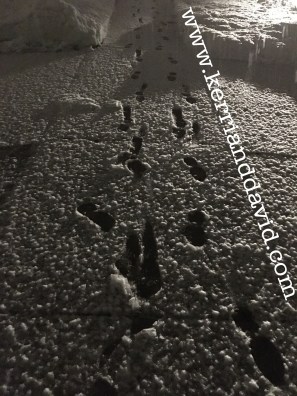
Listening to the brook, the sound of our feet crunching the snow, I remember something John O’Donohue wrote. “The river is a miracle of presence. Each place it flows through is the place that it is…In a river, past, present, and future coalesce in the one passionate flowing.”


read Kerri’s blog post about THE WOODS


footprints in sunlit snow website box copy

Check Your Reality [on Two Artists Tuesday]

ice copy

We parked the truck in the Kemper Center lot, far enough from the shore not to be hit by the flying debris, the chunks of seawall and pavement being hurtled from the impact of the waves. Kerri has lived here for over 30 years, “I’ve never seen anything like this,” she repeated as a towering wave engulfed the gazebo, took down a piece of the wall of the art center, a hunk of coastline disappeared.

Later, after the storm, we went back. Trees were down, encased in ice. Huge sections of the walking path were shattered and tossed into the flooded mess of the parking lot behind the center. Walking was treacherous. Like the trees, the ground, the rocks, the destruction was coated in a thick layer of ice. It was beautiful and inconceivable.

Words mask all manner of reality. We have a word, nature, that can’t even begin to touch the magnitude, the power of where it points. Mother Nature. I have been thrown out of bed in an earthquake that brought down freeways like they were so much satin ribbon. Go to Pompeii or Herculeneum, visit Mt. Saint Helens, watch with disbelief any of the news  footage of any one of the tsunamis that have wiped communities off the map. Wrap your mind around it, if you can.

We are cavalier in our conversations about global warming. We impact, we do not command. We reduce it to questions of business, of protecting the beef industry. Which economy will suffer most? We make up these strangely insignificant divisions. We imagine that we are the center, holding all the controls. We imagine that it is all about us. So small, a chihuahua yipping at a forest fire.

Sitting in the truck, feeling the boom of the waves in my chest as they tore off chunks of the shore, I felt tiny. I remembered a snippet of film I saw about a man who wore a superhero suit and stood in the face of an oncoming storm. He flexed and stomped and raged for the camera. And then the storm hit. The best he could do was run for his life.


aftermath copy


read Kerri’s blog post about THE STORM


bonfire website box copy


ice ©️ 2020 kerri sherwood

for prints of “ice” go here


Look Beyond [on Not So Flawed Wednesday]

cameras copy

“Technology is anything that wasn’t around when you were born.” ~ Alan Kay

On the one hand, this could be a display of old technology. Shelf after shelf of what was once understood as a camera. Not so long ago a camera was a device that employed a once-revolutionary-invention, a light sensitive plastic strip called “film,” to capture images. These film devices, the miracles that populated my youth, are now antiques.

On the other hand, this could be an art piece, a commentary on the contemporary world. Many, many, many cameras, all with their lenses pointed back at us. There are cameras in phones, each a trafficker of the relatively new obsession known as the “selfie.” There are cameras at almost every major intersection of my town. Traffic selfies that come with tickets. In stores I am told to smile because I am on camera. There are cameras in doorbells. Many medical procedures employ teeny tiny cameras capable of fantastic voyages, inner selfies. The cameras shot into outer space transmit back to us images of a tiny speck in this vast universe, a dot called Earth.  Our art piece reveals to us that we are the central object of our study.

Standing in front of the shelf, looking at the myriad lenses looking back at me, I understood with some sadness that the cameras on the shelf used to be understood as arbiters of truth. There is a now an antiquated term, you may have heard it: photographic proof. Proof. It is not so much that the camera – film – is antiquated – but it’s purpose is most certainly passe’. Truth is out of date. Proof has no reliable root. We have replaced ‘photographic proof’ with a new concept, a ‘post-fact’ world.

Buckminster Fuller once said that, “Humanity is acquiring all the right technology for all the wrong reasons.” Were this beautiful unintentional-art-piece-found-in-an-antique-mall one of my creations, you can bet that I’d scribble Fuller’s quote someplace on the shelf, though, you’d have to look beyond the cameras to find it.


read Kerri’s blog post about CAMERAS


savannah selfie WEBSITE BOX copy

Change Your Mantra [on Merely A Thought Monday]

dont try to get it over with copy

It was only after the dive that I realized my folly. Rather than enjoy it I repeated to myself, over and over, to just get through it. I’d be fine once I was back in the boat. I was afraid.

It was a very deep dive, the deepest I’d ever attempted. There were sharks swimming beneath me. There were sharks swimming above me. The Blue Hole. The wall was gorgeous, an explosion of red, orange, and yellow. Looking up was a miracle of sunlight on water. Looking down was a study in the color blue, layers of turquoise, cerulean, disappearing into a bottomless (aptly named) ultramarine.

My mantra, just get through it, was a wall between me and extraordinary beauty of it.

Later, in the boat, I appreciated it. I also appreciated that my experience was unnecessarily fearful. Rather, I understood that the only real danger in The Blue Hole was my doubt in myself. The sharks were not man-eaters. The depth was the limit for amateur divers but not extreme. The dive master was world class. I had plenty of oxygen.  I was safe everywhere but in my imagination.

The dive made me wonder how much of my life I’ve spent telling myself fear tales? Instead of having an experience of wonder, how often have I storied myself in fear? How often have I made up monsters and raced to the other side of the moment, raced to get it over with rather than be in it?

Sitting in the boat, I realized that it wasn’t the fear that I was wrangling with. Fear is natural, especially in alien environments like deep water, especially when sharks are involved. It was my mantra that plagued me. Get through it.

Next time, I told myself, I will have a new mantra. Be in it. Fear is an experience, too. It’s part of life and, at the end of my days, I will be sad if the story of my life was simply getting through it. Or over it. I want to know that I was in it, all of it; the fear, the joy, the ugly, the angry, the beautiful blues, the sad days, and the quiet wandering.


read Kerri’s blog post about GETTING IT OVER WITH


bonfire website box copy

Step Into The Light [on Not So Flawed Wednesday]

luminaria copy

“We can easily forgive a child who is afraid of the dark; the real tragedy of life is when men are afraid of the light.” ~Plato

Sometimes, when I have too much to write about (or nothing at all to say), I poke around for a handhold. Today, Plato reached out and offered his hand.

2019 felt dark. I, for one, was glad to raise a glass to its departure. The word I would dedicate to the year-gone-by is “contention.” We felt like we were thrust to the ramparts, constantly under siege.

And, in the nation at large, it was dark, indeed. It was year in which conspiracy theories ran amok. Subpoenas were ignored. Evidence sublimated. Transcripts hidden. Tax records buried. Facts obscured with so much noise. Eyes squeezed shut to the climate. So much fear of the light. A tragedy.

So, my wish for this new year? Simply this: Light. So much light. And the courage to step fully into it.


read Kerri’s blog post about THE LUMINARIA


luminaria website box copy


Look Before You Bite [on Merely A Thought Monday]

where you stand copy

When John said, “Penny wise, pound foolish,” I would always stop and reconsider my options. John was wise. John was concise. He was a master furniture maker and spoke like a man who necessarily made exact measurements.

If I could slap a label on this era of the USA, I’d call it the penny-wise-pound-foolish-age. Perhaps my label would also apply to the human world at large? I think so. Short term gain is rarely a healthy criteria for determining long term health. Anyone who’s ever experienced a hangover, lashed out in anger, dumped their waste into the drinking water, or jumped into a get-rich-quick scheme will understand.

I read this phrase the other day: Fox is feeding misinformation to an angry populace hungry to consume it. In most mythologies, the fox is a trickster and I couldn’t help but grimace and chuckle at the layers-of-veracity implied. A maker of mischief feeding misinformation to people hungry to gobble it down. Of course, there are two points of view in every fable and it is true of our fable, too: there is the fox and there are those who eat the gruel to fuel their angry point of view. The fox is never without agenda. Control of the point of view of the angry populace is the fox’s agenda. In other words, the fox is not a friend. The fox is like the witch offering the poison apple. Take a bite; it won’t hurt you. Really.

Reds and blues. Post fact era. Foxes in the hen house. Tribes eating tripe. Penny wise, pound foolish.


read Kerri’s blog post about WHERE YOU STAND


donnieandmarie uke website box copy

Dance A Simple Dance [on Merely A Thought Monday]

keep things simple copy

“Simplicity. Patience. Compassion. These three are your greatest treasures.” ~Lao Tzu

“Simple can be harder than complex: you have to work hard to get your thinking clean to make it simple.” ~ Steve Jobs

I am at home in my studio. Even during the times – like now – when my well is dry, I go into my studio and the world makes sense. It is quiet. My intention is pure: I seek an experience, an exploration, not an achievement. In other words, I enter into a relationship with something so much bigger than me. It is a simple dance with no end. The paintings are a map of this relationship.

Krishnamurti wrote that “stillness is the act of worship – not going to temple to offer flowers and pushing the beggar aside on the way.” I’ve been thinking about this a lot lately (thus, not being still;-) in our world of angry competing narratives. Screaming moral high ground. All the shouting down of others. All the static and noise and agenda-masked-as-righteousness. The celebration of the lie (the official term is a ‘post-truth world’). The difference between rhetoric and lived realities. We ask almost every day, “How does this make sense?”

Rome fell. Ask Google the question why? and you’ll get a list of eight simple reasons. Over reliance on slave labor. Military overspending. Government corruption and instability. The loss of values. Weakened and eating themselves from the inside out, they became exposed to easy invasion. Lots of noise. Loss of center.

We know there is no sense to be made so we walk in our beloved Bristol wood. We walk the trails next to the Des Plaines River. We walk the streets of our neighborhood. We hold hands. Simple. We talk about the leaves, the color of the sky. Kerri takes photos of things that catch her eye. Beautiful shapes. Geese flying en masse. An ancient tree. Radiant purple vines climbing from the ochre grass.  We attempt to leave the angry noise even for a short while, to dip our toes into the quiet.

Yesterday we came to the end of the trail and heard a bagpipe playing The Water is Wide. It was lovely. Haunting. So out of place yet so perfect. It made sense. We stopped and listened as the music reverberated through the woods. It brought us fully into the moment. The cool air and sun. The music mixing with the rustling of the leaves. No where else to be. Nothing to change or control or get through. Simple.


read Kerri’s blog post about keeping things SIMPLE


whitetree website box copy

Know The Value [on Two Artists Tuesday]

paint by number copy

“What’s it worth?” This seems to be the least answerable question of our times. Its cousin question, “Is it real?” is under assault and so qualities like ‘value’ or ‘worth’ are less and less discernible.

For instance, I laughed heartily recently when I listened to a podcast Horatio sent my way. It was about the billions of dollars spent on our educational system of testing that has produced minimal results. It doesn’t work. Data, brain science, and common sense have known this for years. I can hear Tom now (and see his famous sigh-with-eye-roll), “It has to be real. It’s about relationship. It needs direct application.” Do the tests make for better education? No. Of course not. The opposite. And, we knew that before implementing the system of testing. So, what is real? What was it worth? The system consumes itself.

A few years ago, Kerri and I went to the Chicago Art Expo. We came upon a gallery installation, a single piece. It was priced at $40,000.00. A line of twine stretched across the booth. Clipped to the twine was a single household sponge. It had been dipped in paint. Kerri, using her outside voice, said to all who could hear, “ARE YOU KIDDING ME?” It was purchased. What was it worth? Was it real? It was the precursor to artist Maurizio Cattelan’s recent piece. He duct taped a banana to a wall. He’s now sold three versions for $120,000 apiece.  What is it worth? What is real? Art commenting on art. The system consumes itself.

Politics in America. It’s all about crowd size regardless of what the photograph reveals. [sorry, I couldn’t help myself]. There are so many that we actually keep a running tally of the presidential lies. We are slack-jawed at those who nod their heads and bellow their agreement with the demonstrably untrue. What is real? What’s it worth? The country hungrily consumes itself.

We haunt antiques stores. We rarely buy anything but enjoy the exploration. At School Days Mall, one of our favorite adventure antique grounds, Kerri turned and gasped. A paint-by-number landscape wearing a Minnie Pearl tag. “I recognize this painting!” she said, wide eyed. Her mom, Beaky, liked to paint and had a paint-by-number phase. The painting evoked a good story. It evoked a momentary possibility that this might be THE ONE Beaky painted. Kerri sent a text to her sister. They shared a memory. They reached through time and had a moment with their mother. Priceless.

Watching Kerri, so excited, text with her sister, it occurred to me that one reason we go to antiques stores is to touch stuff that comes from a time when value and worth were better understood. We go to the throwaways to find some substance. What is real is not in question.

Banana taped to the wall or paint-by-number landscape? What’s real? What’s it worth?


read Kerri’s blog post about PAINT-BY-NUMBER


tpacwebsitebox copy

Decide To See [on Two Artists Tuesday]

heart leaf copy

When you come to our house, pay attention to the small things. You will find many, many, many hearts. Heart shaped rocks, heart shaped leaves, shells that are the shape of a heart. This is not an accident. It’s also not a collection of “things” – like a collection of shot glasses or figurines. No, it is altogether different.

Kerri looks for hearts. Often on our walks she will gasp, pull out her camera and take a picture. I know that she has seen another heart. Usually, she engages with it and walks on. Sometimes she picks up the heart and it comes home with us.

To be clear: she doesn’t buy hearts from the store. She is not a collector of heart shapes. Kerri looks for hearts. When we are out in public she will gasp and move toward someone, striking up a conversation. Soon there is laughter; always there is a story. Usually, she engages with the heart and walks on. Sometimes she picks up the heart and  it is in our life forever.

Since seeing the recent Mr. Rogers movie, we’ve been talking a lot about intentional thinking, about focus placement. We’ve been talking about what we look for when we go out into the world – what we decide to see. Everyone decides what they see but very few people know that they have that decision. Everyone decides what they think but very few people know that they have that decision. It’s what made Mr. Rogers so special. He knew he  had decisions and he talked about it with children. Children are capable of listening.

It’s very easy to see the gunk. The dark is an easy choice; fear makes it so. It takes some intention to see the light.  Hearts are always present but they require some attention and resolve to see. They ask that we look beyond the superficial gunk to see the heart-substance. That’s why Kerri picks them up and plants them around our home. It’s a practice. She’s built a practice of seeing the hearts. She goes into each day looking for the hearts.

It turns out that hearts are everywhere. You can see them, too, if you decide to see them.


read Kerri’s blog post about HEARTS


heart rock website box copy

Ask A Simple Question [on Not So Flawed Wednesday]

everything to lose copy

Here’s a very sexy beginning to a blog post: this morning I read that sales of durable goods in these United States are up .06%. Stoves. Washing machines. Dryers. It is a dubious statistic. The week before our wedding, our washing machine AND dryer died. The nice salesman at the appliance store, an older man, began his sales pitch with reminiscence. “I remember when we actually made good products built to last. Now we make crap built to fall apart.” The next 45 minutes was a lesson in what’s built to break in 5 years or less. He steered us away from more appliances than he tried to sell. It was eye opening.

“Durable” goods, these days, are built to be less than durable. They are built to be replaced. They are built to be thrown away. They are built to produce nice looking economic statistics. [note: Kerri and I have and still cook on a stove that is at least 40 years old. It looks like hell but works like a dream. It was built in the era before planned obsolescence was considered a consumer best-buy]. The seedy dark side of our consumer culture is 1) the mountains of refuse we leave behind and 2) how rarely we turn and look at the consequences of our consumption.

The Great Pacific Garbage Patch , one of five garbage patches gyrating around our oceans, is at least twice the size of Texas and growing. When I was in graduate school I took a class about my city and the environment. Like me, none of my classmates knew what happened to our trash. None of us knew our watershed. None of us knew how our trash impacted our water.  We take our refuse to the curb. It goes away. Magic!

Where does it go? The latest National Geographic Magazine (12.2019) has an eye-opening article on our addiction to plastics and the pollution/environmental devastation it creates. One of the chief denials of the modern era is that humans are somehow separate from the environment in which we exist. We can do whatever we want to do to “it” and “it” will have no impact on “us” at all. According to the story, we are above it all. And, as is true of all denial tales, we either wake up and reorient or we hold fast to our delusion and drown as the unsinkable ship goes down.

Speaking into steadfast denial often requires a new, courageous, and unlikely voice. Enter Pattie Gonia, an environmental advocate drag queen. A modern berdache.  A powerful presence, an artist, standing in the trash, wearing the trash, asking (and answering) a very simple question: what do we have to lose?


Watch this short documentary to learn more about EVERYTHING TO LOSE and PATTIE GONIA:


read Kerri’s blog post about EVERYTHING TO LOSE


heart in island sand website box copy