Snap Your Fingers [on Merely A Thought Monday]

we should be wide awake billboard copy

When I was roaming the world working with corporate types, tilting at windmills, I would tell my be-suited crowd that words matter. I’d relay a story I heard from Don Miguel Ruiz. He told his audience that people in the United States completely misunderstood the word, “spell.” He said, “You think to put a spell on someone is magic, like hocus-pocus. But, that is not it at all. Tell a little girl that she is fat and you will have spelled her forever.”

She will hate her body. That is a powerful spell.

Words matter. Tell the nation that the “Democrats are vicious” or that the news is “the enemy of the people” and the enchantment is undeniable, angry.  Push the spell through a propaganda machine and it magnifies in intensity. Like a ritual drum, the thump-thump whips the glassy eyed adherents into a red frenzy. Insist that long debunked conspiracies are real or that the deep state is out to get us all and the spellbound will see demons threatening everywhere.

The nation body splits and just like the little girl looks with hatred at the other part of itself. A powerful spell.

‘Hoax’ thump-thumped in the face of undeniable fact and the mesmerized fall into line, repeating what they are told to repeat. “Cluck like a chicken!” the hypnotist suggests and the sleepers dutifully cluck. Common sense surrenders to the spell.

Teachers of consciousness use different techniques but are in general agreement about how to awake from a nasty spell. Step back. Doubt what you think. See what is there and not what you think is there. Detach from your attachment to what you want to believe, to what you are being told. The salesman always wants you to buy the car. He is not your friend. He does not have your best interest in mind. He will use his words tell you anything. Despite what you are told, this car will not make you happy, it will not solve all of your problems. It will not make you sexy or powerful or complete. Uncouple from the words, the spell being woven, and see.

If she is lucky, the little girl one day wakes up and realizes that the hatred she experiences is not her own; it was planted in her with a word. The hatred she wields against herself and turns on to others is not of her creation. She learns that she must snap her own fingers and call herself awake. The hypnotist, she understands, only has authority if she continues to cluck and sleep.


read Kerri’s blog post about WAKING UP


luminaria website box copy


Value It [on DR Thursday]

DawsonDetail copy 2

“Creativity is a dance where the flow of the eternal gleams through the brittleness of time and the distance of space.” ~ John O’Donohue, Beauty

The arts are so often seen as unnecessary. They don’t pencil out. Hard to make money, yada yada. The budget just submitted by the current administration once again is attempting to cut the funding for and kill the National Endowment for the Arts. “A waste of money,” they say.

No way to measure it. Can’t be reduced to a spreadsheet.

Kerri was recently asked by her employer to calculate how many hours per week she spent working on her music. “What constitutes working on it?” she asked, “I think about it all the time. I’m constantly listening for and searching out good music. Does it qualify as working on it when I sit to play, to compose, to noodle on an idea?” She sighed the sigh that all artists sigh when asked to reduce their artistry to a number. “Maybe 125 hours a week? Does a lifetime playing, composing, conceptualizing, conducting, rehearsing and leading choirs count in my working on it” she quipped. They didn’t smile. The committee got together and determined her value based on their spreadsheet.

We know that when a society disappears from earth it leaves behind art and artifact. We discover what was important to the society by the arts they produced.  The architecture, the pottery, the scribbles on a cave wall. Their values expressed. Their arts – like ours – are the eternal gleam pressed into specific forms.

The arts are nothing less than the glue that keeps a society together. The common story is, after all, a story, and it is told through literature and theatre and dance and music and painting.

One of the necessary first acts of every dictator, after identifying a scapegoat, is to eliminate the artists, the thinkers, and the educators. It is a control strategy: rend the common story. Split the people. Then, make questioning and expressing a crime. Diminish reason. Eliminate the voice of imagination and reflection. Vilify the voice of dissension. Appeal to the reptile brain [that part of your brain that deals with the basic functions but has no reach into higher order thought].

Asking the question “why” and challenging the group-think is the artist’s and academic’s job. To discern between truth and lie. To open eyes. To open hearts. To open minds. Value beyond measure in a free society if the society values its freedom.

Yada yada.


read Kerri’s blog post about NEW MOTHER


bonfire website box copy


new mother ©️ 2017 david robinson


Get Off The List [on Merely A Thought Monday]

indecency copy

“Are we even aware of our biases anymore?  ~Shawn Langlois, 2018 Marketwatch. Check out the chart.

“What we all feared has happened. Trump has been normalized.” ~ Bill Maher

“I think they’ve been unleashed.” ~ J after listening to the poolside conversations at the YMCA

It was an accident of timing that I was directing a production of the docu-drama, GOD’S COUNTRY, with college students in Santa Fe, NM when George W. Bush was up for re-election. The play chronicles the rise of a white supremacist group and the man they murdered, Allan Berg, a Denver-based talk show radio host. Much of the dialogue is drawn from court documents from the trials of the white supremacists and the transcripts of Allan Berg’s shows. It’s chilling.

The students and I studied hate groups. We studied division. We read studies about how easily a person or community can be slowly drawn into a mindset of hate. It’s a prescription, like slowly boiling a frog. Angry people are an easy mark to be led down the hate path.

One of the studies that stayed with me was Lawrence Britt’s The 14 Characteristics of Fascism (at that time, the USA exhibited many of the characteristics on the list). The list was chilling in 2004 during the production. It is horrifying now that we’ve waded into the swampy waters of #14: Fraudulent Elections. Last week in the USA  an entire political party (with one exception), despite overwhelming evidence, lined up and gave explicit permission to their leader to allow a foreign power to manipulate our elections.

David Neiwert wrote a book, called In God’s Country: The Patriot Movement and The Pacific Northwest. In it are eye-opening tales recounting how a community becomes complicit with its haters. “Boys will be boys.” “Oh, that’s just who they are.” “They didn’t mean any harm by it.” “Turn a blind eye.” Hate crimes rapidly multiply when a community is willing to let it slide. Explain it away. Normalize it. “That’s just who he is.”

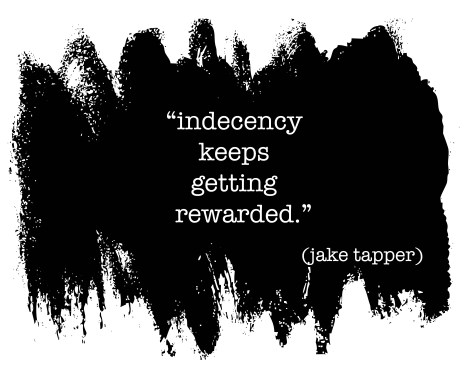
And what happens when the enemy, the latest scapegoat that unifies the party-in-lock-step (#3 on the list), is the other half of us, the other party? What happens when indecency is rewarded and ignorance applauded? What happens when fear is the reason the lock-steppers cover their ears and claim that they see no evil? Low-information comes with a very high price.

As they say, history repeats itself. And, somehow, we find ourselves – at least half of our nation – embracing the list.


read Kerri’s blog post about INDECENCY


seagull in fog website box copy


Sit Together [on DR Thursday]

AtTheDoor1 jpg copy 2

Our cartoon, At The Door, lives in the category of ideas-that-we-knew-would-never-fly-but-wanted-to-do-anyway. In other words, we knew we’d make the submission and the syndicate would reward our good efforts with silence. And, they did just as we predicted!

If conflict is the epicenter/driver of story, then At The Door has a premise filled with great story potential. The dog wants to go out exploring the unknown. The cat wants to stay in his comfort zone. His bowl is the center of his cat-world and he is rarely found far from the bowl. The dog is an idealist, a dreamer. The cat is a realist. A conservative. He enjoys raining on the dog’s parade.

You’d be surprised how much material you can write with such a simple premise. We laughed heartily in the writing of it, especially because we drew our inspiration directly from our crazy Aussie and enormous cat. They share space. Together, they stare out of the door or window, their desires are wildly apparent. Each following their star. Each honest in their pursuit.

In versus Out. Cats-and-dogs-living-together. Oh, my!

Truth? I’d forgotten about At The Door. And, then, watching the news of the day combined with the wave of contention swirling around us, I remembered. I sought the cartoon file more for solace than anything.  I wanted to revisit my belief [my experience] that division need not be ugly. Division need not be disingenuous. Division provides the ripe necessity for collaboration. Two points are a mathematical requirement for the third point to become possible; it’s called ‘perspective.’ Creative tension can be a positive force for forward movement and new ideas if the division serves an honest intention.

If the division is the intention, sitting at the door together becomes, as we’ve seen, altogether impossible.


read Kerri’s blog post about AT THE DOOR


drc website header copy


dogdog babycat paws touchingwebsite box copy

Know They Are Watching [on Two Artists Tuesday]

deer tracks converge copy

We go to Bristol wood to return to center. It is a place of peace. It somehow breathes serenity into our overactive minds.

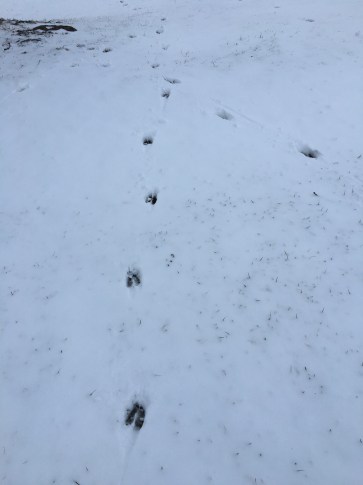
Sign of deer are everywhere in the woods. We rarely see them but we know they are there. I imagine they watch us. I imagine they silently encourage us to walk slower, to catch our breath. To listen to tree song. We delight when we walk a path where they recently tread.

Deer are a symbol of gentleness and intuition. Balance and peace. This summer, on the Island, we saw deer everyday. We would retreat from the contentious community back to the littlehouse, pour some wine, and take a walk. A deer would inevitably appear and we’d stop talking. We’d breathe. We’d watch. It would watch us, too. After a few moments it would leap and disappear and, with it, our day’s concerns would also disappear. The deer would shift our conversation, from a lengthy list of disgruntlement to the beauty immediately surrounding us.

I’ve decided that, in our broken-wrists-time-out, our goal should be to make the whole world Bristol Wood. That we shouldn’t retreat to find peace but should invite peace and balance and serenity into the rest of the day, no matter where we happen to be living it.

Things I used to know. Things I once practiced.

Know that they are there, everywhere. Watching. Silently encouraging us to walk slower, the breathe, to focus on the beauty immediately surrounding us and not on the other stuff. It turns out that balance and serenity are practices, not pursuits. They are choices. Peace-of-heart-and-mind do not exist in the woods exclusively. Peace comes to the place where I decide to allow it. To practice it. To make it a priority.


read Kerri’s blog post on DEER SIGN


deer in woods copy


tpacwebsitebox copy


Get Serious [on Merely A Thought Monday]

er or uc copy

Looking back on the experience, I see a map of choices.

Kerri fell. Both wrists were painful. We knew it was bad. In the ski patrol hut, the medic’s advice was to go get x-rays. Choice #1: To get x-rays or to not get x-rays? We had a conversation in all seriousness with the medics, that, given the nature of healthcare in America, it might be a valid option to skip it. To go home. To ignore it and let it heal as it will. The problem with ignoring it: the loss of motion that comes with ignoring what might be broken or torn in her wrists.

So the choice was not actually to get x-rays or to not get x-rays. The choice, the real choice, was financial ruin or loss of motion. Kerri is a pianist. It is her livelihood and her life. So, choice made: financial ruin.

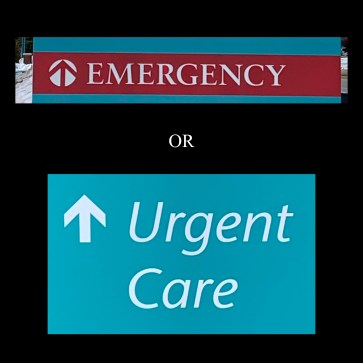
We pulled into the medical center and saw a sign. To the right was the emergency room. To the left was the urgent care center. We sat in the truck and debated the option. While Kerri writhed in pain, in all seriousness, we sat in an idling truck and discussed the merits [or lack thereof] of our insurance policy. If we chose the right hand path, we would meet the vast, gaping deductible. Like Evel Knieval attempting to jump his motorcycle over the Grand Canyon, we’d have to gun our engine and run at the edge. No parachute. So, we chose the left hand path. We went to the desk of the urgent care and asked if they did x-rays.

Choice #2 was not, in truth, the emergency room versus the urgent care. The choice was which canyon did we have the best chance of surviving?

A few days later. An appointment with a great orthopedic doctor. She, in all seriousness, told us that she ignores the part of the patient file that speaks to their health insurance. She explained that there is dilemma that doctors face: do I advise my patient to do what is best for their health or do I advise them to do the thing that might keep them out of bankruptcy? She ignores the file because she wants her patients to hear what is best for them. She told us that she needs to keep herself blind to the financial reality that her best advice might necessitate. “Yet another untenable choice,” I thought.

Our choices reminded me of an experience we had a few years ago. We were shopping for a new washing machine. The salesman, an older man, was embarrassed by the products he was selling. He, in all seriousness, took us down the aisle of appliances and told us what was wrong with each machine. He was convincing us NOT to buy his appliances. Mostly, he told us, they were designed to fail. He said, “We used to know how to make things in this country. Now we make crap on purpose.”

The healthcare in the richest country on earth is just like the appliances sold in the richest country on earth: Designed to fail. Making crap on purpose. The way I am certain that I see clearly? Sit with your wife, a world-class pianist, who has just broken both wrists, and listen to the choices you are considering. Clarity, in all seriousness, comes when the crisis hits.

As we shake our increasingly obese and unhealthy bellies, wave our angry signs and shout about making America great again, it seems we are falling further and further behind. We saw it this week in our senate, did we not? At least our capacity for denial of the truth [in our post-fact, low-information frenzy] is running in front of the rest of the world. I can only hope, as a nation, we break our collective wrists sooner rather than later. In our pain, perhaps we will look at the sign and have a real conversation, in all seriousness, about our choices, about what we can and cannot survive.


Read Kerri’s blog post [written with a cast and a splint!] on CHOICES


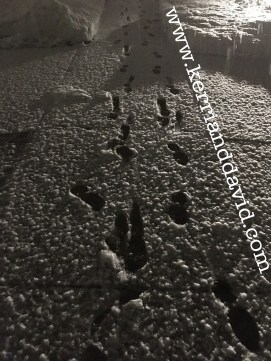
snowsteps website box copy

Stand Out [on Two Artist’s Tuesday]

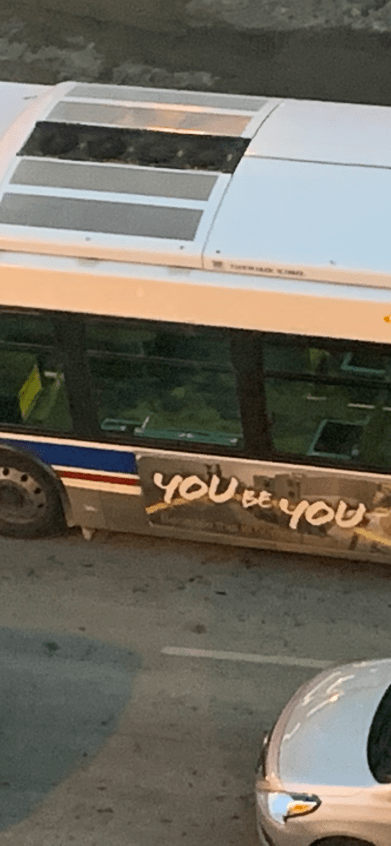
you be you bus copy

You be you. If you think about it, who else can you possibly be? As trite as it may seem, this appeal on the side of a bus captures in simple marketing language one of the greatest paradoxes of living life in the most individualistic culture on the planet. We are reinforced to be hyper-unique but hammered repeatedly to fit in. It is the ultimate split intention. It is why we have such a ubiquitous self-help industry and so many preachers-of-purpose-seeking. Asking, “Where do I fit in?” is a terribly hard question to answer when the expectation is to stand out.

I suspect our current dedication to division is, to some extent, built upon this paradox. Split souls are generally angry souls and anger is an easy organizing principle to exploit. Tribes of anger need nothing more than enemies to bridge the split. A good enemy, real or imagined, can provide to an angry tribe both a sense of individual purpose and a place to belong.

I heard a term the other day that frightened me: low information voter. Years ago I heard an economist speak at a conference and his message was profound. A healthy democracy requires an educated populace. Without the capacity to sort through the heaps of rhetoric, pull apart the agendas to see beyond the manipulation, without some simple capacity  for analysis, or a bigger picture, then votes will be cast from simple, uninformed and often angry belief. In other words, democracies fall when its members do not care enough to know what they are voting for. Power will always corrupt. The brilliance of a democracy is that the people are meant to be the ultimate check on power. In order to be the check, they have to look beyond the political party line and ask, “What really happened here?”

The leaders of angry tribes need low information voters. It’s the only way they can stay in positions of power. It feels good to fit in. But, in a culture known for its individuality, it feels all the more satisfying to stand up, to stand out and ask, “What’s really going on here?”


read Kerri’s blog post about YOU BE YOU


savannah selfie WEBSITE BOX copy

Coalesce [on Not So Flawed Wednesday]

in the woods copy

Sometimes, when we are walking through the woods, I imagine myself with none of the labels that I claim as important. What if “artist” did not apply? Or “teacher.” What if none of my opinions or ideas or justifications had any merit or substance? What if they were bits of armor or heavy clothing that I could drop as I walked? So much lighter, less encumbered, who, then, would I be? Divested of my made-up-meaning and my hard-fought-for stress, what might I experience?

These imaginings, my questions – at least to me – are not nihilistic. They are the opposite. When I am walking in the woods and all the clutter and noise and the oh-so-important-to-do-list falls away, when all of my investments in my-very-important-ideas and my-resistances-to-immovable-objects drops off, when my frustrations and anxieties evaporate, I come back to my senses. Literally and metaphorically. The cold air. The limbs waving and groaning in the breeze. The quiet chatter of the brook that ambles through Bristol Wood. I become the moment I inhabit. I inhabit the moment of my becoming. That’s it. My “meaning” takes on a proper proportion, no greater or smaller than life itself.

Listening to the brook, the sound of our feet crunching the snow, I remember something John O’Donohue wrote. “The river is a miracle of presence. Each place it flows through is the place that it is…In a river, past, present, and future coalesce in the one passionate flowing.”


read Kerri’s blog post about THE WOODS


footprints in sunlit snow website box copy

Check Your Reality [on Two Artists Tuesday]

ice copy

We parked the truck in the Kemper Center lot, far enough from the shore not to be hit by the flying debris, the chunks of seawall and pavement being hurtled from the impact of the waves. Kerri has lived here for over 30 years, “I’ve never seen anything like this,” she repeated as a towering wave engulfed the gazebo, took down a piece of the wall of the art center, a hunk of coastline disappeared.

Later, after the storm, we went back. Trees were down, encased in ice. Huge sections of the walking path were shattered and tossed into the flooded mess of the parking lot behind the center. Walking was treacherous. Like the trees, the ground, the rocks, the destruction was coated in a thick layer of ice. It was beautiful and inconceivable.

Words mask all manner of reality. We have a word, nature, that can’t even begin to touch the magnitude, the power of where it points. Mother Nature. I have been thrown out of bed in an earthquake that brought down freeways like they were so much satin ribbon. Go to Pompeii or Herculeneum, visit Mt. Saint Helens, watch with disbelief any of the news  footage of any one of the tsunamis that have wiped communities off the map. Wrap your mind around it, if you can.

We are cavalier in our conversations about global warming. We impact, we do not command. We reduce it to questions of business, of protecting the beef industry. Which economy will suffer most? We make up these strangely insignificant divisions. We imagine that we are the center, holding all the controls. We imagine that it is all about us. So small, a chihuahua yipping at a forest fire.

Sitting in the truck, feeling the boom of the waves in my chest as they tore off chunks of the shore, I felt tiny. I remembered a snippet of film I saw about a man who wore a superhero suit and stood in the face of an oncoming storm. He flexed and stomped and raged for the camera. And then the storm hit. The best he could do was run for his life.


aftermath copy


read Kerri’s blog post about THE STORM


bonfire website box copy


ice ©️ 2020 kerri sherwood

for prints of “ice” go here


Look Beyond [on Not So Flawed Wednesday]

cameras copy

“Technology is anything that wasn’t around when you were born.” ~ Alan Kay

On the one hand, this could be a display of old technology. Shelf after shelf of what was once understood as a camera. Not so long ago a camera was a device that employed a once-revolutionary-invention, a light sensitive plastic strip called “film,” to capture images. These film devices, the miracles that populated my youth, are now antiques.

On the other hand, this could be an art piece, a commentary on the contemporary world. Many, many, many cameras, all with their lenses pointed back at us. There are cameras in phones, each a trafficker of the relatively new obsession known as the “selfie.” There are cameras at almost every major intersection of my town. Traffic selfies that come with tickets. In stores I am told to smile because I am on camera. There are cameras in doorbells. Many medical procedures employ teeny tiny cameras capable of fantastic voyages, inner selfies. The cameras shot into outer space transmit back to us images of a tiny speck in this vast universe, a dot called Earth.  Our art piece reveals to us that we are the central object of our study.

Standing in front of the shelf, looking at the myriad lenses looking back at me, I understood with some sadness that the cameras on the shelf used to be understood as arbiters of truth. There is a now an antiquated term, you may have heard it: photographic proof. Proof. It is not so much that the camera – film – is antiquated – but it’s purpose is most certainly passe’. Truth is out of date. Proof has no reliable root. We have replaced ‘photographic proof’ with a new concept, a ‘post-fact’ world.

Buckminster Fuller once said that, “Humanity is acquiring all the right technology for all the wrong reasons.” Were this beautiful unintentional-art-piece-found-in-an-antique-mall one of my creations, you can bet that I’d scribble Fuller’s quote someplace on the shelf, though, you’d have to look beyond the cameras to find it.


read Kerri’s blog post about CAMERAS


savannah selfie WEBSITE BOX copy