The Pivot Point [David’s blog on DR Thursday]

There are many, many variations from many, many traditions of the concept of presence. My recent favorite is to “stand on the pivot point of the Tao.” No matter the name attached to “the now” there is a universal understanding: in presence – when fully present – there are no problems.

It’s easier said than done since fixating and worrying about imagined futures is what our brains are wired to do.

I thought a lot about presence during our epic drive home yesterday. The entire trip was an exercise in being-in-the-now. Of necessity we drove very slow, windows down with the heater on high. We stopped every hour, opened the hood, and let the engine cool down. We checked the coolant. And then, when certain that we could attempt the next stretch, we got back on the road.

I can’t report that it was stress-free but I can with all honesty say we made the best of it. We appreciated and enjoyed our stops. We discovered some new places. There was no rush or need to keep up with traffic. We kept to the right lane and let the-world-in-a-hurry pass us by.

We had friends on the road a few hours behind us; a safety net. They tracked and celebrated our progress.

When we rolled into our driveway, 20 had dinner in the crock pot and wine ready to pour. We laughed and told stories of the day.

We are unbelievably fortunate in friendship and support. All problems disappear in the presence of good friends. The pivot point is not a place. It’s a relationship.

We had an adventure with no problems. I’m certain that, even if the Scion hadn’t made it, we still would have had an adventure with no problems – because we decided to be present with and handle any experience that came our way. We decided to rest in the support of our friends.

It’s a decision, one we ought to make every single day.

read Kerri’s blogpost about THE ROAD

like. share. comment. support. subscribe…thank you.

An Echo [David’s blog on DR Thursday]

“…repetition as a means of physically marking time, memory, loss, transformation, and ultimately, transcendence.” ~ curator’s statement for the exhibit of Idris Khan at the Milwaukee Art Museum.

Repetition. A mantra. The hours of practice of a musician. A commute to work. Ritual. We walk the same looping trail again and again, season after season. The same is never the same.

We journey to the Milwaukee Art Museum to replenish our spirits. Mostly we visit Richard, Ellsworth, and Mark. I stop by and visit Georgia and Pablo. Not knowing much about him, we were for some reason drawn to the Idris Khan exhibit. Repetition. Stacked images. Words printed on top of words. Pages of musical scores layered and changed into a powerful visual statement. Symbols iterated until garbled and transformed; I leaned in close, then stepped back, again and again, becoming part of the repetition. A dance!

Such a simple star to follow, repetition. And yet…How many letters in an alphabet? How many notes on a scale? From the limited letters or available notes – symbols repeated and mixed and matched – an infinite array of possibilities. Every page of the Quran photographed and stacked. Bach’s Six Suites for Solo Cello.

Wandering through the galleries, his work made me ponder how our inner lives are entirely symbolic. Our days stacked one upon the other. We look though the stack called our past and somehow, through the noise, believe we arrive at understanding. Meaning. An echo.

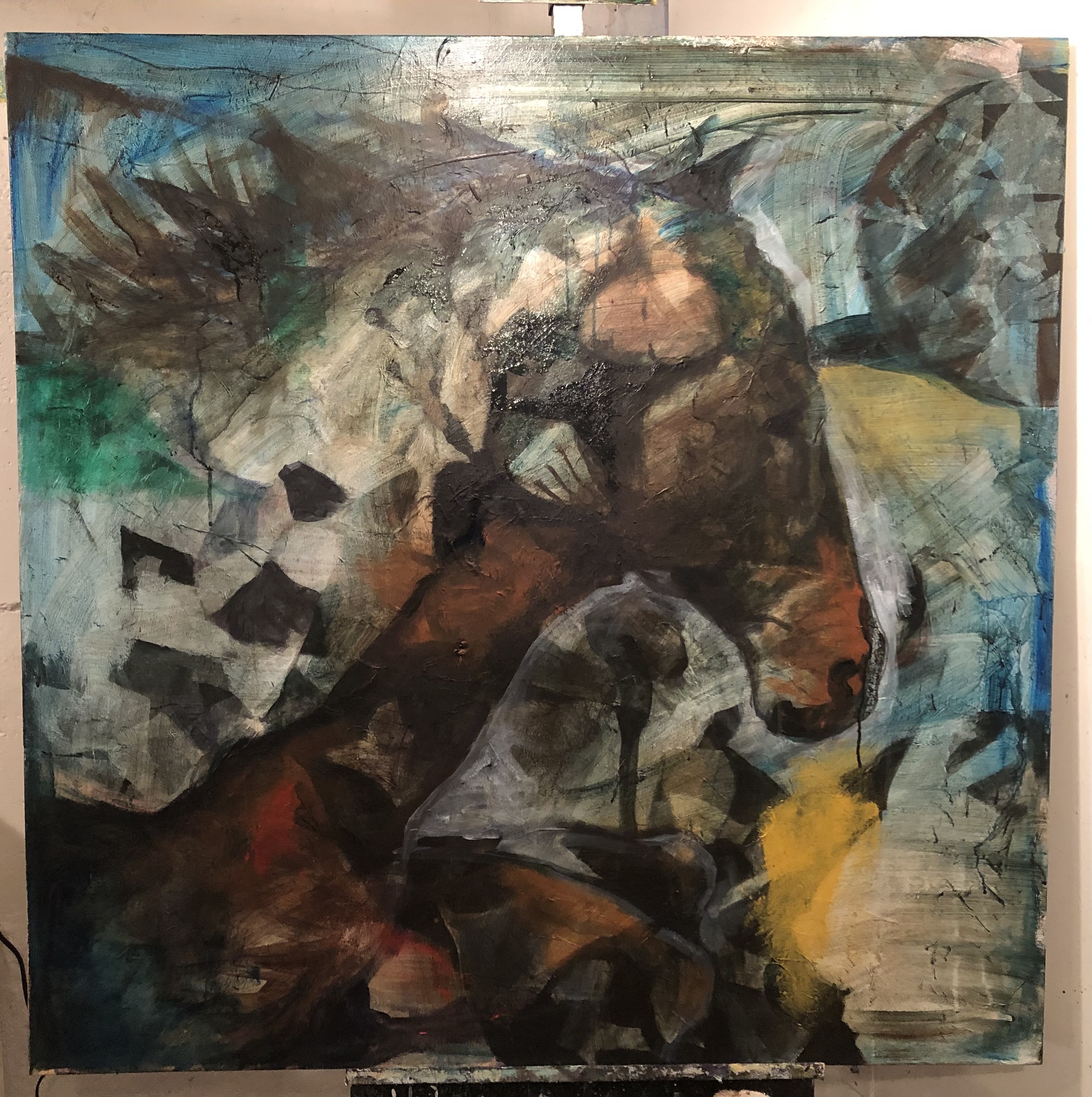
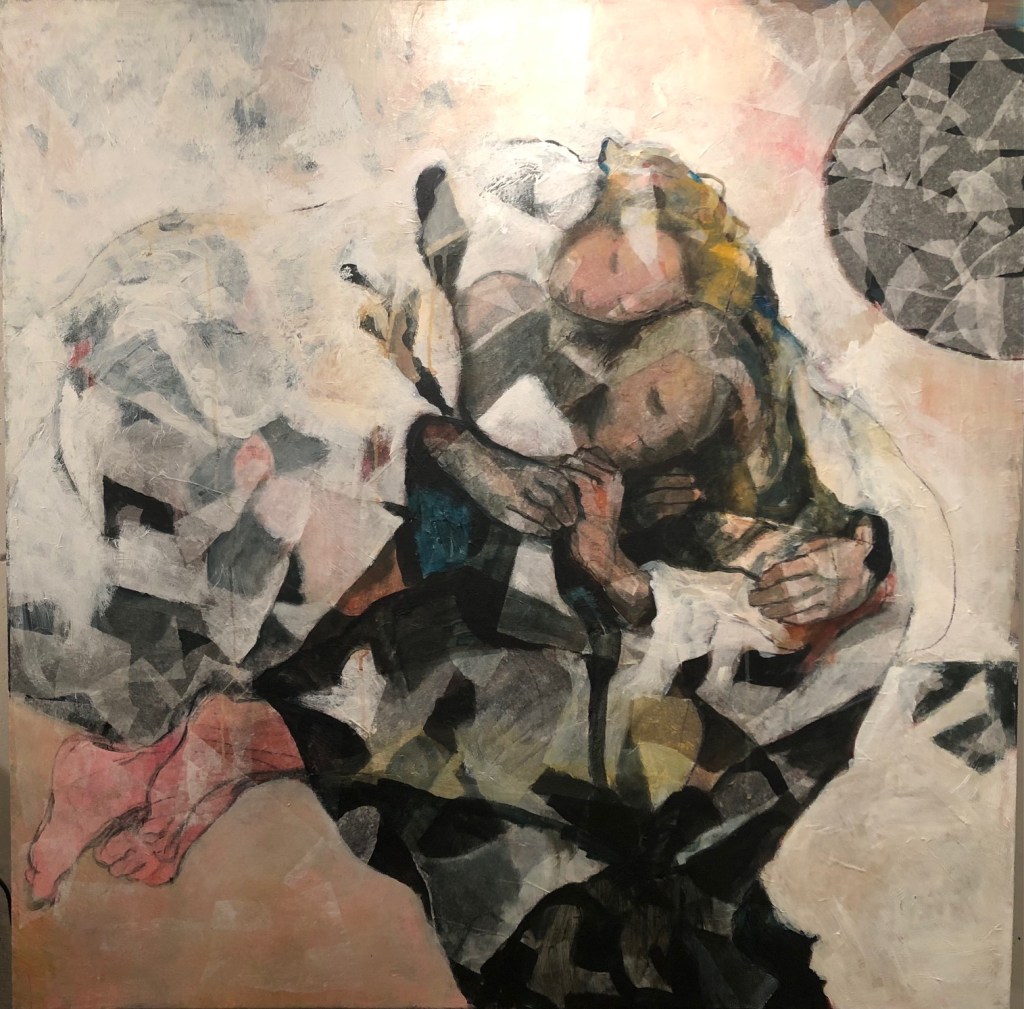
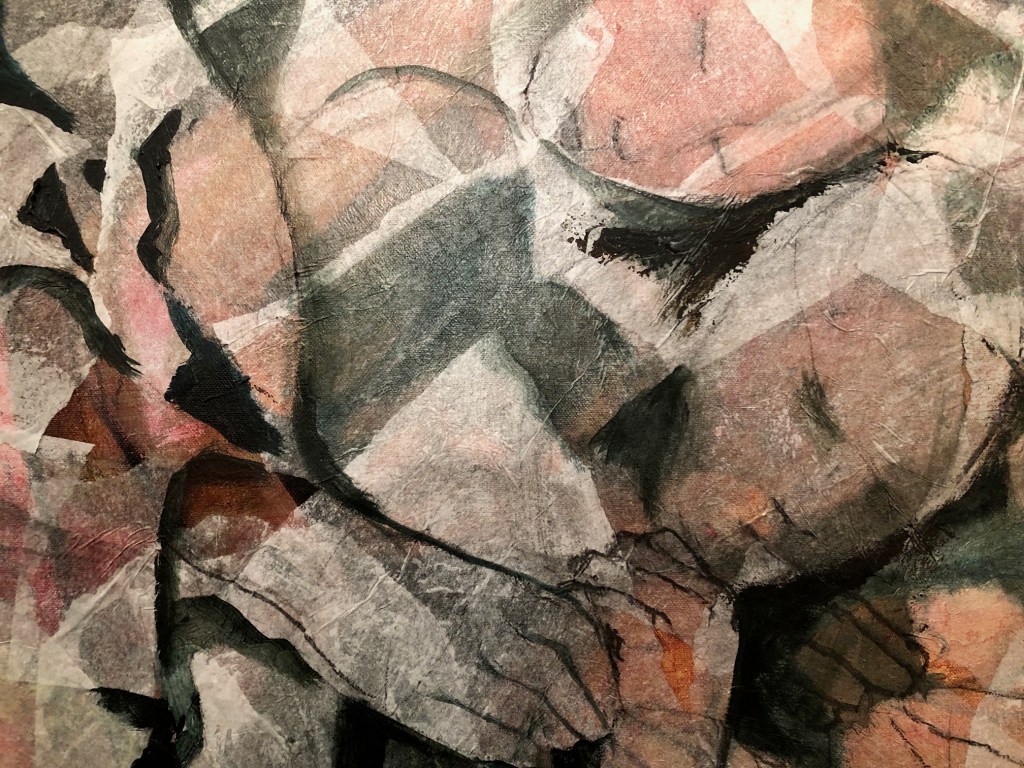
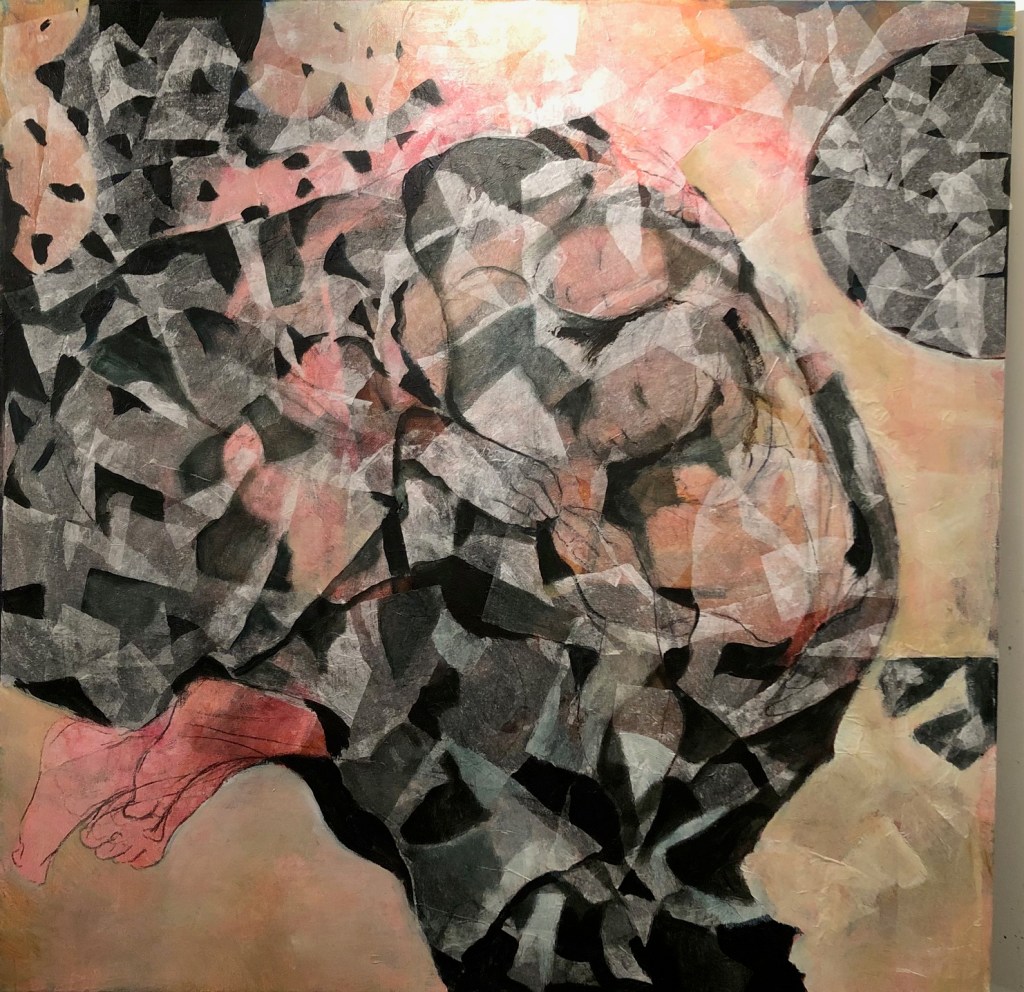
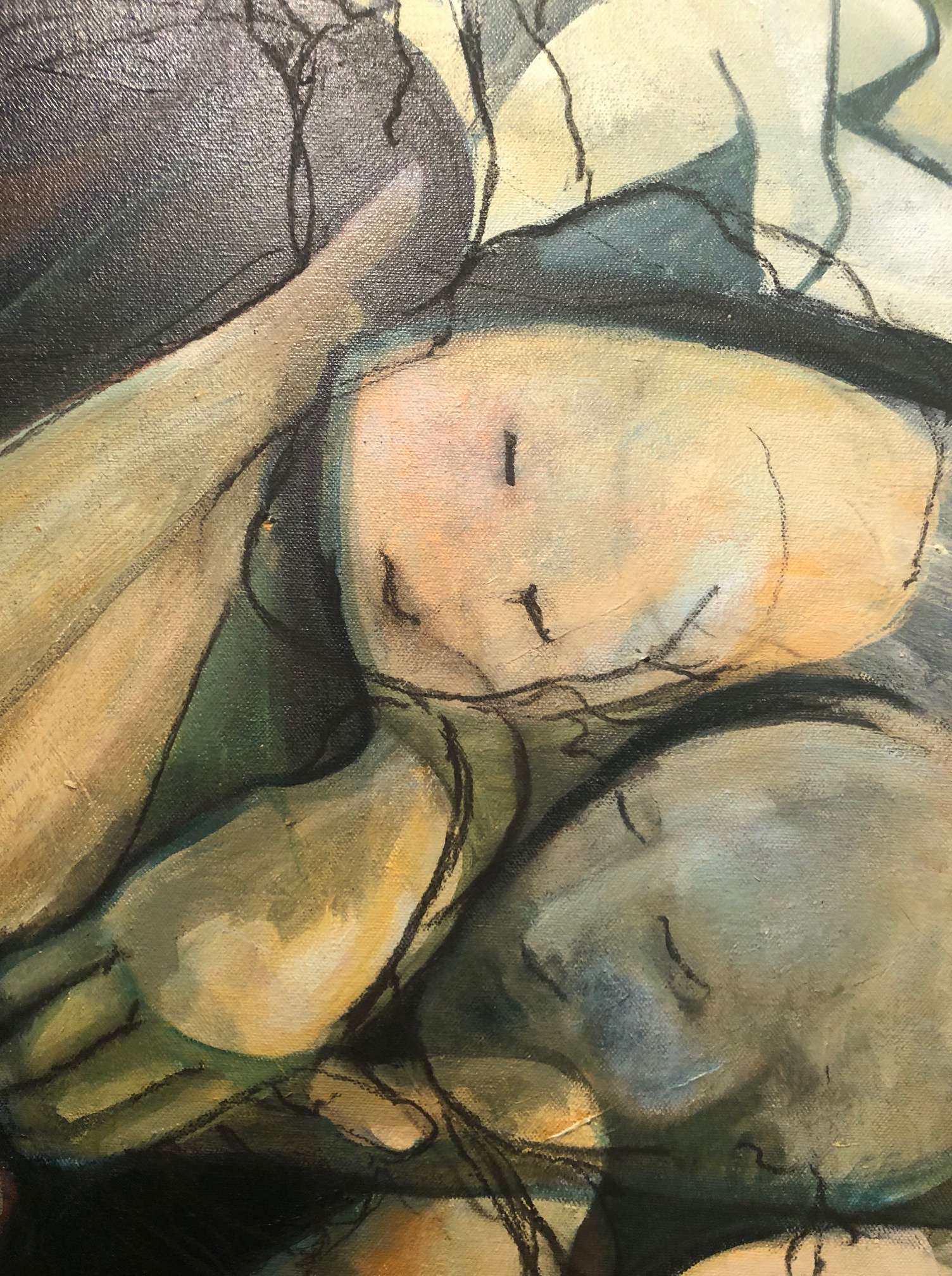
Joy, 50″x56″, mixed media

read Kerri’s blogpost about THE MUSEUM

like. share. comment. subscribe. support…thank you.

Out Of The Many [David’s blog on DR Thursday]

Among other things, Wade Davis is an ethnobotanist, studying how people – cultures – use plants for food, medicines, dyes…in hunting and in ceremonies. The study of plants as living symbols. In a different life, in another path, I would have followed him around attempting to know-what-he-knows. Mythology beyond the abstraction.

For us, this week has become about the coneflower. Earlier in the week I wrote about its symbolism: strength, vitality, healing energy… The color of the coneflower accents different attributes. Orange evokes vitality and enthusiasm. Purple accents strength. Yellow, acceptance and perseverance.

I thought of Wade Davis because his study has taken him to indigenous cultures who live their symbology, their mythology is visceral, a deep-seated guide for how to conduct their lives. For them, the attributes of the plant are not curious abstractions, something to be found in a Wiki or a book or a religious tome. It is ancestral. Lived everyday. He writes beautifully about what he has experienced.

I wanted to know what a coneflower represents so I looked it up. It is not integrated into my being, pervasive to my clan and has not been passed to me by my elders. I want to identify with it so I write myself into the story. I write us into its meaning. It is, for us, new. We will give it roots, make it conscious by planting it in our symbolic garden.

As a society, many of our symbols are unconscious. It is a happy and fortuitous accident that the Olympic Games are happening in the midst of the ugly divisive rhetoric coming from the right in our political campaign. Each day I look at the athletes from the United States and I see a beautiful living symbol of our nation as it really is: diversity, a celebration of ethnicity – united under a single flag. It is, I believe, what our flag – our symbol – represents. Out of many, one.

This flag is one of our few conscious symbols. E pluribus unum is our tradition. It is our intention, written into our founding. It is our ancestry and inheritance. We are the many, united as one. It is what we strive to achieve. Our athletes represent us; they represent who we are beyond the abstraction.

The red hats and their authoritarian leader would have us understand our symbol differently. You can hear it in their language, placing the accent on racial division. Their obsession with degradation, their glee at name-calling, their unwavering commitment to a victim narrative…exposes a dedication to subverting the humanity of those that do not look or think like them. They would have the flag symbolize white nationalism, a radical uprooting of its meaning. Their notion of “one” rejects the many. It is, quite literally, flipping the symbol upside-down (as was proudly flown over the house of Justice Samual Alito).

They are not hiding their intention. They are counting on us to misconstrue or willingly discard the meaning of our sacred symbol.

Look at the athletes representing the USA. Take a walk in the park on the 4th of July and look at the people sharing the celebration in the commons. They are US. Rich in diversity. United.

Acceptance. Perseverance. Strength. Borne of the many, striving to be one.

read Kerri’s blog about CONEFLOWERS

like. share. comment. subscribe. support…thank you.

Be Better At Bad [David’s blog on DR Thursday]

I am painting very badly. It’s not a surprise. It’s been a while since I have consistently been in the studio so it will take a while to loosen up, to stop thinking about the next step. Artistry is not so different from athletics; it takes a while to get back into shape.

Previous iterations of myself would have felt badly for painting badly. That guy would have hidden his clumsy images and too-tight-brush-strokes. These days I’m better at being bad. I like the dance. I’m more interested in cultivating a healthy process so I’m less invested in how I look. How “it” looks. “Bad” is a process step, an opportunity to learn or laugh rather than the judgement that it used to be.

It’s easy to write about the necessity of throwing many pots or writing ten-bad-pages-to get-to-one-good-page. It’s another thing to do it. Celebration of the bad is a necessary step in finding flow. And, after such a long studio hiatus, flow is nowhere to be found. Artists do not train to clear a hurdle or master the pommel horse. Artists train for flow.

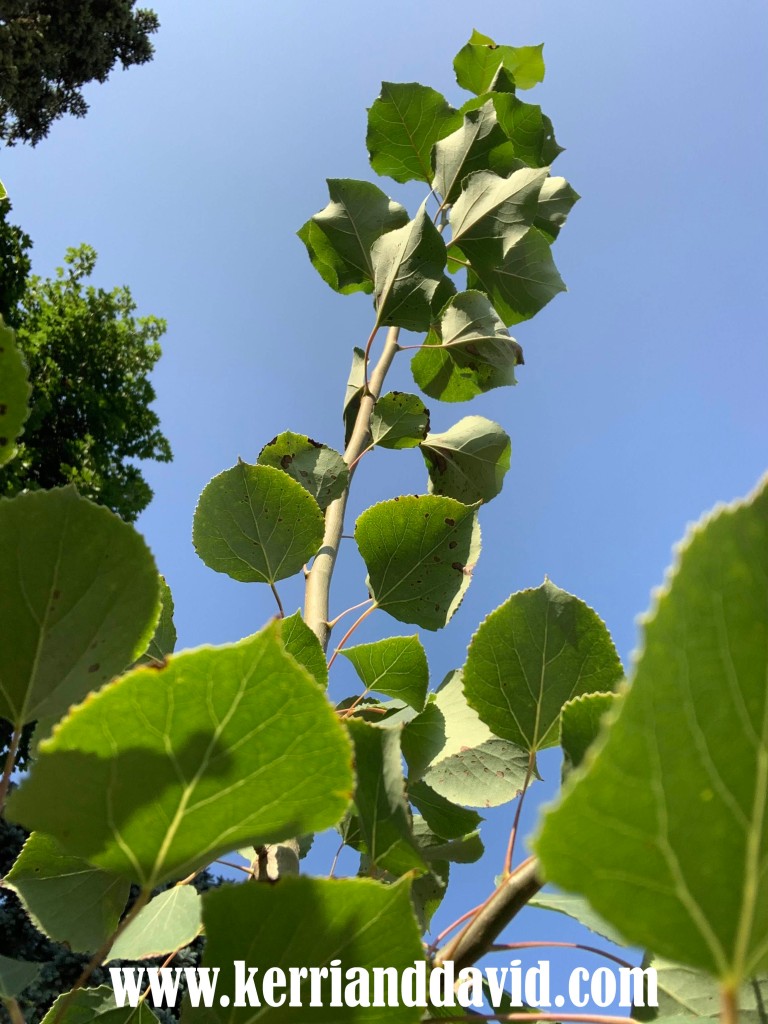
We nearly lost Breck-the-aspen-tree. We kept her in a pot for too long. And then we planted her in a place that was less than optimal. She withered so we quickly moved her to another spot. It was a guess since we thought the first spot was prime. That was three years ago and today she is thriving. She is as tall as the garage and growing fast. Her trunk is no longer pencil thin. It is robust, sturdy. Birds perch in her branches. Last year she was like a gawky teenager and produced weirdly sized leaves. This year she has come into her own.

Last week, after painting especially bad, suffocatingly tight and small-brush-clumsy, I sat outside with Breck. She asked me to remember her freakish leaves. She reminded me of the strange unwieldy branch that reached like a beanstalk above all the others. It was so unusual that we worried for her survival. We worried a giant might come looking for a goose. “Growth is tricky,” she said and quaked.

Yes. Growth is tricky. Sometimes it takes a chat with the aspen tree to remember to take a breath, reach for the sun and celebrate right where you are on the path.

County Rainy Day…in process. Too tight too soon…a step on the way to flow…

visit my gallery site

read Kerri’s blogpost about BRECK

like. share. support. comment. subscribe…thank you!

Arrive Again [David’s blog on DR Thursday]

Deadheading the day lilies, the afternoon sun pouring through the branches, I realized that I’ve walked a circle and arrived again at the starting point. After fourteen years, I’ve returned to the origin-thought of this blog.

I started writing the direction-of-intention after a conversation I co-facilitated. It was a day exploring and discussing diversity, equity, and inclusion. The group’s conversation veered into questions about power. That day I realized that I had an overabundance of thoughts and questions that I needed to study. My very first post was almost a thesis statement; it was an attempt to capture the essence of what I shared with the group: power-over others is not power at all. It is control. Power, real power, is something that is created with others. Control over. Power with.

I did not return to the beginning without help. The current political reality has drawn me like a moth to a flame back to the topic of power. Our two parties live on opposite sides of the line. The red hats are a case study in Control-Over. The Democrats operate on the principle of Power-With.

Control-Over is distinct in the necessity to blame. It is a victim’s game. It is an abdication of responsibility. It demands lock-step adherence and fears counter-point-perspectives. It evades giant swatches of its history. It pretends to hold all the answers and doesn’t tolerate questions.

Power-With is distinct in the necessity to choose. It seeks responsibility and participation. It thrives on counter-point-perspectives and demands collaboration and compromise. It needs to consider and reconcile with its full history, the good and the bad. It asks many questions and eschews the notion of a single answer.

Control-Over is essentially hierarchical. Caste. Fixed. Rule by one.

Power-With is essentially egalitarian. Relational. Fluid. Rule by the many.

It turns out there’s never been a better time to return to the root of my original inspiration. It is, I’ve learned the original root of our nation’s nearly 250 year conversation. The essence of the democratic ideal.

Today we stand squarely at the crossroads:

One choice continues to follow the complex path of power-with.

The other is a hard right onto the powerless path of control-over, not a step back in time as it pretends.

It’s our choice. It is our direction-of-intention.

read Kerri’s blogpost about SUN THROUGH TREES

like. share. subscribe. comment. support…thank you.

Don The Hazmat [David’s blog on DR Thursday]

Last night while Kerri, 20 and I were playing a game of Rummikub, Rob texted. He asked, tongue firmly planted in his cheek, “Wow! You’re so close to the (RNC) convention, are you going to swing by?” I responded without thinking, “Only if I had a hazmat suit.”

Protection from toxic waste.

Before dinner and before playing the game, 20 told me that earlier in the day, while he was driving, he caught himself pondering what he would do to survive if the red tide sweeps in, stains the White House, and reconfigures Social Security and privatizes Medicare as is promised by their conservative blueprint for authoritarian rule, Project 2025. I asked, “Did you ever imagine in your lifetime that you’d be worried about the overthrow of democracy by a populist dictator?” His dad was a WWII veteran, as was Kerri’s father. My mom was a little girl living in Pearl Harbor on the day it was attacked because my grandfather provided services for the navy. In a single generation, the very threat our elders, our “greatest generation,” fought to eliminate, has overtaken the minds and hearts of the Grand Old Party. They’re currently holding a convention in Milwaukee to forward an agenda that would appall Abraham Lincoln but Adolph Hitler would applaud. “Did you ever think…?”

It’s too late for hazmat suits. The toxin is already racing through our system.

In this past week we’ve repeatedly heard the phrase, “We need to tone down the rhetoric on both sides.” It’s not the rhetoric we need to tone down, it’s the reality we need to face. We’re pretending that this an election like any other election, that it is “systems usual.” It is not. Our two party system is now a one party system attempting to fortify our young democracy against a dictatorial leader and his followers who are filled with fascist dreams. The dialed-up rhetoric of Democrats is akin to sounding an alarm warning of a system-annihilating storm. The rhetoric of the reds is the storm.

Unlike the ideal outlined by our founders, this is not a party of conservative values debating with a party of progressive values to find a compromise path forward: a system designed to achieve balance from opposing points of view. This is an ultranationalist aggression attempting to dismantle our system of governance and replace it with one that forcibly suppresses – and eliminates – any form of opposition.

The body dies when the toxin is ignored and allowed to attack the internal organs.

We play Rummikub with 20 to unplug from the worries of the day. Last night while we played, a terrific storm roared through the region, shaking the house with wind and buckets of rain. Dogga paced as lightning flashed. It was hard to concentrate on the game. I couldn’t help seeing the storm as a metaphor (of course…). With so much toxic waste spewing just up the road, and potentially washing away democracy’s foundation, it is no longer possible to unplug. It’s no longer wise to unplug. Not if we want our good house to survive the red storm.

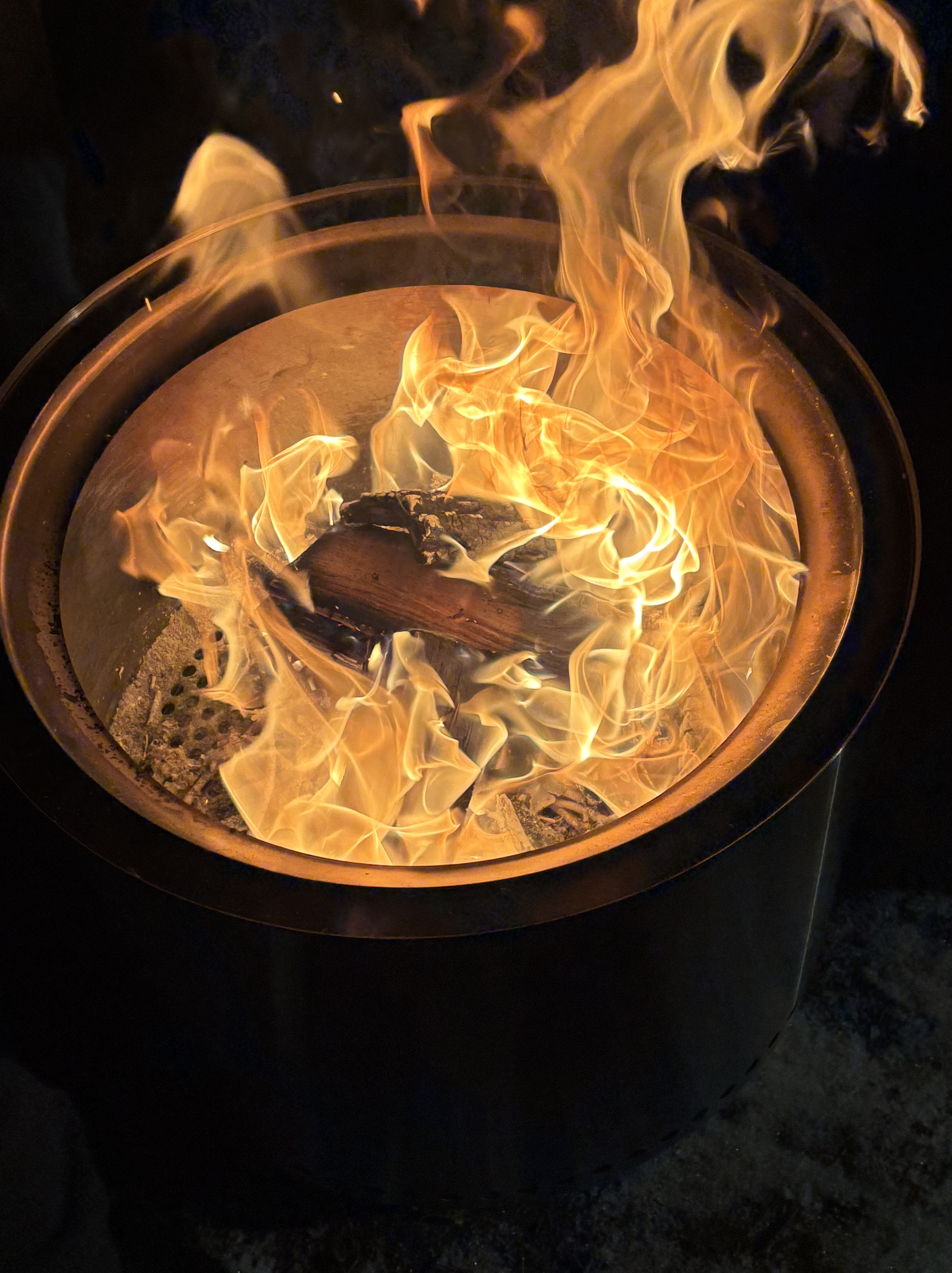
an image from the archives: House On Fire, watercolor

visit my gallery site

read Kerri’s blogpost about THE GAME

like. share. support. subscribe. comment…thank you.

For The First Time [David’s blog on DR Thursday]

As I have previously written, probably ad nauseam, I am a fan of the mythic tale of Parzival (not the opera) mostly because I sometimes feel that I am living the story. Completely bungling the opportunity in the Grail Castle by doing what he was taught to do, feeling full responsibility for the ensuing wasteland, fighting every ogre in pursuit of redemption, his trusty secret weapon shatters in a crucial moment leaving him unprotected and vulnerable to death. Stripping off the armor – his “role” – he walks away grieving the full-realization of his folly. Now, completely lost he follows a hermit who has no answers…and in his lostness, no longer trying to be found, he finds himself for the first time. The Grail Castle returns; he enters to meet again the Grail King, this time without armor or title or role or status or expectation. Fully exposed.

We walked a beach that merely a year ago was rocky and secluded. In a miracle of modern machinery, in record time, the state covered the beach with tons of sand and built a protective breakwater. It is transformed. Now, much more friendly for families and safer for swimming, for boats and jetskis, it is popular and populated. We strolled it as if we’d been transported to another era. It was at one time the same beach and a wildly different place. It is beautiful and protected, its natural rocky state completely covered over with appearance. “No worries,” I thought, “time has a way of washing away the facade, revealing the truth of everything.” In the meantime, the joy-squeals of children racing into the water was a delight.

“Can you see the dinosaur?” she asked, showing me the picture of the tiny breaking wave.

“A Tyrannosaurus Rex!”

“Yes! Look at its tiny arms!” she said, laughing.

Our feet in the sand, lost in time, nowhere else we’d rather be.

“Surrender to what is. Say ‘yes’ to life – and see how life starts suddenly to start working for you rather than against you.” ~ Eckhart Tolle.

read Kerri’s blogpost about THE SHORE

like. share. support. subscribe. comment…thank you.

Stroll With Alexander [David’s blog on DR Thursday]

20 knew we needed a get-away. He suggested a stroll through Milwaukee’s Third Ward. Knowing it was our favorite, he offered to treat us to a bowl of gumbo and a glass of wine at The Public Market. It was a successful temptation. We chose a beautiful day and drove into the city.

Among the many gifts that day as we strolled in and out of shops was the very present spirit of Alexander Calder. Almost every shop we entered featured a mobile or some variation of sculpture suspended from the ceiling. Paper planes, vibrant lemons in tidy lines like a Sunny-Roman-legion on parade, colorful shapes and orbs delicately balanced and dancing in the air, casting shadows. All paying homage to the art work of Calder. My bet is that few of the shopkeepers knew the origin, the ancestry of their twirling displays.

Calder’s mobiles were radical when he made them. He changed our understanding of sculpture and opened a new world of possibilities. Nearly 50 years after his death, his innovation is commonplace. Incorporation into the norm is the hallmark of profound innovation. Computers are ubiquitous but when they first hit the scene they were revolutionary. Electric light, the telephone, automobiles, televisions, cameras, elevators, air conditioning…They change us. They change our expectation.

So, too, the work of artists. The Impressionists shocked and appalled their contemporaries when they initially showed their paintings. They did not know that they were Impressionists. They were reacting to the latest innovation-of-their-day known as the camera – a device that could easily record reality, important events, make portraits of royals… the job of painters – so they either had to explore new avenues of painting or become irrelevant. To our eyes, 150 years later, their work is anything but progressive or shocking. It is everywhere.

Artist not only change what we see, they change how we see. They challenge us to see what we do not yet see.

A-I is currently stirring our dust and is already being incorporated into the daily grind. The pace of change compresses the distance between the moment of profundity and incorporation into the everyday. The realities of the pace-of-change are, like the camera, changing the nature of what it means to make art.

It’s good to remind ourselves that it hasn’t always been this way. What’s twirling over my head is clever and is the ripple of a revolution. It’s why I loved my stroll with Alexander Calder through the Third Ward. 20 didn’t know it, but he gave me so much more than a getaway, a bowl of gumbo and a glass of wine.

a page from an old sketchbook

visit my gallery site

read Kerri’s blog about MOBILES

support. like. share. subscribe. comment…thank you.

Very, Very [David’s blog on DR Thursday]

Last night, sitting on the deck enjoying the waning light, I had a great idea for this post. I didn’t write it down so, of course, I have no idea what my great idea was. All morning I have tried to retrace my mental footsteps but alas, they, too, are lost in the mist.

It would be just like me to write about perception. This is a curtain separating the backstage V.I.P. area from the raucous dancing audience. Kerri tried to take a photo through the curtain. Cameras and purple permeable curtains might serve as metaphors for all manner of my blah-blah. Focus placement, assumptions, obstacles, yada-yada! But, none of that well-worn blather was my great idea.

I’m rarely in V.I.P areas since I am rarely a V.I.P. In fact, this particular V.I.P. area was my first and I have to admit I liked it. I didn’t get crushed in the crowd. I wandered freely. There were drinks had I wanted one. And chairs. Security didn’t blink when I walked up and stood at the apron of the stage. I adored watching the dancing furries and acrobats prepare to take the stage. To me, backstage is magic precisely because it’s behind the curtain: the furries take off their furry heads and sip drinks through straws; the acrobats smoke a joint, laugh and talk politics. Now, backstage magic might be a fun post but it wasn’t my great idea.

I did ponder the designation (of course). It wasn’t just an I.P, important person section, it was a very important person section. Wow. Very. More important than important. Since Craig was performing and we are his parents, I suppose we earned the adverb. Kerri did for sure. I didn’t give birth to Craig (thank goodness! I’ve heard stories…). She did so is most certainly a very. I’ve only moved his stuff a few dozen times but was happy to don the extra designation.

That we were fortunate enough – from a place of privilege – to watch our son perform on a BIG stage, and perform well, – also was not my big idea. He wanted us there and made it happen. There’s nothing better on earth than having a son who wants to share his artistry and successes with his parents. The V.I.P. was icing on the cake, an experience everyone should have once in their life.

That was big but it wasn’t my great idea.

I suppose half the fun of losing a great idea is the search-and-rescue effort to find it. I know it’s in there somewhere. As I grid my recent past in search of some great abstract idea, I couldn’t be happier to have found so much actual-beyond-greatness. Heart experiences. New experiences that resurface all the stages and backstages of my past. A son in his bliss. A mother in her bliss. A crowd of adoring people sharing their bliss.

Maybe writing about bliss was my big idea! If it wasn’t, it should have been. People who I love in their bliss. Nothing better. Very. Very, very.

read Kerri’s blogpost about THE CURTAIN

like. share. comment. support. subscribe. many thanks!

What if? [David’s blog on DR Thursday]

A few months ago Horatio told me that I needed to paint. Lately I’ve been mostly writing. He suggested that it would be good for me to get back into the visual part of my brain, the part that isn’t reliant on words. Horatio is wise. This morning I went down stairs and spent some time in the studio. As is usually the case, he was right.

Weeks ago I sketched a painting on a canvas. It’s been sitting on my easel. Waiting. For today.

It took a few minutes for me to let go. Standing and staring at the sketch, I felt locked up. I grabbed a small brush which is always a signal that I am thinking too hard. I was trying to “solve” the image through a linear sequential process. I put down my little brush, opened a jar of paint, and dunked my fingers in the jar, and began to spread the red paint just like I did when I was 5 years old. I used a rag to smear and pull and shade some of the globs. I reminded myself that I didn’t need to know where I was going. In fact, I needed to “not know” where I was going and dance with the image.

After a while I stopped thinking and started responding. I sighed a deep sigh of relief. I lost track of time. I felt a wave of spaciousness roll in to my too tight mind. Energy restoration.

Horatio must have seen it in me. My grief.

It’s a question of balance. I have lately of my artistry been asking the question, “Why?” As I roll into the next phase of life I am revisiting my roots. Why did I start doing this anyway? Why, as a child, did I paint through the night. If you’d have asked the child version of me the question “Why?” I’d have answered, “Because I have to.” There was no choice. There was no “Why?” There was a driving imperative. A siren call to “What if?”

An aging Daisy. Kerri’s photograph brought to mind Tom Mck. He told me when he entered his sixties, he became invisible. He felt as if he was stepping into the prime of his creative years yet the people he’d mentored or directed or coached – the people whose careers he had informed, shaped and helped launch – the people he reached out to after retiring from his “real” job – no longer considered his artistry valid or valuable. They never told him that he was no longer viable in their eyes but he knew. They either didn’t return his calls or it was months later that he’d get a dodgy response to an inquiry or a question.

I am experiencing some of that.

Today in the studio I realized that I have been asking the wrong question. I already know why. Asking “why” is like picking up a little brush, it is to think too hard. The truth is that I’ve always known: Because I have to. The five year old version of me was not concerned with value and validity in the eyes of others. That version of me thought nothing of dipping his fingers into paint and swirling them across the page. Because it felt good. Because it felt right. This version of me – after I stopped thinking – knew just what to do. I “thought nothing” of opening the jar, dipping my fingers into the paint… What if?

My visibility or invisibility is, in fact, irrelevant. As Tom Mck drilled into me: A writer writes. A painter paints. The rest is simply out of my hands.

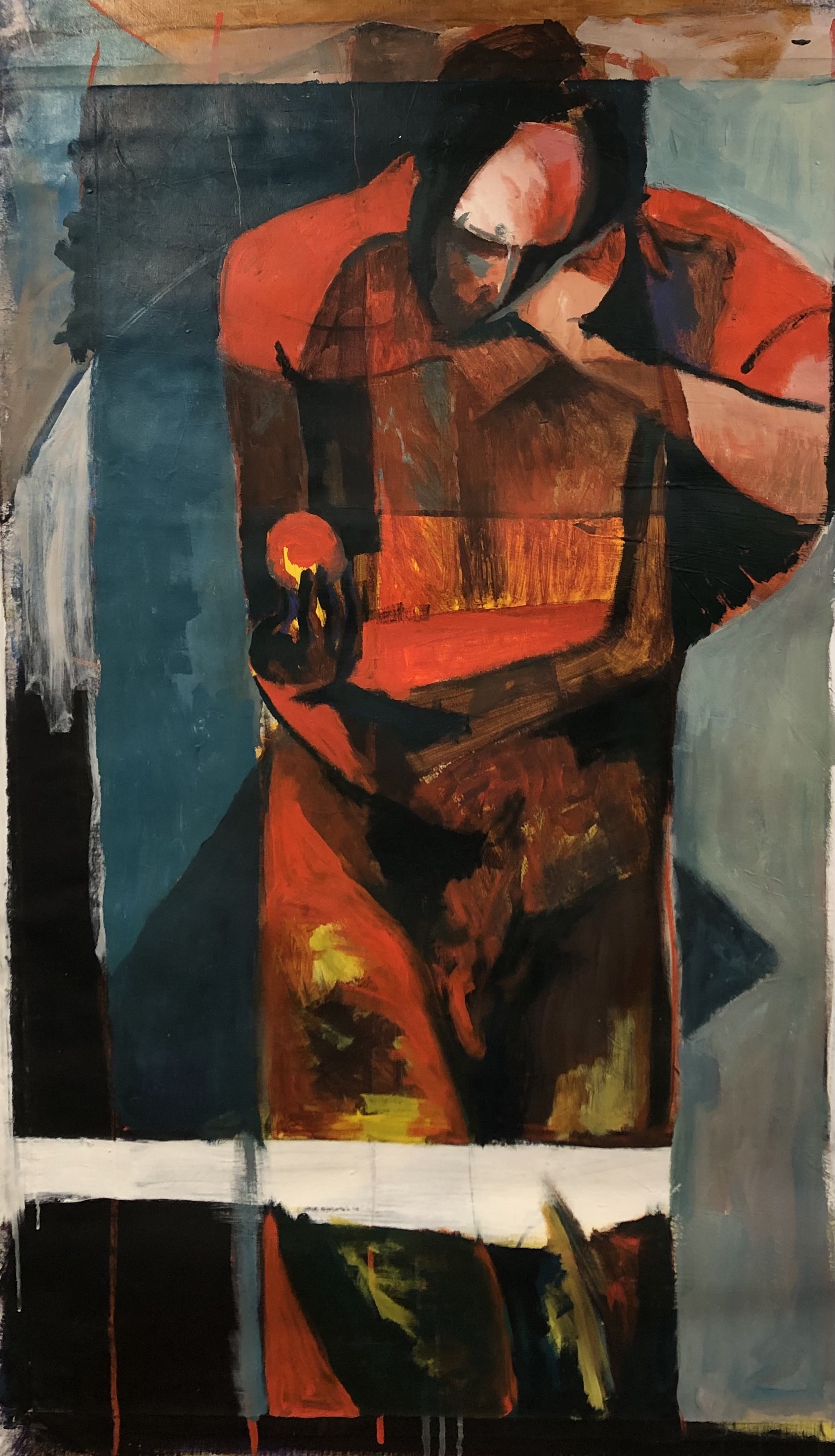
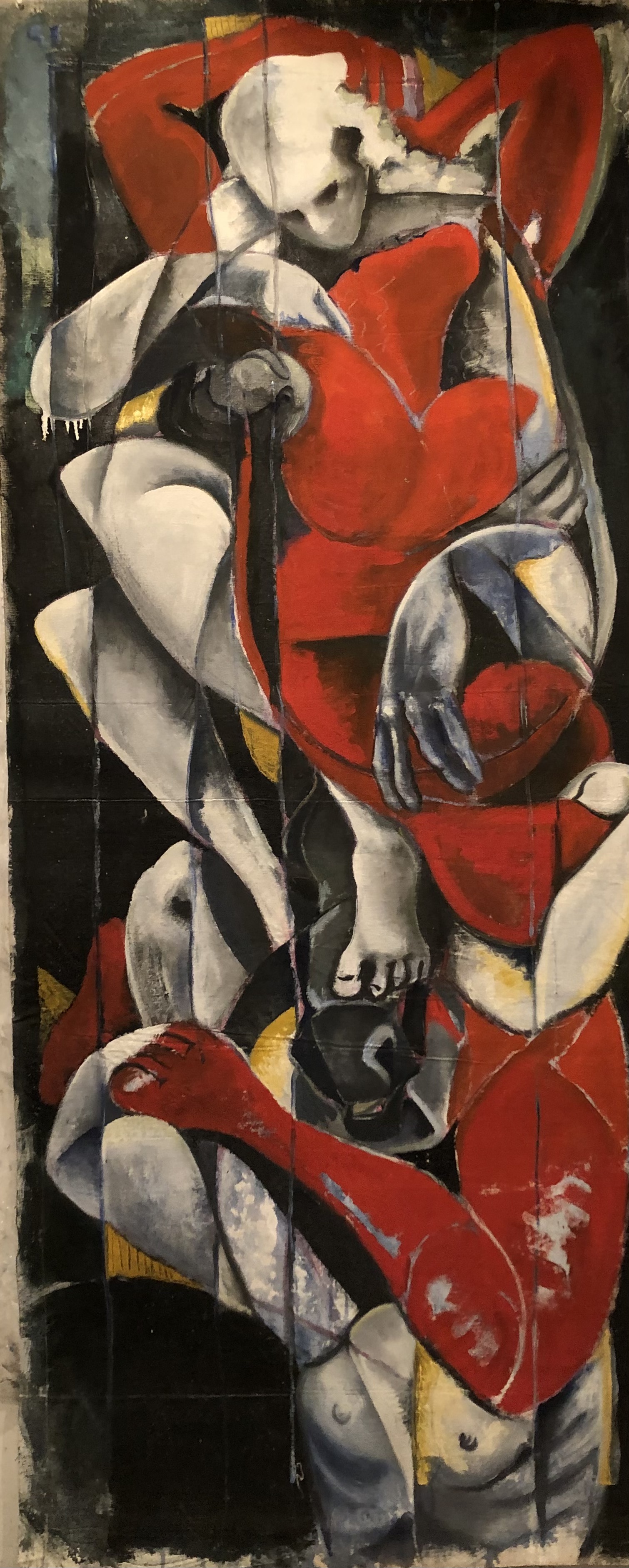
County Rainy Day. Underpainting the sketch with painty fingers

visit my gallery website

read Kerri’s blogpost about DANDELION

support. like. share. comment. subscribe. many thanks!