Conceal To Reveal [on Two Artists Tuesday]

When I was tilting at windmills, one of my favorite things to facilitate was mask work. I brought masks to lawyers, to CEOs, to teacher’s, government workers, elementary school students, corporate trainers, business coaches and sometimes to actors. There’s nothing better than a mask to pop open possibilities and challenge petrified thinking.

Masks conceal and reveal. They serve the paradox and, therefore, are tapped into the root of truth.

It’s impossible to work with masks for long before realizing that the faces we wear everyday are also masks. We “put on” a smile. We attempt to hide what we feel by the mask we manufacture. Some faces freeze in masks of indifference or masks of disdain. We perform ourselves, and craft our masks accordingly.

Many cultures around this world believe the mask opens a communication with the gods. Don a mask and something bigger-than-you speaks through you. When I paint I often have that feeling. Artistry sometimes means getting out of the way so the creation can flow.

It’s why I brought masks to lawyers and CEOs and corporate folks and teachers. To introduce them to the fields that bloom beyond their need to control. So much of their lives, so many of their problems and challenges were wrestling matches of control. They were actively creating the obstacles that they desired to remove.

What do we actually control when we harden our faces over what we feel? What do we gain by attempting to control what others see or think or feel? We are makers of our own prisons. We are deluded by our fantasy that we have the capacity to determine what others see. The only control we exert is upon ourselves.

The mask work makes abundantly clear that control is not power. Power – creativity – flows. It is the dance of the artist to master technique, to learn control, and then transcend it. To get out of the way.

My favorite moment, with every group, in every circumstance, came when the masks released the people and they slowly, respectfully said goodbye and removed them. Their faces was also mask-less. It was like seeing infant’s faces. Bright. Open. They would, for a few brief moments, look at each other, unmasked and unprotected. Simply astonished at being alive, together, in the world.

read Kerri’s blog post about MASK

Follow The Conversation [on Merely A Thought Monday]

I met Horatio on an airplane. With his wife, Teru, we were seatmates on a flight from Washington D.C. to Seattle. I’d just finished facilitating a workshop at the Smithsonian about story, he was stepping toward directing films, and Teru is passionate about writing life histories. We talked about storytelling clear across the country and our conversation continues to this day.

David and I sat next to each other at a conference. I’d only just moved to Seattle, I knew no one. I saw a sign for the conference and wandered in. It was my good fortune to pick a seat next to a brilliant visual and theatre artist. We started talking about life and art. Years later, every gallery I enter, every play I attend, I have conversations with David in my mind – and hurry home to write him or call him and share what we talked about.

To this day, MM is my greatest collaborator. We used to sit in my office and dream big dreams – and then go out and make them happen. He is the ultimate player-of-infinite-games, playing-to-play. When I need my mind opened, my pot stirred, or my obstacles surmounted, I turn to MM.

I was visiting Tom McK at his ranch. When he asked me to help him tell a story I had no idea that his simple question, the story that he needed to tell, would take more than a decade and would only be possible after his death. His story became my story to tell.

It was Tom’s story that I told to Horatio that day on the flight from D.C. to Seattle. It was multiple good conversations over many years with David about writing plays that finally brought me to clarity. MM was my constant companion. With his band, Mom’s Chili Boys, he composed the music that supported the telling of Tom’s story. He built the world of the play and then, together, we stepped into the world and fulfilled Tom’s request.

Fortuitous seat assignments on a flight. Following an impulse into a conference and taking any old seat. Playing an infinite game. One good conversation, again and again, and nothing will ever be the same.

read Kerri’s blog post about ONE GOOD CONVERSATION

Take The Opportunity [on Two Artists Tuesday]

Paul used to teach his actors that, in choosing to step onto a stage, they had a profound responsibility. “Never underestimate your power to influence another person’s life,” he’d say. I took his lesson and passed it along to my students. I hope that a few of my students took Paul’s lesson and, in turn, passed it on. You have a responsibility.

Another lesson I learned, this time from Jim, was that great acting is about standing in truth. “Acting is the honest pursuit of an intention in imaginary circumstances.” Honest pursuit. It’s a misunderstanding to equate the art of acting with pretending. The circumstances are pretend. Actors are meant to be portals to a shared story, a channel to a common experience. They transport. They transform. “Never underestimate your power…”

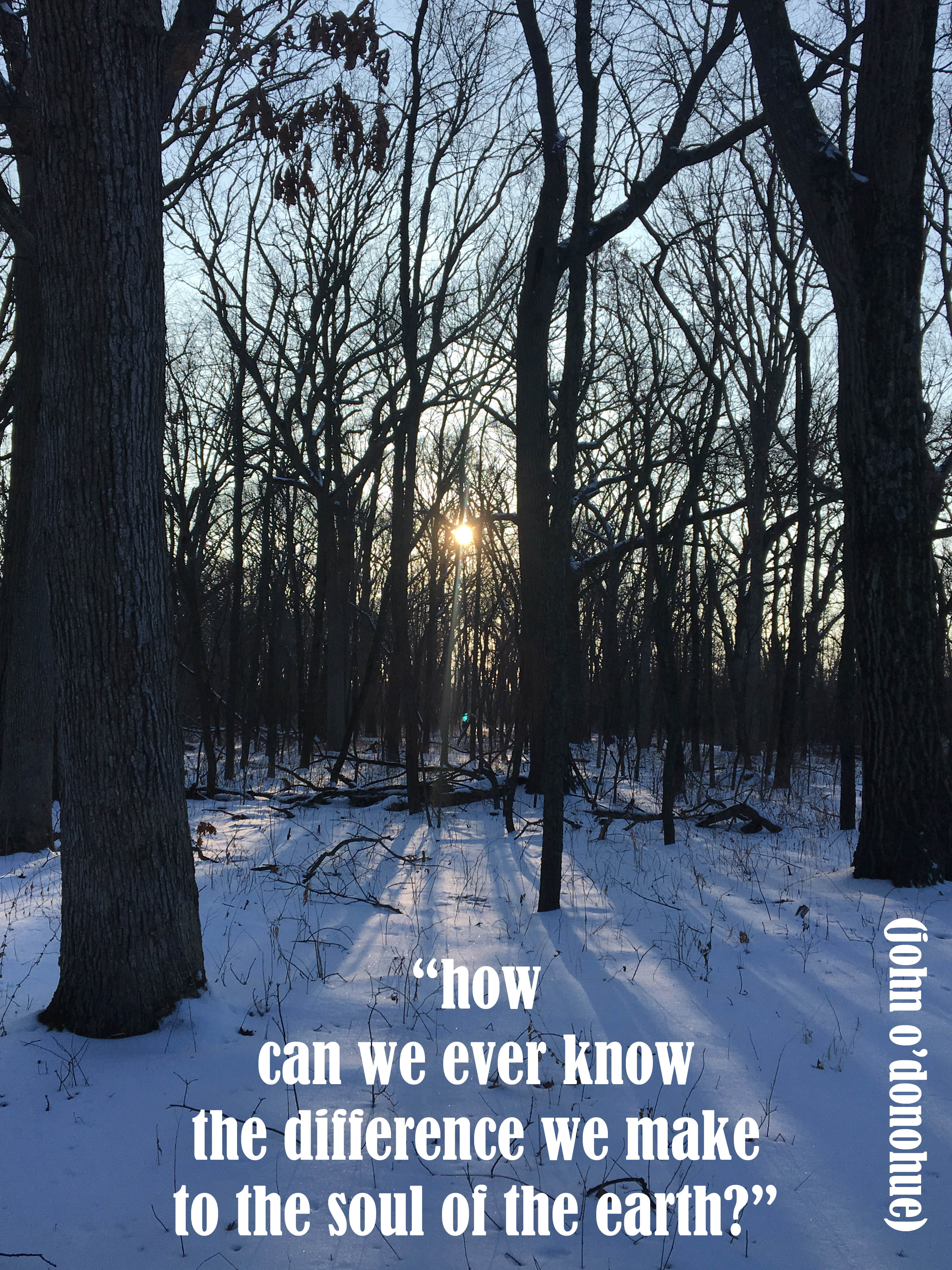
John O’Donohue writes that the soul does not inhabit a body. It’s the other way around: bodies live within the soul. We only think we are isolated individuals, bubbles. The bubble is singular, soul, and we play our small dramas within it. We fill our bubble by how we stand in it, by what we bring into it. There is no on-stage or off. It’s all the stage.

The other day I was exhausted. I was standing on the edge of despair when my phone dinged. It was Rob. “What kind of wine do you like?” he texted. The edge disappeared.

From across the country, MM sends me cartoons that make me smile. Horatio sent an episode of The Twilight Zone. “You gotta watch this,” he said. David sends photos of Dawson at the easel. There is nothing so freeing to an aging artist than to watch a child draw. No limits.

The bubble is singular. The soul of the earth. These good friends, living honestly on the stage, have no idea of their profound impact and influence on me.

These days, when I think of my good teachers and dedicated mentors, when I think of Jim and Tom McK and Paul, I know that, were I to teach again, I would add a small caveat to our legacy-lesson. I’d say, “In choosing to step onto the stage, you have a profound responsibility and opportunity: never underestimate your power to influence another person’s life.”

Take the opportunity. Each and every moment. Ripples sending ripples.

read Kerri’s blog post about SOUL OF THE EARTH

Welcome The New Day [on KS Friday]

Strip the religiosity out of the word ‘Alleluia’ and you’re left with its essence: a sunrise. Pure and simple.

Last year – a decade ago – Kerri needed a song for her cantata. She noodled for a few minutes. There was a phrase. A line of music. The next day she said, “What about this?” She played and sang. Magic. I took out my phone and recorded it. “Someday,” I tell her, “someday we’ll record it in a studio.”

She sings of our broken lives, our shattered hearts. Strip the religiosity from it and her song is about tension seeking resolution. Natural order. Basic physics. Broken lives and shattered hearts seek wholeness. Sunrise. A new day. Pure and simple.

Joy does not have to complicated. No symphonic soundtrack necessary. No fireworks required. Yesterday, after spending a few moments with her son in Chicago, we drove the back roads home. It was dark. Gently snowing. She was heart-warm after having received the single item on her wish list. A few moments. No more. No less. Joy, like the first quiet rays breaking over the horizon, announcing a new day.

Years ago, decades ago, standing in the self-made-wreckage of my life, I sent a change of address card to friends so they’d know where I was. An arrow pointing to the earth. “I’m here,” it read.

We’re here. A new day. Pure and simple. Alleluia.

Kerri’s albums are available on iTunes

read Kerri’s blog post about YOU’RE HERE

you’re here ©️ 2019 kerri sherwood

rest now ©️ 2016 david robinson

Train Your Doubt [on DR Thursday]

tango with me, mixed media, 39 x 52IN

The other night I dreamed I was giving a commencement speech to a class of young artists. I stared at them, looked at my prepared notes, folded them, and told the crowd of curious faces that I had absolutely nothing of value to say. I asked them what advice they would give to me? What would they tell an artist on the other end of the life-road? What wisdom would they share with me? What could they tell me about the artist’s path?

The caps and gowns stared back at me.

Rilke wrote in his Letters To A Young Poet that, “…your doubt may become a good quality if you train it. It must become a way of knowing, it must become critical. Ask it, whenever it wants to spoil something for you, why something is ugly, demand proofs from it, test it,…”

My father is in his last lap. Each day, when I get angry or scared or upset or frustrated, I imagine myself sitting at his bedside. I ask him, “Did anything you were ever afraid of really matter?” He doesn’t need to say anything. He knows I already know the answer.

What would I say if, sitting at his bedside, he looked at me and asked, “What can you tell me about living life?”

read Kerri’s blog post about TANGO WITH ME

tango with me ©️ 2018 david robinson

Feed The Purpose [on DR Thursday]

helping hands

The ends of canvas roles. What to do with the odd strip, the random slice of remains? The left-overs-pieces. I dedicate them to my “narrative” series.

These odd little canvases were originally meant to be rough drafts. Idea-captures for the future. I imagine these paintings to be huge. They are – or have become – the paintings I will do someday. Someday.

The very first canvas was enormous. 11 feet long, maybe 4 feet wide. I have no notes. I sold it before I recorded the dimensions or took a proper photograph. I had an old oblong piece of canvas and some animator’s cell paint. I stapled the canvas to my deck in Los Angeles. I taped house-painter’s brushes to long sticks. I loved what I painted. It was free. An experiment. It became a spot on the horizon. I am walking toward it still.

Helping Hands. There have been plenty of those over my life. There are many of those now.

A few weeks ago, Norm told me about the creation of his “purpose statement.” It was a new and surprising process for him. Almost twenty years ago, Alan wrote a book about creating these statements for people. Through ancient principles, Hermetic Laws, helping people articulate/discover/uncover their “purpose.”

I smiled at Norm’s description and his personal discovery. I remember.

These days I stand solidly in the paradoxical/hypocritical opinion that no human being is simple enough to service a singular purpose. AND, every human being is singular enough to service only one simple purpose: help others. That’s it. Feed other minds. Feed other bodies. Feed other souls. It will feed your own.

Too much solar. Not enough lunar. Too many straight lines. Not enough circles. Too much surface. Not enough soul.

That’s the narrative behind Helping Hands. I opened a box in search of the only photograph I have of that first huge narrative painting. I found it buried beneath yellowing photographs of Tom, and Arnie, and Jim, and Judy, and David, and Bob, and Kathy, and Carol, and Bruce, and Roger, and Doug, and Mike, and…Helping hands all. How could I walk in anything shy of gratitude?

read Kerri’s blog post about HELPING HANDS

helping hands ©️ 2014 david robinson

Sit In The Sun [on Merely A Thought Monday]

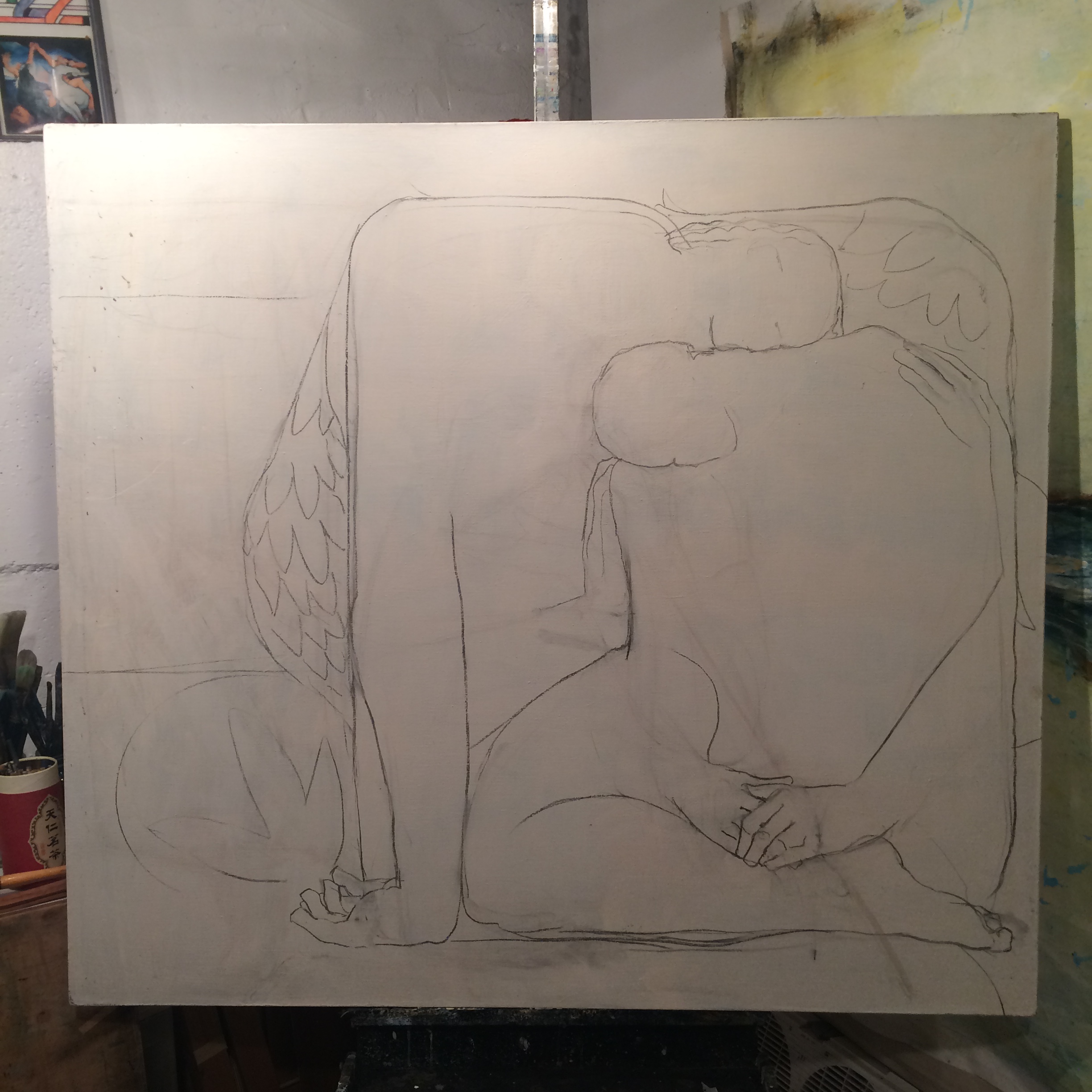
I made a third run at my Polynices & Eteocles painting. Brothers who kill each other over control of the kingdom. Reds and Blues. In the two previous attempts, the brotherly violence morphed into images of shared fatherhood. A quiet unity. On this, my third and last attempt, I grew bored with the image and the statement I wanted to make about these-un-united-united-states.

Kerri avoided my basement studio while the brothers, sketched in charcoal, were killing each other on canvas. With a few swipes of a rag and adjustments of line, the murderous brothers became an angel embracing a dejected soul. And, although Kerri was much happier passing through the studio en route to the laundry room with angels on the easel, I found that I was equally as bored with my feel-good statement as I was with my feel-bad statement. The rag cleared the offending charcoal angel.

I don’t want to make statements.

I know I am in an artistic growth phase when I find myself at cross-purposes. Sit still. Get busy. Get Quiet. Say something. The sitting still and the getting quiet are what’s really required. Germinate. Listen. The getting-busy and saying-something are puritanical overtones. Fear of…

A few years ago, Jonathan told us that a tree must split its bark in order to grow. It seems my bark is splitting.

Yesterday, while moving through my david-yoga practice, I had a wee-epiphany. Every yoga pose is a study of oppositions. The stretch, the balance, comes from oppositional reaching. Inner-space, flexibility, equilibrium are intentional contrast. Contrast need not be combative. I think I am out of balance.

Angels and dejected souls. Brothers warring for control. Combat and consolation. No wonder I’m bored. My statement-subjects are as dusty and old as humanity itself. I think the truth floating to the top in my silent sitting is that I have had too much of darkness. There is a lighter side to poetry and human nature.

I just might need to cross over and sit in the sun for a while.

read Kerri’s blog post about TWO PATHS

Survey And Sit Still [on KS Friday]

“What does it mean?” I asked.

“An abrupt slowing down,” she said, “Like screeching to a stop.” She paused and added, “Like our lives, right now.”

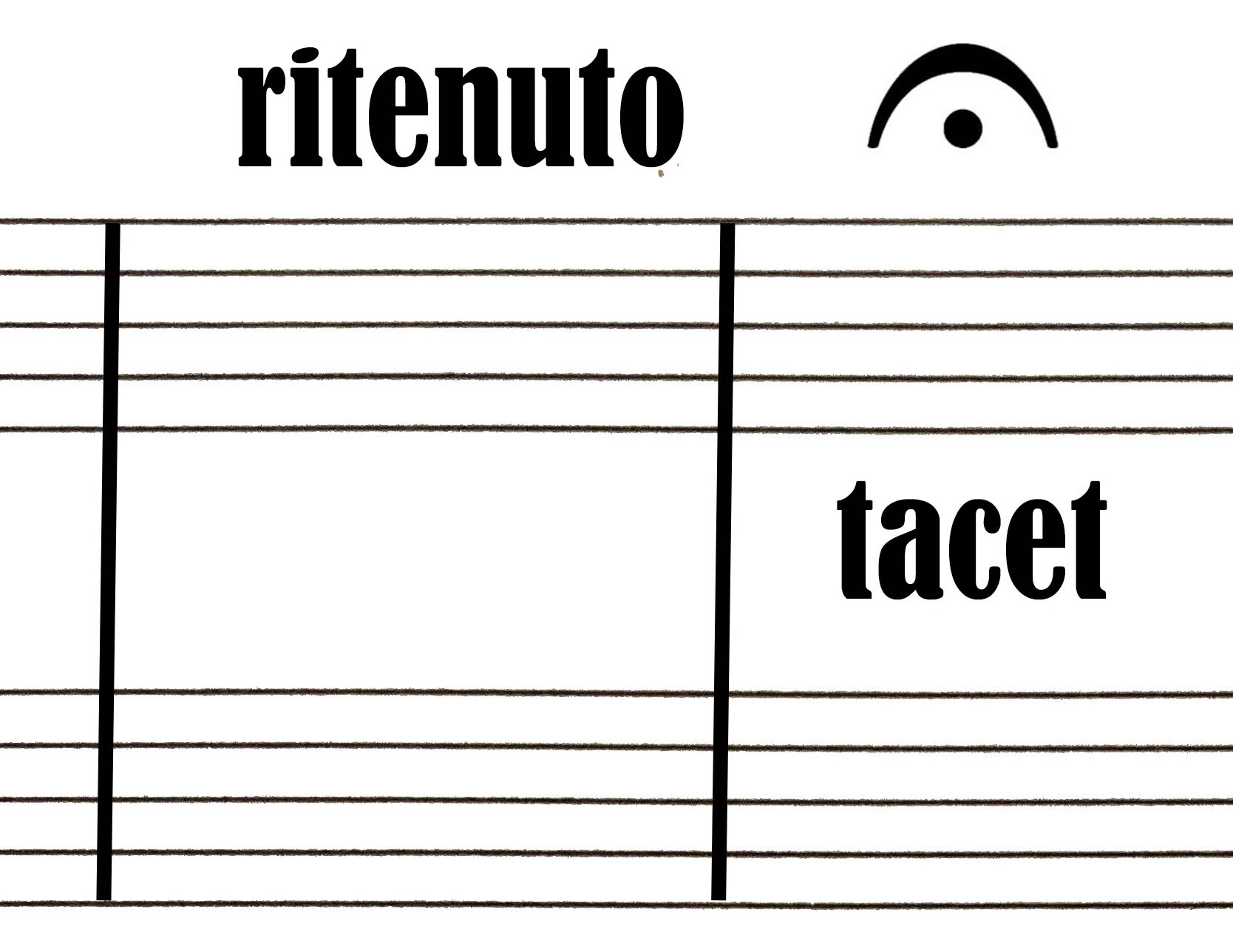
Ritenuto Tacet Fermata. Airbags deployed. No new bone breaks. Oh, wait. Not true. There was that recent slip-n-fall on the wet floor at work. There’s nothing like a pianist falling on an-already-broken wrist to punctuate the force of the full stop. And then, the job disappeared shortly thereafter. “The last job standing,” as she called it. “Don’t let the door hit you on the way out!’

Surveying the wreckage, smarting, she asked, “So what do we do now?”

“Nothing,” I replied. She is still in shock. I am at a loss. “Why don’t we do nothing for a few days.”

It feels as if we stopped – our bodies abruptly stopped – but our souls kept going. They do not have the same constraints as their fleshy cases. It feels like we need to wait for our souls to realize that there was an sudden stop. “We need our souls to come back to our bodies.” She looked at me through sideways eyes.

Silence.

“This year…” she said, before lapsing back into the silence. A few minutes later she began lightly tapping her foot. “Maybe I will write a cantata for a single voice,” her far-away stare already standing in front of the keys.

I looked the other way and smiled. “I think our souls are back.”

Out of wreckage, creativity. “I think that’s a great idea,” I said, trying not to be too enthusiastic. Her idea a tender shoot poking through the crust of her imagining. Exuberance might make it retreat.

Tacet. Silence. There is no rush from the wreckage. Silence and still-sitting is a first step, a necessary step. Take account of what remains. Let go of what flew away. And, emerging from the wreckage, out of the silence, as we know, new music arises.

read Kerri’s blog post about RITENUTO TACET FERMATA

Kerri’s albums are available on iTunes

Avoid The Box [on Not So Flawed Wednesday]

When I was in high school a significant teacher told me that I couldn’t do it all. I couldn’t paint AND be in the theatre AND write. She told me I had to choose. She told me I needed to focus. When she said the word ‘focus’ I felt like I would suffocate if I followed her advice.

One day, standing in the back of the theatre with Roger, I realized that I was bored. I needed to take my impulse to the theatre out of the building and off the stage. At the time I didn’t know what that might look like. My pals in the theatre rolled their eyes, made smallish assumptions, closed their doors to me. What I found, what I created, was thrilling. Profound.

The single consistent criticism from gallery folk of my paintings is that I am stylistically too broad. I’m all over the map. It’s true. More than once I’ve been told to come back when I know who I am. I’m not yet able to go back and, at this stage of my life, doubt that I will ever meet the criteria. I hope not.

I have made wrong turns and burned bridges. I have been my own worst enemy and my own best friend. I’ve broken things that ought not to have been broken. I’ve restored things to wholeness that others could not because I understand brokenness. I’ve run from opportunities. I’ve taken ridiculous risks. As MM asked, “What is it in you that makes you run at every edge and jump?” Fear of heights.

Makaela once told me that there was something feral in me. I thought of her the other day when I realized that DogDog was a perfect reflection of me: he can learn anything but WILL NOT walk on a leash. Try and constrain him in any way and he pulls, resists, and otherwise works to yank my arm out of the socket. I wonder how many arms I’ve yanked when I was approached with a leash? I know that once, a long time ago, I was a good teacher because I knew firsthand the power and necessity of removing constraints.

I’ve given away my best work, my best thinking. I have lived my way into utter irrelevance. The layers of the onion fall away. These days I feel more essence than substance. Pure ghost watching a world to which I have never belonged and rarely understood.

Horatio calls me a polymath to which I reply, “Back at you.” I dare anyone to try and track our conversations. The question in life that I have learned to hate the most is, “So, what do you do?”

I avoid boxes. And leashes. Apparently, that’s about the best I can do.

read Kerri’s blog post about DEFINE YOURSELF

Get To Work [on Two Artists Tuesday]

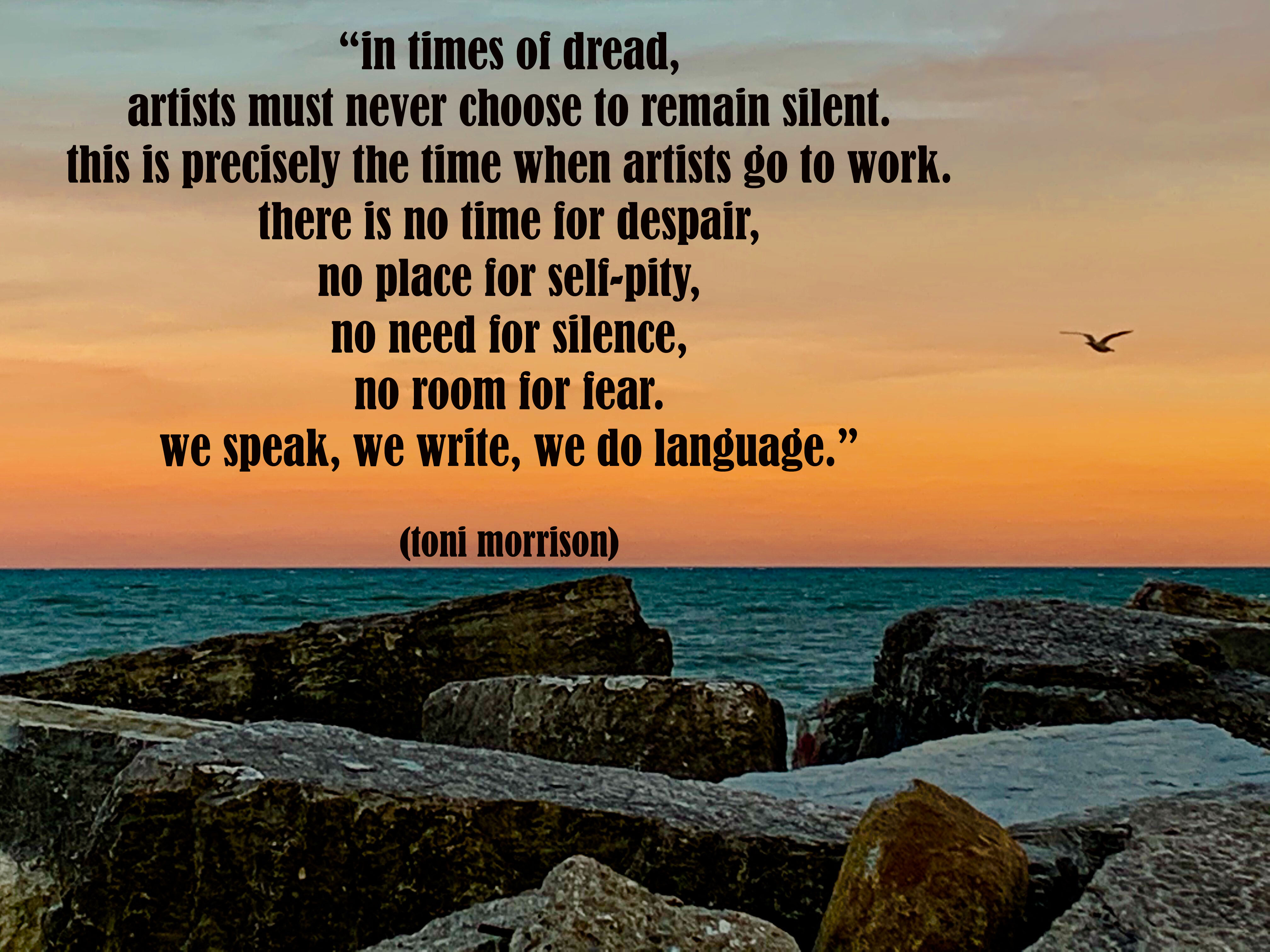
On page one of the despot’s handbook is this instruction: silence the artists. Mute the intellectuals. Authoritarians have power only when people become sheep. Silence in the face of abuse is tacit agreement. Permission to bully.

If I had a nickel for every time I’ve stood before a school board and explained that art is supposed to be powerful, that it plays a very important role in a healthy society, I’d have a lot of nickels. I was generally called to speak when a play or a painting upset the apple cart, when the art made the community confront a truth or look at a reality. Brecht’s Epic Theatre or the plays of Artaud were/are meant to shake the irrational in people, force them into discussion and revelation.

Art can be beautiful, poetry can soothe, but that is only one side of the coin. It can also shine a light and expose an ugly truth. It can give voice to what is not-being-spoken. It can work out problems on the stage instead of sending the violence into the streets. It can ask us to take a hard look at ourselves and our motives. Picasso’s large painting, Guernica, a response to horror wrought by fascists on the people of a town in Spain, is a powerful art-mirror.

The conscience of a community, like the conscience of every individual that comprises the community, lives beyond the superficial, it bubbles in the place beyond words. An artist’s job is to reach into that place, pull the veil for a moment, root or re-root the community in its values.

A despot’s job is to secure a unanimous vote, no questions asked. Sheep.

Art is not superficial. It is not the image or the words on the page. It is what the image, the words, the dance, the music, touch. Hearts. Souls. Conscience.

Without it, what remains is propaganda. Propaganda is never news, it is the opposite of art. It snuffs the question, it prevents the quest for meaning and deep-felt-truth. Without it, communities flatten, lose their center, wither, and fall apart. Silence, eyes downcast or sideways glancing. Permission to bully. Sheep.

It’s time for the artists to get to work.

read Kerri’s blog post about ARTISTS