Care To See [on Two Artists Tuesday]

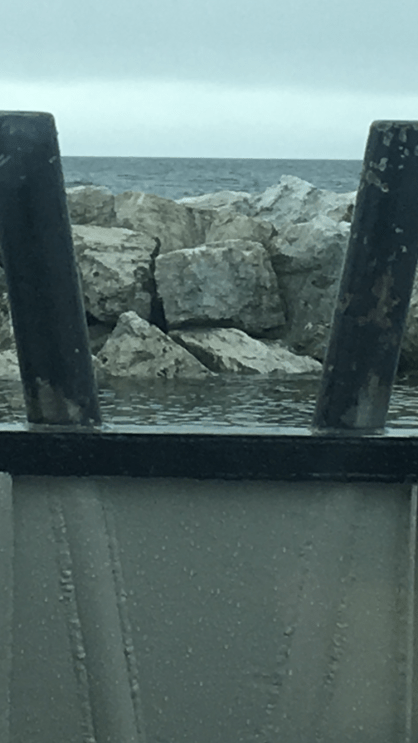
ferry copy

Georgia O’Keeffe was a master of the close-up. I imagine she would have loved this digital age, this era of easy photography. Walking the arroyos of New Mexico with her cell phone, snapping hundreds of photographs of the minutiae. Capturing the tiny beauty that we fast movers are too busy to see. I love that, before cameras were ubiquitous, Georgia was in the habit of walking slow. Looking closely. Seeing.

One evening in London my pal Robert took me to meet Jonathan Miller. We wiled away a long evening talking about art and theatre. Jonathan invited me upstairs to see his studio. He was preparing a series of his photographs for an exhibit and book.  They were an amazing collection of close-ups, textures of peeling paint, gritty brick, rotting fabric draped on walls. None of it was staged. Away on a directing assignment, he would walk the streets with his camera, looking for beauty in the overlooked everyday things. “It’s all around us,” he said, “we just don’t see it.”

It’s true. It takes a wee-bit of intention to be in this life and not run through it. Looking for beauty. It’s all around if we care to see it. Jonathan Miller’s advice: stand still. It is not necessary to seek it; it’s right here if you care to see it.


read Kerri’s blog post about the FERRY IMAGE


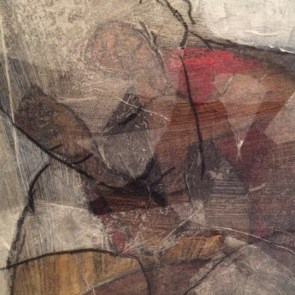
PAX morsel copy

a close up of ‘pax.’ looking closely. make an offer. pax needs a home


spring shadow website box copy


pax ©️ 2015 david robinson

Reach Back [on DR Thursday]

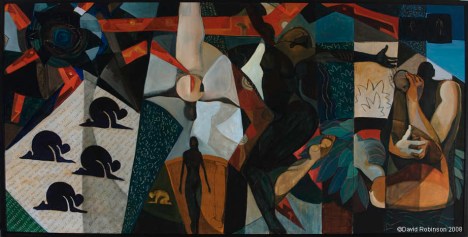
prometheus resurrection morsel copy

Artists are constantly reaching backward and forward through time. They daily pay visits to the work of the masters. They periodically revisit their own past creations. Their work sends ripples of inspiration and opportunity far into the future.

When Beethoven was young he wrote a ballet called The Creatures of Prometheus. It calls for a legion of dancers and is way too big for most contemporary ballet companies to attempt. Contemporary symphonies, on the other hand, desire to play the music because Beethoven, for the rest of his life, reached back into his ballet, mining for musical phrases, developing some of the phrases into his most famous work.

How to play the music from a ballet written in 1801 as a symphonic piece in 2009?

Yaacov Bergman, the visionary and laughter-filled director of the Portland Chamber Orchestra had an idea. Why not tell the story of the ballet. A storytelling would provide the connective tissue, weaving the music together into a cohesive symphonic performance. Because Beethoven wrote a ballet, 207 years later, I had the great good fortune to write and perform the story of The Creatures of Prometheus with the PCO.

And, since we were crossing time boundaries, why not cross a few artistic genres, too.  Yaki hired artist Liz Gil-Neilson to paint and produce a visual storytelling that was projected during the performance. Music, storytelling, contemporary visual art. Ripples, ripples, everywhere.

But, that was not enough. Since I am also a visual artist, Yaki asked that I translate my story into a visual statement. So, I painted three large canvases (Creation, Garden, Resurrection), one for each movement of the symphony, that hung with Liz’s original images during run of the symphony at the George Broderick Gallery in Portland.

Reaching forward. Reaching back. Today, more than a decade after our collaboration, I mine my experiences and paintings for inspiration. As new collaborations arise, as I stand at the base of a new series of seemingly impossible tasks, I’m fortunate to have my Creatures of Prometheus to remind me of the possibilities. They nudge me forward.  Like Beethoven, I reach back into my past work to find a path forward.

It makes me smile to know that in 1801 Beethoven, with a quill pen and ink, scribbled notes at his desk and those scribbles turned into dances and symphonies that inspired stories and paintings and a wacky multi-media collaboration (a phrase that did not exist during his lifetime). And more: a morsel image digitally altered for a blog post written on a computer keyboard. Pen and ink are hard to come by. Reaching backward. Reaching forward.


read Kerri’s blog post about Prometheus morsel


arches shadows k&d website box copy


prometheus resurrection ©️ 2008 david robinson

Bend It [on DR Thursday]

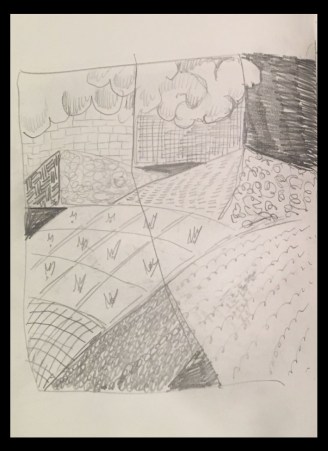
county sketch copy

The terminology in art reads like so much poetry. Zero point perspective. Chiaroscuro. Foreshortening. Rococo. Image plane. Vanishing point. Oblique projection. Intaglio. It goes on and on, these tasty and magical words.

They should be poetry. They describe fields of possibility. They attempt to codify the making of illusion or the impulse of an explorer. Bending space. Deconstructing and reconstituting. Perceptual distinctions. The visual language of cultural norms.

There has been for centuries a mathematics of art. Optics and relativity, movements in science that have their conjoined artistic twins. Rebellions. The maintenance of form. Rules and rule breakers.

I sat in on a class taught by a master artist. He was a lover of landscape (another yummy word) and taught his students an earth-shattering lesson: reality, like time, cannot be caught. It’s a fools errand to try. Painting is a conversation. It is an infinite game. Bend space. Move the tree. Color is fluid, moving, never fixed.  Be like color. Play. Discover. Transform.

I do not consider myself a landscape painter. And then I remember the master teacher and I remove the word ‘landscape’ from my vernacular. And then, suddenly, there is a universe of movement, color, light, and shapes to bend.


read Kerri’s blog post about a LANDSCAPE SKETCH


Newborn copy

newborn. deconstruction. reconstitution.


coffee cups in scion website box copy


newborn /landscape sketch ©️ 2019 david robinson


Admire Them [on Not So Flawed Wednesday]

barnacle tree 1 copy


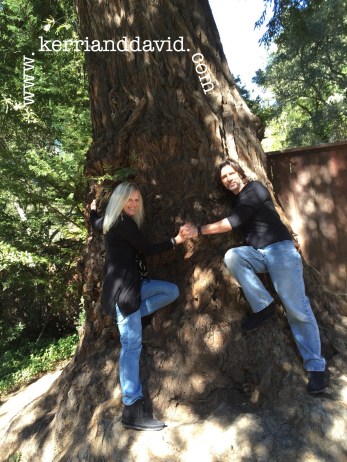
Andy Goldsworthy might have created this tree. The limbs pressing through burls, a tree grown sturdy and beautiful, made unique by its wounds.  It is a monument to resilience.

Tom, an educator the entirety of his life, told me that he was again and again astounded by the resilience he saw in children. They inspired him. Their hurt swirling into a burl,  giving them fuel to rise. Their struggles and fortitude driving their teacher to be better.

In the art gallery, the woodworker told us about his work. He lifted the bowls to show the unique grains, the live edges and imperfections. In every piece, the beauty was once a blemish.

There are many, many trees in our beloved Bristol Wood. Inevitably it is the burl trees, the oddities, that call us to stop for a visit and admire them.


read Kerri’s blog post about the BURL TREE


MayYou copy

may you: a painting/prayer spoken to life’s burls


alice's restaurant, california websitebox copy

may you ©️ 2014 david robinson

Study It [on DR Thursday]

Although this news will come as a blow to my ego, I am not a genius. My work is not opening new and exciting doors in the trajectory of western art. My boyhood fantasy of becoming the next Picasso has evolved into the happy reality of becoming the only…me. I love to paint. That is more than enough. Becoming, with no end in sight.

I rarely do studies or rough drafts. Only when a painting is giving me fits do I stop and study it. And, if I actually stop to do a study, the next step is to wipe the painting off the canvas. You might say that the act of doing a study is a warning to the elusive painting. “Last chance, dude.”

FACE THE SUN began as a study, a warning to CHASING BUBBLES. I was ready to wipe it away. In fact, I was cackling at the satisfaction a fresh start would bring. Kerri intervened. She has an uncanny sense for knowing when I am about to wipe away a painting. More than once, at the very moment my hand is reaching to annihilate the trouble-maker-painting, she rushes in to plead its case. I knit my brow. “You’re kidding, right?”

CHASING BUBBLES lived to see another day. Cleaning the studio, I saw the study that saved the painting. I liked it so I finished it and called it FACE THE SUN. Kerri came into the studio and said, “That painting makes my neck hurt.”

“What?! You’re kidding, right?”

She smiled her “gotcha” smile. Not only am I not the next Picasso but the painter that is becoming me is gullible. I am not a genius but I am an easy mark.


read Kerri’s blog post about FACE THE SUN


snapchat website box copy


face the sun/chasing bubbles ©️ 2019 david robinson


Use Your Magic Wisely [on DR Thursday]

Illustration 08 copy 2

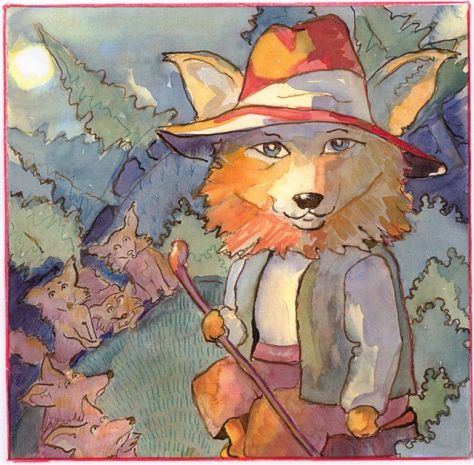
…and the wily old story fox told the pack, “Words are like magic, misused they are tragic…”

“Words are like magic, misused they are tragic, but handled with care they bring insight and good cheer. So listen, dear friends, listen with care.” ~ The Story Fox

I wrote and illustrated Lucy & The Waterfox in 2004, long before this common era of weaponized language use.

Declan Donnellan wrote that, “There will always be a gap between what we feel and our ability to express what we feel. The more we wish the gap to be smaller, the more we want to tell ‘the truth’, then the wider the perverse gap yawns.”

The more we need words, the less capable they are at expressing what we mean. That is the blessing and curse of language: it can never achieve the goal. It can only point us in a direction. The closer we step toward ‘the truth’, the less language can actually reach it. Which, if you think about it, requires us to keep reaching for it. Conversely, we can stand directly on a lie and say exactly what we mean. Dead air.

‘The truth’ is a verb. It is a moving, alive, relational thing.

Language is imprecise and, so, easily manipulated. Endlessly interpreted to fit an agenda. That is precisely why language requires respect and care in the handling. Words are more powerful than most people understand. They are capable of starting wars. They are capable of creating peace. They are capable of inciting division. They are capable of inviting unity.

When the ‘perverse gap yawns’, when words become the weapon of the small minded, it is incumbent upon us – all of us – to listen beyond the words, to recognize and acknowledge the agenda. It is incumbent upon us all to handle our powerful magic with care and use it wisely.

Waterfox coverLUCY & THE WATERFOX is a story for children and adults about believing, following your own path, the power of word


read Kerri’s blog post about LUCY


drc website header copy

chicken and perseverance website box copy


lucy & the waterfox ©️ 2004 david robinson

Chase The Bubbles [on DR Thursday]

morsel bubble chasers copy

Some paintings don’t make it to the finish line and I suspect that this painting, Chasing Bubbles, will be one of those. I’ve been working on and off with it for weeks and that’s the problem. I’m not paying enough consistent attention to the painting to actually develop it into something good. Like an absent father I return to it every once in a while and wonder why the relationship isn’t progressing.

The playwright John Guare said that writers need to write ten bad pages to get one good page. Remove failure from the equation. Place the emphasis on the process and not on the product. Experiment. Play. Make strong offers.

The same principle is the reason why actors rehearse or artists do drawing exercises and rough drafts. A photographer for National Geographic (whose name escapes me) said that he shoots a thousand shots to get one really good photograph.

For an artist, silly notions like perfection interrupt the necessity of flow.

Kerri just thumped me. She looked over my shoulder and read what I was writing. “I like this painting!” she declared. She wants a stay of execution. She rapidly listed all of the reasons why I shouldn’t paint over it. “At least consider it,” she said, glaring at me.

I will consider it. After all, that is exactly what I have been doing. Considering whether or not to keep working it or start anew. Trying to find a way, given my spotty attention, to bring life to this Frankenstein. In either case, I am certain of one thing: this bad page will eventually lead to something good.


IMG_4067

Chasing Bubbles in process or perhaps in its last hours (thump).

read Kerri’s blog post about CHASING BUBBLES


drc website header copy


cropped head kiss website copy

chasing bubbles (for better or worse) ©️ 2019 david robinson

Re-Member [on DR Thursday]

alki cropped copy

a morsel of ‘alki beach’

I was surprised. This was the first painting Horatio pulled from my stacks. It’s an older painting, a piece I’d forgotten.  “I like this one,” he said, and told me why.

Horatio is a great artist so it was a rare treat to rummage around the studio and talk about my work. I don’t often talk about it, not really. When showing paintings, people ask questions and I usually deflect the question back at them. It’s a rule. Artists often get in the way of the relationship between their painting and an observer. I want people to see what they see, not what I think they should see. There is no right answer or any one way of seeing a painting.  That’s the point; they have the power to re-create it for themselves. The magic is on the purity of the relationship. I’m more interested in their re-creation than I am in what I think they should see.

Horatio gave me a great gift. He helped me see ALKI BEACH anew. He helped me remember and in remembering I saw the painting again as if for the first time. It was like meeting an old friend after many years. Since Horatio’s visit I’ve had a chance to chat with ALKI BEACH over coffee. We reminisced about the day, the event that inspired it. I remember how the sun and air felt walking that day so long ago on Alki Beach. I remember sitting in my chair in my studio staring at a blank canvas. I remember the birds, the gulls and crows and eagles. I remember reaching for the charcoal.

I remember my surprise at what emerged on the canvas, the day I stepped back, paint on my face and hands, and saw ALKI BEACH for the first time. I remember thinking, “I like this one.”


read Kerri’s blog post about ALKI


rhode island website box copy


alki beach ©️ circa 2009, david robinson

Love The Mud [on Two Artists Tuesday]

maturity with background copy

“It took me four years to paint like Raphael, but a lifetime to paint like a child.” ~ Picasso

It would seem to be a no-brainer. Mastery comes from a lifetime of doing. Trial and error. Malcolm Gladwell’s 10,000 hours rule: success is nothing more than practicing the task for many hours over many years. As the old joke goes, it’s how you get to Carnegie Hall.

Efficiency. Ease. Body knowledge. Body of Knowledge. Flow. Wisdom. The blossoms of a long-body of experiences. The farmer, over a lifetime of living and working the same plot of land, knows the signs that no one else can see. They sense the storm coming. They smell the time for planting. They waste no time; their 10,000 hours having developed a solid relationship, a kinship with their environment and work.

An artist, over a lifetime of living and working the same plot of music or paint or dance, knows the signs that no one else can see. Artistry is efficiency, a single line saying more than 20. A musical phrase capable of reaching deeper into hearts than was once possible. Like the farmer, their 10,000 hours becomes 20,000 and then 30,000. Their worth, their work, after so many hours of hands in the soil or fingers on the keys, is incalculable.

Awash in abstractions, organizations play by a different set of understandings. Bottom lines are blind to mastery. You’d be amazed (or not) at how many people I know who’ve been “let go” because a younger, less expensive person, might “fill the role” and “cost less.” Mastery as deficit. You’d  be astounded (or not) at how many people I’ve coached who were punished because they became highly efficient. Their life-of-experience made their work look too easy. They were either squeezed for more or released as unnecessary.

What happens when all of the organizational knowledge, the ease and efficiency that comes via experience, becomes a liability? Wearing my consulting hat I’d routinely shake my head at the standard folly of leadership – people in power suits and ties a hundred miles from the dust and grit of the boots-on-the-ground – determining with pencil and paper the time and worth of a task. Abstracting the worth of a life. Budgetary efficiency driving the carefully calculated undervaluation of experience. Actual efficiency red-lined by abstract efficiency. As John would say, “Penny wise and pound foolish.”

Maturity in season of life. It comes from a job description that came across Kerri’s desk. Maturity as a job requirement! A search for someone with the experience necessary to paint like a child. Seeking the mastery that results from years and years of plowing the same fields.

I wonder if the hiring committee merely tossed out flowery language or actually understood that their ideal candidate would come through the door with boots made muddy from a lifetime of walking the fields?


read Kerri’s blog post about MATURITY IN SEASON OF LIFE


buffalo adirondack chair website box copy


Reflect On It [on KS Friday]

her palette - the piano copy

I so loved Kerri’s post yesterday that, today, I’m reflecting it back to her.

Do we ever really know what it takes to do someone else’s job? We don’t know the tools used, the research done, the years of training and experience, how someone perceives their own work. We can only guess and, most often, fall desperately, arrogantly, audaciously off the mark.

Kerri’s piano dominates her studio. A black 6’7″ Yamaha grand. It is not a show piece, it is a workhorse. Littering the music stand are stacks of composition notebooks, idea journals, sketches (she is visual) and pile after pile of church music – old hymnals, new downloads of pieces she’s considering for her ukulele band, choir or handbell choir. On the floor are several heavy binders arranged in alphabetical order with the music already played, binders from the 30 years of experience as a minister of music. There is yet another stack reserved for pieces she’s considering playing with Jim, her brilliant guitarist. Lining the walls are ukuleles, a few guitars, a cello, a keyboard, several music stands, more stacks of the original recordings of her albums (note: they are not stored as sacred artifacts. Rather, they are piled willy-nilly for easy reference). My wife is a Yamaha artist (look it up) and her constantly shifting studio topography (ever-moving piles) is testament to the music in her soul, her very-long history of artistry.

Now, I’ve sung a song or two in the shower. When I met Kerri I told her that I didn’t sing and she fairly quickly called my bluff. I sing in her choir. I delight in singing with her and Jim. They are kind and pretend that I add something to their mix. Nowadays I can even pick out a slow tune on the ukulele!

All of this, however, does not make me capable of really understanding how Kerri plays or composes. I can pluck a note. I can warble a song. I will, however, never have mastery of all the instruments, I will never approach her capacity to transpose on the fly, or compose poetry and melody. I will never hear the nuance she hears, the music of silence. I do not have a natural gift of music nor an entire lifetime to exercise and explore it.

I do not know the tricks of the trade she has accumulated over decades of honing her expertise. Nor do I know the knowledge base she brings about other artists, other musicians and compositions, the instrumentation, the way she ‘feels’ an audience and adjusts, the very technical details and the very heart-based intuitions she has learned through many, many years of study and practice. I can’t understand or even try to predict the amount of time it takes (or doesn’t take) for her to conceptualize, to explore, to create, to review, to assess, to adjust, to re-create. I can respond to her work but I cannot define it, nor would it be credible for me to even try to do so. Out of respect for her work, this ‘music’ that is one of the essential things that define her, I know that I really have no idea. I will never approach all that she knows. What I can do is appreciate the enormity of her talent, the endless hours of study, pursuit, practice, passion, experimentation, frustration, rehearsal, writing, performance, teaching, research, recording, pondering, pounding and playing and playing and playing – a lifetime of experience – that has brought her to this place where she creates beautiful music that seems to take no effort whatsoever.

Making it look easy. It takes a lifetime. The woman who delivers our mail has been a postal carrier for 30 years. It is hubris to think I know what that takes. It is utter arrogance to think I could pick up a mailbag and simply know what she knows, do what she does. Experience is invisible. Value is too easily reduced to dollars and cents. As Kerri wrote yesterday, with regard to anyone, the work they do, the life-path they bring to their work, we have no idea. It is both humbling and respectful to take a step back and consider the invisible, to remember that what appears easy comes from years and years of very hard work.


read Kerri’s blog post on KS FRIDAY


their palettes website box copy