What if? [David’s blog on DR Thursday]

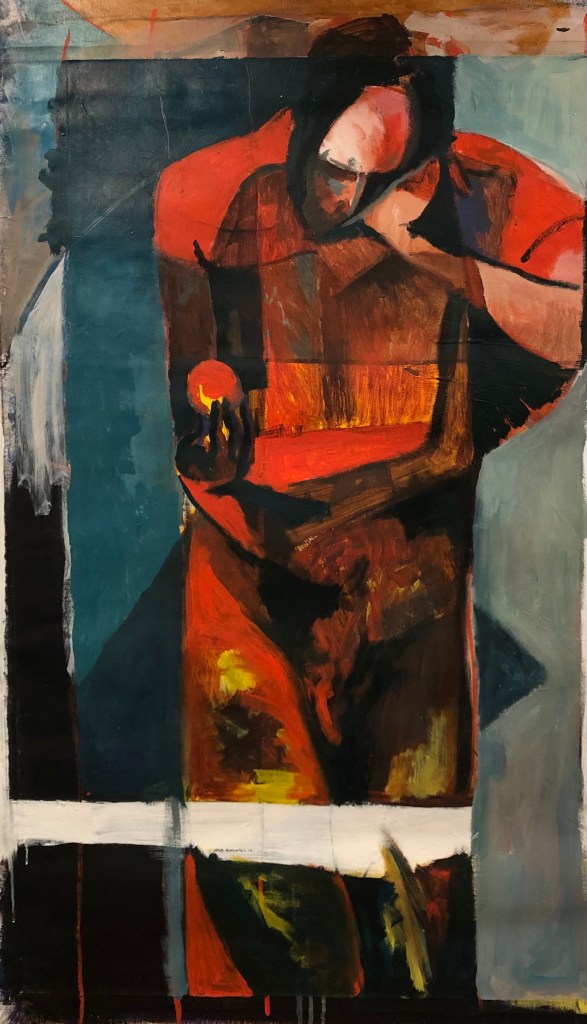
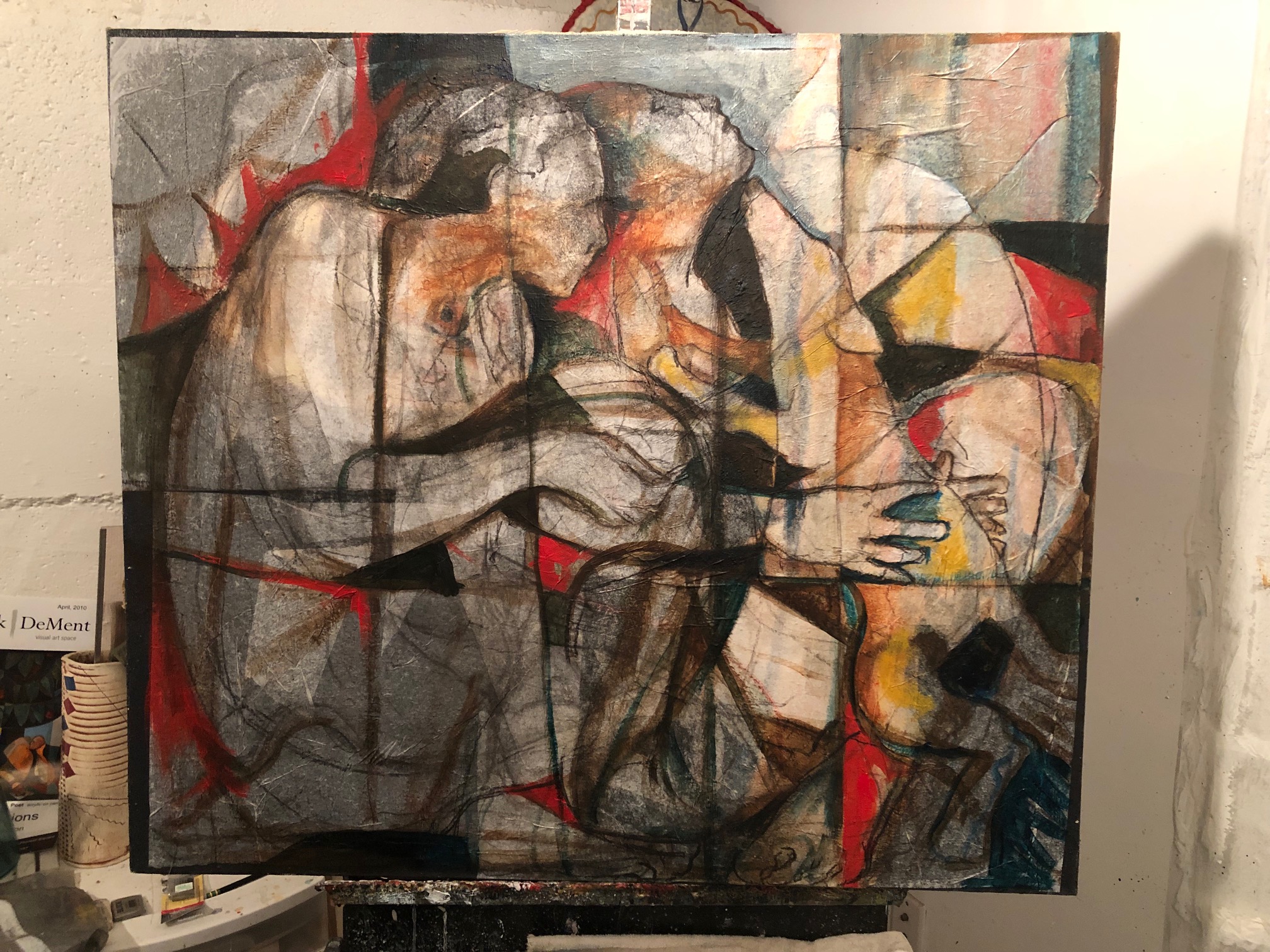
A few months ago Horatio told me that I needed to paint. Lately I’ve been mostly writing. He suggested that it would be good for me to get back into the visual part of my brain, the part that isn’t reliant on words. Horatio is wise. This morning I went down stairs and spent some time in the studio. As is usually the case, he was right.

Weeks ago I sketched a painting on a canvas. It’s been sitting on my easel. Waiting. For today.

It took a few minutes for me to let go. Standing and staring at the sketch, I felt locked up. I grabbed a small brush which is always a signal that I am thinking too hard. I was trying to “solve” the image through a linear sequential process. I put down my little brush, opened a jar of paint, and dunked my fingers in the jar, and began to spread the red paint just like I did when I was 5 years old. I used a rag to smear and pull and shade some of the globs. I reminded myself that I didn’t need to know where I was going. In fact, I needed to “not know” where I was going and dance with the image.

After a while I stopped thinking and started responding. I sighed a deep sigh of relief. I lost track of time. I felt a wave of spaciousness roll in to my too tight mind. Energy restoration.

Horatio must have seen it in me. My grief.

It’s a question of balance. I have lately of my artistry been asking the question, “Why?” As I roll into the next phase of life I am revisiting my roots. Why did I start doing this anyway? Why, as a child, did I paint through the night. If you’d have asked the child version of me the question “Why?” I’d have answered, “Because I have to.” There was no choice. There was no “Why?” There was a driving imperative. A siren call to “What if?”

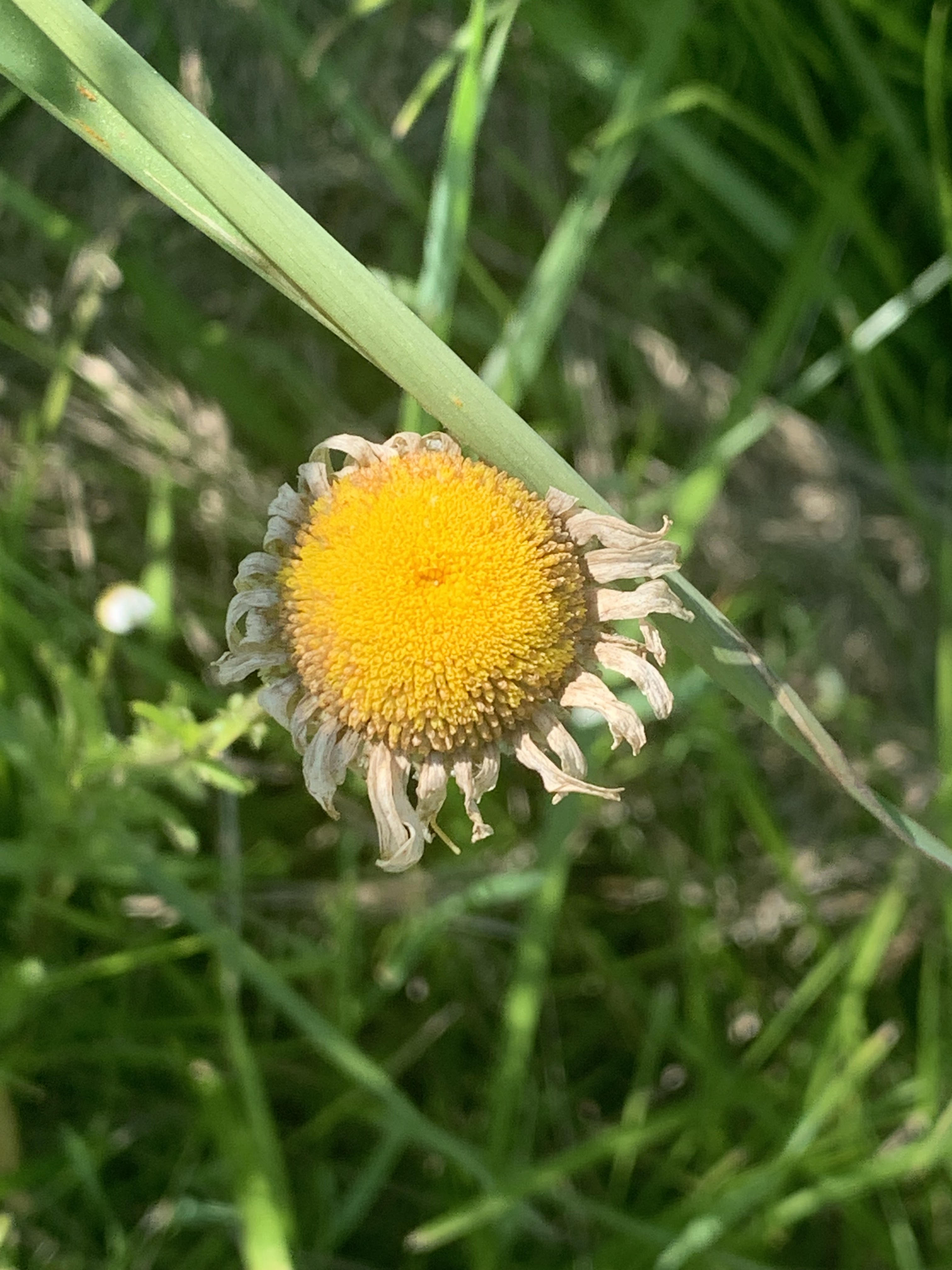
An aging Daisy. Kerri’s photograph brought to mind Tom Mck. He told me when he entered his sixties, he became invisible. He felt as if he was stepping into the prime of his creative years yet the people he’d mentored or directed or coached – the people whose careers he had informed, shaped and helped launch – the people he reached out to after retiring from his “real” job – no longer considered his artistry valid or valuable. They never told him that he was no longer viable in their eyes but he knew. They either didn’t return his calls or it was months later that he’d get a dodgy response to an inquiry or a question.

I am experiencing some of that.

Today in the studio I realized that I have been asking the wrong question. I already know why. Asking “why” is like picking up a little brush, it is to think too hard. The truth is that I’ve always known: Because I have to. The five year old version of me was not concerned with value and validity in the eyes of others. That version of me thought nothing of dipping his fingers into paint and swirling them across the page. Because it felt good. Because it felt right. This version of me – after I stopped thinking – knew just what to do. I “thought nothing” of opening the jar, dipping my fingers into the paint… What if?

My visibility or invisibility is, in fact, irrelevant. As Tom Mck drilled into me: A writer writes. A painter paints. The rest is simply out of my hands.

County Rainy Day. Underpainting the sketch with painty fingers

visit my gallery website

read Kerri’s blogpost about DANDELION

support. like. share. comment. subscribe. many thanks!

All The World [David’s blog on KS Friday]

When I was on the verge of realizing my dream of creating an experiential learning school/program, I kept a poster on my office wall – the alphabet in butterfly wings. It was a layer cake of reminders: Nothing is original. Mimicking nature is a really good idea. We project our meaning onto the world and are oriented into a world of projected meaning. In other words: it’s all made-up. So, make it up!

Teachers are meant to follow a student’s questions, not stuff them with a heavy diet of unattached answers. Create a container of hot pursuit and feed the curiosity. Someday they will create and hold their own container of hot pursuit, if they are lucky enough to survive the system. That thought is not original to me. Every great teacher who I’ve known has told me some version of my borrowed-assertion.

Some day, if you are fortunate enough to take a walk with Kerri, be prepared to stop. Often. “Lookit!” she gasps for the umpteenth time and aims her camera. Stepping off the trail, kneeling in the weeds, tipping her head back to capture the clouds, hovering above an intrepid caterpillar… Catching the miracle is one of her hot pursuits. “I won’t take any more,” she says and I smile, knowingly. My job is to hold the container.

“Lookit!” she said. We were in the lobby of the theatre. Her hot pursuit is also an indoor passion. All the world is her studio. “It’s the letter K!” she smiled. “In lights!” Before I could respond she stepped away, aiming her lens at the ceiling. “It’s so cool!”

From butterfly wings to lights on the ceiling.

It occurs to me (now) that creating or holding containers of hot pursuit is one of my hot pursuits. All the world…

The Box/Blueprint for my Soul © 1996 Kerri Sherwood

Kerri’s albums are available on iTunes and streaming on Pandora and iHeart Radio

read Kerri’s blogpost about K

like. share. comment. subscribe. support. many thanks.

Beyond Words [David’s blog on DR Thursday]

“Truth, like time itself, is a product of a conversation man has with himself about and through the techniques of communication he has invented.” ~ Neil Postman, Amusing Ourselves To Death

I’ve felt for months the need to apologize to J. We were having a conversation about truth – and notions of god – and in his current place-on-the-path he’s necessarily seeking absolutes. For him, relative truth smacks of falsehood or some loosey-goosey scary philosophy. He’s looking for a hard rock on which to build his house of wisdom. I was flip rather than helpful. How do you begin to discuss truth as a cultural orientation or a fluid marker that changes with time? When I was J’s age, truth could be established with a photograph. Not so anymore.

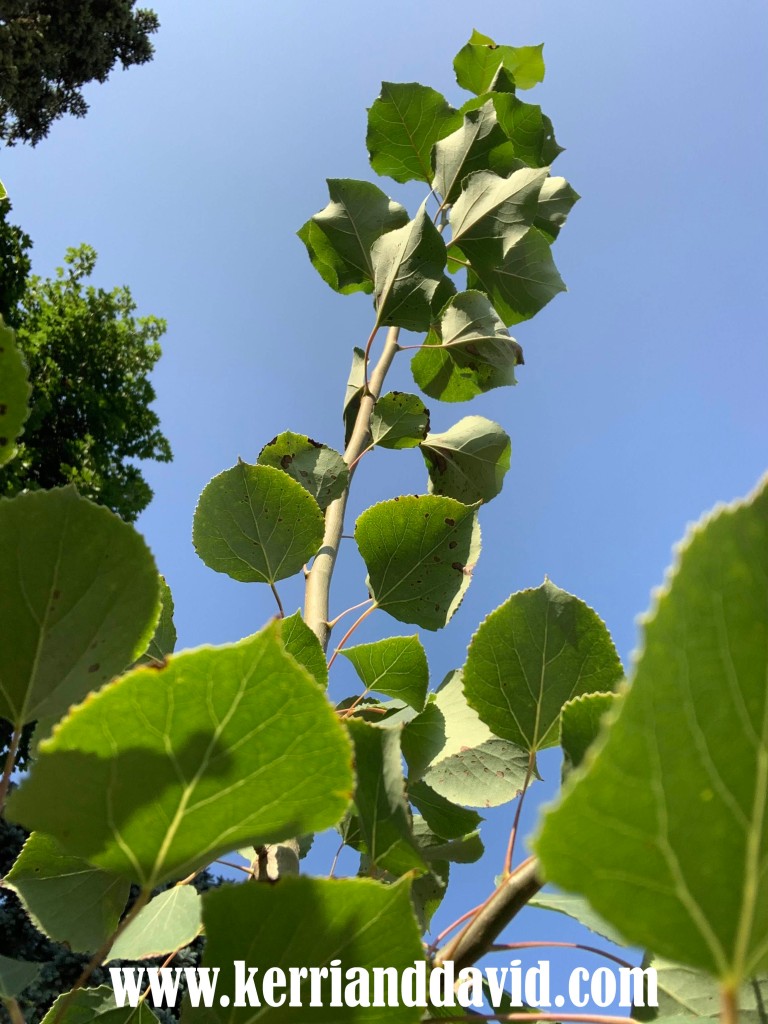
Breck, our little quaking aspen tree has come to represent a form of truth for me. Breck almost didn’t make it. We brought her home from the high mountains of Colorado and for a few years she lived and struggled in a big pot. She barely survived the first place we planted her. It was not a good location so we moved her to different soil where she’d enjoy more sun. And now she is flourishing. Last year she grew more than three feet taller.

Breck’s truth/health has very little to do with hard answers to abstract questions. For her – and me – truth is found in relationships; her environment. The right spot. Good soil. Rejuvenating sun. She brings an impulse to life: perseverance. Tenacity. Adaptability. We love her and I believe she “knows” that, too. Love is a truth that knows no absolute. I couldn’t explain that to J because I was playing with him, bringing levity to his seriousness.

And, in truth (what other word can I use?), I have become a doubter that any serious conversation about truth or gods can happen through something so limited as language. That’s what I should have expressed to J. I should have taken him outside to see the stars.

Now, when I want to have those conversations with myself, when I am seeking a better question, I walk on the trail next to the river. I turn my face to the sun. I try to detach myself from the clocks and lists and tv debates. I look at Breck quaking in the wind. I await each spring for the buds to appear on her limbs. There’s truth-beyond-words in her life-cycle, the return of her leaves and her captivating shimmer dance with the breezes.

read Kerri’s blogpost about BRECK

share. like. subscribe. comment. support. thanks!

A Sculpture Worth Making [David’s blog on Two Artists Tuesday]

The question floated across my screen, something I’d asked a group many years ago. I don’t remember the moment so it was a blast from the past of a former me: apparently I asked, “What if no one else has your answers?”

The timing was interesting since I am currently without answers. Well, more accurately – more honestly – I’m standing still surveying the wreckage.

I appreciated my blast from the past because now, at this point in my life-journey, were I working with a group, I’d flip the equation and ask, “What if no one else has your questions?” I’m no longer a big believer in answers.

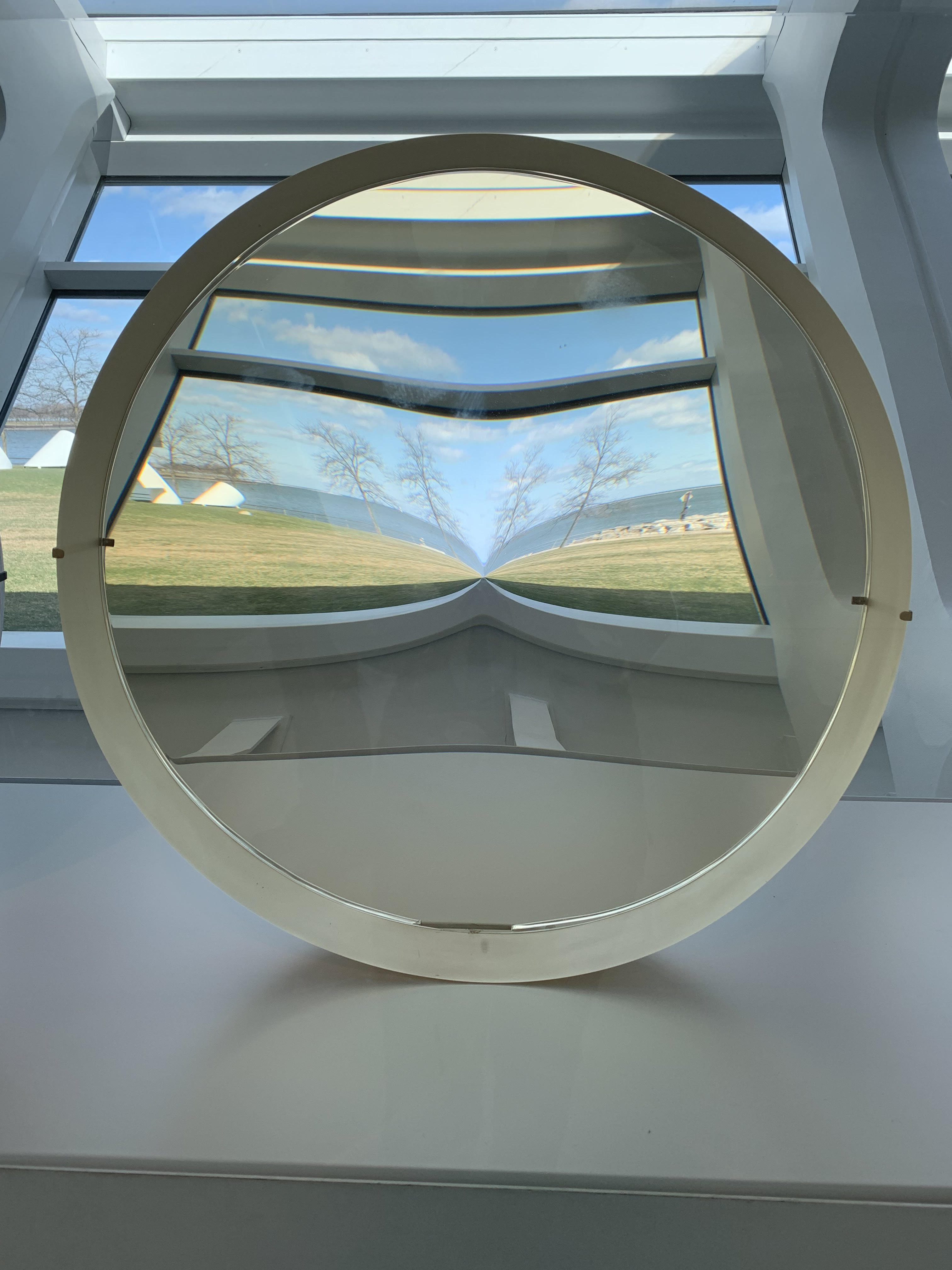
We stopped in the long hallway leading to the contemporary art collection to admire the lens. I didn’t note the title or the name of the artist so I cannot give credit where credit is due. I’ve looked at the piece before but never with the same appreciation. Never from this moment in time. It was suddenly, intensely relevant. All points bend toward a common center. A point of view that generates circles. A single intersection.

“It’s an ego,” I thought. It believes it’s the center of everything that’s happening. It made me laugh. It brought to mind the ubiquitous lesson from Quinn: “There are six billion people on this planet and you are the only one that cares what you think.” Or feel. Or see.

No one else has your questions. No one else has your answers.

Standing before the sculpture I imagined flipping the script and reversing the circle: what would it look like to genuinely care what other people think. Or feel. Or see. With no need to understand it or change it or control it. Only care about it. About them. There’s a common center available in that paradigm, too.

Now, how do I make that lens? That’s a question worth asking, a sculpture worth making.

read Kerri’s blogpost about THE LENS

subscribe. support. share. like. comment. many thanks.

Chase A Ghost [David’s blog on Merely A Thought Monday]

The question came in through our site from a man who was instrumental in Kerri’s decision to record her compositions. A voice from her past asking a good question.

There are many surface answers to his question. In our case, all would be applicable: to give voice to our thoughts, to build a community, to call attention to our work…This morning, as I ponder his question, I think the purpose of a blog, my blog, might be to chase ghosts.

I began blogging utterly convinced that I had very little of value to say. I’d never considered myself to be a writer. It was a challenge I set for myself. Actually, I had one thing to say and decided I would, every day, attempt to write about it until I ran out of gas. I calculated that the tank would run dry in less than seven days. I was chasing the elusive ghost known as voice. My voice.

The interesting thing about ghost-chasing is that it makes you pay attention to everything. Ghosts can come at you in an instant from any direction and disappear just as quickly. Sometimes you can’t see them at all but feel intensely their icy presence. That was the first thing I learned in my voice-ghost-pursuit: I was paying careful attention, inside and out. It was not intense, not a strain or a struggle. I didn’t have to try. It was natural.

Not surprisingly, paying attention gave me more and more to write about, more to reflect upon. More to offer. “Have you seen this? Do you understand it?”

Chasing ghosts is a great question stimulator. Ghosts are curious and require all manner of suspension of disbelief so they are also terrific curiosity-energizers. Among the first line of questioning is about your self: your perceptions, your beliefs, your ideas of who you are and who you are not. It’s nearly impossible to write about others without exposing your self. Voice chasing leads to an astounding realization: the self/other boundary is permeable. We come to know ourselves relative to how well we know others. We only know our voice because someone out-there is listening and, hopefully, giving voice in return. Contrast principle.

Our basement is unusual in that it has box-after-box of unsold CD’s – the hard evidence of the music industry making a quick pivot to streaming services. The stacks of my unsold paintings take up an entire room. Our filing cabinets are filled with ideas and manuscripts and songs-not-yet-recorded. There are folios of cartoons that didn’t quite make it to syndication, folios of ink gestures, watercolors, and sketches. Another kind of ghost: the work of years past. When we met and married, we began blogging together, originally to try and call attention to the voice-of-work-past-but-not-yet-sold. That ghost, a very sad ghost, quickly left us; the joy of writing together each day overcame the initial intention.

The joy of writing together. We no longer chase the ghost of voice. It was here all along (of course). Now-a-days, we pursue a much simpler spirit: the gift of paying attention, the pure surprise of what shows up when we dive into and write about our daily prompt. “You go first,” I say, since she is wiggling with excitement to read what she just wrote.

read Kerri’s blog about WHAT IS A BLOG?

like. share. support. comment (give voice). we thank you for any and all.

buymeacoffee is lending your voice in support of our voice so we can lend our voice to your voice. It’s a circle.

Gain Some Perspective [David’s blog on Not So Flawed Wednesday]

If you’ve not yet bumped into Piet Mondrian’s paintings of trees, this is your chance. Not only are the paintings beautiful but if you’ve ever scratched your head at his more famous abstract/geometric paintings, you will find the forest through his trees. Things are not always what they seem and, in the era of contemporary art, it is necessary to grok the context in order to fully appreciate the content. Of course, that rule also applies in this age of info-tsunami: content rushing across the screen is regularly embraced whole-cloth – sans context – so truth and lie have equal standing.

In the art world, placing content (an individual painting) into context (the historic era, the long-body-exploration of the artist’s work, the source of the exploration) is called “gaining perspective”. Because things are not always what they seem, it is drilled into every artist to regularly stand back, to clear their eyes, to get perspective on their work-in-progress. It is also (or used to be) drilled-in to offer the same courtesy to the work of other artists. Stand back from snap judgments. Check the sources. Understand the exploration. Grasp the historical context. It is never as simple as “liking” or “not liking”; appreciation opens a vast color palette beyond the numbing mindset of thumbs-up or down.

Gaining perspective and learning are the same thing. The most well-educated people I know are not lawyers or doctors. They are actors, directors, dancers, and painters. Gaining perspective takes a lifelong dedication to questioning and researching and double-checking. It is to peek behind the curtain of popular and not get caught in the current reality spin. It is to know that things are not what they seem. It is to know that reactions are easy answers; questions take time. Gaining perspective takes time.

Sometimes she stops so quickly that it propels me forward a few stumbling steps. While I tumbled forward she knelt at a puddle and aimed her camera at a leaf. Or so I thought. I have learned (daily) that she sees things that I do not. I have learned that my assumptions are almost always wrong. She smiled when she stood up. “Look,” she said.

I gasped. I was terrifically wrong. The leaf was nowhere in sight. The reflection of trees in a puddle on the asphalt trail. A festival of texture. A masterpiece of illusion. Piet Mondrian must have knelt at a puddle reflection just like this! “Trees through an icy window,” I said.

Things are rarely – if ever – what they seem.

read Kerri’s blogpost about THE TREES

share it. like it. support it. comment on it. research it. question it. doubt it. grok it.

buymeacoffee is exactly what you make of it.

Find Out [David’s blog on Two Artists Tuesday]

Google “iridescent tree bark” – or any question variation – and the top hits will be Marigold Carnival Tree Bark Glass. Second place on the list will be rainbow eucalyptus. Both are interesting but neither is helpful in our pursuit. This mystery tree is in a park on the shore of Lake Michigan. The bark on the east facing side is moist and shimmers with green, blue and purple. Why?

Google can be a very strict although paradoxical schoolmarm, often requiring exact language for inquiries yet always returning ranked probabilities. Web crawling in the blink of an eye. The art of the question meets a never ending popularity contest. It works most of the time. Sometimes it produces an amazing clown car of results. Today I learned a smidge about Marigold Carnival Tree Bark Glass. And who knew a eucalyptus tree could produce such vibrant color! I’ll be more mindful the next time I’m tempted to say, “That color does not occur in nature.” It turns out that all colors occur in nature. Even puce, the hands-down-winner for worst name of a color.

I gave up the search but Kerri is a dog-with-a-bone when she has a question. After lengthy sleuthing (“lengthy” in 2023 terms. In 1980, her search would have taken weeks but in 2023 she scored a find in less than 30 minutes) she found (drumroll…): blue-green crust fungus! Amaurodon (I’m tempted to insert crack social commentary into this scintillating post about the ease of information-finding in the age of dedicated information-denying but I’ll exercise extreme restraint and stay on my subject). Now, what exactly was my point?

More than once the glistening color has stopped our walks. We stand close and squint our eyes. We stand back and ponder. We take photographs and discuss outrageous possibilities for the surprising color shimmering on the lake side of the tree. We hold hands and I thank the stars for walking through life with someone who entertains as many unanswered questions as I do. I believe it is why we feel young even though our joints sometimes ache. Unbridled curiosity. Delight at running our fingers through paint. The utterance of a common phrase: I don’t know but let’s find out.

In case you’re wondering: I value the clown car of results almost as much as I do an instant-on-the-spot Google return. “There are more things in heaven and earth, Horatio, than are dreamt of in [my] philosophy” (Hamlet. Act 1, scene 5). It invites the second-most-common-curiosity-utterance in our household: now what the heck is this?

read Kerri’s blog post about AMAURODON

share if you dare. like if you like. support if you support. comment if you have something to add.

buymeacoffee is an alien life form attempting to hypnotize you into the outrageous assertion that artists have an insatiable thirst for coffee and it is your life mission to quench their thirst.

Follow The Marker [David’s blog on Not So Flawed Wednesday]

An ode to markers on the trail:

Popcorn is for a safe return. Remembrance. Home is this way.

Cairns are a gift to those who come next. Courtesy. This is the way through.

Blazes are systemic. Reassurance. You are on the correct path.

Signs are for sorting. Guidance. This is a crossroad of choices.

Companions are for amity. Togetherness. A living marker. The journey is best when shared.

“We’ve sorted a lot of life on this trail,” she said.

It’s a loop. We usually walk it twice around. Sometimes we’ll reverse direction and make a third pass. Loops are good for untangling knotty questions. We rarely come to certain conclusions, almost never leave with answers. We metaphorically set markers on our life trail so we know if we are in unknown territory or have been this way before. “Do you remember when…”

Remembrance. Courtesy. Reassurance. Guidance. Togetherness.

“What do you think we should do?”

“I don’t know. Let’s walk another loop.”

read Kerri’s blogpost about MARKERS

comment. if you want to. or share it. or like it. or not. support it. or not. all are appreciated. by us.

buymeacoffee is a like a marker on the trail, similar to a cairn, a sign to-left-to-you-left-by-us so we might both find our way through.

Aim The Magic Lens [David’s blog on KS Friday]

“That men do not learn the lessons of history is the most important of all the lessons of history.” ~Aldous Huxley

You may be as amazed as I to learn that Dogwood is not Doll’s Eye. They have a similar creepy Seussian stare but are not kin. In this brave new world, all we need do is aim Google Lens at the question, “What is that?” and, voila! An answer!

I delight that I am living in the time of easy access to information. I could not write as I do without instant access to synonym and antonym, the lighting fast check-of-fact or spelling, the interesting variations-on-a-theme that pop up the minute I jump down a thought-rabbit-hole. Technology has made it possible for me to be a writer. Were I confined to pen and paper my output would be minimal and certainly impossible to read.

Easy information means easy misinformation. It means easy mass-misinformation. If I were the wizard of the universe I’d provide everyone with a Google Lens for information. All we’d need do is aim our magic lens at a pundit, news-bit or politician and, voila!” Accurate or Absurd or somewhere in between! It would make it fairly impossible to toss a lie into the commons and get away with it.

It’s not that I am enamored of just-the-facts. I’m not. I write stories so I prize a good dose of imagination. But in our time, knowing the difference – or caring about the difference – between fact and fantasy – is tantamount.

One of the great challenges of our brave new world is the intentional passing of fantasy for fact. For instance, Florida. If you are a student of history you’ll recognize in Florida (and, now, sadly, other states) the resurrection of the Lost Cause narrative, a history bending education initiative driven hard by the Daughters of the Confederacy at the conclusion of the Civil War. White supremacy sweeping its dark-side under the rug. Lipstick on a history pig.

I’m capable of imagining that my magic Google Info-Lens would put a stop to the cycle of non-sense but it’s starting to dawn on me that Aldous Huxley had it right: at this moment in history, we have the capacity to check every story, to look up every assertion, to scrutinize every source. It may not be as lightning fast as my imagined Lens but it’s close. We simply choose not to use it. It’s so much easier to believe without question than it is to question a belief.

“Huxley feared the truth would be drown in a sea of irrelevance.” Well.

Today on the trail I learned in a nanosecond that a Dogwood is different from a Doll’s Eye. I know it is possible to assert that slavery was on-the-job-training but it takes a dedicated-head-in-the-sand – and a heart full of ugly intention- to drown the truth of history in a sea of utter non-sense.

No lessons learned. No questions asked. Oops. Here we go again.

I Will Hold You (Forever and Ever)/And Goodnight, a lullaby album © 2005 Kerri Sherwood

Kerri’s albums are available on iTunes and streaming on Pandora and iHeart Radio

read Kerri’s blogpost about Dogwood

what you can do: like it. share it. comment on it. support it. we truly appreciate it.

buymeacoffee is a donation “tip jar” where you can support the continued work of the artists you value.

Name It [on Merely A Thought Monday]

The artist, Joe, had us write our names again and again until the lines lost their meaning, until we realized the lines were…lines. And shapes. Until we realized that our names were drawings. Unique and easy. His message? Everyone draws. And, more importantly though less obvious, the lines do not carry the meaning, the person infuses the line with meaning.

Visiting a pal in the hospital, I watched a heart monitor. More lines. Pattern. Waves. Visual indications of the drumbeat of the body. The drumbeat of the body propels the rhythm of the poet’s pen. Iambic pentameter. Short, loooong. Short, loooong. The poet’s lines reach through time and space, heart-meaning yearning to pulse through another person, to perhaps synchronize with their heart-wave pattern. Centuries may have passed between the inky scribbles from the poet’s pen to the person absorbing the meaning into their beating heart. Time travel. Ancient heart touches the living. “When to the sessions of sweet silent thought/ I summon up remembrance of things past…”

Watch a child learning to “write” their alphabet. Assigning meaning to shape. Crayon fist making lines. The refined adults see the shaky line as crude. Cute. Titanic imagination squeezes itself into alphabetic parameter. The little hand becomes a giver of meaning to shape and line. Expression. Learning to combine the limited shapes for greater and greater complexity. The conundrum: among the first lines we learn to scrawl are our names yet these few lines carry a question that can never be answered. Who am I?

The artist, Joe, had us dash off our names again and again until the lines seemed nothing more than a doodle. The meaning is not found in the lines; the lines and shapes merely point the way to the question.

read Kerri’s blogpost about THE CONTRAIL LINE

share or like or buyusacoffee.com. better than all, let us know you are out there.