What Of Kindness? [David’s blog on Flawed Wednesday]

Kindness is not difficult to share within a friend-group or inner-circle. Kindness is easy with the people that you know. It’s the reason I’ve never met a person that did not consider themself kind. It’s the reason I consider myself kind. I can point to examples.

But what of kindness to those outside of the circle-of-the-known?

Lately I wonder if we can consider ourselves kind when our kindness is reserved; selective; picky.

This morning I read of a farmer who voted for the despot. He is astonished. With the sudden loss of USAID, the elimination of his market, he is losing his family farm. My first thought was not compassionate. My first thought was not kind. “You’re the only one who’s surprised,” I spat. “Idiot”.

What of kindness?

The farmer has been the recipient of government subsidies. He has had FEMA support after natural disasters. He is a veteran with benefits. His parents are on social security and Medicare. He has friends receiving Medicaid. Now, he fears the loss of these programs. Before the election he wore his red hat, pumped his fist and voted for the end of government handouts. He saw no reason to support childcare for single mothers so they might go to work. He did not see himself as a receiver-of-help.

He didn’t want his taxes benefiting those who do not look like him. Those outside of his circle.

For years the farmer has been misled by the fox. And yet, I can’t help but acknowledge that he has participated in his ignorance. He could have asked a question. He could have changed the channel. The despot made no attempt to hide his plan. He was not a stealth candidate. Did the farmer not understand the word “tariff”? Did he not read Project 2025 and the cuts it promised? He lives in the age of readily available and easily accessed information.

Was he too lazy to care? Was he truly blinded by a campaign of foxy-lies? He’s certainly been steeped in an ugly boogeyman of US and THEM. He’s been choked on fear-tales, encouraged to paint himself as a victim of diversity-equity-inclusion. Might he have challenged what he was being force-fed? Yes. But he didn’t. He agreed with it.

Now, he will pay the piper for his choice. We all will. He voted for it. He chose it. Now he will experience it.

What of kindness?

As he discovers his folly, as he meets the stark truth of his choice, does he really deserve to lose his family farm?

What of taking responsibility for the consequences of his choices and actions? He voted for hatred. He voted for indecency and amorality. He voted for misogyny and bigotry. It was not hidden from him. He posted signs on his fence proclaiming his proud allegiance to the despot.

Now, he and his family must rely on the social safety net that he has demonized as socialist. He voted for the safety net to be removed. Now that he needs it he has changed his tune. Soon, he fears, there will be nothing to break his fall.

Hopefully, he will learn – as will we all – that THEM is US. Before we are conservative or progressive, we are citizens of this nation. Together. WE. And we are a diverse community.

Friendly. Generous. Considerate. Descriptors of kindness. Perhaps, through his revelation, when he understands he is – and has been – the recipient of kindness, when helping hands (again) reach and assist him to stand, to survive, he will be more willing and able to extend kindness to others, to people who do not look like him.

Perhaps he will understand that a government is capable of helping all people to rise just as it is now crippling the majority for the sake of a few.

Perhaps in the future he will vote for kindness and equity that extends beyond his inner-circle. Kindness, he will learn, is a crop that is planted and cultivated. To reap the harvest, to experience it, one must first vote for it. One must first choose it. And then pass it on.

read Kerri’s blogpost about KINDNESS

likesharecommentsupportsubscribebekind…thankyou.

Bitter Sweet [David’s blog on saturday morning smack-dab]

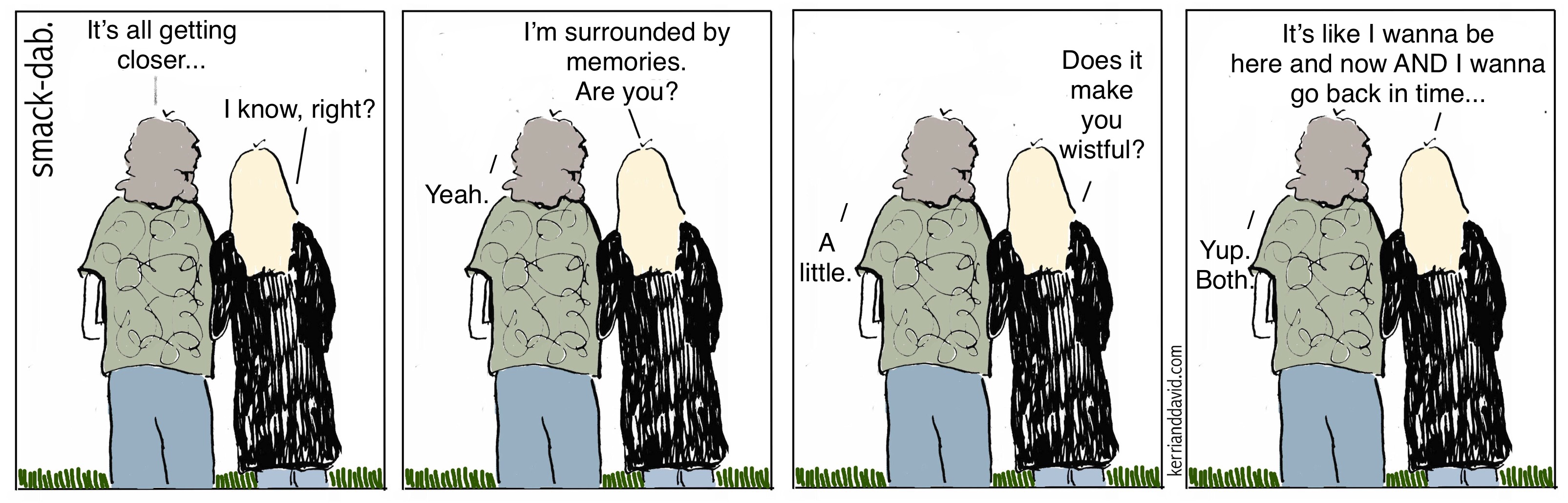
And isn’t that the point of a tradition? To connect the memories of the past to the celebration of today in order to pass them into the future? As Jean Houston once wrote: we are the burning point of the ancestral ship. In our ritual we honor the ancestors en route to joining them.

Conservation and progress need not be at odds.

Today is the Solstice. I just read that the Latin origin of the word “solstice” is “the sun stands still”. “This is because the sun’s apparent movement north or south stops before changing direction.”

In this moment, all of us, regardless of religious tradition or to which date we assign the light’s return, in lighting our candles, making our meals, singing our songs…we stand still with the sun. Just for a moment, in the pause between far and near, we acknowledge that we are the connective tissue between yesterday and tomorrow, bearers of the ritual, missing those we no longer see yet grateful beyond words for those we hug, hold close, and send into the future with leftovers from the feast. Bitter sweet.

read Kerri’s blogpost about BOTH/AND

smack-dab © 2024 kerrianddavid.com

likesharesupportcommentsubscribe…thank you.

I Wonder [David’s blog on KS Friday]

“We can disagree and still love each other unless your disagreement is rooted in my oppression and denial of my humanity and right to exist.” ~ James Baldwin

Our Melange posts generally begin with a visual prompt, usually one of Kerri’s recent photographs. Today, for the first time in our Melange history, she offered me a quote. The photograph, the stone heart, came second.

My dad used to tell me that I’d educated myself into stupidity. He was, of course, regurgitating the sentiments of his fox-news source; those were not his words or his thoughts. He was an educated man, early in his life a schoolteacher, yet his entire life he yearned to return to the simple life he remembered, growing up in a small town in Iowa. His yearning was sincere and pervasive. He was kind to his core and generous to everyone he met. He had no idea what to do with the complexity of the contemporary world and so he found solace in rejecting it.

One of my cherished memories of my dad was the day we spent in the cemetery of his small town. He was far down the road of dementia and wanted to visit his beloved small town one last time. I was taken aback that he had no desire to wander the streets but wanted, instead, to wander through the graves – so that is what we did. He’d point to a headstone and tell me the story of the person buried there. To him it wasn’t a graveyard, it was a reunion. He could not remember what he ate for breakfast but he remembered in vivid detail the people that populated his young life, the names on the headstones.

My dad worked most of his life as a foreman of a concrete construction company. His crews were mostly illegal immigrants. For a few summers I worked on his crew and I have never been more proud of him – or learned more from him – than I did watching his dedication to the men who worked for him. He understood their plight, he valued their hard thankless work, and they were as loyal to him as he was to them.

I can only imagine what he would think of the rhetoric of mass deportation, the radical dehumanization of the men he spent his life working with, the racist lies. I wonder if his yearning for simplicity would cloud his perspective or would he recognize the ugly authoritarianism masked in the maga mass-deception.

He was, at his core, kind. Generous. I cannot imagine he would sign on to the oppression and denial of basic humanity that runs rampant through the maga rhetoric. And, since I am “woke”, a progressive, a man dedicated to learning and asking questions, a believer in open minds and hearts, I am now one of the vermin populating the fox-maga-storyline. I doubt he would sign on to that.

I wonder, if we were sitting on the patio drinking a beer, if he’d question, as I do, how his rural America, his imagined simplicity, became so ugly, so lost in the rantings of a fascist. So un-American.

I wonder if he, from his resting place in the graveyard, wishes now for a better story for his small town, for all small towns – the story of generosity and kindness he remembered as hallmarks of the people who populated his early years, the people and narrative who shaped him, his goodness, his life.

Legacy from the album Released From The Heart © 1995 Kerri Sherwood

Kerri’s albums are available on iTunes and streaming on Pandora

read Kerri’s blogpost about OPPRESSION

like. share. support. comment. subscribe…thank you.

Stroll With Alexander [David’s blog on DR Thursday]

20 knew we needed a get-away. He suggested a stroll through Milwaukee’s Third Ward. Knowing it was our favorite, he offered to treat us to a bowl of gumbo and a glass of wine at The Public Market. It was a successful temptation. We chose a beautiful day and drove into the city.

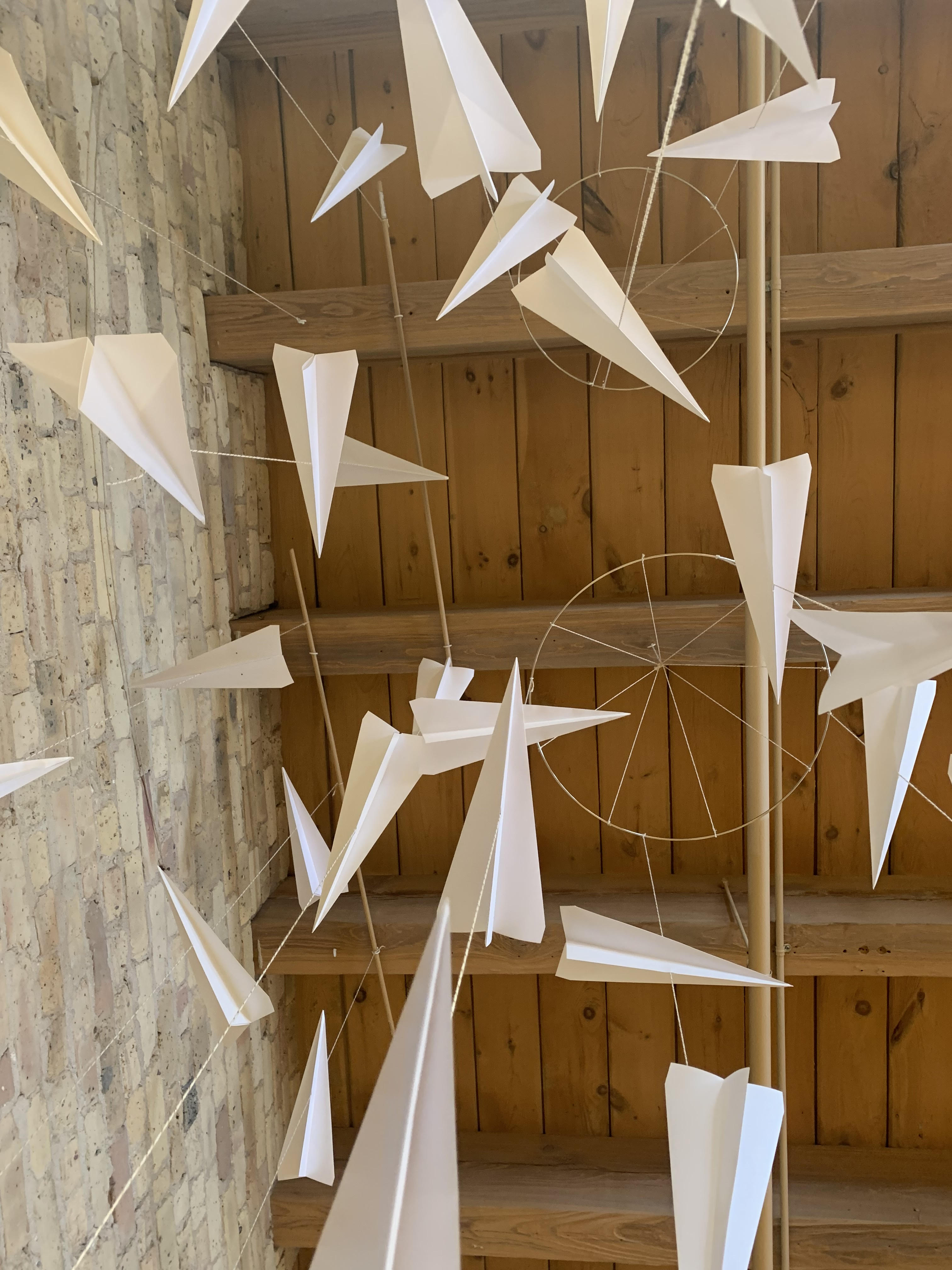
Among the many gifts that day as we strolled in and out of shops was the very present spirit of Alexander Calder. Almost every shop we entered featured a mobile or some variation of sculpture suspended from the ceiling. Paper planes, vibrant lemons in tidy lines like a Sunny-Roman-legion on parade, colorful shapes and orbs delicately balanced and dancing in the air, casting shadows. All paying homage to the art work of Calder. My bet is that few of the shopkeepers knew the origin, the ancestry of their twirling displays.

Calder’s mobiles were radical when he made them. He changed our understanding of sculpture and opened a new world of possibilities. Nearly 50 years after his death, his innovation is commonplace. Incorporation into the norm is the hallmark of profound innovation. Computers are ubiquitous but when they first hit the scene they were revolutionary. Electric light, the telephone, automobiles, televisions, cameras, elevators, air conditioning…They change us. They change our expectation.

So, too, the work of artists. The Impressionists shocked and appalled their contemporaries when they initially showed their paintings. They did not know that they were Impressionists. They were reacting to the latest innovation-of-their-day known as the camera – a device that could easily record reality, important events, make portraits of royals… the job of painters – so they either had to explore new avenues of painting or become irrelevant. To our eyes, 150 years later, their work is anything but progressive or shocking. It is everywhere.

Artist not only change what we see, they change how we see. They challenge us to see what we do not yet see.

A-I is currently stirring our dust and is already being incorporated into the daily grind. The pace of change compresses the distance between the moment of profundity and incorporation into the everyday. The realities of the pace-of-change are, like the camera, changing the nature of what it means to make art.

It’s good to remind ourselves that it hasn’t always been this way. What’s twirling over my head is clever and is the ripple of a revolution. It’s why I loved my stroll with Alexander Calder through the Third Ward. 20 didn’t know it, but he gave me so much more than a getaway, a bowl of gumbo and a glass of wine.

a page from an old sketchbook

visit my gallery site

read Kerri’s blog about MOBILES

support. like. share. subscribe. comment…thank you.

Invite The Bacon [David’s blog on Merely A Thought Monday]

Of course, the problem with leaving well enough alone is that the phrase only pops up when things are not well enough. When change is on the horizon, when a hidden truth is about to breach the crusty surface, when the globe spins and a new insight dawns, it is a sure bet that the keepers of the conservative will bellow, “Leave well enough alone!”

Call it creative tension. The space between progress and conservation is a taut rubber band. Both poles serving a necessary purpose, neither is trustworthy when absent the other pole. So, phrases like, “Leave well enough alone” are signal flags, signs that the tension on the band is high and the snap forward is inevitable. Pulling back always signals an impending forward step. Always.

I’m particularly fond of this image. A tomato slice demanding inaction. And won’t this crabby tomato be surprised in a day or two to see the icky green results of inactivity! Better to invite the bacon, lettuce and toasty bread to the plate, a bit of salt and pepper, and get on with the business of yummy sustenance. Progress by any other name.

read Kerri’s blogpost about LEAVE WELL ENOUGH ALONE

like. share. support. comment. resist. leap. stand very still. all are appreciated.

buymeacoffee is a progressive impulse meeting a conservative over-reaction causing deep distress that can only be cured by an action in the direction of intention to make a better world for the tomatoes that envision it.

Sun Dry [on DR Thursday]

“…people find what they are looking for. If you’re looking for beauty, you’ll find beauty. If you’re looking for conspiracies, you’ll find conspiracies. It’s all a matter of setting your mental channel.” ~ Roger von Oech, A Whack On The Side Of The Head

Our time on Washington Island was multi-layered. Half of the people on the island saw us as invaders. The other half saw us as welcome progress. We were hired to manage the performing arts center which, out of the chute, served as a divisive symbol for the local community. We were the first “non-islanders” to manage the TPAC. Division upon division. And, although we were the focal point of the contention, none of it had to do with us, not really. Our status as invader or progress originated in the eye of the beholder.

Because the actual job was a festival of landmines, I especially appreciated the simplicity – and sanctuary -of our little house, a home provided to us for the summer-on-island-months. Our refuge sat on the shore of Lake Michigan. It was as peaceful as the job was contentious.

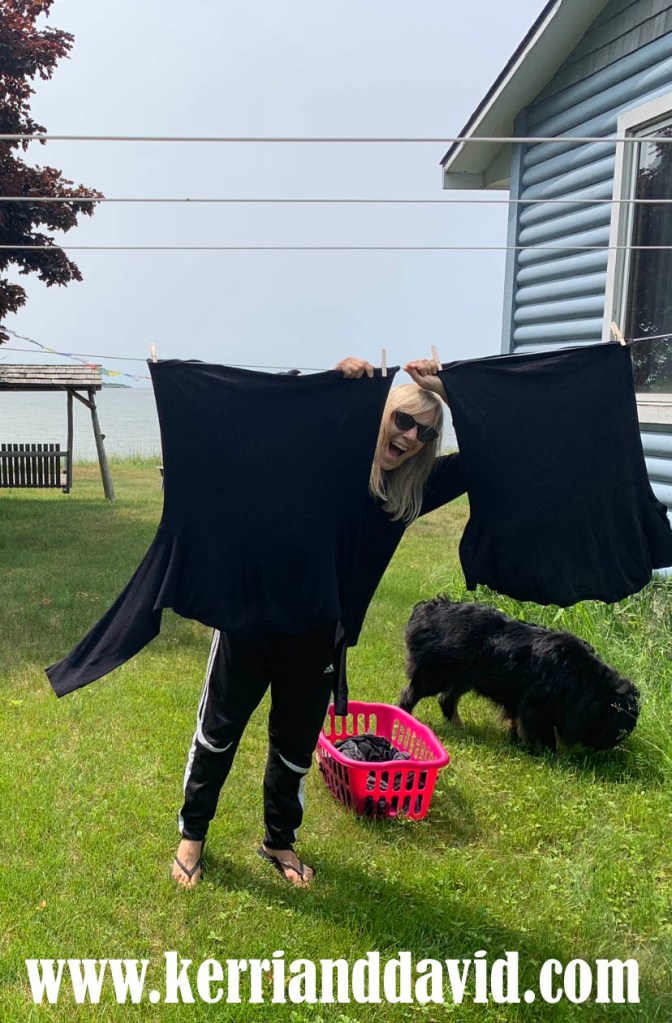
My favorite symbolic act at the little house was hanging the clothes to dry. When we arrived the clothesline was in disrepair. We re-strung the poles with new line purchased at the local hardware store. We quickly grew accustomed to carrying the wet clothes outside. We learned that the wind off the lake sometimes required strategy to what-is-pinned-in-front-of-what. Double clothespins on sheets and shirts was always a good idea. Mostly, I appreciated how the clothesline slowed our pace. It brought us into the sun and in relationship with the wind. The real stuff.

It helped set our mental channel. Hands on, tactile, slow-paced, generous, the power and presence of the lake filled us with awe. So, to our work, we brought awe. Literally. We were in awe of these people that cared so much for their community. Like most communities, they had more than one idea of how to protect it. Progress or conservation.

We understood that these two paths-to-the-same-goal need not be oppositional.

We learned that our job was to build bridges where they had fallen. We understood that, in this divided community, we had to pay attention to what-is-pinned-in-front-of-what. We learned that double pins on big ideas was sometimes a good idea because ideas often generated big wind. Listening was the best idea of all. We understood that if we brought our awe to both sides of the coin, we might one day build a single bridge that could not be burned.

We learned that there was no rushing the process, just as there is no way to rush the clothes drying on the line.

a day at the beach, mixed media, 38x52IN © 2017

my site. yes. as yet incomplete. a testament of continued indecision of my purpose and intention.

read Kerri’s blogpost about the CLOTHESLINE

like. share. comment. support. many thanks for all.

Scribble With Purpose [on DR Thursday]

Henri Matisse said, “Creativity takes courage.” I suppose that is true when considering the enormous pressures to conform to a style or standard. To create what is acceptable or expected. To suss-out what will be rewarded with approval and/or profit. In this context, it takes enormous courage to deviate. To explore. To surprise yourself by breaking form and risking ridicule and rejection and poverty. In this context, it takes courage to show up. It takes courage to punch through.

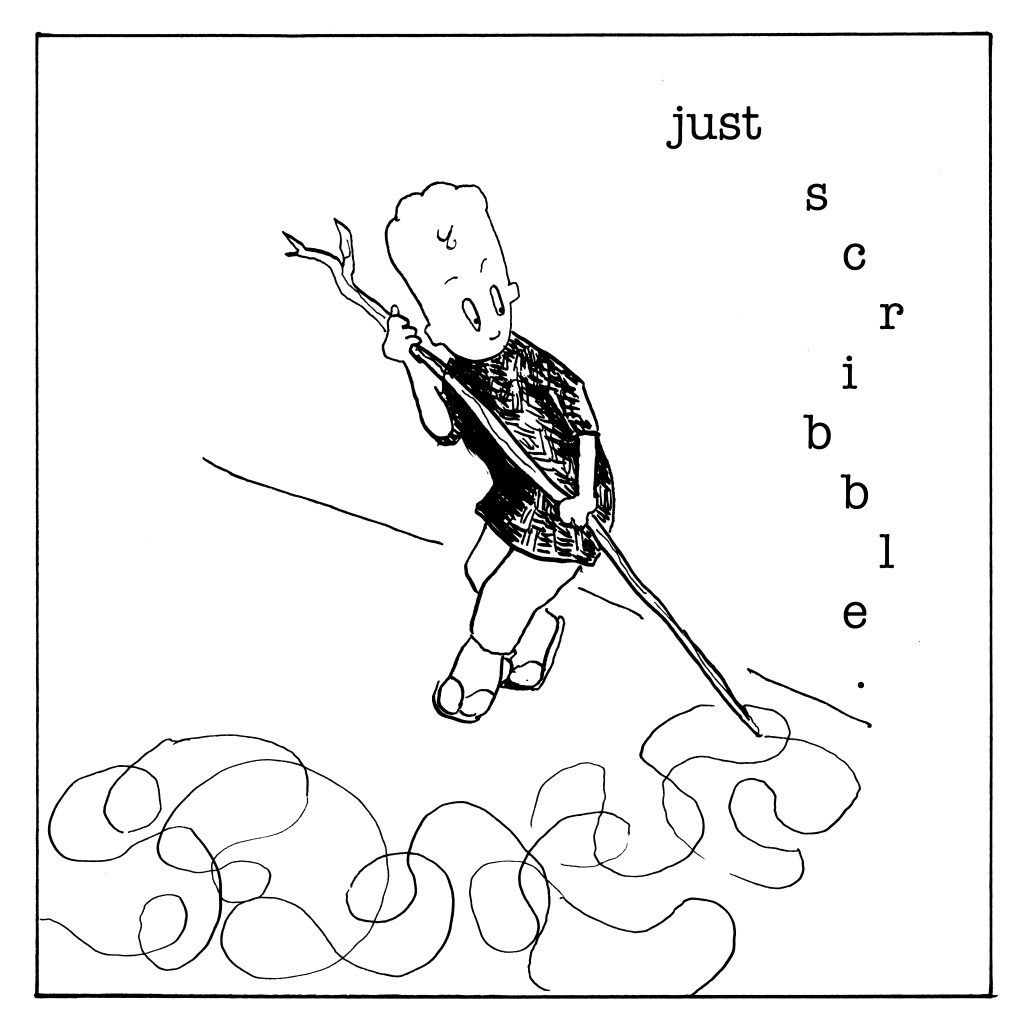
On the other hand, creativity is the most natural thing in the world. Ask any child. On second thought, please don’t ask any child since it will only confuse them. They have no idea that creativity – to an adult – is a separate thing. What’s scary and vulnerable to the tall people is commonplace to the little critters. There’s help for the older folks: allow the child-inside to scribble with abandon. Recognize that the story of, “I’m not creative,” is a creative act. The story of “It’s scary to create,” is also a creative act. It’s a story.

Creativity runs like wild horses through every day of our lives. Our perceptions and interpretations and fears are pure storytelling. The real challenge is not the absence of creativity but the conscious appreciation of our rampant creativity. The squeeze to conform serves as a heavy curtain obscuring our vibrant expressiveness.

The courage that Henri Matisse references is borne of the tension between the desire to be appreciated (to fit in, to succeed) and the yearning to break new trail or sail into undiscovered lands. To risk. To intentionally and publicly scribble outside the lines. To say aloud what needs saying.

Creativity is the most natural thing in the world. As it turns out, so is conformity. We are, after all, like wolves: animals that run in a pack. Humans die in isolation so serving the will of the group is a high priority. The wrestling match between creativity and conformity is necessary.

The progressive impulse. The conservative impulse. A bowstring drawn taut between these two poles provides the necessary tension to send the arrow of our ideas and dreams sailing toward the distant target. Children scribble with abandon. Grown up children, those telling themselves the story of “I’m a creator,” learn to scribble with purpose.

read Kerri’s blogpost about PUNCHING THROUGH

shared fatherhood, 25.5X40.5IN, mixed media on panel

shared fatherhood 2 © 2017 david robinson

chicken marsala/just scribble © 2016 kerri sherwood & david robinson

Spin Off Center [on Merely A Thought Monday]

not too chicken copy

I’ve always been a bit mystified by the hyper-charge surrounding the word ‘change.’ It doesn’t matter which way the word slices, it will either evoke great fear and trepidation [we’ve always done it this way!] or it will reach to the deepest depths of yearning and impatience [we need to be different!]. Guard the bastion. Explore new worlds.

Organizations try to manage change. Yet, organizations sell their products as cutting edge. They promote themselves as leaders of change.

We celebrate change-makers. Game changers. We also honor the keepers of the flame. Rule keepers. We pride ourselves on our innovative spirit while pondering the loss of tradition.

Creative tension. Push, pull. It’s a balancing act, yes? A continuum. Where exactly is the hard line between progress and tradition?

Stepping into the unknown is never easy though, isn’t it true that each day of life is, in fact, a step into the unknown? The wheel spins on and on and on.

Growing old is not for wimps. That’s what Beaky said. We all do it. Movement is life and life is change.

We live in an interesting time. Everything is recorded. Evidence of change is everywhere. Actors get old. Politicians vehemently defend the opposite of what they vehemently defended 20 years ago.

The question is not about change or not change.  It is more about what we desire to be  steadfast in the midst of change. Circumstances change. Opinions change. Beliefs change. Traditions change. But, what is in the center of the wheel? Values like ‘honesty’ and ‘truth?’ Agreements of decency? A constitution?

What happens when those hubs are manipulated and simply fall away?


read Kerri’s blog post about CHANGE


snowsteps website box copy