Each Other’s Destiny [David’s blog on Not So Flawed Wednesday]

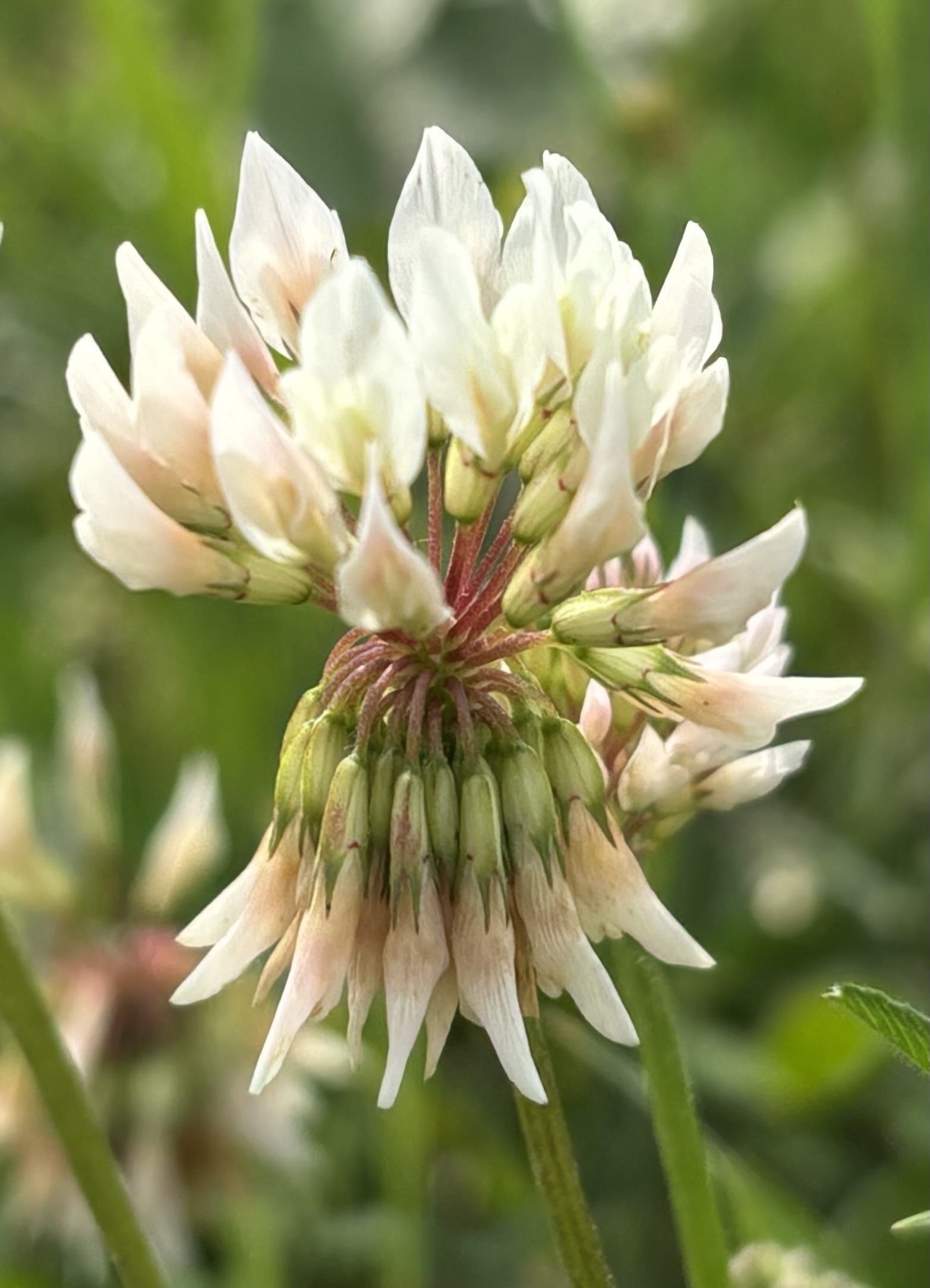
This tiny white clover flower, no bigger than my fingernail, is an entire universe unto itself. It is a miracle of pattern, designed to attract pollinators. Although I am certain is doesn’t waste a moment of its existence pondering its purpose, it serves as a nutrient to soil and through its vast root system it prevents erosion.

When I write that it is an entire universe unto itself what I really mean is that it is intimately connected to everything. Although we have given it a name and dissected it to the last atom, it does not know itself as separate from the sun that feeds it or the bees and mammals that feed on it. It serves and is served. Both/And. That is the nature of the entire universe. We have words for it: interconnection, flow, movement, relationship.

Words separate this from that. That’s the whole point of a word: to make distinct. To make distinct for us and for our purposes. And, because we think our thoughts in words we can’t help but think of ourselves as separate, distinct. In our word-infused minds we lose contact with the connection. Is it no wonder that we spend much of our time pondering our purpose? Having blunted the experience of interconnection is it no wonder that we story ourselves above it all?

That we name things has given us the illusion that we are higher beings, better than the white clover flower. Hubris is most often the cause of civilization’s collapse. Our capacity to name things comes with a matching capacity to deny – that is to lie and lie until we lie to ourselves. We are both the spider and the fly entangled in the web.

Leave it to a poet to capture in two sentences what I have not captured in paragraphs:

“The farthest star and the mud at our feet are a family; and there is no decency or sense in honoring one thing, or a few things, and then closing the list. The pine tree, the leopard, the Platte River, and ourselves – we are at risk together, or we are on our way to a sustainable world together. We are each other’s destiny.” ~ Mary Oliver, Upstream, Selected Essays.

***

we are trying to regroup, rethink and refocus our melange blogpost writing a bit. we – like you – know what is really happening in our world and do not need one more person – including ourselves – telling us the details of this saddest of descents destroying democracy and humanity. though we know our effort will not be 100% – for there is sooo much to bemoan in these everydays – we have decided to try and lean into another way – to instead write about WHAT ELSE IS REAL. this will not negate negativity, but we hope that it will help prescribe presence as antidote and balm for our collective weariness. ~ xoxo kerri & david

read Kerri’s blogpost about WHITE CLOVER

likesharesupportcomment…thankyou

My Fleeting Moment [David’s blog on Merely A Thought Monday]

Alone on the trail we heard a loud pop and then a crack – and then the tree fell. We felt the thud through the soles of our feet.

There was no wind. There was no apparent cause for it to fall. We were, somehow, witness to its final moment as “tree”.

If a tree falls in the woods and someone is around to hear it, it definitely makes a sound. If not? For some reason, in that majestic moment, the quotidian philosophical question popped into my mind and it bothered me. Is human observation really the only validation for existence? Philosopher George Berkeley wrote, “To be is to be perceived.” George didn’t mean perceived by squirrels or hawks or any other critter in the woods at that moment who also heard the sound and felt the fall of the old tree. For humans, philosophers, preachers and politicians alike, human perception is the requirement granting something so grand, something so profound, as existence. How many birds nested in this grand old tree during the course of its life span? How many plants will feed on its fibers now that it has joined the earth?

Hubris is our Achilles Heel.

On our drive to the trail we were rerouted. The road was shutdown in both directions. There was a terrible crash. A car was cleaved, barely recognizable. Certainly there were witnesses to this loud final moment of a human-being pass into non-being. I’m grateful I was not one of them. I do not need to have seen or heard the crash to know that it happened.

Perhaps that is why the question bothered me: “If a tree falls in the woods and no one is around to hear it, does it make a sound?” In a single day, in the space of an hour, I was witness to a tree falling in the woods and aware of a human life ending. I heard the tree so I have no need to imagine what happened. I saw the car, the evidence of the end of human life. I can only imagine.

Horatio wrote a beautiful poem about the death of a salmon after its struggle to return to its place of origin. It’s a poem about the impossibility of life and the cycle of constant renewal. The poem offers we-the-perceivers some rare perspective on the end of life.

I wondered how I could read the days news about starvation in Gaza, brutal raids and deportations without due process…and simply turn the page. That, too, must be uniquely human. To perceive and then tune out. To look the other way, to pretend not to perceive when human beings enact horror upon other human beings. It requires a dedicated lack of imagination.

We are not above it all.

“To be is to be perceived.” Perhaps. It begs an all important follow-up question: In my fleeting moment of human perception, who – or how – do I choose to be?

read Kerri’s blogpost about TINY NAILS

likesharecommentsubscribesupport…thankyou.

Steep! [David’s blog on Not So Flawed Wednesday]

“The beginning of love is the will to let those we love be perfectly themselves, the resolution not to twist them to fit our own image.” ~ Thomas Merton, The Way of Chuang Tzu

After I finish reading my latest book, The Denial of Death by Ernest Becker, I have decided to steep myself in life-affirming reading, the likes of John O’Donohue, Philip Gulley, Pema Chödrön, Mary Oliver, Krishnamurti, Rilke, Rumi, Thomas Merton…I meditate on what I read -whether I want to or not – and in our angry chaotic times I’m feeling the need to wrap myself in the warmth of poets and other lovers of life. People who’ve transcended their small lives and looked into deeper space. I will begin my steeping with Thomas Merton’s The Way of Chuang Tzu – a Catholic Monk translating the voice of the Tao.

I read the quote above and wanted to alter it slightly: “The beginning of self-love is the will to let ourselves be perfectly who we are, the resolution not to twist ourselves to fit into another’s image of who we are supposed-to-be.”

The real challenge in letting ourselves be perfectly who we are is that most of us have no idea who we are. Few of us fit into a box called “me.” Who we are is dynamic and ever-changing. Self-discovery is a life-long affair and we are most fortunate if it is a life-long love affair.

Kerri says that we don’t really-really change as we move through life, we just become more of who we are. The outer layers of illusion and social concoction drop off until the core is revealed. I don’t know if I agree but I love the image. And, I confess that these past few years have felt like a ferocious layer-stripping. If she is right then I have to be…we have to be…close to the core.

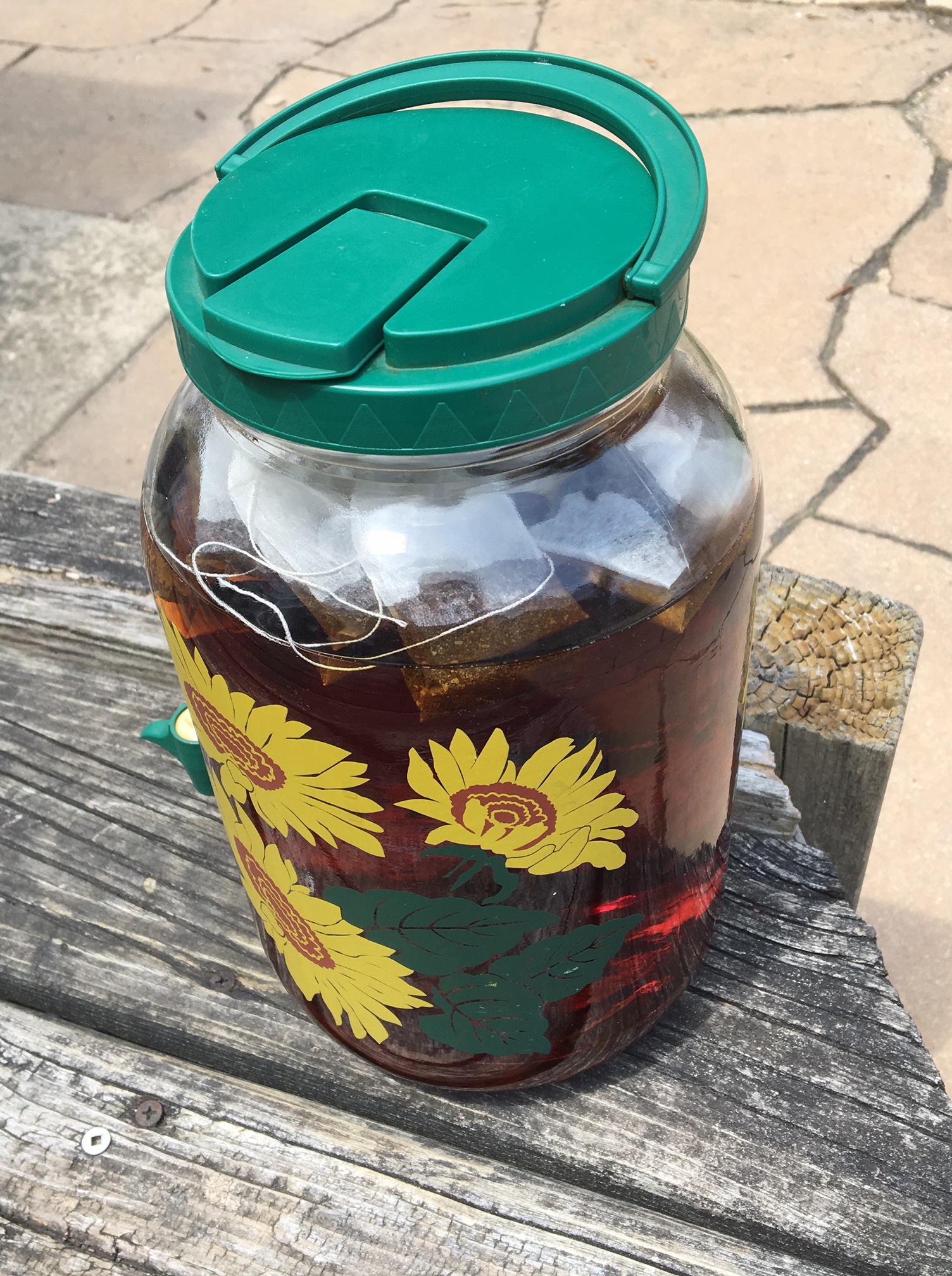
In the wake of the layer-stripping I’m finding that the simple things in this life bring me great satisfaction. We found the old sun-tea jug in the cupboard. With the mint growing in the yard and slice or two of lemon, each day we smile and drink the summer sun from a jelly jar. We tell stories of sun-tea from the past.

It’s the sensual things, like the taste of tea brewed from the sun. On a hot humid day, the sudden shift of cool wind off the lake. The sound of cicadas. Fireflies. Laughter at dinner. The taste of good wine. The stuff of poets. The witnesses of “the eternal now.”

It’s as simple as sun tea, this desire to steep my thoughts in the awe-of-life (as opposed to the awful). And, as the ancient saying goes, as I continue the quest to discover myself: where I place my thoughts my life-energy will follow.

read Kerri’s blog about SUN TEA

like. support. share. subscribe. comment…thanks!

Arrive [David’s blog on KS Friday]

“You must understand the whole of life, not just one part of it. That is why you must read, that is why you must look at the skies, why you must sing, dance and write poems, and suffer, and understand, for all that is life.” ~ Krishnamurti, Think On These Things

The amaryllis is making a reach for the sky. The first time I saw it – a bulb encased in pink wax – I wondered what alien life form just entered our house. We had to ask the same questions we’d need to ask if it was an alien creature: How do we take care of it? How do we feed it? The answer was simple. Leave it alone. That answer confirmed my suspicion. It was an alien after all!

There is so much in this life that I do not understand. In fact, if I am honest, I think most of this life is beyond my capacity to comprehend. Last night, not ready yet for sleep, I watched a nine-minute youtube teaching by Thich Nhat Hahn. Stop Running. The title caught my eye because so much of life feels like running. Running to explain, Running to justify. Running to judgment. Running from fear. Running toward gain. I wanted to hear some thoughts about standing still. In that way, I might understand why there is so much running. In the end, his answer was beautifully simple: rather than run, arrive. Be home.

Rob made us laugh. He’s one of several people who lately reminded Kerri and me that we are not normal. “I didn’t mean for that to sound like it did!” he exclaimed. He’s helping us sort out our plan B. It’s true. Our “normal” in comparison to others is alien like the amaryllis. Rob is attempting to help us see what is special about how we are doing life. And, like everyone, we are mostly blind to ourselves. To our unique choices. To our “one wild and precious life.”

Between the alien amaryllis growing in our sunroom, conversations with Rob and a brief teaching by Thich Nhat Hahn, I am fully confident that I need to cease all attempts at understanding anything at all. Maybe it is time to arrive. Maybe it is time to arrive, to stand still and fully breathe-in all the possible awe teeming in this mysterious ungraspable universe.

Connected from Released From The Heart, The Best So Far © 1995, 1999 Kerri Sherwood

Kerri’s albums are available on iTunes and streaming on Pandora and iHeart Radio

read Kerri’s blogpost about AMARYLLIS

comment. like. support. share. subscribe.

Grok The Rule [David’s blog on Two Artists Tuesday]

“A good poem looks life straight in the face, unflinching, sincere, equal to revelation through loss or gain.” ~ David Whyte

A good rule of thumb in the visual arts: areas of high contrast, in color-or-value, come forward while areas of low contrast retreat. Landscape painters use this rule to create the illusion of foreground and distance. Abstract painters use this rule to move the eye around a composition.

Storytellers and poets use the same rule. High contrast creates interest. It grabs attention. Low contrast sets the environment, the mood. “Some kind of relaxed and beautiful thing/ kept flickering in with the tide/ and looking around./ Black as a fisherman’s boot, with a white belly…” Dogfish by Mary Oliver.

Misused, it’s the rule-behind-the-reason that most of our news is “Breaking News!” False contrast. Hype. It’s the reason our national portrait is continually painted as divisive. High contrast pulls focus. The money follows the ratings so attention-grabbing is highly prized. Low contrast – like agreement, collaboration, sameness, community…truth – doesn’t generate the same level of interest or income.

Like all rules, there are worthy reasons to wield them. In the arts, the contrast principle is used to illuminate unity. To break an individual through to the experience of something bigger. To open questions. In our news-of-the-day, the rule is used to whistle a song-and-dance of discord and distraction. To separate into tribes. To manufacture the illusion of depth while sitting in shallow water.

The reasons to wield the rule are diametrically opposed.

It was a sad day when the young man, standing in our living room, told me that he would educate his child at home. His reason? He didn’t want his son to be stuffed with ideas. “Just the facts,” he said. “Just the facts.”

“Poor souls,” I thought of this man and his young child. How will they ever stare into the fiery face of democracy – an ongoing idea born of high contrast and wild ideas – the artistic kind, meant to bring people together in one nation under every possible god – like a poem. They won’t recognize democracy’s death when without question it slips like ashes through the fact of their fingers.

As for me, I’ll stick with the high and low contrast of Rumi, MLK, Shakespeare, Kahlil Gibran, Mary Oliver, Maya Angelou…

“Your task is not to seek for love, but merely to seek and find all the barriers within yourself that you have built against it.” ~ Rumi

[another worthy rule of thumb: never read the headlines prior to writing a post. All the icky-mush rushes to the foreground and permeates my brain]

read Kerri’s blogpost about FOG

like. share. support. comment. let us know you are out there.


buymeacoffee is a counterintuitive, highly appreciated, offering of support amidst a high contrast environment that keeps the artists among us hopping and hoping.

Lead With The Heart [on KS Friday]

Do you remember The Little Prince? “It is only with the heart that one can see rightly; that which is essential is invisible to the eye.” ~ Antoine de Saint-Exupéry.

What about this one: “The best and most beautiful things in the world cannot be seen or touched – they must be felt with the heart.” ~ Helen Keller

Two extraordinary people sharing the same sentiment.

One more from Mary Oliver: “Every morning I walk around this pond, thinking: if the doors of my heart ever close I am as good as dead.”

What is this business with the heart? Seeing the essential. Feeling the best and most beautiful. Vital life an open door of the heart.

It is a simple message that reaches back through Aeschylus and Confucius, it reaches beyond the invention of the written word. You’ll find it scratched in glyphs. It’s a message older than any religion or spiritual tradition yet weaves its way through all of them. Lead with your heart.

I am a student of metaphor and pattern and can say this with absolute certainty: beneath the hoohah of our angry times is a simple enduring pattern, an appeal from wise voices ringing across the ages and cutting across cultures. A single metaphor: seeing rightly has nothing to do with our eyes. To be human is to lead with our hearts. Closing our hearts to one another might seem righteous but leaves us as good as dead.

[Now that I’m finished moralizing for the day, I think I’ll take a slow walk around our tiny pond, close my eyes, feel the sun, and revel in this day of being alive.]

slow dance/as sure as the sun © 2002 kerri sherwood

…and a bonus!

same sweet love/as sure as the sun © 2002 kerri sherwood

Close your eyes and you’ll see that these tracks have nothing to do with Jazz. Open your eyes and you’ll note that Rumblefish has absolutely no ownership right or copyright to these songs though they somehow possess a ridiculous capacity to misrepresent Kerri and her music.

Kerri’s albums can be found on iTunes or streaming on Pandora and iHeart Radio

read Kerri’s blogpost about HEART LEAF

share. like. support. comment. all are appreciated.

Dine With Jonathan [on Not So Flawed Wednesday]

I lost my copy of On Reflection by Jonathan Miller in one of my moves. He gave it to me. I treasured it both for the generosity of his gift but also a reminder of a night I had a casual dinner with an artistic giant. He was kind. And funny. And shared his ideas, thoughts and new work like an enthusiastic child. He listened intently to my ideas and thoughts like a fascinated friend. It is the mark of a great artist: humility. Healthy doubt. He loved his work and loved to share the exploration. He was brimming with questions.

I left that evening thinking, “I want that!”

That. Secure in my work. The playfulness of a child. The love of the exploration. The fearlessness to my bones knowing that each painting and every play is not an end in itself – not an achievement – but part of the dance of life on the playground called artist. Dedicated to asking questions. Dedicated to surfacing shared truth.

To Mary Oliver’s question, “What will you do with your one wild and precious life?” I say, I want that. Wild and precious.

That. It’s not an achievement; rather, it is a way of being. A practice. It alters Mary Oliver’s question: How will you be within your one wild and precious life?

Safe. Steady. Unshakable through dedicated practice. Arrived at through a lifetime of grace and humility. Or, perhaps, grace and humility arrived at through a lifetime of questioning. The certainty of doubt. That’s what I saw in Jonathan Miller that night. The paradox of the artist: security in vulnerability. To feel so safe as to play without inhibition. To express sans trepidation. To share and receive with equal enthusiasm.

It is a practice available when the artistry is no longer about the “I” but about the “we”. The bigger energy, call it what you will. It’s humbling. That.

read Kerri’s blogpost about REFLECTION

like it. share it. comment on it. buyusacoffee. thank you for reading what we write.

Check The Resale [on KS Friday]

“Although Rothko lived modestly for much of his life, the resale value of his paintings grew tremendously in the decades following his suicide.”

The premise of this sentence made my jammies bunch-up. This wiki entry might have been written about Van Gogh. “Lived modestly” is a euphemism for “poor.” My favorite stereotype: the poor artist.

William Blake also lived modestly; he’d be shocked at the “resale value” of his work now. Nothing brings valuation to an artist’s work like the sudden end of the supply. Blake’s life came to a natural conclusion, so at least there’s that.

How do we know something has value? Resale, of course. Commodity. Soul reduced to a bottom line.

.003 percent of the nation’s budget goes to the National Endowment for the Arts. Valuation. If you desire to truly understand the phrase, “lived modestly,” visit your local not-for-profit arts organization. They’ll heap sincere gratitude upon you if you donate a ream of paper.

As an exercise in understanding soul, ask an actor or painter or dancer or composer the most obvious question: why do you do it?

Their answer will have nothing to do with resale value or commodity. Keep in mind, that doesn’t mean that they don’t want to be paid. Imagine Van Gogh’s answer. Or Mark Rothko’s. Emily Dickinson’s. Wouldn’t you love to know what they knew, see what they saw? Attempting to stand in their shoes, to see what they saw, is the reason that their resale value is so high. They connect us to something greater than commodity.

A caution: the next time you ask yourself, “What’s it all about?” be careful to direct your question to your inner Mary Oliver rather than your inner Elon Musk. They serve remarkably different gods.

My favorite quote of late: “And while a hundred civilizations have prospered (sometimes for centuries) without computers or windmills or even the wheel, none have survived a few generations without art.” David Bayles & Ted Orland, Art & Fear

.003%. That equates to an amount far less than Jeff Bezos’ tax bill. As a percentage, that’s much more than Kerri gets paid for a single spin of one of her pieces on your favorite streaming service (.000079 of a cent). Spotify, Pandora, and the rest are making out like bandits while the independent artists continue to “live modestly.”

What’s the real value of a nation that so desperately undervalues its art? I guess we’ll just have to wait for the postmortem resale.

Kerri’s albums are available on iTunes and streaming on Pandora

read Kerri’s blogpost about ROTHKO

every breath/as it is © 2004 kerri sherwood

Live Like. Reach For. [on Merely A Thought Monday]

These messages are everywhere! Marketing tags, song and book titles, posters and billboards. memes. A sentiment also found in poetry, plays, and religious texts. Live like…

Live like you were dying (title of a studio album by Tim McGraw)

Live like a monk (title of a book by Daniele Cybulskie)

Live like there’s no tomorrow (A ubiquitous quote and set up for follow-up sentiments like, “Tomorrow may never come!”)

Live like.

Live. No guarantees. Dance like no one is watching. Be here now. If I was the rain.

It’s the message human beings like to deliver to other human beings. Don’t waste your one precious life. Realize it. Consider the lilies.

So the story goes, the Buddha was asked, “What’s the biggest mistake we make in life,” His reply: “The biggest mistake is to think you have time.”

It’s as if we were trying to wake each other up. Or, wake up to each other. It’s as if we need to say, “Don’t miss it!” It’s as if we are asking, “Will you help me see it?”

These days there’s plenty of fear-mongering spinning around the word “woke.” I wonder at this collision of universal message and partisan agenda. After all, what is the opposite of “woke”? Why would anyone want to walk through life dulled or asleep? Why would anyone want to walk through life with their eyes closed, uneducated, filled with answers but empty of questions? Why would anyone want you to close your eyes and mind and heart to the fullness of life?

An amazing thing happens when near death kisses open the eyes: all the perceived divisions drop away. People throw themselves on bombs to save other people, people give up their seat on the life boat and, in those moments, skin color, sexual orientation, or politics matter not at all. In Highland Park, while the bullets were flying, decisions made in helping others to safety and the promise of one-more-day-of-life had nothing to do with division.

In the real moments, the awake moments, people reach for other people.

Perhaps that is why we are appealing to each other in beer commercials and bibles, lyrics and legislation, to wake up.

read Kerri’s blogpost about LIVE LIKE

Taste The Sound [on KS Friday]

Toadshade trillium. Say it out loud and taste the sounds. Toadshade trillium. Yummy words worthy of e.e. cummings.

I am working in a tech space and keep a document on my desktop: Terms in this Unknown Land. Tech folk speak in acronyms, PAI and SMB, SERP and TAM. Although my colleagues are mostly left-brainers, they are remarkably poetic in their language, peppering their acronym-speak with tasty terms like “cluster calculations” and “stemmings.” I admit to losing the sense of the conversation in the sound. They are, despite the stereotype, passionate and creative and unconsciously poetic. “Plots a curve of probability.”

Toadshade trillium. Plots a curve of probability. Forget the meaning and taste the sound! What might Mary Oliver have done with those syllables!

My lesson this week: I cannot stand and work at my computer all day. I can do the standing (I have a stand-up desk) but staring at a screen eventually shuts down my brain. Across from my stand-up desk is my drafting table. I think better with big pieces of paper and a pencil and then translate back to the computer. I need to move to think but that’s only part of the lesson. When at the drafting table I’m more likely to take things less seriously. I free myself. I get snarky and funny and scribble and draw big arrows and make fun of myself and the logjam in my thinking. I play.

And, while I play, I talk aloud, and hear the sounds of the shapes that I draw. Poetry and motion. Taste the movement. One and the same. Free the thinking. It’s enough to scare the dog but it’s liberating to my kinesthetic necessity. I scribble notes in every direction and dance back and forth between word and image. Consequently, I produce better work.

Thank goodness I finally tasted a few word-sounds that sent me tumbling into a productive scribble dance.

read Kerri’s blogpost about TOADSHADE TRILLIUM

kerri’s albums are available on iTunes and streaming on Pandora

pulling weeds/right now © 2010 kerri sherwood