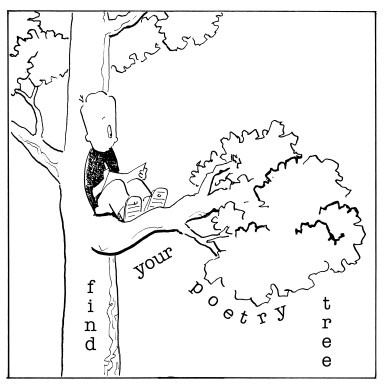
Find Your Poetry Tree [on Chicken Marsala Monday]

findyourpoetrytree WITH EYES jpeg copy 2poetrytreeCreatePRODUCT BAR jpeg copy

I stood before a school board and found myself defending daydreaming. I’d piloted an experiential learning program in the district and the board wanted to ensure my students would be “nose-to-the-grindstone” every moment of every day.

Learning (a creative process) has nothing to do with grindstones. Constant activity, rote exercises and busy-work-for-the-sake-of-busy-work may give the appearance of learning but that’s about it. People learn when in the pursuit of something real and my students were making movies, writing plays or starting businesses. Staring out of the window, I explained, was not only valuable but necessary. I wasn’t making excuses. I had brain science and learning theory to back me up.

There are very good reasons that most “aha moments” happen in the shower, while driving, or, like my students, staring out a window. Inner-space and quiet are necessary ingredients for insight. A good gaze out the window is, in actuality, an inward look, it’s a mental walkabout, a mind-stroll that allows a noisy brain to take a breath and let the logjam of thoughts to relax and flow.

Quinn used to tell me to cultivate my serendipity. He meant that I should open myself to insight, to make myself available to surprises and possibilities, to the utter magic of “where did that idea come from?” Opening yourself requires a good window or, like Chicken, a special poetry tree. On this Chicken Marsala Monday, get your nose off the grindstone, find your poetry tree, and allow the insights to find you.

POETRY TREE gifts and reminders

create TANK TOP copy

Read Kerri’s blog post about FIND YOUR POETRY TREE

www.kerrianddavid.com

find your poetry tree ©️ 2016 david robinson & kerri sherwood

find your poetry tree designs/products ©️ 2018 david robinson & kerri sherwood

Teach [It’s Flawed Cartoon Wednesday]

A teachable moment on Flawed Cartoon Wednesday from studio melange

idiot FRAMED PRINT copy

This one is for all the teachers I know and love. They’ve made it their life’s work to seek the teachable moment and they are masterful at finding it. Everywhere.

On this Flawed Cartoon Wednesday, studio mélange pays homage to the elusive yet ever-present teachable moment.

TEACHABLE MOMENT gifts & products

teachablemomentsPRODUCT BOX jpeg copy

read Kerri’s blog post on TEACHABLE MOMENTS

www.kerrianddavid.com

teachable moment cartoon & designs ©️ 2016/2018 kerri sherwood & david robinson

Move! [It’s Two Artists Tuesday]

Some simple encouragement from studio melange on Two Artists Tuesday

move copy 3

Here’s one of my few guiding principles: knowing “how” to do something always comes after the fact. No one knows how. Truly. If you wait to start until you know ‘how’ you will wait forever. Just start. Make a choice and move. It’s a great gift to make a choice and let your choice be wrong. To make a mistake and adjust according to what you experience. That’s called learning. Sometimes, it’s true, the best choice is to sit still. Sometimes the best choice is to stop trying to figure it out. Try anything. Move.

From studio mélange on this Two Artists Tuesday, give yourself permission to play. That’s also called learning. Experiment. At the end of the day, after all the experiences and adjustments, after all the movement, we’ll ask you how you did it.

MOVE gifts & reminders

move product box bar jpeg copy

read Kerri’s blog post about MOVE

www.kerrianddavid.com

move/move designs & products ©️ 2016/2018 kerri sherwood & david robinson

KS Friday

a musical t.g.i.f. lift from studio melange!

jacketrightnowjpeg copyI’m beginning to believe that high atop the list of human fears-that-lead-to-foibles is the fear of ambiguity (I seem to be writing a lot lately about ambiguity). We want our world to be clear cut, black and white. We want the line between right and wrong to be definitive across all circumstances. We want a ‘normal’ that is one-size-fits-all. We want our word and our book and our laws and our rules and our values and our virtues and our morals to be simple and straightforward and, most important, to be defined by how I define them, not how YOU define them. We want to know what to do. We want to know where we are going. We want to know why we are here. What. Where. Why. Quinn used to call these the BIG three.

We hardly ever know what to do. We choose a path based on what we know at the moment. Choices that are based on ideals, imaginings and sometimes a gut feeling. And, where are we going? Where are you going? Do you know with certainty where this day will take you? Can you possibly know why you are here? What if there is not merely one purpose or one reason? What if that “knowledge” is something you can only see clearly when looking back on your life?

Ambiguity makes space for grace to enter. ‘Not knowing’ is the path that leads to all growth and discovery. Good things happen to bad people and bad things happen to good people because no one is all good or all bad. Isn’t it often true that the things that seemed like obstacles in our lives one day down the road began to appear as great blessings?

It’s probably comfortable to think that this messy life is only black and white. But a comfortable thought is all it is. On this melange KS Friday, take a moment and step into the ambiguity known as music. Let Kerri’s gorgeous piece, It’s Not Black & White, buoy you on a river of grace to the space between rules and lists, the subtle-spirited place where life is lived & experienced and quite simply refuses to be boxed in the fear of artificial certainty.

IT’S NOT BLACK & WHITE from the album RIGHT NOW (track 11) itunes

IT’S NOT BLACK & WHITE from RIGHT NOW (track 4) on CDBaby

PURCHASE THE PHYSICAL CD. RIGHT NOW

read Kerri’s thoughts about IT’S NOT BLACK & WHITE


NEW! KS DESIGNS

life: it’s not black and white [merchandise]

it's not black and white LEGGINGS copy 2

it's not b:w framed art copy

it's not b:w metal travel mug copy

melange button jpeg copy

kerrianddavid.com

IT’S NOT BLACK & WHITE from RIGHT NOW ©️ 2010 kerri sherwood


Chicken Marsala Monday

fallingdown WITH EYES jpeg THIS COPYIf blocking  your creative arteries is the goal then there is no better illusion to consume than trying to be perfect. Eating the idea that you can be free of flaws or experience mastery without mistakes is guaranteed to clog your capacity to move. Notions of perfection turn the imagination toward the fear-monsters and breeds an especially severe  inner critic. Perfection is like the Medusa, give her your gaze and she’ll turn you to stone.

Imagination, creativity, learning, growing,…are words of movement. They are experiences of free flow. If investments like perfection crimp flow, then granting simple graces like trial and error, or “seeing what happens” will inevitably open the channel. Creative flow, like profound learning or wild imagination happens when inner-judges retire; it happens when nature is allowed to take its course. Nature is movement. Falling down is a necessary form of movement. Perfection is about appearances. Learning is about process.

From studio melange on this Chicken Marsala Monday comes this simple reminder. Try. Remove failure from the gallery of options. Get on the bike and ride. Expect to fall down. It’s the only way to learn how to stand up.

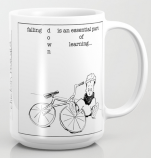
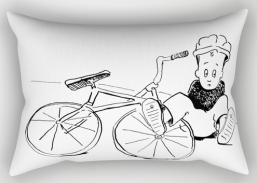
FALLING DOWN IS AN ESSENTIAL PART OF LEARNING merchandise

chicken falling down mug     chicken falling down pillow

kerrianddavid.com

check out Kerri’s thought’s on this Chicken Marsala Monday

falling down is an essential part of learning ©️ 2016 david robinson & kerri sherwood


Chicken Marsala Monday

juststart jpeg

High atop the list of obstacles we erect on our creative life path is this: I don’t know how…. As a coach, I heard it daily from clients. As a consultant, I heard it regularly from business leaders and educators (the pronoun changed: we don’t know how…) Artists regularly lock up in the face of a monstrous HOW?

When I was a young erector of massive obstacles in my path, Quinn would smile and say to me, “Nobody knows how. Just start.” I thought he was being flippant with encouragement but lived my way into recognizing that his advice was not only sound but it was sage.

Knowing how to do something is never a prerequisite for action. It is, however,  a really good excuse to prevent action.

Knowing how comes second. Always. It comes after the fact, after the experience of trying and adjusting and learning. It comes at the end of the day, looking back. That’s when “how” becomes visible. Today’s Chicken Nugget via the studio melange is timeless and simple advice. It would make Quinn smile: sometimes the best thing to do is start.

chicken just start mug


SOMETIMES THE BEST THING TO DO IS START merchandise

kerrianddavid.com

check out KERRI’S thoughts on this CHICKEN NUGGET

chicken just start framed print

sometimes the best thing to do is start ©️ 2016 david robinson & kerri sherwood


Start Walking

photoTell Me. How can I be a learner?

My mind went absolutely blank, and I heard myself saying, Its simple. To be a learner youve got to be willing to be a fool. ~George Leonard, Mastery

I used to do a lot of work in education. My career in the theatre took a sharp left-hand turn when I started consulting with schools. The puzzles that plagued educators seemed to me easy to address. To be human is to be curious. Tickle the curiosity, begin the story and get out of the way.

Tom once told me that teaching is about relationship (not control). He also told me that the best teaching/learning needed to be directly applicable; it had to be immediate. It had to be real. It had to matter – to both the teacher and the learner. The trick is to extend the mattering into greater and deeper levels of abstraction.

An emphasis on testing is an emphasis on knowing. Great learning places the emphasis on not-knowing. It reinforces the pursuit and dispels the notion that knowledge is something achievable. Worthy questions always open more worthy questions. To be human is to be curious. To be alive is to wonder what is on the other side of the hill and then take a step toward it.

The fool George Leonard references isn’t “ the unthinking person,” it is “the carefree fool in the tarot deck who bears the awesome number zero, signifying the fertile void from which all creation springs, the state of emptiness that allows new things to come into being.”

Emptiness. Not knowing. Relationship. Mattering.

Step Into Unknown with SigThe question, “How do we/I do it?” is a great step-stopper. It is the leading edge of every personal and organizational stagnation excuse. We don’t know how. I’ve come to believe that it isn’t a natural question but is learned behavior. It is an emergency brake installed by a system that values right answers over great questions.

My wife and I have a short-hand phrase, Beaky’s Wheelchair, to remind us when we stall, that “how?” is something that can only be known after the fact. No one knows “How?” at the beginning. Beaky needed an electric wheelchair to be mobile and the world of insurance/medicare was standing still. After months of waiting, with no clue which direction to begin, we started making calls. We met every “no” with a “why not?.” We asked a multitude of foolish questions. We learned. And learned some more. Within a matter of weeks, Beaky had her wheelchair.

How do you play the guitar? Paint a picture? Bridge a conflict? Transcend a limit? Know one knows. Tickle the curiosity, let go of any notion that you need to know how, and start walking.

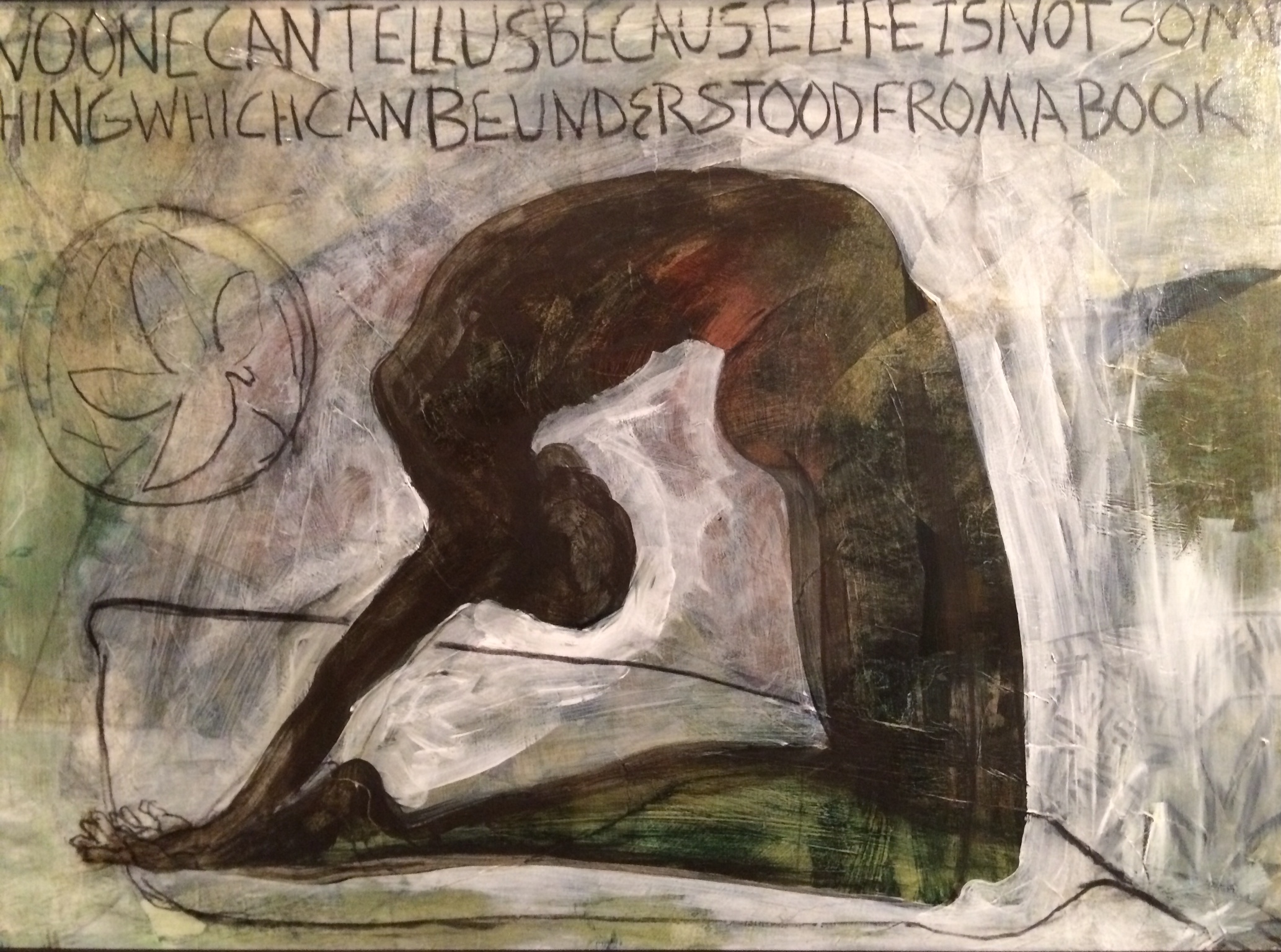
text from Krishnamurti as it appears in my painting

the text from Krishnamurti as it appears in my painting


Save

Save

Save

Save

Cut A New Path

ComfortNow

The latest in my Held In Grace series. This is Comfort Now

It seems to me that most of our days on this earth are spent moving through patterns, conscious or unconscious. These patterns are the rituals of our lives. Some of the rituals are easy to see. For instance, what is the sequence of actions you perform before going to bed each night? What about your ritual of rising each day? The care and feeding of Tripper Dog-Dog-Dog and Babycat are central to my rising and retreating rituals each day. We move through the same actions every morning and evening and I delight in the warmth of the ritual.

Some of the rituals are not so easy to see. Researchers tell us that most of the thoughts we think every day are the same thoughts we had yesterday. We mostly think in patterns (it makes sense once you recognize that language is constructed of category and pattern). We talk to ourselves, cutting paths through the forest of our minds and, once we’ve established a trail, we like to stay on it. Easy is often unconscious. There’s nothing wrong with staying on the easy trail if the path you’ve cut, your repetitious thought-ritual, is self-loving. The rub: ritual paths of self-loathing and self-limitation are also easy, well-worn paths and that makes them both unconscious and hard to leave.

Cutting a new path through the mind forest begins with recognizing that new paths are always available. They just aren’t easy to establish. They require new practices. They require surrender and the first bit of surrender necessary for cutting a new path is the ritual giving-over of needing-to-know-anything; new paths, by definition are unknown.

New paths are not comfortable precisely because they require attention, consciousness.

My teachers taught me that all stories worth telling are stories of transformation. The main character or characters will know something at the end of the story that they did not know at the beginning and the new knowledge will be hard-won. That’s what makes the story worth engaging. Hamlet is a much different character in Act 5 than he was in Act 1. His peace was difficult to come by. He had to learn to surrender. To cut a new path he had to make a practice of peace.

The same ideal applies to the stories we live off the stage.


Be Clumsy

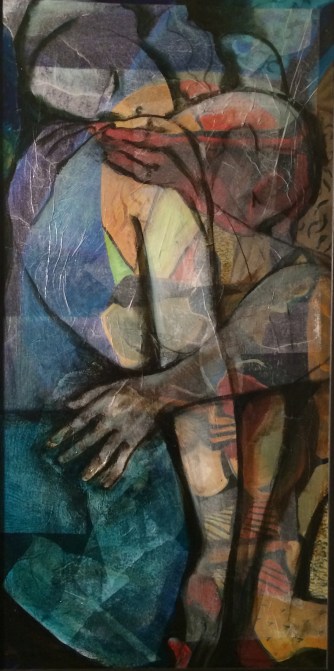
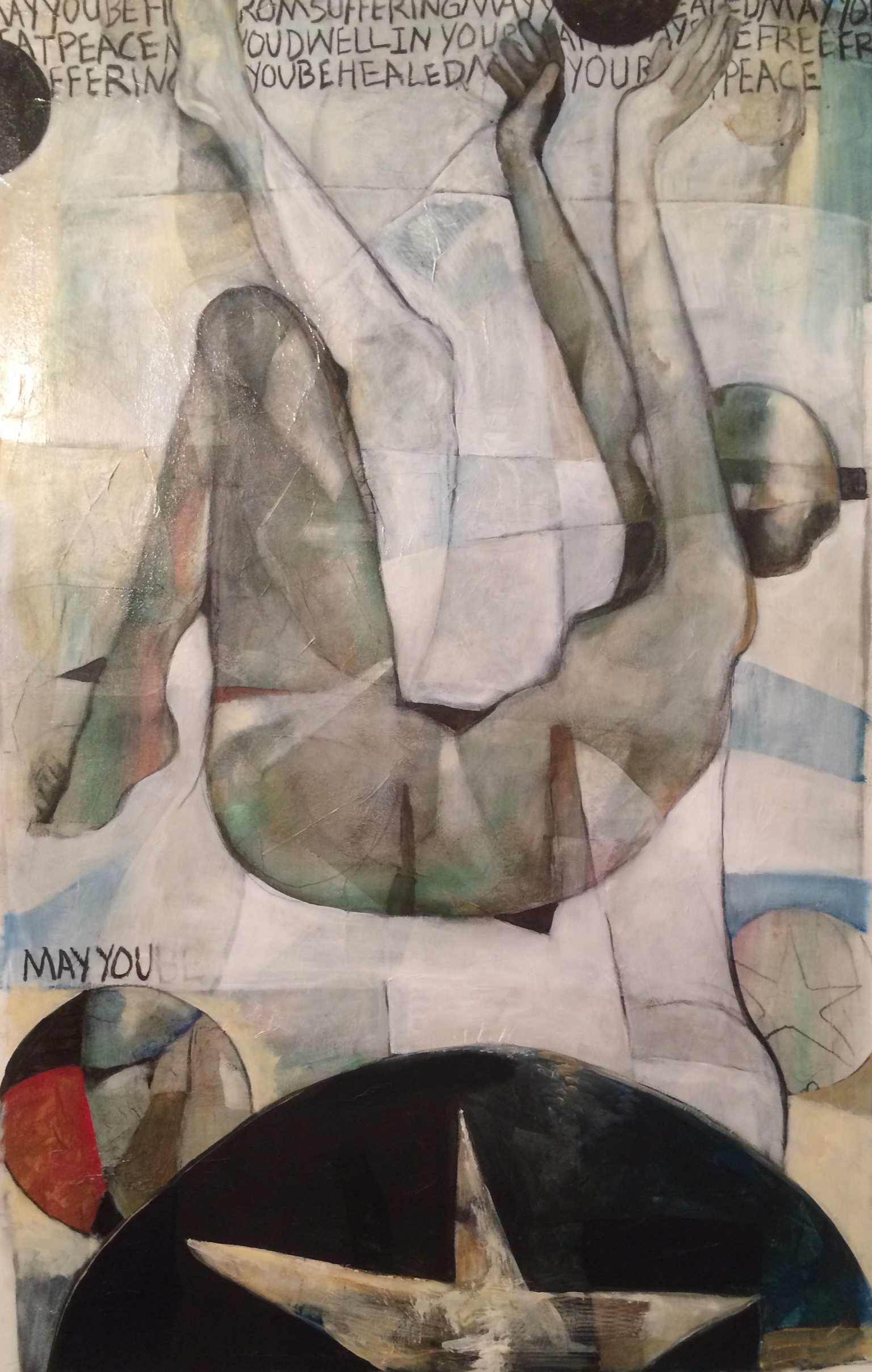
a detail of my painting, May You Be.

a detail of my painting, May You Be.

Clumsy (klum’ ze) adj. 1. lacking dexterity, grace or skill; awkward. 2. ungracefully shaped or made; unwieldy. 3. awkwardly or unskillfully said or done, ill-contrived.

“We don’t allow ourselves to be clumsy,” Kerri said. “Life is clumsy.”

Many years ago I read a commentary that suggested we moderns have a harder time of feeling good about ourselves than people of ages past. The argument went something like this: we have an impossibly high standard to meet and it is mostly illusory. For instance, our predecessors compared themselves and their successes against a relatively small village populace. We are swimming in pool that stretches around the earth. The athletes in our ancestral villages ran against their neighbors, the artists created for a specific purpose that served a tangible need in their community. Our young runners know to the hundreth-of-a-second what greatness requires. They run against the world. Our artists rarely know outside of their own inner imperative why they are creating. With no outer limit they spend a great deal of time wondering if their work has any impact or greater significance. With no outer limit it has no defined audience or community. Stephen, a gifted and prolific artist, used to ask, “Why don’t people recognize the value of art?”

The argument is largely a question of access. Our predecessors had limited and very abstract access to the news of the day, to the happenings beyond their region. We have a 24-hour global news cycle that comes to us on multiple devices that are designed to grab and keep our attention. It is not passive. On our multiple devices we are bombarded with images and messages of what we should look and feel like. Yet, almost all of the images populating our personal measuring stick are constructed. They are manipulated, retouched, powdered and Photoshopped. Legs are stretched. Wrinkles are removed. Sunsets are filtered. We measure ourselves against illusions.

Thus, intermediaries are everywhere. Interpreters abound. I rarely go into a gallery without a curator telling me why the work on the walls is important. The news of the day makes us the rope in a tug-of-war of interpretation.

Art, like life, like deep spirituality, requires direct engagement. It is made rich in the rough draft and the mistake. The broken road is interesting, vital. Learning is a process that takes time. It is messy. It is clumsy. It is not straight, paved, and has no road signs. And, it cannot be walked alone.

There is no forgiveness (of self or other) on the path of perfection; forgiveness is in short supply when the standard is both impossible to attain and an illusion. On the clumsy path, on the messy and muddy road, lives grace, generosity of spirit and deep forgiveness.

Clumsy (klum’ ze) adj. 1. Human

May You Be

May You Be


Dance!

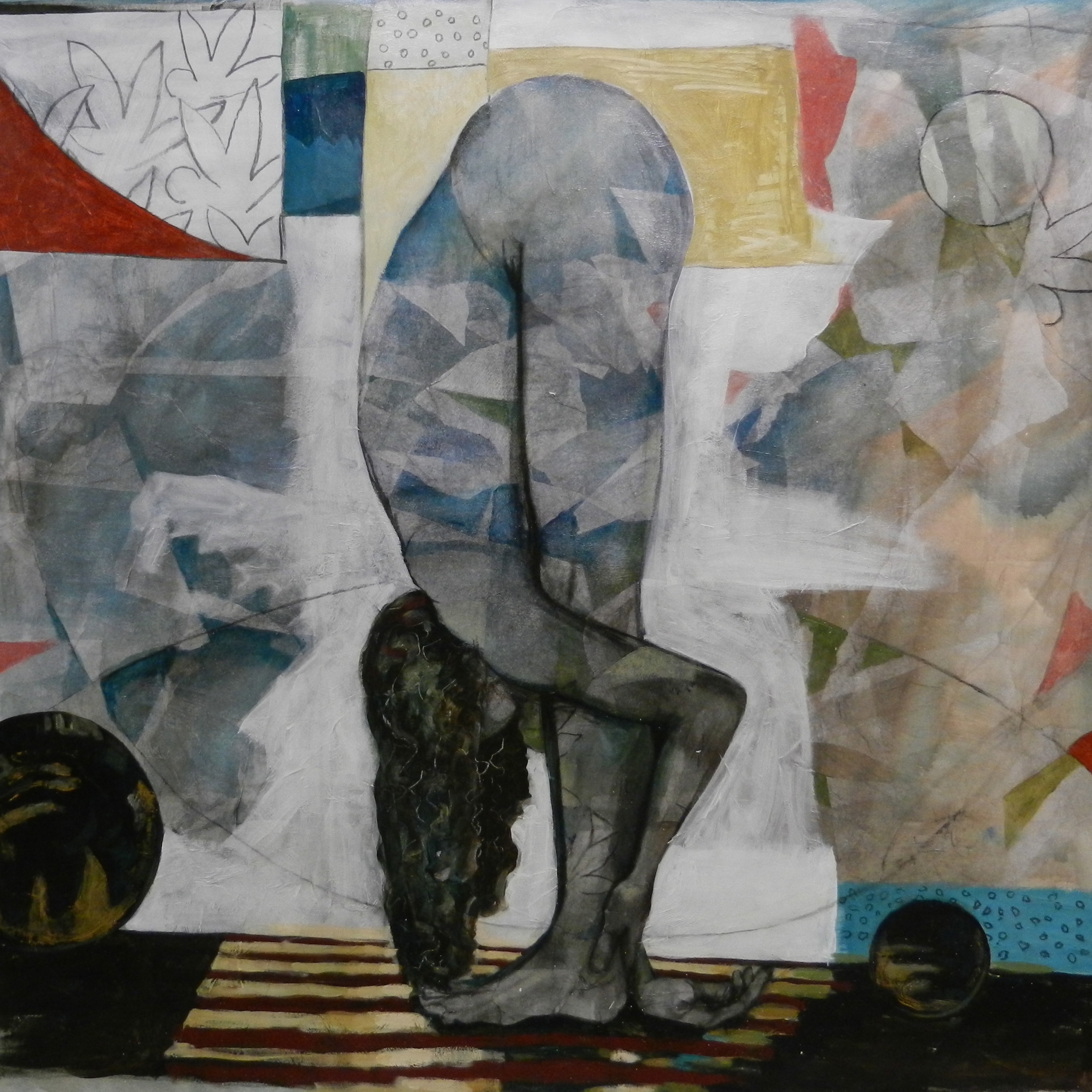
A painting called JOY

A painting called JOY

“A dancer’s body breaks down,” she said, “Painters can paint all their lives. Musicians can play until they are old, but a dancer’s instrument, her body, gives out.”

To be a contrarian I responded, “And then there is Martha Graham. She danced into her 80’s, didn’t she?”

She wrinkled her nose and said, “Not very well.”

The lights dimmed, the movie started, and our conversation ended.

She was, in her youth, a dancer, classically trained. She’d spent the bulk of her adult life teaching and choreographing. And, as she told me, “Those things are all you can do when you can no longer dance. They are what’s left.” Had our exchange not bothered me so much I might have felt sadness for her.

Like an art-mantra, Tom used to say, “A writer writes and a painter paints.” I wanted to say to my seatmate, “A dancer dances.” I thought immediately of Linda who dances even when she is not dancing. She is a riot of movement, joy-in-motion; her need to dance is infectious. Even non-dancers find themselves jigging across the floor when Linda is dancing at the party. I once told her that she is my secret weapon for throwing a successful party.

I imagined my seatmate as a young girl. Before all the training, before the technique and expectations, there was enthusiasm. There must have been joy. There must have been lots of joy. She must have known the world by moving, twirling, spinning in it. Artists – before they call themselves artists – make sense through sound, through scribbles, through spinning. They only way forward in life, the only way to make meaning and to learn, is to scribble more, to engage and translate through movement. Lazy educators write off this imperative as self-expression.

The great artist deathtrap is called technique. It is a paradox. It is necessary. It is a kind of language mastery. It is, at first, a struggle of control. How do you say what you need to say when your language is visual, aural, or kinesthetic? Training is necessary. The path to full expression is always paradoxically through constraints, control of breath or brush. Yet, too often, as is the case with my seatmate, technique replaces the enthusiasm. It can turn joy into judgment. It can make an artist forget their WHY and replace it with a too rigid HOW. It is how artists limit themselves with their artistry. It made my seatmate, a healthy ambulatory woman, believe that she is not capable of dancing.

Later, I told Kerri about my conversation at the movies. She said, “That’s why fewer and fewer people are going to symphonies or galleries. People draw lines. Artists not only limit themselves with their artistry but they also limit access to their artistry.” Joy is infectious. Artistry without it is not very interesting (and, arguably, not artistry).