Cut A New Path

ComfortNow

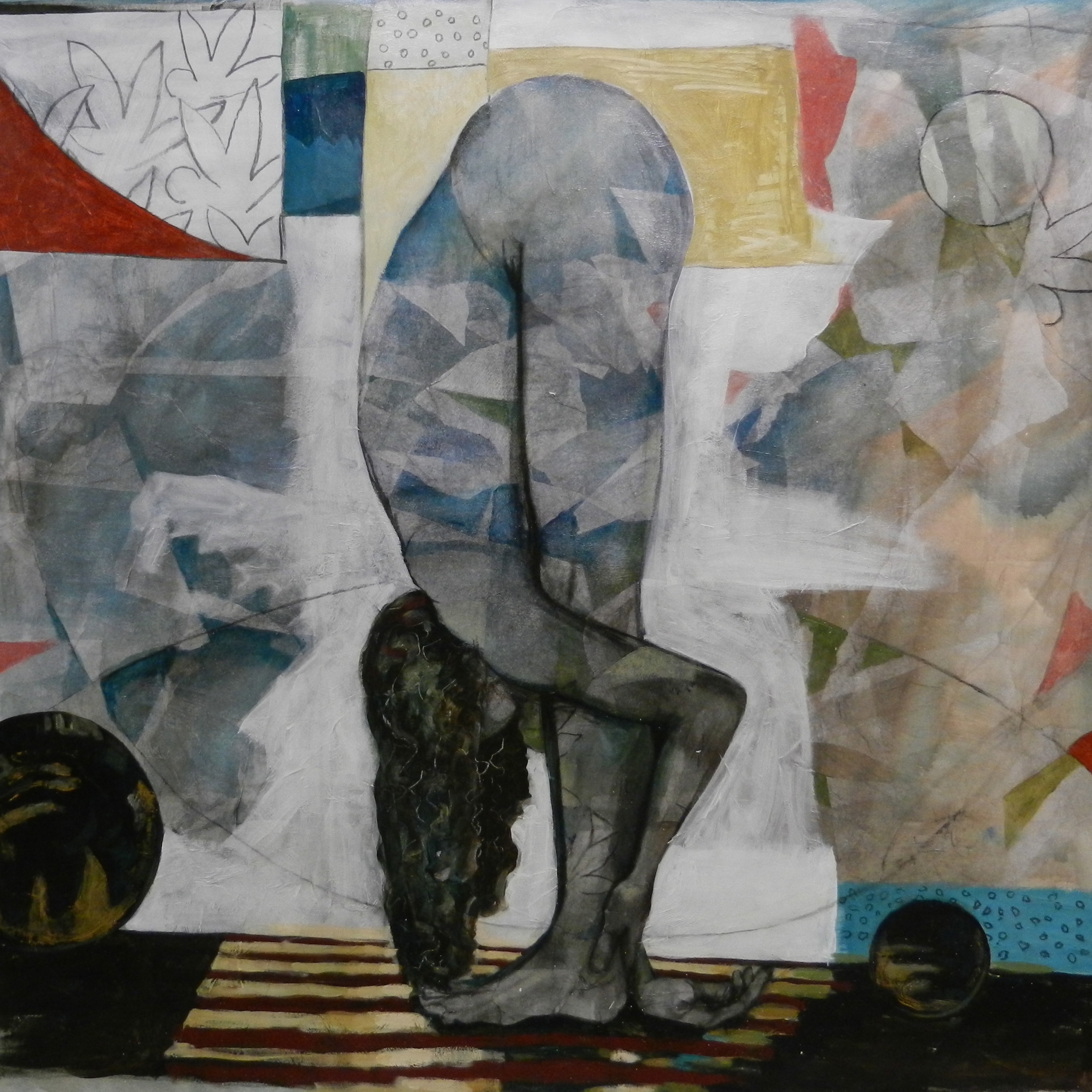
The latest in my Held In Grace series. This is Comfort Now

It seems to me that most of our days on this earth are spent moving through patterns, conscious or unconscious. These patterns are the rituals of our lives. Some of the rituals are easy to see. For instance, what is the sequence of actions you perform before going to bed each night? What about your ritual of rising each day? The care and feeding of Tripper Dog-Dog-Dog and Babycat are central to my rising and retreating rituals each day. We move through the same actions every morning and evening and I delight in the warmth of the ritual.

Some of the rituals are not so easy to see. Researchers tell us that most of the thoughts we think every day are the same thoughts we had yesterday. We mostly think in patterns (it makes sense once you recognize that language is constructed of category and pattern). We talk to ourselves, cutting paths through the forest of our minds and, once we’ve established a trail, we like to stay on it. Easy is often unconscious. There’s nothing wrong with staying on the easy trail if the path you’ve cut, your repetitious thought-ritual, is self-loving. The rub: ritual paths of self-loathing and self-limitation are also easy, well-worn paths and that makes them both unconscious and hard to leave.

Cutting a new path through the mind forest begins with recognizing that new paths are always available. They just aren’t easy to establish. They require new practices. They require surrender and the first bit of surrender necessary for cutting a new path is the ritual giving-over of needing-to-know-anything; new paths, by definition are unknown.

New paths are not comfortable precisely because they require attention, consciousness.

My teachers taught me that all stories worth telling are stories of transformation. The main character or characters will know something at the end of the story that they did not know at the beginning and the new knowledge will be hard-won. That’s what makes the story worth engaging. Hamlet is a much different character in Act 5 than he was in Act 1. His peace was difficult to come by. He had to learn to surrender. To cut a new path he had to make a practice of peace.

The same ideal applies to the stories we live off the stage.


Be Clumsy

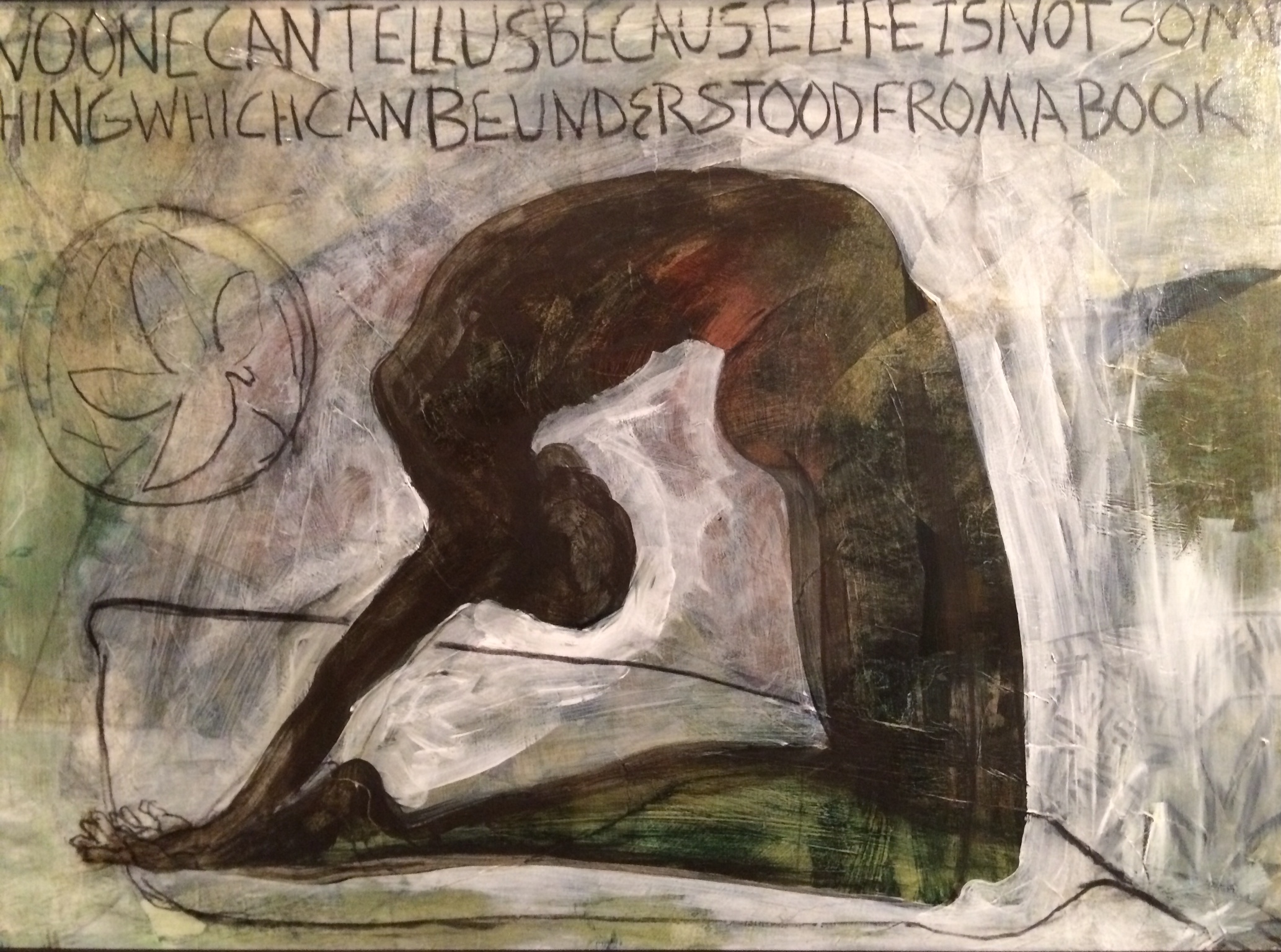
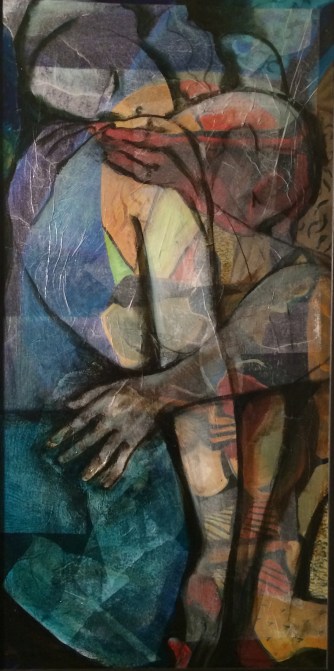
a detail of my painting, May You Be.

a detail of my painting, May You Be.

Clumsy (klum’ ze) adj. 1. lacking dexterity, grace or skill; awkward. 2. ungracefully shaped or made; unwieldy. 3. awkwardly or unskillfully said or done, ill-contrived.

“We don’t allow ourselves to be clumsy,” Kerri said. “Life is clumsy.”

Many years ago I read a commentary that suggested we moderns have a harder time of feeling good about ourselves than people of ages past. The argument went something like this: we have an impossibly high standard to meet and it is mostly illusory. For instance, our predecessors compared themselves and their successes against a relatively small village populace. We are swimming in pool that stretches around the earth. The athletes in our ancestral villages ran against their neighbors, the artists created for a specific purpose that served a tangible need in their community. Our young runners know to the hundreth-of-a-second what greatness requires. They run against the world. Our artists rarely know outside of their own inner imperative why they are creating. With no outer limit they spend a great deal of time wondering if their work has any impact or greater significance. With no outer limit it has no defined audience or community. Stephen, a gifted and prolific artist, used to ask, “Why don’t people recognize the value of art?”

The argument is largely a question of access. Our predecessors had limited and very abstract access to the news of the day, to the happenings beyond their region. We have a 24-hour global news cycle that comes to us on multiple devices that are designed to grab and keep our attention. It is not passive. On our multiple devices we are bombarded with images and messages of what we should look and feel like. Yet, almost all of the images populating our personal measuring stick are constructed. They are manipulated, retouched, powdered and Photoshopped. Legs are stretched. Wrinkles are removed. Sunsets are filtered. We measure ourselves against illusions.

Thus, intermediaries are everywhere. Interpreters abound. I rarely go into a gallery without a curator telling me why the work on the walls is important. The news of the day makes us the rope in a tug-of-war of interpretation.

Art, like life, like deep spirituality, requires direct engagement. It is made rich in the rough draft and the mistake. The broken road is interesting, vital. Learning is a process that takes time. It is messy. It is clumsy. It is not straight, paved, and has no road signs. And, it cannot be walked alone.

There is no forgiveness (of self or other) on the path of perfection; forgiveness is in short supply when the standard is both impossible to attain and an illusion. On the clumsy path, on the messy and muddy road, lives grace, generosity of spirit and deep forgiveness.

Clumsy (klum’ ze) adj. 1. Human

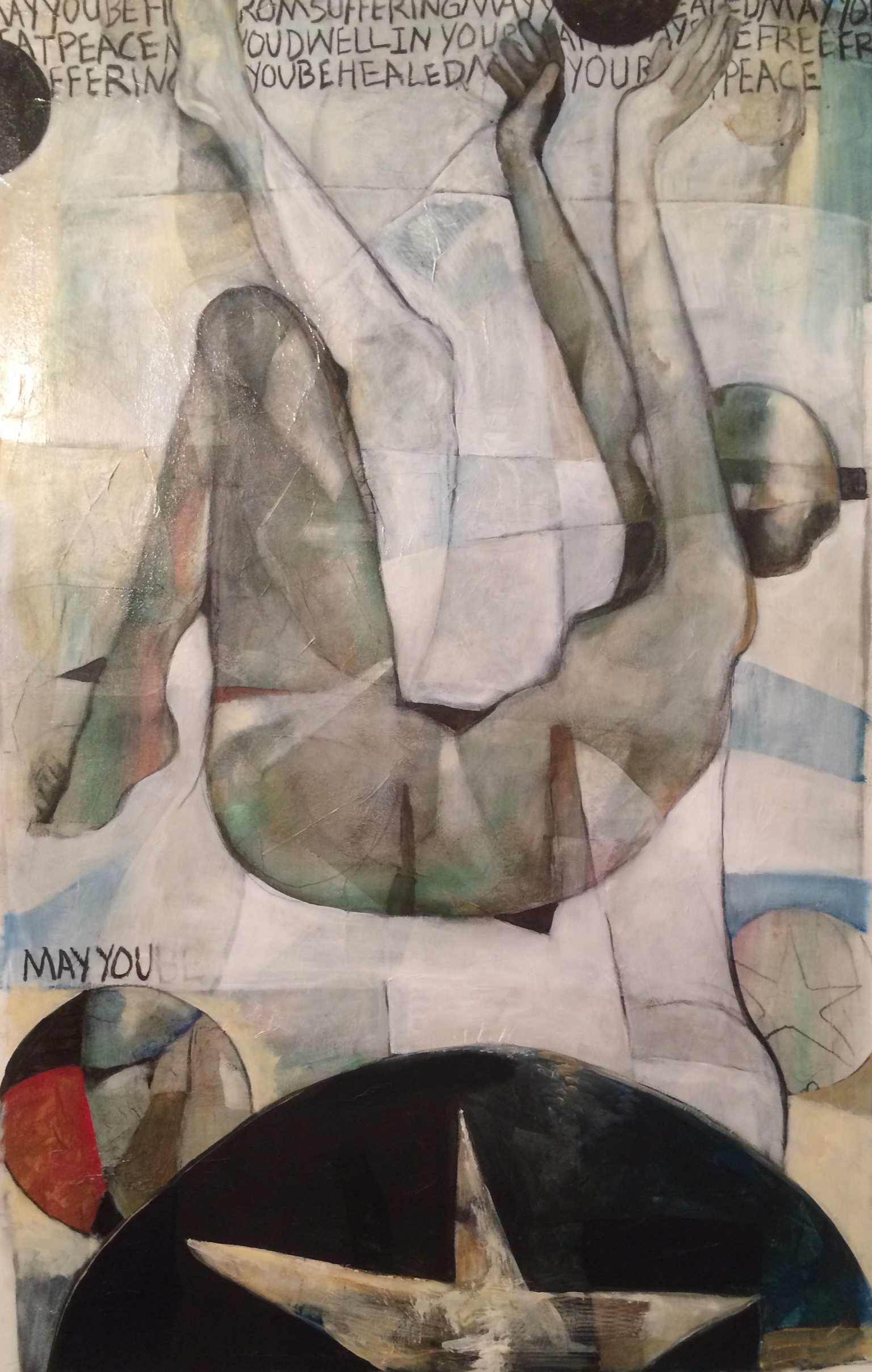
May You Be

May You Be


Dance!

A painting called JOY

A painting called JOY

“A dancer’s body breaks down,” she said, “Painters can paint all their lives. Musicians can play until they are old, but a dancer’s instrument, her body, gives out.”

To be a contrarian I responded, “And then there is Martha Graham. She danced into her 80’s, didn’t she?”

She wrinkled her nose and said, “Not very well.”

The lights dimmed, the movie started, and our conversation ended.

She was, in her youth, a dancer, classically trained. She’d spent the bulk of her adult life teaching and choreographing. And, as she told me, “Those things are all you can do when you can no longer dance. They are what’s left.” Had our exchange not bothered me so much I might have felt sadness for her.

Like an art-mantra, Tom used to say, “A writer writes and a painter paints.” I wanted to say to my seatmate, “A dancer dances.” I thought immediately of Linda who dances even when she is not dancing. She is a riot of movement, joy-in-motion; her need to dance is infectious. Even non-dancers find themselves jigging across the floor when Linda is dancing at the party. I once told her that she is my secret weapon for throwing a successful party.

I imagined my seatmate as a young girl. Before all the training, before the technique and expectations, there was enthusiasm. There must have been joy. There must have been lots of joy. She must have known the world by moving, twirling, spinning in it. Artists – before they call themselves artists – make sense through sound, through scribbles, through spinning. They only way forward in life, the only way to make meaning and to learn, is to scribble more, to engage and translate through movement. Lazy educators write off this imperative as self-expression.

The great artist deathtrap is called technique. It is a paradox. It is necessary. It is a kind of language mastery. It is, at first, a struggle of control. How do you say what you need to say when your language is visual, aural, or kinesthetic? Training is necessary. The path to full expression is always paradoxically through constraints, control of breath or brush. Yet, too often, as is the case with my seatmate, technique replaces the enthusiasm. It can turn joy into judgment. It can make an artist forget their WHY and replace it with a too rigid HOW. It is how artists limit themselves with their artistry. It made my seatmate, a healthy ambulatory woman, believe that she is not capable of dancing.

Later, I told Kerri about my conversation at the movies. She said, “That’s why fewer and fewer people are going to symphonies or galleries. People draw lines. Artists not only limit themselves with their artistry but they also limit access to their artistry.” Joy is infectious. Artistry without it is not very interesting (and, arguably, not artistry).

Meditate On Mistakes

taking advantage of my mistakes: a detail of my latest painting in progress called Weeping Man

taking advantage of my mistakes: a detail of my latest painting in progress called Weeping Man

A meditation on mistakes:

Actors know. In performance, when they forget their line, they come alive. The exhilaration of forgetting shocks them into presence. The mistake achieves the essential thing: presence. The audience may not be aware of the lost line but they cannot help but come into presence when the actor does. That’s how it works. Presence begets presence. Actors also know that, in such a moment, tension is their enemy. Panic is counterproductive. Relaxation is the only path back to their play.

Mistakes wake us up.

Many years ago, I produced a summer theatre company. In the middle of a performance, a storm blew out the power to the theatre. The performance stopped. The emergency lights came on. The actors looked at the audience and the audience looked at the actors. And then, in the ghostly blue-white light, the actors continued their play. It was the one and only time that the play was riveting. Actors and audience alike became invested. They were together in an experience that was unique. It was, as are all true mistakes, unrepeatable.

the under painting and sketch.

the under painting and sketch.

The playwright John Guare wrote that a writer must write ten bad pages to arrive at the one good page. The writer must value the ten bad pages for the single good page to be possible. The ten bad pages, what educators, locked into testing regimens, might call mistakes, are necessary. Up front expectations of perfection are guarantees of mediocrity. No process is perfect – and that’s the point. Perfection, like happiness, comes after the fact. It is the blossom of a rich process. It ensues and only becomes available when mistakes are valued, when exploration is encouraged. A rich process is alive with trial and error, with strong offers that may or may not work. The strength of the offer, the capacity to make a grand mistake, learn, adjust and boldly offer again – is a great definition of freedom. It is otherwise known as vitality.

It’s what artists understand. When nothing seems to be working, when the most powerful offers fall flat, when paintings turn to mud, relaxation is the only path forward. There is comfort in knowing that the single good page is out there somewhere if only you keep making grand, luscious, brilliant mistakes.

Cross The Boundary Of Elements

TODAY’S FEATURED IDEA FOR HUMANS

Cross The Boundary

In a world of right and wrong, yours and mine, red states and blue, crossing the elements means relinquishing the idea that “I know,” or that “I’m right.” My “normal” may not be your “normal;” it’s a good bet that my perspective is not your perspective. Cross the boundary of elements and stand for a moment in other people’s shoes; swim in their element.  Reach across the known to see what they see. Find the middle way.

 FOR TODAY’S FEATURED PRINT FOR HUMANS, GO HERE.

Step Into The Unknown

Step Into Unknown with Sig

FOR TODAY’S FEATURED PRINT FOR HUMANS, GO HERE…

See The Force

from my children's book, Peri Winkle Rabbit Was Lost

from my children’s book, Peri Winkle Rabbit Was Lost

Bill is a board member for non-profit education organization and is forming a case for changing the curriculum. He’s asked me to help him shape his argument. The students going to the organization’s classes did not fare well in the public schools. As Bill wrote, most of the students are interested in the arts and there are no arts available. He wrote that the curriculum is mostly “traditional.”

Many years ago, my mentor, Tom, told me that the alternative schools were filled with artists, so Bill’s observation is not surprising. Anyone familiar with Howard Gardner’s work will recognize the notion that people learn in different ways. Desks are torture chambers to kids who need to move or manipulate things in order to process information. I was one of those kids and I can tell you that the word “torture” is not an overstatement. Even today, sitting is unproductive time for me. I do my best thinking while I walk or while painting. Staring out a window is also highly productive: after all, the imagination is a fancy dancer.

Bill is making the same wrong assumption made by all people interested in educational reform when they first wade into the swamps of change: he’s focusing on the teaching and the teachers. If only the teachers could see the value of working experientially, engaging the students in a real pursuit instead of an abstraction, all things would be better. On the surface, that might be true. What he’s not considering are the forces in place that require teachers to default to rote exercises, compartmentalization, and standardization. In his case (and all cases), the teachers are not being reinforced (paid) to engage the students on a learning journey; they are being reinforced to raise test scores. The change he seeks is not in the teachers or the teaching. He must address the forces of compliance that teachers, just like their students, must obey. He must address the systemic assumptions that define the expectations.

This is the same conundrum that organizations face when they desire their employees to work in teams but are structured to reward individual achievement. The desire for team is in direct conflict with the systemic foundations.

As Arnie recently reminded me, 1) our system of education was not created by educators, so 2) the aim was never to educate but to standardize. These two aspects, the structure and the intention, are powerful forces to change. They now define our assumptions of what education should be. Systems are living things, and, as I learned in school, will fight to the death just like all other living things.

Bill has his work cut out for him. Changing the focus of the teachers is the easy part and can only happen when the focus of the system supports the deep human desire to learn.

Go here to get my latest book, The Seer: The Mind of the Entrepreneur, Artist, Visionary, title_pageSeeker, Learner, Leader, Creator…You.

Go here for hard copies.

Learn To Laugh

Comedy is about other people’s pain. Wiley Coyote going off the cliff one more time is funny. The guy slipping on the banana peel is hysterical as long as you are not that guy. Humor is mostly a status drop for someone.

I’ve been writing and drawing a cartoon called FL!P for almost half a year now so I’m inadvertently making a study of what’s funny and what is not. Recently some acquaintances that know me from my coaching life took me to task because my comic strip seemed out of character. “It’s mean,” they said. “Yes.” I said. That is precisely why it is funny.

The strip is aimed at entrepreneurs and there is a need for a bit of levity in a world so steeped in self-interest and confusing agendas. In many traditions around the world the trickster is an integral part of worship. We are not meant to take our gods so seriously. The reverence is always found in the relationship and the realization that the godhead is in all of us. It is our flaws that take us closer to the creative. Worship is a relationship and a full relationship includes laughter, joy, play, as well as inner quiet and awe. Tricksters break rules and pull the blanket off of societies inequities. Tricksters help us see what we pretend not to see. The Emperor would still be strutting around naked if the trickster boy hadn’t spoken a truth that the rest of the village denied. Truth comes easier with laughter. I can tell you that there is much public prancing in the world of accelerators and incubators but very little real apparel. Humor is necessary in a landscape so rife with pretending.

Artists are often of necessity the tricksters of their culture. It is the artists’ job to open eyes to what is there (versus what we think is there). It is the artists’ job to bring the communal attention into the present, to slap-stop the puffed up importance of things that do not matter so that the things of real importance can be seen. With a 24 hour news cycle and a congress ruled by corporate dollars it is hard for us to sort out what is valuable and what is not. The narrative in the commons rarely reaches the level of significance. It is no wonder that many people confess to getting their news from John Stewart and Stephen Colbert (both heroes of mine).

The greatest lessons of my life did not come gently and I am all the more grateful for the force behind the learning. My lessons came with status drops and like Wiley Coyote I have gone more than once over the cliff with an anvil close behind. Comedy is mean. Learning requires falling down. Stepping into the unknown is potent because of the myriad of things to trip over. If you can’t laugh at the bungle you’ll miss the lesson.

897. Join me in inspiring truly powerful people. Each day I will add a new thought, story or idea to support your quest and mine.

For a humorous look at the wonderful world of innovation and new ventures, check out my new comic strip Fl!p and the gang at Fl!p Comics.

It Matters

808. Join me in inspiring truly powerful people. Each day I will add a new thought, story or idea to support your quest and mine.

From the department of subtlety in language comes a submission from Skip. During lunch today (His email said, “Meet me for a black and tan. We’ll call it late lunch or early dinner.”) During “lunch” he told me about a speaker who made the distinction between a student and a learner – to make the point that our systems of education (higher and lower) are not about learning. To be a student and to be a learner are not the same thing at all.

The distinction is in the assumptions beneath the words. The word “student” implies the need for teachers, curricula, etc. The deeper implication is in the necessary action: it is ‘other-directed.” The word learner, on the other hand, requires no teacher, no agenda, nor a curriculum. The necessary action is self-directed. The action can be facilitated, it can be mentored, it can be shared, but the imperative is within.

Why, you ask, does this matter? Isn’t this just splitting hairs?

Last year Skip and I met at a conference for educators on reinventing learning but in Skip’s words, it was not about learning at all. It was about reinventing teaching. The organizers were educators so their assumption set necessitated students and teachers in an expert driven relationship. The teachers know. The students receive the knowing. No learning required. There were incredible conversations that day and few had to do with learning.

Learning is a pursuit. It is a discovery path. There is nothing passively receptive about learning (note: the moment you separate content from method you end all learning and enter the realm of student/teacher).

It matters. The way we ask the question determines the possibilities we see or don’t see. None of our current questions in the field of education have much to do with learning. I walk in many worlds and in the business realm I regularly hear these phrases: “Why don’t my employees take any initiative?” “They expect to be rewarded for everything?” “It’s impossible to critique anything because they take it so personally.” “Everything needs to be an ‘atta-boy!” “They might do just what you ask but never go beyond the prescription.” Frustration abounds.

Well. We get what we create. Students look for permission, color inside the lines, need approval and fixate on their grade. Learners embrace challenges, step across lines, and know intrinsically whether or not their work is good. It matters.

Keep Walking

795. Join me in inspiring truly powerful people. Each day I will add a new thought, story or idea to support your quest and mine.

Last week, the night before the launch of my new business, 6 hours before I was to get on a plane and travel for a week, my computer died. There was not time between stops to get a fix. There was no way to put up a post. My string of consecutive posts ended at 794. After I stopped trying to figure it out and recognized that the gods of technology both grant and revoke access, I settled into a week with minimal technology. It was lovely. And a new era presented itself. Here are two short lessons that came during the week that my computer died (and have nothing to do with technology):

1) As it turns out, no challenge is insurmountable. Challenges only appear insurmountable when given too little time. They seem insurmountable when the choice is to stop. Stopping is a valid choice. In fact, stopping is to make the choice for a new challenge. Resting is a valid choice, too. I learned that I’ve been on a thirteen-year pilgrimage back to Bali. What I thought was a lost cause was really a long walk with a few rest breaks. A great teacher has been waiting for me. He asked me to return and break bread with him.

2) These past several months of wandering have been extraordinary in the invisible helping hands that have opened doors, lighted my path, and provided support, guidance and dear friendship. All of my life I thought that when the helping hands appeared, they illuminated a single path. It turns out that is not true at all. They help. They support. They guide. Within their guidance there are many choices to make. There are many possible paths. In this way, destiny or fate has many faces. It is both random and predetermined. Energy can take many forms. Choice is always available. As a wise person once wrote: there are many paths up the same mountain. What is important is to keep walking.