Look It Up [David’s blog on Not So Flawed Wednesday]

I find that I have a different definition than most people of the word ignorant. In the book of words it is an adjective describing the lack of education or sophistication. I’ve come to understand it as a noun, someone who ignores in order to shore-up their belief. So, in my book of words, someone who ignores information, facts, data, someone who refuses to question, is an ignor-ant.

I’m writing this post a few days ahead. It’s the day of the Iowa caucuses and, if the polls are accurate, most of the caucus-goers are dedicated ignorants. Thought-foundations built upon quicksand. It brings to mind two quotes. The first is from Isaac Asimov:

“There is a cult of ignorance in the United States, and there always has been. The strain of anti-intellectualism has been a constant thread winding its way through our political and cultural life, nurtured by the false notion that democracy means that ‘my ignorance is just as good as your knowledge.” 

And, isn’t that a proper summation of our times? A democracy can only survive over the long haul with an informed populace. Ignorance, ignorants, will be the death of our democracy. It begs a question that’s ever present and hard to ignore: what are we (they) afraid to learn? That brings me to the second quote that popped into my noggin. This one is from Robert Pirsig:

“You are never dedicated to something you have complete confidence in. No one is fanatically shouting that the sun is going to rise tomorrow. They KNOW it is going to rise tomorrow. When people are fanatically dedicated to political or religious faiths or any other kinds of dogmas or goals, it’s always because these dogmas and goals are in doubt.”

The ostrich buries its head in the sand, the monkey plugs its ears. The fate of the MAGA lemming is the trap of the dedicated ignorant. It makes possible the untenable: angry insistence of being the great defender of democracy while championing a fascist yet being completely incapable of discerning between the two. It requires a wee-bit of knowledge and study to understand the difference between fascism and democracy. Fanatical embrace is the only available path to those who fear facts, information and ideas that might call into question what they already surmise: what they believe, what they think, what they are told might not be true.

Ignorance is never the equal of knowledge. I’d never take my car to be fixed by a someone who calls him/herself a mechanic yet has no knowledge of how an automobile works. It seems basic. I wonder about the Iowans going to the polls (or any republican for that matter), exercising the great power of the vote, yet refusing to exercise the freedom of thought, the expansion of mind, that their democratic privilege affords them.

In my book, that is the definition of an ignorant.

read Kerri’s blogpost about KNOWLEDGE

like or not. share or not. support or not. comment or not. either way, ask questions and seek to know beyond what you think.

buymeacoffee is what you make of it after you investigate what it is and what it is not. try it!

Gain Some Perspective [David’s blog on Not So Flawed Wednesday]

If you’ve not yet bumped into Piet Mondrian’s paintings of trees, this is your chance. Not only are the paintings beautiful but if you’ve ever scratched your head at his more famous abstract/geometric paintings, you will find the forest through his trees. Things are not always what they seem and, in the era of contemporary art, it is necessary to grok the context in order to fully appreciate the content. Of course, that rule also applies in this age of info-tsunami: content rushing across the screen is regularly embraced whole-cloth – sans context – so truth and lie have equal standing.

In the art world, placing content (an individual painting) into context (the historic era, the long-body-exploration of the artist’s work, the source of the exploration) is called “gaining perspective”. Because things are not always what they seem, it is drilled into every artist to regularly stand back, to clear their eyes, to get perspective on their work-in-progress. It is also (or used to be) drilled-in to offer the same courtesy to the work of other artists. Stand back from snap judgments. Check the sources. Understand the exploration. Grasp the historical context. It is never as simple as “liking” or “not liking”; appreciation opens a vast color palette beyond the numbing mindset of thumbs-up or down.

Gaining perspective and learning are the same thing. The most well-educated people I know are not lawyers or doctors. They are actors, directors, dancers, and painters. Gaining perspective takes a lifelong dedication to questioning and researching and double-checking. It is to peek behind the curtain of popular and not get caught in the current reality spin. It is to know that things are not what they seem. It is to know that reactions are easy answers; questions take time. Gaining perspective takes time.

Sometimes she stops so quickly that it propels me forward a few stumbling steps. While I tumbled forward she knelt at a puddle and aimed her camera at a leaf. Or so I thought. I have learned (daily) that she sees things that I do not. I have learned that my assumptions are almost always wrong. She smiled when she stood up. “Look,” she said.

I gasped. I was terrifically wrong. The leaf was nowhere in sight. The reflection of trees in a puddle on the asphalt trail. A festival of texture. A masterpiece of illusion. Piet Mondrian must have knelt at a puddle reflection just like this! “Trees through an icy window,” I said.

Things are rarely – if ever – what they seem.

read Kerri’s blogpost about THE TREES

share it. like it. support it. comment on it. research it. question it. doubt it. grok it.

buymeacoffee is exactly what you make of it.

Look Closer [David’s blog on Two Artists Tuesday]

It is not in my nature to look closely. I more easily jump into the sky and see clearly the lay of the land. It’s why I am drawn to metaphor and appreciate the universal stories. It’s what made me useless as a consultant: no one really wants to know where they are going or what icebergs lurk over the horizon. They particularly resent it when you tell them that the big horse is filled with Greek warriors. Ask Cassandra!

Detail, on the other hand, has been an acquired skill that I am and will be forever acquiring. Kerri is a master teacher. Detail is her forte’.

What I am learning at this phase of my life: the real riches come in tiny packages. The miracle of a snowflake. Holding hands. 20’s laughter. The sound of crunching leaves. A hope held close. Savoring the broth. A gesture of kindness, like a smile or holding open a door. Expressing appreciation to the bus driver or the wait staff. Sitting still inside a poem to fully taste the sound of words.

Paying attention. I know I write about this often. It’s a part of the learning…

Of course, the tiny doors (a closer look) always open on infinite passageways so there remains great worth in jumping into the sky to see how vast is the landscape of the heart. Both/And. Beautiful either way.

read Kerri’s blogpost about THE SNOWFLAKE

like it. support it. share it. comment on it.

buymeacoffee is a snowflake of infinite possibilities if you choose to see it.

Mix Harmonious [David’s blog on DR Thursday]

Harmony in color. The place where the language of music finds a home in the visual arts. Synesthesia.

Harmonious color arrangements, like harmonious sound arrangements, must share at least one common “note.” Mix a little yellow into each color on the palette and the colors will work like chords. They’ll be compatible. Pleasing.

It’s probably obvious in my paintings. I’ve never really studied color. I use what pleases my eye (like a musician who plays by ear). Now, I want to know. It’s counter-intuitive; after decades of painting I to want to understand the basics. I want to know what I know and discover what I don’t know. I suspect what I don’t know is monumental.

Long ago, Mike sent me a color study that DeMarcus did when he was in art school. The image is of a cactus. At the base of the painting is the palette that he selected. He framed this piece and kept it on his wall over the course of his very long life and artistic career. It must of been a reminder: don’t forget the basics. It hangs in my studio though, for me, it carries a different reminder: don’t forget your lineage.

Dropping into an episode of Home Town recently, I laughed aloud when Erin Napier said that the only useful thing she learned in art school was the color wheel. I am, as is true of every artist that has been at work for decades, finding my way back to the simple basics.

When I was a kid, pre-internet, I had a cardboard color wheel with a rotating “locator” window meant to help a budding artist know what-color-goes-with-what-color. I didn’t pay much attention to it. It felt like study and I was impatient. I needed to make messes. I didn’t appreciate it at the time but I knew intuitively that I needed to move around to learn. I made swatches for days. I made some terrifically ugly color combinations. I painted some perfectly awful paintings. I still do.

The bubble-of-learning is moving from my body and slowly – ever so slowly – floating up to meet my brain. And, in this contentious world, I’ve decided that the best place to start is with harmony. Harmony in color. A little intentional recognition of sameness to create some pleasing compatibility.

read Kerri’s blogpost about MAUVE AND OLIVE

like. support. share. comment. we appreciate all the colors of your participation.

buymeacoffee is a “tip jar” where you can help the slow-witted-artists you appreciate learn at long last what color goes with what.

Listen To The House [on Not So Flawed Wednesday]

When it’s humid our refrigerator has an incontinence problem. Upon entering the kitchen and stepping into the latest puddle, we call out as if it was normal, “The fridge tinkled again!” Sometimes I wonder if the neighbors can hear us. And, if they can, do they double-lock their front doors against our madness? Do they pull down their shades as we pass by?

We think we know the problem with the fridge’s urinary tract. We ordered a part months ago that arrived magically through the mail and now sits within view of the tinkling-fridge. It’s like knowing you’re going to need a hip replacement, ordering the part, and setting the titanium hip on the kitchen counter for months until you have the courage to schedule the surgery. “Yep. There’s my hip. Someday I’m going to install that thing…” Our new part has been in view for so long that I no longer see it. I’ve incorporated it into my visual expectations. We’re still working up the courage.

The refrigerator’s incontinence began when the ice-maker went on strike and refused to make ice. We met and negotiated but the ice-maker negotiating team is difficult. We’re having a hard time discerning their demands and are clueless about the original issue. We know the ice-strike and the fridge-tinkle are connected but are somewhat mystified by the humidity-trigger. So, in the meantime, thoroughly mystified but incredibly adaptive to our circumstance, we bring in ice from our beloved the corner market, Morelli’s Deli. We place towels on the kitchen floor.

And what might this have to do with living the good life? “Deferred maintenance is a fact of life!” Kerri insists and she is right. As I’ve learned from our sweet old house, there is always something to fix and that’s what gives our beautiful home its character. And, in the face of the obvious-never-ending-list, the best plan of action is to relax. Do what you can do when you can do it.

This may come as a surprise but, in the face of a long to-do-list, I had to learn to relax. I had to practice the skill of letting go. I’ve had to exercise the muscle of realistic expectations. I was not a willing student at first – I had to recognize that I had lessons to learn! …so many lessons…

How fortunate am I that our house is a master teacher? When you visit, I’ll show you how to jiggle the door. And don’t ask me about the cabinet handles in the kitchen! The first lesson from our house: explain nothing. Smile, relax, and say, “Yes. I know. It appears that needs fixing.”

read Kerri’s blogpost about ICE

like. share. support. comment. all are appreciated.

Note The Evidence [on saturday morning smack-dab.]

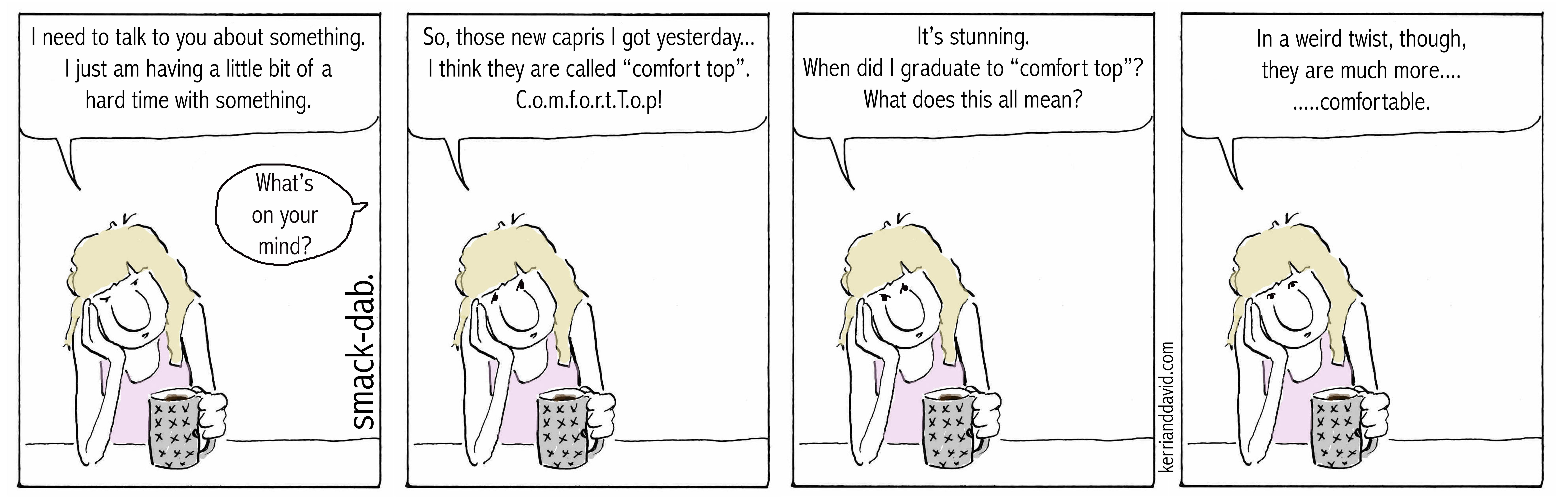
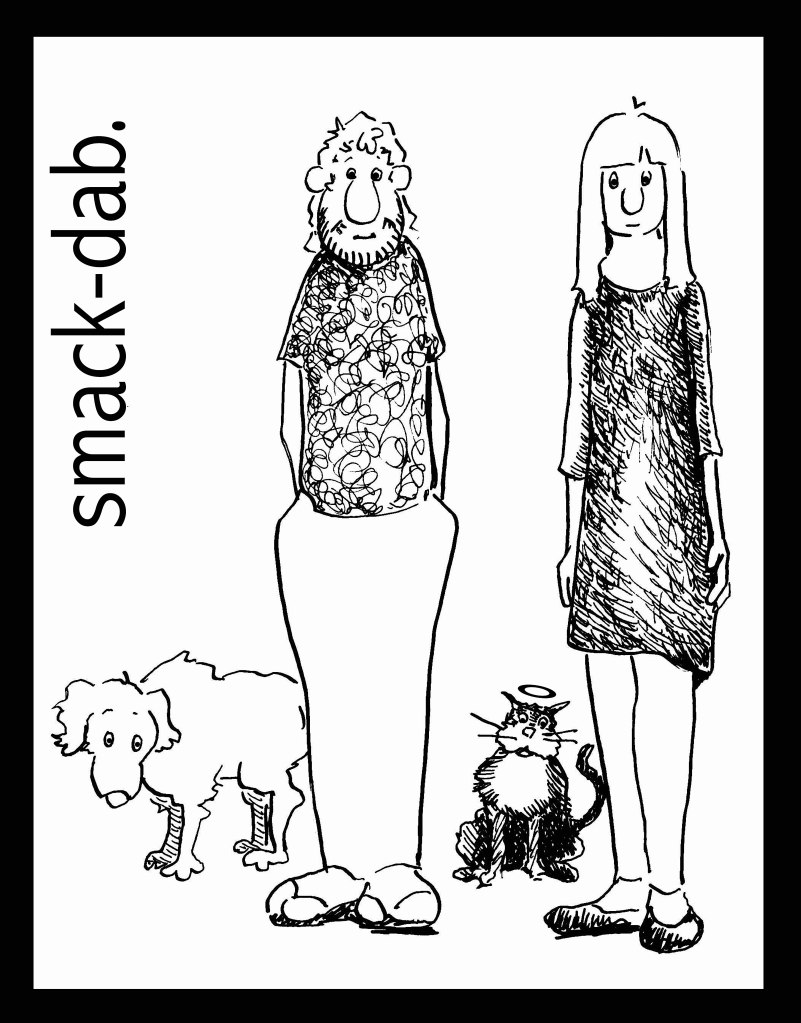
Never let it be said that I am incapable of learning. As evidence of the rare penny-drop, please note the absence of question or comment after the first panel of this cartoon. This implies that I am either listening without need “to solve” or that I recognize a comment in any direction might end my life. Either way, a remarkable demonstration of learning.

Also note that I am off-screen. I will leave the reason for my cartoon-suggestion-of-healthy-distance up to your interpretation.

Learning! I’m learning!

read Kerri’s blogpost on COMFORT TOP

smack-dab © 2023 kerrianddavid.com

like it. share it. tell us about it. buyusacoffee. Many thanks!

Embrace The Accident [on Two Artists Tuesday]

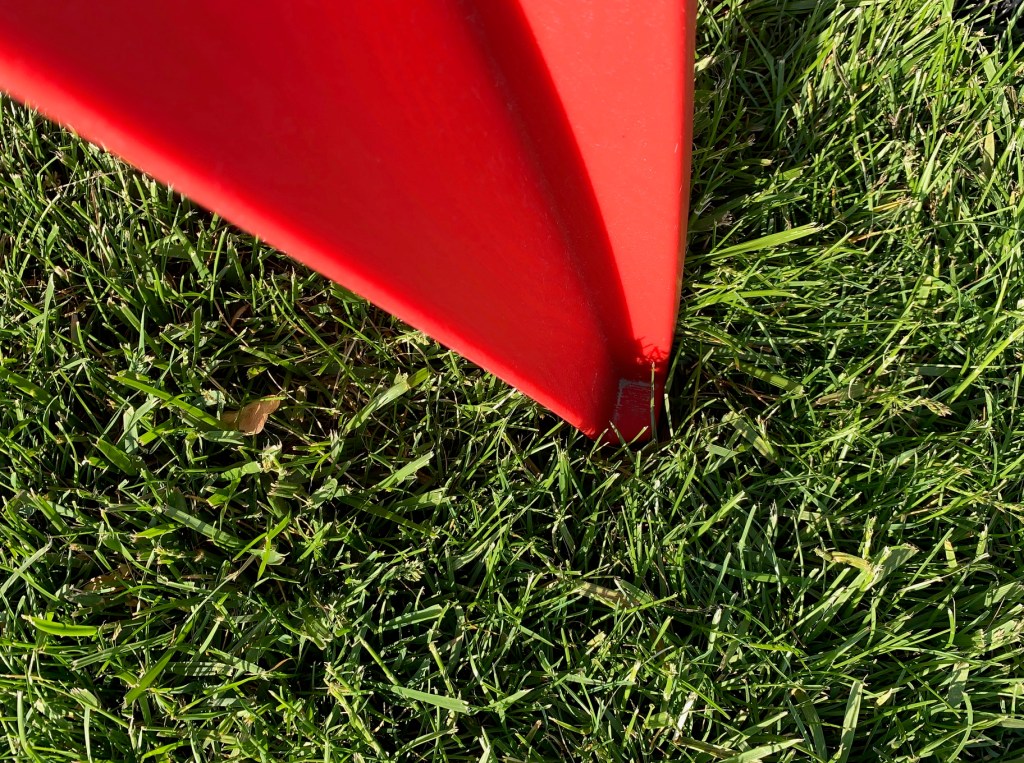
I am a big believer in happy accidents. Kerri didn’t intend to take this photo. A vibrant shock of red thrust into a field of green. I’m tempted to slap a title on it and enter it into a contemporary photography exhibition.

I’ve read that serendipity, an “unplanned fortunate discovery,…is a common occurrence throughout the history of product invention and scientific discovery.” It’s also a common occurrence throughout the history of art. It’s also a common occurrence throughout the history of…history. We have experiences and then we make meaning of them. Not the other way around.

I suppose we pride ourselves on our capacity “to know” so we forget that all knowledge is the result of a stumble, a discovery found at the far end of curiosity, exploration or an outright mistake. The point of a hypothesis (to borrow a term from Quinn) is to cultivate serendipity. Try it and see what happens.

I’ve been following the conversation in the tech-o-sphere about the sudden blossom of the very lucrative job “phrase engineer.” Human beings attempting through trial and error to learn how best to converse with the technology we’ve created. AI. ChatGpt. The unspoken goals are (not surprisingly) efficient and effective communication. There are now several sites with useful phrases, conversational hints, Youtubes abound with guidance for best ways to ask better questions, quickly eliciting the best result: an answer. It’s glorious and reminds me of old 3rd grade language primers or my high school foreign language class – only more enthusiastic.

I am among the millions who hope beyond hope that someone-out-there bumbles into the secret of effective communication. Perhaps if we discover how to communicate with artificial intelligence there will be a profound blowback and we will, serendipitously, discover the secret of easy communication with each other. Generosity. Empathy. Kindness. How-you-say-what-you-say matters.

“AI, tell me what you see and I will listen with an open mind and heart.” I know, I know. More pie-in-the-sky. But as a dedicated believer in happy accidents, I’m given to think that anything is possible.

read Kerri’s blogpost about RED ON GREEN

like it. share it. buyusacoffee. tell us your thoughts. all are appreciated.

Creative Think [on Merely A Thought Monday]

The truth is that I could talk with MM all day. Our calls are few and far between but it always feels as if we’re picking up a conversation from yesterday. His perspective on life is vast, deeply rooted like an oak tree, yet simple enough to play on a banjo. As per usual, he left me with a head-full-of-thoughts-to-think.

One of the thought-rocks he dropped on my head was this: we’ve lost touch with our connection to the humanities. And, we’ve lost that connection, not by accident, but through reckless intention. Years ago I was wide-eyed with disbelief when the local school system stripped history and the humanities from their course offerings to make more room for STEM; science, technology, engineering and math. “Short-sighted and fundamentally stupid,” I said to no one listening. Art was long gone. Music was nowhere to be found.

It’s hard to measure the real worth of the humanities on a test so it was sailed off the edge-of-the-curriculum-world. What , exactly, is the value of kindness, the worth of considering others, the merit of empathy and understanding interconnectivity? How important is it to know where you come from? The origin and cycles of knowledge and the grand mistakes of the past? What might be your intellectual lineage, your moral ancestry? How important is it to consider opposing ideas, to recognize there are many ways of seeing a single event? What happened the last time an out-of-control authoritarian impulse attempted to quash a diversity of opinion? How worthwhile might it be to understand that democracy is nothing more or less than an idea about how humans might create community together? It is not a given. It is not a fact. It is an ongoing relationship. The province of the humanities.

The operative word is “together.”

I laughed aloud the day after my call with MM. Two articles crossed my screen. Because I’m searching for jobs I’m paying attention to articles like The Ten Most Important Skills For Workers. You’ll not be surprised to learn that analytical thinking currently tops the chart but the king is about to be unseated by a new/old champion: creative thinking. Also rising in the top ten are “curiosity and lifelong learning” and “motivation and self-awareness” Of course, “unmotivated and unconscious” have probably never topped the list of desirable skills…though most factory work – and varieties of corporate work – generally produce those qualities in previously motivated human beings.

[I take a moment of silence to recount the multiple times I have, in my life, been told I was un-hire-able because I was too creative. “You’ll see how to improve things and want to make changes,” a manager famously told me. “My job,” he said, “is to keep that from happening. To maintain the status quo.” In another famous jaw-dropping moment, a potential employer told me I was not an attractive hire because I was educated so, “I would want things.”]. A cautionary tale to all those who currently fear exposure to ideas and the other purported horrors of the humanities and a fully educated mind.

Educated = curious = questioning. It’s simple.

Listen to Sir Ken Robinson ask a still-relevant question about whether or not our schools kill creativity. Killing creativity is the same as killing the humanities. Killing our humanity.

Ultimately the horse race between the analytical and the creative is itself symptom of the schooled ignorance. They are not really separate things. The right brain and left brain are only detached for the sake of study and discourse. They are ends of a spectrum and one cannot exist without the other. Like science and art: both are concerned with dancing to the beating heart and movement of the universe. They are two ways of walking at the yet-unknown. They are not oppositional.

Another quote from MM roared into my mind: if you ignore 100,000 years of human evolution, you might-could just miss the fundamentals.

It’s consilience. The unity of knowledge. The whole system. Heart and brain and gut. That’s the loop that MM and I regularly travel. We circle out and return once again to E.O. Wilson.

“One day we’ll figure it out,” posits MM. It’s another reason I adore our conversations: with his tongue firmly planted in his cheek, he is, all the same, infinitely hope-full.

read Kerri’s blogpost about CREATIVE THINKING

like? share? comment? coffee? (QR or link) all are greatly appreciated.

Nod [on saturday morning smack-dab.]

There is a lesson I receive again and again but – for obvious reasons – the penny refuses to drop. The learning hits me and slides off my Teflon brainpan. The lesson is this: Listen, don’t solve. Especially in the middle of the night. Particularly in the middle of the night. My job is to nod, nothing more.

The reason for my late night ineptitude? At the risk of reinforcing a stereotype, I am a male. I am hardwired to solve. When I’m tired I have no editor. Okay, when I’m rested, I have no editor so imagine my predicament in the dark hours.

It’s shocking. Since so much of my career was built on my great capacity to listen, I am sometimes astounded at how quickly I begin my lobby for a solution.

Dogga looks at me and shakes his head. I know what he’s thinking. “He’ll never learn.” It’s true. I can say with the utmost confidence that last night’s lesson is already forgotten and I am fully prepared to learn it again tonight.

read Kerri’s blogpost about LISTEN

smack-dab. © 2023 kerrianddavid.com

Open The Binder [on Merely A Thought Monday]

He was referred to me because he was failing. His English teacher told me that he was impossible, that he rarely came to class and he “just wasn’t interested in writing.” At the time I was working at the “alternative school” running an independent study program. My job was “to catch the students that were falling through the cracks” or “to retrieve the students who’d already fallen.” To this day, the language kills me.

We talked. We laughed. The assignments I gave him were about fun and breathing space. After three sessions, when he trusted me not to judge him, he came to our appointment with a thick black binder. It was very old. The seams were ripping. It was a sacred object. He tapped his fingers on the cover, still deciding whether or not to share it with me. He wriggled in his chair, vulnerable.

I will always remember the moment he asked, “Can I show you something?” I felt honored. It is what I always feel when an artist comes out of hiding and shares their work with me.

He gingerly opened the binder. It was literally bursting with stories that he’d written and alive with illustrations that he’d drawn. This young man was ditching English class so he could hide in the football stadium and write stories.

I asked him to read to me. As he read, he made marks on the page. “What are you doing?” I asked.

“Making changes.”

After a few sessions I asked questions about the characters. He shared his illustrations. One day, he came to our session with a new story complete with sketches that we placed in sequence across the floor. As he read, we stepped to the next drawing. And the next. He made more marks on his pages. He made notes on his sketches.

One day I asked if I could read one of his stories to him. As he listened to me read, he began to coach my reading. “Whoa! Did I write that?” he said, grabbing the pages from my hand. And then he asked, “How can I write that in a better way?”

“I don’t know,” I smiled. “What does it mean to be better?”

read Kerri’s blogpost about BE YOU