Skip The Handbook

We walked some great beaches this summer. In this post are my three most recent paintings. Kerri calls them the start of my Beach Series. This one is called, They Draw The Sunset In The Sand

I just made myself laugh out loud. “Lol!” I’d have texted to myself had I not been breathless from my guffaw. No one can accuse me of needing to be entertained.

I was writing about my history with curators, galleries and their consistent criticism of my work: I am stylistically all over the map. And, it’s a valid criticism! I am stylistically schizophrenic. I was overcome with laughter by what I wrote after using the words ‘stylistically schizophrenic:’ If I didn’t know myself (and, most of the time I am the last person to see in myself what is obvious to all – so it is a solid argument to make that I do not know myself)…. Wow. I might have made a good lawyer had I not been so dedicated to seeing things from multiple points of view. My paintings reflect my dedication (as it should be).

When I was younger I tried repeatedly to squeeze myself into a stylistic box. I thought that the advice and feedback I was receiving from gallery representatives meant that I was somehow lacking or out of control. In the handbook of real artists it must say in bold print something about possessing a consistent style. The youthful me looked all over creation for a copy of the handbook but could find it nowhere. How could I call myself an artist if I had not first read the handbook?

This one is titled, A Day At The Beach

My attempts ‘to fit’ into the single style rule made me miserable and, worse, made my work stale. In my mind, achieving real-artist-status meant I must learn to contort myself yet the price of contortion was very high. Twice in my life I took a year long hiatus because my attempt to fit into a single-style-box left me with deep aches and no creative fire. Once, so burdened was I by the pain of my contortion, I burned most of my paintings.

Fire is cleansing. Creative fire is clarifying. I have learned through my fire that the real handbook is internal and uniquely personal. As John once said to me, “Your job is to paint the paintings not to determine how or where they fit.” The painters I admire and feel a kinship with are stylistic pantheists. They are more visual explorers than technical geniuses.

There is a bridge that every artist must cross. It comes in the moment when the inner compass is no longer at odds with the necessities of learning technique, when the well-meaning comments of teachers and mentors and agents and representatives are just that: well-meaning comments. The compass, your internal rulebook, will let you know without doubt whether the comment needs to be considered or discarded. Growth happens either way.

This one is untitled at the moment…

visit www.davidrobinsoncreative.com to see the full extent of my stylistic pantheism.


Meet Your Obligation

a detail of my latest – and yet unnamed – painting

“I feel like I have an obligation to live,” she said, in response to the question from the audience.

Joyce Maynard was reading from her latest book, The Best Of Us, at The Book Stall, an independent bookstore in little downtown Winnetka. Kerri has been a huge fan for many years but had never been able to attend a reading so we jumped at the opportunity. The Best Of Us is a memoir. In 2011, in her late fifties, Joyce met her “first true partner.” A year into their marriage he was diagnosed with pancreatic cancer and died 19 months later. Her book is the story of their all-to-brief time together.

“It’s not a book about death,” she said, “It’s a book about learning what love really is. What is truly important in life.” She added, “I don’t think people should have to pay 20 bucks for my catharsis.”

An obligation to live. I loved the phrase and all that it implied. Sometimes life collapses. This week, we remembered 9/11. We watched Irma wreak havoc on the heels of the devastation of Harvey. Fires burn homes and lives in the west. Listening to Joyce Maynard read from her book, I felt as if Viktor Frankl was sitting beside me whispering, “See! She is not looking for meaning where none can be found. She is making meaning. She is giving meaning to her path. That is the ultimate creative act!”

It is the fire that burns beneath an obligation to live. To not waste another moment of this amazing life seeking for that which cannot be found; but it can be given.

Save

Be An Instrument Of Peace

I asked Kerri which of my recent paintings most accurately represented me as an artist. I was building a new website and wanted my home page to highlight a single painting. Without hesitation, she said, “The one titled, He’s A Stubborn Pain In The Ass.” I’d have protested but I knew my protests would be drowned out by her gales of laughter.

When she could breathe again, she said, “Use ‘An Instrument Of Peace.’ It’s the painting that best defines you as an artist. It’s what you bring.”

I am always excited to enter the studio to work because, for me, it is a place of peace. It is THE place of peace. And, as such, it is the place of clarity. When painting, my mind is silent. Peace is a quiet place. It is dynamic, immediate.

It’s a paradox that I enjoy. Peace is more practical than paradise. It lives beyond the turmoil of story and ideals and points of view and resistance. It lives beyond thinking and striving in any form. It is methodical-miraculous.

Horatio and I have often talked of entering the studio and disappearing into work, of becoming present. In other words, we stop ‘becoming’ entirely and simply ‘be.’ The epicenter of the paradox: creating in the absence of striving. It sounds like an ideal, doesn’t it? It sings like an impossible hippie aspiration or a Bob Dylan lyric. The Buddhists have a shorthand phrase for this practical peace: chop wood, carry water. In other words, it is not found in what you do. It is enlivened by how you are within what you do.

Krishnamurti wrote that if you want peace in the world you first must be peaceful. The phrase, Be Peaceful, is appropriately redundant: you will be peaceful if at first you learn to BE.

The trick, as someone once taught me, is to make all the world my studio. After all, it is not the place, not the studio. It is me. I can’t think of anything I’d rather bring to the world than to create as an instrument of peace, to –maybe- be an instrument of peace.

The new website: davidrobinsoncreative.com


Be A Nart

My latest: A Day At The Beach

John inadvertently coined my favorite word of the week. We were sipping wine, watching the fire burn in the chiminea, and he was telling us about a recent trip to the Milwaukee Art Museum. It was his first visit and he was thrilled by it. In a moment of brilliant thought collision, he said, “I’m a Nart.” His eyebrows knit and eyes crossed at the force of the collision. “What I meant to say,” he said, shaking his head, “is that I am not very well versed in the arts.” We laughed heartily. A new word was born.

Nart (noun) – a person not well versed in the arts.

When people talk with me and Kerri about their encounters with the arts they often include a disclaimer as if we are, as artists, universal experts (and critics) of all artistic experiences. I told John that, even as an artist, I feel that I, too, am a Nart. I’ve studied it, experienced it, practiced it, rejected it, claimed it, been lost in it, found in it, baffled by it, thrilled by it, transported, disappointed, confused, bored, energized, fed and starved by it. The longer I do it, the deeper into it I walk, the less I am able to put my arms around it.

It is impossible to contain. It is impossible to plumb the depths of it.

In my younger years I was intimidated by this vastness. I thought my job was to grasp it. It was – and is – a calling and I felt inadequate to the call. Now, I understand that my job is not to grasp or contain or to know. My job is to experience it. And, to relate what I experience. I will never be able to express all that is living within me. I will never have enough life to find its (my) edges.

Art is intimate and public, deeply person and intrinsically communal. It can heal or destroy. I have never been more lonely than when standing empty in front of a canvas. I have never been more fulfilled that standing before a finished canvas wondering where the past few days went.

Roger once told me that, where the arts are concerned, there are levels of sophistication. Shakespeare, like fine wine, is not immediately accessible. It takes time for black-and-white thinkers to develop a socket for metaphor to plug into. Art, after all, is not a thing. It is a relationship. The more time you give it, the more experiences you have with it, the more rich and complex it becomes. It opens. You open. If you are lucky, it is a yoga (a practice) that is necessarily personal in a never ending pursuit of greater range and flexibility.

Greater range and flexibility can only be found when you are a Nart. Relationships are made vital in not-knowing. Those who think they know have stopped seeking. They have stopped relating. To believe you know, is to stagnate.

Although I didn’t say it, it would have made John re-knit his brow, but he is lucky to be a Nart. I hope that will always be so.

Don’t Ask Why

DR 002

From my archives. I call this painting Alki Beach.

When I woke up this morning, researching the color blue was not on my to-do list. Did you know that in Belgium blue is the color associated with baby girls? Pink is for boys. To be blue in the German-speaking world means to be drunk rather than the English assignment of depression. Color associations are cultural.

I jumped down the rabbit hole of color symbolism and meanings because I’ve been building a new catalogue for my paintings. I’ve been revisiting the eras of my work, looking at every painting I’ve done (those that I documented…). A few days into my cataloguing Linda asked me why I never paint with the color blue. Linda loves the color blue. She is a veritable celebration of blue in earth, air, and water. “You never use blue!” she exclaimed. “Why?”

BlanketOfBlueSky

A Blanket Of Blue Sky

“I always use blue,” I sputtered, convincing no one. Since my move from Seattle to Kenosha my paintings have been more earth tones, umbers and sienna. The blues are there but certainly not dominant. Linda has never seen the work from my blue period.

“Why don’t you use more blue?” she laughed.

‘Why’ is one of those words that can either bring you to clarity or will drive you crazy. Knowing ‘why’ is useful in a Simon Sinek seminar or valuable in the pursuit of a purpose driven life but is near-to-impossible when attempting to articulate an artistic choice. The top two responses are conversation stoppers: 1) I don’t know, and 2) It feels right. I suppose there is a third response, the anti-why: 3) why not? It, too, leaves no room for discourse and is generally a lousy explanation.

IslandDreaming

This one is called Island Dreaming

“Why don’t I use more blue?” I asked Kerri. Without looking up or missing a beat she responded, “Why don’t I use seventh chords?” Leave it to my wife to hit me with a musical-zen-koan.

Horatio often reminds me that to enter the studio is to also enter stillness. Working in and from stillness precludes all questions of why and how.

Did you know that blue is the most commonly used color in corporate identity and that it is a color rarely found in fruits and vegetables? It has more complex and contradictory meanings than any other color. Among the seven billion people on earth, roughly 4 billion of them prefer blue to any other color.

This morning while entering images into my catalogue – most were predominantly blue – I heard the echo of Linda’s question. “What’s up with blue?” I asked myself. Abdicating all responsibility for internal answers, I did what we all do at such moments: I turned to Google.

Did you know that blue is generally embraced as the color of heaven?

Why?


Shared Fatherhood

My latest: Shared Fatherhood.


Dance With Parallax

My favorite word of the week is ‘parallax.’ Horatio pulled it out of the word bin during our latest conversation about art and artistry. We were discussing the difference between what an artist sees in their work and what others see – and how artistic “sight” changes over time. I scribbled the word along with the phrase, “the difference in what you see and what others see. Perspective over time.” After our call I looked up the word in my dictionary:

paral-lax (noun) 1. Apparent change of position. 2. Angle measuring star’s distance from Earth.

Many years ago in a fit of vulnerability I showed my mentor, a great theatre and visual artist, my paintings. I lined them all up for him to see. I followed him around the room as he quietly studied each piece. Finally, after taking in all of my work, he asked, “What’s the meaning of the spheres?” I was dumbfounded and had no idea what he was asking. “Spheres? What spheres?” So he led me back around the room, revisiting each painting, showing me the three spheres that appeared in EVERY single painting.

“What’s with the spheres?” he repeated, knowing that there wasn’t an answer but there was certainly a vast new question. My universe spun a bit that day so astounded was I at my inability to see the unifying principle in my own paintings.

I needed his eyes to see my work. Isn’t that the point?

When I think back on that day, on that younger version of my self, I revisit the fear, the raging vulnerability I felt in sharing my paintings. I feel again the deep doubt I held against myself. I recall the nausea of inviting someone I admired into my house of doubt. I somehow believed that, to be an artist, I had “to know” what I was doing – yet knew with certainty that I had no idea what I was doing. I knew with certainty that he would see through me to my lack of knowing.

And, he did. Thank goodness. “What’s with the spheres?” Such a simple question yet it spun my universe and pitched me through the portal of a new perspective.

I learned that day that artistry has nothing to do with knowing. Life has nothing to do with knowing. Knowing is an illusion, temporary at best. Knowing has everything to do with hiding.

Making a life, as Master Marsh just reminded me, is an engagement with the unknown. It is to have experiences. It is to make meaning of the experiences. If you are lucky, you learn to have the experiences first, and make the meaning second. It is to understand that, in this dance of knowing and not-knowing, sight and blindness, chaos and order, consciousness and unconsciousness, there are no fixed points. There is dance:

dance (noun) 1. An act of stepping or moving through a series of movements.


fine art prints available at society6.com

my original work on zatista.com

Save

Change Nothing

a detail from In Peace I Pray.

Thoughts from the mountain.

I grew up with these mountains so it should come as no surprise that I get quiet the moment I step into them. Like a too-tight coat the chaos I wear in my day-to-day life simply drops off; stepping into the mountain is to step out of the noise. Literally and figuratively.

Tom once told me that people change when they are ready. Rich once told me that people change when the pain of staying the same grows greater than the pain of making the change. Change when you are ready, change when you are in pain. Skip taught me that a business intending to change people was destined to fail. It is a fool’s errand. Business is about business not change. I loved this bit of advice from Skip because he is a natural-born change agent, a mentor of mentors (and, poetically, entrepreneurs). In a moment of frustration Kerri told me that people don’t change, they simply become more of who they really are. The masks drop off and we unwittingly reveal ourselves. Change as revelation.

As I hike through the snow toward the summit I wonder if change, at least the human notion of change, is as made-up as the rest of the stories we tell. It is in the forest, which is a festival of the cycles of life, that ideas of different ways of Being seem…superficial. Disconnected. Within seasons there are plenty of changes that roll around and around and around again. Perhaps this thing we call ‘change’ is nothing more than a recognition of the cycle, a readiness to release our dedicated resistance to life? A readiness to release our stories of limitation and division.

Kerri caught me staring at the mountain

Toward the end of his life, Joseph Campbell said that he suspected that all life (energy) was consciousness. There is 1) energy and 2) the forms that energy takes. Although seemingly disparate, seemingly separate, all forms fall back into energy. He said, “The universe throws forms up, then takes them down again.”He might have said that change is nothing more than the cyclical movement between energy and the forms it expresses.

Jim taught me that the art of acting was the art of being present. I know that when I stand in front of a canvas and begin to work, all notions of time disappear. Another day on the mountain, sitting in an adirondack chair midway up the slope, basking in the sun on warm day, we watched Kirsten snowboard. She flew by us several times. When she rides, it is clear, there is no other place, there is no past or future. There is now. She is vital, alive. In that place, riding the present moment (the only place that actually exists), the noise drops off. I know, and Jim knew, when fully in this moment there is no need to pester yourself with misplaced notions of being somewhere else, being anyone else.


a blast from the waaay past: August Ride. I lost track of this one and if you know where this painting is, let me know.

Hold Hands And Step

Today, I believe the single greatest obstacle we throw in our way, the single greatest disservice we plant in our children, the unfortunate self-imposed exile many seniors adopt, the great source of interruption to all creative dreams and dreamers, is this: the ridiculous notion that one must know “how” to do anything before starting to do it.

Knowing “how” comes second.

The opportunity to look back and see “how” comes (necessarily) at the end of the process, not at the beginning. To learn, one must begin by not knowing “how.” Not-knowing-how is the basic assumption of lively, active, creative beings.

The second assumption: no one does this walk alone. No one knows all things. To successfully not-know-how invites the opportunity to ask questions of others. Hold hands and step.

Peter Block wrote a terrific book with a title that says it all: The Answer to How is Yes.

Honor All Perspectives

my latest painting. Hope asks, “What do you see?”

Hope Hughes, Kerri’s longtime assistant and voice of reason in all-things-business, passed through my studio and flung herself in front of the painting I was working on. “Stop!” she cried. “Don’t touch it! It’s finished!”

“Finished? I just started,” I whined. She laughed at the perplexed look on my face.

“Put down your brushes,” she smiled, “and listen for a minute.”

Over time I’ve learned to listen to Hope. She makes sense of the world through her feelings which comes in handy to an over-cerebral artist like me. She has no inner-editor in the early stages of communication so I’ve learned her heroics are pure. She sees something that I do not. This is not the first time Hope has thrust herself between me and the painting I am about to destroy, so when she asks me to ‘look’ there is usually a good reason. I set down my brushes, cross my arms, and huff as if to say, “I’m listening but make it fast.”

Each time she begs me to stop work on a painting, a great debate rages in the household. This time was no exception. I sit in my chair and listen to what she sees. It is always diametrically opposed to what I see so I pretend to pout (I secretly love this process because it is EXACTLY what I adore about art in general and painting in particular). She tries to get me to tell her what I intended to paint, coaxing me to talk about what I see but I refuse. As Joseph Campbell once said, “If an artist respects you, s/he will not tell you what a painting means. ” Art is always about a relationship between the piece and the viewer and the artist needs to stay out of the way. If the artist has no respect for you (or themself), s/he will tell you what the painting means to them. I respect Hope so I stay out of the way.

In this painting, Hope sees deep humility in dual fatherhood.

My refusal drags other people into the fray. She snaps a photo of the painting and then shares it with others, asking what they see in the painting, what descriptors they would use. As is always the case, the replies sometimes align with her perception and sometimes not which further fuels the debate. 20 had the misfortune of coming over for dinner and he was subjected to the photograph test.

In this painting, 20 sees grief and loss. In this aspect he agreed with Hope: the painting is finished.

When I first started showing paintings I would follow patrons through the gallery (they did not know I was the artist) and listen to their perceptions. They rarely saw what I intended but what they saw was marvelous – almost miraculous to me. It was an advanced course in understanding the futility of trying to determine what another person perceives. Art, I learned in those days, is a living relationship. Perception is personal. No one is a blank slate. Paintings evoke. The meaning is made between the patron and the painting.

I enter into the studio to drop out of my many descriptors and over-cerebral tendencies. I go to the studio to engage in a pure relationship with…my muse(?) I am never more alive than when I am painting. I am never more quiet than when I am painting. The images that emerge from my quiet are sometimes incidental, always surprising, and are sometimes just a map of a moment in the greater relationship of my life. Only a moment. I feel that I have never finished a painting because the paintings themselves are not distinct, separate from each other. They are living things. They change over time. They are moments, marks in the sand in a greater ongoing relationship in the long-body of my life.

What do I see in this painting? It is not important to know. Is it finished? For me, never. And, and for Hope, yes.

Every artist needs a Hope Hughes. Someone they trust, someone they respect to step in front of their work and without editor, tell them what they see. Hope reminds me that the true value/purpose of art is to create a commons capable of affording multiple perspectives and the rich opportunity to discuss the differences in what we perceive.

Make Purple

Polynieces and Eteocles

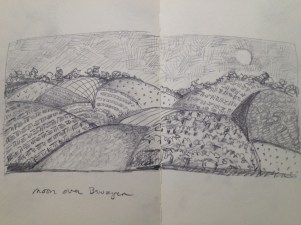
I dug out an old drawing this morning. I’ve been thinking about it for days and finally decided to heed the impulse and find it. I drew it years ago, a study for a large canvas I intended to execute but the timing wasn’t right or the thought was not complete. I can’t remember. It would have been a statement piece, based on a myth. Polynieces and Eteocles, two brothers fighting for control of the kingdom after the death of their father, Oedipus. They refused to share the riches. They lost sight of the kingdom in their lust for control and killed each other in their battle. Both lost.

I remembered the drawing after reading the daily news. It popped into my head as an image that seemed relevant as I listened to the intensity and insanity of the blues and the reds. These days I hear a lot of rhetoric about what is good for “the American people” and I am certain – it is among the dwindling things I am certain of – that these diverging rhetorical paths are not good for anyone. The kingdom is nowhere to be found, so lost are we in the power struggle, the alternative-truth-games and all of the accompanying hyperbole.

Recently 20 came over for dinner. He read to us a disturbing article from the newspaper and asked, “So, do you think we have it all upside down?” It was, of course, a rhetorical question. The article was from a February 12th issue of The New York Times, Husbands Are Deadlier Than Terrorists, by Nicholas Kristof. It was an appeal to stay focused on what matters in the midst of so many smoke-and-mirror-power-play intentions. It was a plea to not be lost in the diversions:

            “Consider two critical issues: refugees and guns. Trump is going berserk over the former, but wants to ease the rules on the latter….In the four decades between 1975 and 2015, terrorists born in the seven nations in Trump’s travel ban killed zero people in America, according to the Cato Institute. Zero.

            In that same period, guns claimed 1.34 million lives in America, including murders, suicides and accidents. That’s about as many people as live in Boston and Seattle combined.”

           It’s also roughly as many Americans as died in all the wars in American history since the American Revolution….”

There is, admittedly, much to fear in this world but it is rarely where we pin the blame. Insanity almost never recognizes itself.

According to the myth, Oedipus put a curse on his sons. That was the reason they could not peacefully share the rule of the kingdom. It was a curse. They couldn’t help it. So, it was their fate. No lesson learned. No growth possible.

We have a long legacy of using inequity to create and reinforce division. Perhaps that is the curse we inherited? That is the “reason” we cannot find common ground and shared governance? Is it our fate to murder each other and project the danger onto the people least capable of defending themselves: the current wave of immigrants? It seems lazy but certainly appears to be effective.

It might now be time to execute my painting. I’ve lately been focusing on grace and images of internal peace. I seem to be out of accord with the times in which I am living. According to the data we are killing each other faster, more efficiently and more eagerly than any external threat. All the while our ruling class seems singularly devoted to keeping us in primary color-coded camps rather than working with the creative tension that moves divisions in a unified direction. And, we seem singularly devoted to playing along, not a hint of purple to be found.

Art is, after all, an expression of who we are and I can find no other more relevant American image. It will, of course, be a symphony of reds and blues.


Save