Share Through Your Eyes [David’s blog on Not So Flawed Wednesday]

We slept on the living room floor last night. Our chugga-chugga air conditioner doesn’t reach our bedroom at the back of the house. Record breaking heat drove us to improvisation. “We’re camping!” we exclaimed, spreading blankets on the throw-rug, Dogga jumping with enthusiasm into our bed-making-attempts, ruffling our efforts.

In the morning, we could barely move. “My shoulder is killing me!” I whined.

“My hips are burning,” she frowned.

We laughed and together howled, “OUCH!” I creaked to the kitchen to make coffee.

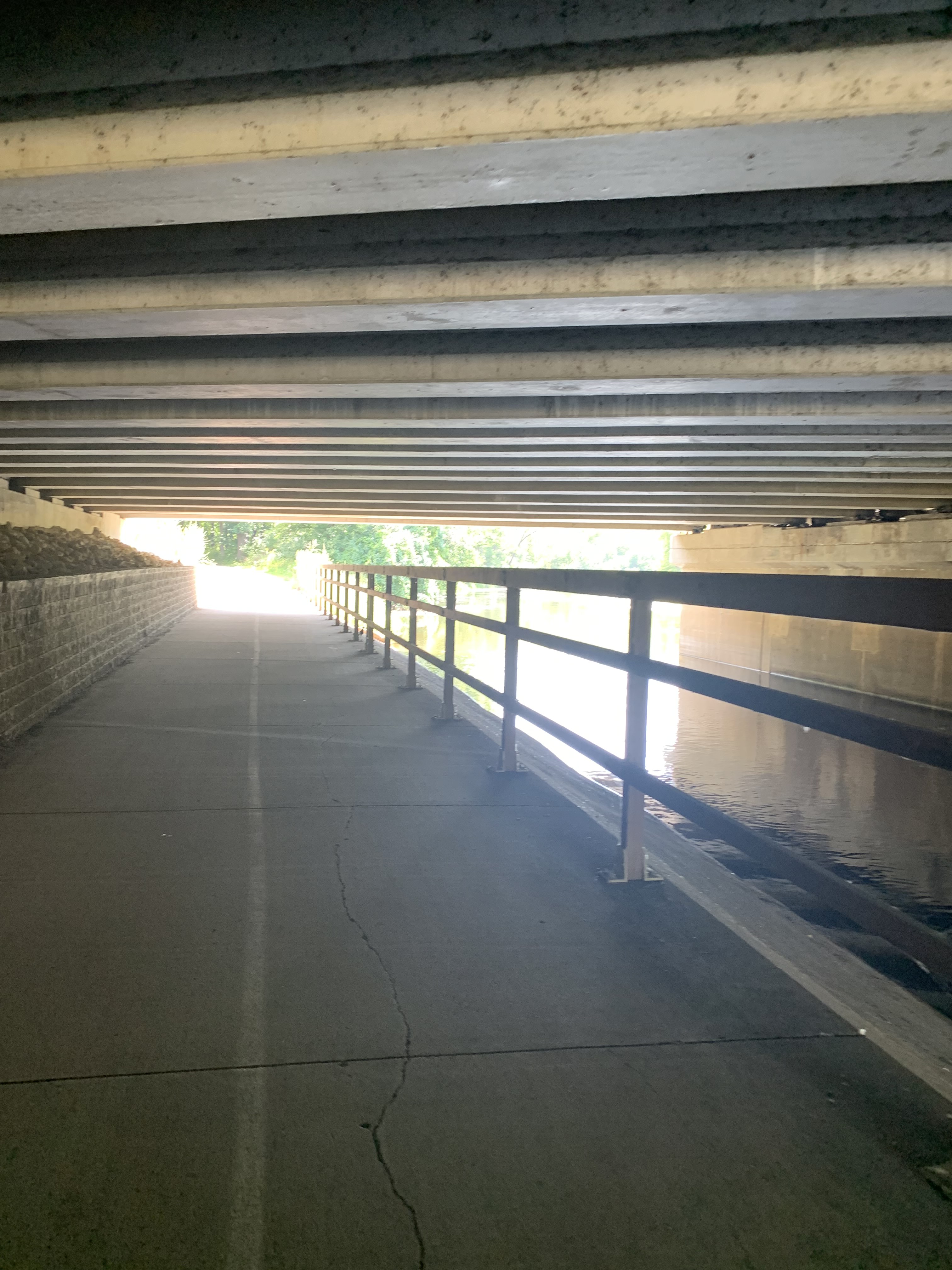
While waiting for the coffee to brew I thought of the underpass. On Saturday we explored a new part of the river trail that ran beneath several busy roads, including the interstate highway. As we left the heat of the sun and entered the cool of the underpass, Kerri asked, “Do you think people sleep under here?”

“Yes, I do.”

Standing at the coffeemaker I was awash with thankfulness. I slept on the floor by choice. Our dog woke us this morning nuzzling our faces. Our ancient air conditioner kept us cool through a brutally hot night. We laughed at our aches and pain.

It’s funny the way thoughts tumble and connect with memory, constellating into well-worn images or plowing new conceptual pathways. Udayana University, Bali. One of my graduate school peers had just completed a presentation on homelessness in the United States. The Udayana faculty was horrified. “But you are the richest country on earth,” a wide-eyed Balinese professor stuttered. “How can you let a member of your community go without a home?” To him, it was the height of shame for a community not to care for their own. It was, in fact, inconceivable. This moment was central to my memory: I saw in his eyes the high esteem he held for us fall into the dark basement. He was suddenly very proud to be Balinese. His community might not have financial resources but they had a form of wealth that made paupers of his American guests.

“It’s the contrast principle”, 20 says. Oppositions illuminate. Cultural differences clarify. What we normalize we cease seeing. I’ve stepped over people sleeping in the street. In Seattle, I routinely rode my bike on paths under a freeway lined with tents and shopping-cart-possessions. In Bali, a man stopped his work in the fields and walked with me because it was rude to let a guest walk alone. We did not speak because we did not share a common language. When I reached my destination, we nodded and shared through our eyes that most universal of gratitudes: genuine appreciation for the companionship of the other; an authentic wish for the well-being of all.

read Kerri’s blogpost about THE UNDERPASS

like. share. support. comment. thank you
Join The Kerfuffle [on Two Artists Tuesday]

Rob and I have been having a text conversation about AI. For him, an Orwellian curtain is descending. For me it’s a pattern: progress that pushes people into the unknown always ignites a kerfuffle.

Months ago Skip suggested that I jump into the dialogue raging around phrase engineering for AI. Basically, people learning better ways to ask the technology for more efficient and effective results. As a visual artist and a writer, he believed I might be able to stand with a foot in both evolving camps. Cross disciplines. I thought about it. Read everything I could find. I decided against. As an artist, someone who’s taken his artistry into the wilds of organizations, education, change initiatives, DEI, intercultural communication, coaching, software start-ups…a cross-pollinator – I’ve shouted my perceptions at the top of my lungs but rarely found ears that would or could listen. Why should an engineer listen to an artist? Why should a CEO give credence to a theatre artist? There are many many reasons. The notion of doing the same old thing in the same old way in a new context made me…tired.

What is a new way?

I’ve read that the mission of the industrial age was to create technology capable of sparing or lessening human physical labor. The mission of the information age is to create technology capable of sparing us from the rigors of thought. All in service of making life easier.

My last exchange with Rob led me back to Neil Postman’s short forward to his book Amusing Ourselves To Death. “Huxley feared we’d become a trivial culture…” Rereading the forward I thought, “Spot on”. Among the many upsides, having something or someone else think for you definitely has a downside.

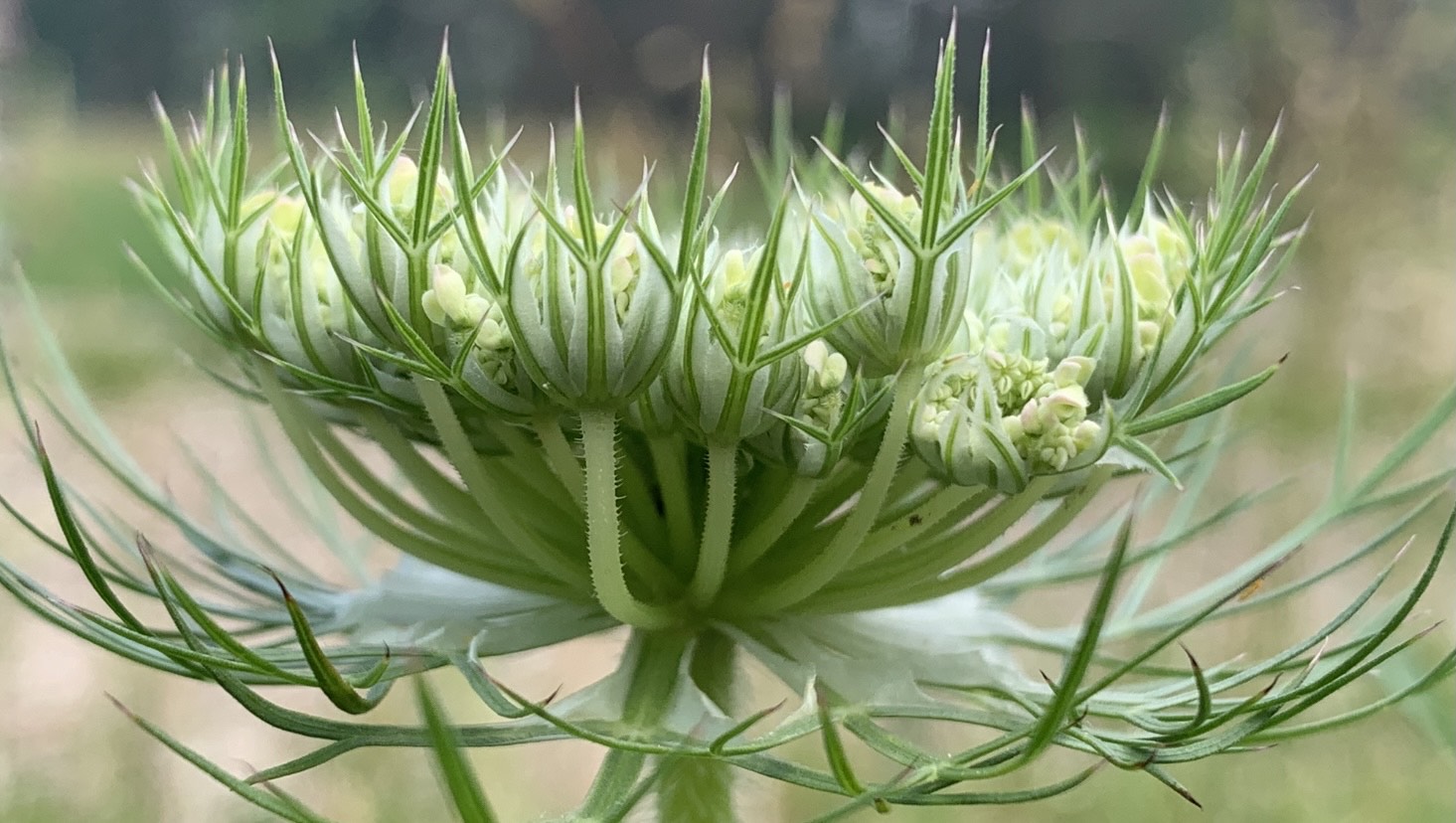
Perhaps our AI era will hold up a mirror so we might better see ourselves as part-of rather than separate-from. Perhaps all the space we gain in our brainpans, as we are spared the rigors of thought, will open new frontiers. It always has in the past. In a miracle of biomimicry, one of Skip’s creations in our start-up was a social network view: a visual of personal connectivity, an active map of all the people a user communicates with. The lines of connectivity were profoundly meaningful to me. The ability to see the thriving network active in my working life was a revelation. A pulsing flower, a wild carrot of interconnectivity. I appreciated my peers – my support system – in new ways because I could see them. My social network view made it undeniable: nothing I do, nothing I think, is independent of my community. We create.

Growth and learning is always in the direction of the unknown. Whether we realize it or not, even amidst the greatest kerfuffle, we take these bold steps together.

read Kerri’s blogpost about WILD CARROT

like it. share it. support it. comment on it. we appreciate it.

Learn The Language of Color [on DR Thursday]

Earlier this week I wrote of DeMarcus’ notes on color made when he was a first year art student. I flipped through the fading pages before placing the notebook back on my shelf and lingered on these gems:

“If we wish to create we must learn the Language of Color.”

“Color stands for JOY in this world of seeing.”

“Through the language of COLOR, we add JOY to the world of seeing.”

His notes are from a lecture. In my mind I see some fantastic art teacher, a life teacher, standing before a class of enthusiastic hearts that included the young DeMarcus, infusing them with a purpose that demanded they pay attention to others, to their reason for creating. Bring joy. Through the language of color, speak to a world that doesn’t know how to see. Speak to a world desperately in need of Joy. Color theory as community tending. Igniting the idea in the students, the teacher then set them free to explore how, through color, to bring joy to the world. The lesson was simultaneously both practical and existential.

I wish I knew the name of DeMarcus’ instructor. I’d send a deep debt of gratitude into the universe.

It is profoundly easy to diminish the role of artists in our culture. Note the dearth of art programs in schools. The emaciated National Endowment for the Arts relative to other budget lines. What might be more important in our times than artists striving to weave togetherness through the language of color? What might be more necessary than opening eyes to see beyond grey assumptions? We diminish ourselves when we devalue our art.

I knew DeMarcus when he was in his 90’s. Those early lessons still twinkled in his eyes. Or, perhaps, a lifetime of speaking the language of color, a lifetime of offering the joy of seeing, brought a permanent twinkle to his eye . He understood artistry as more than indulgent self-expression. He understood – and helped me understand – that artistry came with a responsibility to others as well as to the self. Service. See, in order to help others see, through the language of color, joy.

prayer of opposites, 48x48IN, acrylic on panel © 2006

my-as-yet-still-unfinished-site [I hope you’re not holding your breath]

read Kerri’s blogpost on COLOR

like it. share it. comment. buyusacoffee. thank you for reading our work.

Make It Visible [on Two Artists Tuesday]

“I believe that the very process of looking can make a thing beautiful.” ~ David Hockney

Sometimes I look at a blank canvas and see a composition. My job is to follow the image. To make it visible.

Sometimes I have an idea and I bring it to the canvas. My job is to explore the idea. To make it visible.

It’s a chicken-and-the-egg conundrum. What comes first? When I look at the peony do I see beauty or do I bring beauty to what I see? Is beauty a decision?

“Good-God!” I hear Kerri’s inner monologue-commentary on my too-ponderous questions. “Get out of your head! Smell the peonies!”

I wish I could. What happens when it’s not a peony that I see but my neighbor? Or someone whose worship is strange to me? Or someone with a different opinion?

Sometimes I look at a blank canvas. Sometimes I have an idea that I bring to it. Sometimes my job is to follow the image. Sometimes my job is to explore the idea.

The tricky part of language is that the biases are unseen. For instance, in English, the emphasis falls on the noun: me. Canvas. It implies the two are separate. Distinct. It obscures the relationship between. Connectivity is relegated to the basement, a lower status or obscured to the point of nonexistence. It fosters a philosophical orientation of…”it happens to me.”

Connectivity, once seen, once understood, requires us to recognize our responsibility for what we see. Our participation in the dance of creating what we see. In what we bring to “it”. What, exactly, do we wish to make visible?

read Kerri’s blogpost about the PEONY

Hold Space [on Not So Flawed Wednesday]

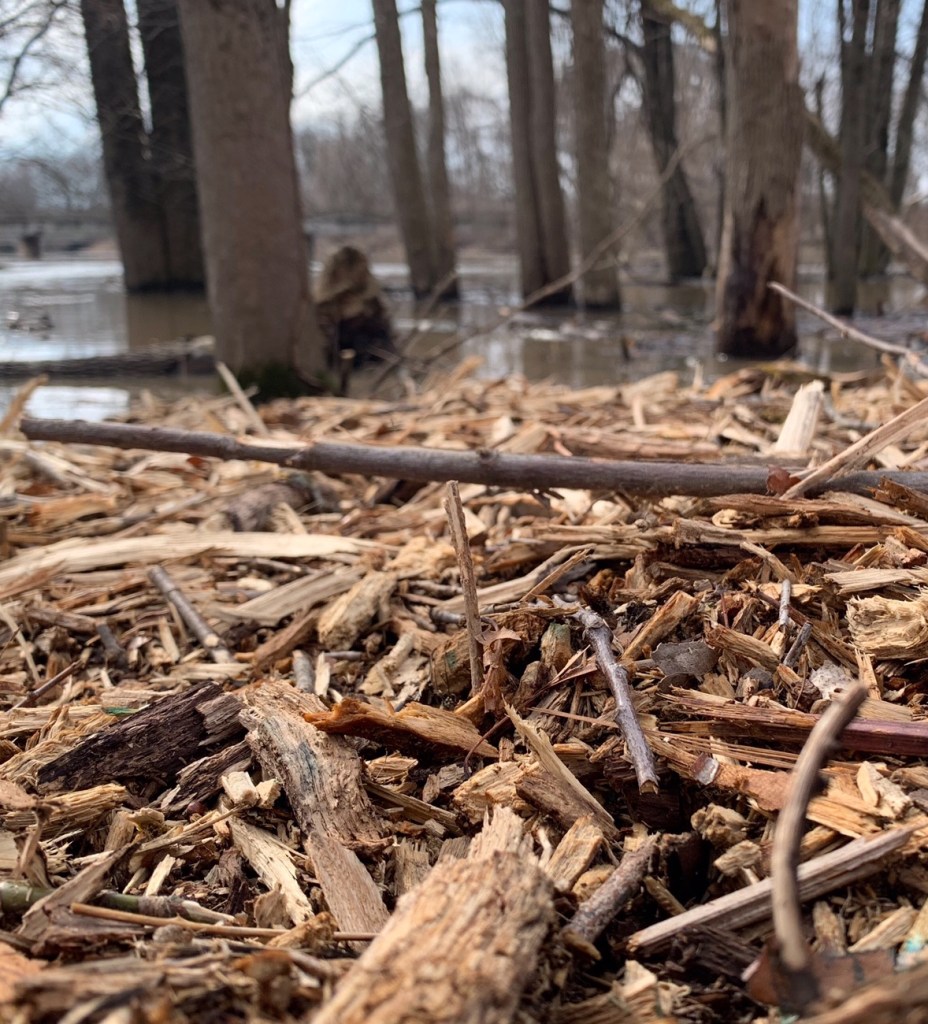
I just realized why the stripped forest is having such an impact on me. While opening the back door to let Dogga out, my dials spun and it slapped me in the face. I am like the forest.

For several minutes, staring at the photograph, writing then rejecting, then writing and again rejecting what I’d written, I decided to get up and let Dogga out. This picture was making me anxious. Moving around has always been good for me when I’m thought-wrestling.

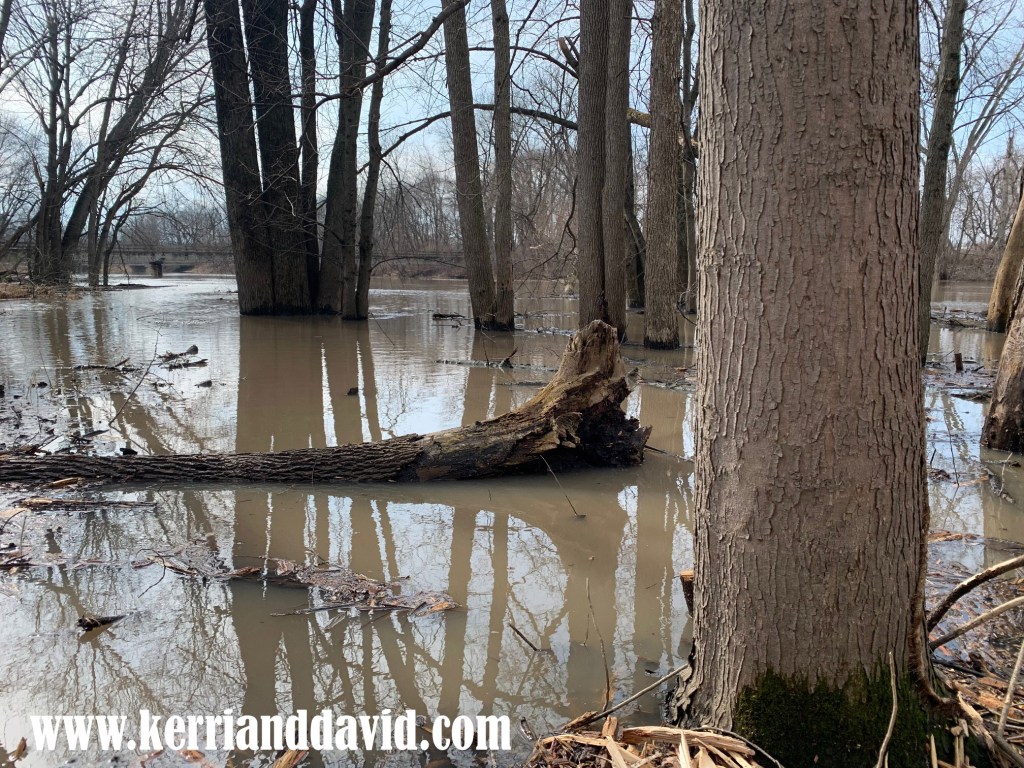
I am like this forest. Exposed. Chips and debris are everywhere. Water is overtaking the trees.

I was writing about a question Justin asked one night at dinner. “What’s your stance about secular Calvinism?” he asked.

“I don’t think I have one,” I replied. Justin’s eyebrows hit the ceiling and I made a snap decision not to follow my reply with an explanation. He was sorting his belief and searching his heart. Empty space was more useful than cramming my erudite-and-empty justification into the moment.

Insight requires space. Lots of space.

I wish I could express how rare it is for me to keep my mouth closed when I have a thought on a topic. Kerri will laugh aloud when I read this to her. “No joke!” she’ll say. I wanted to say to Justin, “I don’t have a stance because I think it’s a given.” His question was akin to asking about my stance on the existence of the moon. No culture sees itself clearly.

No person (me) sees himself clearly.

Chips and debris. The river has overrun its banks. One half of the photo is the result of natural forces. The other half is man-made. Choices. Circumstance and intention. This landscape, once so familiar, will never be the same.

I’ve spent my life cultivating my capacity to see pattern and metaphor. It’s an artist’s prerogative to make the strange familiar and the familiar strange. I am the forest. Familiar, yet completely unknown. Stripped for rejuvenation.

Insight requires space. Perspective requires distance. Perhaps the reason I left open space in my conversation with Justin is something I need do for myself, too. Searching my heart, I am the forest. Stripped of invasive plants I can see all the way to the river. So much space.

What is my stance? Right now, thankfully, I don’t think I have one. I’m holding the space for insight to come.

read Kerri’s blogpost THE FOREST

Stay On The Root [on Merely A Thought Monday]

I wrote a note to myself and put it on the stairs. Later, I’ll carry the note up to my studio/office. It reads: standing still in the sacrament of uncertainty.

I know well this sacrament of uncertainty, this thing of mysterious and sacred significance. I’ve been here before, many times. Standing still is becoming easier.

This morning these words caught me so I underlined them in pencil: They are fully aware that their common ancestors, the Tairona, waged fierce but futile war against the invaders. In their mountain redoubt, lost to history for at least three centuries, they chose deliberately to transform their civilization into a devotional culture of peace.” ~ Wade Davis, The Wayfinders.

Deliberate transformation into a devotional culture of peace. Imagine it if you can.

She was so wise! Karola’s advice to the 30 year old version of me: let the glass go empty. That was terrifying advice to my younger self. At that age, I feared losing myself in the emptiness. At 60, having been empty (and emptied) more than a few times, her advice is sage. As she knew, empty is the only place that you have a chance of finding yourself.

I know now that I used to go into my studio to escape the noise. It was the only place where I could make sense – or find sense – of this crazy world. Studio as fortress. As armor. I will, at some point, re-enter my studio. I wonder what I will paint now that sense-making is no longer a priority. I wonder what I will imagine now that the armor is off.

I tell myself to “stay on the root.” Advice from Saul. That means to stay in the moment. Even in the intense discomfort of uncertainty I do not want to rush through a day of my life. Uncertainty and loss are life experiences, too. Colors on the palette. No less valuable than joy or conviction. When I listen to myself, when I sit solidly on the root, the circumstance remains but the discomfort disappears.

I’m doing what I’ve so often advised others to do: when you cannot see, ask those you trust to tell you what they see. Perspective requires some distance and I am sitting squarely atop my event horizon. I cannot see. These days I’m happily borrowing perspective. My friends have wise-eyes. They tell me – each in their own way – to stand still. Honor the sacrament. Listen. Empty and make space for imagination.

read Kerri’s blogpost about BEGINNING

Cross The County Line [on Not So Flawed Wednesday]

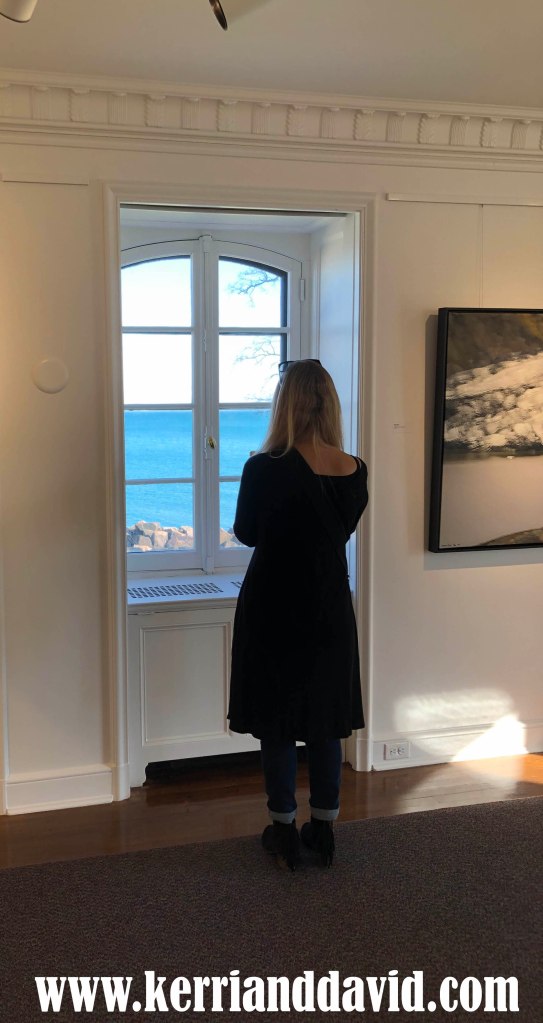
Drive west from our house near the lake for a few miles and you’ll come to the interstate freeway that runs north to Milwaukee and south to Chicago. Cross under the freeway, continuing west and you enter what we call “the county.” Rich farmland. The freeway serves as a dividing line from urban to rural.

Sometimes it feels like crossing the line into another culture. Blue to red. The county redness puzzles me but that’s a topic for another post. We drive into the foreign culture with the same curiosity we might bring to Tunisia or India. “I wonder what they see…” is a common refrain.

Sometimes crossing the freeway line feels like an escape into open space and a breath of fresh air. Once upon a time we took Sunday drives; the point was to go get lost in the county. “Left or right?” Kerri would ask. Both choices leading to the unknown.

We are avid freeway avoiders. It doesn’t bother us to take extra time traveling to Chicago or Milwaukee on the backroads. Less aggression. We relax and enjoy the ride. Often, especially during rush hour, our backroads travel proves faster than the traffic jam.

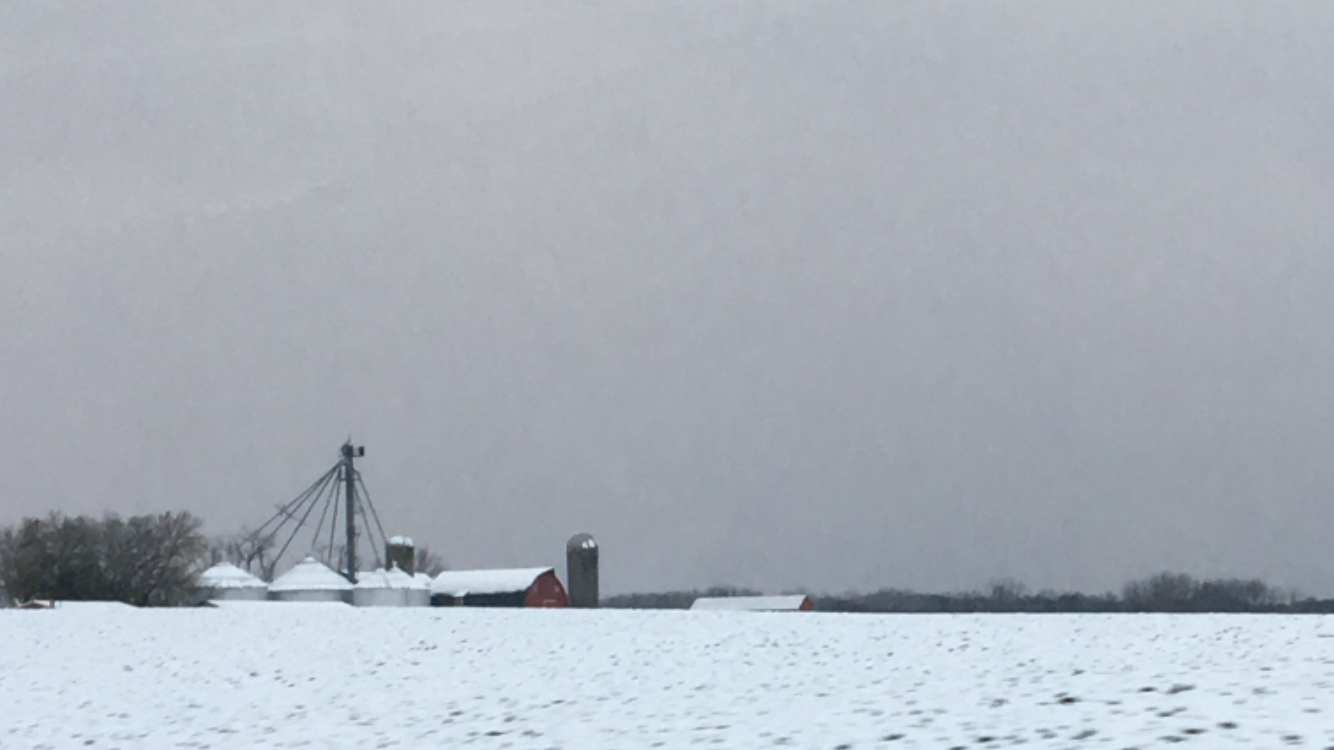
Last week, en route to the hand specialist in Milwaukee, we traveled our usual backroad path, winding through the county. There was no snow at our house when we left. We crossed the freeway into another landscape, blanketed with white. It was as if we crossed the line into another season. We entered an alternate reality.

“That’s so odd,” I said.

“No,” Kerri replied. “That’s the county.”

read Kerri’s blogpost about THE COUNTY

Teach The Full Story [on Merely A Thought Monday]

Viewed from space, the earth is round.

That simple fact has led some truly dedicated reality-deniers to the startling conclusion that the earth is flat. They argue that it’s absurd to think that half the population of the earth lives upside-down. Of course, no one has yet been able to prove that there is a top or bottom to the universe so it’s anyone’s guess which hemisphere of the earth is right-side-up and which is up-side-down. Be careful on those vacation cruises not to sail too close to the edge.

The Republican party in these un-united-united-states have become the political equivalent of flat-earthers. Cherry-picked half-data spun by a dedicated-nonsense-media into a Flat Stanley reality. Two-dimensional thinking in a three-dimensional world. It’s a problem. It’s a scary problem. The good ship USA is on course to meet the edge while the captains on the bridge wrestle for control of the steering wheel.

What is the steering wheel? The story we tell ourselves about ourselves. Our history. The Manifest Destiny story is meeting the realities of demographics. The party of white-dominance is in a panic to maintain its story of supremacy. They’d rather run us over the edge than let this richly diverse nation fulfill its promise. Fulling the promise begins with telling the full story. In Florida, the governor has literally banned the schools from telling the full history of this nation.

In other times, more clear-headed times, these laws would be acknowledged as authoritarianism. In our times, it’s marketed as the Republican response to “woke-ness.” In other words, education is the enemy. Stick your head in the sand. Hear-no-evil-see-no-evil. Proclaim the earth is flat or be prosecuted.

It was inevitable. The rhetoric of “All men are created equal” would someday need to reconcile the reality of a system built on the institution of slavery. Our forefathers wrote about it as the single greatest threat to the survival of our nation, this vast difference between our rhetoric and actions. In a school – capable of teaching our history – that would seem to be a very important and timely history to explore.

Systems do what they are designed to do and ours has performed as intended, elevating one group while suppressing others. It’s in our legislative record. It’s in the writing of our founders. It’s history.

For the second time this week I’m using this phrase: As I learned in school, systems are living things and will fight to the death to maintain themselves. We are watching a system – our system – fight to the death to maintain itself. In this fight, it will lie, cheat, scratch, steal, bite and squeal. It will incite fear. It will turn citizens against other citizens. It will whip up division and demonize those it brands as “other.” It will toss away all ethic and morality to maintain itself. It will make laws to protect itself. We are witness to it. We are participants in it.

The national story will maintain itself as flat, or, at long last, take a hard look at itself and change.

I was truly alarmed when I read that teachers in Florida are afraid to teach the history of the United States.

Our nation is round. Plump and full of rich diversity with a rich complex history. It is, after all, the reality of our nation, the story we are living. It is the reason for our successes – cultural crossroads have always been places of innovation. Perhaps it should be the story we at long last embrace. Perhaps, rather than muzzling our story, legislating for white-fragility, we will someday – as a nation – be proud of our iridescence and work to tell our full story rather than the flat-lie the reality-deniers are asking us to swallow.

read Kerri’s blogpost about BE

Re-Connect [on Merely A Thought Monday]

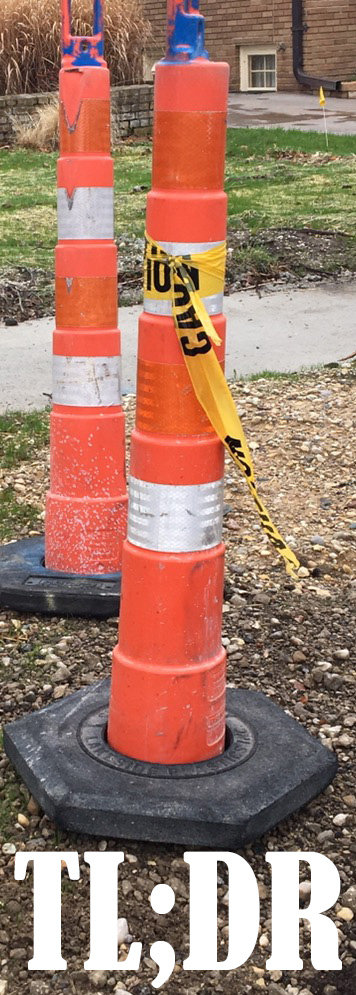
The latest addition to my “Terms in this Unknown Land” document is TL;DR. Too-Long-Didn’t-Read. I laughed aloud when I heard this new acronym in a meeting. If there is a sign of our times, an identifying marker of our era, it is this: TL;DR.

We communicate through text and emoji. Chat. Twitter is a thing because it mandates brevity. Scrolling the news app is a study in cramming the full story into a brief headline. Marketers have mastered the 5 second ad. Businesses are liberal in their use of “narrative” and “story” but have no time to actually hear one. A short synopsis will have to do. Get to the point.

As a member of my culture I find that I scan more than I read. If I can find it on Youtube, I’d rather watch it than read about it. When I began writing blogposts ten years ago, the “rule” was 800 words or less. The rule has adjusted with our attention spans and now the target is between 400 and 600 words. Often, when I receive links to articles, they come complete with an estimate of how many minutes are required to read them. Yesterday, I read advice from a marketing guru that suggested we restrict paragraphs to two sentences or less; more than two sentences is a red flag: too much information. Less than two sentences is…a sentence.

So much information is coming at us all the time, we have no time or thought-space to take it all in. I wonder if we can discern relevance from dreck. A quick look at our leaders leaves me with a resounding “No!” Relevance is lost in the dreck and, since they represent us, they are us, our information inundation has rendered our attention spans tiny and blunted our acuity. We are awash in information while wisdom has gone missing.

Each week I attend meetings; the central concern is explicitly or implicitly about helping people connect. It reminds me of the conversations I heard in graduate school: while living in a city of a million people, the concern was about how to create community. So many people. So little community.

I ponder these things every day. With our ubiquitous technology, we couldn’t be more connected. Through social media, I know what people had for dinner or what cute thing the kids said. I receive advertising that confirms my devices are listening to me. Yesterday, for-the-hell-of-it, I said, “Machu Picchu.” Today I am awash in travel ads for Peru.

We are connected. Connection to everything is connection to nothing. Relevance is hard to discern in a tsunami of information masking as connectivity.

Relationships – real relationships – take time. Values cannot be communicated in a text. They must be demonstrated and deeply rooted in lived narrative. Stories that carry relevance cannot be well-told in synopsis. Opinions are so easy to tweet. Dreck is easy to fling. It is not the capacity to share that we lose in the crush. It is not connection. It’s the capacity to be present. With presence comes the capacity to listen. Presence is not in a hurry to be some other place.

Rich connectivity requires more than quick consumption of information. Sharing, real sharing, the kind beyond pressing a “send” button, is a two-way street between people who have the time to invest in each other. Once, it was called relationship.

TM;CL. Too much. Can’t listen.

read Kerri’s blogpost about TL;DR

Take Another Sip [on DR Thursday]

I am spending a significant amount of time studying software. An unlikely task for an artist that prefers brushes and canvas over screens and keyboards. This improbable exploration follows a trend in my life: much of my work has taken place in foreign arenas. I love it because I learn. I love it because I am completely prepared to fail: a trait necessary to walk an artist’s path. To learn, it is necessary to begin in unknown places and make big mistakes. The same rule applies to creation. “Make big offers,” John used to say to his actors. “See what happens.”

Yesterday in my software study, I read about Mathilde Collin, the CEO of Front. She inspires me. She believes work should make people happy. She believes people shouldn’t dread getting out of bed in the morning. She believes in balanced-lives and finding each person’s “genius zone” and leaning into it. She knows a healthy culture doesn’t just happen, that it must be created and tended. And modeled. She believes paths to prosperity must include everyone.

I’ve also spent some time with Evariste Galois. He was a French mathematician who died in a duel at the age of 20. The night before he died, so the story goes, believing it was his last night on earth, he compiled and wrote his thoughts, his life’s work. What he left behind has kept mathematicians busy for more than two centuries. I’m not a mathematician but I am a systems guy and Galois’ Group Theory is useful when studying cultural change – or, more to the point, why it often looks like change but doesn’t really change. Rearranging deck chairs on the Titanic. It’s useful to consider when products are being developed – or stories – when they iterate but go nowhere.

When I come down from the office I am often glazed. Kerri gives me a glass of wine and steers me to the Covid table. While I stare at the bubbles in the wine she makes a snack. Food and wine always bring me back to the land of the living. After a cracker and cheese, a sip or two, I blink my eyes and she says, “Welcome back.” She knows better than to ask what I did at work. A time or two I’ve taken her hand and headed back toward the mind-cave and she’s learned to dig in her heels. “I learned the most amazing thing,” I say. She responds, “Take another sip and we’ll talk about it later.”

Mathilde Collin. Evariste Galois. Both are French and it only just occurred to me that they share the same country of origin. Revolutionaries both, believing that the systems should work for the people – rather than the people working for the system. Life should feed passions. Evoke personal genius. Happiness.

All of this good stuff from a stumble into the land of software.

“Take another sip,” Kerri prompts. I blink my eyes. “We’ll talk about it later.”

read Kerri’s blog post about WINE BUBBLES

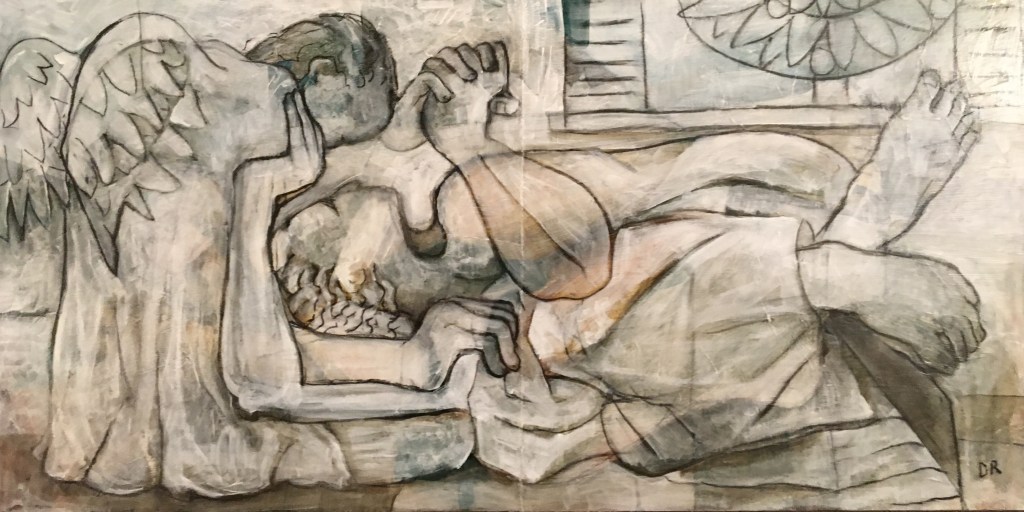
in dreams i wrestle with angels © 2017 david robinson