Place It In The Hollow [on DR Thursday]

For some reason, people need to leave a trace of their passage. We paint on the walls of caves. We erect monuments to ourselves and our heroes. We build cairns to mark the way for those who come behind; we build cairns so others will add stones to the marker. We put plaques on benches and engraved bricks in walkways. We graffiti bridges and walls. Banksy has made a fortune tracing his masked passage.

Growing tired as we hiked up the trail, we sat on an old log. We looked over the valley, turned our faces to the sun. And, as we stood to continue up the trail, Kerri pulled a sharpie from her bag. We left two small dots on the log. “We were here.”

Our work in the world not only can be a marker, it is a marker. Every little action is a stone on the cairn: we contribute to the whole whether we like it or not. The person who delivers packages to my door makes my life better. Easier. The score of people who created this computer, invented this software, manufactured the chip that makes it all work, have made my life better. Someone coming behind us will see the cairn we’ve constructed and add to it. Improve upon it. The first computer I touched was a toy compared to this miracle sitting on my lap.

I’m an artist and sometimes wonder if my paintings will live beyond me or will they end up in the Goodwill as so much used canvas. I hear the advice, so often offered to me: “Yours is to paint them, not decide what happens to them.” Too true. Mine is to make the offer. I have no control over the acceptance.

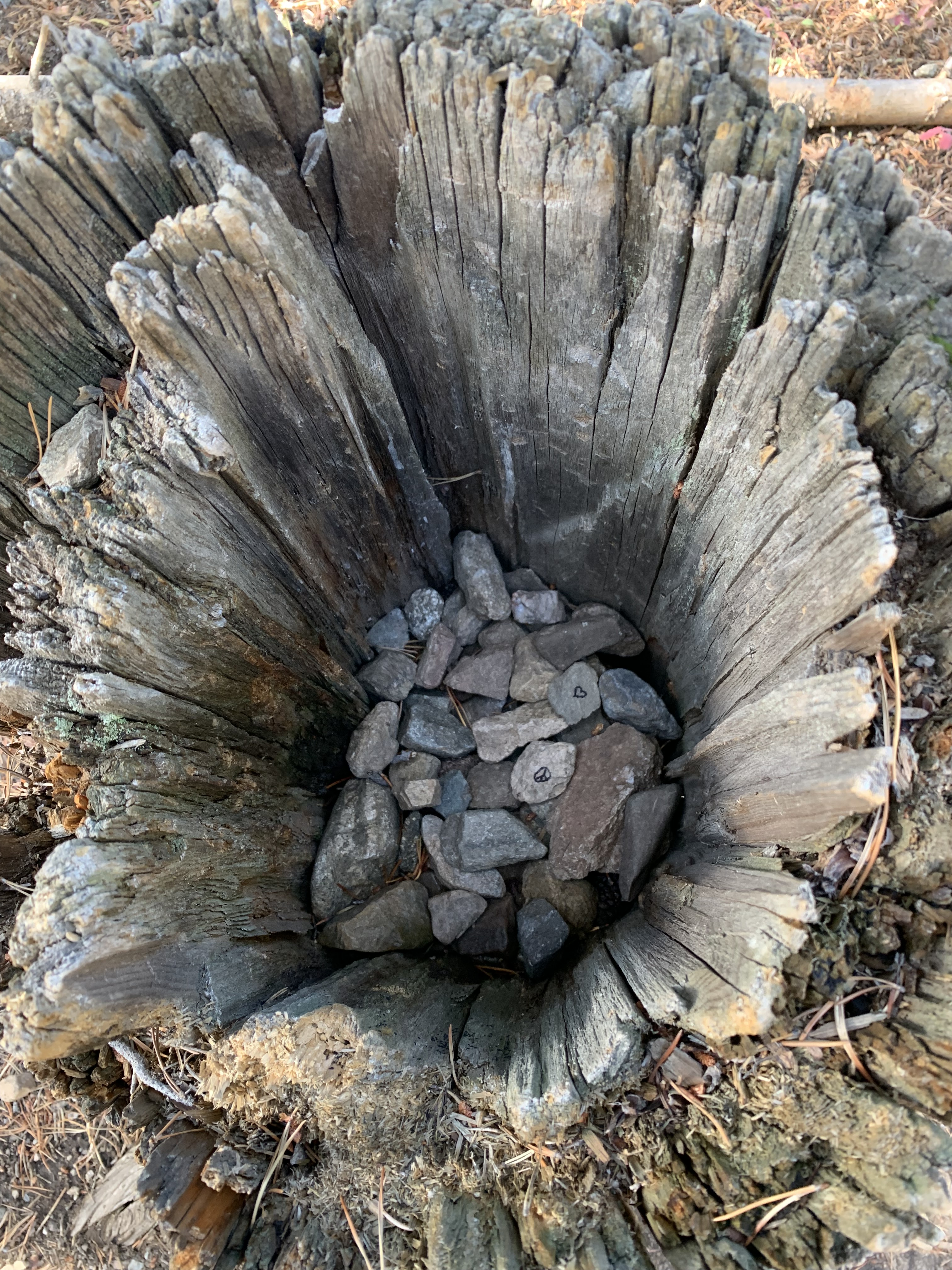
Returning down the trail, Kerri peered into the hollow of a stump. It was filled with stones! Hikers, just like us, had left a note that also served as an ancient invitation: I was here. We picked up stones, the sharpie came out of the bag, scribbled a heart and a peace sign on our rocks before placing them in the hollow. “Do you think anyone will see our stones?” Kerri asked.

An ancient question. Deeply human. Heart and Peace.

read Kerri’s blog post about THE HOLLOW

three graces © 2012 david robinson

Know Why [on Merely A Thought Monday]

I’m working with a software start-up company. Upon returning from travels I found our conversation has shifted into articulating mission and vision and purpose. None of us are keen about writing these kinds of statements but the exercise is useful and necessary. Why do we do what we do? What, exactly, do we do? In that order. Why. What.

Why? It seems as if this should be an easy answer. To support other people. To support other people in doing what they need to do.

I couldn’t help but think of our experience last week. We shared our story of breaking down in Hays, Kansas. It was late in the afternoon. It was the day before my dad’s funeral in Denver. We hobbled into the dealership. They were jammed with customers and couldn’t help us. There wasn’t a rental car to be found. It looked bleak. The dealer recommended a garage on the other side of town. Davis Automotive. We limped into their parking lot. We told our tale. They moved heaven and earth to help. Why?

It was nearing the end of their day. They, too, were jammed. Yet, they helped. They took the time. They made our problem theirs to solve. They took to heart my need to make it to my dad’s funeral. My need became their personal mission.

I returned to work with a new view on mission statements. They need not be lofty or abstract. In fact, they should be visceral. Tangible. Everyday. Support other people in doing what they need to do. Why? Because they need it. Just like I need it. Or you need it. These good mechanics fix cars. That is their “what.” Their “why”: help people get where they need to go. Help people do what they need to do.

Help people.

It’s how interconnection works. My mission is, in a real way, to make your path easier just as your mission is to make my path easier. I need mechanics because I do not have that mind or skill set. They need software designers because cars are computers and they can no longer diagnose problems without them. I am an artist, a teller-of-stories. Mechanics and software designers need my mind and skill set to remind them that, beyond their role, their mission, their job, they are human beings living a universal story. Nothing they do will matter, nothing I do will matter – ever – if it is not in service to the support of others’ growth, or need, or desire or fulfillment. I cannot be fulfilled if my work does not support you. And vice versa.

So, why are these good men and women, these software engineers and entrepreneurs creating their software? They see a real need. They see people struggling. And, like good mechanics who encounter a brokenhearted son en route to his dad’s funeral in a truck that will not run, they know exactly what to do. And, they know why.

read Kerri’s blog post about SERVICE

Whisper, “Thanks.” [on KS Friday]

We found the gratitude wall in a small mountain town. It was a mess of appreciation, overrun with thankfulness. I thought, but did not say, “This ought to be the visual expression of every inner life.”

I didn’t write on the wall. I whispered my gratitude to the wall. Kerri played for my father’s funeral service. This woman, who is a Yamaha artist, considered a modern master at her instrument, after breaking both wrists, after a second fall, an injury from which she will never fully recover, with a middle finger that sometimes responds and sometimes does not, with a pinky that is curling, wrists that cannot bend, hands that cannot reach the keys as they once did…she played. For the first time in many, many months. She stood at a piano and played. Beautifully.

My dad, a great lover of music, spent hours of his life listening to her CDs. He loved her playing, delighted in her compositions.

I cried for two reasons at the funeral. Both reasons overwhelmed me with gratitude. I was a mess of appreciation, so, I whispered my bottomless thank-you to the gratitude wall.

kerri’s albums are available on iTunes & streaming on Pandora

read Kerri’s blog post about GRATEFUL

grateful/as it is ©️ 2004 kerri sherwood

Hold The Vision Lightly [on Not So Flawed Wednesday]

“Тhe gentle overcomes the rigid.
The slow overcomes the fast.
The weak overcomes the strong.”
…
“Everyone knows that the yielding overcomes the stiff,
and the soft overcomes the hard.
Yet no one applies this knowledge.” ~
Lao Tzu, Tao Te Ching

If there is a metaphor on this day – or a lesson – it is that a plan or a goal held too firmly is…not useful. Tom Robbins wrote that stability is not rigidity. Stability, like all aspects of balance, is dynamic, constantly adjusting. How’s that for a paradox? Stability is fluid.

My clan is gathering. We are driving a long distance to attend so have plenty of time to talk, to think, to remember. Kerri has lost both of her parents so I have many questions about the river of complex feelings running through me. Joseph Campbell said in an interview with Bill Moyers that “No one lives the life they intend.” I wonder what life my father intended? I think he was more capable of rolling with his circumstance than I, at first, understood.

There are no straight lines in nature and it turns out that we humans, we storytelling animals, are a part of nature and not above it. Our story of dominion is just that, a story. My dad loved to be outdoors. He tried to be a school teacher but there was not enough air in a classroom. He couldn’t breathe so he made a life out in the elements. His skin, at the end, was so sun-baked that it was brittle. He achieved his desire and his desire was simple.

I am, at this point in life, ecstatic that I didn’t achieve what I set out to do when I was 20. I actually thought I was a train on a fixed track and learned through derailing (a few times) that I needed to let go of my notion of the track. I found my artist when I let go of my artist. On this drive, en route to the funeral, I fully appreciate my wanderer heart and my compulsion to step off of edges. I could have done with a bit less chaos but am now of the mind that life has given me a master class in balance. It continues to teach me to open my hand and not hold so firmly to my ideas, my beliefs.

I am currently working with software engineers. They are building a system. It has rules and boundaries and limits. It has a guiding principle. It will do what it is designed to do. And yet, it will never be finished. It grows and changes almost daily. There is a master plan, but the vision does not blind the visionary or the developers to surprises. To changes. They learn as the software emerges. On one hand it is a foreign land to me and on the other, I know intimately how this land works. There are no iron tracks. No straight lines. The movement is in cycles and circles and every time we try to force it into a line, we impede the process, we inhibit the growth.

The lesson is always the same.

We awoke this morning exhausted. And, rather than push our way back onto the road, we sat and sipped coffee. We watched the sunrise. We decided not to put our day on an iron track. We appreciated our moment. So, there is some hope, some small evidence – some – that the lesson is taking root.

read Kerri’s blog post about TRACKS

Make It To Last [on KS Friday]

I’ve watched master carpenters work. They consider the wood, the grain, the feel. Joinery as artistry. When John volunteered in the scene shop I teased him that furniture made for plays need not survive the apocalypse. No matter. He built tables and chairs for plays that will be at auction 100 years from now. He cared about his work, not his circumstance. The future hosts of Antiques Road Show will speculate about the mysterious origins of the unique and fine furniture found in the old prop house.

Standing in the old firehouse I was taken by the floors. They were not mass produced, engineered in a factory, or pre-cut to fit a template. They were planed by hand. Individually cut. They were pegged into place. The human touch was everywhere apparent. Someone, now long gone, cared about the job. Rough carpenter, solid sturdy work. Unlike the contemporary version of flooring, this was made to last. It was meant to outlive the artisan and the artisan took pride in that.

I recently learned that our refrigerator was engineered to breakdown in seven years. “It’s not a good business model to make things to last,” the salesman explained. Years ago, when I bought my truck, Rob told me it would start having trouble at 90,000 miles. It would be junk by 130,000. He was spot on. “They’re made to fall apart,” he said.

It is true, we do things fast. And, there’s a host of praises to be sung about our capacity to produce, the speed at which we invent and adapt. However, I wonder what the person at the factory assembling my destructible refrigerator thinks of their work. It must just be work. What about the engineer and designers? Made to fail? And what about me? A consumer of goods, an easy discarder-of-things.

Standing on the floor of the firehouse, I couldn’t help myself: systems do what they are designed to do. I wondered, in this age of easy discards, what kind of community conversation we would entertain if the business model – if the community model – the leadership model – considered the pride of workmanship, if human hands and hearts were more apparent in the process. Pride in workmanship. What if we made things to last rather than to discard? Would we see each other through different eyes?

read Kerri’s blog post about the FLOOR

Kerri’s albums are available on iTunes & streaming on Pandora

untitled interlude/released from the heart ©️ 1995 kerri sherwood

Surface The Pattern [on DR Thursday]

Steve read my book and said he didn’t really understand the thing about pattern. His comment at first surprised me but then I realized he was actually reinforcing the point: we are unconscious to our patterning. We think in patterns. We see in patterns. Culture is pattern. Pattern is invisible and making it visible is a necessary first step in change processes.

The people who surface pattern are often seen by the mainstream as deviant or rebellious. Women demanding equal pay are attempting to make a pattern visible. The BLM movement is attempting to make a cultural pattern visible. Shining a light on longstanding oppression is never welcome in the halls of power.

The people who work to repress the visibility of cultural pattern, conserve the norms, generally claim a righteous superiority. They are keepers of the culture and feel threatened, even victimized, by the sudden visibility of cultural pattern. Exposure is always a threat to the existing pattern and no one relinquishes power or privilege without a fight. The current raft of voter suppression laws – made possible by the fantasy of a stolen election – is a great example. The Big Lie is a textbook example of how far people in power will go to hide a privilege-norm. It is, for us in these un-united states, not a new phenomenon; it is a longstanding well-guarded pattern.

Change happens when the patterns are surfaced. There will always be a tide that rises to extinguish the light of exposure. In the long run, those hardy voices that were, at first, branded as deviant or dangerous, we come to honor and respect. They refused to be silenced. We claim them as our heroes. MLK. Gandhi. Rosa Parks. Cesar Chavez. Susan B. Anthony. There are so many. It is no easy task to surface the patterns. The path of a light-shiner is dangerous and difficult.

John Lewis gave great advice for those dedicated to surfacing unconscious patterns: “Get in good trouble, necessary trouble, and help redeem the soul of America.” He also said that, “…transformation will not happen right away. Change takes time.”

Opening eyes to unconscious pattern, to what is obvious yet unseen, is an artist’s path. Seeing beyond what you think you see…seeing beyond your field-of-dedicated-belief, being curious enough to question what you are being told – can you imagine anything more necessary – more vital – in our age of rabid-misinformation and desperate-pattern-suppression?

read Kerri’s blog post about PATTERN

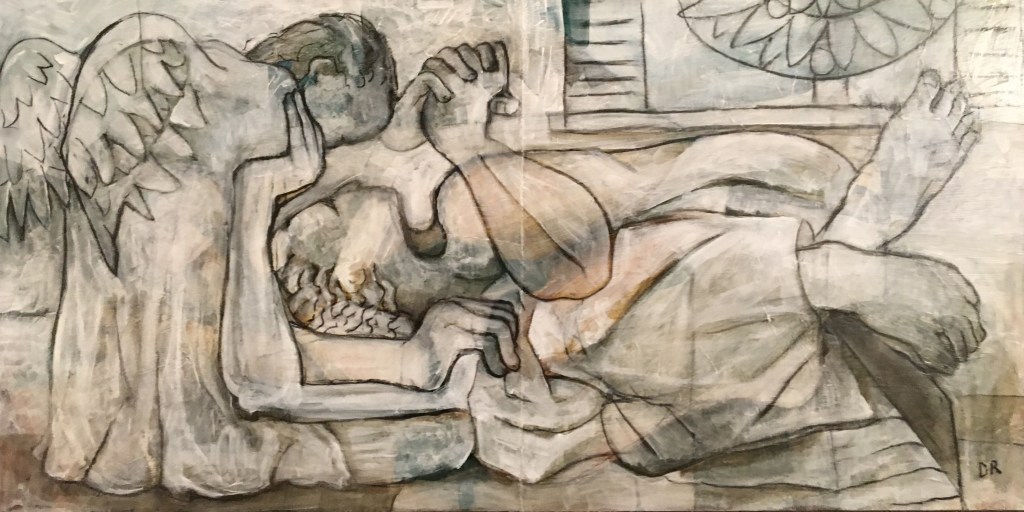
in dreams I wrestle with angels ©️ 2018 david robinson

Feel The Rhythm [on Not So Flawed Wednesday]

We lay awake in the night listening to the waves pound the shore. Boom. Rest. Boom. Rest. This lake that is sometimes glassy-in-stillness can rival the Atlantic Ocean in restlessness. It has many moods. It can turn on a dime. I have found great peace walking the shores. I have stood in awe as it blasted those very same shores, hurling boulders with ease.

When we were fortunate to live for a summer in the littlehouse, right on the lake. Kerri had to adjust to the constant sound. Her musician’s ears were caught in the rhythm of sound lapping the shores. Nature’s metronome. We teased about parking a piano on the back deck so she might compose an album of pieces set to the lake’s pulse.

The most striking visceral-revelation that I brought back from Bali is that we function together. Just as I am impacted by the lake, my pace and rhythm are impacted by the people around me. No one is an island. David Abram wrote in The Spell of the Sensuous that it is nearly impossible to meditate in the un-united states. We are an angry frenetic lake, fast moving wave. Changeable. I will always remember pausing at the custom’s gate re-entering the country. It was too much. Finally, I stepped through the doors and felt sucked into a chaotic turbulent whitewater river. It was months before I adjusted, before a walk down the street didn’t feel like a fist fight.

Columbus (my dad) would sit for hours each morning, on the porch. Listening. When I was younger I wondered what he was listening to – or for. He grew up in Iowa and came into adulthood moving to the rhythm of the corn. He lived his adult life in Colorado. It was a different rhythm, the metronome of the mountains. For many years he yearned to live where he understood the rhythm. He was, I think, listening for the corn.

When I return to Colorado I feel an immediate recognition. The mountains are the rhythm I was born into. Alignment. My original dance was a mountain dance.

Kerri and I are both transplants to the lake. Perhaps that is why we hear it so clearly. Jim E. told me that people go to the shore to stare into the infinite. We listen to the lake with the same awareness. The lake was here before me. The lake will be here after I am gone. The mountains, too. We are, of course, delusional to entertain the idea that we control it – nature. That we are somehow separate. Sometimes I think it is the artist’s job to bring proper perspective to the community, to pop the separation-notions – even for a moment – out of ego-brains.

This lake could hurl me like a pebble. It also brings peace to my soul. Stillness. We are not as distinct as we want to believe. That recognition is the single greatest blessing of artistry. It’s a circle dance. Just as my dad is disappearing back into the corn, I, too, will someday rejoin my original rhythm and fold back into the mountain.

read Kerri’s blog post about THE LAKE

Look For Joey [on Merely A Thought Monday]

It’s been a life-long fascination of mine. In the most individualistic culture on earth, we like to display our status by wearing brand names and shop the same stores in malls that look the same across the nation. We are the inventors of the chain store, the strip mall. The one-size-fits-all. The suburb and cookie-cutter-house. Here in the cult of the individual, we like to do what every one else is doing.

Kerri and I tease about writing a book. It’s called “Looking For Joey.” Google Joey Coconato or his YouTube channel, My Own Frontier, and our blogs pop up at the top. We’ve not written much about Joey Coconato – a few posts – but to our great amusement, we top-the-google-list. And, so, these days, we are regularly contacted by people who are looking for Joey. They think we know him. They think he’s editing his next video in our basement.

Joey lives off the grid. He backpacks the American wilderness and documents his treks with videos. We became avid Joey fans when pandemic-isolating last year and vicariously got “out there” through Joey’s films.

After watching a few of his films it becomes abundantly clear that Joey is what everyone on the grid pretends to be. An individual. His clothes are ripped. His gear is constantly in disrepair. His food is what he can get his hands on at the moment. He is not climbing any ladder. In other words, he is not invested in how he looks, what he wears, or whether or not he’s doing things the way he ought to do them. He’s doing life in his way. At his pace. In his place. According to his star.

After receiving the latest: “Do you know where Joey is? It’s been 8 months since he posted…” I decided that, in these un-united-united-states, everyone is looking for Joey. He has, for me, ascended to the level of metaphor. He is authentic in an age of thin veneer.

While people are draping themselves in tribal-hate-flags and crying “individual freedom”, sticking their heads in the Q-sands as an act of liberation, blinding themselves in a rabid-festival of group think, all the while shaking their fists declaring, “No one can tell me what to do.” Insisting without any connection to reality that an election was stolen, that vaccines in a pandemic are filled with micro chips, that January 6 was an ordinary day at the Capitol – we are a mess of lockstep inanity.

I think everyone is looking for Joey. They – we – no longer know what is real so they -we – are splintering into disparate group-fantasy. Lemmings singing a chorus of My Way as they – we – plummet off our collective cliff.

Honesty is not that hard to spot if you want to look for it. Much of the fight falls away when you are prepared to acknowledge that much of what we profess is cotton-candy, that we are terrified of looking at our full history. Shops and malls and online outlets are not great places to look for answers. Running from critical race theory does not make our past go away.

A walk about in nature has a way of making the absurd abstractions fall away. Carrying your food on your back and looking for water when you need it strips away the investments in the ridiculous.

Individuals – people truly living out of their own center – generally don’t have to wear brands or broadcast their individuality. They are not seeking validation. They are not fighting for their freedom. Like Joey (I imagine) they simply live it.

[ the cool Dr. Seusss plant is called white baneberry or doll’s eyes.]

read Kerri’s blog post about STAND OUT

Attend To The Quiet [on KS Friday]

My studio is a place of quiet. Inside and out. It is the place where I go – where I’ve always gone, when I need to recenter myself of exit the crazy-brain. Lately, my studio has been blown to bits. Water has been a near constant invader, either from the ceiling when the pipe broke in the spring or from the floor when roots clogged the sewer main. Twice. It seems as if water wants me to take a break from painting. There’s a metaphor in there somewhere.

Each time the water rises, the paintings rise, too. We scramble to move everything up the stairs. Mostly, they are stored on blocks so live protected above the rising tide – but pulling up carpet or clearing space for the plumbers has meant a perpetual studio deconstruction. Kerri stubbed her toe – okay, broke her toe – on one of the bigger paintings that now populate our sitting room. It’s a maze of paintings out there. Yet, she is wise. She’s insisting that we leave the paintings where they are, scattered here and there. At least for now. At least until we can clear out and rethink our space.

Kerri is much more sound sensitive than I am. I am much more spatially sensitive than she is. The sign on our deck, “Shh” addresses her need for sound-quiet. It’s all about space-quiet for me. Space-quiet means open space. It’s been that way all of my life: if there’s too much stuff, I shut down.

The water, as it turns out, is trying to tell me something. Lately, when I go down into the blasted-apart-and-now-empty-studio-space, I can breathe. I feel it every time I descend the stairs. I breathe. My space had become too impacted. Too many paintings, too many tables, too little space. “Shh.”

I’ve often written about the time, after I moved to Seattle, that I burned most of my paintings. I needed space. I felt like I couldn’t breathe. I was tired of hauling and storing paintings. I didn’t know what else to do. I needed air and fire brought it to me.

And, so, the water pours from the ceiling. It bubbles up through the floors. Again. What feels like a catastrophe comes with a cautionary message. No fire is needed this time. To attend to the space is to attend to the quiet. Stop. “Shh.” Breathe.

SILENT DAYS on Kerri’s album BLUEPRINT FOR MY SOUL, available on iTunes or streaming on Pandora

read Kerri’s blog post about SHH.

silent days/blueprint for my soul ©️ 1997 kerri sherwood

Honor Difference [on DR Thursday]

A Double Haiku:

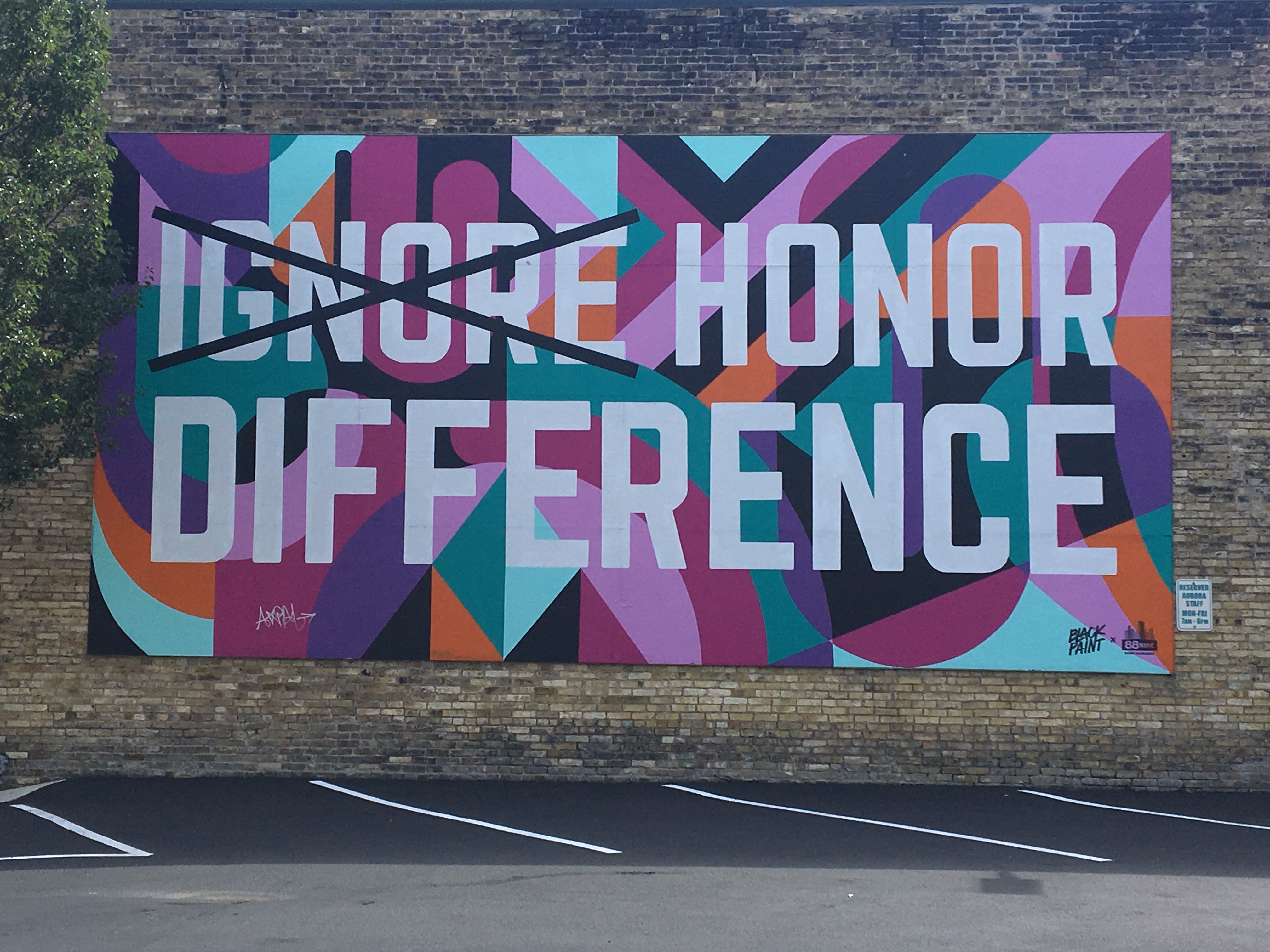
Honor Difference.

A mural in Milwaukee.

Heart of the ideal.

Infinite palette,

Many hands, many painters,

Eyes that choose to see.

Read Kerri’s blog post about Honoring Difference

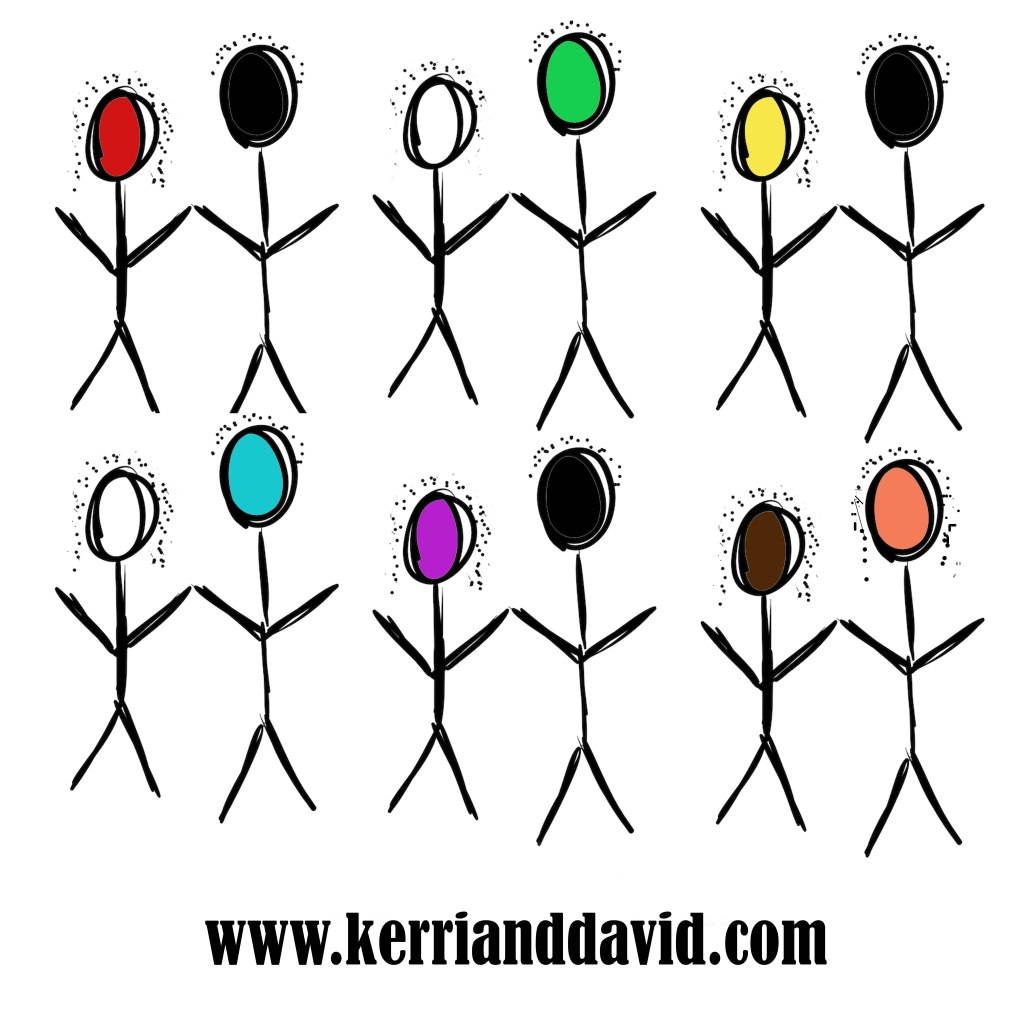
helping hands ©️ 2012 david robinson